Podcast
Sinocism Live
Hosted by Bill Bishop · EN
Bill Bishop, author of the Sinocism newsletter, chats with experts from around the world to help us all get smarter about China. Topics discussed include politics, foreign relations, business, finance, culture, history and markets. It started as a podcast but is now video too.
Nearly 400,000 investors, policymakers, executives, analysts, diplomats, journalists, scholars and others read Sinocism for valuable insights into China.
sinocism.com
sinocism.com
21episodes
Episodes
Newest firstAll episodes
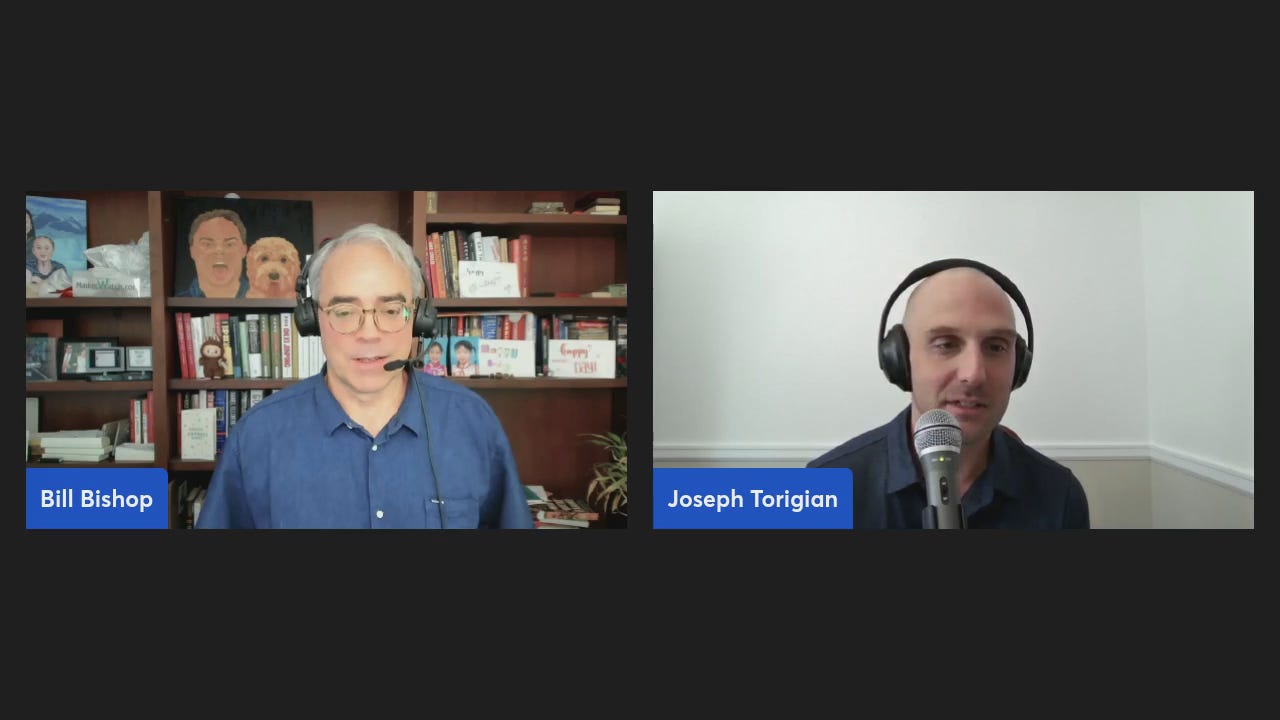
Joseph Torigian on Xi Zhongxun, Xi Jinping, Party History, and the 9.3 Parade
Sep 500:59:40Tap to summarizeThis is a recording from the September 4th live conversation I had with Professor Joseph Torigian about his excellent book on Xi Jinping’s father - The Party's Interests Come First - The Life of Xi Zhongxun, the importance of history to the Party, and to Xi Jinping, and how we might view the recent commemoration of the 80th anniversary of the “Victory in the Chinese People’s War of Resistance Against Japanese Aggression and the World Anti-Fascist War”. This is a public episode. If you'd like to discuss this with other subscribers or get access to bonus episodes, visit sinocism.com/subscribe
Transcribe →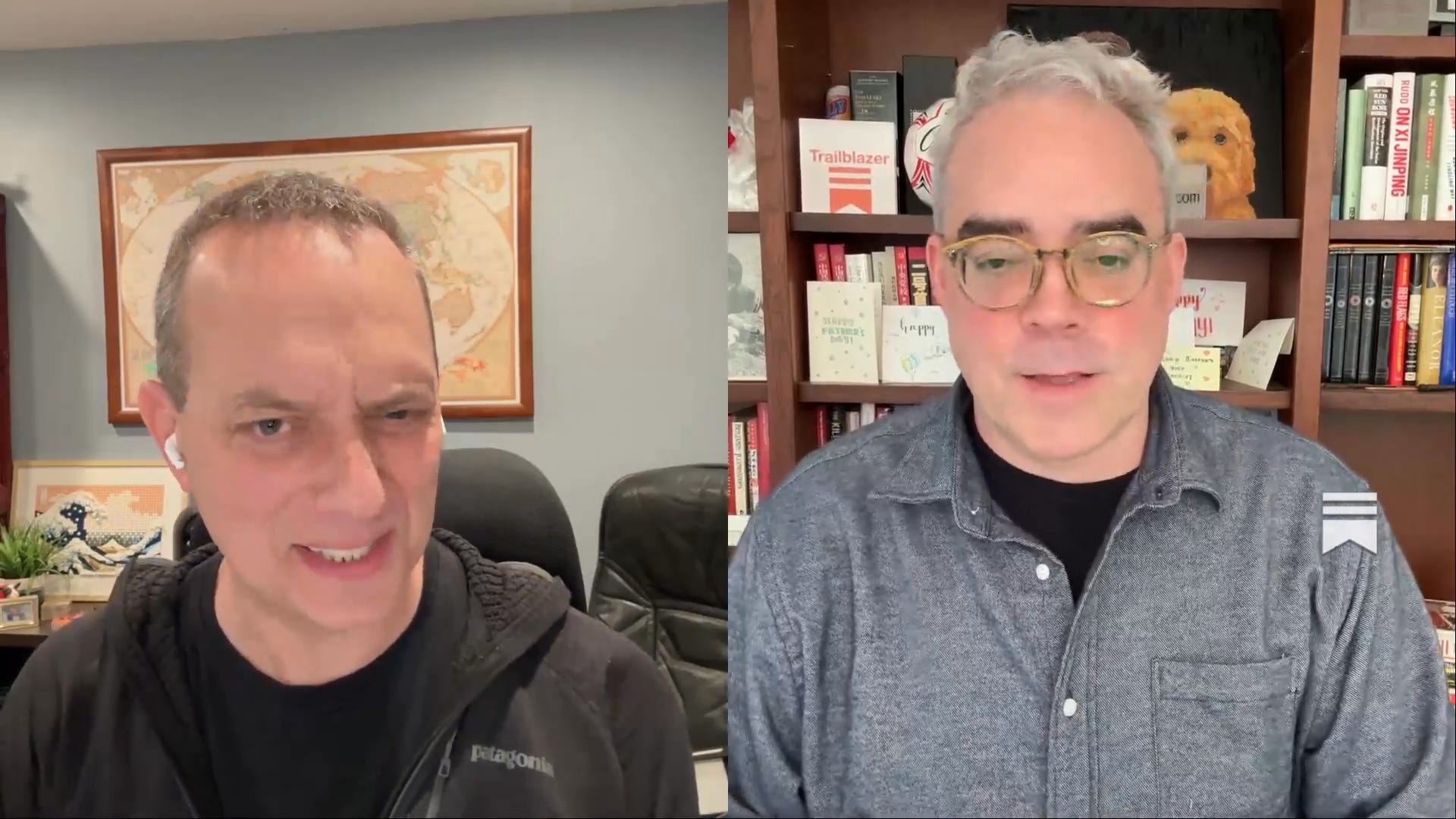
WTF2.0: Bill Bishop
Apr 1, 202500:40:59Tap to summarizeI joined Jonathan V. Last on his show at The Bulwark to chat about China and the Trump Administration. This is a public episode. If you'd like to discuss this with other subscribers or get access to bonus episodes, visit sinocism.com/subscribe
Transcribe →
Sinocism Live: A chat with Jon Czin about US-China, Xi Jinping & some other fun topics
Mar 21, 202501:00:05Tap to summarizeThanks to everyone who joined the live discussion tonight.This is a recording of a March 20th, 2025 Sinocism Live conversation with Jonathan Czin, now the Michael H. Armacost Chair in Foreign Policy Studies at the Brookings Institution, and before that was for many years at the CIA as one of the US intelligence community’s top China experts. He was director for China at the National Security Council from 2021 to 2023, where he staffed all of President Biden’s interactions with President Xi.I learned a lot from Jonathan Czin in this conversation and I think you will too. His recent work:What Beijing wants from a US-China trade war - BrookingsBurying Deng: Xi Jinping and the Abnormalization of Chinese Politics - China Leadership MonitorThoughts on the political demise of Miao Hua - BrookingsAbetting competition, restraining Beijing: Recommendations for diplomacy toward China - BrookingsAnd his bio:Jonathan A. Czin is joining the Brookings Institution as the Michael H. Armacost Chair in Foreign Policy Studies and a fellow in the John L. Thornton China Center. He is a former member of the Senior Analytic Service at CIA, where he was one of the intelligence community’s top China experts.Czin led the intelligence community’s analysis of Chinese politics and policymaking, playing a central role in assessing and briefing senior policymakers on President Xi Jinping, his rise to power, and decisionmaking on an array of key issues and crises. From 2021 till 2023, he was director for China at the National Security Council, where he advised on, staffed, and coordinated White House and inter-agency diplomacy with the People’s Republic of China, including all of President Biden’s interactions with President Xi, and played a leading role in addressing a wide range of global China issues.He also served as advisor for Asia-Pacific security affairs in the Office of the Secretary of Defense, and overseas at a CIA field station in Southeast Asia. Czin holds a master’s in international relations from Yale University, graduated magna cum laude from Haverford College, and studied at Oxford University. He is proficient in Mandarin Chinese. This is a public episode. If you'd like to discuss this with other subscribers or get access to bonus episodes, visit sinocism.com/subscribe
Transcribe →
Chris and Bill talk TikTok ban and US-China under Trump
Jan 18, 202500:59:03Tap to summarizeI had a good conversation this afternoon with Chris Cillizza about what may happen in the next few hours with TikTok Us, and how President-elect may try to undo the ban. we also chatted a bit about what US-China relations may look like in the Trump 2.0 Era.Join me for my next live video in the app. This is a public episode. If you'd like to discuss this with other subscribers or get access to bonus episodes, visit sinocism.com/subscribe
Transcribe →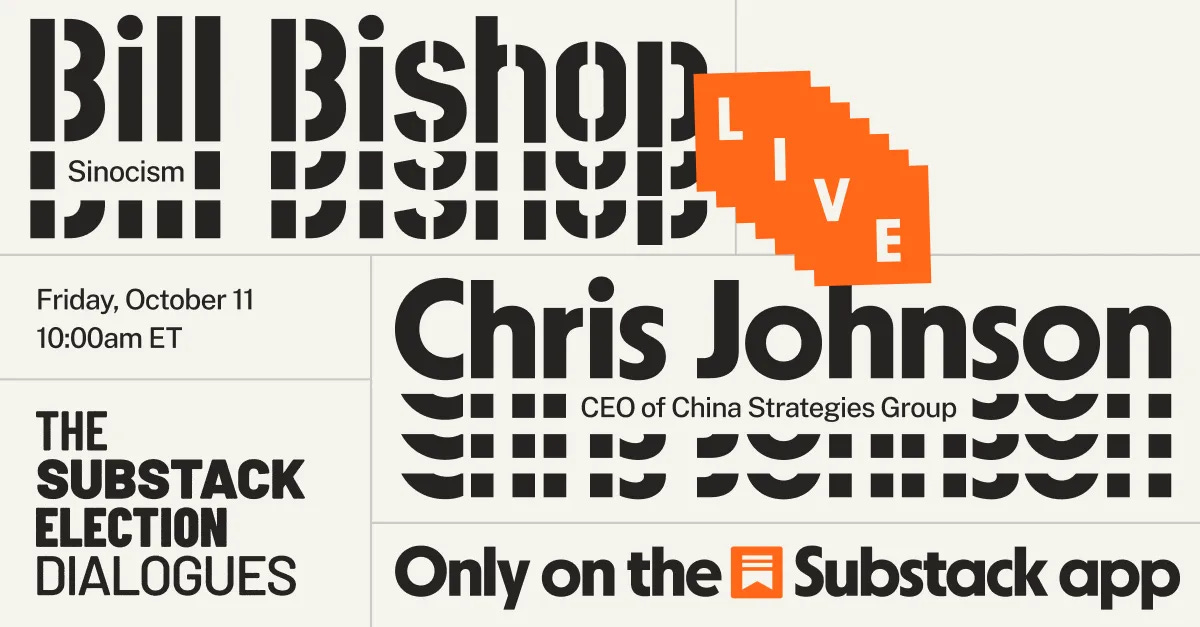
Substack Election Dialogues: China and the US election
Oct 12, 202400:55:30Tap to summarizeThanks to everyone who tuned in live to my Friday discussion with Christopher Johnson on China and the US election. Our talk was part of the ongoing Substack Election Dialogues. Chris is President and CEO of China Strategies Group. He served for nearly two decades in the United States Government’s intelligence and foreign affairs communities. In addition to his work advising multinational corporations on their business and commercial strategies in China and greater East Asia, his insights on the Chinese leadership and on Beijing’s economic, commercial, foreign and security policies are regularly sought by senior Administration, Congressional, military, and foreign government officials. Chris also serves as a Senior Fellow on Chinese Politics at the Asia Society Policy Institute's Center for China Analysis.The live videos are first available in the Substack app, and that is also where you can find me most days on Notes and in the Sinocism chat:I hope you enjoy this discussion, let me know if you think I should do more.Thanks This is a public episode. If you'd like to discuss this with other subscribers or get access to bonus episodes, visit sinocism.com/subscribe
Transcribe →
Sinocism Podcast: Tu Le of Sino Auto Insights on the rise of the China vehicle industry
May 9, 202300:56:46Tap to summarizeIn this episode of the Sinocism Podcast Bill speaks with Tu Le, Founder and Managing Director of Sino Auto Insights. Tu recently attended the Shanghai Auto Show. We discuss the rise of China EVs both inside China and increasingly in other countries, and especially of BYD, why the legacy foreign auto manufacturers are struggling and will continue to struggle in China, and how “China EV Inc” will win share in many overseas markets. We also discuss Tesla’s positioning in the PRC and some if its challenges ahead, especially from BYD, both inside the PRC and in other markets around the world.Links:Sino Auto InsightsSino Auto Insights newsletterDoug DeMuro reviews the BYD Han:The BYD Song L:Transcript:[00:00:00] Bill: Welcome back to the Sinocism podcast. Today we're very lucky to have Tu Le to talk about the PRC auto industry. Tu is the founder and managing director of Sino Auto Insights. Tu recently relocated to Detroit after many years in Beijing. Tu and his team at Sino Auto Insights do advisory and market research work for companies and investors who want to understand the PRC auto industry and especially the rise of Made in China EVs. He also writes an excellent weekly newsletter and does a podcast and occasional or weekly, I think, , Twitter spaces. I will put links to those in the show notes. Tu, welcome and thanks for joining the podcast. Great to see you again.[00:00:36] Tu Le: Bill first. , thanks for having me. Last time we saw each other, I think we were at Central Park having a coffee at Jamaica Blue. That quite a few years ago.[00:00:47] Bill: Tu and I are old friends from, from Beijing. , so, and, and it's, it's good to see you and, , nice to have you, , back in the US and Detroit. , Detroit is home, right. But it's also a great place to be if you're working on the auto industry.[00:00:59] Tu Le: Yeah. It's kind of ground zero for what's happening in the EV and mobility space. So, so it's, it's a great time to be back.[00:01:05] Bill: I've been really wanting to get you on the podcast for a while and I got finally motivated to do so after reading, what you were talking about from the Shanghai Auto Show, which you were, you, you just came back from China, I think, like a week ago, right? You're there for Tu or three weeks, , and nice to be able to travel again, right?[00:01:21] Tu Le: Oh, man. It was, , it was kind of, , surreal because the last time I traveled internationally from China, we were just, we had bags packed and everything, so a little bit different.[00:01:35] Bill: Yeah, no, much, much better. , and I think, you know, the Shanghai Auto Show clearly rocked a lot of people's worlds, and so Tu is going help us understand what's going on, and that's why, you know. So I wanna start though, first with, if you could just tell us a little bit about yourself and how you ended up in China, working in the audio industry and, and what your firm does.[00:01:54] Tu Le: Okay, sure. So, as you'd mentioned, I grew up in Detroit, actually in Pontiac, Michigan.. In my entire family, all eight of us have worked. In the automotive space, along with our significant others. And, my first job, actually out of undergrad at Michigan State University was working at GM where the recently canceled Bolt is manufactured.[00:02:16] Tu Le: After grad school I moved to Silicon Valley, worked there for about six, seven years., and I met a girl and chased her over to Beijing actually. So I quit my Silicon Valley job and what I thought was going be a three or four year commitment ended up being 13 years. I had moved to Shanghai, took a job with Ford in Lujiazui actually for about a year, and then moved back to Beijing due to some family stuff going on.[00:02:46] Tu Le: And, then I started freelance consulting and worked at a couple of Chinese e e e-commerce startups in Beijing. And then I got pulled over to do some freelance consulting because one of my, friends. Had found out that I had some automotive background and, you know, Mercedes, BMW and Audi, they're all located, and VW group are located in Beijing.[00:03:09] Tu Le: And so I started Sino Auto Insights because, you know, right around 2014, 2015, where, you know, at ParkView Green, Tesla had opened the first retail store for China. And so I really started seeing, a shift in what was going on in the space and, a lot of articles and a lot of bad takes. So I started the newsletter, started the consultancy, because of my experience in Detroit, Silicon Valley and China with startups.[00:03:37] Tu Le: It's been quite an adventure and we, what we do is we, , , , we're a management consultant consultancy that helps mobility companies enter markets, develop products, raise capital and build their brand and work with them to find customers. And so we were focused primarily in the China market, but now we've kind of expanded because China, EV Inc.[00:04:05] Tu Le: Has expanded. And with the Inflation Reduction Act, we've recently opened a Detroit office and are, are starting to help companies here expand into the EV space and the mobility space.[00:04:20] Bill: Oh, that's fascinating. And I just, just to your, like what you mentioned about the, Tesla dealership at, or the, the showroom at, at the phone call the Parkview Green. ,I actually, you know, we both, we lived near there. Our, my kids went to school next to it, I think years went to Fangcaido, right.[00:04:35] Tu Le: That's right, exactly. I live right next door,[00:04:37] Bill: you go.[00:04:38] Bill: Right. And so, and so I went there right after it opened with a friend with a, with a friend of mine from Henan who had like, he had a a, a couple of 730s and a BMW very, you know, had like cars had, could buy what he wanted. And it was really fascinating because he wanted to buy a model S right early on.[00:04:54] Bill: And he got in there and he's like, God, it's like, it's, it's just so bare bones that does not, you know, so he didn't buy it because he's just like, this is like, not this just, I wanted like a German luxury car.[00:05:06] Tu Le: and it was over $120,000[00:05:08] Bill: No, they were, they were quite expensive. I mean this was early, early days. Right. And obviously Tesla's done well since then, but it was just really interesting how when they entered the market, they were not at all focused on, I mean, they were, they were, they had a, a brand image, but actually inside the cars, the way they were appointed was not near what sort of Chinese luxury buyers were used[00:05:29] Tu Le: right, and, and I would venture to guess, your friend was probably a little bit older,[00:05:35] Bill: Hey. It was, it's like 40 at the time.[00:05:37] Tu Le: Okay. So he is pretty young because the digital natives, and, and we'll get into this a little bit later, but the digital natives are the ones that are really looking at the safety and the connected vehicle.[00:05:48] Bill: And the, and the screens that make it look like you're, like at a currency trading station, right.[00:05:52] Tu Le: oh, yo. Yeah.[00:05:53] Bill: I want to jump to something that you wrote in your, your latest, , newsletter, , which is excellent. Everyone subscribed to it. And I will link to it, as I said earlier.[00:06:04] Bill: , but the one, the one about the Shanghai Auto Show, so you wrote. In 20, 30, 50 years from now, we'll likely point to Aha Shanghai TW 2023 as that watershed moment. It's the moment most media outlets acknowledge that the foreign legacies that dominated the China auto market for the last 35 years or so have been overtaken and unable to compete with the EV products launched by China, EV, Inc.[00:06:31] Bill: Within just the last few years, the legacies haven't given up by any means, but the writing is on the wall. BYD overtook Volkswagen as China's best selling brand in, first quarter 2023, the first time it's ever happened, BYD has no plans of giving up that title for the foreseeable future and are likely only only going to pull away even further.[00:06:53] Bill: China will never be like it was again, where brand heritage and being foreign gave you an advantage.” So if you're a foreign auto manufacturer…the sense I got from talking to some people reading the media was the foreign, some of the foreign execs who went to the auto show were shocked.[00:07:16] Bill: And so like, like what do they do? And more importantly, how did they fall behind so quickly? Right? I mean, they have had massive operations in China for decades. Didn't they have a flow of information that helped them understand how the market was changing?[00:07:30] Tu Le: So there's a few different things going on here, Bill. I think that the fact that most executives outside of the top management haven't been able to travel to China in three and a half years really limited their ability to kind of see and feel the differences and the changes. I was in China for most of that three and a half years.[00:07:56] Tu Le: And I saw the proliferation of green plates over the last few years. ,[00:08:01] Bill:</str...
Transcribe →
An excerpt from Tania Branigan's Red Memory: The Afterlives of China's Cultural Revolution
May 2, 202300:13:29Tap to summarizeIt is my pleasure to be able to run an excerpt from Tania Branigan’s excellent new book “Red Memory: The Afterlives of China's Cultural Revolution”. Tania has also kindly recorded herself reading this chapter, so you can listen to it if you prefer. Tania writes editorials for the Guardian and spent seven years as its China correspondent, reporting on politics, the economy, and social changes. we overlapped in Beijing and became friends. We also recorded a podcast about the book which you can listen to here. You can purchase the book on bookshop.org or on Amazon. The audio edition will be available from Tantor starting 7/11/23 wherever audiobooks are sold.Begin excerpt:Chapter 5Chongqing saw some of the era’s fiercest fighting, with the rift between Red Guards descending into warfare. The Kuomintang had made it their capital while battling the Japanese occupation, and it was home to multiple munitions plants; when armed struggles broke out in 1967, the military backed one side and helped its fighters seize what they needed. The factions battled with grenades, machine guns, napalm, tanks and ships upon the river – everything except planes, a resident recalled.They executed in cold blood too: even the injured, even the pregnant. Tens of thousands fled the city and at least twelve hundred people died, though the true toll was probably much higher. Some were caught in the violence by chance, like the eight-year-old killed by a ricocheting bullet as he played on the street. The others were not so much older, and you could blame chance there too, even if they saw themselves as soldiers. They never thought it would be so serious, that people would die, that so many would die. By the time they saw their friends fall they’d been battling for hours. They were numb; none of it seemed possible. Had it really happened at all?Shapingba Park held the proof. More than five hundred of the victims, mostly teenagers, were buried here, at a Red Guard cemetery hidden on one edge of the site, behind a grove of trees. It was the only Cultural Revolution site in the country to be recognised as a national heritage spot. But a mossy wall surrounded the plot and the public were not allowed in any more. I had come before, and stared through the chained gates. Though the cemetery was only half a century old, it reminded me of the Civil War graveyards I had seen in the American South, crumbling and overgrown. Luxuriant greenery crawled over marble monuments, immense and once stark white but now lichened and grey. Stone torches topped great pillars and obelisks, carved with red stars and Maoist slogans and the number 815. It was the rebel faction the dead had belonged to, named for a critical date in its inception in 1966.‘People began to die on 1 July 1967. On the tenth, I was put in charge of the bodies,’ Zheng Zhisheng recalled. He ran a chemicals business in the city, but back then he had been a student, and they had called him the Corpse Master. He was peering through thick tortoiseshell glasses that still bore the maker’s sticker. Two more dusty pairs lay on his desk, jumbled with books, newspapers, a giant magnifying glass and two lidded porcelain cups. He delved for a photograph. ‘This is October 1967. Twenty-seven people – twenty-seven corpses.’ Most of the faces were turned away from the camera. One mouth gaped so wide it could swallow the viewer.‘I had seen dead bodies when I was young. But I’d never had to handle them. I was a model student, and the faction leader thought I was a helpful person and not afraid of hard work. And also,’ he added, after a moment’s thought, ‘I’d opposed him at the beginning. So he thought of me and put me in charge. I was forced to do it. I put make-up, and an armband, and a Mao badge, on each one. At the start I was afraid of the dirty work. I had to wash the dead bodies and I used soap to wash my hands all the time. Afterwards I didn’t mind about that. The second thing was the smell. The dead bodies stank and I wanted to throw up. The third thing was ghosts – I thought ghosts were terrifying. Although I was an atheist, China had these traditional ideas, and so I was afraid.’He foraged for another handful of photographs and showed me a bobbed, full-cheeked young girl. ‘She was the first I dealt with. We used formaldehyde. She went to help the injured on the battlefield and when she stood up she was shot dead. She was sixteen.’ He reached for another. ‘This one is from the university – people were buried there too, but the monument was destroyed later. Now it’s all flower beds.’ He replaced the pictures amid the clutter.‘I felt they were martyrs and it was a waste for them to die so young. After people in our faction died we treated the others as enemies and hated them. So when we captured them, some of them were stoned until they were unconscious. Then they were sent to hospital. Afterwards we moved them to another hospital – but that was just an excuse. On the way we beat them to death; that’s why we ended up in prison. Back then we hated the Fandaodi faction but now I think both factions were cheated. They were all innocent. They were all victims.’The Fandaodi prisoners, already injured, had been battered with rifle stocks. By him?‘No, no.’ He shook his head. ‘It was two other people.’You ordered them to do it, I’d heard?‘Yes.’ He was concise, not curt. ‘I didn’t feel any sadness: I just wanted to take revenge. The other faction had killed our martyrs. I didn’t know them – it was factional.’Zheng and others had been jailed for years for their role in the armed conflict. After release he wanted to search for the victims’ families and make amends, or try to. But someone warned him that the parents might sue, and he gave the idea up. ‘It’s a lifelong nightmare. It’s very traumatic. I have nightmares that I’m still in prison. Afterwards I tried to work hard and to reconcile myself with what I had done. I tried to do good things, and when I stumbled I stood up and carried on. I cried many times.’But the lessons he had learned were priceless, he insisted, though he struggled to define them. A slight sigh escaped him, as if he was hoping I might abandon the subject. ‘It can’t be described in a few words. For foreigners, looking at the Cultural Revolution is like reading a difficult book. It’s really hard to understand. Even young people don’t have an interest.’He was afraid of what might happen if people did not face up to the past and that later generations might echo the mistakes his had made. It was not a repeat of the Cultural Revolution itself he feared – history had progressed, he said. So what was it?‘Turmoil.’ He stopped there, considering.‘For example, with the Tiananmen Square incident – I actually wrote to my son, because he was at university. Because I had that turbulent past, I didn’t let him join them. The students were patriotic. They wanted to fight against corruption. But they were being used by bad guys.’ It took me a moment to understand. He spelled it out: ‘They were manipulated by people like Fang Lizhi, Wu’er Kaixi and Wang Dan, who were pursuing Western large-scale democracy. We can only be led by the Communist Party. We can’t have big democracy like the Americans. It can only bring turbulence and chaos. We had more than two thousand years of feudalism; America started with two parties and democracy. Foreigners can’t understand China; they can’t understand China’s past. Corruption is caused not by one-party rule but by who has checks on the leadership. We can’t get rid of the Party’s rule – impossible. We don’t need any turbulence and chaos.’It was a common view in China, even among relative liberals. The country was not ready to be free; though how it might ever become so, if not allowed to evolve, was never explained. For Zheng, individual caprice and disobedience, pride and egotism had produced this disaster. Stability and the common good were all.Those at the top, such as Deng and Xi’s father, had been forced into a reckoning too. They had suffered, and watched the torment of loved ones. They had lost their oldest friends and their glorious dream of a better, happier China. When they reclaimed power, they did all they could to prevent another disaster. For their own sake, and that of the masses, they committed themselves to stability. They determined that never again would a strongman ride roughshod over his peers, his country and the people. Though Deng would dominate until his death, they did their best to institutionalise and, especially, collectivise rule. After the protests of 1989, which were fuelled by obvious divides in the leadership, the determination to avoid public splits was absolute. It is not hard to imagine the emotions engendered by millions of young people massing in Tiananmen Square again: the cold instinct for survival, the ruthlessness born of the revolution, for which they had already sacrificed so much – but, too, the visceral fear of where it could all lead.The Party adopted unwritten rules to ensure that no one outstayed their welcome, limiting top leaders to two five-year terms and setting a retirement age. Even misdemeanours were handled in line with an unofficial code: members of the politburo might be purged for corruption, but the most senior figures of all – the Politburo Standing Committee – were untouchable, as were their families. You survived and thrived by cultivating patrons and your wider networks....
Transcribe →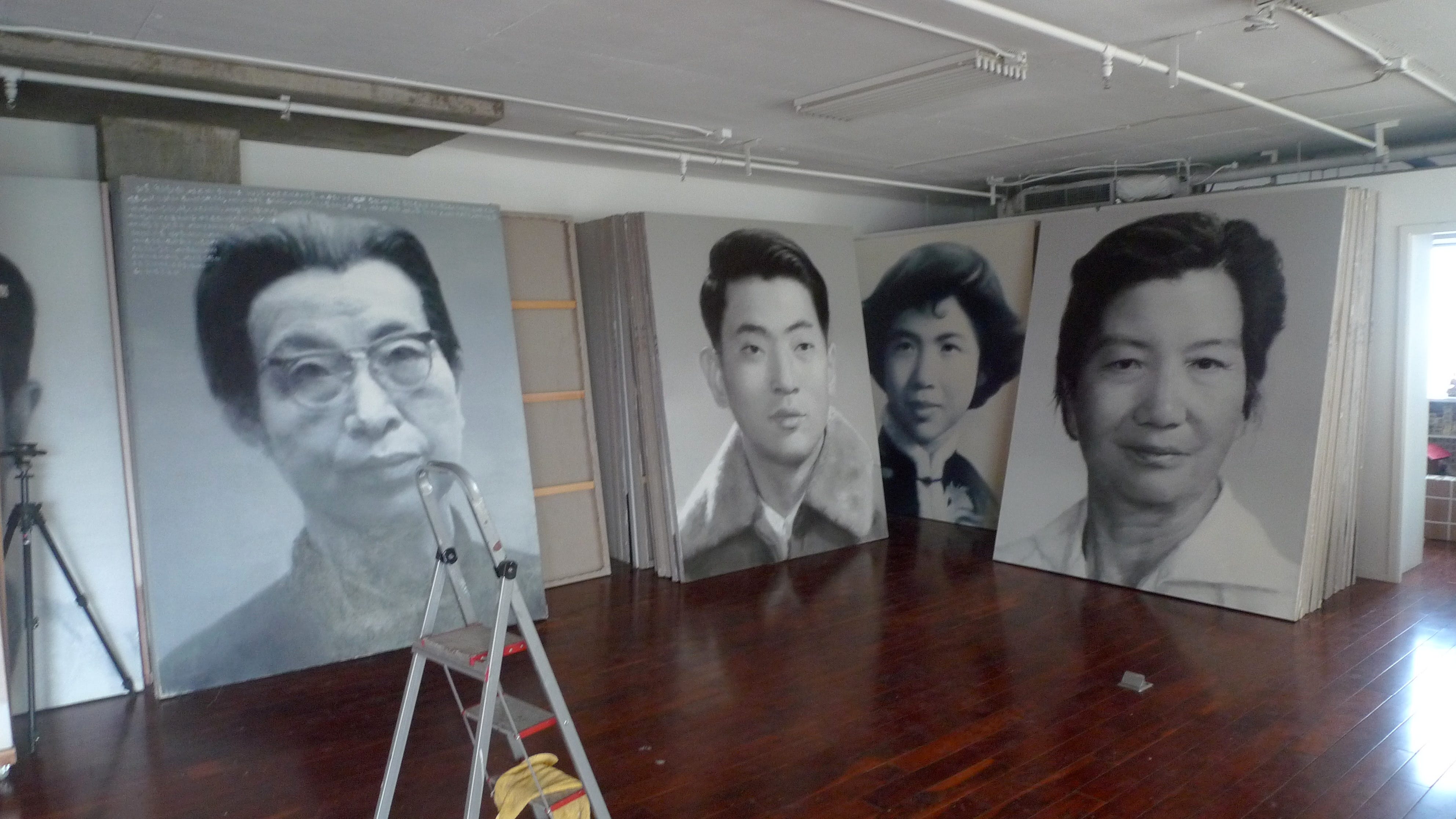
Sinocism Podcast: Tania Branigan on her book Red Memory: The Afterlives of China's Cultural Revolution
May 2, 202300:49:44Tap to summarizeEpisode Notes: Tania Branigan and I discuss her excellent new book “Red Memory: The Afterlives of China's Cultural Revolution”. Tania writes editorials for the Guardian and spent seven years as its China correspondent, reporting on politics, the economy, and social changes. We overlapped in Beijing and became friends. I have also published an excerpt from the book here. You can purchase the book on bookshop.org or on Amazon. The audio edition will be available from Tantor starting 7/11/23 wherever audiobooks are sold.Links:China's Cultural Revolution remembered by artist Xu Weixin - video | The Guardian2012 - China's Cultural Revolution: portraits of accuser and accused | The GuardianXilin Wang: Music by a Survivor | Hamburg International Music Festival - YouTubeWang Xilin ( 王西麟 ): Yunnan Tone Poem (1963) - YouTubeTranscript:[00:00:00] Bill: Welcome back to the occasional Sinocism podcast. I know I've been absent for a while, and now that I do the Weekly Sharp China podcast, I've realized I like podcasting. So we'll be recording more Sinocism episodes with guests I think are really interesting.[00:00:11] Bill: Today. We are very lucky to have Tania Branigan to talk about her excellent new book Red Memory: The After Lives of China's Cultural Revolution. As Tania writes, it is impossible to understand China today without understanding the Cultural Revolution. That is something I agree with wholeheartedly. So much so that I even wrote my grad school thesis on Mao badges.[00:00:30] Bill: I will also be running an excerpt from her book in the coming days, which is released in the UK already and will come out on May 9th in the United States. Tania writes editorials for the Guardian and spent seven years as its China correspondent reporting on politics, the economy, and social changes.[00:00:45] Bill: She lives in London. Welcome Tania, and congratulations on this great book. [00:00:50] Tania: Thank you so much for having me on.[00:00:51] Bill: Oh, it's my pleasure. It's great to see you. It's been it's been a few years and I appreciate it. I got an advance read of the book last year and it [00:01:00] really is it really is, I think, an important book and an important contribution.[00:01:03] Bill: So can you, just for the listeners, can you just talk a bit about your background? So when you first started working in China and what you did when you were there. [00:01:12] Tania: So I came out to China in 2008 just ahead of the Olympics, right at the start of what turned out to be an incredibly news packed year, as you may recall, right?[00:01:22] Tania: And I had never particularly wanted to be a foreign correspondent per se, but I just felt that China was the story of our time, really. Which is only proof to be truer perhaps as time has gone on. And because it's a pretty small bureau there were never more than two of us, max. And quite often there was one of me, I was covering absolutely everything.[00:01:44] Tania: So from natural disasters through to politics, through to culture, business even very occasionally when I couldn't help hit sport. But I became particularly fascinated by this topic and by [00:02:00] China's more recent history, [00:02:02] Bill: one question on your time there. When you arrived, was it already past the Wenchuan earthquake?[00:02:07] Tania: No. And in fact that was one of the sort of formative moments, for me reporting on, yeah, [00:02:15] Bill: it's 15 years next in two weeks. It's crazy. [00:02:18] Tania: It's hard to believe it's gone past so fast. I still think about those parents who lost kids. [00:02:24] Bill: And that, no, it's terrible. Terrible [00:02:29] Bill: So what led you to this book?[00:02:33] Tania: You did actually, as I say in, as I say in the book, I probably wouldn't have written it without you. So I was obviously aware of the Cultural Revolution. I knew something about it. I'd read a little around it. But then it was just when I had that lunch with you and then over coffee, you started telling me about your father-in-law and about going to try to find his body, which I feel is probably a story actually [00:03:00] at this point, that you should.[00:03:00] Tania: Tell rather than me. [00:03:02] Bill: And just for listeners the, I actually tried to have my wife be a special guest but she didn't want to do it, but Tania has interviewed her. I'll put a link in, into the story. I think we you did that great story about the artist Xu Weixin 徐唯辛, which maybe we can talk about too.[00:03:20] Bill: But no, sadly, my. Like many Chinese families people had horrible experiences in the Cultural Revolution. My father-in-law killed himself in 1967 1968 when my wife was like a year old, a year and a half old. And it, it just, it was a, he did it in Miyun outside of Beijing and involved a train.[00:03:47] Bill: And so we went. We had a family member a brother of his who was dying, who came back to say goodbye, and the family went out to this train embankment with this idea that maybe they could dig up the [00:04:00] bones and no one could figure out remember where it happened. Someone went to the village and found an old lady who remembered, and the old lady's warning was just be careful because that time that year, a lot of people jumped in front of train.[00:04:15] Bill: So just make sure you get the right bones. It was just like, oh my God. It was just like this collective ..I mean it was just, it was quite chilling, but it was also like, this is what every so many people of a certain age in China bear these kinds of memories. [00:04:34] Tania: And so that I think was really what struck me.[00:04:37] Tania: Obviously the sort of the cruelty and the loss and the fact that so many people are still living with loss now. And then as you said, the fact that the villagers were matter of fact about it. I remember you saying, they were sympathetic in some ways, but just uncomprehending of your mission in another way.[00:04:59] Tania: And [00:05:00] I think in many ways it was the fact that it was so commonplace, really, that stuck with me because there were so many horror stories you hear from the Cultural Revolution, horrific atrocities that have taken place, but here was a loss, which in a way was sort of typical and that people were still living with the consequences of.[00:05:25] Tania: And so I remember Carol saying to me, You know that even though she was now a mother herself, she couldn't imagine what it would be like to have a father, that there was this kind of space in her life and she couldn't imagine it being filled. And I think that really said so much about the way that people are still living with the consequences all these years on.[00:05:50] Bill: And it really, I think, and it's how people process lost and process the anger and the grief and so much. A lot of it is repressed and we've [00:06:00] seen cycles over the years of expressions or people trying to express, we had right after Xi Jmi came into power, I think one of the, one of the earliest red guards trying to make an apology.[00:06:10] Bill: And, it angered Xi Jinping. It's one of those things where in many ways there were periods where there's been an allowance or it's been allowed to talk about it and then it gets pulled back and you can't really talk about it. And I think we're now one of those periods, but back to where we were talking about it, it was also really around that, around the artist Xu Weixin and what he was doing.[00:06:37] Tania: That's right. . And so you suggested I go off to see him, which was an extraordinary experience because he has this, or had this studio full of around a hundred paintings and they are just immense. It's, I think it's quite hard for people who haven't seen them to imagine them, isn't it?[00:06:53] Tania: Because they're. So daunting when you look at them, they're two and a half meters tall. They're monochrome. [00:07:00] [00:07:00] Bill: And you, I have you did a video for The Guardian. I'll put that in the show notes for people. We've been there. We took our kids cuz my wife's dad and her grandparents were in it.[00:07:10] Bill: So three, three of her family members are in it. And they are, you went there and then were you in Beijing for his show or you missed, you were, you came after? [00:07:17] Tania: No, I came after. And of course that was the only show that he had on the mainland. Of these works we should p...
Transcribe →
Sinocism Podcast #5: 20th Party Congress and US-China Relations with Chris Johnson
Nov 4, 202200:59:34Tap to summarizeEpisode Notes:A discussion of the recently concluded 20th Party Congress and what to expect ahead in US China relations. I'm pleased to welcome back Chris Johnson, CEO of Consultancy China Strategies Group, Senior Fellow at the Asia Society Policy Institute Center for China Analysis and former Senior China analyst at the Central Intelligence Agency. This is the 7th Party Congress that Chris has analyzed professionally.Links:John Culver: How We Would Know When China Is Preparing to Invade Taiwan - Carnegie Endowment for International PeaceTranscript:Bill: Welcome back to the very occasional Sinocism podcast. Today we are going to talk about the recently concluded 20th Party Congress and what to expect ahead in US China relations. I'm pleased to welcome back Chris Johnson, CEO of Consultancy China Strategies Group, Senior Fellow at the Asia Society Policy Institute Center for China Analysis and former Senior China analyst at the Central Intelligence Agency. This is the 7th Party Congress that Chris has analyzed professionally. So we have a lot of experience here to help us understand what just happened. Chris, welcome back and thanks for taking the time.Chris: My pleasure. Always fun to be with you, Bill.Bill: Great. Well, why don't we jump right in. I'd like to talk about what you see as the most important outcomes from the Congress starting with personnel. What do you make of the leadership team from the central committee to the Politburo to the Standing Committee and what does that say about.Chris: Yeah, well, I, think clearly Xi Jinping had a massive win, you know, with personnel. I think we see this particularly in the Politburo Standing Committee, right, where on the key portfolios that really matter to him in terms of controlling the key levers of power inside the system. So we're talking propaganda, obviously, Uh, we're talking party bureaucracy, military less so, but security services, you know, these, these sort of areas all up and down the ballot he did very well.So that's obviously very important. And I think obviously then the dropping of the so-called Communist Youth League faction oriented people in Li Keqiang and Wang Yang and, and Hu Chunhua being kind of unceremoniously kicked off the Politburo, that tells us that. He's not in the mood to compromise with any other interest group.I prefer to call them rather than factions. Um, so that sort of suggests to us that, you know, models that rely on that kind of an analysis are dead. It has been kind of interesting in my mind to see how quickly though that, you know, analysts who tend to follow that framework already talking about the, uh, factional elements within Xi's faction, right?So, you know, it's gonna be the Shanghai people versus the Zhijiang Army versus the Fujian people. On Wang HuningBill: people say there's a Tsinghua factionChris: Right. The, the infamous, non infamous Tsinghua clique and, and and so on. But I think as we look more closely, I mean this is all kidding aside, if we look more closely at the individuals, what we see is obviously these people, you know, loyalty to Xi is, is sort of like necessary, but not necessarily sufficient in explaining who these people are. Also, I just always find it interesting, you know, somehow over. Wang Huning has become a Xi Jinping loyalist. I mean, obviously he plays an interesting role for Xj Jinping, but I don't think we should kid ourselves in noting that he's been kind of shunted aside Right by being pushed into the fourth position on the standing committee, which probably tells us that he will be going to oversee the Chinese People's Consultative Congress, which is, you know, kind of a do nothing body, you know, for the most part. And, um, you know, my sense has long been, One of Xi Jinping’s, I think a couple factors there with Wang Huning.Sinocism is a reader-supported publication. To receive new posts and support my work, consider becoming a free or paid subscriber.One is, you know, yes, he is very talented at sort of taking their very, uh, expansive, um, theoretical ideas and coming up with snappy, um, snappy sort of catchphrases, right? This is clearly his, um, his sort of claim to fame. But, you know, we had that article last year from the magazine, Palladium that kind of painted him as some sort of an éminence grise or a Rasputin like figure, you know, in terms of his role.Uh, you know, my sense has always been, uh, as one contact, put it to me one time. You know, the issue is that such analyses tend to confuse the musician with the conductor. In other words, Xi Jinping. is pretty good at ideology, right? And party history and the other things that I think the others had relied on.I think the second thing with Wang Huning is, um, in a way XI can't look at him I don't think, without sort of seeing here's a guy who's changed flags, as they would say, right? He served three very different leaders, Jiang Zemin, Hu Jintao, and now Xi , um, and, and continued on and I think at some level, uh, and we look at the rest of the appointments where it appears that, uh, loyalty was much more important than merit.Um, where that's also a question mark. So there's those issues I think on the Politburo. You know, you mentioned the, the Tsinghua clique it was very interesting. You had shared with me, uh, Desmond Shum of Red Roulette fame’s Twitter stream sort of debunking, you know, this, this Tsinghua clique and saying, well, it turns out in fact that the new Shanghai Municipal Party Secretary Chen Jining can't stand Chen Xi, even though, you know, they both went to Tsinghua and were there at the same time and so on.Um, you know, who knows with Desmond Shum, but I think he knows some things, right? And, and, and it just a reminder to us all, I think, how little we understand right, about these relationships, especially now, uh, with Xi's concentration of power. And also a situation where we've had nearly three years of covid isolationBill: Right. And so it's really hard to go talk to people, even the fewer and fewer numbers, people who, who know something and can talk. Back to the standing committee. I, I think certainly just from friends and contacts the biggest surprise you know, I think, uh was Li Keqiang and Wang Yang not sticking around. And as that long explainer said without naming them they were good comrades who steps aside for the good of the party in the country,Chris: Because that happens so often,Bill: whatever that means. Um, but really the, the bigger surprise was that, oh, Cai Qi showing up. Who I think when you look at the standing committee, I think the general sense is, okay, the, these people are all, you know, not, they're loyal, but they're also competent, like Li Qiang, Chris: Right, Bill: The likely new premier number two on the standing committee is pretty competent. The Shanghai lockdown, disaster aside, Cai Qi on the other hand, was just, looks more like, it's just straight up loyalty to Xi. I think he was not really on anybody's short list of who was gonna make it on there. And so, it does feel like something happened, right?Chris: Yeah. Well, um, a couple things there. I think, um, one, let's start with the. The issue you raised about the economic team cuz I think that's actually very important. Um, you know, I, at some level, sometimes I feel like I'm sort of tiring my, of my role as official narrative buster or a windmill tilter.Uh, whether, whether it's pushback from Li Keqiang or the myth of the savior premier as I was calling it, which, uh, we didn't see, or that these norms actually aren't very enduring and it's really about power politics. I, I think I'm kind of onto a new one now, which is, you know, Xi Jin ping's new team of incompetent sycophants.Right? That's kind of the label that's, uh, come out in a lot of the takes, uh, since the Congress. But to your point, I mean, you know, Li Qiang has run the three most important economic powerhouses on China's east coast, either as governor or as party chief. Right. He seems to have had a, a good relationship with both.Private sector businesses and, and foreign, you know, people forget that, you know, he got the Tesla plant built in Shanghai in a year basically. Right. And it's, uh, responsible for a very significant amount of, of Tesla's total input of vehicles. Output of vehicles. Excuse me. Um, likewise, I hear that Ding Xuexiang, even though we don't know a lot about him, uh, was rather instrumental in things.Breaking the log jam with the US uh, over the de-listing of Chinese ADRs, uh, that he had played an important role in convincing Xi Jinping it would not be a good idea, for example, to, uh, you know, we're already seeing, uh, sort of decoupling on the technology side. It would not be a good idea to encourage the Americans to decouple financially as well. So the point is I think we need to just all kind of calm down, right? And, and see how these people perform in office. He Lifeng, I think is perhaps, you know, maybe more of a question mark, but, But here too, I think it's important for us to think about how their system worksThe political report sets the frame, right? It tells us what. Okay, this is the ideological construct we're working off of, or our interpretation, our dialectical interpretation of what's going on. And that, I think the signal there was what I lik...
Transcribe →
Sinocism Podcast #4: The Economist's David Rennie on online nationalism, discourse power, reporting from China, US-China relations
Feb 10, 202200:54:44Tap to summarizeEpisode Notes:This episode's guest is David Rennie, the Beijing bureau chief for The Economist and author of the weekly Chaguan column. Our topic is online discourse, nationalism, the intensifying contest for global discourse power and US-China relations.Excerpts:I spoke to some very serious NGO people who've been in China a long time, Chinese and foreigners who said that this was the worst time for NGOs since 1989, and the kind of mentions of espionage and national security was a very serious thing. So then I had to make a decision, was I going to try and speak to someone like Sai Lei. Clearly he is an extremely aggressive nationalist, some would call him a troll and there are risks involved in talking to someone like him. But I felt, I'm one of the few English language media still in China, if I'm going to add value, I need to speak to these people.I had a very interesting conversation with a CGTN commentator…He said, I can't tell you how many Western diplomats, or Western journalists they whine. And they moan. And they say, how aggressive China is now and how upset all this Wolf warrior stuff is and how China is doing itself damage. And he goes, we're not, it's working. You in the Western media, used to routinely say that the national people's Congress was a rubber stamp parliament. And because we went after you again and again, you see news organizations no longer as quick to use that. Because we went after you calling us a dictatorship, you're now slower to use that term because we went after you about human rights and how it has different meanings in different countries. We think it's having an effect…One of the things I think is a value of being here is you have these conversations where the fact that we in the West think that China is inevitably making a mistake by being much more aggressive. I don't think that's how a big part of the machine here sees it. I think they think it worked….To simplify and exaggerate a bit, I think that China, and this is not just a guess, this is based on off the record conversations with some pretty senior Chinese figures, they believe that the Western world, but in particular, the United States is too ignorant and unimaginative and Western centric, and probably too racist to understand that China is going to succeed, that China is winning and that the West is in really decadent decline…I think that what they believe they are doing is delivering an educational dose of pain and I'm quoting a Chinese official with the word pain. And it is to shock us because we are too mule headed and thick to understand that China is winning and we are losing. And so they're going to keep delivering educational doses of pain until we get it…The fundamental message and I'm quoting a smart friend of mine in Beijing here is China's rise is inevitable. Resistance is futile…And if you accommodate us, we'll make it worth your while. It's the key message. And they think that some people are proving dimmer and slower and more reluctant to pick that message up and above all Americans and Anglo-Saxons.On US-China relations:The general trend of U.S. China relations. to be of optimistic about the trend of U.S. China relations I'd have to be more optimistic than I currently am about the state of U.S. Politics. And there's a kind of general observation, which is that I think that American democracy is in very bad shape right now. And I wish that some of the China hawks in Congress, particularly on the Republican side, who are also willing to imply, for example, that the 2020 election was stolen, that there was massive fraud every time they say that stuff, they're making an in-kind contribution to the budget of the Chinese propaganda department…You cannot be a patriotic American political leader and tell lies about the state of American democracy. And then say that you are concerned about China's rise…..their message about Joe Biden is that he is weak and old and lacks control of Congress. And that he is, this is from scholars rather than officials, I should say, but their view is, why would China spend political capital on the guy who's going to lose the next election?…The one thing that I will say about the U.S. China relationship, and I'm very, very pessimistic about the fact that the two sides, they don't share a vision of how this ends well.Links:China’s online nationalists turn paranoia into clickbait | The Economist 赛雷:我接受了英国《经济学人》采访,切身体验了深深的恶意 David Rennie on Twitter @DSORennieTranscript:You may notice a couple of choppy spots. We had some Beijing-VPN issues and so had to restart the discussion three times. Bill:Hi, everyone. Welcome back to the `Sinocism podcast. It's been a bit of a break, but we are back and we will continue going forward on a fairly regular schedule today. For the fourth episode, I'm really happy to be able to chat with David Rennie, the Beijing bureau chief for The Economist and author of the weekly Chaguan column. Our topic today is online discourse, nationalism, and the intensifying contest for global discourse power.Bill:I've long been a fan of David's work and the approximate cause for inviting him to join the podcast today was an article on the January 8th issue of The Economist on online nationalism. Welcome David.David:Hello.Bill:So just to start, could you tell us how you got to where you are today?David:I've been a foreign correspondent for frighteningly long time, 24 years. And it's my second China posting. I've been out there so long. I've done two Chinas, two Washingtons, five years in Brussels. I was here in the '90s and then I went off, spent a total of nine years in Washington, DC. And then I came back here in 2018 and I was asked to launch a new column about China called Chaguan, because previously I wrote our Lexington column and our Bagehot column about Britain and our Charlemagne column about Europe. They all have strange names, but that's what we do. And so this is my fourth column for The Economist.Bill:We last met, I think in 2018 in Beijing in what seems like before times in many ways at The Opposite House, I believe.David:And the days when we had visitors, people came from the outside world, all of those things.Bill:Yes. You are quite the survivor, as they say. Although there are advantages to not worry about walking outside and getting sick all the time. Although it's better here in DC now.David:It's a very safe bubble. It's a very large bubble, but it's a bubble.Bill:So let's talk about your article, the January 8th issue. It was titled “China's online nationalist turned paranoia into click bait”. And I thought it was a very good distillation of the surge in nationalists and anti foreign content that is really flooding or was flooded the internet in China. And you interviewed one of the people who's profiting from it because it turns out that not only is it good from a sort of a sentiment perspective, but it's also good from a business perspective.Bill:And that person Sai Lei, interestingly enough, then recorded your conversation and turned it into a whole new post and video about the whole experience of talking to a foreign correspondent. Can you tell us a little about the story and why you chose to write it and just to add the links to David's article and the Sai Lei article will be in the podcast notes.David:So I heard from friends and colleagues, a couple of things in two directions. One was that in the world of private sector media, a couple of reasonably well known explainer sites, popular science video companies had been taken out of business by nationalist attacks. One was called Paperclip, the other called Elephant Union. And their crime in the eyes of online nationalists had been to talk about things which are fairly uncontroversial in Western media, that eating beef from the Amazon or eating beef that is fed soy grown in the Amazon is potentially bad for the rainforest and maybe we should eat less meat.David:But because this was in the Chinese context, that China is the biggest buyer of soybeans, this explainer video was attacked as a plot to deny the Chinese people the protein that they need to be strong, that this was a race traitor attack on the Chinese. And it was outrageous because the West eats so much more meat than China. And so that was one element of it. And I heard that these companies had been shut down. The other was that I'd been picking up that this was an extremely bad time for NGOs, particularly Chinese NGOs that get money from overseas. And we'd seen some really nasty attacks, not just on the idea that they were getting money from overseas, but that they were somehow guilty of espionage.David:And there was an NGO that did incredibly benign work. Tracking maritime and Marine trash, as it floats around the coasts of China based in Shanghai, Rendu Ocean. I'd done a column on them the year before I'd been out with their volunteers. It was a bunch of pensioners and retirees and school kids picking up styrofoam and trash off beaches, weighing it, tracking where it came from and then uploading this data to try and track the fact that China is a...
Transcribe →