Loading summary
Transcript56 lines
- [00:00]
Designer Shoe Warehouse
At Designer Shoe Warehouse we believe that shoes are an important part of, well, everything.
- [00:06]
Jamie Loftus
From first steps to first dates, from all nighters to all time personal bests.
- [00:12]
Designer Shoe Warehouse
From building pillow forts to building a.
- [00:14]
Jamie Loftus
Life for all the big and small moments that make up your whole world. DSW is there and we've got just the shoes. Find a shoe for every you from brands you love at brag worthy prices at your DSW store or dsw.com bring.
- [00:31]
Target
Spring to your door with Target Circle 360 get all you need for Easter hosting spring get togethers and more with unlimited same day delivery Through Target Circle360 from Easter Basket goodies to fresh florals, getting everything the same day is easy. Open the Target app and bring the magic of the season to your door with unlimited same day delivery Through Target Circle360. Visit target.com circle or the Target app for more details. Subscription required. Same day delivery is subject to terms applies to orders over $35.
- [01:00]
Designer Shoe Warehouse
Are you still quoting 30 year old movies? Have you said cool beans in the past 90 days? Do you think Discover isn't widely accepted? If this sounds like you, you're stuck in the past. Discover is accepted at 99% of places that take credit cards nationwide and every time you make a purchase with your card, you automatically earn cash back. Welcome to the now it pays to Discover. Learn more@discover.com credit card based on the February 2024 Nielsen report Amazon Pharmacy presents.
- [01:31]
Tay Zonday
Painful thoughts 20 more minutes to kill in the pharmacy before my prescription is ready. Maybe I'll grab some deeply discounted out of season Halloween candy. I never had a chocolate pumpkin with raisins before. Those were raisins, right? Next time use Amazon Pharmacy. We deliver. And no, those were not raisins. Amazon Pharmacy Healthcare just got less painful. Cool zone media 16 minutes.
- [02:55]
Jamie Loftus
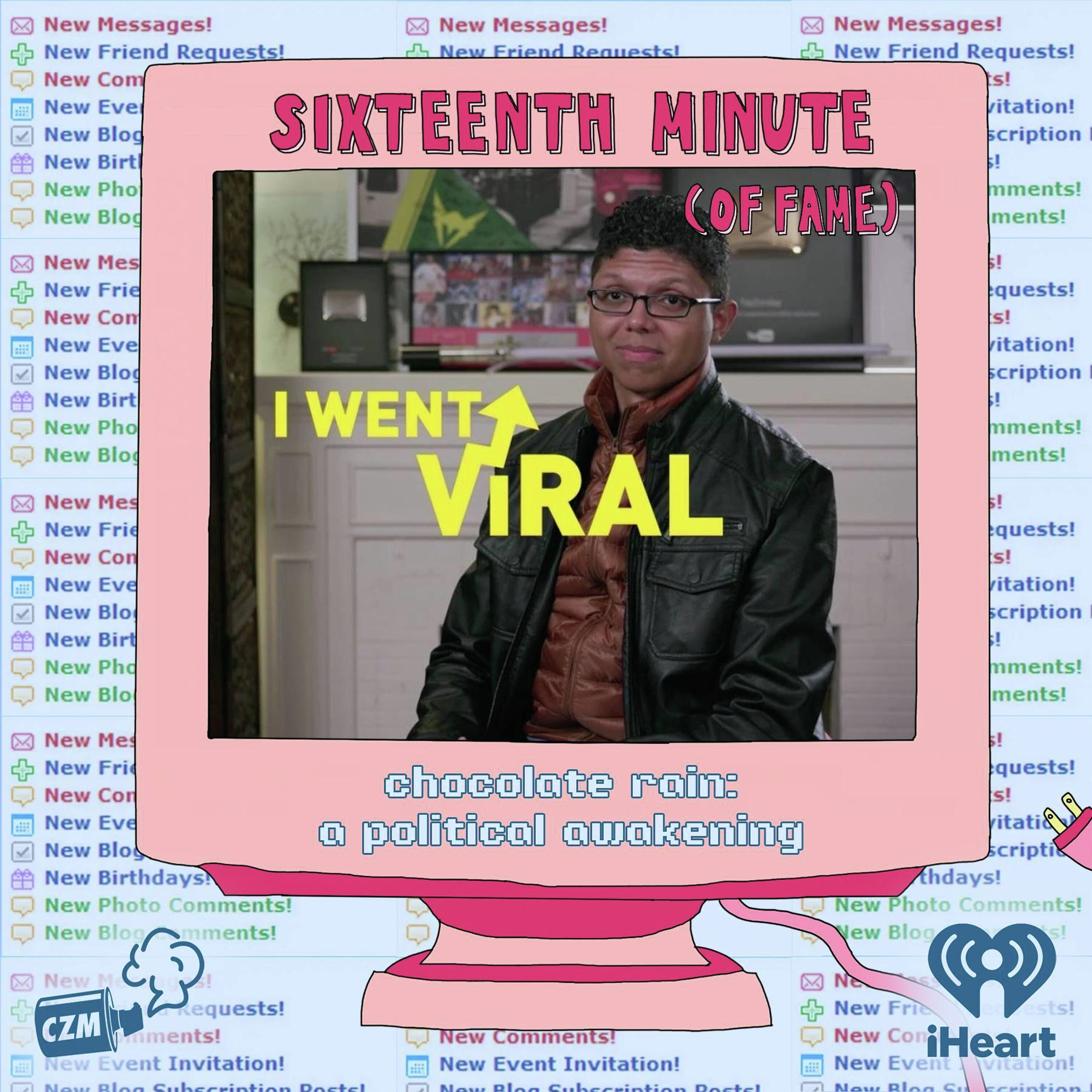
Welcome back to 16th minute, the podcast where we talk to the main characters of the Internet, see how their moment in the spotlight affected them and what that says about us and the Internet. And today we're continuing our series with the one and only Tay Zonday of Chocolate Rain fame. And if you've been living happily in the WI Fi signalless woods up until yesterday, maybe you're unfamiliar with Tay and his most famous work, which has been going viral every year so since 2000. Goddamn seven. But you might not know the deep anti racist roots of that same song, something that was pretty obscured for the first decade or so of Chocolate Rain's history. And for all that, and for Tay Zonday AKA Adam Bonner's origin story as a young autistic mixed race guy who started posting on YouTube and unwittingly became an online superstar just shy of the US recession and in conjunction of then Senator Barack Obama becoming a national star. For a full look at what Tay's rise to fame looked like in the moment, head back to the first episode of this series where we cover it in detail and Tae himself gives us some insight into his early life. But today, for this minisode, I'm going to hand the mic off to the incomparable Tae Zonday to tell you about his political education specifically. Maybe this sounds a little weird, but go with me here. When we left off in our first episode, Tay had just begun to be educated on the consequences American systemic racism had well into the present, something his mixed race family hadn't talked to him about as a kid as he grew up in the 80s and 90s. And when he told his white dad about beginning to learn this with some excitement and enthusiasm, his dad began to cry. I guess I'll just add here that this material, while the kind of conversations that I'm really into are not necessarily canon to the Tay's on day story, and it might not be for everybody. However, I was really touched at how open Tay was with sharing, how he reached both the place he was in his political consciousness and how that formed Chocolate Rain and how he's grown since. So if you're into that sort of thing, I think you'll really like this episode. If you just want to hear the rest of his story in terms of his linear viral experience, definitely tune in to our concluding part on Tuesday. The following episode is the process that Tay went through to try to get to the root of his father's behavior, and they're still close to this day. But getting to a satisfying conclusion required that Tay go through a thorough history of activism and academia that he was largely unfamiliar with. And that's where we're picking up today. So if you're in the mood to be radicalized or re radicalized, gather round. Here's Tay Zonday.
- [05:54]
Tay Zonday
I'm going to unpack this for almost 30 minutes, but it is a journey that should have familiar scenery for a lot of people. I'll crudely define critical Race theory as the idea that historical racial injustice manifests as present day racial oppression, even if people in the present day are not not deliberately or consciously being racist. I'll crudely define sociological Marginalization theory as the idea that race, class, gender, physical ability, religion, all of these are axes of Oppression that have favored and less favored groups. So critical race theory would argue that white supremacy creates unacceptable injustice in a person's life the moment they are conceived. So it says, a baby born will die before the sin. Sorry, that was low hanging fruit. Sociological marginalization theory would argue that if you're a white, male, Christian, able bodied, heterosexual, property class, you are conferred advantages in society that you would not be conferred if the playing field was level. Critical race theory and sociological marginalization theory are both what would be called structuralist theories. So what does structuralism mean of which these structuralist theories are a part? I'll crudely define structuralism as the idea that your theory of how the world operates in terms of power or knowledge also determines the motivations, morals and identities of groups of human beings. Famous structuralists include Charles Darwin, the evolution guy, Karl Marx, the communism guy, Milton Friedman and other economists, Betty Friedan and a lot of second wave feminist epistemology. There are many critiques and schools of thought that point out the shortcomings of structuralism and we call those poststructuralism. We're not done with theory. But real quick, let's check back on this moment with my father, where 21 year old me just excitedly repeated structuralist terminology that bell hooks uses. White supremacist capitalist patriarchy, and my father started to cry. A post structuralist like Derrida might say that my father was crying and thinking, not me, and receiving my structural observation as a very personal accusation, because my father believed in the goodness of his heart and the sacredness with which he had lived his life, that the structuralist term white supremacist capitalist patriarchy did not apply to him, and that he had lived his life differently. Or in the post structuralist critique of Derrida, my father believed that he had repeated the structure differently. A common criticism that post structuralism has of structuralism is that structuralism confiscates choice from individuals in order to render people as dominoes. And it's almost like just the words of bell hooks without any other context. White supremacist capitalist patriarchy made my father feel like a domino that I had suddenly started to render in a certain way. And some people are listening to this and thinking, yeah, but bell hooks was not making a personal accusation against your father in using structuralist terminologies. And many of you thinking that way will also say, well, the truth is just the truth and we've got to be able to speak about the truth. And if that's traumat for some people, then that's work. They have to do that's not on the person speaking the truth. What's interesting is that almost every person I encounter who advances that perspective and I point four fingers back at me because it's a perspective I have held many waking days in my own life. As soon as I turn the tables and start listing the myriad ways their life has been enabled by plunder, genocide, oligarchy, etc. They react much as my father did. It's hurtful and makes them defensive. If I point out, hey yeah, that iPhone that you posted, all that fire and brimstone ad hominem humanist outrage with online probably contains minerals mined by child slaves in the Democratic Republic of Congo and was probably manufactured under very questionable human rights conditions in Asia. And those things were both partly enabled by technocratic currency manipulation that eugenically devalues African born and Asian born bodies relative to your body using the exact currency that you pay your car note with and bought your lunch with. Nobody likes to be called out like that. Even if the accusations are true. They like to think of themselves as Derrida thinks of the individual. They like to believe they are the exception to the rule. They are repeating the structure differently and it does not apply to them. So before anybody is too hard on my father, really think about yourself. Because especially if your life is derived from Western civilization, you have never experienced nor acted upon anything from your cradle to your grave that is morally sacrosanct in a structuralist interrogation of power and plunder. And in my experience, when policy discussion gets reduced to personal absolution Olympics, that's almost always mutual assured destruction, which as I'll get into in a little bit, is kind of the point of today's social media. By the way, I love bell hooks and I love my iPhone, but I can love them and still acknowledge reality. I can love them and still powerfully win policy arguments and powerfully lead a revolution with no invocation of my personal moral absolution. We're still unpacking this moment with my father. I told you we'd be here a while. Put another marshmallow on the fire. I don't think my father's sadness and hurt in this moment was simply him believing bell hooks had taught me to accuse him of white supremacist capitalist patriarchy. But also he desired for me to feel as though I lived freely in a world where I did not have to be constrained by racial identity. I think another part of that tearful reaction was part of his realization that I'm not living in that world, that these things are very, very salient concerns for me. And that the post racial utopia family life that emerged from his and my mother's dreams did not extend beyond our household. And that I had somehow, almost like Eve bit the apple. I had become corrupted by, oh wait, there's this whole other world out here. And I it's his now adult son. And just like I'm, I'm exiting the matrix and realizing, wait, I feel wet, I feel cold. Nobody told me about these things. I don't feel placated anymore. And so that's how I wrote Chocolate Rain, to find a way to talk about race that didn't make my father cry. No, we're getting way ahead in the story, but recording this is the first time I ever made that connection.
- [12:41]
Target
Bring spring to your door with Target Circle 360. Get all you need for Easter hosting spring get togethers and more with unlimited same day delivery Through Target Circle360. From Easter Basket goodies to fresh florals, getting everything the same day is easy. Open the Target app and bring the magic of the season to your door with unlimited same day Delivery through Target Circle360. Visit target.com circle or the Target app for more details. Subscription required. Same day delivery is subject to terms. Applies to orders over $35.
- [13:11]
Stassi Schroeder
Hello, darlings. Pack your suitcase for a new season of the Hulu original reality series Vanderpump Villa.
- [13:18]
Jamie Loftus
Let's do this.
- [13:20]
Tay Zonday
Ciao. It's Stassi.
- [13:21]
Adam Bonner
Of course.
- [13:22]
Tay Zonday
Lisa brought in her favorite to be resident chaperone of the castle.
- [13:26]
Stassi Schroeder
Stassi is an icon. She's my eyes and ears. I love that it's get ready for the luxury and drama that awaits us in Italy.
- [13:35]
Tay Zonday
Cheers to all the toxic couples in the castle.
- [13:37]
Stassi Schroeder
Season two of Vanderpump Villa premieres April 24th.
- [13:40]
Tay Zonday
Streaming on Hulu. Ch, ch, ch.
- [13:42]
Designer Shoe Warehouse
Chumba Looking for excitement? Jumba Casino is here.
- [13:45]
Tay Zonday
Play anytime.
- [13:46]
Designer Shoe Warehouse
Play anywhere. Play on the train. Play at the store. Play at home. Play when you're bored. Play today for your chance to win and get daily bonuses when you log in. So what are you waiting for? Don't delay. Chumba Casino is free to play.
- [13:58]
Target
Experience social gameplay like never before. Go to Chumba Casino right now to play hundreds of games, including online slots, bingo, Slingo and more. Live the chumba life@chumbacasino.com no purchase necessary.
- [14:09]
Designer Shoe Warehouse
VGW Group void where prohibited by law 21 + terms and conditions apply.
- [14:13]
Adam Bonner
Does this podcast make you happy? Of course it does. That's why you're here. But it only Comes out once a week for happiness every night. You need Adam and Eve. Yes. I'm talking about sex toys. It's cool. It's cool. You have earbuds in, right? Adam and Eve, America's most trusted source for adult products, has been making people very happy for over 50 years with thousands of toys for both men and women. Just go to AdamAndEve.com now and enter code IHEART for 50% off. Almost any one item, plus free discreet shipping. That's adamandeve.com, code iheart for 50% off.
- [14:58]
Tay Zonday
I will say, and this is the meat of why I did that theoretical breakdown that we'll get back to. Revolutionary and resistance dialogue has become a little bit too enamored with structuralist language in 2025. We're kind of in love with structuralism being the path to revolution. I have at times been guilty of that. And part of the reason for that is just social media is very, very struct in how it organizes our public discourse. You could even go so far as to say that Chocolate Rain was a post structuralist piece of content on a post structuralist wild wild west Internet. So you had this perfect alignment of stars. Today, the Internet is much more regimented. In 2007, you did not have algorithmic feeds monitoring, spying on thousands of pieces of user telemetry to try to predict what would keep the user on the platform as long as possible. YouTube was actually curated by human editors at that time. So yeah, there's this whole viral video era from around what I'd say Diet Coke and Mentos in 2006 all the way through maybe gangam style in 2011, where these massively viral videos were possible on a post structuralist Internet, where eventually companies like Google and Facebook learned they would make more money by imposing more structure. And that's where we get recommendation engines and feeds, these ads and platforms that spy on all of our behavior to try to predict what will addict us. And so a phenomenon like Chocolate Rain that had vague and flexible meaning that could be widely appropriated, that's not allowed on today's Internet. That's profane. Ads can't predict human behavior in that type of ecosystem. Today's Internet needs content to be what capitalists would call a fixed asset. That also means it must have a fixed meaning and a fixed audience response. The viral video era in which Chocolate Rain went viral was completely different. It was all about reframing, reappropriating, lampooning meaning. The top content creators like Venetian Princess or barely political on YouTube, they would parody the music videos of gigantic artists like Lady Gaga or Justin Bieber and their parodies would get tens of millions, in some cases hundreds of millions of views. And if young people today take away one thing about how the Internet used to be and how it is different than what we have today, it's that it used to be possible to completely reframe the meaning of a mainstream content asset and have your reframe reach a gigantic audience, not a pre vetted and partisan audience whose confirmation biases are just validated by the way that you reframe a piece of content. No, you could reach an undecided, undifferentiated majority completely outside of your thought bubble or thought ecosystem with the content you uploaded in the past organically. And this all circles back to my earlier statement that revolutionary discourse, and you could maybe sometimes call it leftism bread tube, it could go by many names, has fallen a bit too much in love with structuralism. Because passionate young activists have grown up in this fake oligarchic information regime where it is impossible for layered meaning, symbolic meaning, metaphorical meaning, liminal meaning, to access undecided eyeballs and grow an audience. They'll sometimes attack positions that introduce complexity, as though that complexity is motivated by malice and a rejection of their throughline narrative that they want to reach an audience with. The problem when a passionate revolutionary responds that way is that it is conflating the algorithm's act of speech with the individual's act of speech. The late great Michael Brooks was right. We must be ruthless to systems and kind to individuals. Audre Lorde was right. The Master's tools will not dismantle the Master's house. World history is filled with endless revolutionary actors who introduced complexity. Dadaism introduced complexity as it lampooned and critiqued fascism using the optics that fascism put forth itself. Young people will watch Chocolate Rain today and be like, I can't believe that people missed what the meaning of this was in 2007. And I'm like oh, okay, yeah, it's cause we operated in an information ecosystem that did not corral us into self destructive literalism. Everybody was accustomed to regularly encountering online content that had not been free sorted to validate their most vulnerable biases and goad them into a codependent voracious consumption experience around time sucking content related to each bias. Some people will ask, well, why didn't you speak out more clearly at that time that you had this vision of Chocolate Rain being a ballad about institutional racism? And it's partly, not entirely, but partly because I knew it could be a Trojan Horse. And I knew that people making comedic parodies and saying, oh gosh, it's a fun, silly song that I sing to my kid at bedtime was part of the penetration phase for that Trojan Horse. And it was not time for the soldiers to jump out. And by the way, because we live in extremely estranged and Balkanized times now, that Trojan horse approach is one of the only ways to raise the political consciousness of somebody who is a good person, but who is not personally nor spiritually prepared to understand your worldview. The fact that social algorithms banning metaphor and nuance also serves to ban that slow crawl Trojan horsing, which is literally the anthropological process by which new coalitions and new societies and new cultural meanings evolve, means that today's private sector search and social network oligarchies are injurious to humanity and how they operate. So if you are young and your entire life has been lived with this boot on your neck, this boot of engagement, optimized algorithmic information feeds driven by search engine optimization, metadata and telemetry, you face an extra challenge in pursuing intellectual and creative liberation. As Ralph Ellison puts it, live in New York, but don't let New York live in you. As Henry Louis Gates Jr. Writes about sophisticated African literary criticism through the signifying monkey and the root, a trickster signification is the performance of metaphor and lampooning established meaning and established power the same way Noam Chomsky talks about how human beings themselves are wired for generative grammar and creating a structure whose meaning is not beholden to itself.
- [21:49]
Jamie Loftus
And we'll be back soon with more from Tay Zonday.
- [21:58]
Target
Bring spring to your door with target circle 360. Get all you need for Easter hosting spring get togethers and more with unlimited same day delivery Through Target Circle360. From Easter Basket goodies to fresh florals, getting everything the same day is easy. Open the Target app and bring the magic of the season to your door with unlimited same day delivery Through Target Circle360. Visit target.com circle or the Target Target app for more details. Subscription required. Same day delivery is subject to terms. Applies to orders over $35.
- [22:28]
Stassi Schroeder
Hello darlings. Pack your suitcase for a new season of the Hulu original reality series Vanderpump Villa.
- [22:35]
Jamie Loftus
Let's do this.
- [22:36]
Tay Zonday
Ciao. It's Stassi.
- [22:38]
Adam Bonner
Of course.
- [22:38]
Tay Zonday
Lisa brought in her favorite to be resident chaperone of the castle.
- [22:42]
Stassi Schroeder
Daci is an icon. She's my eyes and ears.
- [22:46]
Tay Zonday
I love this.
- [22:46]
Stassi Schroeder
Get ready for the light luxury and drama that awaits us in Italy.
- [22:51]
Tay Zonday
Cheers to all the toxic couples in the castle.
- [22:53]
Stassi Schroeder
Season two of Vanderpump Villa premieres April 24th.
- [22:56]
Tay Zonday
Streaming on Hulu.
- [22:57]
Target
How to have fun anytime, anywhere.
- [22:59]
Tay Zonday
Step 1 Go to chumbacasino.com chumbacasino.com Got it.
- [23:04]
Target
Step 2 Collect your welcome bonus. Come to papa.
- [23:07]
Adam Bonner
Welcome bonus.
- [23:07]
Target
Step 3 Play hundreds of casino style games for free.
- [23:10]
Adam Bonner
That's a lot of games, all for free.
- [23:12]
Target
Step 4 Unleash your excitement.
- [23:14]
Tay Zonday
Woo hoo. Ch ch ch.
- [23:15]
Target
Chumba Chumba Casino has been delivering thrills for over a decade. So claim your free welcome and live the chumba life. Visit chumbacasino.com no purchase necessary vgw group.
- [23:24]
Designer Shoe Warehouse
Void where prohibited by law 21 +.
- [23:26]
Adam Bonner
Terms and conditions apply does this podcast make you happy? Of course it does. That's why you're here. But it only comes out once a week. For happiness, every night. You need Adam and Eve. Yes. I'm talking about sex toys. It's cool. It's cool. You have earbuds in right? Adam and Eve, America's most trusted source for adult products, has been making people very happy for over 50 years with thousands of toys for both men and women. Just go to AdamandEve.com now and enter code IHEART for 50% off. Almost any one item plus free discreet shipping. That's AdamandEve.com code IHEART for 50% Off.
- [24:15]
Jamie Loftus
Welcome back to 16th Minute. I love my listeners so much. And by that I mean I was able to find someone to make an urn for my dad's ashes after putting out a call two weeks ago. Really impressive stuff, you guys. And here's more political theory from Tay's on day.
- [24:32]
Tay Zonday
You're just like that song the Revolution will not be Televised. Well, today's revolution will not be hashtagged. It will not be trending. At least not uncentralized for profit, engagement, optimized search and social media. And let's pause a little bit. Let's back off because I just made a bold claim. I said the revolution is impossible using today's privatized, centralized, oligarchic search and social media. The easiest counterpoint to that assertion is what about Occupy Wall Street? What about Black Lives matter? What about MeToo? Those are fantastic counterpoints and I want to go on a bit of a detour. And we are already in a detour. So it's kind of a detour inside of the detour, but topic of movements, meanings and the structure of algorithmic social media. Sort of being like a goalie who intercepts every scoring kick in the effort to start revolution. It's worth exploring with real world examples. It's important to acknowledge that people have lived many different and oftentimes heroic stories, and that one perspective does not seek to steal valor nor confiscate well deserved praise for many different life arcs. I have to put that asterisk out there now before I even suggest that things might have an additional layer of meaning, because Internet algorithms mutilate any assertion that is part of an interrogative and misrepresent curiosity and exploration and dialectic as declarative and gospel in order to gaslight and agitate. By the way, a lot of y'all talk about representation as a social justice concept, and rightly so, but I'll just put out there as an aside that syntactic misrepresentation might be the most consequential type of misrepresentation determining your future. Because Santactic misrepresentation by Internet algorithms acting on textual metadata is so insidious and the only way you can inoculate yourself against it is to be so educated that you can argue every position you agree with and disagree with better than its most passionate and educated and devoted acolyte. You got to intellectually be like Yoda from Star Wars. That's the part of Attack of the Clones that you missed if you didn't read the novelization is that Dooku had studied the dark side for 10 years and Yoda's like, surprise motherfucker, I know the dark side better than you do. So say hypothetically, you disagree with a libertarian, you disagree with a neoliberal, you better know the dark side better. So when they throw Hegel and John Locke and Adam Smith and John Stuart Mill and Ayn Rand and Milton Friedman and other astrology in your face, you can say, hey, I have that whole collection of tarot cards. I didn't realize we were having a horoscope battle today. But you are going down. That's the aside. I'm like Olive Garden. Sometimes asides fill you up more than the main course. So keeping our eye on the ball, I said the revolution will not be hashtagged. It will not be trending. A lot of these terms that trend on social media and become the names of movements are sort of euphemistic. They are integrationist euphemisms to describe revolutionary causes. To me, integrationist means that justice will be achieved by augmenting, remodeling established power, usually without changing its stakeholders. Revolutionary means we gotta reimagine established power in its stakeholders which is often state power, the power of government. Martin Luther King Jr. Is a revolutionary who got backpedaled and celebrated as an integrationist. He was condemned around the time of his death by a lot of persisting media brands that you've engaged with. They called him a traitor and a communist and a washed up relic for talking about oligarchy and militarism. That's not what you learned in grade school. You learned that he had a dream and did the March on Washington where he dreamed of integrating consumerism and public access. And then the curriculum ends until you go to college. That integrationist caricature of Martin Luther King Jr. Has other lies that piggyback on it like the only black revolutionary discourse during the civil rights movement was militants, the Black Panthers, sometimes the black nationalists. I call attention to that false binary because it gets carried forward into the overton window of acceptability of what is allowed to trend on social media. Just replace Martin Luther King and the Black Panthers with the term Occupy Wall street and the lyrics of Boots Riley. We've got the guillotine, you better run. I love Occupy Wall Street. I love Boots Riley. But in between them, are we questioning meritocracy? Are we questioning perpetual growth? Are we questioning corporate personhood? Are we questioning fractional reserve banking? And I'm not discounting that acolytes are, but I'm talking about what trends widely. And many will point out that those more specific critiques and concerns that are kind of implied by Occupy Wall street are not themselves trending more widely because they're more niche. I would say thank you. That's exactly my point. Do you think Chris Crocker screaming Leave Britney alone was not niche when it trended in the summer of 2007? The knowledge ecosystem in which Chocolate Rain trended was one in which niche content and niche concepts were allowed to reach a large, undifferentiate audience. But more than that, Occupy Wall street is also quite literal. Its politics are not hidden. It's the syntactic pineapples on pizza. You know it when you see it and you love it or you hate it. Metaphor and having soldiers to jump out of your conceptual Trojan horse once it penetrates that requires figurative and widely discordant meaning, which is the antithesis of literal meaning. So in summary, between the literal and broad trend of Occupy Wall street and the militant revolutionary literalism of Boots Riley, there is niche and figurative meaning that is not as able to trend on algorithmic social media. Black Lives Matter is a wonderful example of literal meaning as well as important heroic historic accomplishments in public education, policy implementation, and policy discourse. Now zooming out, speaking about race is always this sort of awkward cohabitation because you are spe about socioeconomic reality that correlates with biological fiction. I especially think that Black Lives Matter makes a great juxtaposition with Chocolate Rain because they exist on opposite sides of this divide where algorithmic social media took over the world. Chocolate Rain could not have thrived in the social media ecosystem six years later, and Black Lives Matter could not have thrived in the social media ecosystem six years before. Both Chocolate Rain and Black Lives Matter are sort of torch bearing of a very established discourse and even disagreement about black identity and black activism. I mentioned Ralph Ellison earlier, and I think that conceptualizing Chocolate Rain as a Trojan horse, as something that was not averse to reframing and appropriation as it spread its message, is very in line with an Ellisonian perspective on racial identity. This perspective is captured in Ralph Ellison's best known novel, Invisible man. And we'll come back to that in a minute. In contrast to Chocolate Ray and Ralph Ellison, Black Lives Matter makes me think of Richard Wright's Native son, another legendary, essential work of American literature. One way that a black life matters to Richard Wright, through his protagonist Bigger Thomas, is to tell a racist society, you need to see a rational actor who is responding intelligently and logically within that which you pathologize, because that is the only way to complete the consciousness journey of seeing yourselves. Richard Wright might even say that pathology satirizes the pathologizer. The way a black life matters to Ralph Ellison is very different because he believes being black gives you one side of an important Hegelian dialectic that exposes the world to you through juxtaposition. Crudely put, a dialectic is arriving at truth through an argument between opposites. The outsiderness of blackness being the opposite of presumption gets deployed by Ellison as a de Tocqueville like ethnographic superpower. Ralph Ellison would say that all of these identities that people ascribe to themselves, racial identity, political identity, they're all like imaginary friends. And all of you people who reduce your identity to a monolithic dogma are like children sucking on different flavors of pacifier. And it is intellectually exhausting to be around you. And the only liberation for an enlightened individual is to understand that the human species is like an ongoing aluminum fire between structuralist identities held by passionate, dogmatic, and misinformed individuals. You can't put out an aluminum fire. All you can do is stay far enough away and maybe get a long pole to make some s'mores. Now here's the takeaway. The other thing I'll note is that regardless of what one believes on any topic, they are always going to be able to find individual cases, individual stories that bolster their position and discredit the opposition. That's the case with all three of these Occupy Wall Street Black Lives Matter MeToo everybody can build or find a feed that cherry picks truthful content that confirms their biases regardless of proportion. One reason it is so important that revolutionary messaging that critiques power is not gatekept from reaching a wide audience is that the more characters you put in the story of a critique, for example everybody, the harder facts are to discredit. Okay, I'm done. That's the button, the theoretical button on the interaction I had with my father at age 21 and my answer to the question of why did the language of Bell Hook's white supremacist capitalist patriarchy make my father cry in that moment? I think that groundwork helps contextualize a lot of the rest of the story. Holy moly. I'm looking back, that's like 29 minutes of groundwork from when I was 12 minutes into this. This is why I cannot make friends, because that's exactly who I am on dating apps. And if you get to know me, I am the 4000 word messenger. Like I just had a thought. I to with citations. They should add that to the matchmaking criteria at sperm banks. Like no, he's not six feet tall. No, he's not a millionaire. Yeah, he sends really long text messages that are widely cited and he does it at the least appropriate times, like during the middle of movies and at birthday parties. I should totally put that in my hinge bio. No, my biggest problem with the dating apps is that questioning is not a category. Asexually romantic is not a category. And it kind of goes along with being questioning. I've been publicly questioning for all of my public life life and I've had a partner or two, though not really any lasting relationships. I used to think that having a high partner count was somehow this clarifying thing, but I know people who are in the hundreds from all over the human and situational buffet and they still have no clue what they're into. I'm definitely sapiosexual. I'm attracted to intellect, although I'm also not like a lot of career intellectuals. You know that term interdisciplinary? I'm inter undisciplinary. I'm supposed to be getting back to the story of my career, aren't I? You can tell when my ADHD medication just like fuck that fool. We left the bloodstream. He's on his own.
- [36:03]
Jamie Loftus
Thank you so much again to Tay Zonday, whose social media you can find in the description. And now that you're fully dialed in, now that you're well aware that in the context of Tay or Adam Bonner's life, that Chocolate Rain was but a chapter in his larger political education, next week he's going to share his story. Story up until today. And if you're a person on the Internet, which, face it, you are, you too could unwittingly become a main character. And Tay's insight and wisdom on the topic 20 years on is well worth hearing. That's next week on 16th Minute. 16th Minute is a production of Cool Zone Media and iHeartRadio. It is written, hosted and produced by me, Jamie Loftus. Our executive producers are Sophie Lichterman and Robert Evans. The amazing Ian Johnson is our supervising producer and our editor. Our theme song is by Sad13. Voice acting is from Grant Crater and pet shout outs to our dog producer, Anderson. My cats Flea and Casper, and my pet Rockford, who will outlive us all. Bye.
- [37:16]
Adam Bonner
Does this podcast make you happy? Of course it does. That's why you're here. But it only comes out once a week for happiness, every night. You need Adam and Eve. Yes, I'm talking about sex toys. It's cool. It's cool. You have earbuds in right? Adam and Eve, America's most trusted source for adult products, has been making people very happy for over 50 years with thousands of toys for both men and women. Just go to AdamAndEve.com now and enter code IHEART for 50% off. Almost any one item plus free discreet shipping. That's AdamAndEve.com code IHEART for 50% OFF.
- [37:53]
Designer Shoe Warehouse
Do you own a business that's ready to thrive? It's time to let Intuit QuickBooks take things like unpaid invoices and tracking expenses off your plate so you can take things to the next level. Intuit QuickBooks is an all in one business platform that can help with the day to day tasks like invoicing and expenses. Manage and grow your business all in one place. Intuit QuickBooks your way to money Money movement services are provided by Intuit Payments Inc. Licensed as a money transmitter by the New York State Department of Financial Services.
- [38:26]
Adam Bonner
For some of us, personal finances aren't just personal. They include a lot more people than ourselves. Loved ones loved ones, neighbors, the communities we call home, and the causes we hold in our hearts. At Thrivent, we help plan your financial picture with the bigger picture in mind. Because even though our business is helping guide your finances, our ambition is to make it mean so much more. Thrivent where Money Means more Connect with us@thrivent.com Millions of people have turned to Claude, the AI assistant from anthropology topic, because it just feels different. Where other AIs often sound a little robotic, Claude has been designed with special research that informs its character, meaning that Claude just gets it when it comes to empathy and emotional intelligence. That's why Claude has become the if you know, you know choice for dating advice, career coaching, gathering your thoughts for those important life decisions, and more. Give Claude a try for free at Claude.com that's C-L-A-U--E.com and let us know how you feel the difference.