Loading summary
Transcript179 lines
- [00:00]
Jamie Loftus
Does this podcast make you happy? Of course it does. That's why you're here. But it only comes out once a week for happiness, every night. You need Adam and Eve. Yes. I'm talking about sex toys. It's cool. It's cool. You have earbuds in right? Adam and Eve, America's most trusted source for adult products, has been making people very happy for over 50 years with thousands of toys for both men and women. Just go to AdamAndEve.com now and enter code IHEART for 50% off. Almost any one item plus free discreet shipping. That's AdamAndEve.com, code IHEART for 50% OFF.
- [00:39]
Ryan Seacrest
Legends, the greatest social, casino and sportsbook experience has arrived@legends.com with thousands of the best free to play casino style games, chances to earn millions of bonus coins and win real money, Legends is revolutionizing the Vegas experience wherever you are. If you love winning, then you'll love playing at L E G E N D. Legends is a free to play social casino. Void. We're prohibited. Play responsibly. Visit legends.com for more information. Legends with a Z.com is legendary fun.
- [01:07]
Amy Brown
I've never felt like this before. It's like you just get me. I feel like my true self with you. Does that sound crazy? And it doesn't hurt that you're gorgeous? Okay, that's it. I'm taking you home with me. I mean, you can't find shoes this good just anywhere. Find a shoe for every you from brands you love like Birkenstock, Nike, Adidas and more at your DSW store or dsw.com.
- [01:39]
Dave
Mom, I need to lay low.
- [01:41]
Amy Brown
For a few days. Lay low?
- [01:42]
Dave
What's going on?
- [01:43]
Amy Brown
I only paid for this Hyundai Tucson.
- [01:45]
Christopher Allen
Christopher Allen lynch deal's so right it almost feels wrong.
- [01:49]
Dave
Get the car or SUV you want at the Hyundai Getaway Sales Event.
- [01:52]
Christopher Allen
Get 0.99% APR for 60 months or 7,500 bonus on the Hyundai Ioniq 5. Visit your local Hyundai dealer today. Offers end March 31st. Call 562-314-4603 for details.
- [02:09]
Amy Brown
Media welcome to part two of the 16th minute. Two horny brands on social media spectacular. My name's Jamie Loftus and this week I'd like to open our show with a little game. Every time in this episode I say the word brand. Grab a beverage of your choice. I know many of you are driving. Use your discretion and drink whatever it is. When you hear the word brand in this episode, the only guaranteed result is that you will have to pee very soon. Enjoy. Welcome back to 16th minute, the podcast where we revisit the Internet's most notorious main characters, talk to them and see how their moment in the spotlight affected them and what that says about us and the Internet. And this week we're not going to beat around the bush. We're digging into part two of the world of sentient all too horny brands on social media. So to bring you up to speed and go back and listen to part one if you haven't Sentient brands are the culmination of around a century's worth of American marketing techniques, beginning with the combination of faulty crowd psychology meets faulty Freudian psychology employed by early advertising juggernauts like Edward Bernays. For a few decades, persuasion was all about convincing Americans that by consuming this product that joining this group, the American military, anyone would make you just like everyone else. And that being just like everyone else was the goal of human existence. The idea was to blend into the consuming blob that composed the mid century. But around the time of the Vietnam War this changed. Fitting in was no longer a popular stance and so advertisers pivoted in response, pushing consumption instead as a way of expressing one's individuality. And if you have a boomer in your life with an inexplicably weird specific collection that they went into debt curating as an act of self expression, my mom's was Longaberger Baskets.
- [05:03]
Dave
Dave learned basket weaving from his father and in time created an empire making and selling handcrafted baskets in all shapes, sizes and colors. At its height, the Longaberger company was a billion dollar a year business with 12,000 employees worldwide.
- [05:23]
Amy Brown
Beanie Babies was a popular one. The list goes on. Then you'll know how successful this pivot truly was. So by the time the Internet came around, American advertising had undergone a lot of change as consumption itself had become an increasingly large part of the American identity. In a world that was increasingly flooded with brands and options of things to buy in a world like that of the Internet, where influencers were becoming king and there was nothing more off putting than a pop up ad, it was up to the next generation of millennials to figure out how to make an old product fresh and worth paying attention to. Last week we talked to one of the pioneers of this space Serenity disco, who used their knowledge of Tumblr in the early 2010s along with its community building techniques and managed to create a brilliant absurdist way of selling waffles. And this was extremely successful. They won industry awards and set the bar for future accounts going weird if done by a genuine weirdo. And I say this with love, would become a near surefire way to get younger people to engage with a brand that they might not normally think twice about. But if you've spent enough time online, and if you're listening to this show, then I'm assuming you have, you'll know that different approaches are necessary in order to be effective on different social media platforms. Wholesome absurdism was definitely the way to go on Tumblr, but that wasn't necessarily how to succeed on Twitter or YouTube or eventually TikTok. So this week we're taking a look at what this 2010's era renaissance looked like over on the bad application that used to be fun twitter.com and while a lot of us have positive associations with pre elon Twitter, as embarrassing as that is to admit, it's undeniable that Twitter has always been an excellent tool for rage, bait and pedantic arguing. And there was absolutely no brand that harnessed this tendency better than Amy Brown of the Wendy's Account, stoking carefully calibrated rivalries that would escalate to flirtation and death threats with the likes of Burger King and especially that red headed bitch Ronald McDonald. Fuck off at McDonald's. There can only be room for one red headed broad in this space. But before we can get to Amy, it's important to have a little insight into what a social media manager's job even looked like in the mid-2010s, something we will continue to explore next week as we talk about how it changed going into today. Because the field of social media management has always been dominated by women and femmes. And what does that mean? Because as I was preparing for this series, I realized that I was going to be speaking to exactly one man in this three part series, as opposed to three people who identify as either women or or non binary. And that is no coincidence, particularly the further you go back in this space. The social media manager has a long history as being considered a job for girls. Ugh. But there is truth to this. So many of my friends early just out of college jobs were as social media managers in male dominated workspaces and she or they often ended up being the person who had to translate a relatively boring product that these men were selling into a compelling, visually appealing social post. And like many niche issues affecting women and femmes, there was a fair amount of discussion regarding how women dominated and by extension underpaid. This position was in the late 2010s following the MeToo movement. This is from a piece in Wired from 2018 by Jesse Hempel called How Social Media Became a Pink collar job. Between 70 and 80% of social media workers self identify as women on the salary compilation site PayScale, their career has been referred to as the pink ghetto. Duffy and Schwartz, who are data analysts, I'll add, studied 150 job postings to determine how businesses recruit social media specialists. These companies, which included buzzfeed, Equinox and Thrillist, advertised jobs that called for applicants to be sociable, exhibit deft emotional management, and be flexible, all traits that Duffy says are typically associated with women. The feminized nature of social media employment, Duffy and Schwartz argue, is connected to its, quote, characteristic invisibility, lower pay and marginal status, unquote, within the tech industry. The pair cites statistics from PayScale that place average pay for a social media specialist at $41,000. But that's for staff jobs. I cannot believe the pay is that low in 2018, and this had been talked about for years already. In Alana Hope Levinson's 2015 piece the Pink Ghetto of Social Media, referenced in the above piece, she draws a comparison between the perception of social media as a woman's job and to the same pattern, undercompensation and general disdain for the long women dominated PR space. She writes, it's hard not to hear these stories and draw a parallel to public relations, an industry where 85% of workers are women. Quote, People in the media like to say that PR is a pink ghetto because the often low prestige jobs are almost exclusively populated by women, says a female editor who left her job in social media at a major news organization. But social media is the true pink ghetto, unquote, she says her time in her previous role was characterized by unpaid overtime and a dearth of promotion and raises. And so while I know that many of you have your aspersions about the advertising profession writ large, that makes sense. But as always, there is a person behind the screen who has that job mainly because they need it to survive. And they are doing more than just tweeting. As Serenity described last week, and as this week's guest, Amy Brown, expands upon, this job would often consist of a lot of customer service, taking in DM folders full of verbal abuse, and sometimes balancing multiple clients in order to make ends meet. Not to mention that the whole concept of seeming like you're just tweeting is a facade in and of itself. While any good account has a lot of humor and spontaneity There is always a strategy and a planned narrative voice to accounts like this. There are real stakes attached to the people running them. So even if this isn't your favorite approach to advertising, and that's totally fair, this is a classic example of everyone being in a somewhat compromised position. It's like, well, you know what it is. So, as usual, women are shaping this new space and will fail to get adequate credit or compensation for it. And interestingly enough, the most dedicated chronicler of this movement in online advertising was a pivotal figure in the movement himself. Nathan Olabak has written two extensive micro histories of both brand Twitter and and horny Brand Twitter for Vulture in 2019 and 2022 respectively. And these pieces, I cannot overstate, were enormously helpful in researching this series. They're linked in the description. And if you are even a casual observer of this space, you will know what I'm talking about when I say that this same writer, Nathan Olabak, was the copywriter behind the nihilistic Woke Statum's Twitter account of the late 2000s hey.
- [13:26]
Dave
We still going out tonight?
- [13:29]
Amy Brown
Yeah.
- [13:29]
Nathan Olabak
That's a fake plan.
- [13:30]
Dave
The only thing real in this ad.
- [13:32]
Amy Brown
Is that 100% real beef.
- [13:33]
Anderson Cooper
Dude, no.
- [13:35]
Amy Brown
And if you don't know what I'm talking about, good for you. And put a pin in that. We'll be back for more on him next week. But in his 2019 piece, Brand Twitter Grows Up, Auelabak gives a pretty comprehensive history of brands across the consumption spectrum. Don't know and how we arrive to the subject of today's interview per this world did not exist in earnest until around 2012. But there were faint rumblings of the bizarre irony that would later dominate Twitter advertising. In 2007, the Los Angeles Chargers tweeted.
- [14:16]
Nathan Olabak
So hungry, need to find my wife and head to P F Chang's Iconic.
- [14:22]
Amy Brown
But as it turned out, this was not a brilliant engagement strategy from the Chargers. It just happened that the Chargers took the handle of a lapsed Twitter user who had written this himself on a personal account years earlier. So it just looked like an entire professional sports team wanted to go to P F Chang's with wife. Where was wife? Did they ever make it to P F Chang's? We do not know. By the late 2000s, as brands slowly migrated to Twitter after the platform's huge surge in popularity and legitimization in the wake of the 2008 election, some brands experimented with tweeting in first person. Alabak uses this example from KFC in 2009, where the Colonel is watching basketball.
- [15:11]
Nathan Olabak
Gonna watch a little college basketball, I'm told. I'm kind of an expert on buckets.
- [15:17]
Amy Brown
Ayo just kidding. 21 likes pretty weak. And if you can believe it, these kinds of posts were considered bizarre and kind of risky at the time. But today they're kind of boring, right? Olabak also points out that most people assume that the people running these Twitter accounts were just interns, completely unpaid and therefore inclined to be loose and lazy with the accounts, a notion that for some still persists to this day. And so, I repeat, it's not unpaid college students, you dolts. It's exhausted, underpaid adults, women. But in the early 2000 and tens, as Twitter fights were well established as a great way to get attention of any kind, brands began to realize that it wasn't drawing attention to the competition to interact with other brands online. In fact, brands talking to each other seemed to help both brands. It's a may the best poster win kind of mentality. But it started small with brands interacting that were not in direct competition with one another. A good example, Allebak points out, is a summer 2012 fake feud between Old Spice deodorant and Taco Bell. Here's me and my fiance performing that for you, Old Spice.
- [16:45]
Nathan Olabak
Why is it that the fire sauce isn't made with any real fire? Seems like false advertising.
- [16:50]
Amy Brown
Is your deodorant made with real old spices?
- [16:54]
Nathan Olabak
Depends. Do you consider volcanoes, tanks, and freedom to be spices?
- [16:59]
Amy Brown
Okay, a little nationalistic at the end there, Old Spice. And if you're familiar with these products, this actually makes a lot of sense because guys who eat too much Taco Bell often reek of Old Spice deodorant. Do you see what I'm saying? So by the mid 2010s, this approach is almost standard for brands, not news organizations, mind you. It is now considered normal to write and post in a way that personifies a company with hundreds of thousands of employees as just a little guy like you. But this riskier, edgier approach is by no means the industry standard until later in the decade. In fact, in the early to mid 2010s, the standard was that corporations were so desperate on Twitter to fit in with everybody else, just like advertising 75 years ago did. Almost like we're in a demented cycle. Here we see communities like R Fellow kids referencing the hello fellow kids meme.
- [18:03]
Dave
How do you do, fellow Kids?
- [18:05]
Amy Brown
And it actually became a popular corner of social media to make accounts parodying brands trying to act like cool young people. I had so much fun looking at these old cringy attempt to fit in tweets and I want to share some of my favorites. One I didn't know about that made me laugh so much was from SpaghettiOs. For context, it was a big thing in the mid 2010s social media to like acknowledge what happened on this day in history, regardless of whether that historical event had anything to do with you or what you were selling. This led to the SpaghettiOs Twitter account posting a photoshopped tribute to Pearl Harbor. This was done totally sincerely. It was so funny. Especially if you consider that my friend Ifywatiwe would later pose as SpaghettiOs on Twitter in 2020 and released a fake statement of SpaghettiOs supporting Black Lives Matter. Look it up. He's so funny. The point is, brands were considered cringy more often than not during these years. Serenity, Disco and Denny's were major major outliers, which is part of why people still talk about them. And I don't think that the often young social media managers themselves are to be blamed for this cringiness. Anecdotally, most companies were not as hashtag brave as Denny's and weren't willing to let their employees take big narrative swings with their social media accounts. And this is how we got an influx of brands awkwardly trying to chase trends of the time. A lot of brands saying bae, brands saying on fleek and brands commemorating 911 in the weirdest way possible.
- [20:00]
Nathan Olabak
Lets get 2,296 retweets for the 2,296 people who lost their lives 13 years ago today. 911 neverforget no.
- [20:17]
Amy Brown
Brand saying bae was actually a very successful parody account that Alabak references that I hadn't thought about in a long time, but it was a very popular account. It was mainly screenshots of popular brands awkwardly saying BAE while also indicting the job of social media managers in general. Here's an example attached to a screenshot of the Jimmy John's account saying BAE a lot.
- [20:44]
Nathan Olabak
It is straight up someone's job to make a sandwich shop seem more likable. People used to be black Smiths and.
- [20:53]
Amy Brown
This is the environment that leads us into the 2016 election cycle. Brands get weirder during this time. While parody accounts like brand saying BAE remains popular, the brand accounts themselves double down on trying to be cool because at this time becoming the target of the malevolent brand saying BAE was something to be avoided at all costs. And this led to Hamburger Helper and I promise I'm not kidding. Making a 2016 mixtape, which inspired a series of diss tracks from other accounts, including Wendy's. In the years to come, I've been.
- [21:32]
Anderson Cooper
In the kitchen whipping, whipping I've been chefing Mix it with my latte Water whipping and I'm stirring, y'all I'm beefing, I'm a service Water whipping and I'm stirring, stirring it, y'all are beeping I'm a serving I stir it, I stir it I stole, I stir it, I stir it I hit the poverty bachelor I mix it, I mix it I whip it, I whip it so good you would think I'm a natural.
- [21:53]
Amy Brown
Is it a parody of Watch the Throne called Watch the Stove? Yes, but I think it's good. But it's the Wendy's account, as run by Amy Brown, that takes this heightened approach, cranks it up to a 12 and gets it all the way to the national news in January 2017. And because Anderson Cooper really had some fun with this and I think reenacts the entire feud that took place between Wendy's and some guy, I'm gonna let him tell it to you. Please enjoy.
- [22:25]
H
Before we get to the meat of it, it'll help to have just a little bit of a basic backstory. This is about Wendy's, the hamburger place. Everyone of a certain age remembers, where's the beef? But there's actually another slogan, one that Wendy's has used for years and years. Take a look.
- [22:38]
Dave
If hamburgers were meant to be frozen, wouldn't cows come from Antarctica?
- [22:44]
Amy Brown
Wendy's hamburgers are made with fresh, never frozen beef. Who else can say that?
- [22:49]
Dave
It's way better than fast food. It's Wendy's.
- [22:52]
H
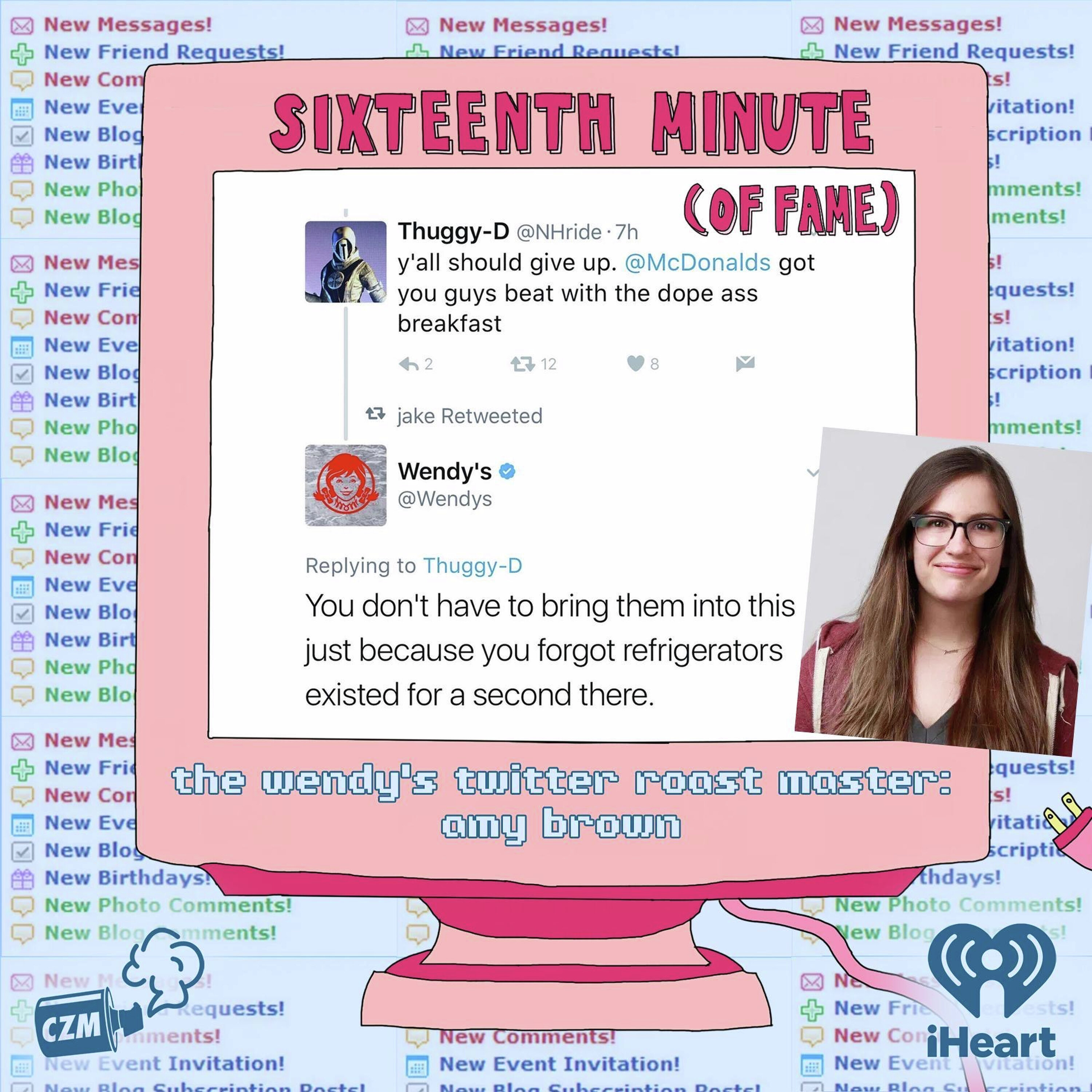
Okay? Wendy's has this thing about its beef being fresh, not frozen. Apparently, in the world of big hamburger, every distinguishing factor counts. A few days ago, Wendy's tweeted a reminder of its long standing policy on its meat, and I quote, our beef is way too cool to ever be frozen. Smiling emoji with sunglasses, totally innocuous tweet, right? It's like the kind of tweet no one could possibly have a problem with, right? But of course, somewhere out there, someone was having the kind of day that made them say to themselves, I believe I shall now spend a sizable hunk of time arguing with the social media account of a fast food company that someone's name is Thuggie D. An exquisite Twitter exchange happened between Wendy's and said Thuggy D. Tonight, I will be reading the Wendy's tweet and Frank from our studio crew will be playing the role of Thuggy D. Take it away, Frank.
- [23:40]
Anderson Cooper
Your beef is frozen and we all know it. You'll know we laugh at your slogan fresh never frozen.
- [23:46]
Dave
Right? Like you're really a joke.
- [23:49]
H
I like that last line, to which Wendy's replied, sorry to hear you think that, but you're wrong. We've only ever used fresh beef since we were founded in 1969.
- [23:58]
Dave
So you deliver it raw on a hot truck.
- [24:03]
H
Let me pause here, because you have to admit that is an interesting question that Thuggy deposes. And this is where Wendy's gets a little frosty and responds, and I quote, where do you store cold things that aren't frozen? Ah, yes, a riddle. But how will Thuggy D respond?
- [24:19]
Dave
Y'all should give up.
- [24:20]
Anderson Cooper
McDonald's got you guys beat with that.
- [24:22]
H
Dope ass breakfast and Wendy's brings down the hammer with you don't have to bring them into this just because you forgot refrigerators existed for a second there. Boom. Thank you, Frank. That was excellent. Excellent read.
- [24:37]
Amy Brown
I actually really, really love this clip, and it does remind me of how desperate people were to feel normal about anything in January 2017. If only they knew. In any case, Amy Brown struck again with the Wendy's account that March, getting over 130,000 likes on Twitter for the following interaction with McDonald's, as performed by me and my fiance, McDonald's says, attached to a picture of a steaming Quarter Pounder. Today we've announced that by mid-2018, all quarter pounder burgers at the majority of our restaurant will be cooked with fresh beef.
- [25:15]
Nathan Olabak
Wendy's replies, so you'll still use frozen beef in most of your burgers in all of your restaurants. Asking for a friend.
- [25:25]
Amy Brown
She got him. McDonald's is he him to me? And this also got a ton of mainstream media coverage. And for a few glorious minutes for social media managers, it was actually cool to be a brand on Twitter. They were so cool, in fact, that the Wendy's social media team that Amy Brown was a part of did a Reddit AMA at the end of 2017, where most of the commenters either congratulated the brand on being the only one funny enough to follow, or were curious how the tweets had translated to actual business quoth Wendy's in response.
- [26:02]
Nathan Olabak
It can be hard to track impressions, engagements, brand metrics, other marketing mumbo jumbo. People are talking about us a lot, so that helps.
- [26:11]
Amy Brown
And it's not a stretch to say that the success of the account run primarily by Amy Brown throughout its peak had a big effect on how other brands managed their stuff. Oh, this is how you get on the news. Let's do that. But now things escalated. It wasn't just unrelated, not competing brands talking to each other. Amy's success meant that direct competitors were constantly flaming each other on Twitter at this time. MoonPies vs Hostess DiGiorno vs Papa John. The list goes on. Isn't it weird that this is my job? Anyways, you might remember Netflix firing off this one to the tune of over 300,000 likes to the 53 people who've.
- [26:55]
Nathan Olabak
Watched a Christmas Prince every day for the last 18 days. Who hurt you?
- [27:01]
Amy Brown
Some brands took the tack of flirtation, which would get very popular in the years to come. And yes, this is Duolingo pissbird foreshadowing. Other brands tried to foster friendships with fellow brands, but as has been true in the media since time immemorial, the best and most successful approach was always aggression. And nothing bears that out more than Amy Brown's work. Because the Wendy's tweets were pretty good, here are some of the more successful ones so this interaction is spurred by Dunkin. There is a picture of a Dunks representative in front of a Wendy's wearing a pink sprinkled donut costume, holding a tweet that's printed out from Dunkin that says, listen to the life size donut. You don't have to settle for spicy nuggets. Dunkin Spicyside the post says, here's some advice about spice. It's always better on a donut, like the spicy Ghost pepper donut.
- [28:05]
Nathan Olabak
Dunkin Spicyside Wendy's quote tweets and writes, stick to pushing the food. That's so good you took it out of your name. My grandma has more heat in her roasts. Lol. Hope they'll still take your return at Spirit Halloween after the stink of this tweak gets on your costume.
- [28:22]
Amy Brown
Okay, play the horns. Here is Wendy's fighting with a random guy. Random user Louis tweets to Wendy's, you know Burger King also has spicy chicken nuggets.
- [28:35]
Nathan Olabak
Wendy's replies, yeah, and there's also water in the bottom of the dumpster out back if you're thirsty.
- [28:42]
Amy Brown
And I remember this one. Another interaction with just a normal person. Random user Jordz tweets to Wendy's, if you reply, I will buy the whole Wendy's menu right now.
- [28:54]
Nathan Olabak
Wendy's replies prove it.
- [28:58]
Amy Brown
George is ready to play ball and returns with a photo of a full trash bag saying, here's your proof.
- [29:06]
Nathan Olabak
Wendy's in Short Order Replies thanks for sharing your baby pictures.
- [29:12]
Amy Brown
Work from the Wendy's account was so influential that in the years to come, communities like our fellow kids and brand parody accounts like Brand Saying BAE actually became less popular, Alabak explains in his piece. And what this says about the world is somewhat unclear. But this account and Amy's work did ostensibly change the game permanently. And so when we come back, Amy Brown of the Aggro Wendy's Twitter account.
- [29:48]
Jamie Loftus
Does this podcast make you happy? Of course it does. That's why you're here. But it only comes out once a week for happiness. Every night. You need Adam and Eve.
- [29:58]
Amy Brown
Yes.
- [29:58]
Jamie Loftus
I'm talking about sex toys. It's cool. It's cool. You have earbuds in right Adam and Eve, America's most trusted source for adult products, has been making people very happy for over 50 years with thousands of toys for both men and women. Just go to AdamAndEve.com now and enter code IHEART for 50% off. Almost any one item plus free discreet shipping. That's AdamAndEve.com code IHEART for 50% Off.
- [30:27]
Ryan Seacrest
Legends, the greatest social casino and sportsbook experience has arrived@legends.com with thousands of the best free to play casino style games, chances to earn millions of bonus coins and win real money. Legends is revolution, the Vegas experience wherever you are. If you love winning, then you'll love playing at L E G e n d z.com Legends is a free to play social casino void. We're prohibited. Play responsibly. Visit legends.com for more information. Legends with a Z.com is legendary fun.
- [30:56]
Dave
Hi, this is Jevon, your blinds.com design consultant. Oh wow, a real person. Yep. I'm here to help with everything from selecting the perfect window treatments to wow. Mm. I've got a complicated project. No problem. We make the complex simple. I can even help schedule a professional measuring install. I didn't realize you did that. We can also send you samples fast and free.
- [31:17]
Amy Brown
Wow.
- [31:18]
Dave
I mean, I always thought I needed.
- [31:20]
Amy Brown
A designer to come to my home.
- [31:22]
Dave
But scheduling's always a Nightmare. Not with blinds.com, we're on your schedule and there's no haggling pressure or hidden fees either. Hmm. I just might have to do more. Whatever you need. How about you tell me what you had in mind? Okay then.
- [31:37]
Amy Brown
So the first we're looking at is for guests coming over, and I'm thinking of something blinds.com has covered over 25 million windows, all backed by a 100% satisfaction guarantee.
- [31:47]
Jamie Loftus
Shopblinds.com now and save up to 45%.
- [31:50]
Amy Brown
Site wide rules and restrictions may apply.
- [31:55]
Christopher Allen
Hey, it's Ryan Seacrest for Albertsons and Safeway. It's stock up savings time now through March 25th. Spring in for storewide deals and earn four times the points. Look for in store tags to earn on eligible beverage items from San Pellegrino and Pepsi or breakfast favorites like Chobani, Greek Yogurt, Dan and Oikos yogurt and Pete's Coffee plus many more. Then clip the offer in our app for automatic event long savings. Stack up those rewards to save even more restrictions apply. Visit Albertsons or Safeway.com for more details.
- [32:35]
Amy Brown
Welcome back to 16th Minute. Can someone please link me to an Etsy store that can make a custom urn My dad has been sitting in a suitcase for months and we're back with more on the sentient brand era of social media. I just want to add one last thing before we jump into our chat with Amy the Silence Brand meme, something that I kind of associate with Gen X and elder Millennials, and it was essentially an attempt to push back on this brand interaction of the2010. Silence brand means, quite literally, that it's a meme that people use to reply to any brand account like the ones we're talking about. They usually are bad Photoshops featuring movie monsters with lasers shooting out of their eyes. Silence Brand. You get it. You'd use these when a Wendy's tried to cheekily insert themselves into an unrelated conversation, usually by name, searching the name of their company. And unfortunately, this meme evolved from a really depressing conservative one called Silence Liberal, used in a similar way to own the snowflakes or whatever. And who did these geniuses have lasers coming out of their eyes? Famous dictators, of course. But I've noticed as time goes on, young millennials don't seem to have the same qualms with being parasocially advertised to if that meant that they could talk to a funny stack of pancakes on the Internet, a trend that by the time Gen Z and Gen Alpha were on, social media would become increasingly more normalized. Probably not a good thing, but what can you do? We're all going to be underwater in 30 years. This week we're talking to another heavy hitter, and for my money, arguably the only writer who got big enough outside the account to be recognizable to the extremely logged in. Amy Brown and I are longtime mutuals, and I honestly didn't even know she ran the Wendy's account until I started to work on this series. To me, she was a great joke writer who I'd followed a long time ago on Twitter under her personal account and then later on bluesky due to the Nazi problem. But indeed, Amy's was not just the voice of the Wendy's account at its peak. She also got a fair amount of press for having done so. Press I know she would want me to reassure you because she's very normal and not an attention freak, that she wasn't really seeking out. People just wanted to know who was behind this account they liked so much.
- [35:09]
Nathan Olabak
Behold the SaaS master behind Wendy's.
- [35:11]
Ryan Seacrest
Twitter.
- [35:12]
Amy Brown
Twitter read a Mashable headline in early 2017, doing something that might have seemed counterproductive to the brand, revealing the person behind it. But even if Wendy's were opposed to it, the knowledge that there was someone just like you posting up a storm professionally really seemed to only strengthen the brand, which has continued with the same narrative voice after Amy's departure with a lot of success. So let's hear the story from her side. I give you Amy Brown.
- [35:41]
Dave
So my name is Amy Brown. I am maybe best known as the social media manager at Wendy's from 2012 to 2017. I'm currently a freelance writer and social media strategist trying to pivot out of social. We can probably touch on that. But yeah, I live in Berkeley, California, with my husband and my kids and our very old dog, Heather.
- [36:04]
Amy Brown
I'm curious a little bit more about you, your background. Where did you grow up? How did you grow up?
- [36:09]
Dave
So I grew up in a place called Pickwick, Ohio, which is about half an hour outside of Dayton, Ohio, which is probably still not a helpful geographic reference if you're not from Ohio. But basically I am from a rural area half an hour outside a very small city. So my world growing up was pretty small. Like, I literally, my backyard was a corn field and a soybean field. So I spent a lot of time on the Internet. We got a computer at my house, like pre Y2K. And yeah, I just, I took to it. I spent a lot of time on the Internet. I was always the. I was the nerd in growing up, my high school classmates actually voted me biggest nerd in the senior polls. My pictures in the yearbook and everything. Not always the easiest to be the smart kid. So I spent a lot of time on the computer seeking out, I don't know, music and just people to tell me that there's life after high school and all that kind of stuff. And I've also always been a writer, so that's the other piece of it. I've always been extremely online and always been a writer. Went to journalism school. I graduated with a degree in newspaper journalism in 2011, which is not a great time to be graduating with a degree in newspaper journalism. So I pivoted into marketing and after a stint in like copywriting, I ended up at Wendy's just because I knew a lot about social media and I kind of threw myself out there. And yeah, now I've been working at it for a really long time.
- [37:27]
Amy Brown
I do believe that some of our best writers and artists today were very online indoor kids. What were your early memories of the Internet? What got you hooked?
- [37:39]
Dave
As I say, my earliest memory of the Internet is actually I was on like a pen pal website my mom found when I was like 9 or 10 years old. It was like something my mom had like vetted and felt was safe. And I made friends with this girl named Catherine in Scotland and it just like we were like besties. I have no idea what happened to her. We lost touch when I was like a teenager. I hope she's doing well. But yeah, I really like. It was just like I met a friend who was like minded. Like I had friends at school, but she was the first person I felt like really got me. From there it was like I got my foot in the door on diary land, which was like an early live journal. I had a regular diary and a poetry diary for my like 11 year old. Poetry. And then yeah, from there like LiveJournal Zanga. I was very early on like the MySpace train. That's where I started.
- [38:26]
Amy Brown
I was really into Post Secret. Remember that?
- [38:29]
Dave
I loved Post Secret. I actually, I have a postcard in the first Post Secret book.
- [38:34]
Amy Brown
When I was cleaning up my childhood home last year, I found a postcard that I made and was too afraid to send to them about having a crush on a boy who is 8 inches shorter than me in high school. And I like made a whole visual and I'm like, probably for the best that I didn't send it in, but I remember the feeling of making it.
- [38:54]
Dave
Yeah, I remember reading Post Secret in like the, on a computer at the library and being like, oh my God, this, this is revolutionary. But yeah, it was definitely a lot of like seeking community and just like like minded people. I guess people started becoming famous on the Internet while I was still in high school. Like Tila Tequila is probably the first one I can think of, right. And I definitely didn't aspire to fame in that kind of way. Not Like a reality TV way. But I did always, I always kind of thought it would be like a, like a cool thing to get out of my hometown and be like, yeah, be someone notable and then be like haha, suckers. I don't know. But yeah, I always like there was a, there was a phase where I like, I thought I was gon be an actor and so I do. I think there was kind of a through line of like attention or like external validation. I mean I think I've always been like a very high achieving person, like self driven. So I think I kind of saw like, like fame as like the ultimate, the ultimate thing you can achieve to show that you've like been successful at whatever it is you're doing. I was pretty shy. I'm still pretty shy. And so my way of introducing myself to people would be like, to connect with them on MySpace first. And it turned into a like by the time I was like a junior or senior in high school, I would run into people at the mall and they'd be like, you're Amy from MySpace. And so like that.
- [40:08]
Amy Brown
Oh my God. Okay, wait, tell me more about that because that is an experience I, I definitely never had.
- [40:16]
Dave
I was very much like not cool at high school, but then like to, to people in this other space that I inhabited, I was like a person. And I didn't necessarily feel like I was being anyone else either. I just kind of like put out my interests. I actually I found like a, like an old Screenshot of my MySpace profile the other day. And under famous movie, under favorite movies, it's like every movie I'd ever seen in my life. Right. It's just like here's every band I've ever listened to, but just really trying to like put myself out there and find people to like connect with and a little bit of, a little bit of posturing for sure. Yeah. I would say that was my first brush with like using, using the Internet as like an extension, I don't know, as an introvert. It sometimes is like an extension of my internal monologue. It's like things I can't say out loud I can like put on Twitter or MySpace. So yeah, I think that was really my first, my first experience with that.
- [41:06]
Amy Brown
What was your feeling when you were going into school? What was the goal?
- [41:11]
Dave
Oh yeah, so I thought I was going to be like girl investigative reporter. I was going to be like investigating corruption in the newspaper, which is like not even really a thing the newspapers do anymore. An investigative reporter uncovering corruption and like doing Doing good stuff. I took my journalism classes. I branched out into like some creative writing classes. I graduated in 2011, so only it wasn't until my senior year that we even touched on like blogging and online because it seemed like, oh, maybe that'll be a thing. So I took like a, I took like an independent study course where I got to make my own blog, which was basically the most preparation I got in a formal sense for like social media and the Internet and stuff. I graduated and took an internship in social media because I could not find a job. I applied for like a hundred jobs after I graduated and ended in like a paid internship doing social media in 2011, which was like pretty sleepy. In 2011. My experience was very much like, it was like, just like we feel like we should have social media accounts. We don't know what to say. And also we need, we want to make sure that like nobody's saying bad stuff about us. Which like, they weren't because I was working for a like a very small division of McGraw Hill that like I don't think anyone had ever heard of. It's like they make standardized tests and stuff.
- [42:23]
Amy Brown
The approach to social media at that time was like, more we need to do this and like more self conscious than we're going to forward our brand.
- [42:32]
Dave
By doing this, I established the accounts. They got set up with like a social media monitoring software, a very early iteration of it. It was extremely clunky but like, so they wanted to know what people were saying about them and also some competitors. But it was kind of this weird spot at the beginning where it's like, what do we even, like what do you say? Or like even who's the audience, right? Like who is the audience for a Twitter account for like a testing company? And I don't know that we actually got that answer while I was there because again, I was only there two months.
- [42:59]
Amy Brown
Where do you go from there?
- [43:02]
Dave
So my first two full time gigs were as like a, a copywriter at small marketing agencies. Mostly like blog posts with SEO keywords in them, right? Like, and then I'd also just like website copy for like municipal governments and stuff. Like I, I wrote some stuff for like the city of New Albany, Ohio, like kind of smaller stuff that my name's not on. And mostly writing as opposed to social media. I'm living in Columbus, Ohio at the time because I went to school in Ohio and that's where Wendy's is headquartered. And in about 2012 I noticed that they have posted for a social media manager. They've got a job opening. And I just. I had thoughts. I was like, I bet I could do this. I bet I'd be great at this. So I applied kind of on a.
- [43:42]
Amy Brown
Whim, pretty much fresh out of college when you started this job.
- [43:45]
Dave
I was 23 when they hired me at Wendy's. Yeah.
- [43:48]
Amy Brown
Do you recall what their social media was like at the time you entered the position?
- [43:53]
Dave
Oh, man. I do remember what Wendy's social media was like in 2012, because I went into that interview room so confident, and I was like, here's everything I want to know about what you're doing right now. Like, they had. I had, like, followed them on Pinterest and they were like, we're going to do a cool thing that looks good. But then it was like just the longest image ever. I was like, you're doing stuff that's really annoying to me as a user. Which, looking back, I just, I walked in, like, I was just like, yeah, I can do this. And for. For some reason that, like, went well, but I can imagine it going, like, plenty of other ways. But, yeah, it was like, come to Wendy's and buy a Frosty. They were doing, like, Photoshopped pictures of a cartoon Frosty doing stuff which, like, I think could have had legs, but, like, wasn't really dry. Frosty had its own Facebook page. It was very Facebook centric at that time, right? Like Facebook and a little bit of Twitter. They had an Instagram account that someone was clearly just like, taking pictures on their iPhone and uploading. I remember when I started, there were 37,000 followers on the Twitter account, which felt like a lot of the time, but obviously these days isn't really that much. They were working with, like, an. An ad agency based out of New York on all of this stuff. And I was the first social media person internally. I got hired by the director of digital, who went on to be like a really great mentor to me of.
- [45:09]
Amy Brown
The sort of Mount Rushmore of iconic brand accounts. You're pretty early to it. When you were starting this job, were there any accounts specifically that you're like, oh, like, this is an account that I think is doing it well.
- [45:24]
Dave
It was Taco Bell. It was. Taco Bell was like Buzzfeed would put out these lists because it was like the heyday of Buzzfeed too, right? And they'd be like 25 times. The taco Bell Twitter account was all of us. And I was like, I can do that for Wendy's. I can make the Wendy's account. All of Us. I don't know how we're going to get there, but yeah, I, like, I saw that and I was just like, we, we could do that. Like, I could do that. They were like the blueprint. To me, it was that. And it was not Starbucks social, but like Starbucks was such a big deal back then. It was like, it like, like, like a lifestyle brand almost. And so that's what I was always talking about is like, we're going to be cool like Taco Bell, but also like we want people to feel proud that they're holding a Wendy's cup, especially around this.
- [46:02]
Amy Brown
I mean, I don't, I guess, I don't know because I'm no longer 23, but when I was going in for similar jobs at the same age, I was like, with the same level of confidence. And I felt like what worked to my advantage was that the people who were interviewing me didn't understand how the Internet worked. They weren't Internet natives. And so I think they were sort of like, yeah, sure, great, try it out.
- [46:24]
Dave
Actually, so, funny story. They. My boss, after they hired me, he told me I was the least experienced candidate they interviewed. And that what really put it over the edge is that at the time I had, I had like 200 followers on my personal Twitter or something. But I put my personal Twitter handle on my resume. And the hiring manager went to my Twitter and he said, what set you apart is that you had like an actual personality. And like we're looking for someone to have an actual personality, like behind the brand. And he's like, all the, all these other people were clearly trying to like build a personal brand, right? They're like, they're posting like, here is my take on xyz. Like I kind of shit posted my way into the job, which, which is also very funny.
- [47:00]
Amy Brown
And they told you in school you couldn't do it.
- [47:02]
Dave
I know.
- [47:03]
Amy Brown
Are you working strictly alone? Are you sort of. Are you pitching stuff to your bosses? Are you pitching arcs for the Twitter account? How does the day to day work in terms of strategizing for an account at that time?
- [47:15]
Dave
So when I came on at Wendy's, they also were bringing on a new ad agency at. Right around the same time. And so that was really. I was the entire internal team. And then everything else was these guys at vml, they're based in Kansas City, they're like a big deal now largely because of the Wendy's work, which is pretty cool for them. I would not have been able to do anything I did without that support. But yeah, it's like copywriters and strategists and art directors and so the way it worked when I started was I was responsible completely for community management, which is when you reply to someone. So all of it, like the funny stuff, the customer service stuff, all of it. And then our agency worked on. First we worked on like revamping a strategy and like, what does the brand sound like? And they. They sort of. They would take a first pass at it and then bring it to us, which was me and my boss at the time. And I had sort of a lot of latitude to give feedback, be like, this is or isn't how. How we should be proceeding. And then. Yeah, on the day to day they were creating posts and copy. And then a lot of. A lot of my job was running that up the Wendy's side for approvals. So, like, there are brand managers who want. Who want to make the. Make sure the product looks right and like legal want size on everything. I often did a lot of the behind the scenes, like internal corporate stuff and not so much the. Like the actual tweets and Facebook posts were always our agency. But I helped with the strategy and then the community management was me for the first couple of years. And then eventually my role expanded. We added another person to the team internally. We handed off community management largely to a guy at our agency who did it up until I think like last year. He was there for a really long time.
- [48:56]
Amy Brown
So it is like a pretty large. Yes, collaborative operation.
- [48:59]
Dave
I was gonna say. That's actually something I've always kind of felt bad about in the coverage is that they always want to be like, this is the person. And like, you can. You can tell people that it's like me and a whole bunch of other people. But obviously the end product is whatever like the writer wants it to be. Right. So I don't know. That's not always a compelling piece of the story to be like. I had lots of help, but I had lots of help.
- [49:21]
Amy Brown
Well, thankfully, I'm not interested in a compelling story. A lot of the original pieces about either the Wendy's account or you specifically, it was either like the points of view that it landed on felt very black and white. Like you are being duped by a brand by relating to the brand. Or it's just this one person, but. But it seems like it. There is like gray area in there where it's like there's multiple people. There is a plan.
- [49:48]
Dave
Yeah.
- [49:48]
Amy Brown
What was the goal of these accounts when you were starting? And as time went on what was the goal of engagement and what were you building towards?
- [49:57]
Dave
Yeah, I mean, obviously we wanted everyone to know about like the latest cheeseburger and stuff.
- [50:02]
Amy Brown
Right.
- [50:02]
Dave
But when I, when I showed up at Wendy's, they were in the middle of, of like a massive corporate rebrand. So like, you might remember the old Wendy's logo that literally said like old fashioned hamburgers on it, which was something they really, they were like, we, we, we want to shed the old fashioned perception. Right. So they, they redid the logo, which is the one that's now just like Wendy. And they were sort of, they started, they started redo, like making all the restaurants fancy. Like, I'm sure you've been to a renovated Wendy's. So that was all happening right around the time I showed up. And it was very much, it very much played hand in hand with the social strategy, which was to kind of make people think of Wendy's as not just like a place where senior citizens get chili, which is something I saw online a lot. I would see people be like, my grandma likes Wendy's. Who eats Wendy's? And so I think that was a big. But then there's always like individual marketing goals. Like, we were always supporting like campaigns for the latest thing. Because in fast food there's, it's just like a parade of limited time items. Like that's, that's the entire model. So new limited time item, new bunch of posts. But then also doing something called always on, which is just like reminding people that Wendy's exists. And yeah, with the goal of like ultimately driving people to a Wendy's or even just like getting them to think more positively about Wendy's in general. So like, maybe the next time like, like bumping Wendy's up from I will never eat there to like, oh yeah, I would consider having that for dinner because it's really hard to like draw a direct line from a tweet to a purchase unless someone's like, I bought this hamburger because of this tweet. So a lot of it was around like the brand sentiment and like, maybe not awareness because like most people have heard of Wendy's, but like changing how you think of Wendy's. The, the whole brand's jumping on trending stuff, which you didn't ask for a history lesson, but I'm going to give you one anyway, which is I will.
- [51:45]
Amy Brown
Take.
- [51:47]
Dave
Was not really a thing until suddenly it was. I feel I forget which super bowl it was, but it was the one where all the lights went out and Oreo made this tweet they were like, you can still dunk in the dark. And that was like an iconic case study in social media for, like, ever. It was like if you go to a conference and someone's talking about the dunk in the dark tweet, you've like got a bingo on your. On your bingo board. Right? Wow. Okay. So I think this really, they got like a ton of attention for it and I think it really started this idea that like, oh, brands can jump in and talk about anything. So we, we tried that a little bit around, like Super Bowls a lot of the time and often it was a thing where it's. We've got pre approved things to say for like this scenario and that scenario and a little bit of like having fun in the, in the comments with community management. I will say, I think a place we kind of landed as a company was suddenly there were something every brand was trying to make like the Oscars or the Grammys or the super bowl relevant. And it's like if everyone's talking at once, nobody's really like. We actually kind of pulled back a little bit from that kind of stuff because it's like, how do you even, how do you even break through something.
- [52:50]
Amy Brown
That noisy because you're a part of it Seems like, and correct me, but like this sort of wave of brands developing very specific editorial voices. When did that start? What was that? Was it a mistake? Was it planned? What? What was that?
- [53:08]
Dave
Yeah. So I will say for Wendy's, I think that really started like a year before the roast thing blew up. We had like another viral incident where we were kind of poking fun at Burger King. And I actually, I will admit I went a little bit rogue expecting that nobody would see it, but we had sort of. So Wendy's comes out with the 4 for 4 and then Burger King comes out with the 5 for 4. Like a week or two later. It's like the exact same thing as the four for four plus a cookie. Internally, we are all pissed off and we're like, what do we do about this? And everyone decides we're not gonna do anything. We're not gonna, like, bring more attention to the 5 for 4. But then people start tweeting at us about the 5 for 4. And I remember I'm like in a meeting and I just like, I dash off a reply about it to someone making fun of Burger King. I believe, I believe they asked what we had that Burger King doesn't. And I said, edible food. And that was like the whole tweet. And yeah, I got out of that meeting and it was going bananas, and I was like, I'm fired. Because we agreed we weren't going to do this, and I did it anyway.
- [54:02]
Amy Brown
But it worked.
- [54:03]
Dave
I'm assuming it worked. I don't remember anyone being mad at me, though. I'm sure. Yeah. Like, I. I feel like they were probably a little miffed at the beginning when. When they were like, I thought we weren't going to talk about this. What are you doing? But, yeah, I kind of just like, I was like, oh, people are asking us to say something. Like, they're expecting us to say something now. Which was not the case when we made this decision. But, yeah, I will say I'm very lucky in that regard that my boss was kind of like, that's funny. And not like, oh, my God, you didn't listen to me.
- [54:29]
Amy Brown
You were making really effective marketing choices that I'm sure would have been completely anathema to a lot of marketing elders at the time. Do you have any specific memories of how those discussions went or.
- [54:42]
Dave
Yeah, I think my favorite example is. So when we did go, like, mega viral with the roast, like the one that Anderson Cooper read. Right. In 2017, I remember at work the next day having to explain exactly what happened and what it meant. Like, our head of marketing didn't have a Twitter account, so he was like. He also didn't understand. He was like, I didn't review or approve this. Like, where did you get permission to do this? And I was like, well, community management is just a thing we always do. We're always replying to people. I think they did not realize that on our end, we were. I think the idea that there wasn't an approval process for those reply tweets really scared some people. Yeah, we actually. We ended up having to bring in our ad reps from Twitter to, like, explain why this was good, because there was definitely. The vibe was a little weird. Yeah, my boss was very excited, but, like, yeah, his boss was, like, not sure what was happening.
- [55:36]
Amy Brown
So let's talk about the roast. For the uninitiated, how did the roast come about? It was 2017.
- [55:43]
Dave
Right, 2017. Early January 2017. I actually, I remember a lot about the day because it was just like, such a. Such a nothing of a day until suddenly it was like, the day. But so it's. It's January 3, 2017, and the office is still closed, but we are technically launching a new brand campaign. So I'm like, I'm in my pajamas. I'm working from home on the couch things are slow, though, because it's like the first day after the new year. And the new campaign is all about fresh, never frozen beef. Because that's Wendy's big differentiator with the hamburgers. It's like the meat's never frozen. So we have some sponsored tweet out about how the meat's fresh, never frozen. And the sponsored tweets are always where people are getting a little, like, getting a little feisty with you because they're not following you. So they're like, why am I seeing this Wendy's stuff? Like, I don't want this. So this guy comes in and he's like, you're lying. It's frozen. And I kind of. At first, I gently pushed back. I'm like, I'm sorry. You think that I think is what I said. Like, like, very corporate. Like, you're wrong. It's always been fresh, never frozen since 1969. Yeah. And so this guy really laid it up for me, though. He really just, like, he set me up so well. And he said, you mean you want me to believe you deliver it raw on a hot truck? And I was just like. And so I remember, I sort of. I answered him with a question. I said, where do you store cold things that aren't frozen? And I think that made this guy a little bit upset because he sort of went like, McDonald's is better than you anyway. And I said, I. The final nail in the coffin. I told him he didn't have to bring McDonald's into this just because he forgot that refrigerators exist, existed. And the crowd went wild. Literally, the next day, Anderson Cooper and one of his staff, they were like, they acted out the tweets on Anderson Cooper360 on CNN, which I'm sure Wendy's was thrilled about. They were thrilled when we were able to quantify it for them in the language that marketing people care about. So when we were able to be like, we got X amount of media impressions, which is valued at like, X number of dollars, suddenly they were like, okay, yes, we see the value. But when it was like, I made a funny tweet, and it's on Anderson Cooper, they were kind of like, okay.
- [57:54]
Amy Brown
Were people tracking you down? Were people sending you weird messages? What. What was the personal. You know, what were you taking home with you?
- [58:01]
Dave
Yeah, so my fatal misstep was giving an interview about it. The week that it happened, someone from Mashable reached out, and I give this interview, and, like, my boss is in the room, PR is in the Room. It's a very tame inter. Interview, but the piece comes out and it's all about me, right? It's like, it's about. Here's Amy Brown. They call me the sass master in the headline, right? And then, like, there's like a. They're talking about how my mom is proud of me, right? And it's just like. It's this. It's like a profile piece that I wasn't expecting. And so that gets me pegged forever as the lady who did it, right? Because there's. And so it did. It got very weird. Yeah. People. My. My social accounts were not private at the time. They. They quickly became private. But, like. Like, there was a. Also being a young woman made it weird. Like, there was a. I stumbled. I. I used to Google myself. I don't really anymore, but I used to just see what was going on. And there was like, a conversation on a message board that was like, would you bang the Wendy's Twitter lady? And I remember these guys were like. They had, like, scoured my Instagram photos, and they were like, well, I think maybe she has weird teeth because she never smiles with her mouth open. Just like that, level up. And like, yeah, there were. I. I'm Jewish, and some people figured that out. So there were, like, groipers in my DMs being like, I'll save you when they come for the Jews. Like, literally saying shit like this to me. Oh, my God, Ex boyfriends popped back up. They were like, hey, can I tell people I used to date the Wendy's Twitter lady? And it's like, if you want.
- [59:26]
Amy Brown
Like, I mean, I feel like it's even the rare case where it's even weirder to ask for permission than to simply just do it. Because it's true there.
- [59:35]
Dave
It's like, I guess, if you're interested in that. Also, one guy, a guy who dumped me, went on Twitter and was like, you guys are all celebrating the Wendy's Twitter lady, but she's like a bipolar alcoholic and a bad person. It's like, Jesus Christ. No. Oh, my. Dated for like a month. He dumped me. And I was just like, I didn't even know you were mad at me. Like, what is going on?
- [59:57]
Amy Brown
And what a way to find out in a way that professionally implicates you as well.
- [60:01]
Dave
Honestly, it kind of like, ruined my brain for a couple of years. I just like. Like, I would wake up and I'd be like. I would wake up with, like, a sense of dread being like, what is happening on my Twitter account, what happened there while I slept? Because, like, I'd wake up occasionally and there'd be a guy in my DMs being like, is this your address? And it is my address. And it's like, gee. Like, which, like, I. When that happened, I got, like, real paranoid, though. I never, like, nobody ever came to my house or anything. But it's just the idea that someone has that information and they did that on. They did that for that reason.
- [60:33]
Amy Brown
But I'm assuming just based on having had similar jobs, that you're not compensated to a level that you can really, like, protect yourself.
- [60:41]
Dave
It's such a funny misconception. Sometimes when I talk about the Wendy stuff, people assume I must be like, rich. They're like, oh, you did that Wendy's thing. You made a lot of money. And it's like, no, the shareholder, like, the shareholders made a lot of money. Like, the chairman of the board made a billion dollars. Right? It's like, I. I made five figures. But, yeah, I definitely. The mental health piece was really, really tough, honestly. And there is. There's backstory, too. I actually, I. So I've had depression my whole life. Anxiety, too. And actually, the. In 2016, the summer of 2016, I took a leave of absence from work to do an intensive outpatient mental health program for depression. And I had just come back to. I had come back to work in October, and then all the roast stuff happened in January. So I was still, like, trying to find my footing.
- [61:28]
Amy Brown
Still, like, also a very normal election cycle in the middle of that, too. That's nuts.
- [61:35]
Dave
Yeah, it was a. Yeah. When I look back at it, I can't believe that all happened in, like, a year. But, yeah, so I'm still trying to find my footing. I, like. And I was, like, very. I was, like, vocal about why I was taking leave, too, because I'm like. I'm like, oh, we're going to break the stigma. Like, depression is okay. I'm going to tell everyone I have depression and it's going to be fine. And, like, it was not. Not fine. People were weird. People were uncomfortable.
- [61:56]
Amy Brown
There was a brief period of years in the mid 2010s where I genuinely believed that, like, being very straightforward and honest, like, it was like, oh, it's not that there's a systemic problem. It's that, like, I must not be articulating.
- [62:09]
Dave
It's like, no, I just need to talk louder about having depression, and everyone will understand.
- [62:14]
Amy Brown
We'll be right back with more Amy Brown.
- [62:21]
Jamie Loftus
Does this podcast make you happy? Of course it does. That's why you're here. But it only comes out once a week for happiness. Every night. You need Adam and Eve. Yes, I'm talking about sex toys. It's cool. It's cool. You have earbuds in right? Adam and Eve, America's most trusted source for adult products, has been making people very happy for over 50 years with thousands of toys for both men and women. Just go to AdamAndEve.com now and enter code IHEART for 50% off almost any one item plus free discreet shipping. That's AdamAndEve.com code IHEART for 50% OFF.
- [63:00]
Ryan Seacrest
Legends, the greatest social casino and sportsbook experience has arrived@legends.com with thousands of the best free to play casino style games, chances to earn millions of bonus coins and win real money leg Legends is revolutionizing the Vegas experience wherever you are. If you love winning, then you'll love playing at L E G-E-N-D Z.com Legends is a free to play social casino void we're prohibited. Play responsibly visit legends.com for more information. Legends with a Z.com is legendary fun.
- [63:28]
Christopher Allen
Hey, it's Ryan Seacrest For Albertsons and Safeway, it's stock up savings time now through March 25th. Spring in for storewide deals and earn four times the points. Look for in store tags to earn on eligible beverage items from San Pellegrino and Pepsi or breakfast favorites like Chobani, Greek Yogurt, Dan and Oikos Yogurt and Pete's Coffee plus many more. Then clip the offer in our app for automatic event long savings. Stack up those rewards to save even more restrictions apply. Visit Albertsons or Safeway.com for more details.
- [63:58]
Dave
Dreaming of hydrated skin amidst these dry winter months? Daim offers clean, master esthetician crafted skin care products that deeply nourish, protect and hydrate. Their formulas, made with clean ingredients, lock in moisture for skin that stays soft, smooth and radiant all season. Long. Hydration starts with Dime's best selling Hyaluronic Acid serum, delivering deep moisture where your skin craves it most. This lightweight, fast absorbing serum helps quench dryness, plump skin and boost elasticity from the inside out. Once your skin is prepped with the serum, seal in all that hydration with their Dewy Day Cream, a rich, luxurious moisturizer designed to provide all day softness and lasting glow. Together, this powerful duo keeps your skin smooth, supple and luminous even in the harshest weather. Shop the duo now@dimebeautyco.com that's dimebeauty co.com and get the hydrated skin of your dreams. Foreign.
- [65:08]
Amy Brown
Welcome back to 16th minute. My mother literally got kidnapped at the Austin airport this week. She's fine now, but. Oh, my God. Here's the rest of my interview with Amy Brown.
- [65:20]
Dave
In the wake of the. Of the big tweet, right? We sort of. We decide. We're like, well, we gotta lean into this, right? Like, we. We don't know that when this will die down, so let's try to ride it out. But it got to a point where it was. It was me, our other person in house named Meredith, and our community manager at the agency named Matt. And we were literally, like, taking shifts on the Twitter account just trying to reply to, like, as many people as possible. We're like, we can't let it die. And, yeah, I definitely am. I mean, social media in general is a really hard gig for people who want to have work, life, balance. You know, it's like, there's no. There's no stop button. And. Yeah, there's the part where it's like. I mean, I think that probably ties back into the groipers in my DMs, right? It's like. It's a. It's a turning point for the Internet where it's like, oh, the Nazis are here and Trump is here, and, like, they're talking to me. And, like. So, yeah, it was definitely. I. Yeah, I actually. I ended up. Wendy's and I ended up mutually parting ways. I like to say it that way. We mutually parted ways in March of that year, like, two months after the big tweet happened, which in turn turned into. There are actually, like, there. There are, like, Reddit threads where people are like, why'd she get fired? And it's like, I didn't get fired for assuming that. Yeah, it's like, actually, I just kind of went nuts and had to, like, step away for a while, you know, and then.
- [66:36]
Amy Brown
This isn't even a particular, like, a stab at Wendy's. I think it's like any corporation you would work for where it's like, oh, that thing worked more of that. And you're like, well, no, that will kill me. Like, oh, we can't. We can't actually do that. I'm glad that you were able to step away. I was curious when. In. When in 2017 you made that call?
- [66:54]
Dave
Yeah, I. In March of that year, and I freelanced for about a year. Like, I really. I. I was in. I was in a position where my name had, like, really been out there. So it was pretty easy for me to just like, pick up some freelance work. Although honestly, I was living. I was living with. Actually, yeah, my. My husband and I got married that year, too. God, so much stuff happened in, like two or three years, but I was kind of just like, sitting around playing video games, like, trying to. Trying to get my brain back to normal, like working maybe 20 hours a week.
- [67:24]
Amy Brown
There is no playbook for the stress that comes with a job like that in the way that someone starting a job like a social media management job or community manager job now would.
- [67:36]
Dave
It was really. It was harder on my nervous system than I think I realized while I was doing it. Just like, I think about it now, right, how the social media platforms are engineered to, like, keep us engaged. And like, I don't know, I feel. It feels very much like. Like a slot machine, right? It's like the. The lights go off and the, like, button lights up and it's like my brain is. My brain is, like activated. And then I, like, I logged off and my brain was, like, very still and quiet and I didn't feel very good. You know, I was like, oh, I don't want to be alone with my thoughts. So there was a lot of that. And yeah, I think a lot of. A lot of fear that, like, oh, my God, this is just like. Because I would take job interviews and they would just want me to. They were like, can you come here and do the Wendy's thing? And it's like, I, no, I don't want to. Like, I don't want my whole career to just be, like, writing sassy tweets. So that was also. I had this fear for a long time that, like, I would just be pigeonholed as this one thing forever. I will say, right? A resource that was very valuable to me. And part of the reason all the social media managers seem to know each other is because we had like a. We had like a private Facebook group back in the day that was just like a bunch of social media managers for brands. And so I remember when the Wendy stuff happened, I was just like, hey, it's me. I feel insane. Like, can anyone help me? And I actually, I still. I have a lot of, like, long standing friendships that came out of that group, which actually no longer exists anymore because, like, online communities grow and die and whatever. But I feel like the group really started to grow and take off, like, right around 2017 when I left. Just because there were a lot of. A lot of people working in social at that time. There were some other smaller groups I was into. I remember. I remember leaving one angrily because someone was, like, talking about the Wendy stuff. They were like, oh, they'll fall flat on their face soon enough. And I was like, I'm right here.
- [69:15]
Amy Brown
That's such a fascinating thing to me. It's like you're being addressed as Wendy's and it is personal to you.
- [69:22]
Dave
That was also. Yeah, it's. It took a long time for me to disentangle my own personality with Wendy's, which was like, it is such a up thing to look back on where it's like, well, if I'm not at Wendy's, who am I? And it's like, any. Anyone. You can be any. You don't have to. But, yeah, I just. Because I think it all goes hand in hand.
- [69:39]
Amy Brown
Right?
- [69:39]
Dave
Like, I was pretty. I was pretty unhappy and I didn't realize it, so I just, like, stayed busy. And my way of staying busy was work. Like, I had a series of, like, shitty boyfriends. And like, that was not fun. So it's like my personal life was whatever, but work was great. Work was so good. Yeah, the work got pulled out from under me and I was like, well, who am I? And, like, I'm in therapy, but, like, my therapist doesn't know what. Like, how do you even talk to a therapist about this? Yeah, I actually. I have a therapist I work with now who I've been talking to. I've been working with her for, like, four years. I didn't even approach the. The Wendy's and online stuff until, like, year three, because she's so offline. And then I had to, like, kind of explain what the Wendy's Twitter stuff was like. She wasn't super familiar. So that was really fun. I was like, yeah, I have trauma because a thing happened to me on the Internet. And she's like, what? Because I remember, like, none of the brand managers at work really understanding what I did until suddenly we went viral and they were like, oh, that's what she does. But, like, in the early days, it was a lot of, like, what do we need? Like, I would. I would run into people at work who are like, oh, yeah, my son has a Facebook. Can he help? And it's like, no, but. So a lot of, like, feeling undervalued, feeling stressed out. A lot of just, like, trying to. Trying to figure out what the heck you're doing. Like, yeah, a lot of commiserating. A lot of, like, no stupid questions. And, yeah, just really getting to, like, getting to meet people who Do. What I did was nice.
- [70:57]
Amy Brown
When you're entering, like, a job that basically hasn't existed until now, and then you're really good at it, how does your identity become entrenched and then how do you, like, untangle that? That sounds like such a bizarre process.
- [71:12]
Dave
No, it really. I. It was like I. I felt, and I know now that this is not the case, but it felt like I finally found the thing I'm good at. It was like, this is the one thing I do, and I do it for Wendy's. And, like, I stood there for such a long time because I really, really liked my boss. But, yeah, I definitely. I had. I had thought about leaving before, you know, just to, like, work somewhere else. It was my first real job out of college. But, yeah, it certainly. Especially after everything started getting big, and I was, like, really proud of the work, too. That. Yeah, I just. I got such a sense of pride. I was like, look, I'm doing it. But, yeah, it was very much like, this is, like I said, outside of work, it's like, oh, things aren't going so great. Like, all. I, like, honestly, the only thing I was really stoked about was my dog. There was a long time where I was very weird about the Wendy's stuff. Like, in the process of disentangling myself from it, it was like, I just don't want to talk about it. Like, I'm sure people at my next couple of jobs probably picked up on it. They'd, like. They'd mention that I was the Wendy's lady, and I'd, like, grimace and be like. Or like, even now, sometimes I just don't mention it. Like, I just started a freelance project, and they were like, introduce yourself. And I was like, hi, I'm Amy. I live in Berkeley, California. And the guy who hired me is like, sell them. Yeah. I was like, yeah, I've worked for all these companies, and I did the Wendy's Twitter account. And then, of course, at least one person is like, I'm such a big fan. And I'm like, no, I'm just some lady. It never stops being weird when people are like, that was so cool. I love what you did, because for me, it's like, oh, I made some tweets and I got paid for it. And then I didn't do that anymore. And. But I, like, I was writing a freelance article, and I was interviewing a guy who's in his 20s, and he was like, when I was in college, which also made me feel like the oldest person in the world. But like, when I was in college, what you did made me want to do what you do, and I was just like. I almost cried. I was like, that's really. He was like, you're. He's like, I think you are better than you realize. And I was like, that is a really cool thing to say to me, and I'm going to cry. I feel ways about that. Like, other people have managed to make money off the Wendy's thing. Not me, though. I mean, I guess I should like the fact that I am where I am in my. My career and, like, have a decent network and stuff. Like, it. It wasn't nothing, but it certainly, like, I didn't get a. I didn't get a big fat check for the Wendy stuff. Right. Also. Also, they're not to. Not to put too fine a point on it, but some of those are my tweets, some are Meredith, some are Matt's. I guess I just. I always want to make sure everyone. Because I think I feel like it was really kind of a bummer that nobody else got the spotlight shown on them. Although I have always felt like maybe they were lucky in that way, too.
- [73:41]
Amy Brown
For something at the time that you were, you know, you were paid a living wage. But it's. I. It seems to me that the value you were adding to the company outweighed what you were being compensated.
- [73:53]
Dave
Yeah, I would. I would say that's fair. I would also say that's pretty typical for advertising. Like, I sort of. I'm of two minds with it, which is like, wow, I did this incredible thing and I didn't really, like. Like, at least didn't really receive much in the way of monetary value for it. Although I will say my boss did give me the company tickets to the super bowl after the Burger King tweet. So, like, I did. I, like, that was very cool. That was like a thing that I never would have experienced otherwise. But yeah, on the other hand, it's like, I don't know. That's. That's how advertising goes. Like, you make a. The. The person who made the Oreo dunk in the dark tweet isn't famous. Isn't famous or rich. And like, I don't know. It's. You don't. That's. That's not what it's about. But my name is a hyperlink on know your meme.
- [74:34]
Amy Brown
So in the time you're there, 2012 to 2017, how was social media changing from your perspective, working at this company at the time?
- [74:45]
Dave
Lots more brands, lots More people talking. I. I think. I think also just a shift away toward. A shift towards monetization. Right. Like, I. I started and, like, we were on Facebook and Facebook was a major platform for us, and then suddenly it's like, oh, you can't really get organic reach out Facebook anymore, partially because everyone's using it now. So it's like, how does everything go in the feed? Like, you gotta pay for the audience, but certainly a lot of that. The other big piece of it, which I think a lot of people like to pretend doesn't impact their work, but it obviously does, especially nowadays is the political landscape and how that's changing. And, like, especially now, like, the political landscape and the social media landscape are inextricably linked because of Elon. And so, like, yeah, I think that's another big piece of it that just like. Like, I used to. I used to feel like I was just having fun with my friends, and now it's like, oh, I'm using, like, a state propaganda machine.
- [75:33]
Amy Brown
Is there a solution for that? How do you ethically yell at a company that's probably just run by a person?
- [75:38]
Dave
Yeah, I mean, I think to me, the yelling is part of it. I will. I am. I actually got dragged for this take on Twitter back in 2021. I don't think it's funny to, like, send death threats to corporate accounts, but I got on. I got on the wrong side of some people who do think it's funny. They were like, no, it's fine to tell Mr. Peanut to kill himself. And I'm like, I mean, in theory, that is funny, but, like, the person reading the account is gonna read it as if you're talking to them. And, like, I don't know. I know that if enough people tell me to kill myself, the wheels in my head are gonna start turning, right? Like, no matter whose account I'm operating.
- [76:11]
Amy Brown
It'S not gonna feel good.
- [76:12]
Dave
It's not gonna feel good. Yeah. But, yeah, it was very much. It was very much a. Like, you're a tool of capitalism if you think that people need to be nice to social media managers. And it's like, I don't think it should be illegal to yell at a brand account. I think you should just remember that there's a person back there who's probably doing that job because they couldn't get a job as a writer or something.
- [76:31]
Amy Brown
The tricky thing is behaviorally, how do you adjust it to. Yeah, say what you're trying to say without making someone just like you his life harder.
- [76:40]
Dave
General idea of, like, saying you're mad about something. Like, social media managers pull analytics. Like, they will. They report up and, like, if enough people say they're mad about something, that will reach them, but, like, know your very specific tweet, that's like, kill yourself. Like, that's never gonna reach the president doing anything. Yeah.
- [76:58]
Amy Brown
That's a screenshot for the person who tweeted it.
- [77:00]
Dave
Yeah.
- [77:01]
Amy Brown
What is your relationship to social media and the Internet like, now?
- [77:07]
Dave
I am still trying to spend less time on it. I've definitely. Like I said, I'm not on Twitter anymore. I'm on Blue Sky a lot, but I'm trying to step back, given the. Just the political landscape. My husband's actually on a business trip this week, and he was like, if you spend all week on Blue Sky, I'm going to be pissed off at you because you're just going to be, like, spiraling when I get home. I was like, he's very right. I was like, he knows the drill at this point. Yeah, I deleted my Facebook. I just, like, I don't know, after the inauguration and everything. And how Zuckerberg's kind of been involved in all that. That. And, like, I don't know. I don't really use my Facebook for much anymore. I was posting pictures of my kids there, but, like, now. Now they're training the AI on everyone's faces. And it's like, I don't, like, maybe my kids won't care when they grow up, but maybe they'll grow up and be really pissed off at me for letting Mark Zuckerberg train his AI on their faces. So I'd rather, like, I'd rather be safe than have them real mad at me. So I did that. I don't post pictures of my kids on Instagram anymore either. I used to have, like, a. Like, I had, like, they were very much like a part of my. A part of my presence on the Internet. Just like, here's what I'm doing. Here's my family. And so I've kind of taken a step back from that too. Just thinking a lot about, like, what are they doing with our data? I still try to use it the same way I always have. Like, I'm always using it with a focus on just, like, having fun with my friends. Like, I just. Yeah, I just want to, like, shitpost and laugh. It's also been. Been a pretty cool tool for me, the Wendy's thing, even though it was weird. Like, anytime I need a new job, it is much less difficult for me than someone else. Because I can just, like, can go on LinkedIn and be like, hey, I need a job. And people will be like, the Wendy's lady needs a job. And so, like, it's been like, I am. I am recently, well, semi recently unemployed. And just like, I actually, I had had this fear when I quit Twitter that, like, people would forget who I was, which is such a. Such a weird idea to have. And I heard from, like, everyone in the world, like, a billion people were like, I want to help you. And it just kind of reaffirmed for me that, like, community's not the website. You know, it's like, I have a community and they live. They live in the world and sometimes I talk to them online, but it's like, I don't know. It was a really good reminder that my community will still exist if Twitter goes away or if Instagram goes away. Right?
- [79:12]
Amy Brown
Amy would later quit Twitter in the best way possible by changing her profile picture to a young Elon Musk as an awkward PayPal executive and tweet, why did my wife leave me? Incredible. Also, quick shout out to Wendy's because Amy told me that she met her husband working there and they now have two little Wendy's. Now that's fresh beef. Can you say that about someone's kids? Thanks so much again to Amy for her time. Please check out her work in the description and follow her on Blue sky while you're at it. She's the best joke writer ever. And next week, in our thrilling conclusion of the Sentient Brands that Got Too Horny series, we look at where this road of escalating personification in the social media brand world reaches a divergence in a wood. On one path, rampant lockdown era nihilism. The other path, begging strangers to pee on them. Anyways, here's a little bit more of the Hamburger Helper mixtape. Bye.
- [80:15]
Anderson Cooper
You could catch me at the stove. I was whipping up a boy. I just came back from the stove Five star restaurant at home. I just dumped out that whole packet. Add the powder, let it simmer. I was whipping, whipping, whipping should be done about 10 minutes. Hold up. I told you I'm serving that. Stroking up hot up the oven is molten lava. Hey, I get some more for mama. Hey, serving your auntie and serve your uncle. Hey, I boil the pot and I dropped the bundle with my wrist until I got that carbon tunnel. I'm a top tacos enchiladas. No, I'm a pasta and lasagna boy. I got too many flavors. You might have thought it was catered I fried them noodles like macaroni I stay with chicken like catch Tori y'all should try to talk about some people Ain't no competition in my category hey keep that heat on me I'll be in the kitchen 350 degrees homie hey all these haters salty I'm too seasoned homies dripping down I got cheese on yeah let me make sure that we straight I deserving y let it make sure that we eat let he stay with that heat Only one beef with the lean in it I added the different ingredients that's why the street show me love cause I've always been feeding.
- [81:24]
Dave
Them.
- [81:29]
Amy Brown
16Th minute is a production of Cool Zone Media and iHeartRadio. It is written, hosted and produced. Produced by me, Jamie Loftus. Our executive producers are Sophie Lichterman and Robert Evans. The amazing Ian Johnson is our supervising producer and our editor. Our theme song is by Sad13. Voice acting is from Grant Crater and pet shout outs to our dog producer Anderson. My cats flea and Casper and my pet rock bird who will outlive us all. Bye.
- [82:01]
Jamie Loftus
Does this podcast make you happy? Of course it does. That's why you're here. But it only comes out once a week for happiness. Every night. You need Adam and Eve. Yes, I'm talking about sex toys. It's cool. It's cool. You have earbuds in right? Adam and Eve, America's most trusted source for adult products has been making people very happy for over 50 years with thousands of toys for both men and women. Just go to AdamAndEve.com now and enter code IHEART for 50 off. Almost any one item plus free discreet shipping. That's AdamAndEve.com code IHEART for 50 off.
- [82:40]
Ryan Seacrest
Legends, the greatest social casino and sportsbook experience has arrived@legends.com with thousands of the best free to play casino style games, chances to earn millions of bonus coins and win real money. Legends is revolutionizing the Vegas experience wherever you are. If you love winning, then you'll love playing at L E G e n d z.com Legends is a free to play social casino. Void we're prohibited play responsibly. Visit legends.com for more information. Legends with a Z.com is legendary fun.
- [83:08]
Christopher Allen
Hey, it's Ryan Seacrest for Albertsons and Safeway. It's stock up savings time now through March 25th. Spring in for storewide deals and earn four times the points. Look for in store tags to earn on eligible snacks like outshine fruit bars and Ritz crackers or sweet treat favorites like Nestle drumsticks, nerds, Gummy clusters and Lindor chocolates, plus many more. Then clip the offer in our app for automatic event long savings. Stack up those rewards to save even more restrictions apply. Visit Albertsons or Safeway.com for more details.
- [83:37]
Dave
Catch the new Hulu original comedy Mid Century Modern, from the creators of Will and Grace, executive producer Ryan Murphy and director James Burroughs. When three best friends move in together, Palm Springs will never be the same. They're fun, they're fabulous, and they're turning life's lemons into spiked lemonade. Shake up a batch of cocktails, relax by the pool and get ready for some serious shade. Mid Century Modern stars Nathan Lane, Matt Bomer, Nathan Leigh Graham and Linda Lavin. Mid century modern premieres March 28th. Streaming on Hulu.