Loading summary
Transcript61 lines
- [00:02]
A
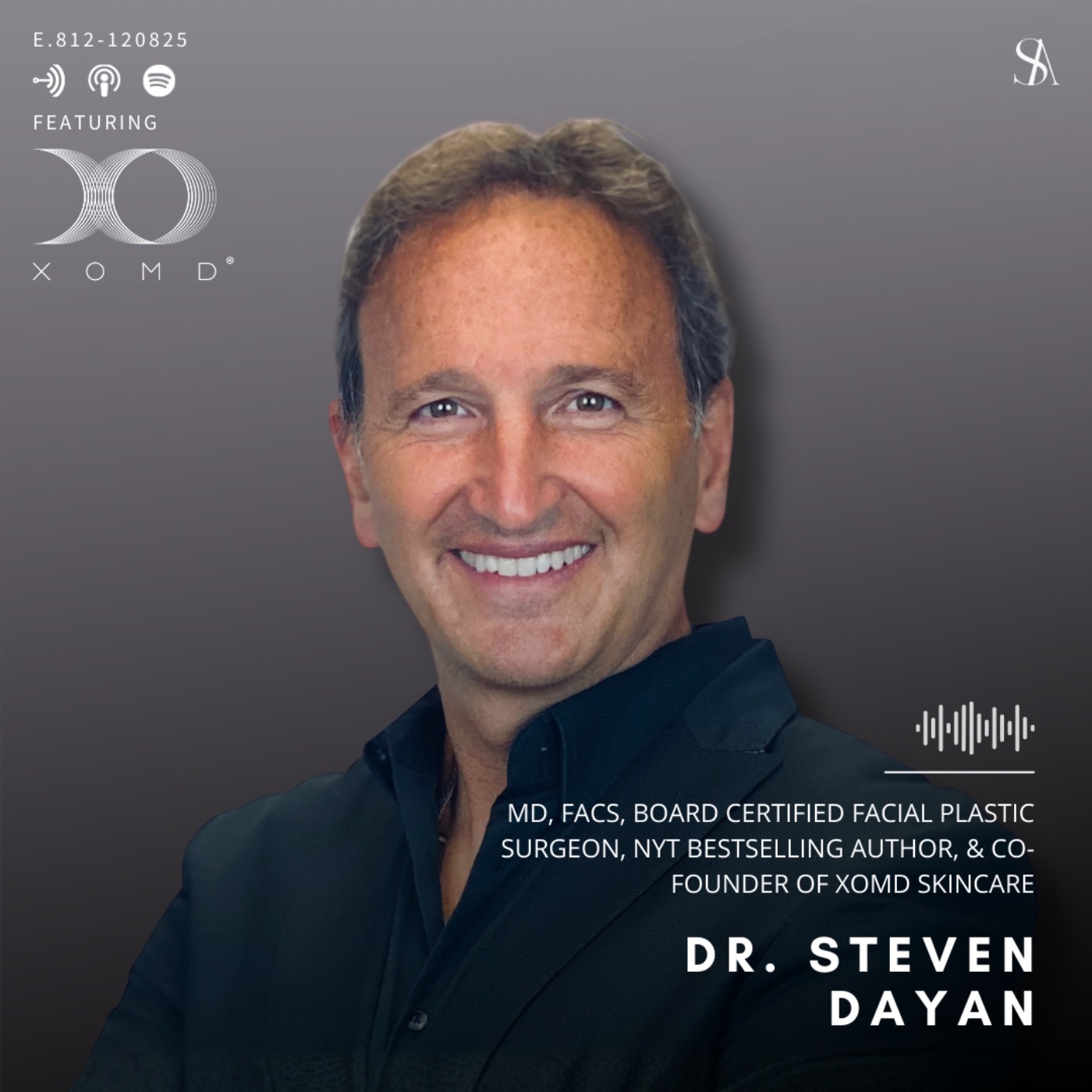
Hey, guys. Welcome back to another episode of Skin Anarchy. This one is very special because we are interviewing a true legend today in the world of aesthetics, bridging the gap between so many different areas of medicine and bringing it into a place where we can really holistically understand beauty. And so I know for a lot of you listening that have been around for the ride for five years, you know, we love talking about the intersection of beauty with psychology, aesthetics with topical solutions, and just all of the wonderful things that really contribute. So today's guest really embodies all of that with his career, with his work, with his impact. So without further ado, please welcome Dr. Stephen Dayan. Welcome, Dr. Dayan. It's an honor to host you.
- [00:39]
B
Pleasure to be here.
- [00:40]
A
No, I'm excited because ever since we decided to do this, I've been waiting to dive into this with you because this is something that I feel like no one really can touch on. Like, what really is beauty and how do we interpret beauty and, like, as both as consumers, but also like, even medical professionals. Without ranting too much, I want to talk about your career because it's multifaceted and you've touched so many areas with your work. When did you know you wanted to go into medicine?
- [01:05]
B
I think I'm a son of an immigrant, so I think you're born with the thought you're going to medicine. Early on, I was more interested in playing sports, football, and being social than school. I got a late start, but around college, after getting a scholarship to go to college, like football, which I realized quickly, I was not going to be a professional football player, I. I quickly converted to becoming a student, and I fell in love with school. In college. I went From B +C + Average in high school to being straight A's in college and becoming fascinated with education. I studied philosophy and religion, which still encompasses so much of my thinking and so much the way I interact with my patients and my colleagues. And then I went on to medical school. University Illinois, where I studied medical school. And I knew quickly I wanted to be a surgeon. My original plan was to be a neurosurgeon because I was so motivated and so driven to be at the top of my game.
- [01:53]
A
Yeah.
- [01:54]
B
And I had risen up to do really well in medical school. And last minute, I had a detour because I talked to a neurosurgeon in the community, said, no, you should do something else. Neurosurgery is not the greatest field. I was always an artist. I worked with clay. I was a sculptor for many years. And I loved clay and I loved being artistic, and plastic surgery is my second choice, so I went that route and I never looked back. Love plastic surgery and everything about it. Yeah.
- [02:15]
A
It's interesting you say neuro, because a lot of people start out saying, I'm going to be a neurosurgeon and find something else that fits better. I did the same thing when I was younger. I was like, I'm going to be a neurosurgeon. And then it changes. But that's amazing. You've written books and done so many wonderful things. And I kind of want to talk about your books because this is one of the only examples that I've seen personally where someone has really put this down on paper, this idea of beauty and what it means in so many different ways. We talk about things like the golden ratio, the technicals, and you always have an interest in philosophy. Can you talk about the authorship component of your career? When did that start?
- [02:50]
B
So that's a great question. But early on, I hated writing. I was terrible at it. But when I came out into practice, I realized that no one's going to. No one's going to advocate for me other than myself. So I learned to start writing for myself. And I started writing commentary for local newspapers and magazines. And I eventually started falling in love with it. And truthfully, I got to a point where writing became my passion, my creative outlet, and I gave up clay sculpting. One day, I put words on paper. I started to visualize it like clay. I started to mold the words. I'm like, the more I mold the words, the more this became, like, a vehicle or an outlet for me that became a canvas. I loved it. Writing became my passion. I would take weekends and weekdays, go to different locations, form parts of the very distant foreign caves and coves and islands, and I would set up shop there and write for writing retreats, basically. And I would come up with new ideas. Like, I spent a weekend in Nietzsche's house because I love Nietzsche so much. I wrote feverishly for a week and came up with new theories, like, so that's what I like to do. I went to Brazil on Saturday, Guassu Falls, and just wrote for hours. And I would do Iceland, and I would sit in Reykjavik by myself and just write. And that was really something I love doing. And to this day, I still love doing that.
- [03:58]
A
That's amazing. I love that it came from a place of true inspiration. Sometimes medical literature, when it translates to something everybody can relate to, it becomes a little harder. I know that there's been a lot of times where surgeons have written books and then it get. It stays very technical, it becomes harder for people to understand. My real question is, when you read the books, you'll know what I mean, where it's becoming more understandable for you when you read them. Because beauty, like when you talk to surgeons, doctors especially aesthetics experts, they get very technical. Where was that point for you, where you wanted to stay technical, but bring light into what all of that technicality actually means and how it translates to what we perceive as beauty?
- [04:40]
B
I love this story premise, the way you come at it with the question. And I think it has its nidus in writing itself. When you write something, and I'm going to encourage all listeners to write, if you really want to know something, write it out. You can argue, you can talk, but until you write something out logically have to explain lane and defend your position, that's when you really start to learn. And you become much more accomplished, much more confident in what you have to say. You become more influential because you can really back it up. You've studied it, you've written about it, and it makes sense to you. That's where I got with beauty. I was struggling when I first went into practice and I came out of plastic surgery. And like many of us, we were taught the golden ratio, or how to make a face perfect. And yes, I can make a perfect face, or perfect, as close to it as you can be, I can get. I knew the defined proportions that makes a face perfect. And the patients weren't necessarily happy with the perfect face. It didn't seem to correlate. I could give them a perfect nose, but they may not be happy. And on the converse, they may not have a perfect nose. It might be a little curve to it or a little bump to it, and they love it and they look beautiful and how beautiful that person is relative to how they feel about themselves. And I started to realize there was something more, that beauty was not subjective, it was more objective, and it was something that was more primitive than we really wanted to believe. So I started digging deep and I went back to my evolutionary biology beliefs, back to where I was when I was in college. This is something everyone has to think about, because how do you define beauty? I taught a class at DePaul University for 10 years on the science of beauty. I would ask my students, how do you define beauty? It's a very difficult thing to define. And if you ask most people that come up beauties, it's beautiful beyond skin deep or it's in the eye of the beholder. Those are all real nice colloquial terms, but that's not science. If we're going to talk beauty, we got to talk semantics. We got to change that. We have to define that word so you and I can talk the same language. And we don't have that in aesthetic medicine. In fact, we don't have that in any of our applied sciences, not even art or anything there's any way to find beauty. Beauty is a very difficult thing to find. So I wanted to define it, but I had to start there. I had to define beauty and work from there. First thought about it, wrote about it, and I researched it and I looked at from the neuroscience perspective to the philosophical perspective, to the artistic perspective, to the plastic surgery perspective. And where did beauty enter up? Beauty to me became a raw, the rawest form of communication. And it's evolutionary preserved. It's throughout all species, throughout nature, over millenniums. And what beauty says, I'm healthy, I'm well, and I have good genesis. That's what beauty is. You do not think beauty, you feel beauty. When you see something beautiful, you feel good. And we actually have plenty of evidence now from Functional MRIs show if you see something beautiful, your brain lights up in your pleasure centers. But if I ask you to find that beautiful, you no longer have reward center, your pleasure centers no longer are stimulated. But if I give you a glass of wine, I say, do you like it? The many you have to think about it, you no longer get rewarded by it. If I show you a painting and I say, do you like that painting? The more you have to think about it, you don't get the pleasure of it. So beauty, you. You consume beauty deep in your amygdala, deep in your most primitive parts of your brain, and you feel it. It's very interesting. And why? Because beauty distills down to survival. As humans, we only have one purpose on Earth. This is from an evolutionary biology perspective. It's not speaking religiously, it's not speaking spiritually, not culturally. Excuse me here if I'm not politically correct here, but you only have one purpose on Earth, and that is to procreate with someone who's the best genetic match and create a better version of yourself by having offspring. And that is our only purpose on Earth, to make our species survive. So you have to protect your genes. How do you protect your genes? You protect your genes by making sure you don't get eaten by a lion. Your brain is very good at determining what risk or threat processed in the most deepest components of your reptilian, archaic brain. And that is down deep in your amygdala. You already determined if something's a threat. And we're really good at that. But we're also good at determining if someone is beautiful. What is beautiful mean? Means they're fertile, they're healthy. Well, and they have good genes. So that's the scientific evolutionary theory of beauty. But that's not what I do. I don't make people more beautiful. And there's a huge distinction here. And this is where aesthetic medicine and most of the beauty industry is missing the big point here. Something I call attraction. Attraction is subjective component of beauty. To be attractive, there's gotta be someone who pitches the attraction and someone who receives it. You can be beautiful in a vacuum, but you can't be attractive in a vacuum. So let's say one day you're on the beach and, and a guy walks by, or a girl, depending on your flavor of enjoyment. And he or she is a beautiful specimen just perfectly built by every mathematical proportion, every parameter that we define beauty. But your dog died that day and you're not in a good mood. You don't even see that person walk by. But take another day, you're in the mood, feeling good about yourself. You just got a raise and that person walks by, wow, he is really hot. Or she is really gorgeous. They have, they project that beauty, but you have to interpret it. So beauty has a subjective component to it. And that's the most important part about what I do, but also about the whole beauty industry, what they do. So let's define down that attractive subjective component that includes many things. Now, beauty is a part of it. The physical beauty that says, I'm healthy, I'm, well, I have good genes. But also included in what makes someone attractive is their adornments, their jewelry, their makeup, their hairstyle, cultural preferences, their posture, and probably nothing more important. And this is the key factor, nothing more important than confidence. The person that we can't keep our eyes off of, that we're just compelled to watch, is the person who walks into the room and struts across the room with confidence. Not narcissism, but confidence. We all want to be with that person. And my job as an esthetic physician is not to make someone beautiful, it's to make them feel feel beautiful by giving them increased self esteem and confidence. Then they walk into my office and they're gorgeous and I did my job. That's where we need to go. As aesthetic medicine physicians And I'm not. And beyond that, I would say if you're a cosmetologist, to anyone who is in the health, beauty, health and wellness field, that should be your aim is to make people more attractive, not more beautiful. When we try to make people beautiful, we get into trouble and they get overdone.
- [11:04]
A
That's so interesting what you said and it really makes me now think about all of the things that are now impacting people's perception of what they feel is going to make them more confident. So I see like, for example, like a lot of the younger generation, they're on TikTok social media all day scrolling and looking at everybody. I'm sure you saw the trend of everybody had filler, everybody was getting filler, ridiculous amounts of filler. It makes me wonder the psychology of that. I completely agree with what you said. That confidence component is what we're chasing. But where does confidence intersect with this? The perception that we get from just watching other people? And especially now in the world of social media where everything's digital, we're not having those in person interactions as much. I grew up, I'm a millennial. We met everybody, we were out there at school. Now kids aren't really doing that. What are your thoughts on how that's evolving this field?
- [11:53]
B
I love this question because you're getting to the crux of the biggest issue we have right now, not just in aesthetics, but culturally, especially with Gen Z's in a post Covid era. Yeah, completely leads to my latest creation to address this is XOMD Skincare, which I want to, I'd love to dive into with more but before we get there, I want to talk, I want to touch on something that you just mentioned is like on TikTok social media, looking at all these people and why are they succumbing to getting all these treatments and not looking right? Why are doctors and providers overdoing it? We have a problem with training and recognizing what makes a face beautiful and why we don't teach that. Because what we teach in aesthetic, the opposite. But the general of our field, the general consensus and how we teach is how much product to put into a face, how much neuromodulators, whether it's Botox, dysport, Xaman juvo, how much of that to put in and or how much filler. It's pink by numbers. So with these big rooms with thousands of providers and there's someone up on stage saying, you have to do this, you have to do this. Put in 6 units here, 100 units here, 53 cc's here, 6 cc's here. And they're not thinking about why they're doing it and how to do it. And then they think it looks good. We have an aesthetic bias. We start to look at this over and over again and our minds start to change what we think is beautiful. And I've published on this, as have many of my colleagues that have shown that if you see something over and over again, you start to become accustomed to that. So if you surround yourself with other people that look bizarre and strange, you're going to look bizarre and strange, but you're going to think that's normal and pervasive throughout the esthetic industry. Whether you want to start with makeup artists, hairdressers, nail technicians or eyebrow technicians, or even plastic surgeons and dermatologists and providers, nurse providers who reject. You have to check your cultural bias, your esthetic bias all the time. And I think there's an easy way to do that. But it's something that takes training and self awareness and it's very hard to do that in aesthetic medicine because we've been trained the wrong way. So I think we're going to. We're seeing a difference now because there's been a pushback, right? The consumer saying, wait a second, I don't want to look like those crazy movie stars, or I don't want to look like that crazy doctor or her that she walks in with her lips across the room and they're saying, don't do that. We have to retrain our providers, our physicians, students, to look at what makes a face beautiful and why. Less product in the right places. Turn the corner of the mouth up by 1/2amillimeter to a millimeter and you will perceive that person as making a better first impression. That person may become happier because if you smile, you become happy. If you frown, you become angry. It's called the biofeedback that actually happens. We have plenty of studies in psychology to show that smiling makes you happy, frowning makes you angry. The expression first, then the emotion. And we've been able to show that. So with filler and toxin. If I put neuromodulators right here, if I put bunch of Botox in your glare area and you can't frown, you become happy. People see you happy and they start to be happy. Because we have mirror neurons. When you and I communicate with each other, if I smile, you smile. You don't even know you do it. You do it subconsciously. We're trained to empathize as Social beings with the person next to us, our mirror neurons are always activating. It's all happening in a subconscious level that we're communicating happiness. It's a reason why we like to be around other people that are happy. So if I put neuromodulator here, or I put filler in your call, your mouth, I raise it up just a millimeter. The person who you talk to now thinks better of you. They actually become happier. And then that can spread up to 3 degrees. It's really fascinating when you see what happens here. Now, the opposite also happens. If I make you look unnatural, I take away all your crow's feet. So when you smile, you don't see any crow's feet. Now, when someone looks at you and you're smiling, and you're smiling, it looks like a fake smile. They don't trust you. Your authenticity goes down. You've lost trustworthiness. That person, something's wrong with her. They don't know what it is. But your muscles aren't working completely.
- [15:43]
A
Yeah.
- [15:43]
B
And they're unattracted to you. And now they don't want anything to do with you. We don't even realize what's happening. So when doctors or nurses or PAs or whoever's doing the injection puts too much in, they don't realize they're hurting that person. That person. Want all my wrinkles gone? No, you don't want all your wrinkles gone. If I take all your wrinkles, people think you're inauthentic, you're less attractive, and make you less social. It's intricate and deeper than just removing a wrinkle. Now let's get to your question. We asked about social being social because that is the crux of what we're trying to do. I want to make people feel better about themselves. Why not? Just so they can look at themselves in the mirror all day long, so they can go out and be the best version of themselves. That's what I do. If I realize that's what I'm doing, I've got to make them present themselves in a natural way that makes them look more attractive, that makes them have better success, whether it's financially, socially, academically, or romantically. So when I do a study, now, I put something into my studies, and I've published over 200 papers, of which probably at least three or four dozen have been on first impressions and quality of life. Because that is what I need to do as an aesthetic position. I don't need to make them more beautiful. I need to improve Their life. If their life is not getting better, why are they coming to me? I got to make their life better. What do you think about yourself? Is your mood up? Is your self esteem higher? And what do other people think of you who don't even know you? They see your photo or judge you on a video screen and they look at you and say, wow, she's really attractive. She looks like she's academically, financially, socially successful. I put that into all my valuations now and it changes the whole dynamic because medicine, anesthetic medicine, is stuck in this rut. Let's get rid of wrinkles, folds, make the nose a perfect shape. And I'm like, let's go past that. What does the consumer want? What does the patient want? They want to look good, feel good, they want anyone to know what they had done and they want their life to be better. Now let's measure that and work backwards.
- [17:29]
A
Absolutely. That's brilliant. I don't think any of us have thought about it in that depth. It just makes so much sense. That's how human psychology, that's how we think. And so to translate that into actual practice, that's phenomenal, I think. How do you see the future of aesthetics then, in terms of training? Where do you think we need to be headed to build this into the whole system where everybody's doing this?
- [17:50]
B
It's a conflict because most training today is done by people who have a vested interest. It's the companies who provide the products for us. They can only train based on what was completed and the clinical trials that were approved by the fda. So they have to go by those parameters. What I do in best practices may be different than the way the study was done. And I've done many of these studies. I've done 40 or 50 phase three trials, which is the final trial to get products approved. When we do these studies, we have to go out of our way to, to make a difference because we have to judge and we say, yes, this product works. So I have to overdo it. I do it in the study is not how I do it in clinical practice. But then the companies go out and they say, we got approval, let's get this product out to market. They got to train people, but they can only train based on what the government will allow them to train. The regulatory buyers allow them to train based on the study results. Now that's not how I do it. The best way to learn is to go through CME training, which allows me to talk about how I do it right. But who's going to sponsor that. It's expensive as a solo practitioner. It's not something I can give out to the masses. So we work with the companies that we apply for grants and sometimes they give us a grant for us to teach the way we want to teach. And there are people learn that way. So if you're out there learning, you've got to spend time learning outside of the standard training with best practices, find people who offer best practices. There are a few programs that do that, not a lot, very few. But you can learn how to do it well and also how to do it safely. Some of the ways the drugs and the products get approved, the devices get approved is not the safest way to do it. Once the product comes into the marketplace, we start learning like oh my gosh, maybe we should use this epic cannula here or maybe we should use a smaller amount of toxin because it may not be safe. Or maybe that device shouldn't be at such a high level of juuls settings. But those things come after it's been in the marketplace for a while. So you want to learn the safest and best techniques. Now a lot of the academic meetings you can get that training or you can find courses online with some reputable companies and physicians that do it. But the mass training is not the standard, not the best way to practice in my opinion. Yeah, so I think we have to go back to. So that's one. You have to train best practices but on top of that you have to. I would love to go back and most importantly teach people what makes a face beautiful and why. To go back to the psychology of what we do. Fellows, I've been training for years that I talk to my fellows, I'm like, what do you think is the most important class you took in medical school? No, the most important class you took in medical school is psychiatry. Yeah, I go, you understand that one first and that's going to lead to your success faster than anything else. You got the hands. I'll teach you. It's the decision making that is important and the understanding, empathizing with what the patient wants and why that's really hard to do. I want to, if you give me the privilege to go a little bit further, I'll tell you something else that'll be interesting. Two years ago, my partner in life and partner in business, Dr. Sabrina Fabi, who's a world class dermatologist, we got a grant and we traveled the world and we went to six different regions. As Covid was ending, we went to India Korea, Asia, the Middle East, South America, North America. We traveled all around the world and we did Africa. We did beauty in those cultures. We contrasted how we view those cultures in the US So how does an Indian doctor treat an Indian doctor in Delhi versus how does an Indian doctor treat an Indian patient in the US and we looked at the cultural differences, how we treat people, what we look for. It was fascinating. We published seven different articles in the journal Cosmetic Derm looking at beauty around the world and studying it. And what we found was incredible because beauty standards change slightly. What we find beautiful here may not be what they find beautiful there. There's a difference. You have to recognize that differences. Now, there are certain things, I know you've asked me this before. There are certain things we all find pleasing our brain can recognize right away and interpret as fertility or healthy, well, potential. We all can recognize that those are things like symmetry, averageness, body, certain body size ratio, certain colors of the face and contrasting contrast of the skin and the eyes are certain things we all can look at and say, that's pleasing, doesn't make someone attractive. But that was consistent across cultures. But then there's minor differences. An African American person in Africa doesn't want a chin. In America, where it doesn't have the right proportions, that person needs a chin. No, they may want filler in their lips. In America, we're like, wait a second, African American person, their lips look big. They don't qualify based on the scales that we had when we got the drugs, the device approved for fillers in the lips. We wouldn't necessarily treat someone the lip size of most of the African Americans, the U.S. but they want their lips filled with. So we went there, and it's not necessarily to make them bigger, but to give them better shape. So we presented that and I did a paper here in the US looking at skin types 4, 5, and 6, which are mostly African American patients. What happens if we fail their lips? Their satisfaction is so high they want their lips filled. But that's not how we're taught here. They're taught, go by these scales and these numbers and it doesn't achieve our goals. That's where we steer wrong. We get bad outcomes, whether in patients, current culture, patients from another culture or different age groups.
- [22:55]
A
Yeah, I love that topic. And I think that's so valid, everything you're saying. Because being myself, being an Indian American and being raised in America, I struggled with this my entire life. I would look at my Caucasian friends and be like, I don't know what to buy for myself or even something like makeup, something simple with beauty. Always a struggle because you don't know, even lining your lips or like putting on blusher or however it becomes this struggle for a lot of people. I love what you said and being able to bring that to esthetics. I feel like that would be absolutely game changing for obvious the field, but then the customers, the patients, like people who actually want to know what it feels like to feel beautiful without having to compare themselves all the time. I talk about this a lot on my podcast, Skin Care because I want to dive into your brand. That's a beautiful line. Just to preface, we talk a lot about, okay, this is what everybody needs. Everyone needs over exfoliation or you need glass skin skin. And it's. That's not true. If you have super melanated skin, you need to get rid of hyperpigmentation. You can't buy the products that are geared for over exfoliating. Too much retinoids, too much. It doesn't make sense. Let's go into xomd. That's a beautiful line and I want to dive into the philosophy behind it. Where were your thoughts when you were wanting to create a line for the skincare?
- [24:10]
B
This is a beautiful story on so many levels. So as we talked about just a few minutes ago, my passion is the science of attraction, the science of beauty. I wrote a book in 2014. I taught a class on it, New York Times bestseller on it. I've published probably 100 to 200 articles on the science of beauty. It's my passion. I recognize there's more needed in skincare than making skin look beautiful, but my goal is to really improve people's lives. Sabrina Fabi, who is my partner in life, is a dermatologist ranked number fifth in the world by, by Newsweek magazine. She's incredible. She is super knowledgeable about skin care at every level. Both of us have spent so much time consulting with companies. There are companies that have sold for over a billion dollars that her and I have been behind the science. We've helped with it, we've created, we're behind the scenes. Every year for probably the last decade, I've had someone come to me and say, steve, we want to put your name on a brand. Can we slap your name on a brand? Be your brand. And I can never do it. Sabrina's had the same opportunities. If I put my brand, look, I'm Dr. Stephen. I'm famous. And look at the skincare brand. That's not me. It's not authentic. It's like Michael Jordan's got a steakhouse here in Chicago. Michael Jordan doesn't create the stakes, just puts his name on there. I couldn't do that. It would. So I had to do something unique and different based on my insights, my theories and ways in which I think I can make a real difference. I wanted to pour in the science of Attraction. Sabrina wanted to come up with skincare that can really make someone look. That can really help women of all ages, especially women going through hormonal issues. We've bantered about oxytocin. Now, oxytocin is one of the most wonderful molecules that exist in nature. Some call it nature's medicine. It's incredible that we have this powerful molecule all within us. And we all know it. We feel it. When you are in love, when you have a baby in your hands, you glow, feel great euphoric feelings, feeling you get a high like you've never had from anything else. Everyone who's in love knows that feeling. The first time those tingles of love is oxytocin. When you hold a baby, many women will tell you breastfeeding is one of the calmest, most serene, most satisfying time periods in their life because guess what, their oxytocin is at an all time high. When women are ovulating, their oxytocin levels go up. Oxytocin is a molecule that's way too big to get into the skin. But people, we take it as a. There's a nasal spray, it's got a short half life. But could I elevate oxytocin levels? That was the first thought in my mind.
- [26:35]
And during COVID we all felt the same thing. Covid was a monumental shift in all of our social mores. We sat around behind a screen and talked to people. At first it seemed great. It was simple, easy, comfortable. But quickly we learned something was missing. A conversation over suite is not the same. We are social beings. We need to be with each other. Covid was devastating depression. Rates went up 57% in teenage girls suicide ideations 30%. 13% of teenage girls attempted suicide. Oh my gosh, these numbers are drastic. People were drinking, we were dying. We are social beings.
- [27:20]
A
Yeah.
- [27:20]
B
So why is that when we're in someone else's presence, we thrive? It's not just that we're next to them, that we're talking to them. There's a communication that happens between humans when we're in the same area in the same space. We call it energy. But what is that energy? We've never defined it what is that energy? So I was on a mission. Like this is all circling in my head and then I have to preface it by. In 2020, I wrote a paper, it was the first of its kind to show that blind people who are visually blind, they cannot see 20, 400 vision. If I put someone in front of them, three feet away from them, they can detect how beautiful they are. Just as good and consistent with some with normal vision.
- [28:00]
A
Wow.
- [28:00]
B
It was 2020 paper I published in Der Dermatological surgery. It was one of the best papers of the year. And it was the first time someone was able to say that blind people can detect beauty. How do blind people detect beauty now? I based it on studies that show that blind people can detect beauty. Risk and danger. They can assess risk and danger. Maybe they can detect beauty because both of that happens the amygdala. So we have an innate sense to, to sample the people around us and we can tell if they're a threat or if they're beautiful. Beauty in my definition means they're healthy. Well, and they have good genes. So if someone's in front of you, you feel they have healthy and good genes. Women are better at detecting this than men. You're much more self aware. Men were not so good, but women are really good at it. Remember a time period where someone's sitting next to us and we get this feeling like, oh my gosh, you feel a tingling. Why? Why do you feel that? You are picking up sense between you two. I was fascinated by this concept. Then Covid hits and we're missing something. I started diving deeper into all of this. Then Sabrina gets pregnant. Okay.
- [28:58]
A
Yeah.
- [28:59]
B
And she glows. She walks into the room and it lights up. And I was like, oh my gosh, it's oxytocin. It's oxytocin. So we started looking into the chemistry of oxytocin. Could we get it? How do we increase it? Then I stumbled across something known for 20 years, but no one's touched on it. And the neurochemistry of the skin, the skin brain axis, has been overlooked for 20 years. First described in 2002. But many people don't realize that within your skin is dopamine, serotonin, endorphins and covalence and oxytocin. Many neuropeptides. Neuro means neurohormones that are in your brain also are in your skin.
- [29:38]
How does that happen? Your ecto, your brain and skin evolved from the same germinal layer when you're an embryo. So when you're an embryo growing as a one or two cells. The same parts that developed into your brain also develop into your skin. So you're embodied, which means your skin is embodied with nerve endings. There were 5 million free nerve endings in your skin, right? And they are little sensory monitors that are picking up all the time on your environment. They're telling you if the temperature's hot, they're telling you the temperature is cold. They're also picking up on people around you, constantly giving your brain information at a subconscious level. An animal knows to run when it senses danger. The reptile crocodile is that consciousness. But how does it know to run from danger? We have that innate ability, we just not self aware of it. So we have the ability to sense our environment and we have the ability to sense people around us. And one of the ways we do it is, is with these neurohormones and neuropeptides that are in our skin. When someone touches you, your oxytocin levels in your skin go up and particularly oxytocin serotonin goes up. When you sit in the sun, you feel good. How does that happen? You sit in the sun, you feel good. It's not because you're like, oh, I like the sun. It's because your skin is telling your brain it feels good. It needs some vitamin D. Sun is bad. So I want to go there. But oxytocin became my interest because I realized oxytocin gives you that glow, oxytocin makes you feel great, oxytocin reduces anxiety, and oxytocin fosters pair bonding, brings couples closer together. So can I elevate oxytocin levels? Yes. I found a Jasmine derivative. Jasmine is a beautiful flower recognized throughout the world and Sanskrit and from your part of the world. It has such, such a storied history and used during wedding ceremonies or fertility ceremonies. And it's still prevalent in many parts of the world. Yeah, and it's she who intoxicates is how the Sanskrit originally talks about it. So why is Jasmine so great? Why is it in baths? Why is the smell attractive? Because jasmine has an ability to stimulate oxytocin levels in the skin. I went back and found neurochemistry to show this and some articles to show this from 2000 early 2000s that show this. I was like, okay, if I can get that jasmine to increase the levels of the oxytocin in the skin, can that have a positive influence on the way our skin looks? And yes, oxytocin is an incredibly powerful antioxidant anti inflammatory, angiogenic, it reduces inflammatory mediators. So it's really wonderful for the skin along with many other parts of your body. My goal was to get that elevated. So I was able to, I was able to find a molecule that's been reported to do that in the biochemical literature. And oxytocin is unique because when it goes up in your skin, it signals your brain to release more. So there's positive feedback with your brain. Your brain releases more, which makes you feel good. It's the reason why when someone gives you a hug, massage, or you kiss someone, your oxytocin levels go up. You feel it in your skin, then in your brain, and you feel good. You're close to that person. When oxytocin levels go up, your pupils dilate. Men and women stand closer together. Women find men more attractive. In fact, they find masculine men more attractive than feminine men. Which male will stand closer, make guard next to their partner if she's ovulating? Your oxytocin levels are high. There's all memory gets improved, all these wonderful things that happen when oxytocin levels go up. I'm a student of the science of attraction. I'm like, what if I put a pheromone in here? What would happen? Now, pheromones are controversial and I think you probably know what pheromones are. But for those in the audience who don't know what pheromones are, they're chemical messengers. That species that work within the same species, you emit them.
- [33:15]
The same. Someone of the biological being of the same species picks up on that chemical messenger and it influences their physiology or their behaviors. Right, and where is it most commonly recognized is in mating when they're in heat or ovulating. A female releases a pheromone, usually from the groin area, genital area and the armpits. It gets picked up by the opposite sex attractant and they mate. What's a signal? Do humans emit pheromones? It's controversial and the prevailing theory is known by many social psychologists. I believe in them because there's enough evidence, research to show that humans express pheromones. We just don't recognize it as well. We're not self aware about it. But if we can train ourselves to be self aware. Yes. I decided to put what I believe was a pheromone. I found carob. Carob is a legume that's common to the Mediterranean basis also a storied history. It's recognized throughout cultures as an Aphrodisiac, as well as an antioxidant, anti inflammatory. It's good for digestion. Many people use it for the skin. But it also has a long history of being an aphrodisiac. Now why is it an aphrodisiac? No one explained that. So I dove deep into the literature. I really spent a lot of time researching this and I was able to find articles from the early 2000s showing that one of the derivatives of carob of once you distill it is isobutric acid. Isobutric acid is a volatile fatty acid that women release during ovulation. And women don't know they release that, but they release it. When men smell that, they got a buttery aroma to it. They get instantly more attractive, their testosterone levels go up and they even think of themselves as more attractive. So when I found that, I'm like, okay, let's pour some of that into this product. And then Sabrina was like, okay, we need to make the skin look great. So she made sure that there were quality products in there like a vitamin C, a vitamin E, a ferulic acid, as well as tyrosinase inhibitors, other anti inflammatory and anti hyogenic properties. We have a peptide recognized to increase collagen elastin formation, to thicken up the phosphorus, the cellular membranes for repair, reducing redness and brownness. We put all that together. It's not easy to get that to play nice. So we had to go through multiple iterations before we found the perfect formulation. And we thought we had it. And then the viscosity had to be good and all that. Then we said, let's test it now. This is going on for three years. This doesn't happen overnight. Yeah, we're going to do a double blind, placebo, randomized, controlled crossover trial. And I know you know what that is, but many people out there don't know what that is. That is the strictest of clinical testing you can do. You can't get any stricter than that. The cosmetic companies do not do that. Why? Because it's very expensive. Your chance of having a good outcome are low, very low. So why would you spend all that money when you can just take the money and spend it in marketing if you're a startup. But Serena and I, reputations of 20 years, we are not going to put our name on something unless we could prove a difference. So we did, we put it to the test. We didn't tell anyone about it. Come six months later, the test is done and we get our results back. Oh, My gosh, I cannot. The results were so profound that I was like, I can't believe this. We looked at skin quality and a statistical significance of 0.0001. What that means is that the possibility that this happened just by random occurrence is 1 in 10,000. The chance of this happening, the vehicle of the product we're creating, is 99.99% because of us, what we created, skin quality was improved. Decreased redness, decreased dryness, increased radiance, increased dewiness and increased hydration and a skin quality level. Then all those measures that we talked about in the first half of our conversation here, about the soft signals, the psychosocial skills, where my passion is, are women more attractive if they wear this product? Four weeks later and eight weeks we tested it, and yes, they were found to be more attractive. There's eight categories. We looked at five out of eight at statistical significance, all eight had increased improvement. They were all found to be more attractive when they were using our product. But statistical significance in five, including attractiveness. They look three years younger. They look like they made more money. They look like they were academically more successful. They looked like they were more socially successful, they dated more successfully and are more attractive. That blew our mind. Then we're like, do these women find men more attractive? And the answer to that question was, yes, they found men more attractive also. Now remind you both of these and the skin quality and all three skin quality and attractiveness levels, and looking at what they found as the opposite sex more attractive, placebo is zero, no change. So this was our vehicle. Our active ingredient was showing all this improvement. Placebo was finding nothing. Then we looked at something that never gets looked at in any study that you will see in skincare. And we weren't going to talk about this. I was like, sabrina, let's just put this in there because I'm curious. I promise we won't talk about it, but I'm curious. I just want to see if we can have this influence, and that's on sexual satisfaction. Can we improve sexual satisfaction? Because I put a pheromone in there and I want to test, did it work? So we took a scale from the sexual health and wellness literature called the New Sexual Satisfaction Scale. It's a validated scale for the audience who doesn't know what that means. That means the scale that's tested and determined to be reliable and accurate for what we're attempting to test. So it's a validated scale. It means it's gone through already a vetting process, a Good scale. So we tested sexual satisfaction in our group using our active. It was so profound that I couldn't believe it. 18 out of 20 categories were statistically significant improvement in sexual satisfaction. And it was things like, do you get better arousal? Are you more available? The frequency and the intensity of your climax, your orgasms. And we're looking at things like that. These are things we don't talk about in skin care. But it was profound. What was placebo? Zero. That's. I'm like, that's insane. So I'm like, this is a mistake. So I called up Santa Station. I'm like, I think we made a mistake. This can't be possible. She's okay. She rechecks it. She's like, no, doctor man, it's right. I'm like, oh, my gosh. I was, like, blown away that skincare can do that, because how is it doing that now? Is it increasing oxytocin or is it the pheromone? Or is it that people are so happy with their skin, they feel so good about themselves that they're showing up better in their relationships? Hard to say. We went to the partners of the people that were in the trial, and we said, okay, how is your sexual satisfaction? Five out of five categories, statistical significance. Partners are also. The premise is, why do this? I created a skincare line that falls within the philosophy that I strongly believe in, is I'm going to make you a better version of yourself. If I don't do that, then why are you coming to me? If my skincare doesn't work for you, then why are you using it?
- [39:59]
A
Right.
- [40:00]
B
I presented this data at multiple medical conferences over the last year. And everyone gets up there and they. They pitch their skincare. And we've been focused on collagen and elastin.
- [40:09]
A
Right.
- [40:09]
B
Okay, I can increase collagen. Elastin. That's so pre Covid. We're post covet. Let's get into the 2000 and twenties. Tell me what you do for me. What does your skincare do for me that doesn't just increase my collagen lesson, because no patient comes in and says, Dr. Diane, I want more collagen. Elastin.
- [40:25]
A
I can.
- [40:25]
B
I can scrub my arm over your hand and give you more collagen with a brush. If I scrub hard enough, I'll increase collagen. That's not the end metric. The end metric is, do I make you have a better life? That's neurochemistry and neurocosmetics. We coined it the world's first moodseutical. And we trademarked that because we're like, this is something unique and differentiated and new. And it's very hard to get people to understand that unless they understand the whole story behind it. So I'm glad you asked me about it because it's very intricate, it's very complex, but it makes. It's very simple. And then it makes so much sense.
- [40:59]
A
That is the future. I feel like that's. First of all. That's phenomenal. Congratulations and thank you for this. I interview skincare brands every day, and I been. And I love skin care, but that is next level. That's an entire. It's not only a new category, but the data that you're looking at is a whole different lens. That's huge. And I feel like if there's anybody in the audience, like entrepreneurs, you got to learn from this. Okay? Because I'm also am sick of seeing the same redundant stuff. We keep testing the same stuff. I had this conversation a month ago. I mentioned this earlier. Retinoids, for example, all the classical things that we've studied so extensively in dermatology and all. There's tons of papers out there, whatever. And that's wonderful. But it's exactly where you've touched on so many times in our conversation, where it's like, we have to go beyond that. Because just putting a retinoid on five nights a week and then thinking that's not enough. Because people are complaining of all these other downstream effects. They're still coming back about hyperpigmentation concerns. They still feel like their husband's not noticing, their skin looks better. These are real things. I'm blown away by this approach. If we can get there as a society where everybody is pushing for this train of thought and for this approach, there's going to be a huge fluctuation in the way consumers interact with their beauty products. How many dollars are we spending every month on, like, just random skin care? Now we have K Beauty everywhere. I'm not against K Beauty, but we're buying the same thing over and over again. That's absolutely phenomenal. I'm so excited.
- [42:27]
B
This philosophy goes deep. It's not just skincare. Right. I believe I'm opening up a whole lane into aesthetics, which I've been pushing for 25 years, is to think about aesthetics differently. Don't think about it just making someone more beautiful on the micro levels, giving better proportions to their face or better angles or wrinkles, or just getting more collagen and more elastin and more ground substance. More hyaluronic. No, that's not what people are asking me for. They want to look better, feel better, not anyone know what they did and make their life better. Right, let's go there and work backwards. Whether we're doing facelifts, nose jobs or skin care or we're doing any other product in the esthetic industry, people say.
- [43:02]
A
You can get all the procedures in the world, but if you don't have a good skin care routine and if you don't do something that's like actually going to help, it doesn't matter. It doesn't matter how much filler you get, how many surgeries you get done, you have to have something you maintain. I always used to wonder this myself, was like, why is that? Why did they say that? And I don't think it comes down to just topical application of different molecules. If you're taking care of your skin every day in and day out and noticing a difference, your overall satisfaction with any procedure you get, any augmentation, that's going to actually increase. People are probably going to notice that I already feel good about my skin. But a little tweak here and there, that's a different mindset than someone desperate going into a clinic saying just fix me. It's a whole different mindset. So from that perspective as a consumer and even medical side, I'm excited about what you're doing. This is absolutely revolutionary.
- [43:50]
B
Oh, thank you. And neuro cosmetics. Mark my word, you're going to hear more about it. When we first came out with this, I've had skills, skeptics. I don't believe it. I don't get it. But anyone who's a scientist who recognizes the literature and I can present it all so that I publish in a peer reviewed journal. But there's articles I'll reference, I have hundreds of them. It talks about neuro cosmetics. The fact that we overlooked it for so long is like, how did we miss these neuro hormones? Neuropeptides are already in your skin. Why don't we leverage what we already have there to improve not only the quality of our skin but also how we feel about ourselves. So you're going to see it. Mark my words. Since I put this out there, I've had friends who are in the media. Ah, Steve, I don't believe it. I've had critics in skincare. Steve, I don't believe it. I'm like here, read my paper. I didn't believe it either. I did the study, now I'm starting to see other articles. I'M an editor of medical journals, but I'm also the director of multiple meetings. I get abstracts and now I'm starting to see it. I know we had talked about this earlier, but where's the future of healthcare going? In aesthetic healthcare, you're going to see emerging, you're going to see neuro cosmetics, mark my words, is coming and you're going have. I'm not. I may be the first, but I'm not the last that's going to talk about these neurocosmetics. It's coming. Sexual health, wellness, holistic health. Peptides and aesthetics are merging, they're interconnected.
- [45:02]
A
No, I completely agree with you. Trust me. I am one of those people that. I've always believed in this, even when I didn't go into medicine. And I think a lot of us do. I hear from our listeners every day and they're not looking for the same solutions. They're not, because it's not working. This is one of my biggest questions for you because you're at that intersection of true education and your own practice. Where do you think we need to focus now as the medical community in terms of raising awareness around these, like a new approach to obviously skin health, but also this skin, gut, brain axes that you mentioned and all the other axes that we never even really touch on in medicine and medical training.
- [45:39]
B
So I call it the Neo Romanticism and Aesthetic medicine. I wrote an article on this recently. I'll send you your ages. Published in Modern Aesthetics. And I think we're into a new era, the Romantic era of aesthetics. We're going away from the Enlightenment area of aesthetics. We were all about sterile numbers and science and listen, I'm a huge science fan, but we're focusing too much on the micro of scales and measurements. Let's get to individuality, expressions, emotions, passions of aesthetics. Focus on that because we've got all the micro. We got the we know about the collagen, we know about the elastin, we know about the gene markers, we know about the how much hyaluronic hydration we need. Let's get to what makes someone feel good and why we're not all the same. We have differences, we have cultural differences, we have social differences, we have religious differences. And let's put that also into how we show up to be the best version of ourselves. And let's let our aesthetics match where we need to be. I call it the Neo Romantic era that takes a shift in training and education. It's the stuff people don't like to train, but it's for those who think more humanistically. It's what makes people most attractive, in my opinion.
- [46:46]
A
Yeah, I think it's interesting how our residents and fellows going to be trained. I really feel like we're at that stage of it's got to evolve. We got to evolve now. And allopathic medicine is wonderful in its own right, great discoveries and innovations. But we got to get this out into the world where the new doctors and the doctors of tomorrow are like already primed to come into it with this mindset of it. It's a lot more than the anatomy and physiology and violet. It's a lot more than that. I'm very interested to see where this evolves. Very exciting.
- [47:11]
B
Yeah, me too. It's an exciting time. I hope people catch this wave and get to appreciate because it makes a big difference. I'll tell you, my clinic patients come in. I love your skincare. Let me say, I like it, I love it. And that makes me feel great because I know I created from the ground up. It's kind of like if you cook a recipe, your whole family came over for Thanksgiving this year and if you cooked everything and they love it, doesn't that make you feel good? That's how I feel when patients tell me they love my skincare. I love that.
- [47:33]
A
No, it's a beautiful line. I've been using it myself. I've loved it. It's sensorily appealing as well. Science and solid, but sensorially it's amazing.
- [47:41]
B
So I think we talk about the packaging real quick.
- [47:42]
A
Oh my God, I totally forgot. It's so awesome you did futuristic look to it. I love it.
- [47:48]
B
I want to give kudos to Sabrina. Not only is she a brilliant dermatologist and a great mom, she is also a incredibly creative designer.
- [47:57]
A
An artist.
- [47:58]
B
An artist. And she works hard on creating our own versions of X and O. She's no. If this is going to be ours from the ground up, we are going to do everything to make it something that no one else has ever seen before. So she created the X and O. So we have an X and O now. That's cute, right? We play off the concept of oxytocin, X and O. Male and female genes, they fit together perfectly. It took many months to get those to be perfect. They have to fill, right? They have to check stability with them. But now we're reaping the benefits of it because we have one, our fourth design award right now. So the New York Design Awards amuse design awards. So people are recognizing it. So if this Sits on your shelf. It is really beautiful and you're going to really like it. And it's something that I think has appeal beyond just the product, what's inside it. Just seeing it hopefully makes you. It's a whole sensorial experience. We hope.
- [48:46]
A
No, I was actually. I'm so glad you brought this up because you remember opening the packaging. I was like, oh, my God, I love this. It looks like it belongs in an architectural magazine. It's so, so beautiful. House off to Dr. Fabi for doing this. It's beautiful. You guys are gonna fall in love with the line. It's like that number one feeling when you first get into your products. It's. Oh, actually, yeah, I want to display this. I want to use this every night. I love it. It's beautiful and so well thought out.
- [49:08]
B
It's been great. Now we're working on travel size, so we're creating those and that's taking a long time, but we're making little mini ones, so that's coming soon.
- [49:16]
A
How was that, though, the package? Such a unique packaging design. How long did it take you guys to to.
- [49:22]
B
It was painful and I was against it. After the study came back, I'm like.
- [49:25]
A
Let'S go to market.
- [49:26]
B
This is great. Let's share this with everyone. No, we got to get the product. It's got to be this design. It was a whole fiasco, but it worked and it's great now. We're thrilled. Doing it all over again now with minis, it's worth it because people love it and we're having so much fun. Like, we have all these little sweat. We have a satin robe now and we have. We're creating a one night stand, which is our overnight kit that you could take with you. And we have conversation cards, so little cards that like help you create to be more social. We did a speed dating event and people don't know how to be social anymore, especially Gen Z. And half the women wear xomd, half that were xo, half them didn't wear it. And then I tested in a speed dating event, but I gave them a little conversation card so they could talk to each other and ask each other questions. Those conversation cards have now turned into a gift that we give to people and they want to start having a conversation. You pull up cards that ask really provocative questions. So we're all about the social. Everything about us is, let's be social with our skincare. Yes, it's skincare and skin quality is great. Let's go beyond that. One more thing. I have to mention this is important. We don't have oxytocin in there. People ask that all the time. Is there oxytocin? No.
- [50:27]
A
You mentioned jasmine. Right?
- [50:28]
B
You were saying Jasmine is our. We found a jasmine that's able to stimulate levels. We've never actually tested for oxytocin itself. So people ask all the time, is it okay for me to take this with other things? It's a cosmetic, not a medical product. It's very important we keep it as a cosmetic product. If you have a mood disorder, we're not your answer. If you have rosacea. I got rated one of the 10 best products by Parade magazine to reduce redness or greater reducing redness. And I use it in all my post laser patients who have very sensitive skin. You can't get any more sensitive than post laser. I use it all of them. But we're not designed for treating any medical conditions.
- [51:01]
A
Yeah, that makes sense. That's really cool. Working with medicinal botany, I always find that intriguing because there's so much potential. Potential that you found something in jasmine and also these plants that have been around forever. I've always wondered that. There's so much untapped potential and if we weave it into modern medicine and science, it's phenomenal. What we'll find so exciting. Dr. Dan, thank you so much. This has been an honor and privilege to be able to chat with you, learn from you. I've really enjoyed this conversation. I'd love to have you back anytime. I know our audience would absolutely love that. Thank you so much.
- [51:28]
B
I really enjoyed talking with you and I appreciate you giving me a long format to discuss this because this is not something I can give you in a five, ten minute sound bite. You really have to know the story.
- [51:39]
A
That's in the spirit of science. Right. We have to dive in. I love that you have so much data. I think that's the one thing I always try to tell our listeners when making decisions about what to put on your skin, what to buy, get critical, get surgical with your deep dives and understand like, where am I really missing something and where's the data? And is this brand being upfront with me about that? I always try to put that out to our listeners because that's when you're going to notice changes. If you keep buying redundant brands, I'm sorry to say it, but you're going to want to be out of a lot of money and you're not going to see any results and then you're still going to be like, what do I do now. So I just really encourage everybody dive into the research and the data and the science. And if a brand is being transparent, what with your dollars, agree. Thank you.
- [52:20]
B
Thank you.
- [52:22]
C
Hey guys. So I hope you love that episode. Please make sure to hit subscribe if you're tuning in to us on any podcast platform. We are available on so many different platforms, so wherever it is that you're tuning in, just go, hit subscribe. You'll be immediately notified when we publish new episodes. This way you're able to tune in to amazing insights from experts, brand founders, industry leaders, authors, all the wonderful people that we host. And that's very important for me because I love to hear from you guys and really understand what you love and what you want to hear more of. Also, make sure to to give us a follow on all of our social media outlets. We're available on Instagram, TikTok X, you name it, we're there. We also have a blog on Medium, so if you're a reader and you love Medium blogs, check us out on Medium. We publish some really great articles on there that do deeper dives than just what's available on the podcast. And it's really a great place for all of you science geeks out there that want to learn a little bit more. We go above and beyond with our research and making sure bringing you information that you usually probably won't hear about in other outlets. So check us out, leave us a comment, leave us a review, and we'll be back next time with another episode.
- [53:29]
B
Thank you.