← Skin Anarchy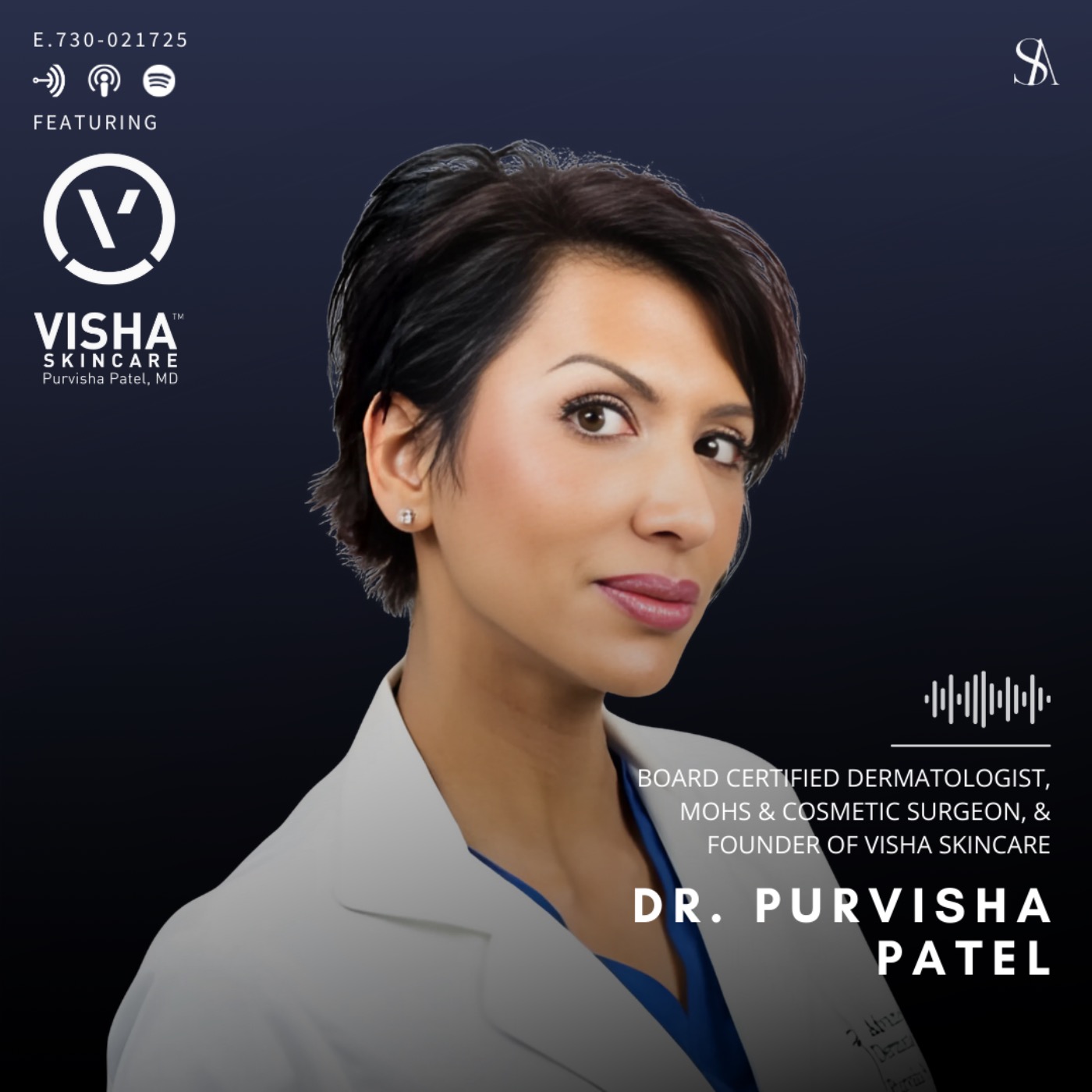
Loading summary
Transcript81 lines
- [00:00]
A
Hey guys, welcome back to another episode of Skin Anarchy. This is Ekta. I'm really excited about today's episode because we're going to be interviewing a wonderful dermatologist that has this great skincare line that I've really fallen in love with because all the products are genuinely something that you need in your collection and that you can really benefit from. Whether that's body care, facial skin care, maintenance skin care, they're really tried and true product. I feel like we need options like that for truly genuine good skin health. Like we need tried and true options. So without me ranting too much, I would love to introduce you guys to Dr. Purvisha Patel, who is the founder of Visha Skincare and also a board certified dermatologist and Mohs and cosmetic surgeon. Welcome Dr. Patel. I'm so excited to host you.
- [00:43]
B
Oh, that's so kind of you. That make me so happy that you like the products. Yes, thanks for having me.
- [00:47]
A
Yeah, no, I genuinely love them, you know, and I not only for the products that are meant for our facial skin, which I know everyone obsesses over, but your body products are amazing too. Like you've just really knocked it out of the park and I can't wait to dive into that. But I really want to learn about you and your background because I, I find it so interesting to learn how dermatologists decided to become dermatologists. So if you could walk us down memory lane and tell us a little bit about yourself.
- [01:12]
B
Yeah, absolutely. You know, I was born in London, raised in Wales and my parents came in true Patel fashion into the motel industry in Kentucky and then grew up in Virginia and went to University of Virginia undergrad, med school, University of Tennessee dermatology residency, University of Louisville for cosmetics and most micrographic surgery. The decision to become a doctor was my parents idea, but the decision to be a dermatologist was my idea and something that I really wanted to do because the skin's the largest organ of the body and we get to see all ages, we get to see children all the way up to to end of life and infants and we also, we're like little Sherlock Holmes. So I think for me in particular I just have a good photographic memory and through all the studying and everything, dermatology came naturally because it's more of a visual diagnosis and visual learning. And so I chose it because it was path of least resistance. And because of that on a daily basis, whether I'm doing skin cancer, most micrographic surgery, or I'm doing cosmetic surgery or facelifts, or whether I'm doing my skincare or just treating acne and rashes, it comes easy. And so because it comes easy, you love what you do, right? You just. Yeah, you're not working at all as you're doing what you love. And so you never really work a day in your life.
- [02:35]
A
I feel like a lot of, you know, I'm Indian as well, and I feel like a lot of Indian doctors, we go into it because our families are, like, super, you know, like, pushing us, like, go into something, like, stable, and then you end up falling in love with the field. So I love that you have that, you know, that story. That's really cool. But, you know, I want to learn. When you decided to start your own.
- [02:52]
B
Line, you know, that's a really great question. You know, I was a solo practice. I run my own practice called Advanced Dermatology and Skin Cancer Associates. And the original office is in Memphis. Then we have now we have offices in Olive Branch and in Arlington, Tennessee. And we're going to open in Oxford, Mississippi, as well. So I think initially being in the south, as a brown female dermatologist, I got a lot of patients coming of skin, of color, people who wanted to see a brown dermatologist. And one of the biggest, even across cultures, all skin types, I would say, is dyspigmentation or hyperpigmentation. When the melanocytes in the skin get bigger and you can see them with your eyes. For example, in lighter skin tones, it might be freckles and sunspots or seborrheic keratoses and Lenigo, things that happen from the sun as you get older. And in darker skin tones is post inflammatory hyperpigmentation or spots that we get after like a little footprint from an acne scar or something that broke the skin. That was kind of a uniform theme. And I knew back then, this has been like 16 years, that hydroquinone, 2% was going to go off the market. And so we knew that that was going to be a dangerous thing for people and that, you know, the ability to get bleaching solutions and lightning creams over the counter was not going to happen anymore in the United States. And so I said, well, let's look at the alternatives. Let's go to the lab. And I actually called a chemist who's now the head of my whole visual labs. He's amazing. And I said, listen, these. These are ingredients that I know lighten hyperpigmentation. Like, these are all melanocyte inhibitors, you know, like. And I need you to look and see, like, how we can put this in some sort of formulation that's not going to be too caustic or irritating for someone, and that is actually going to make the same results as the hydroquinone 4%. So that's what prescription product we use in the office as a dermatologist. We will start with 4% hydroquinone, and we'll go all the way up in concentration, depending on what we're trying to treat. And so I said, I need it to work like hydroquinone 4%, but I need to be safe, to be over the counter so people can use it to address these things. He's an absolute genius, and he came up with illuminotics. And it's actually just a patented blend. And it's got known tyrosinase inhibitors, it's got known inhibitors of the chemical that makes the skin darker or makes melanocytes get bigger. Using ingredients like azelaic acid, licorice, kojic acid, malic acid, were able to create a patented blend. And we. So we patented it and blended it. We blended it first and then patented it because it proved in clinical studies to work the same as a 4% hydroquinone. And then we were so happy, we put it in our hero products, which are the serums.
- [05:31]
A
That's so cool. I love that you did that. Because honestly, I've had this conversation before. I think it was pretty early on, you know, in the podcast, where I used to be, like, kind of concerned about some of these conventional actual medications. Because I. I don't know, I feel like all of medicine is like this where there are just certain drugs that are just. I feel, like, outdated, you know, and I feel like they need to be, like, reevaluated in some ways. And so that's really interesting to me that you really did put in the work to find something specifically for hyperpigmentation. Because I always worried when I would go to dermatologist and they would try to give me hydrocar, I'd be like, I don't want it. You know what I mean?
- [06:05]
B
Like, I was scared as, like, and I was getting that too. But also, you know, this is. It goes back to, I guess, maybe to the Indian dysphoria or maybe just British colonialism. I was always told that you can't go outside in the sun because you'll get dark or your dark, your pimples will get darker, or, you know, you're not going to be pretty because you're dark. And I. I blame that on British colonialism, and I Understand the whole psychology behind it. But that was my mom, right? Like, yeah, that was my mom. And that's her baggage trauma that she gave to me. And so, you know, the concept of bleaching your skin out, like, this is a skin bleach. Use the skin bleach. Here we are. We're growing up in a world where we're, like, trying to love ourselves and love the skin we're in. And I love that now. I've seen it. I've seen it. Like, I grew up in a world where brown kids. I wanted to be lighter. I dyed my hair blonde, had green eyes. I mean, come on. I wanted to be. Not me. And so, you know, I grew up having to love myself and love my skin color. And obviously, I'm teaching my daughter that. But not calling it skin bleach and not having it so strong and not have. So that was kind of important. Like, let's get something out there and, like, make it a skin brightener. But it is going to lighten the dark spots. It's just not going to bleach your whole face.
- [07:15]
A
Yeah. And I love that you brought this up. Honestly, I think anyone who's, like, of Indian descent or anyone who's of color that's grown up in a culture outside.
- [07:23]
B
Of the US or in a British colony.
- [07:25]
A
Yes, exactly. Exactly. Yeah. See, it becomes this real topic where people are genuinely harming themselves trying to, like, get this lighter skin tone and thank God, like, that, you know, we didn't do that here, you know, but there are so many people that we hear about. I mean, even through, like, our family circles, you'll hear these, like, stories, and it's scary.
- [07:45]
B
In other countries, they're doing IV solutions, right? Like, yeah, Indonesia happens. So part of my market research, you know, just fun fact, but Indonesia has, like, more skin bleaching clinics than anywhere else in the world through IV therapy. And they don't realize that, though, that those Glutathione IVs, and we do them here in the United States, too, but we're, like, marking them under health and wellness. But those IVs are causing endocrine disruption.
- [08:08]
A
That's. I mean, I'm not surprised. I'm not surprised. And that's the. That's the scariest part about it. We. If you can cause endocrine disruption, I mean, that really goes to show you because our endocrine system is so resilient. And I feel like, you know, I had a conversation recently about, like, just, you know, like, colorism and, like, this whole idea of like, inclusivity. Right. And I feel like a lot of times products have been marketed in a way where it's indirectly promoting this idea of you need lighter skin. It's just not true. Like, it's like, we need to get away from that. And so I really like the fact that you're coming from this medical place and you're saying, listen, we can still have beneficial outcomes.
- [08:43]
B
Clear skin. Why don't we have clear, healthy skin?
- [08:46]
A
Yeah, exactly, exactly. No, I love that. I think that's really brilliant. And you know, I want to actually ask you a little bit about that, you know, just to kind of educate anyone out there who does have like, like, you know, really bad hyperpigmentation or they're worried about it. Where should we start? You know, I know your products are amazing, but like, just a general understanding of like, what they should know.
- [09:05]
B
So these molasses or pigment producing cells are not evenly distributed in our skin at birth. And so a lot of times, even genetically, some people, as they get older, with ultraviolet radiation. And you look, when it comes to dyspigmentation, we have to think of the blue light or high energy visible light coming off our screens as well because that contributes to hyperpigmentation. So we're not, you know, skin cancer. Yes, the sun hyperpigmentation, we're talking about sun and blue light. Some people are on their computers all day long. They're, well, how come I have all this discoloration? Well, it's because it's coming from your computer and your screens, from your job. You know, not necessarily from sitting next to a window or being outside in the sun, but melanocytes, they protect your skin. That's their job. And so when they get any kind of ultraviolet radiation or blue light radiation, these cells actually create tentacles and go to the top of the skin and kind of fan out and they make melanin, right? They're making pigment because they're trying to protect the skin from the ultraviolet radiation. And so what we're seeing with the naked eye is dispigmentation. We're seeing discoloration, we're seeing sunspots, or we're seeing darkness. Wherever we had a pimple or our line, wherever we had a scar, because melanocytes are acting up in that area and they are activated by ultraviolet radiation from the sun. Blue light, of course, and heat and inflammation. And we don't talk about inflammation yet. We eat complete garbage that creates inflammation in our bodies. Right. So gut health has to do with skin. Yes, I said it. These Are all things that contribute to these melanocytes getting excited? And when they do that, that's when we see them with the naked eye. And so, people, the first thing you can do to protect yourself, of course, is use a mineral SPF greater than 30 and it has to be tinted. So if you're going to go for the light coming out of the blue light coming out of the screens, then you want to use a tinted mineral sunscreen because the tint has iron oxides in it. And that's going to get that blue light component.
- [11:08]
A
Oh, wow. I didn't know that. Yeah, we know about the tinted thing. That's interesting. So you are you, like, completely. Like, do you not believe in, like, the chemical sunscreens? Like, what is your take on that?
- [11:17]
B
Well, I'm a skin cancer surgeon, so I believe in, like, any sunscreen.
- [11:20]
A
Yeah, yeah, yeah.
- [11:22]
B
But I'm a ride or die mineral block.
- [11:25]
A
Makes sense. Yeah. I've heard a lot of people, like, kind of argue for both sides, but that's interesting. I mean, I like mineral as well, you know, so I, I use mineral. And I think a lot of people out there are. They've kind of shifted lately. I've been hearing that a lot people are switching from their chemical base to like, more mineral. And I don't know what the reason for it is. I know there's a lot of information out there.
- [11:43]
B
There's hypersensitivity. Yeah. Some of the chemicals, the oxybenzone and those, they can create irritation. Like, some people can have sensitivity around their eyes. You know, it can burn and so it can create inflammation. And I think that's one thing. Also, like, chemical sunscreen stings your eyes when you sweat, right?
- [12:02]
A
Yeah.
- [12:03]
B
So if you're outside sweating and you're protecting yourself from the sun, it can get kind of irritating and then, you know, reapplication. There's lots of reasons. I mean, I think, honestly, and I tell this to my patients all the time, the sunscreen that's going to be best for you is going to be the one you're actually going to wear every day.
- [12:17]
A
And I want to get your opinion on this because I feel like social media has kind of gone haywire, you know, with all of the information. I mean, I know there's a lot of really great people out there trying to educate, tell us about what we should do and should not for our skin health. But, like, what do you think the influence of TikTok and Instagram, you know, there's a lot of people claiming to be doctors These days. And you're just out here telling people all this stuff. And so there's a lot of people influenced by that. What's your opinion about all that in terms of how people are getting their knowledge and then utilizing that knowledge for their skin health?
- [12:46]
B
There's just so much out there, I think, and even you have to be aware, and I'm a board certified, certified dermatologist. You have to be aware that we get paid by companies and skincare lines to create posts and promote the products. And it's very, very sneaky how we are told to do that. I mean, we post. I don't because I have my own brand, so nobody wants me. But you know, like the, a lot of my great friends, you know, it's like a wonderful revenue stream and they truly do believe in their product. The products that they're promoting. They put a post and you don't see like paid advertisement. You see hashtag partner. That should be a red flag because I mean, not to be rude and I don't want to like, hate on certain brands, but like Cerave and Cedar has no great ingredients. They're just not irritating. That's their bonus is like we relied on them over Covid because people couldn't get to see a dermatologist and we didn't want them to use products that were going to harm their skin. And so there was this huge uptick and these brands that are really, I call them like basic brands, like, they're, they're great, they're great for washing your face and using a moisturizer, but they're not going to change your skin.
- [13:59]
A
You know what's crazy? I love that you said that. And by the way, I'm stealing that. The basic fish brands, like, I'm stealing that phrase. It's my new favorite phrase because I had this like, kind of, I don't know, I was like traveling a lot and I didn't have any of my skincare that I usually use. Right. And I ended up going and buying a bunch of like, drugstore stuff. And I felt like literally my skin went from like, I would say like a 7 out of 10 to like a serious like 3. There is a difference. And I feel like there's been this argument before where I've seen it, you know, on social media where people are like, well, you don't need to be like, you know, going crazy with where you buy your brand or what brands or where you buy your products or what brands you purchase. It's all the same. And I'm like, no, it's really not.
- [14:38]
B
But also, everybody's skin is different, Right? Like, there's going to be somebody that uses a brand that doesn't work, right. For my skin, it's going to be great for them. And that goes back to, like, you know, I'm going to say, like, the first thing I tell patients is, you need six glasses of water, eight hours of sleep, multivitamin probiotic, probably no sugar, no dairy. Right. And then I'll say, if they're inflammatory condition, I'll say no gluten. Like, let's. Let's talk about gut health first. Like, let's calm down the inflammation. We have to understand, like, the skin's the largest immune organ of the body. The gut's the second largest immune organ in the body. And so what we eat is actually really important because food used to be medicine, and so everyone's different. Even products that we use in our skin are not going to be the same uniformly.
- [15:19]
A
Gut health is something that I feel like it's becoming another buzzword, and it's really. It irks me when I see that, because it's a really complex field, and we need to understand that it's crazy that we're still doing this, you know, And I just hope someday that consumers are going to wake up and be like, what am I actually doing? And how does the body actually work? You know, but going to that, like, the gut health thing. I love that you mentioned that because you had earlier mentioned inflammation, and I'd love for you to speak a little bit more about this.
- [15:45]
B
Yeah. So foods, for example, sugar and dairy, right? It's broken down very easily by the bacteria in our gut, and it overgrows. And when you get an overgrowth of some bacteria, say you're not eating enough fiber, right. Then the bacteria in the lining of your gut starts eating through the mucous membrane, like eating through your own gut, right? And then it comes into contact with all these little packets of immune cells. We have all this lymphatic. We have all these little. We have, like, in this little cilia in our gut, there's. Your immune system's right there, right? Because it's the barrier between the body and the inside. And, like, the skin is the barrier between the outside and the body. And so you. That revs up the white blood cells and creates an inflammatory cascade, and that in turn creates inflammation in the blood, which makes acne and rashes worse.
- [16:38]
A
I never. I never see people talking about that. Like, it's always like, well, I'm inflamed and like they're talking about something that looks like rosacea. Honestly, you know what I mean? It's not even like a normal skin condition, but that's where, that's why I wanted to ask you because, you know, inflammation has this really broad. I feel like there's a lot of stuff going on, you know, out there in terms of knowledge around inflammation. But they're not talking about it like.
- [17:00]
B
This because the skin is the largest immune organ, so it's exposed. Let's talk about eczema. Eczema is an inflammatory condition. If you're taking hot showers and you're not moisturing after you moisturizing or you come out of the shower, like everyone in the winter, the skin cracks like cracks in the pavement because there's something called trans epidermal water loss, which means the water that's on the skin evaporates and then the skin cracks. And like cracks in a pavement, the nerves get exposed to air. Just like a paper cut. When the little, these tiny little cracks and tiny little nerves get exposed to air, what's going to happen? It's going to itch. So we scratch and we scratch this huge traumatic fingernail event right on the skin. And that creates inflammation.
- [17:40]
A
Yeah, right.
- [17:41]
B
Wound, wound healing. It creates like redness, histamine release from the mast cells. I mean it's creating pain which could be perceived as itch depending on what nerves are firing. And so that is eczema. And so the way to prevent that is to seal the cracks. You can use a steroid cream, but you can seal the cracks. But say you already have cracks skin and you already have an inflammatory process increasing the inflammation. By increasing like your inflammatory, like foods and things that you eat, you can easily increase that inflammatory response unnecessarily. So I'm not saying like, oh, you know, eating clean makes will make you not have any rashes, but what it will do is calm what you have down. And most people who have eczema do like they figured it out, they're like, oh yeah, when I eat this, my eczema get worse, gets worse. Or when I'm stressed out, this is what happens. I mean people who live with eczema. Eczema is a genetic condition where it's effect in the skin's ability to retain moisture. The water evaporates too fast and doesn't stay on. So that's called as atopic dermatitis. But you know, I think people who have it and they have it for their whole lives, if they figure it out, it's like, throughout their lives, they'll figure out what works for them.
- [18:50]
A
Right, yeah, that makes sense. I mean, also right now, I feel like there's an uptick of, like, a lot of autoimmune conditions kind of popping up, especially in the West. I mean, I. I know I've seen. There's been a huge change. For example, a lot more women are being diagnosed with, like, Hashimoto's, whereas, like, 20 years ago, it wasn't even common. But, like, I feel like every woman has something going on these days. And. And, you know, there's many contributing factors to that. But, like, in terms of skin health, what is your opinion on that with all of these new emerging conditions?
- [19:19]
B
Yeah, and I just think that has to do with inflammation. Right. Like, these autoimmune conditions are inflammatory. So then you will have an increased level of inflammation in the skin, which means if you did have acne, it might be a little worse. Or if you did have eczema, it could be a little worse. You know, you have to treat. I don't. You know. Yes, yes. I'm a dermatologist. I have. I have so many creams to give you, including, like, Vicious Skincare. Face Defeat was made for eczema. Right. But, yes, I. Barrier repair. Will repair the barrier.
- [19:47]
A
Yeah, no talking about. I want to talk about Visha a little bit now, because I love the brand. I really love it. I think the offerings you've created and the formulas are really brilliant. Your advanced purifying cleanser, I've been obsessed with this one. I feel like I don't need that exfoliator anymore because I was kind of like that consumer that hated having to carry around two or three different kinds of cleansers because it just felt so ridiculous to me.
- [20:11]
B
I'm personally a huge fan of that. I have to take it with me when I travel, because if I use anything else, I feel like I break out. When I was developing these products, I would see acne patients and be like, well, I can give you these washes, and you use one in the morning and one at night. Or I can. You know, what. What can I do to just come up with, like, a wash that's going to address everything that they need, that they can travel and they won't have an issue. And essentially, when it was a hit, because we were able to treat people fish. It's almost like a legacy, right? When you make something and you're able to treat people that are not your patients, it makes you feel good. We were able to make Something that's helping people in clear acne and seborrheic dermatitis and shave bumps, like for men who were shaving and they get a lot of ingrown hairs. People in the military, they get. There's a big issue with people shaving and getting a lot of shave bumps. And so the advanced purifying cleanser was addressing a lot more than just being a cleanser.
- [21:06]
A
I really like this cleanser because, I mean, it really shows everything you just described. It shows because I found that my skin is more balanced. I feel like day to day, there's different needs, you know, in terms of the cleansing aspect for my skin personally. And even though I consider it pretty normal. And so I think this is such a great, great option, you know, regardless of what's going on with you and whether you have acne, whether you don't. Just a really nice cleanser for everybody. And I just rarely. I rarely see that in the industry. And the other one I want to actually ask you about, this one, I think we had kind of discussed this earlier was the Advanced Correcting Serum. I really enjoyed this serum. Yeah, yeah. This is really brilliant.
- [21:41]
B
This is. This is me looking at, you know, there's some popular dermatology office products that we have that had ingredients in them like C. Ferulic, you know, or, you know, and I said, well, I loved it. And I was like, well, how do I make this better? Like, how can I put a retinol in this and put a skin. Skin brightening agent in this and have the C frolic? So, you know, we were able to put retinol, vitamin C, vitamin E, fruic acid, hyaluronic acid, and the illuminotics. And we were able to create a niacinamide in there. Vitamin C, vitamin E, ferulic acid, niacinamide, hyaluronic acid, and luminotics, which is the patented blend. And this product is just one product twice a day. So it does five things. So instead of having to put your serum on and then your retinol on and then your night cream, you're able to just wash your face, put the serum on, and then put your night cream on.
- [22:34]
A
That's what I found to be so amazing about it is it's not like. Because I know a lot of people claim that, right? They're like three in one or whatever. And it's like, okay, well, really is it though? You know, and I always run into those products that. That don't work for me. This one really kind of blew Me out of the water though I have.
- [22:50]
B
To credit my chemist, the vicious skincare chemist for this. I only knew what ingredients I needed. They are the ones that were able to, you know how hard it is to mix vitamin C in anything.
- [23:00]
A
Yeah. That oxidizing.
- [23:03]
B
They were able to do the C and the retinol together, which I was just blown away that they were able to make that stable. And it is, it's finicky, you know, but, you know, they were able to do that and the fact that it was a serum, so it just sinks in your skin and gives you like the results. It's, it's a results based product. Like you use this, then you can use your moisturizer after. And when we did our clinical studies, we were just blown away. So I have to agree with you. It's one of my absolute favorite products. And it's for men and women too, because men, men don't like using a lot of things. Right. Like if they can use one thing in the morning and one thing at night and addresses everything exclusively, including their discoloration and hyperpigmentation, they're like all for it.
- [23:46]
A
Like, as a woman, like, I can tell you it gets really old having to do like the 15 step routine, like where you're just kind of confused, where you're like, what do I need now? Do I need retinol tonight? Do I not, you know, do I add the vitamin C? I mean, it gets so confusing, especially right now. We talked about, you know, this like age of tick tock, right? Where everyone's like, well, here are my, you know, five things, five serums. And I'm like, like literally three of those are not even touching your skin by the time you put them.
- [24:11]
B
Let's talk about the fact that it doesn't matter. Like I can give you flour, eggs, chocolate and oil and it doesn't mean you're going to get a chocolate cake.
- [24:22]
A
Yes, exactly.
- [24:23]
B
Right. Like you, these individual ingredients that people are using, and there are certain brands that only sell individual, like very cheap individual ingredients. We are not chemists. Like, we're not, we're not. If you put certain things on in a certain order, you can actually undo them. Yeah, you undo the benefits. Or if you mix certain things together, they can actually become stronger and more caustic to the skin. And so, you know, these, some combinations are never meant to be together. So I find that really dangerous. When people do buy single ingredient serums, or for example, they'll put their hyaluronic acid on and then put their actives on after. And then you're like, well, none of it worked. Something has to be said about putting these power ingredients into one formulation.
- [25:07]
A
Yeah, no, I, I love that you, you know, you kind of talked about that because I think that that's one of the biggest. I mean, I look at this industry and I'm just like, literally, that's the biggest money grab I've ever seen in my life is the people that are selling them individually because, honest to God, you're never going to use them to their full. Right. It's never going to empty. The bottle is never going to be empty. So you wasted your money. Right. And two, the ingredients never worked on your skin, so, like, you'll never see results ever. And then people come out and they say, well, my skin care doesn't even work, so I'm going to go use beef tallow. And I'm like, oh my God.
- [25:41]
B
Like, yes, vicious people.
- [25:44]
A
That's why I really, really love this. I love the serum. I think, you know, anyone out there, you guys can benefit from this. Especially like I've been using it and it's just been so nice. Like my skin feels wonderful and I don't feel like I'm missing anything.
- [25:56]
B
And to those beef tallow people, do you smell?
- [26:01]
A
Oh, I don't get it. I will never get it, man. The beef tallow, like, just why I want to talk about. There's a very interesting and wonderful, you know, group of products you have which are, I guess mommy centered, you could say, you know, and I love that. That's so cool to see. We don't have enough of those products, I think. Can you talk a little bit about that, you know, in terms of skincare and how there are certain things that are more relevant to mothers?
- [26:29]
B
Yes. I mean, and this, you know, personally, on a personal note, I actually came up with a mommy line when I was pregnant.
- [26:36]
A
Oh, wow.
- [26:36]
B
Because I didn't want to give up my anti aging products. You know, I'm like, well, I had my kids a little later on and I was like, well, I don't want to, I don't want to stop using my active ingredients. You know, screw that. And so we basically, I basically took the retinol out of the advanced correcting serum and increased the azelaic acid to make that mommy brightener. And essentially it became an even stronger hyperpigmentation product for melasma. So melasma is something that we would call the mask of pregnancy. And so these melanocytes that we just talked about that get bigger with Sunlight can be hormonally influenced to become more sensitive to sunlight. So melasma means that people get dark patches in a mask like distribution usually on the face when they're pregnant. Or even some birth control pills can do it for some females. And it's quite stigmatic in the sense that nobody really wants to have like something that looks like a mustache and they don't have a mustache. You know what I mean? It's just a dark patch. And so that's when they generally do turn to bleaching agents. And so it was nice to have the serum that was the hydroquinone alternative and also over the counter something that somebody just go and get. We are in all J.C. penney's and we are obviously on Amazon on our website and we're looking at more distributors. But, you know, it was nice to have someone just go be able to go get something that you can use on your face twice a day to help with the melasma. Another thing that. And obviously pimples and acne. And with hormones raging, depending on where you are in the pregnancy, there's a lot of people can have a lot of breakouts. The mommy cleanser was made to be not as irritating, but definitely not as strong. Sorry. As the advanced purifying cleanser. But definitely going to get the job done as far as treating and clearing the skin during pregnancy. And then we have the Mommy Bright Eye Booster, which we took the caffeine out. So the reason why the Advanced Bright Eye Booster works so well. Yeah, it's 17 reduction in fine lines and wrinkles and puffiness around the eyes in less than six minutes. And that was done with photography studies. It's because it has caffeine in it. But of course, when you're pregnant, you don't want to. Most people don't want to use products with caffeine in them when they're pregnant, even though it's probably not going to be absorbed in their body. But the mommy Eye booster took the caffeine out and added the umbilical extract, another extract in there to help with the puffiness and lines around the eyes. And that's just something that you probably want to maintain as you go through your skincare journey. Like once you're on a routine and you get pregnant, it's easy to just flip to the mommy line then and you have your serum and your products to use. And then of course, the bump to baby was kind of a favorite because we're able. And I got the idea of this formulation actually from an Allergist that came to my clinic one day when I was practicing and he had come with a drug company and he said to me, I have a cream that prevents eczema. And I just looked at him and I'm like, what? And he goes, yes, I have an allergy clinic in, you know, in New York. And he's like, this cream, I use it on my moms with allergies that have babies that are expecting the babies to have eczema. He says, we use it on the babies and they don't get eczema. And I'm like, all right, we're going to dinner. So I sat down and talked to him about the ingredients and realized he had an anti inflammatory barrier repair. And he literally just gave me the formula. He was like. I said, what if we came up with a cream that the moms could use this on their bellies to prevent stretch marks?
- [30:04]
A
Yeah.
- [30:05]
B
And then when the babies are born, we can use the same product on the babies to prevent eczema. And he's like, have at it. Here's the formula. I don't. He didn't want to have anything to do with it. And so I ran with it. I don't take credit for the formula, but I do add the part where we put some more anti inflammatory ingredients in there to help with stretch marks. So stretch marks happen when the skin is stretched too fast and the collagen can't keep up. It's like cracks. Once again, cracks in the collagen underneath the skin and they can. That can actually get really red and itchy. Right. And so when people scratch that, that causes inflammation, going back to inflammation and can be really uncomfortable, but also can create scarring and long term effects. So this bump to baby is used on the belly as the belly is growing, and then the same product is used on the baby.
- [30:55]
A
Wow, that's really, really fascinating that there's this anti inflammatory, you know, component that can actually genuinely help prevent, I mean, the formation of eczema. I didn't, I didn't even know that we could do that.
- [31:06]
B
Yeah. And it was such a hit that we were, you know, because my. You said, I have three, I have three offices. So basically our beta testing is like all my patients, right?
- [31:17]
A
Yeah.
- [31:18]
B
And so we had all these old men come in and they were all buying this bumped baby. And finally some farmer says to me, like, ma'am, can you. They don't say doctor, they say, ma'am, can you make this so it doesn't say a baby on it? I thought yeah, sure. That sounds like a really great idea. Let's put the same stuff in a, in a container that says face to feed. And that was that.
- [31:47]
A
Wow, that. So that's, I mean that's really brilliant though. I don't think there's anything else like that. Right. That I've seen. I haven't seen any product that can do that. Okay. So in terms of like the anti inflammatory, I want to kind of rewind a little bit because you said that if you put it on the baby when they're born, it's not, they're not gonna.
- [32:02]
B
It's barrier repair. We just talked about atopic dermatitis and how that's caused by the inability of the skin to retain moisture and the water's evaporating. And the way to prevent that is to seal the craft cracks so you're feeling the cracks before the rash can happen. He was right. He was right.
- [32:19]
A
Like you haven't, I haven't seen much preventative care in like OTC products. You know, when it comes to dermatology. I just don't see that like in the industry. But that's really, really fascinating.
- [32:29]
B
Well, it's going to. The science of it. The root cause.
- [32:31]
A
Yeah, yeah, absolutely. That's really cool. I think that's something all everybody can benefit from then, I mean, because I know I'm getting like drier skin as I'm aging. I'm in my late 30s now and I'm literally like, my skin used to be oily and it's like all of a sudden feel a desert, you know. So I think about this stuff all the time where I'm like, my skin is drier. So what does that mean for me in terms of the inflammation? And I feel like that could really help as well in that.
- [32:56]
B
Absolutely. And estrogen has something to do with it too. Right. So, yeah, like the rejuvenating moisturizer was made for face, neck decolletage and vaginal skin. So no one talks about how the skin on our bodies change even when we have our periods. Some women are so sensitive, they even know when they're going to have their period because of the way they're skin changes or their, you know, they, they feel in their body. We were looking at what's happening. We're. Well, we're losing barrier repair. We were losing skin barrier because estrogen levels are declining and we need to repair that and get the moisture back in there and then have something to boost it. So we used phytoestrogens actually with the rejuvenating moisture because you didn't want to use hormones.
- [33:38]
A
Yeah.
- [33:39]
B
And then we did studies to show that it didn't increase in. We did different BMIs to show that the, there was no increase in blood level of any, of any hormones or anything like that. But the rejuvenating moisturizer addresses that estrogen decline. And nobody talks about labia.
- [33:55]
A
Yeah. Ever.
- [33:56]
B
Like, nobody cares or people are embarrassed to talk about it. Like everything starts to hang, everything starts to tag. You know, everything starts to fall. And so we need to, we need to look at that. This is our body. We know we're talking about feeling and looking great and longevity. We're talking about, you know, feeling good about ourselves. Like, why are we just putting stuff on our faces?
- [34:18]
A
Exactly. And also like, when it comes to this whole conversation with like anti aging this anti aging that, it's like at some point needs to stop being anti aging and you need to start thinking about true like, like solutions, you know, solution oriented care. And that needs to be at the forefront. But unfortunately we're so wrapped up in like our forehead wrinkles, you know, and that we're not thinking about like. Yeah, you know what I mean? It's like, it's not even talked about, like you said. And now we have like, I think a lot of like times I noticed this where we have sexual wellness brands. And I'm like, you guys are focusing on everything except what is like actually relevant when you start aging. Because it's, it's just not a topic of conversation, you know, that you have dryness and it's a real thing women go through and you know that yada, yada.
- [35:01]
B
Well, we had to put, we put rejuvenating moisturizer. The way we spelt rejuvenating was the capital V because it was meant to be very subtle. And when we were doing our beta testing, it seemed like the women preferred that because, you know, they don't want something that says like coochie cream on their cabinet. You know, they want something that they can have on their bathroom cabinet. And no one's gonna, I don't know, maybe it's just the south. But they, you know, that was. Seemed to. We asked patients, like, what would you use? Like, what kind of packaging would you use? Like, we had, we got feedback. You know, we were asking women, like, you use the product. And the reason I knew it was successful, it was really funny because I sent out little tiny little jars of cream out. I think like 10 ladies came in one day and I said, oh, I'm Going to send this. And within, like, a day, these same ladies were sitting in their cars when I walked into the office the next day. And my manager's like, what did you give them? They want more. I was like, sure. So I gave them another few jars. And then finally someone says something, and she's like, how many times do we have to get these small jars? You're just going to give me a big jar of this stuff? And I'm like, well, we're trying to see if it works, and we have to get your blood levels. You know, we just want to. This is. We're testing it for formulation. She's like, this is it. I want this stuff. I want this stuff in a jar. And I'm like, okay.
- [36:12]
A
Love that your brand is so founded in actual patients and, like, what actually goes on with our skin. I cannot commend you enough for that. I feel like, you know, with Visha, like, you've really accomplished that, where it's like, you have a brand that you're going to stick to and you're going to want to use over and over again. So I really encourage anyone listening, like, if you guys are sick of switching products and trying to figure out what the right balance is between your 15 different serums you have, like, you need to just drop all of that and actually get behind a brand that's going to work. I mean, this is really great stuff that you've done here, you know, Dr. Patel, I love it. I love it so much. I would love for you to kind of give us some words of wisdom for anyone that's listening and wants to go into medicine. Dr. Patel, about, like, you know, any. Anything you can offer in terms of guidance or advice.
- [37:00]
B
Love mentoring students, and thank you so much for your kind words about the wanting to do medicine is wanting to give to humanity and anybody when we grow up, you know, they say, oh, medical school's hard. There's so many people that will try to discourage you along. Nothing. I mean, every. Nothing is difficult. It's as difficult as you make it right. You can. You need mentors. Get the mentors. You need the help taking the test. Get the help taking the test. What you should want is to help mankind. You know, you want to help other people live and be strong and get better. And I think that's the basis of all the doctors that I know is that we've woken up one day saying, this is how we're going to love humanity. We're going to love the world. We're going to give love by healing. If that's what you want to do, then get. You can, you can contact me, I can plug you in with universities around where you are. But people who want to go into medicine, you'll know when you want to go into medicine because you want to heal. And that's your way of giving, giving back to the universe, you know, and I think that's, there's lots of ways to heal. You don't always have to practice medicine. I mean, you can heal people with words, you can heal people with music, you can heal people lots of different ways. But medicine also is food, right? You could, you could be a cook, you could be a chef, you could be a nutritionist, you could be a dietitian, you can be a fitness instructor. This is all medicine. Medicine is thing are things that you do for the well being of your body.
- [38:24]
A
So glad you said that because I feel like people do put things into this like big box, you know, of like I have to go this route or I'm never gonna.
- [38:32]
B
We are not just pill pushers, you know, we're not.
- [38:35]
A
For anyone listening that does want to go into medicine, please really take those words to heart and, and do it for the right reason. You know, I completely back you up with what you said. But yeah, you guys check out Visha Skincare. It's amazing. I promise you're gonna fall in love with it. I definitely did. And it's, it's something that actually works, like I said before, but Dr. Patel, thank you so much. It's been so.
- [38:54]
B
No, thanks for having me. It's been an honor.
- [38:55]
A
Yeah, no, the honor is mine, truly. And I can't wait to have you back if you ever have time.