← Skin Anarchy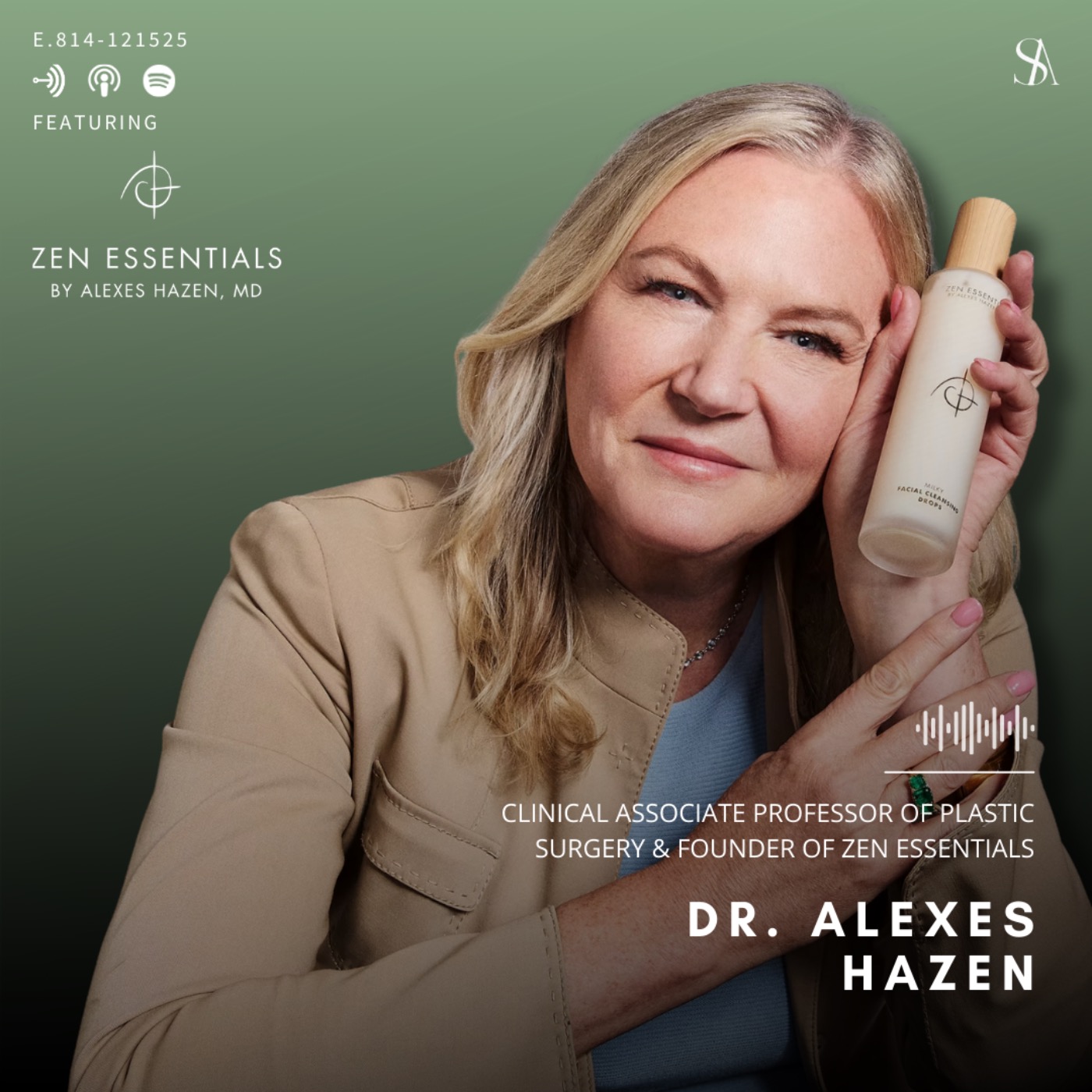
Skin Anarchy
Healing Sensitive Skin by Caring for the Whole Person with Dr. Alexes Hazen, Founder of Zen Essentials
00:48:43
Loading summary
Transcript143 lines
- [00:00]
A
Hey guys. Welcome back to Skin Anarchy. Today's episode is very special because we're going to be talking to a true expert in the space of skin health. She is truly accomplished in the, obviously the medical field and her practice, but then also has a beautiful line called Zen Essentials, which I really, really love, the whole range and I can't wait to dive in. So without further ado, please welcome Dr. Alexis Hazen. Welcome, Dr. Hazen. I'm so excited to host you.
- [00:23]
B
Hi. It's so good to be here. Is. And, and we've been looking forward to talking with each other for a long time. So I'm super excited to be here.
- [00:32]
A
Yeah. And it's been a long time in the making and I'm glad we're doing this because I have so many questions for you and I love the line and I can't wait to dive into all of it. But I really kind of want to start with your, your medical journey. Like where did you know you wanted to be a doctor, like at an early age or how did you land into medicine?
- [00:49]
B
Yeah, it's such, it's kind of an interesting journey because. But now when I look back and I put all the pieces together, I think I did kind of know, but some part of me didn't know. So I ended up going to college, being a history major. When I graduated, I really didn't know what I wanted to do, but I had this vague idea that I wanted to do something in healthcare, but I wasn't really thinking I wanted to be a doctor. So it was 87 and I worked for the New York City Department of Health doing AIDS education. AIDS was a really big problem then and we were doing prevention education for IV drug users, among other things. And through that experience I sort of fell in love with the idea of medicine. But meanwhile I hadn't done pre med, so I applied to a post baccalaureate pre med program and I also applied to the United States Peace Corps and I got a assigned to Honduras in the health sector. So I decided that probably wasn't something I was going to do after med school. So I went to the Peace Corps and worked in the health sector and then really got a lot of hands on experience, worked with local health center, doing everything from like giving vaccinations to doing talks in. I was in Honduras, so it was in Spanish on health and disease prevention. I did a latrine project, water projects, everything with about the most basic health care. And I came back, went to Bryn Mawr for a year to get my pre med Requirements and then went to med school. In med school I sort of thought I would do something in international health and because that was what my experience was. And then I fell in love with surgery and specifically plastic surgery and ended up doing a residency in plastic surgery and then a fellowship in microsurgery. But brings it full circle is when I was a kid, very young too, I was burned very badly. I had an accident and I burned my face, my neck, my shoulder and I had plastic surgery. I was in the burn unit at New York, what was then, I guess Cornell, now it's Weill Cornell and there wasn't even a burn unit. But so I had experience with plastic surgery from a very young age and, and it was always something that I was sort of interested in. And then it kind of circles back to the development of the skin care product line because I was always interested in scars. So that's kind of my short version of a long journey.
- [03:31]
A
Yeah, no, I mean it's really inspiring because I mean you've been pioneer in merging this idea of wellness as, as well as plastic surgery. And I think that's very rare in the field because it's either one or the other. And it's never like this world where we're being truly holistic and we're being multidisciplinary. And so I would love to get your take on that in terms of like what truly inspired you to bring that holistic lens into such a technical discipline.
- [03:58]
B
It's such a great question. Well, I think it is really technical. I mean your point is really well taken because a lot of what we do is very detail oriented and technical. I did a fellowship in Microsoft Surgery which is literally working under an operating microscope where you're sewing very tiny things back together like blood vessels or nerves or, or the like. And so there really couldn't be anything much more technical than that in, in surgery. But what I noticed so that always fascinated me and I love that aspect of it and I also love the creativity of it. But what I noticed is that patients did, didn't do well if they weren't all, if they weren't taken care of in terms of their whole being. So if someone was really anxious, their pain would be out of control. If someone didn't have a good like home healthcare team and I, and I'm not talking about trained nurses, I'm just talking about support, then they wouldn't do well. And so I noticed that just like if you didn't have basic ingredients in terms of stable environment, basic healthy habits And a way to sort of calm your mind and find peace that you didn't do well with surgery and especially with the recovery piece. Like, you might be okay pre op, but post op, dealing with pain, if you have anxiety, if you don't sleep well, if you don't have a good diet, if you don't hydrate, like all those things are a real problem for people post op. So I just started incorporating it into my practice and really just the first thing was just like asking the questions, like, are you anxious about having surgery? What are you worried about? And then sometimes it was a simple fix. Like, yes, I, I've never been in an or. I've never been in a hospital and I'm really nervous about doing that. So, you know, we literally would have people go do a tour of the hospital or go take a look at the or, or speak to the anesthesiologist ahead of time. So sometimes it could be something very, very minor and then in other cases it would be a whole thing of, okay, I don't have BMI cutoffs. A lot of surgeons just have like a strict, you know, I don't operate over people. A certain bmi, I don't have that, but I have. Do you have comorbidities? So sometimes I, it would take a patient, you know, a year to get ready to be a great candidate for surgery because their hemoglobin A1C, which is a marker of kind of long term elevated sugar in the blood, might be high. And so you want to get that down to a normal level. But then sometimes it was a simple fix, like, okay, we need to get you a post op pillow so you can be, your head can be elevated. But it really was about noting that people just do so much better if they are healthy going in and supported going in and kind of know what's ahead of them.
- [07:13]
A
Right? No, that's a really, really like such a strong point that you made. It makes me really think about how we are approaching just skin health as well. Because there's this whole component of management of expectations almost that doesn't really get addressed. And I always wonder about that because I think obviously from your reference point and you're used to this with your patients, you're used to like the, like having to explain to patients like what to expect. But like a lot of times brands, I feel like, don't take that into account. So like you have people that are expecting results that are beyond a topical solution and then they get frustrated and then we have this like snowballing Happening in this industry where it's like. You know what I mean? So.
- [07:59]
B
No, no.
- [08:00]
A
Yeah. It's a.
- [08:00]
B
It's a very good point. Well, the thing that I think fascinates me about skin and skin care the most is that, as you know, your skin is an organ.
- [08:10]
A
Yeah.
- [08:11]
B
And it's the biggest organ in the body, and it really reflects your health. If. If you don't think that, just start looking around at people who you consider healthy and look at their skin, and then think about people who, you know, who are not healthy, who have very bad diseases and look at their skin, and it's just. It's like a. It's a mirror of exactly what's going on in the body. So to your point, if you think that you're just gonna buy some topical stuff and it's gonna make you look healthy and vibrant, that is erroneous thinking. Yeah. You know, and I think a lot of people do want a quick fix, but a lot of people really do want to turn their life around and want to be healthy. And your skin, there's just almost no way it's gonna look great if you're not taking care of yourself in the most basic, important ways.
- [09:07]
A
Right.
- [09:08]
B
What are those things? I mean, it's. It's such. It's really basic stuff. It's eating well, it's being hydrated with fluid, and it's getting enough sleep, and it's managing your stress. And if you can do those things, then that you're, like, so far ahead of the game, and then the things that you put on your skin will really have the opportunity to make a huge difference. And I do believe. I mean, I think skin care these days and skin products are incredible. There's tons of amazing stuff out there that can really make you look much more vibrant and healthy. But you got to do the other stuff as well.
- [09:51]
A
Right. No, that's. I love that. And I love that you said that, because one of the big questions I do have is when you look at the field of plastic surgery, I think for a long time, especially back in the day, it was all about reconstructive surgery. And that. That was like, the real heart and the core of it, and I love that. But now, when the way the field has evolved, and, I mean, you can speak to this obviously much than I ever could, but the way I'm seeing it with reconstructive surgery, it was more of, like, fixing a problem. And now it's almost like sometimes I see people who come out of a surgery and then you see their results, and it's almost like problems were created that weren't there before. I just want to hear your thoughts on this whole ethical dilemma that I feel like we're facing in this field, especially with maybe surgeons that aren't as trained as they could be before taking on certain cases. Like, what are your thoughts on that?
- [10:40]
B
Well, I mean, I think it's potentially a huge problem, and I think that patients have to be really, really careful in selecting their surgeon. So one of the things that we talk about a lot is making sure your surgeon is board certified. And board certification is a very rigorous process and it involves training for years and then a series of exams, usually oral and written, and then a ME maintenance of certification that's required over years, which usually means more examinations and taking educational courses. So I think that's sort of one gateway into making sure that you're getting the right person. But then what's the right thing?
- [11:30]
A
Right.
- [11:31]
B
I think that one of the problems is due to greed and patient demand, sometimes the wrong thing ends up happening. So that can mean that someone who's not a good candidate for a particular surgery ends up having it because they want it really badly. And the surgeon isn't ethical enough to say, you're really not a good candidate and you're not going to get a great result. I think because of all of these, these sort of TV shows that showed incredible results from a bunch of, you know, really, now we're talking cosmetic plastic surgery. People have some very unrealistic expectations about what's possible. And that has been a real disservice to patients and to surgeons. So I think managing expectations, finding someone who's highly qualified, and then sort of even a broader topic. At some point, it's important to accept who you are, the body that you've been given, the face that you've been given, and come to some kind of love and acceptance of your basic sort of structure.
- [12:52]
A
Right.
- [12:52]
B
I think it's. To me, it's sad when people really reject all that because, you know, all of our bodies are potentially incredibly functional and could be very healthy and provide us with all that we need. And so it's sad to me if somebody really kind of rejects many of the things that they were born with.
- [13:14]
A
Absolutely. And then when it's validated, their rejection is validated. Right. By like a professional or something. Yeah.
- [13:21]
B
One of the things that kills me is every now and then I'll have a patient come to me and. And they've gone to their surgeons for opinions about, let's let's just say breast or whatever it is. Think cosmetic. And they will sometimes say to me, what do you think I need? And I sort of say, I don't think you need anything. I mean, what do you think you need? It's not my opinion. It's what. What bothers you. What do you want to be different? And some surgeons literally will have the patients. They'll examine the patient, and then they'll tell them what they, quote, unquote, need.
- [14:03]
A
Wow.
- [14:03]
B
And I think that's just such a bad message.
- [14:07]
A
Yeah, yeah. That's not right.
- [14:09]
B
Right. Like, who am I to tell anybody what. What they. Yeah, it's different. If you have cancer and I'm reconstructing you, then I can tell you, okay, well, this is what needs to come out, and this is what's possible, and these are your options. But that's very different than someone coming in and just kind of saying, I'm a blank. I'm your canvas. What would you do to me?
- [14:33]
A
Yeah, exactly. Exactly. I love that you said that. That's. That's one been my. One of my biggest, I think, annoying things in my mind as this idea of, like, there are people out there that are really telling patients, yeah, I think you'd be better off with a nose job. Or I think we can go this size with your breasts. Or like, it's like, that is not your role, and that's not your lane. And there's no level of medical training that ever teaches you that.
- [14:59]
B
I think it is wildly inappropriate for a surgeon to tell a patient what size breasts they should have.
- [15:07]
A
Yeah.
- [15:07]
B
I think what you can say, I don't think we can go larger than this because of these reasons. And going smaller than this might not make much of a difference. But to go in and say, okay, you're getting 450. Yeah, I think it's. It's. To me, it's insane.
- [15:27]
A
It's insane. It's insane. I mean, I think that's crazy.
- [15:31]
B
And I.
- [15:31]
A
And I also don't understand how we don't have a system in place that checks people like that. That's one of the biggest, I think, snowballing things going on right now in aesthetic medicine is that there aren't these checks and balances put into place that you normally see. I come from the world of trauma, and you can't do anything trauma. Like, there's. Somebody's gonna be down your throat if you even suggest, like. And. And so when I look at aesthetic medicine, I'm like, what's going on what are we doing?
- [15:57]
B
I mean, I, I totally agree with you and I think the other thing that, and I don't know where, where this will end up, but there, it's a really an ethical question. But should we as doctors just be able to charge whatever people will pay?
- [16:14]
A
Right.
- [16:15]
B
Yeah. Or should there be some sort of caps on things? And to me, I understand that this country is capitalist and I don't have any real problem with that. But I do think in medicine, even though we may be doing cosmetic surgery, I think there's some obligation to not just charge whatever you feel like. And the world's so crazy now and there are so many, so many incredibly rich people that people are charging just nutty amounts for what are not, they're not, they're like simple surgeries. I mean it's not like a face transplant, which by the way, I've done, but it's not that. It's things like a facelift. It's a four hour operation. It is not a life altering thing really. And I think facelift is a great operation. I think people do it very well. I'm a impressed with a lot, a lot of the results. But should you be charging $250,000 for that? To me that seems like not being a good doctor.
- [17:20]
A
I agree. Same. No, I am right there. Same wavelength with you on this. Crazy. The other day I actually saw this term and it like blew my mind. I like had to sit there for a minute and it was literally luxury plastic surgery. And I'm like, what are you, what are we putting like an LV logo on this? What are we doing here, guys? I mean this is, this is insanity. Like exactly what you mentioned, like 250, $300,000 for a facelift. And you're now, now they're kind of compartmentalizing it into like, oh, this is a luxury experience. And, and do your training programs know that you're advertising this?
- [17:55]
B
I'm waiting for the societies to have a problem with it. And I sort of feel like I'm almost like Debbie Downer. I'm always on my high horse about this. And it's not that I don't think that doctors should be well compensated. Of course I do. And it's not that I have anything against, personally against the people who are doing this, but I just think on some level it's basically wrong. Yeah, it is. We did take an oath, all of us. And the purpose is to help people. Right? That, that is the purpose. And if your purpose was to make money, well, you should have gone into another field.
- [18:31]
A
Going to business for, for business. I mean, business is going to make you a hell of a lot more money than, than medicine, I'll tell you what.
- [18:38]
B
Right.
- [18:38]
A
I mean, no loans.
- [18:40]
B
Yeah, exactly. Among other things. And you're making money right from the, the get go, as opposed to us who are full time, we're in training or. Right. Like losing money essentially.
- [18:51]
A
No, I love, you know, I love this conversation because this is why I think I have always really appreciated the world of skincare because I think it's a really nice, I think it's a nice world because you don't get too crazy and you, there's not too much that you can really do if you're not doing crazy stuff like DIY and all that. Feel like it gives. It kind of goes back to your point that you made earlier about how people perceive themselves and what they feel like they need. And I think it's just, I feel so much more comfortable knowing if someone's experimenting with things like peptides and growth factors and these things than like, okay, I'm just going to go get a procedure done and change the whole architecture of my face. And it's like, that's where I feel like skincare really shines, is this innovation aspect of it. What are your thoughts on where we're headed with skin care, the entire industry and the innovation?
- [19:40]
B
I think it's kind of a really exciting time in skin care because I think that there's a lot of awareness that we can make a difference in how we look and how we age by taking care of our skin. I think it's something that men and women are realizing and you can really sort of protect your skin and you can help it along by doing things at a pretty much younger age than what we used to think. And then things like big skin problems that are really debilitating for some people, like acne, there just are better and better treatments for it. And I think there's sort of two prongs. One is the topical stuff that you can put on, on your skin. The other is the whole advent of lasers, microneedling, radio frequency and the sort of non invasive types of treatments that can ameliorate a lot of problems. Everything from acne to scarring to rosacea to fine lines and wrinkles or even deep lines and wrinkles. So I think we're gonna see more and more young people using topical stuff at an early, earlier, earlier age. And I think we're going to see lasers and sort of the, I mean, they're not really invasive, but the non invasive skin technology blossoming and becoming more mainstream. Yeah. And I think things like scars will be treated very aggressively.
- [21:18]
A
Yes.
- [21:19]
B
Right after surgery, which I think is great.
- [21:22]
A
Yeah, that, I feel like that's a huge white space right now is the scar. Scar treatment and like really management of scarring from the very, very early stages of like post op and stuff. Yeah.
- [21:33]
B
There are a lot of surgeons that do kind of focus on that, but there are tons of surgeons who don't, you know.
- [21:39]
A
Yeah.
- [21:39]
B
I think in the world of like cardiothoracic surgery, orthopedic surgery, they're big pockets where they're not doing a lot yet, but more and more they are. And usually found in my practice. The thing that changes the way I do things is mostly patient demand. So for example, patients know that you can do things less invasively and they know that there are treatments for scars and they know that their friend had the surgery and their scar looks great. You know that that's really where I think where innovation in a way comes. Patients just demanding and asking questions.
- [22:21]
A
No, I completely, I completely agree with you. I think that's really the, it's like the foundation of making sure that you're getting what you are actually going to get if you don't ask questions. I feel like this topic has come up before on the show where it's like you guys, for all you listening out there, you have to kind of take that portion of your care into your own hands and not be scared to ask questions. Because if there's anyone who's really truly qualified doing work on you or giving you any kind of medical care, they're not going to be scared to answer your questions.
- [22:50]
B
You know, if you are dealing with an educated patient, it's, it's so much easier, such a pleasure. Because then you're, you're speaking the same language in a way.
- [23:00]
A
Right.
- [23:01]
B
They understand the importance of post op care and all the things that are sort of check boxes for doing well.
- [23:08]
A
Absolutely. Now I want to talk about Zen essentials. I love your line. I think it's so beautiful and it's so. It's just such a healthy approach to skin care overall. And I really like that you've made it the way you have because I feel like the big white space that no one's really addressing in the skincare space right now. I mean, yeah, there's a lot of biotech and crazy stuff out here, but like just genuinely good stuff. Skin care. I feel like we're not seeing enough of that where it's like you grab a moisturizer and it does what it needs to do, helps your barrier. It does all the things. So where did the concept really come from for you? Like when did you realize you wanted to create a line?
- [23:43]
B
I wanted to for a really long time and I, I wanted to kind of. I mean it sounds like we're similar in that we've both been fascinated with skin care and products for a long time.
- [23:54]
A
Yeah.
- [23:54]
B
So I was always trying out new stuff and just love to, to mess around with finding new products and masks and what works and what doesn't work. But I never had time to really dedicate to, to doing this because it takes a long time to actually develop products and packaging and all that. But I developed debilitating skin rashes.
- [24:16]
A
Oh no.
- [24:17]
B
Like about five years ago. And I had, it's just sensitive, I always had sensitive skin, but suddenly I had these rashes all over. And I went to every kind of doctor. I finally ended up with an allergist and turned out I developed allergies to a lot of ingredients in your basic skin care stuff and your household cleaning stuff like Tide. I couldn't use even toothpaste and it probably was like a cumulative stress response and I probably had a little sensitivity and then over time it just got worse and worse. So I literally had to start developing my own shampoo. Everything, everything had to be super clean. And so I decided that I wanted to start a skin care line that actually works because the things, there are lots of clean products out there that are one ingredient product. So you could find something, an oil that I could use or I could, but. But I couldn't find anything that had a retinol in it that I could use because suddenly there's perfume in it or there's linoleum in it or there's a preservative that I'm allergic to. So basically I couldn't find a sensitive skin care line that was non toxic that actually works. Yeah. So. And maybe there are a couple, but they smelled so bad and they were so unluxurious. And when I say luxurious, I don't mean exclusive. I mean that it feels great and smells great and looks good and obviously it's not free, but it's also not at the luxury price point. So basically it was really personal need. And then I'm, I've just always been fascinated with like what ingredients actually work. And I wanted something that everybody could use. Young people, old people, different skin colors, different skin types. And one of the things That I found in all my research is that basic. It's kind of like diet and recovery from surgery. Like, everybody needs the same things. If you're a woman or a man, you don't need different things, different amounts of them. But you. We all kind of. Our skin requires the same stuff. And to the extent that we think that that's not the case, it's just marketing strategy because it's hard to market to men and women, all skin colors. And so what companies do is they. They pick a market that they're going to target. And so then they say, okay, this is for postmenopausal women, because you need exactly this. Eh, we kind of all need the same stuff, you know?
- [27:10]
A
Yeah, no, I mean, that's such a solid point, though. That's something we don't really discuss. I feel like now seeing how cluttered the space has become. Right. I mean, everybody's got a skincare line these days and it's like, I'm here for it, I think. Okay, if you think you have an innovative idea, like, definitely come out with what you think is missing. But at the same time, I think you and I were speaking about this before the recording where people chime in every day. I know with us, you know, in our email inbox. And we were getting these questions of like, well, I've got five products that do the same thing, right. Which one do I layer first? And I'm like, pick one, pick one. But yeah, it doesn't matter. And also it's more so like, where do you draw that line of, this is what you need. This is what your skin will actually utilize because it's, it's skin mimetic versus this is just made in this, in outer space. And we don't know what this even does. So that's where I feel like I get very frustrated, obviously, as a consumer, but then for consumers, consumer, it's sort.
- [28:05]
B
Of like if you tackle any topic in the health and wellness arena.
- [28:12]
A
Yeah.
- [28:12]
B
And you kind of do a little bit of a deep dive on it, sometimes it becomes so overwhelming that you end up throwing up your hands and saying, you know what? I, I don't know what supplement to take because they're, they're telling me a million different things. So I'm not going to do anything.
- [28:31]
A
Yeah.
- [28:31]
B
To some degree. Skin care, there are so many products out there and there are so many people saying, talking out of two sides of their heads that it, it is overwhelming. And so for a lot of people, especially people who are new to it, if you're like 40 year old woman who had a mother, who had a skin care routine. You've probably figured something out that works. But if you're like a guy and you're, you're embarking on this or young girls, they don't know what to do.
- [29:01]
A
Right.
- [29:01]
B
There's so much being thrown at them via TikTok or Instagram. Suddenly you're like putting oatmeal masks on your face and raw eggs and. I don't know. You don't know?
- [29:14]
A
No. It's a scary. I don't know if you've seen it and I hope you have it because I feel like you're going to have nightmares. I did. I went on to the dark side of TikTok once and it was the DIY skincare TikTok bad. Oh my God. I swear to you, I had nightmares for a week. I was like, this is some crazy stuff going on here. And like now what is it? There was like a health advisory issued about at home Botox or something crazy like that. Yeah. What is going on? And that's where that. But that's the thing, that's the downside I think, of having all these brands come out here.
- [29:52]
B
True. And, and on the one hand it's great that there's so much of opportunity and on the other hand it's just completely overwhelming. And then the DIY stuff can be, you know, there are obviously some really incredibly practical tricks to reducing cost and figuring out how to do things on your own. And then there's some really dangerous stuff.
- [30:15]
A
Yeah.
- [30:16]
B
It's hard to sort of siphon out what's, what's good and what's not good. But I think one, one take home message that I got from developing this line and from my own personal experience having these terrible rashes. Is that your skin, it's, it's not like a raincoat.
- [30:35]
A
Yeah.
- [30:36]
B
Your skin is an organ and it absorbs things and it absorbs toxins. So if you put, if you look at the back side of your moisturizer and there are 10,000 ingredients in there, half of which are chemicals, your skin's gonna absorb those chemicals and they, a lot of those things are toxic. Is it gonna kill you? No. But it might make you sick, it might make your skin very itchy, rashy, unhappy. So I think we really have to think of our skin, something that, that takes stuff in and can, and that can make you either healthy or unhealthy. And so it's really important to think about, you know, what you're putting on your skin. And I think a good rule of thumb is if something doesn't feel good, if something smells toxic, it probably is.
- [31:35]
A
Yeah.
- [31:36]
B
You know, it's just like when you go into a place where they've just done industrial cleaning.
- [31:41]
A
Yeah.
- [31:42]
B
Or. Or where they've sprayed for bugs or something like that. And you smell and you're like, this doesn't smell healthy because it's not, it's not healthy, you know?
- [31:51]
A
Right.
- [31:53]
B
So you should, anything that's like that you should definitely not put on your skin.
- [31:58]
A
I mean, I've had like, literally I've had founders tell me for like, well, we had to fix the smell of this because it smelled terrible when we first formulated it. And I'm like, that's not good.
- [32:10]
B
So this big take home lesson I learned is so parfum P R F U M. So that is a compound of a bunch of different chemicals. It's not actually perfume. But what it does is it covers up the toxic smell of products. And if you look on the back of probably 75% of the skincare products, it contains parfum. And it's like I said, it's not a scent, it's a chemical that reduces the chemical smell of these products. And so you're absolutely right. If you're creating a product that has a terrible chemical scent, it's because it's full of terrible chemicals. So you don't want to be using that stuff. I have either the fortunate or unfortunate. I'm allergic to, to parfum, so I can't use any product that has that ingredient. But actually that's probably a blessing because I don't think anyone should be using these things.
- [33:10]
A
I agree with you. I completely agree with you.
- [33:11]
B
My products have a pleasant smell or no smell, but it's from essential oils or the actual ingredients. So in the cleanser it smells like coconuts. Like you people always say, oh, I always feel like I'm embarrassing vacation when I use the cleanser. And because it's from natural coconut oil, which is a great way to prevent drying out when you use a cleanser. So one of the problems with a lot of cleansers is they really, they take, they strip too much and so then they dry you out and then any aroma comes from the actual ingredients rather than covering up the ingredients.
- [33:48]
A
Right. No, I actually, I wanted to say to you when I knew you created a beautiful line was when I used it with a retinoid, when I put. And I, I don't know if anybody else has this problem, but for Me, when I use my tretinoin.
- [34:01]
B
Well. Right.
- [34:02]
A
It doesn't layer well.
- [34:03]
B
I get like that weird where you take your hand and it's like the moisturizer is like rolling off.
- [34:09]
A
Yes. The pilling. The pill. Yes, it's so. And also, not only that, it stings for me, like bad stings. And I was like, when I first tried the moisturizer, I remember it was my. On a tretinoin night. And I was like, I'm really gonna put this to the test. And I put it to the test and I felt nothing. No pain, nothing. It was beautiful. Didn't pill. Amazing. And I was like, oh, my God, I love this. I was like, so happy.
- [34:35]
B
Really good point. It's a really good test of products because. Yeah, because we. And we were talking about this earlier that it's so confusing for consumers and patients. Like, what. What do I put on first if I'm wearing sunscreen? When do I put that on?
- [34:50]
A
Right.
- [34:50]
B
And if products don't layer well, it's like a total nightmare because then your last product, like pills and. And you can't smooth it out. And so the whole. It's almost like all for naught. Yeah.
- [35:04]
A
And it's like occluding. There's so many products now that they're all. They're so all in one that they occlude everything else. So if you put on. I know a lot of people chime in and they ask us about the sandwich method, for example, with their tretinoin, and it's like, okay, if your dermatologist told you to do it, by all means, do it. But like, if you're putting on your favorite random super occlusive cream before that tretinoin, you're not getting any benefits of that. Vitamin A. We don't even. The skincare industry doesn't address this. And I feel like there are ways to do it without directly doing it too. You create brands and products that are just genuinely good for the skin. They're gentle, they. They really marry with the skin's physiology. You avoid all of that. And so.
- [35:45]
B
Yeah, and I think the. A big thing now that we're going to see more and more is so in our. In our cleansing drops, there are probiotics. And just like how we now understand a little bit about the gut health and how the bad things that can happen when you go on antibiotics and that when you. Destroys the flora of your gut and how important that is in maintaining your basic health. So the skin's the same thing. So you have Natural bacteria that are on the skin. And you don't want to eliminate them 100% because they're. It's like any kind of symbiotic environment where some of, some of those, those bacteria are actually healthy and you need them because they, they take care of other problems. Just. You just don't want an overgrowth. And then certain bacteria aren't good. So having probiotics, both in cleansers but also in products like moisturizers, you're going to see more and more of that. So our cleanser has it, but now the smaller companies are already putting some probiotics into their creams. The big companies are not nimble enough. They can't change their formulations that quickly.
- [37:04]
A
Yeah.
- [37:05]
B
Because it takes like, it's. It's a major undertaking. But I think it's a really good point that we, we have a lot of natural barriers in our skin. We have a lot of natural, almost like an immune system in our skin, and you don't want to destroy that. And a lot of the products do. They're too harsh, actually. And the cleansers are too harsh. And they strip the skin. And then one of the biggest problems nowadays, I would say acne and then things like rosacea. And those are really inflammatory disorders.
- [37:46]
A
Right, right, exactly. And that's why I think that's the thing. It's kind of funny you bring this up because I had a conspiracy theory for a long time. I think I still do to some degree where I really believed, because there was a crazy stat reported. And I don't know if you saw this, but one of these big companies, right, like these big conglomerate, the really big ones that own everybody, like Neutrogena and all that, they reported that their Studies show that 70% of all people that utilize skin care are reporting to have sensitive skin, and the other 30% are reporting to have sensitized skin. And I'm just like, well, that can't be random. There's got to be a reason for that. And it's. I really believe that we are. There's a lot of stuff going on where people are putting things in products that are literally leading to obviously, barrier disruption. But exactly what you're talking about with the microbiome, this heavy level of dysbiosis that's being induced. Totally agree.
- [38:44]
B
And I think that's what happened to me.
- [38:46]
A
Yeah, it's.
- [38:48]
B
So we're being assaulted by toxins every day. As you live in, like the woods in Alaska, you are. You go outside, we're exposed to toxins and they're not at the level, at the sort of the magnitude where you're going to get cancer from it, but you are going to have a reaction to it and your immune system is fighting this. And this is why there's so many people who have immune mediated disorders right now and inflammatory disorders. And I think it's this assault on our immune systems from various toxins in the air and the water, in the environment, in the food. I mean in this country our food is heavily, heavily contaminated.
- [39:36]
A
Plastic.
- [39:37]
B
It's plastic. I mean it's terrible. It's not so much you can, can you get good? Yes. But it's so expensive that the average person can't afford to be buying their food from farm stands. Yeah, yeah, I completely agree. I think, I think what ends up happening is then this assault shows up on in your skin and your skin becomes sensitive and really it's. Everyone's skin would be sensitive. If we continue this assault, I think it's really important to, to kind of stop the clock with this and try to use products that are going to be more forgiving.
- [40:21]
A
Yeah, I agree. What are your thoughts on endocrine disruptors? How do you feel about endocrine disruptors, what we know about them? Do you think that there's a lot of fear mongering out there or do you think that it's really true what we're hearing?
- [40:35]
B
I think that it, I mean it's a. So first of all for our listeners they are things, they're chemicals that are in skin care and they typically were there to help preserve the products so that the shelf life. Because if you have, if you have no preservatives in a product, the shelf life is like two to three months. Yeah, we, you do need preservatives if you're going to have them traveling and, and whatever. But I think phthalates, I think the synthetic fragrances like I was telling you.
- [41:11]
A
Yeah.
- [41:11]
B
Oxybenzone, parisons, triclosan and these are the hard things. No one's going to remember this and that's okay. But I think that they are not good. Yeah. And I think that I'm not so worried about the reproductive. So the people are worried about them because they're chemicals but because they can potentially disrupt your hormonal cycles which could, if you're a guy is one one way and if you're a woman it's a different way. And then also thyroid and immune function, I think that they're probably in small enough quantities. That's unlikely. It's kind of like causing cancer, you know, it would take.
- [41:58]
A
Right.
- [41:58]
B
So much of these products, you have to use them so often in such huge quantities. But I do think what it tells you is that they're not good, you know?
- [42:08]
A
Yeah, yeah.
- [42:09]
B
That they're toxic. Because if you can, it just change your hormonal regulation, like that's very powerful.
- [42:18]
A
Yeah, that's huge. I know.
- [42:21]
B
So I guess the short answer is I don't like them. The longer answer is I'm not so worried that it's going to disrupt your, your hormonal balances, but I am very worried about it in terms of just your basic skin health.
- [42:36]
A
No, it makes a lot of sense and I, I like your answer a lot. I think it's very, I think more of the more well balanced answers I've gotten because people are like, yes, they're going to destroy your life. And it's like, I don't think we're there yet, guys.
- [42:48]
B
You know, people get crazy about this stuff. It's like they're two extremes though, right? Because there are people who then, then you end up having to put hemp on your face, which, you know, doesn't do.
- [42:59]
A
Right.
- [43:00]
B
You know, like, I can't do the hemp shampoo, guys. I'm just not doing it. I mean, I did have, I made my own baking soda toothpaste for months until I could find one that was, didn't have the stuff in it. But there are, there are healthier preservatives. So the alcohol based preservatives I think are just fine. And that's, that's why those things aren't in like your, your, your paranoid version. Like maybe they are in there to disrupt our hormones.
- [43:33]
A
Yeah.
- [43:34]
B
Who put them in there? In theory, if we're not going down the conspiracy route, they're just to preserve the product. But I still think that they're not good. And there are better, they're better preservatives.
- [43:49]
A
Right? No, I, I completely, I completely hear what you're saying. And I think. Yeah, I mean, for me, I think as a consumer, especially whenever I hear about these things, like, I feel like there's a new one every week. Honestly, if I'm being very real, every week there's something new that we're talking about and it's like, yeah, they're gonna be there. But then it's also, it's the nature of the beast though, right? Because we're working with so many chemicals that you guys want. I mean, think, look at the milky toners right now. Every single 17 year old, has a milky toner. I'm like, all that is is film formers, you guys. There's nothing in there.
- [44:23]
B
I know, I know. Well, the kids skin care and now they're getting into baby skin care.
- [44:29]
A
Oh my God. Don't get me going on that, don't get me going on that one.
- [44:33]
B
Baby skincare, I love that. I mean, which is, I mean it's just a marketing ploy. Right? Like babies, we, we've always used barrier creams on babies. Like that is.
- [44:43]
A
Right. But they're doing like skin penetration enhancers and stuff. And these. Come on guys. Like, yeah.
- [44:50]
B
Which is the best?
- [44:51]
A
Yeah. But I mean it's just, it's a crazy world though that we're in with skin care and I think that there's definitely room for experimenting. But at the same time, I think going back to your point of is this going to tomorrow lead to you developing cancer? That you have to kind of weigh the consequences and weigh the, weigh the pros and cons and, and the load at which you're being exposed. There's always a chemical load and like a toxin load that you're dealing with. So I think these terminologies and understanding what bioavailability actually means, these are just things that I think consumers haven't caught up to yet. And I would love to see a world where there's more education to where people can now start discerning this information.
- [45:30]
B
Exactly. But that's going to take time, just like with everything. And it's also, in a way, we don't have a health care system. We have a sick care system.
- [45:42]
A
Yes.
- [45:43]
B
We have a health care system. A system where we're really trying to educate people about their health and well being and where the focus and importance is on being healthy. Then we're kind of fighting an uphill battle. It's going to take a lot to change the way we think about it. And I'm not sure how to do that except I do what I can, you know?
- [46:07]
A
Right, right.
- [46:08]
B
But it's not, it's, it's really, it's a cultural shift, I would say.
- [46:15]
A
I completely agree with you. I, I mean, I really, really love the way you think about all of this and it's, it's so refreshing to hear someone talk about it in such a logical way. And I'm a huge fan of Zen essentials for everyone listening out there. You guys got it. You got, I mean it's a great line. You've created something truly usable. That's my, I think My favorite thing. Yeah. I mean, there. And I. I try skincare products literally every day, and literally 50 of the stuff is irritating my skin. I feel like my face is about to fall off, you know?
- [46:47]
B
Well, I had the same thing when I was developing the line, so I, I, you know, trialed a bunch of companies that could compound stuff for me.
- [46:54]
A
Yeah.
- [46:55]
B
And they. And they had, you know, all natural lines, and most of them, I just couldn't. I, you know, I'm a good litmus because, like, I'm so sensitive that I couldn't use most of them. There you go.
- [47:06]
A
No, and that shows that you created something that is truly safe for everybody to use. Because for me, I never used to have sensitive skin at all. But I told you, especially with, like, tret or any kind of active that I put on my skin, my. It's immediate. I get a reaction, and I need to calm that down. For just everyone listening out there, this is one of the biggest reasons I am so behind lion likes and essentials. Because inflamma aging is the number one reason you guys are aging. That is the number one. I don't think anyone can stress that enough. Inflammation is the root cause of every single breakdown of every protein in the body. Every structural component is broken down because of inflammation. So if you're inflaming your skin perpetually, that's going to do way more harm for you than just stopping what you're doing and going with a line that's not going to irritate you. You're going to rebuild your barrier for the first time if you do that.
- [47:58]
B
So you're. You're 100% right.
- [48:00]
A
Like, and no one talks about it. That's why I, like, when I see a line like yours, I'm just like, okay, thank you. Because I don't want to put on something where my. My cheeks turn red. That's not good. That doesn't mean, like, I really think consumers think that, like, oh, if I'm not red, it's not working.
- [48:19]
B
No, you're totally right.
- [48:21]
A
Yeah.
- [48:21]
B
Totally right.
- [48:23]
A
This has been great. Dr. Hazen, thank you so much.
- [48:25]
B
You're so welcome. It was lovely talking to you, and I feel like we touched on a bunch of great topics, so I'm psyched to connect again.
- [48:33]
A
Yeah. I would love to do a part two. And for everyone listening, you guys have to go check out Zen Essentials. I'm going to be linking everything in the show notes, so please scroll down right now and check out the links. But thank you so much for tuning in. Hey guys, so I hope you love that episode. Please make sure to hit subscribe if you're tuning in to us on any podcast platform. We are available on so many different platforms, so wherever it is that you're tuning in, just go hit subscribe. You will be immediately notified when we publish new episodes. This way you're able to tune in to amazing insights from experts, brand founders, industry leaders, authors, all the wonderful people that we host. And that's very important for me because I love to hear from you guys and really understand what you love and what you want to hear more of. Also, make sure to give us a follow on all of our social media outlets. We're available on Instagram, TikTok X, you name it, we're there. We also have a blog on Medium, so if you're a reader and you love Medium blogs, check us out on Medium. We publish some really great articles on there that do deeper dives than just what's available on the podcast, and it's really a great place for all of you science geeks out there that want to learn a little bit more. We go above and beyond with our research and making sure we're bringing you information that you usually probably won't hear about in other outlets. So check us out, leave us a comment, leave us a review, and we'll be back next time with another episode. Thank you.