← Skin Anarchy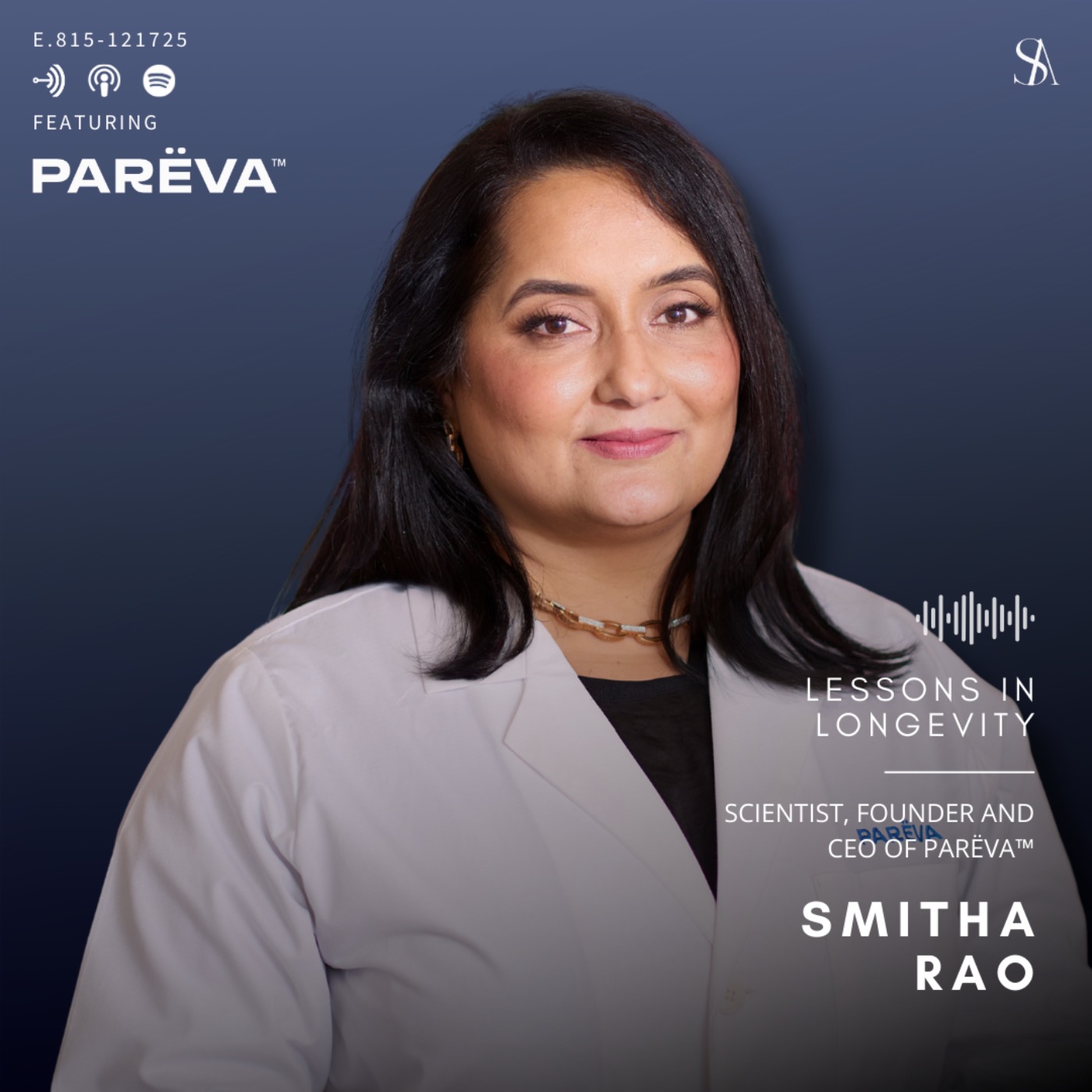
Skin Anarchy
Lessons in Longevity: Skincare That Goes Beyond Anti-Aging Featuring Smitha Rao of Parëva Beauty
00:40:33
Lessons In Longevity
Loading summary
Transcript61 lines
- [00:00]
A
Guys, welcome back to another episode of Skin Anarchy. This is a very special and cool episode because it's going to be talking about skincare grounded more than just anti aging claims. This is more about longevity. And I know recently you guys caught our new series, which is Lessons in Longevity, which is what you're listening to now. And this brand is actually a representation of what skincare, you know, what direction skincare is headed when it comes to really helping us understand longevity, utilize the tools of longevity in our day to day routine. So without further ado, I'm going to introduce you guys to Smitha Rao, who's a scientist first and foremost. She is the founder and CEO of Pariva Beauty. Welcome Smith. I'm so excited to host you.
- [00:42]
B
Thank you, Ekta. Happy to be here.
- [00:44]
A
Yeah, I'm really excited to dive in because like I was saying in the intro, longevity is such a new topic and I feel like consumers want to understand what it means. Especially with the skin being our largest organ. It's very difficult to translate that message. But I love the brand, I love what you're doing. I want to kind of kick things off with you kind of walking us down memory lane and telling us like, where did the concept for the brand start and where did your journey begin with skincare?
- [01:08]
B
Amazing. Let me introduce myself to you, your audience as well. My name is Mitarao. I've been in beauty for 18 years. I never thought I would be doing what I'm doing. I'm classically trained in biotechnology and for the first early part of my career, I created molecules and I have patents for those new, innovative molecules that went into many of the beauty brands that you see today. Then I transitioned to be the head of innovation and product development for 15 brands across beauty and wellness brands like Strivectin, Sugar Bear. I consulted for Olaplex. So really these frontier innovation led brands looking at technology, looking at very cool new ways to deliver performance to consumers. I've created over 200 products for 15 odd brands, almost always in a leadership capacity, really engaged with the consumer, understanding the scientific credentials that are new and innovative and creating first to market products. That's my background. I'm practicing for this new chapter forever. And as a scientist, nothing comes overnight. If it is created overnight, chances are it won't last. So, so how did Parva start being in the industry for 18 years? I saw a disconnect. A lot of brands were chasing headlines. You saw a lot of fear based marketing hype relying on magic and miracles. But our consumer insights was telling something Very different. Right. That consumer wanted to learn the science, you know, how it's working. And there was a really big desire for the consumers that I was certainly talking to to really embrace science in a big way. That was the opportunity for us at Pariva to kind of own that space. We are a brand that is Pariva. The name Pariva is the Sanskrit word. It means joyful transformation. Our brand has three specific pillars. First is the power of good science. The second is the spirit of radical transparency. And third is joy. Our mission is to extend skin health with clinically crafted, professional grade products for longevity. That was how the brand was created.
- [03:19]
A
Wow. I love that. It's interesting because you have this background in, you know, heavy R and D for some very, very heavy hitting brands and products. That's very important because I think we can learn a lot from brands like Tribec. They've made such great strides in the skincare industry that like to build off of that is absolutely huge, you know. So I love that you're bringing that forward and coming from that place because what I see a lot of in the longevity space now, because it is such a new space on all fronts, especially skin longevity, there's not enough power behind who's bringing it forward. I don't get convinced easily when it comes to skin longevity. So I want to actually start there and I want to talk to you like, have you educate us on this because what is it? I mean, there's so much information, I'm sure, Smith, that you've seen it everywhere you look. Someone's talking about this molecule or this peptide for longevity. What was your take on longevity before you formulated any products? What was that angle you were approaching it with?
- [04:14]
B
I will share my story first and I'll tell you what I think longevity is. Very rarely do you come across a moment in time where the consumer desire to embrace science and technology, innovation in longevity intersects. Sometimes the technology is ahead, the consumer is not ready, or vice versa. I think this is a perfect opportunity for brands that are led with good science and have a lot of substance because the consumer is looking for it. We've seen the word longevity be thrown around quite a bit. Rightfully so. I think the spate of innovation and advancements in technology are phenomenal. It's such a great time, you know, whether you're in beauty or in wellness. And what we can do in overall health is fair. Fantastic.
- [04:59]
A
Yeah.
- [05:00]
B
When I think of longevity, it means extending skin health in a simpler, more consumer friendly way. It's really extending your prime. If you are A woman that wants to look beautiful beyond your age. I think that's what this longevity will deliver. It's about extending your prime. If you're an athlete, building your, you know, athleticism and really working to have spirit, agility, longevity will help you retain that longer. Right. It's not just about time, it's about quality. That is why for Pariva, our mission is extending skin health with professional grade products. I feel very passionately about this. I'm a scientist first and foremost, and I detest the word anti aging. Yeah, I detest the word because the fact of the matter is everybody ages. The reality is it's how you age. Right. And so it's all about better quality, longer time. Extending your prime is how I think about it.
- [06:00]
A
That makes sense. I love the messaging because it mimics what many people have known for so many centuries before us, which is, you know, that how like aging, there's ways to be like aging in a healthy way and then there's ways to be aging in a way that is accelerated. And it's, you know, it's, it's self inflicted. And so I think it's really interesting to watch this movement because we're almost taking principles known for so many centuries in such a long time, and we're finally saying, listen, let's put them at the forefront, you know, and let's re. Like, let's revisit this conversation because clearly something was working. Like my parents, I'll tell you, both my maternal grandparents lived to be centennials. They were very old when they passed and even then it was because of other circumstances. Their health was amazing and they grew up on the basics. I'm sure people who come from different cultures in America have that story because, because when you grow up in these like true blue zones all around the world, you, you get the best, you know?
- [06:55]
B
You know what I mean?
- [06:56]
A
Your body gets the actual amount of specific nutrients in a controlled way. That is, it's very natural to how we are biologically as human beings. I feel like there's so much to be learned there. And then when you apply this model to something like skincare and topical care for your skin, it becomes very intuitive. With that said, I want to dive in. I know that you've created something very novel here with preva, and I'd love to dive into the technology. I believe it's called molecular eight, number three.
- [07:24]
B
Yes, it's called molecular three. I'd say the inspiration for this is very simple. When I look at what we see in beauty and wellness, I Was head of innovation for half a dozen wellness brands. Everybody wants to fix aging. Oftentimes you're not successful because you're not sharing what's actually in the formula or in the product. Our approach was to really look at science and what's happening in peer reviewed platforms to understand what are the root causes of aging. The hallmarks of aging study, cited 300,000 times, kind of maps out the various cellular biological pathways of how human beings age. Molecule 3 was inspired by that research and it took us almost 18 years to get here. We looked at the hallmarks of aging study and hyper focused on three specific areas. First, we wanted to target inflammation. Second, we wanted to look at aging. I call it birthday aging, but it's like really chronological aging. We wanted a technology to address that. We wanted a technology to look at inflammation and we also wanted a way to minimize external stressors, whether UV related or lifestyle related. Those were the three specific hallmarks we chose. And that's how molecule 3 was created. Molecule 3 is a combination of three plant stem cells. I'm the inventor for this technology. It is exclusive to Pariva Beauty. And this specific blend of ingredients is patent protected. It harnesses two really important attributes. First, it influences NAD in skin when you apply topically. It also influences exosomes in skin when applied topically. Couple more things around the technology. It is not human derived. It is also not gmo. We use biotech applications. I was very particular about this because I'm a scientist, but I'm also a mom. The consumer wants to see, you know, can we push the biotech muscle, so to speak, and create ingredients that are non GMO and then still deliver incredible benefits when you apply it topically. And that's what molecule 3 does. The combination of three plant stem cells targeting NAD plus and exosomes in skin when applied topically. Non GMO, vegan and sustainable.
- [09:38]
A
That's very interesting. So you said that Mollocker, it's inspired by Nobel prize winning research. Right? You walk us through the actual breakthrough that shaped this platform 100%.
- [09:49]
B
So the real breakthrough is we were looking at exosomes for a very long time. I wanted to launch a skincare brand. I was terrified up until I started working on Pariva that this is what I wanted to do. Because, you know, you see all the failures. Scary world, scary world and launching a brand, I mean, every day. The amount of effort it takes for startup founders to launch something is a huge amount of effort. The real thing is I did not want to launch a brand for the sake of launching unless the technology was sound. So let's start there. So we really went after exosomal delivery and there's a few reasons for that. When I thought about topical skincare, the reality is the skin barrier, very little penetrates it. Right. So in order for any technology to have deeper and targeted delivery, we needed to look at how can we deliver it through the skin barrier where it actually has an impact. Exosomes where the most important thing that we focused on because of targeted signaling. That's the Nobel Prize inspiration. Right. We knew this was there. The idea of exosomes has won quite a few Nobel prize awards. We wanted to take that and put it in topical skincare. And that's the inspiration.
- [10:58]
A
So that's interesting because you mentioned that you're working with plant derived exosomes. That's interesting.
- [11:03]
B
Yeah.
- [11:04]
A
Okay, that's. I mean, I think that's the real for a lot of consumers. And I know, I get these emails a lot, you know, from a lot of you listening in that, you know, what are exosomes and how do I know when to get behind technology that incorporates exosomes. I'd love to have you talk about this because I think it's important for consumers so that they understand that, you know, even though it's plant derived, there's a lot of benefit here and why exosomes matter.
- [11:29]
B
I think. Let me start at the top and tell me if I can, if you want me to go deeper. Exosomes are very important because they're very small nano sized vesicles of the cell and they act as cellular communicators. So for instance, if you have incredible vitamin C that you're using or a peptide, the exosomes are able to take some of these polygon positive signals and translate it into the cell. Because of its size, it's able to communicate between cells to say, hey, make more collagen, make more elastin, et cetera. It's a very simplified explanation. You can use human derived exosomes and you can use plant derived exosomes. They are not the same. I cannot come and say, listen, plant exosomes are identical to human. That would be factually incorrect. It's comparing apples and oranges. There are benefits to both. So for instance, human derived, it's closest to human. The disadvantage is that a, there are a lot of regulatory considerations. It's very difficult to market in Europe. There are some sensitivity issues that you need to be careful with and there are also ethical issues. How do you source these? Where are the cells coming from yeah, they do work though, right? Like, if you look at the pros and cons on a very broad. Is my aspiration for Pariva at that time when I did the whiteboarding exercise, I cringe at this word. But I wanted to create something that was clean. I wanted to create a brand that was scalable globally. So for me, when I think about some of the hardest and harshest regulations around the world, eu, for instance, or credo clean, those are areas I wanted the brand to grow into. So when you go back and say, what can I deliver that has phenomenal efficacy, but also meets some of the stringent criteria. I could not use human full stop, period. And people, I mean, it's hard to like, I have this very dual, like, duality. I'm a scientist, but I'm also a mom. I pay attention to what kind of things I put into my body and what do I give my child. So it became almost a scientific challenge to say, can I push the envelope that I have incredible results? Can I keep it non human? That's how we landed with plants. I would say the advantages of plant, plant stem culture or plant stem cells that are delivering these type of efficacy is it's much, much safer. You do have, you know, clearly we have a lot of clinical data. We've invested in three breakthrough clinical studies for our brand. We have demonstrated with efficacy that the technology is very powerful in driving results. It's also much gentler on skin, safer. You mitigate some of the issues with irritation and sensitivity. That's how I chose this approach for molecule three. I think with exosomes being so new, this is the new frontier of aging, right? Or anti aging. This is where the future is going. We have to do a lot more research in learning the delivery and understanding how these molecules will work. I am so excited that we were able to create molecule three. We have phenomenal clinicals. We have received so many awards for this technology. Six awards in less than eight months. It's both a combination of editorial as well as technology innovation. And we've proven beyond a doubt that it is safe. So I look at safety and efficacy as two sides of the picture. And I wanted both of that when I launched Pariva.
- [14:48]
A
Yeah, I can get behind that. I have an entire regulatory seal called safe. I'm a huge believer in that. Safety and efficacy is always first. And I think that it's interesting that you're doing this with plans and I, I want to chime in a little bit just for our listeners because we got these questions from you Guys, one of the biggest things to look for, and I think with topical skincare, it's important to consider that you can't do a lot of human derived because there's not enough happening behind the scenes on the regulatory front. You can't expect brands to come out here and say these are human stem cell derived exosomes in a topical formulation. That's not going to happen because I mean it will happen. If they're lying to you, let's be real, that's the truth. They're going to lie to you and tell you this because there's not regulation there yet. The FDA hasn't approved that. So if you go and you are marketing something that's human derived and you're saying this comes from baby stem cells, that's not okay. You have to be very critical when you're shopping and dissect the science out because there are certain things that are simply not allowed in the world of cosmetics. So I think that's an important distinction. Smith, I wanted to clarify that for our listeners that they should get behind technologies that are not over claiming and they're not going above and saying, oh, this is what it is when it's not in reality. I get behind approach because I think that you're right on the level of exosomes, which are nano levels. That's a nanoscale. There's a lot of potential there, even if it is plant derived because you're not thinking about a lot of the biomimetic components that you would normally think about when you think about eukaryotic communication between cells. So it is a different way of delivering plant based ingredients that are going to hit in a more efficacious fashion than what we've seen before in this space. You and I are the same on that word. It's kind of cringy now to say clean clean, but if you really come to the truth of it, that is one of the cleanest ways I think in exosome technology.
- [16:37]
B
This is the frontier biotech enables that. By the way, my principle on no human being wants a dirty product full stop. I can get behind clean if you actually have a little bit more of an honest conversation of what is clean. So I'm going to get on my bandwagon here. But the reality is clean beauty is a marketing terminology. There is no consensus a homogeneous way to say this is clean or this is unclean. Every consumer understands this. It's also a little bit of controversy marketing by saying, I have these 15 things that are going to not cause whatever disease. It's easy for the consumer to do. It's fear based marketing. My principle is you can only claim to be a clean clean brand if you're transparent. We are clean brand. We tell you what's in our products. We have something called the factuals which we'll get into in a minute. We tell you that we comply with credo clean. They have 2700 questionable chemicals. We don't use that. So to me we don't need to reinvent what is considered clean or unclean. We just need to be very clear what clean means to us. For us, it's true transparency. You cannot claim to be a clean brand if you're not transparent. You can't hide behind magic miracles, not tell you what's in the product and then claim to be clean. It's just not possible.
- [17:58]
A
Absolutely. I agree with you. The word clean is evolving now. Consumers from what I've seen now look at the word clean and wonder, okay, this doesn't mean what it was before. You know what I mean? Where you only have three things in an ingredient. No, it's more of like where is this going to land with everything else that I'm using? How does this marry with my makeup, my other skincare, my day to day spf? Those are all components that come into play here as well. So I want to actually talk to you about that as well because I know the line is very tight and I like that you've kept it that way so far where there's not a lot of skews and there's not a lot of confusion for consumers. Can you talk to us about where that decision making was for you when you did you know like exactly what kind of products you wanted to incorporate the technology in or how was that whole thing?
- [18:45]
B
So I knew what I wanted to create in terms of biological efficacy.
- [18:49]
A
Yeah.
- [18:50]
B
But I would say in all humility, the reason why I half as good as an innovator is because I am obsessive about consumer insights. What I heard loud and clear. Right again. Consumers want more science. They are so fed up with this fear based marketing. There's a lot of confusion. A couple of very important truths rose to the top. First, consumers are fed up with 13 step skincare.
- [19:15]
A
Yeah.
- [19:17]
B
To me as a scientist, I can tell you it is the worst thing you can do. Like you bought something on TikTok, you slathered on your face. You're marketed to mix one formula and another formula thinking it's a smoothie. You are destroying your skin barrier. Right. There are technologies that are never meant to be mixed together, you know, And I think that in the zeal of marketing and consumption, we've just gone a little to the extreme in how many steps we need to have. So I kept hearing this very simple truth that the consumer said is like, oh my God, this is a lot. I don't have time. This is too much. And the consumer that I'm talking to, they're like very clear, like, give me something that's simple. Give me something that works so I don't have to have my degree to figure out what's good for. I was thinking about longevity, right. Like when you go back to longevity and our mission, right. We want to extend skin health. The thing that I want to instill in our consumers is simple but consistent steps. We really wanted to extend skin health with clinically crafted, professional grade products. That's our brand mission. Simple, simple steps that you can use consistently, but you have great results. That's how the assortment became tight.
- [20:36]
A
I love that. Yeah.
- [20:37]
B
There's a couple more things. Right. We are a startup brand and I was very passionate that I wanted a couple of very important steps in longevity. Prevention is the most underrated step.
- [20:51]
A
Yeah.
- [20:52]
B
How do you measure prevention of aging? It's very hard to measure. It's easier to measure repair. Right. Because you were here and then you came back here. It's easier to measure repair. However, I would say I've worked with five a list celebrity brands and I can tell you a little secret. The celebrities who are marketing all kinds of products, they don't experiment on their skin. They stick to the basics and they hyper focus on prevention. So I wanted a prevention step. We have C 35.5 firming glow serum. It is our best prevention step. Use it every day. If you're not preventing your aging rate, that is a prevention. I wanted a restoration rejuvenation step. So that's the second step. And I wanted something to prep your skin for makeup. So I kept the assortment very tight. That's how it started.
- [21:37]
A
I love that. I love what you said about Nobody wants the 15 step skincare routine. I could not agree more with you. For our education side, we've been making these carousel decks. Right. For our social media. One of them not even lying to you. It's been one of our most viewed, most interacted with deck. And you know what it's talking about? Tretinoin, how to layer tretinoin.
- [21:56]
B
That is the sandwiching of the sandwich.
- [21:58]
A
Right. And it's, it's literally. And it's not anything groundbreaking. But you know why it's blowing up is because people don't know how to layer their skin care. And it's because of exactly what you said. Like nobody has time to play chemist at 6am when we're trying to get out the door. So it's a huge problem. And I think also, you know, another thing that you mentioned that I a hundred percent believe in is that we are really wrecking our skin barriers. I mean, every time I get questions, you guys are asking me, you know, how do we layer vitamin C with azelaic acid? How do I layer it with my tretinoin? These are all things you shouldn't have to ask because they should be built into a great formulation. They should be things that. Right. So that's where I feel like founders such as yourself and what you're creating. I mean, this is where we need to vote with our dollars because we need the efficacy, but we need to get that guesswork out. Otherwise we're never going to get efficacy. So if you're looking at a brand that's selling you 80 SKUs and they're expecting you to put it together on your own, you really have to pause and be like, wait, I need to go somewhere else, because this isn't it. And even if I put this together in the most optimal way, there's no guarantee that the actual base formulations of each of these products is not going to make me break out, have reactions, whatever.
- [23:11]
B
Yeah, I love. I'll tell you one more insight that came about. Yeah, Two things, actually. First, the consumer truth. We're getting into that possibility. But I will share with you three simple truths. What's in my product? Does it work? And why are we talking about anti aging? Three simple truth. Consumers want to know what's in my product. It is the hardest thing to answer. And I'll tell you why. Because so much of beauty is marketing. Right? I love marketing. I think that there is a real good time and place where you tell the story and the promise and we want to look better. Like, I am a big believer that products have to change your perception. Otherwise it's not going to sustain. It's a promise. I get it. Right. But the marketing pendulum has swung the other way. Oftentimes it's blatant lying. You put in a little tiny amount of hyaluronic acid and you say, I'm like the hyaluronic acid, like, blah, blah, blah, right? So a $25 product and a $300 product both claim the same Thing, what is the consumer going to believe?
- [24:17]
A
Right, Right.
- [24:18]
B
You're a dog. You know this. Right. The dose determines the efficacy and the dose determines the toxicity. If you're not able to say, listen, we have 35.5% clinically backed ingredients, unless you say that and you're very transparent and you tell the consumer, this is what's in my product. Yeah, I think that is the future. We see this in nutrition already. Right. I fundamentally believe Pariba has something called as a factuals. It's a very bold system. We are telling, we are taking complex formulations and we are breaking it down. We tell you the high percentages of clinically backed performance ingredients, functional ingredients and base ingredients. I've broken it out that way because I really wanted the consumer to understand why I only have three products. It took so many years to get here. We actually have a lot of amazing high quality ingredients that cost a lot. And I'm doing this in a way that you get professional grade results at home. That was the intention.
- [25:18]
A
Wow. I love that you broke it down and explained where this matters in a formula. You know, this is where it fits and that's huge. I don't think I've seen any other brand do that. That's really big.
- [25:27]
B
Thank you. Thank you. This was. It's a personal story. I'm a private person, but. Okay. So the thing is, we wanted to get pregnant. It took a little bit of difficulty. So the thing that I could really lean into is let's clean up our life. Let's focus on high quality foods. Let's remove stress in our lifestyle and really focus on eating right, working out and taking care of ourselves. Our skin is the largest organ. So let's look at cleaning up our personal care routine as well. And I am in this industry, right. I am in this industry and I looked at the label of the products I was using and I knew the label is good. It tells you what's in the formula. But there's a lot of things it's not disclosing either. Right. No woman or man wants to downgrade their skin care. It's part of your self care. Right. And so my mission then became if I ever launch a brand, I said this to myself so many years ago, I'd love to be able to tell the story of high functional performance ingredients, ingredients in a way that the consumer understands. That became the mission of the factuals because the skin is the largest organ and it is a reflection of your inner health. Right. So I would hope for customers and consumers not to Experiment too much and really take a moment. For brands like mine and other science lab brands that are focusing on transparency and efficacy. Takes a lot to get these products out and tell our truths. This is why we are doing this. That was the inspiration of the factuals when I went through my pregnancy struggles and I wanted to clean up my life.
- [27:01]
A
No, thank you for telling us and sharing that because that's really important. It is coming from a personal place. You know, the development and the product development side, I think that is one of the biggest challenges in the skincare industry. A lot of the people who behind these giant brands, nothing wrong with those brands, but there's not a lot of, I don't know, they're coming from a very generic place. If something's trending, they'll make it. If consumers love it, they'll make it. But it doesn't make sense from the efficacy side. You can't do that because if you haven't used it yourself and if you don't have experience yourself, then what are you creating? So I really appreciate you sharing that.
- [27:32]
B
Yeah. And that was impetus of the factuals, which is our radical transparency. I actually have a lot of aspirations for that over time, I'd like to take. Radical transparency is a very big pillar of our brand. We are going to, as the business grows, you bring the consumers in. How we are building, how we are hiring, how we are sourcing. I see this as a very big pillar that we will constantly engage our community in really understanding what's behind Pariva, what our thinking is. But again, baby steps. The brand is less than a year old, so I have to focus on other aspects before I deepen this commitment to radical transparency.
- [28:07]
A
Yeah, I think you have started on the right foot. And for a lot of us out here in the space of consumers, the more transparency a brand can provide, the more likely that brand is going to blow up in the long run. That's my take. After having interviewed so many brands and seen their development over years, what I noticed every single time is if you're transparent and if a consumer can figure out what it is that you're doing and why you're doing it, that's going to make them want to keep coming back. And this is why I never understand the brands that are like not doing that, you know, or like they use very vague. And you know this also. Right. It feeds back to that clean beauty conversation I think you and I were having where it's like for a long time we've hid behind these terms, you know, and we've hit these like umbrella words in terminologies that don't mean anything. Eventually you have to take that off. You have to take the veil off and be like, what is in this? And why do I need this for my health? For example, I want to talk about one of your products, the THD based vitamin C serum 35.5. I would love for you to talk about this because vitamin C is a quick, critical step in everyone's routine. I think we're all using vitamin C somehow in our skincare. What made you want to go with the vitamin C derivative rather than like lscorbic?
- [29:18]
B
Yeah, so actually if I take a step before, I wanted the best prevention serum possible. I mentioned to you already, prevention is such an integral part of longevity, right?
- [29:27]
A
Yeah.
- [29:28]
B
So the daily prevention step of being able to include technologies in your prevention serum is critical if you're not preventing your aging. Right. Vitamin C is a holy grail product. L ascorbic acid. I've worked with it extensively in previous roles. I knew the, the moodiness of that technology. It's very difficult to stabilize. It is actually very, it's clinically proven. It's very difficult to stabilize. It is simply not sensorial. Even if you got it to stabilize on the, the way it behaves on the skin, it's very sticky. You know, a lot of people have sensitivity to L ascorbic acid. You know, they, we've heard feedback that it tingles. It's, you know, it gets their eyes to water. And the most important is it doesn't smell good. Yeah, I felt like I don't want to dis l ascorbic acid. And I wanted to go back to the drawing board. Longevity is going to be very easy if you give pleasure. Right. So skincare is about pleasure and sensoriality. So I said, look, I want this prevention step and all of my products to have that sensoriality where you don't feel like you're compromising on fun and joy. Joy is our third pillar. That's why I looked at other derivatives. THD is very well studied. I've known this molecule for a minute. But we put it in a 30% thd. Remember I talked to you about a delivery system. We have exosomes in our molecule. This is called a delivery system because it penetrates deep into the stratum corneum. And then that's very important. Right. Because anything that sits in the very top is hard to have really meaningful benefits. We knew THT because it's oil soluble. It penetrates deep into the Skin. That's why I chose THD. And just so you know, this formula, the C 35.5 Foaming Glow Serum, it's one of our bestsellers. We've won a lot of awards for this, including your own. Thank you for the shout out. It's doing really well. It's an anhydrous system, so there's very little water in there. It's mostly non aqueous. It also has turmeric, resveratrol, ceramide, sodium hyaluronate and everything is powered by our molecular 3 technology. It's in every single Pariva product and the results are quite remarkable. I'd love for your audience to check out the product and the before and afters. We've had 18% improvement in firmness. We keep getting recognized because this C35.5 Firming Glow Serum is very, very good if you have sensitive and rosacea skin. So we've been getting recognition for that. This formula took me almost five years to create. Great products take a long time.
- [32:07]
A
Yeah, you got to put it. And another thing I think it's important to bring up for those of you interested in vitamin C, one of the things I would love for you to understand is that even if someone says that they have stabilized L ascorbic, that doesn't mean that it stays stable once it hits your skin. Stabilization is relative to the actual jar, like the bottle that it is that it's stored in. Like it's going to stay stable on your shelves. But when it hits your skin, it must convert to L ascorbic ascorbic acid, because that is the only way that the transporters on the membranes of your cells can take it up. Otherwise it does nothing. You know what I mean? I'm just trying to tell everybody because I feel like this is a big misconception with vitamin C. People think that let's take stabilized in the bottle. It must be amazing for my skin. Even though it's L scorbic or you remember the orange droppers back in the day, right? Like, everybody was showing those. That's not true. Even when it hits your skin, pile on like a really basic solution on top of it. Like the chemistry that happens on the top of your skin is still going to be there. Whether something's encapsulated, whether it's stabilized, whether it doesn't matter because it has to break apart on the skin's physiological surface.
- [33:14]
B
I agree. I'm a big believer. Like, honestly, the other innovation philosophy is I look at bioavailability, which is your point. Ekta. Because the reality is you can take the best ingredient, prove that it's stable in a packaging.
- [33:28]
A
Yeah.
- [33:28]
B
It doesn't brown. Consumers look at very simple cues. Right. Does it smell bad? Does it brown? Very simple visual cues. But the reality is it's so much more complicated. I'll give an example that is very, very simple. We've heard of turmeric, which is a fantastic ingredient, anti inflammatory. Use it quite a bit in foods. You can have a golden latte. But when you take the turmeric and pair it with pepper, the potency amplifies so much more. And that means bioavailability, the combination of ingredients that are proven to increase efficacy. One plus one is so much more than two. I look at that in formulations, I look at delivery systems. When you create very complicated products. Products like my C35 has molecule 3C, 30% oil soluble vitamin C. We have resveratrol, ceramides, turmeric, sodium hyaluronate. And it is in an airless packaging. I hate vitamin C products in dropper. It drives me crazy. Yeah, it's in an airless packaging. So you have dose dispension, it does not turn brown. It smells divine. You have to really be intentional. And that's why I look at combinations of ingredients that deliver that bioavailability. So that's why we are seeing results the way we are, which is it's gentler on the skin, but it delivers results very quickly. This is longevity to me, where you look at well known technologies, you push the envelope in formulation, you push the envelope in sensory, but you get remarkable results. And I want to tell everybody, nobody wants to look old. I don't either. I don't want to look like an old prune. Right. I want to look like myself. Right. Just better. And that's what longevity is. It's just extending your brain.
- [35:11]
A
I couldn't agree more. I love that you've poured so much thought and time into your formulas because. Yeah, that's the beauty of chemistry done. Right. Right. It's going to take a long time, but when you get it, it's going to perform like nothing else. I really encourage our listeners. You really got to vote with your dollars with these brands nowadays because there's a lot out here and it's a lot of marketing. There's a lot of overlap in what people are saying. And so these kind of conversations that I try to get out of our guests, which Smith, you're doing an amazing job of educating our listeners. Thank you. Because this is the kind of information that I hope people take away and then make their purchasing decisions based off of, rather than like, okay, I looked at the. Even that dropper thing I was telling you, where people were showing those droppers. Right. Of the different. Even that was misleading. Right. Because at the end of the day, it doesn't always tell you about what's really going on inside of the formula. So I think when you look at things from a more critical lens, I don't know, it helps everybody, you know, I hope.
- [36:07]
B
And that's the job of. As a scientist, by the way. Scientists makes mistakes as well, right? At some.
- [36:12]
A
Yeah.
- [36:12]
B
It's just. It's like you're trying to do your best to understand with the information you have. I also want to tell you about another product, and it's a little off script, but the other myth that I want to bust is collagen. Collagen, when you apply it topically, does nothing.
- [36:28]
A
Yeah, it's too big.
- [36:28]
B
It's too big. It doesn't penetrate. It's a very complex protein. It's not just about collagen. It's about the folding structure of collagen. For our call 20 gel cream moisturizer, that was another one we poured a lot of heart and soul. I was inspired by PRP in its regeneration properties. So we brought in signaling peptides, senolytics, quality niacinamide. That formula, if you've not tried, is neck and neck. Between those two products, the C35.5 Firming Glow Serum and the Cold 20 Gel Cream Moisturizer, I wanted to signal youthful collagen and technologies that help the skin regenerate its own collagen. And that's how we got there.
- [37:06]
A
I love that, and I love what you said is the opening. You're right. Collagen. Yeah. I mean, the folding properties are everything with any protein. But that's really interesting that you've done that. I think for a lot of times, consumers, like, with collagen, we either believe that you have to have something injectable, or you just put it on top of your skin. I feel like that's where we've landed as an industry, and there's no one really talking about all of the other things that go into actual healthy collagen. So that's a very good point that you made, the folding properties. So I want to actually talk about how to incorporate your products, because I know right now we don't. As much as I would love everybody to buy one brand, stick to it, use it for 90 days. You know, I Would love that. I wish we had a world like that. Everyone's got so many products and in terms of layering, just give people advice. If they buy the C35.5, how does that go? Where do you put that? Do you put it on first?
- [37:56]
B
I think the way I've designed the system, you can use any one of our products and interject it into your rituals. My Recommendation, I have three products. We have the C 35.5 Foaming Glow Serum. The goal is to prevent future aging. It also has firmness, glow. All of those benefits. This is the most advanced technology in our portfolio. Put it on clean skin two times a day. One pump is all you need for the whole face and neck. It's very concentrated. Do a patch test. This is the first thing. You put it closest to your skin and it does its magic. I would say immediately thereafter is our regeneration. The called 20 Gel Cream Moisturizer. This is a very beautiful moisturizer. It builds the barrier. It improves look of lines and wrinkles. In fact, we have a claim which I'm so proud to share. One jar of Call 20 gel cream moisturizer lasts for 28 days. In a clinical study, when we measured the look of lines and wrinkles, length, width and depth, we saw a two years younger looking skin. Skin looked two years younger with that product. So I'm so impressed by it. And we were able to do that with one jar in 28 days. Apply the gel cream moisturizer. It sinks into your skin. It's formulated without silicones. It's really great for everybody. Then put the prep step, which is our clean hydra bond primer. It is a pore minimizer barrier lotion and a primer in one. It's the prep step. Layer it on just before makeup. If you're wearing sunscreen, put the sunscreen first and makeup. If you're wearing sunscreen as part of your cosmetics, then just put the primer and follow with your color cosmetics.
- [39:30]
A
Makes sense. I love that. Thank you so much for sharing that because that's the biggest. Those are the questions I'm going to get. Let's address this now before everyone chimes in. That's really good to know. I think I've been using the formulas myself. They marry beautifully. In any skincare routine, no matter what you're using, you can really benefit from the formulas because they're the essential building blocks to good skin. They're really addressing the core things that we need to focus on when it comes to healthy, beautiful skin. I'm a huge fan. What you're creating is beautiful. Congratulations on all of the wonderful recognition. It is very well deserved for everyone listening. If you guys have any questions about Pariva, if you want to know more, we do have a 20% off code that we're offering. So scroll down in the show notes of this episode and then you can click the link there and we will make sure that you get a nice discount on your purchase. Thank you so much.
- [40:15]
B
Thank you, Ekta. I'm so happy to be part of this. I really appreciate everything and your support. This means a lot. We've invested so much in the science, the clinicals, and the brand building. Any support for a startup brand like mine would go a long way. I really appreciate it. Thank you so much. Bye.
- [40:33]
A
Hey guys.
- [40:34]
C
So I hope you love that episode. Please make sure to hit subscribe if you're tuning in to us on any podcast platform. We are available on so many different platforms, so wherever it is that you're tuning in, just go, hit subscribe. You'll be immediately notified when we publish new episodes. This way you're able to tune in to amazing insights from experts, brand founders, industry leaders, authors, all the wonderful people that we host. And that's very important for me because I love to hear from you guys and really understand what you love and what you want to hear more of. Also make sure to give us a follow on all of our social media outlets. We're available on Instagram, TikTok X, you name it, we're there. We also have a blog on Medium, so if you're a reader and you love Medium blogs, check us out on Medium. We publish some really great articles on there that do deeper diversity dives than just what's available on the podcast. And it's really a great place for all of you science geeks out there that want to learn a little bit more. We go above and beyond with our research and making sure we're bringing you information that you usually probably won't hear about in other outlets. So check us out, leave us a comment, leave us a review, and we'll be back next time with another episode.
- [41:41]
A
Thank you.