← Skin Anarchy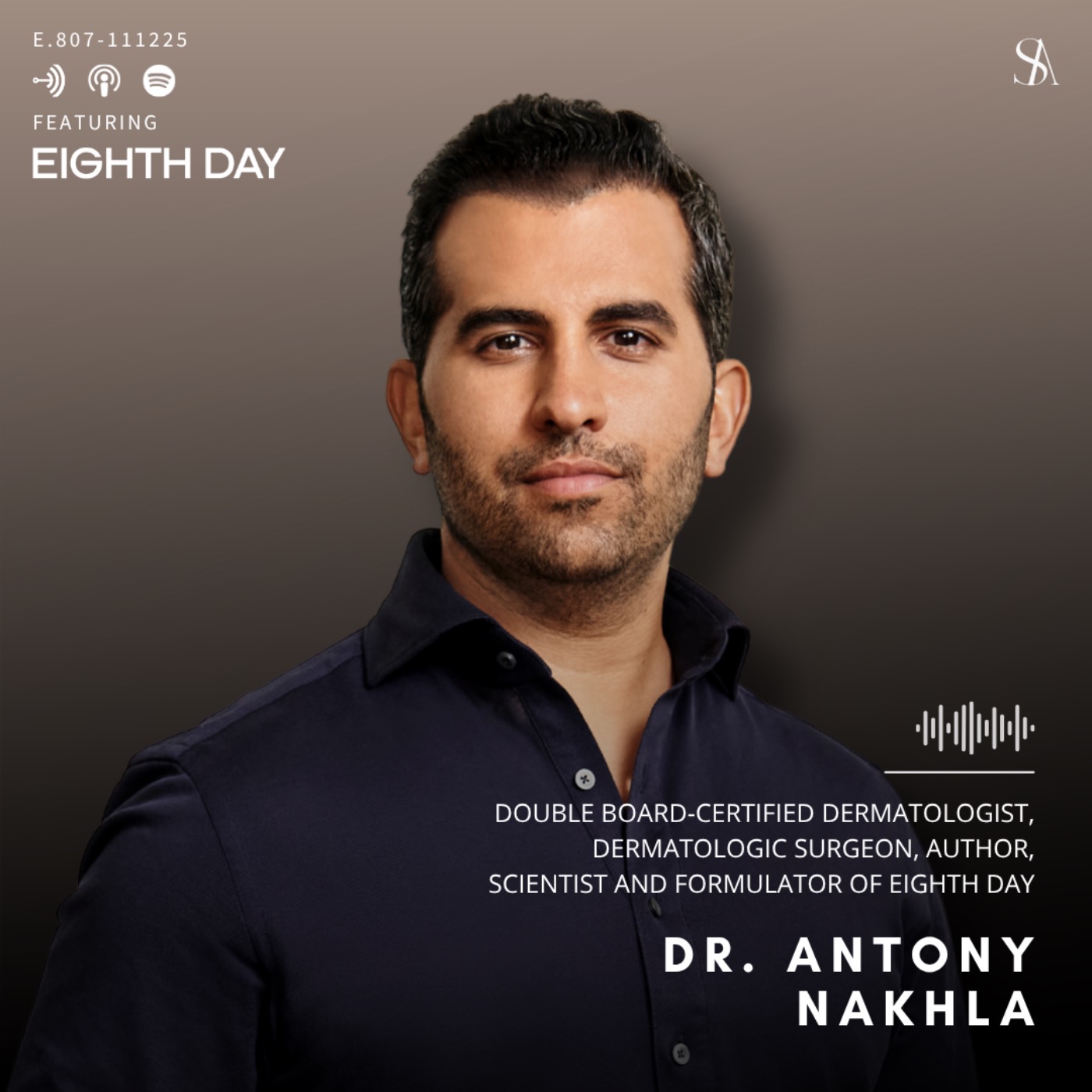
Skin Anarchy
Precision, Peptides & Regenerative Science with Dr. Anthony Nakhla of Eighth Day
00:37:25
Loading summary
Transcript47 lines
- [00:00]
A
Hey, guys. Welcome back to Skin Anarchy. It's Zekda. I'm really excited about our episode today because we're interviewing a brand that's really been kind of a game changer for a while now. I'm sure a lot of you have heard about them. So without further ado, please welcome Dr. Anthony Nakhlo, who's the founder of 8th Day. Welcome, Dr. Nakhla. I'm so excited to host you.
- [00:20]
B
Thank you so much. Thanks for having me.
- [00:23]
A
Yeah, I'm excited to dive in. I've been a fan of 8th Day, I think, long before we connected. I remember seeing your products and, and trying them my prior to ever connecting with your team. And I, I find it to be very unique, your approach coming from the regenerative side of medicine and bringing it to skin care. I'd love for you to walk us down memory lane, if you don't mind, and tell us about your. Your medical background. What led you to creating a skincare line?
- [00:49]
B
Yeah, thank you for that intro, and I'm humbled to hear that you've enjoyed the brand and the products. So I'm a dermatologic surgeon focused on reconstructive treatments for patients that have had skin cancer, specifically something called Mohs micrographic surgery. And this is typically for facial skin cancer and people who have complicated facial tumors. So working a lot with patients that have had pretty disfiguring types of skin cancer and using wound healing techniques to try to help them. My career began when I graduated from residency and I worked with one of the foremost dermatologists in West Hollywood who was at the time treating HIV patients with what's called facial lipoatrophy. So people who had sort of lost facial volume due to the HIV medications that they were taking, and this idea of bringing somebody back to baseline, bringing them back to themselves again, and the power of that, it became my beauty philosophy. It's what I gravitated towards, which is reconstructive work as opposed to sort of cosmetic enhancements or changing somebody's appearance to sort of meet some sort of perceived standard of beauty. So through this work, I had the privilege of restoring patients back to baseline and bringing themselves back to themselves again. And in my practice, my beauty philosophy is that you look best when you look like yourself. And so I wanted to translate this work that I was doing on the regenerative and wound healing side and sort of bring that to life through a comprehensive skin care line with my beauty philosophy in mind of trying to achieve sort of the best version, the most natural and unique version of yourself that's unchanged or unfiltered or un sort of affected by what the cultural zeitgeist of telling you what to look like is.
- [02:43]
A
Yeah, yeah. No, no, I love that. I mean, it's really fascinating because the world of wound healing from the side of going to the hard medicine, it's very complex, as you know. And when think about skin care, it's very fascinating to see how skin care is approached like this, this vanity thing. Right. But then when you look at the. When you look at science and you think about like, what is the skin, how does it work? It's almost intuitive, right from the medical side that we would approach it from this angle of. No, you have to bring in like serious medical principles here because you're dealing with microtraumas every day. You're dealing with damage on some level every day, whether that's through UV or environment. So can you go through maybe some fundament of wound healing for us that we should understand? And maybe some of the things you brought forward. You were thinking of how to formulate this in a skin care line?
- [03:37]
B
Sure, that's a great question. Yeah. So first and foremost field of dermatology is a specialty all of its own. It's essentially four years of post medical school training just focused on the human skin, which is your largest organ. Much the same way a cardiologist focuses on just on the heart, a dermatologist. And the training of a dermatologist is so intensely fixated on, on skin. And the reason why I opened with that is that we have to think about the expertise that it takes to understand how human skin works. And really this is about studying and experiencing and encountering skin firsthand. So the human body has this really incredible innate ability to heal and regenerate itself. Sometimes when I remove these large tumors from people's faces, we'll allow them to heal over the course of a few weeks before we even stitch them up. Because the body has this ability to sort of contract wounds, lay down new collagen, build elastin, and essentially contract a really large and complicated wound. And so we use ingredients in that process that help stimulate the wound healing cascade. And the reason why I say cascade is it's. It's almost like a one sort of like a stepwise process that occurs where you're signaling one cell to tell another cell to tell another cell to do its job. And this is very different than, than skincare that's sort of focused on botanical extracts or what plant cells can offer. This is about tapping into the body's innate healing mechanisms that are really far more powerful and far more focused on human skin and the human biology itself.
- [05:23]
A
Yeah, no, that's really. I'm glad you bring that up actually, because there has been this buzz around plant based and I've been kind of trying to get people to understand that there's this whole issue with compatibility and, you know, there's a lot of stuff there to unpack. But I like what you said and I like how you explained the skin as a, as an overall organ. I think for a lot of us, we don't really think about it because how many times do we think about the skin as we have to maintain it like an organ? Think about the liver like this, we think about heart health. But no one really goes in and tells us like, and when you look at preventative medicine, for example, and no one tells us, like, you guys, you need to do something for your skin. And so I think because it's so resilient, consumers, you don't really just sit around and think about what should I be doing day in and day out for my skin. So it's very fascinating actually, when you look at it from that angle. For me at least, it's very fascinating. So I want to talk about the core principle of eighth day. You're using peptide rich plasma, which I don't think a lot of us understand what that is. Can you dive into the science of that?
- [06:27]
B
We really care about giving customers potent formulas that perform. I would say that one of the brand pillars is that we use what's called bioidentical ingredients. So these are ingredients that are biologically identical to what's already part of your skin and what your skin recognizes. So the same signaling molecules that I spoke about earlier that tell your cells to heal and to repair themselves, these are the ingredients that we focus on. And so our tagline for the brain is that we speak the language of skin. And that means that we're speaking to skin cells in their own sort of native code that helps them to understand what's going on and to promote the healthiest version of themselves, which in turn is the most beautiful type of skin. Skin that's resilient and plump and well hydrated and is filled with collagen and elastin. And all the things that make your skin healthy and resilient are the things that make your skin beautiful. So peptide rich plasmas are patent pending skincare technology. And it's composed of these 24 bioidentical peptides, growth factors, and amino acids that stimulate skin cells innate healing and repair mechanism. So I've identified these ingredients that are similar to some of the ingredients that we use in our wound dressings to help repair complicated facial wounds. And they com. They're composed of not so sexy sounding ingredients I would say, but they're the type of ingredients that you might not hear about, but they really work. Things like insulin, like growth factor, TNF alpha, the immune modulators that help your skin to repair and rebuild themselves.
- [08:11]
A
Interesting. Yeah, no, it's fascinating because I think people don't really, we don't think whatever cell is secreting is actually going to help it in the long run with its health. I, I don't think a lot of times it's intuitive for people to understand like about, in terms of cell signaling, like what is it really that they respond to. Many times you see in skin care, I've seen this a lot in the industry where people are coming up with these incredibly complex biomimetic peptides that sometimes they're not just not going to land because it's, it's just very difficult for the cell to respond to something it's not used to. I mean cellular biology is so complex that it makes more intuitive sense to sense to work with what is actually coming up. If you're having like certain cytokines, certain proteins secreted in media that you're growing cells in, that's more likely to actually be biocompatible with those cells. So I think that's also the conversation that needs to be had is with the growing industry people keep chasing these buzz worthy biotech ingredients, but in reality where's data there like with cellular biology in mind. So I think that's very fascinating what you're doing, keeping that at home with what the cells used to responding to that kind of thing.
- [09:21]
B
Yeah, that's, that's true. And I would say understanding the cell and the molecule and the response of the cell to that molecule is really key as well as understanding how you can even deliver that molecule to the right cell. So a lot of our focus is on dermal cell health because your epidermal layer, first layer of your skin is constantly sloughing off. So the real action is, is in the deep cellular level, the level of the dermis and even the subcutaneous fat. So we try to use ingredients and delivery systems that actually penetrate skin. Skin has this incredible ability, as it should, to sort of repel and essentially keep things out. Well, we're trying to hack the body a little bit and actually deliver molecules to the areas where we get the most benefit and where we really start to see that lasting change, which is the deep cellular level in the dermis and subcutaneous fat.
- [10:18]
A
Yeah, that's really fascinating and I agree with you. I think sometimes I think we chase buzzwords, but really we should be chasing things like delivery technology. That is the next, I think, frontier for skin care. I definitely look for that a lot more, I think, in my own skin care preferences now than I ever did before because of exactly what you said. Like if it's not getting to the cel, you're not going to do anything, nothing's going to happen. So for consumers to be mindful of that, I think is so critical now, especially now everyone has a skin care brand these days. So it's very, very difficult to sift through all of that and figure out what's actually going to work. And that's very relevant.
- [10:54]
B
I think a good example of that is. So we just developed in our ultra rich moisturizer which we just launched, we use three molecular weights of hyaluronic acid sort of to comprehensively layer the skin and to hit it at different levels of penetration. But also we added a really unique technology that combines L ornithine, which is an amino acid that helps prevent fatty acid degradation by up to 29%, which is actually a very significant amount if you think about fat cells in your skin, it's what keeps your skin beautiful. Your skin, as you get older, you start to sort of hollow and you lose facial volume. And what we attempt to do with fillers is restore that facial volume, but really it's about protecting the longevity of your fat cells. So thinking about skin in the multi dimensions and trying to address the different layers of skin is something that we really care about and something that when we thoughtfully craft these formulas, we're using delivery systems that actually that actually get the molecule to the right place.
- [11:58]
A
Yeah, that's very fascinating that you bring that up. We hear a lot about, for example, I'd love for you to kind of explain this a little bit. Is that with anything related to peptides or anything related to, I guess, more complex cell signaling? Everyone talks about things like regenerating collagen, regenerating elastin. What are your thoughts on that? Is that the right way for us to be thinking about regenerative skin care or should we be more focused on what you've described with the fat cells and other components?
- [12:25]
B
Yeah, I think it's, it's all of those things as opposed to either or. I think that just as in my practice, when I, when I do see a cosmetic patient, or when I see patient that's in need of sort of a global approach to facial rejuvenation and reconstruction. We have a toolbox of many things. We have lasers, we have ingredients, bio biotechnology derived of wound membranes that we, that we place. So with skin care, you want to address all of those things. In our skincare line, we care about exfoliative products, we care about stimulating collagen, elastin, we talk about sort of stimulating your own sort of inborn hyaluronic acid secretion through fibroblasts and then we talk about fat cells. So I think you have to focus on all of the aspects. And the nice thing is that the direction of skincare technology and sort of bioengineered ingredients is that we're addressing these from different angles, these different pain points. We're really affecting change now with the type of ingredients that we're talking about.
- [13:35]
A
It's fascinating. Now I want to learn more about something because there's a debate going on right now in the skincare world where people are now talking about this phenomena of ingredient overload, especially in luxury skincare products. Can you speak on this a little bit in terms of is there such a thing and what is too much when it comes to ingredients?
- [13:57]
B
No, I have a different point of view. I think that it's already hard to get skincare to perform at the level that we want it to. So these sort of like one, one ingredient per bottle type of products are actually, I would say, products that we've modeled ourselves against. So it was always fascinating for me to see a patient come to my with hyaluronic acid serum by itself and then vitamin C by itself and then retinol by itself. And then I'm asking them when and how they can apply all this stuff. And it's like a 20 step process. Yeah. And if you end up mixing all these products anyway on your skin, why not just combine them in one singular application that's compatible, that is stable and that has the right delivery mechanism. So in the case of skin care, more is more when it comes to bioactive ingredients. And I think the way to ensure that is to really take a hard look at your inkey list. And if it's two sentences long, you're not getting much out of your skincare product. If, if your active ingredients are really present at clinical levels and there's a lot of them, you're, you're maximizing your time and you're maximizing the effects. It's kind of like making a smoothie. Right? Like, if you throw up a whole bunch of nutrient dense foods in the blender, you're getting a real action packed meal as opposed to one or two ingredients.
- [15:28]
A
Right? No, I'm so glad you said that because that has always been like one of my fusing points, I guess, when I look out into the industry and see how consumers are interacting with the products. Because I get it, you see a product that has the urea and the hyaluronic acid and all of these wonderful ingredients. But then you're like, if you combine them together, like you said, are you even, are your cells even exposed to them? Because after one or two layers, you're not even seeing the benefits of the third, fourth, fifth, whatever layer when people are literally doing what, nine step skincare routines at this point, it's gotten a little out of hand in that way. So it's fascinating.
- [16:04]
B
Yeah, no, I appreciate that. For me, it's very hard to sort of control somebody's regimen if they're mixing and matching a lot of products. That's why a lot of our customers and most of my patients, they're really committed to the line. So like, they know that when they use this cleanser, they can use this resurfacing tonic right after, and then they know they can use my serum right after. And then it's very hard to, I would say, mix and match a lot of different things when you don't understand exactly what's in those products. So our really serious customers are, are buying into the entire process and the entire line. And I think that's, that's the way to control what preservatives are in these products, what active levels of ingredients, what's the step or what's the order by which to use exfoliative product and then a peptide and then an amino acid. So all of that is important. And I think the step by step process is also key in understanding whether you're mixing the right things together.
- [17:09]
A
Right? No, absolutely. And I, I wanted to ask you about this because there is this whole phenomena of ingredient synergy as well with all of the, especially when you're working with very high tech ingredients and you get into the biotech space. Can you speak a little bit about that in terms of what are some things, maybe when you were going through the formulation process for the, the line, what were some ingredients that you found to be incredibly synergistic in how they work and the benefits they provide for.
- [17:35]
B
The skin I think that's a great question. So product that we're most known for is the regenerative serum. So that has the highest concentration of our peptide rich plasma. The serum formula itself is patented, which is very hard to do in skin care. And the synergies I found were combining, yes, hyaluronic acid, but also all of the amazing neuropeptides that are available, like gaba, for example, and then slipping in a couple really amazing antioxidants that actually perform even better than, than the most commonly used antioxidants like vitamins A, C and E. So we use savage ginger root extract and we use knotgrass flavonoids, which are really high, super potent scavengers of free radicals. And I found that getting these to work together and play nicely in a stable formula took a lot of time and energy. But once we were able to do that, what you're essentially doing is combining six or seven serums into one. So I found this synergy in putting a lot of categories of ingredients into one bottle and the results sort of speak for themselves. That product has sold out multiple times. And it's. The clinicals on it are really amazing. And we don't only do consumer perception studies like a lot of brands do. We focus on true metrics, we use cutometer studies and we measure things like skin, skin firmness and elasticity and hydration levels. So we're getting that real independent look at whether the product is performing or not. And the clinicals on that product are amazing.
- [19:12]
A
Wow, that's, that's really fascinating. I'm glad that you are looking at the real data. That's very, very important. I don't think a lot of people can say that. It's kind of one of my pet peeves as a consumer is when I don't think see the real data. It's like, where, what did you guys test and how many participants were there? I mean, there isn't a lot of transparency around that. So I really appreciate that you've done that. You've done it the right way.
- [19:33]
B
It's very cool. Yeah, thank you. I think we owe it to this customer. I mean, our customer is the most discerning, highest paying luxury customer. This is the customer that for many years was buying story, fantastical storytelling, some Amazonian berry at the bottom of the rainforest or some crazy story that they don't buy anymore. Now it's all about science and efficacy and yes, beautiful packaging and a really beautiful experience. But they want, they want products that perform and they want to See skin, skin changes, like real change, real science, real results and real changes in their skin right now.
- [20:12]
A
I love that and I'm really excited to see that shift in consumers because I think there were a handful of us, the nerds for a long time and now everybody's kind of getting with it. Like you really have to look at the science and you have to dive deep, deep and try to understand how the skin works. So I, I love that the industry is shifting in this direction. It's very cool to watch.
- [20:32]
B
I agree with you. Yeah. I've been a part of the nerd team for a while as well. So. Fellow nerds. Yeah.
- [20:38]
A
I want to ask you because as a Mohs surgeon, you, you see the long term effects, environmental damage, damage especially. Can you explain to us, like, what misconceptions do you think consumers still have about prevention versus reversal when it comes to skin health?
- [20:53]
B
Yeah, that's a really great question. I've been in private practice for 16 years. I've had the privilege of working with over 10,000 surgical skin cancer patients. Most recently, I operated on a very close friend of mine, one of my best friends who's my age, who's. I always joke with him that he's the best looking one out of us. And it broke my heart to remove a gigantic basal cell carcinoma from the center of his nose. And we ended up reconstructing him in a way that the scar is almost imperceptible, but it did leave a giant scar in the end and he suffered through that process and procedure. He looks great, but again, it's not, it's never perfect, it's never the same as it was before. And I'm seeing a lot more young female patients with skin cancer like in their 30s and 40s. So the number one skin health rule, despite what anything you hear on TikTok or, or social media elsewhere, is that using SPF is, it's akin to, to smoking, like not using SPF or laying out in the sun. It's like, it's like smoking two packs a day. The level of, of damage and the potential for skin cancer has already been established. There's no question about it can get vitamin D elsewhere, but this idea of baking your skin in the sun is so outdated. And it's something that we need to get really serious about because more and more I'm seeing young, beautiful people with skin cancer and it's even harder to see. Of course it's hard to treat anybody with skin cancer. It's a little less painful when they're in their 70s and 80s and they don't necessarily care about a giant scar on their face. It's extra painful when it's a young beautiful person. And it's the number one, the anti aging and skin health rule. It's the unbreakable skin commandment, I call it is using daily spf. So as far as prevention, that's it. Like it hasn't changed. Still the same. I really prefer zinc oxide products like the one in our daily SPF which is formulated with EPI zinc. That's our proprietary blend of just plain zinc that just disappears on your skin. You almost feel like it's not on. And then as far as reversal goes, there are a lot of methods in dermatologists offices to help reverse sun damage. The easiest is to use a topical retinoid at bedtime every night. That's been shown to accelerate the removal of precancerous lesions and reduce cancerous lesions on the face. So it's not only an anti aging tip, but it's a really great skin health and preventative measures to use retinoids. We have a retinal in our night cream treatment which is 250 times stronger than standard retinol that I really love. It's extended release, micro encapsulated. It doesn't cause any irritation, but you can use any retinoid of your of your choice. I happen to like that one because it goes on and doesn't really irritate your skin at all and it really performs very well. So it hasn't changed much throughout the years. It's SPF and retinoids. And then if you want to get a little bit more courageous, you can see a dermatologist for things like laser resurfacing and frequent skin checks and even things like liquid nitrogen, freezing precancerous lesions. Those are the best methods.
- [24:13]
A
That's very interesting and I'm glad you brought up retinol and retinol because there is a huge divide going on right now in the consumer space about people are saying, I don't believe in them anymore. I don't want to use them because of all the skin purging. And there's the other side where people are saying, I don't know, I mean, this is the most studied ingredient and this is the most data that we have around anything. So why wouldn't you use it? Where do you stand on that? I mean, what are your thoughts on, on that whole debate?
- [24:43]
B
The data is clear. I would consider if you go to any dermatologist office, those Are the still the two products that they recommend the most. It's SPF in the morning and retinoids at bedtime. And in fact most dermatologists will write you a prescription for one of three retinoids. The strongest versions of, of retinoids or the prescription strength. Those are usually best for patients that have oily skin or people with acne. And so that's why a lot of people turn to retinol, which is the lightest version or the least. I would say not only the, the least irritating but the least efficacious. And then the in betweener is retinal, which is the one I use to formulate the night cream treatment. And retinal is one step in the conversion process below the prescription strength retinoids. But it's considerably stronger than retinol. So retinal is really I think the best of both worlds. You're getting the potency without the irritation. And it's, it's really a super effective molecule. So I still stand behind retinoids. And I think if you're serious about preventative skin care as well as anti aging skin care, it's SPF and retinoids. Those are the, I would say the two most important.
- [26:00]
A
Interesting. Yeah, no, I find it to be a interesting debate. I mean I, I think that there's definitely the data is obviously data speaks and science speaks, but I think a lot of times when no one talks about and I think you addressed this earlier when you were describing the formulation and what you've included in the formula. I think people don't concentrate on the idea that you also should use things like antioxidants. You should be using other supportive ingredients as well. It can be a little harsh on your skin to have just if you're, you've been prescribed tretinoin and that's all you're using and there's nothing else you're putting on your skin, maybe you're gonna see harsher results than somebody who does have this more holistic approach to their maintenance care. So I think that's a fascinating angle for sure when it comes to retinoids. What are your thoughts on that?
- [26:47]
B
Yeah, I agree with you. It's interesting. You're saying there's a debate about this. I think among the true experts, meaning dermatologists. The, the, the evidence is, is clear. And I don't think I opened with this idea that dermatologists are really the ones who spend four years studying the human skin biology. And so I would say if you're looking for the Most accurate data. Continue to visit your dermatologist as well as resources found at the American Academy of Dermatology or the American Society for Dermatologic Surgery, both of which I'm a member. And you can put, you can put a lot of these debates to rest if you find the right sources.
- [27:31]
A
Yeah, fair enough. Now, I want to talk about one thing, which is what you brought up earlier, actually, about your consumer. And you were talking about how they are the people that were kind of buying into these extremely luxury, I guess, experiences, right. And they were chasing the ingredients that we don't really hear about. How do you define luxury when it comes to functional skin care?
- [27:52]
B
Yeah, it's a great question. I think that science has become the new luxury. So like I was saying earlier, the old luxury was about extremely over the top, fancy packaging. Some of the stuff my patients would bring in looked like a spaceship. Ingredients that, yes, they're luxury cues, but they make no sense to put on your skin. For example, encrusted diamond, encrusted skin care, or caviar or 24 karat gold. Like, almost like hitting. Hitting you over the head with luxury. That was, that was what our grandmothers loved. I think the modern customer is, is well educated and wants efficacy. I think that's, that's the punchline is that science is the new luxury. And this customer who's serious and has the means to spend, does not want the fluff. They want the results. Now, that said, they also, I don't think they want to compromise anywhere. So you can find really great scientific skincare products at your dermatologist's office that work, but they smell like omega fatty acid and they go on, they pill, they don't feel good on your skin. So I would say like the pinnacle right now of the desire of the luxury customer is that they want the science, but they don't want to compromise on the experience. And in fact, I became obsessed with this idea of experience. Everything down to like the boxes and the primary and secondary packaging and the detailing on all of our touch points. This customer wants it all. And I think that backing into the science, but still having an amazing experience, products that go on like a dream, they're not overly fragranced, they're perfumed like some of the products in traditional luxury. And they work well with your makeup and they work well with your other products. And they just, like, you want to use them because of how great they feel.
- [29:51]
A
Yeah, no, it's really fascinating because I've said this before on the podcast and I and I really do stand by it. I think packaging sells. I think that is at the end of the day, unfortunately, we were there for a long time and you spoke about something very, very true when you said all of these crazy ingredients, the really out there stuff, but also with the packaging, I mean, there have been so many brands I've seen where it's like the formula is next to nothing, there's nothing inside. It's just that the packaging is what's driving it and the aesthetics of it is driving it. And so I think it's very interesting to watch consumer behavior when it comes to what they feel is true luxury. What you have to like almost like a placebo effect that you induce, you know, where you're like, oh well, this comes in very fancy packaging. So it must have been really put through the ringer when it comes to the formulation and the science. But unfortunately, sometimes that's just not the case. So it's an interesting world.
- [30:45]
B
Sometimes that's not the case. You're right. Oftentimes it's not the case. And I would say if we can educate the customer to both consider the formula and the ingredients. But also there's nothing wrong with being emotionally moved by a brand. I think it's really beautiful and I think that there's, there's a lot of trust that a brand can build by, by being great on those other touch points like packaging. And for example, we really care about sustainability. So all of our packaging is made with non virgin plastic. It's refillable, it's housed in glass that you can recycle. Some of the tubes that we use are made with sugar cane. You end up as a brand spending a lot of money on this development. But you, the more you care, I think the more your customer notices and then they buy into the entire philosophy and the entire, I would say, brand ethos. And then that becomes an equally important component of their loyalty to the brand. So it's everything. It's kind of like your question about should we focus on the collagen or the elastin or the subcutaneous fat? It's a, it's. You gotta focus everywhere and you have to almost obsess about these details in order to get them right.
- [31:59]
A
Yeah, no, I agree. I definitely agree. I think there, that's something that definitely has always stood out to me about 8th day, is that it is a very, very thoughtful brand. I think for a consumer it's very. You've really thought about everything and you've thought about the experience that we have when we interact with it. And I think that's very rare to find in this industry. From the brands I've seen and reviewed, I think it's, it's very rare when you come across a brand that is able to give you science in a way that's not in your face with the white packaging and the clinical, the super sterile packaging. And it doesn't feel like you can connect with it on that psychological level. I think that's a huge, huge part of people sticking to a routine. For example, if you're not sticking to a routine because you just don't connect with the brand on some level, there's going to be no benefits. You're not going to see any, like any benefits of, of having that. You can spend $300 on a face cream, but if you're not using it every day, what's the point? So I think to be able to craft that in a full experience is very rare. And I really applaud your whole team for really bringing that to life because I think it's a great example of how that can be done in this space.
- [33:07]
B
Thanks so much. Yeah, we're a quiet luxury brand, which I would say dovetails my beauty philosophy. There's a beauty in simplicity, there's a beauty in not being over the top. And in fact, this is the way I approach my patients. The patient that wants her lips bigger and bigger and bigger is not my patient. I'm the doctor who says no to that patient. And so I would say this brand is for that sophisticated customer who appreciates the beauty of quiet luxury and the beauty of simplicity and not being over the top, but also really wants high performance ingredients. I think that kind of sums up our approach to packaging and the brand identity in general.
- [33:52]
A
Absolutely. That's wonderful. Can you give us any kind of a sneak peek into any kind of innovations that are on the horizon, any new launches or any new biotech you're exploring or working on?
- [34:03]
B
My team would smack me if I gave away too much. But we did, like I mentioned before, we did just launch our ultra rich moisturizer and this was really, I would say, an incredible innovation. We used those ingredients that I mentioned earlier in a complex that we call volumetric sub Q. And this is about viewing the face in all dimensions. And as we age, our face hollows and we start to lose fat in our temples and in our mid cheek and under the eyes. Even the fat pads under the eyes start to thin and the face hollows. And addressing facial fat loss is, is really something novel. And I would say with the advent of a lot of my patients coming in on GLP1 medications and losing facial volume, I think this is a really big breakthrough for them. A lot of them are using it under occlusion, meaning they're like really gooping it up at bedtime and then finding their skin considerably plumper in the morning and bouncier. And this is really just the power of bioidentical ingredients at work. And not just moisture, not just like the typical emollients that you would find in a, in a moisturizer, but really ingredients that are speaking your skin's language and getting your, your cells to perform at the highest level. So I think that's a really cool innovation.
- [35:26]
A
Yeah, that sounds fascinating. And I'm, I'm a huge fan by the way, of the, the ultra rich moisturizer. I love like a really nice, especially at night, like a really thick moisturizer. It's been lovely using that product. So you did a great job with that one. It's wonderful.
- [35:41]
B
Thank you.
- [35:42]
A
But thank you so much, Dr. Nakola. This has been really great and I've learned so much from you this conversation. I think that like I said, 8th day has always been on my radar as a brand. I've always really appreciated the way you approach science. And I think for a lot of us, a lot of you out there listening, I think most of us here like science backed skin care. So if you guys haven't checked out 8th day, you really do have to check out the brand and look into the science. It's truly wonderful when you find a brand that sticks to their guns when it comes to not compromising. And I really encourage you guys, but thank you so much. This has been so wonderful.
- [36:14]
B
You know, one thing I didn't mention is why I named the brand 8th Day and not Dr. Napoleon's Magic Cream. And I'll close with just telling you that I wanted to build a brand that wasn't based on a person. I think we've all seen that movie before where the brand is, it's an eponymous brand, it's about somebody. And really this brand is about a philosophy. It's not about me. So the cycle of time is measured in seven days. Eighth Day is synonymous with renewal. It marks the start of your skin's next chapter. And it's where innovation meets potential and where transformation begins. So it's really more about a beauty philosophy that's much bigger than the founder and really proud of, of where we're headed. And thank you so much for having me on your show and appreciate your time.
- [37:04]
A
Thank you so much. And I love the name, by the way. I've always loved the name, so I'm glad you explained it to us. I should have asked you in the beginning because I. Even when I first discovered the brand, I was like, I really love their name.
- [37:14]
B
Like, thank you.
- [37:16]
A
Wonderful name.
- [37:17]
B
Yeah, it's better than Dr. Nakla's magic cream. So we're. We're in a good place.
- [37:23]
A
All right. Thank you so much. Hey, guys. So I hope you love that episode. Please make sure to hit subscribe if you're tuning in to us on any podcast platform. We are available on so many different platforms, so wherever it is that you're tuning in, just go, hit subscribe. You will be immediately notified when we publish new episodes. This way, you're able to tune in into amazing insights from experts, brand founders, industry leaders, authors, all the wonderful people that we host. And that's very important for me because I love to hear from you guys and really understand what you love and what you want to hear more of. Also, make sure to give us a follow on all of our social media outlets. We're available on Instagram, TikTok X, you name it, we're there. We also have a blog on Medium, so if you're a reader and you love Medium, Medium blogs, check us out on Medium. We publish some really great articles on there that do deeper dives than just what's available on the podcast. And it's really a great place for all of you science geeks out there that want to learn a little bit more. We go above and beyond with our research and making sure we're bringing you information that you usually probably won't hear about in other outlets. So check us out, leave us a comment, leave us a review, and we'll be back next time with another episode. Thank you.