← Skin Anarchy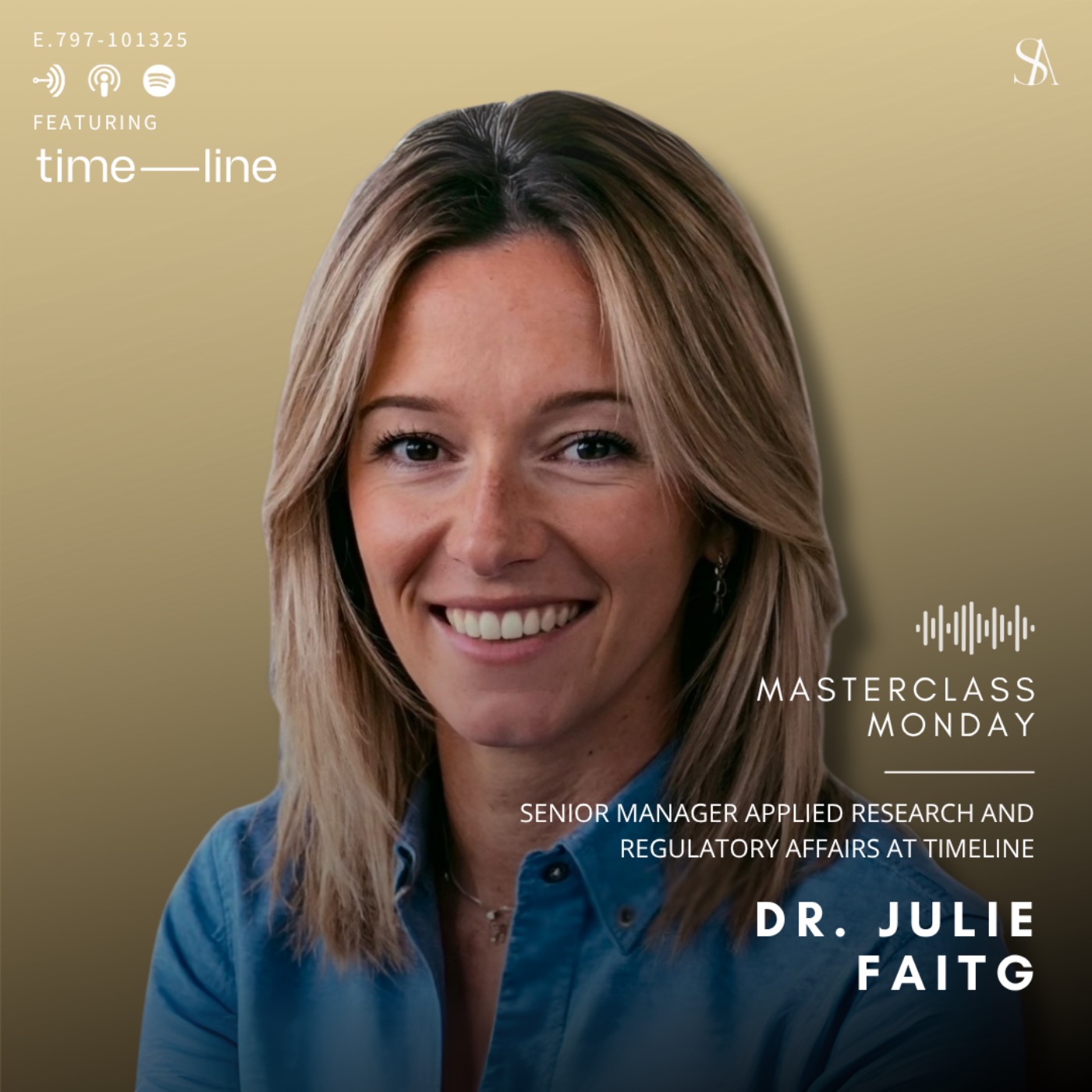
Skin Anarchy
The Science of How Mitochondria Regulate Skin Longevity - Timeline Masterclass Part 2
00:35:52
Masterclass Monday
Loading summary
Transcript53 lines
- [00:01]
A
Hey, guys, welcome back to Skin Anarchy. This is episode two in the masterclass with Timeline. I am so excited to be introducing you guys to a researcher and a scientist who knows so much about mitochondrial health, mitochondrial physiology. She's really spearheading the work that Timeline is doing on that level. So without further ado, please welcome Dr. Julie Feige, Senior Manager, Applied Research and Regulatory affairs at timeline baucom.
- [00:26]
B
Dr. Julie, thank you very much for having me in this podcast. Really, thank you.
- [00:31]
A
Oh, I'm so excited to talk to you. You know, I was, as we were talking about earlier, before the show, I mean, I'm a huge geek. I know a lot of our audience loves to dive deep into that science. And I think with mitochondrial health, there's a lot of buzzwords out here. And I know that Timeline has a very unique approach to, you know, what you guys are really targeting with mitochondria. So before we dive into that, can you give us a little overview, maybe a 101 on, like, why do mitochondria matter and what should we know on a very surface level about them?
- [01:03]
B
Yeah, that's a really good question. So mitochondria, often they are called the powerhouse of the cell, which sometimes I think we are missing so many, many things because I like to call her the CEO of the cells. Basically. There was a lot of people so recently calling that way, and I think this is so, so true because, yes, they are known to produce so much to help to produce the energy, but they have so multiple function and everything is interlinked. So I think that's what people reduce them sometimes with this sentence, powerhouse of the cell. And for all the organ of our body, they are so concerned and so helpful. And it was mostly seen for a disease perspective before being a buzz, you know, like, because this word means so much to the researcher, but when it came out to the public saying, what is the mitochondria people saying? It's battery. It's giving you energy, but it does so much more. So that's why I think today it's really out there to the public and we need to really detail everything that this organ is doing.
- [02:11]
A
Yeah, I mean, I love what you said that it is so much more. It's more like the CEO of the cell. Can you dive a little bit more into that and dive into that physiology as far as understanding them beyond their role as production powerhouses, I mean, what do they really do? What is their true purpose?
- [02:27]
B
Yeah, so basically they have multiple function. So, yeah, the main function that everybody knows is about energy, but they also link to calcium capacity. They also link for the skin, for example, helping on different cell type. They're linked to the collagen, elasticity, firmness. They link if they're dysfunctional, not giving enough. Yes. Power, but also connecting to other organelles to give the message to function properly. And so basically, if your mitochondria are not healthy, you will have some dysfunction in the cascade of your organs or different target function. So this is what is really important to know about that because there's so many. I can go deeper to all of the function, which will take us like four hours. But they're doing, I mean, literally so many, many things about that. So.
- [03:24]
A
Yeah, yeah, that's really good to know though, for our understanding. Now, I know that you've studied mitochondria in multiple tissues, you know, in muscle, brain and now the skin. How do their roles differ depending on what tissue they're found in?
- [03:38]
B
Yeah, so basically, yes, I've looked at muscle, brain and now skin. And so basically where you find mitochondria, it's where there is energy demand, obviously. But for example, blood cells cannot have mitochondria. This is the only place where you don't have mitochondria. And so in muscles, they optimize, sustain energy for contraction. In the brain, for example, they prioritize rapid, precise energy. For neurons. In skin, there's the big balance of high turnover for repair, defense against external stress. And I think this is really important to know that in different organs they have like different capacity. And also in terms of morphology, they're not looking the same because mitochondria is not just a simple organelle. There's a big network and everything is interlinked in our body. And so mitochondria is kind of the center of that. That's why we call it the CEO of the cell. So in every single tissue for muscle, yes, we need to run, we need to walk, we need to move, to have the mobility. So contraction is the most important thing for the brain is essentially, as I said, you know, the messages between neurons. And for the skin, yes, it's the largest organ of our body. So we need this high turnover repair and defense, because this the first organ out with the contact with outside. So that's, that's where mitochondria are acting in a different way.
- [05:07]
A
Now how do they drive skin vitality? I mean, you know, like what exactly do they influence in the skin?
- [05:14]
B
Yeah, so basically, so first with energy, because mitochondria, as I said, generate ATP and this Energy is needed for the cell, for all the repair, the growth, the turnover. But it's also really interesting because on different layer of the skin you have the keratinocytes and you have also the fibroblast. The keratinocytes really knew the epidermis, fibroblasts in the dermis. And they have mitochondria in all of the different layers in these skin cells. So this is where you also need the energy, but it's also linked to the synthesis. So all the collagen and elastin production. So LC mitochondria means also firmer, more elastic skin. While dysfunction of the mitochondria in the skin leads to wrinkles, sagging, et cetera, with skin tone and brightness. Also because this mitochondria in melanocytes and so to regulate all the pigment production. Then I can talk about biofunction for the skin vitality also because all the energy but the calcium and the synthesis of the lipid in the stratum corneum. So many things that mitochondria interface with and all the regeneration because mitochondria they need also the to be recycling as we mentioned in timeline a lot because we focus on mitophagy. And when you have LC mitochondria, you have LCD regeneration of your skin. Proliferation, differentiation. This is where mitochondria is really important into all of the skin vitality process.
- [06:50]
A
That's very interesting, you know, because when we we talk about skin care, obviously the conversation comes up about aging. By now I think things are shifting a little bit because people are getting more interested in like true longevity. What does skin longevity mean? And so I would love for you to speak on this because with aging there is a loss of function. And it's not just right that we're talking about. Take us deeper into the cell, like inside of a skin cell. How do dysfunctional mitochondria accelerate this kind of decline?
- [07:21]
B
Yeah, this is really interesting because aging shows up at a gradual decline in core function. It's not going to ended up like, oh, aging, dysfunctional cells dying, et cetera. It's really showing progressively. And so you have a slower energy production, you have a weaker repair, then you have also reduced protein synthesis and mainly I would say impaired communication between all of the key organelles and aspect of your cells. And so this is where also mitochondria play a central role in this decline. Because if they become less efficient, yes, again, they produce less ATP. They're starving the cell of energy needed for renewal. The collagen building decreased the biomittenance is not kept in a good way. We have damaged DNA, protein and lipid, accelerating cellular wear and tear. So all of this combination which is so important, you have low energy and high damage. So this is where inside the cell you won't see maybe right away outside, but it will come out quite big after because it needs to start from the inside and then becoming like being outside and seeing like big wrinkles also like spot or like darkness or like lack of elasticity and yeah, more wrinkles. And this is where the inside the cells happen. When you have dysfunctional mitochondria.
- [08:49]
A
That makes sense. Yeah, that makes sense. And when we talk about the skin, we always hear this. People say it is our largest organ. It's very vulnerable because it's exposed to all of the environment, every environmental factor. You know what, why is this important for us to understand when it comes to mitochondrial health?
- [09:05]
B
Because I mean, as you said, and I think this is why also at timeline we went after doing all the study on muscle, immune, etc. We go to skin because it's the largest organ of our body and unlike many internal tissues, skin cells face, as you said, UV radiation, pollution, oxidative stress daily and all of them directly damage mitochondrial DNA, also protein and membranes. And so since mitochondrial DNA, like the robust protective structure that shield all this nuclear DNA, it's more prone to problems and deficiencies at the end when this UV radiation go on top of your skin and deeper depending on which uv, uva, uvb. But the skin's turnover and energy demands make it like the mitochondria work harder than in many other tissue because they're really directly the first team to come to really act and as a team to work against all this external stressor so trigger that having all this UV pollution, this chronic inflammation, intrinsic aging. Mitochondria really act as a protector and she needs to, so she needs to be healthy. So that's, that's why the skin needs them to be really healthy. And yeah, this is.
- [10:26]
A
Yeah, no, I like that you, you called it a sheet, you know.
- [10:33]
B
Yeah, because I'm really into seeing is believing. I, I like to see images of mitochondria. I need to see how they look to understand them. Because in many cases in biology, if you want to know what something does, it's often, I mean, useful to know what it looks like.
- [10:50]
A
Yeah.
- [10:52]
B
So this is really something I like to do. And that's why we did also skin biopsy. We're looking at mitochondria inside. But yeah, I like to call it she. Because for me it's one of your best friend and you need to take care of her. Like she's really in contact all the time with everybody. And when one mitochondria is not working, they try to talk to each other like a big network. It's not just a simple bubble. It's really like really branch dynamic organelle. And when someone some of the might coney are not happy, they're trying to help her literally. But when it's too late, it's too late. But they're really trying their best to help each other. So that's why I love it.
- [11:33]
A
No, I love it. I love it so much. And you know, we always hear about like mitochondrial DNA comes from your mother and it just makes sense to call them a she. It's. I like that. Yeah, I'm stealing it. I'm stealing it. No, I. I think this is so interesting everything you're saying. I'm just trying to absorb everything. I think when one of the biggest things is people talk mitochondrial resilience a lot. I hear that come up a lot. And how does this can. Let's dive a little deeper, you know, into the science can talk to us about things like oxidative stress, inflammation, what happens during sun exposure. Like any of the data that you've seen around these parameters.
- [12:06]
B
Yeah, no, for example, it. This is really important because when you do, for example you said when you apply UV radiation in your body, so you create some erythema. So basically inflammation and so inflammation triggers like but mitochondria and stress and so they release things that you don't want them to release. There's a lot of oxygen species over there and so you really want to like avoid all this degradation. And basically that's why you need something to keep them like healthier all the time. And so the resilience is really because this is their role like mitochondrial resilience. How mitochondria maintains energy but not only and all the action that she's here for repair damage oxidative stress control. And despite all these constant challenges and the fact that resilient mitochondria efficiently neutralize this reactive oxygen species preventing all this oxidative stress, but not just that from damaging DNA protein lipids. But they also help to keep inflammation in balance, ensuring also that you have immune response repair rather than degrade tissue. And so that's why you need to take care of them. And when you have that might when you have like the pollution, the sun or the stresses, mitochondria can recover and adapt by doing, for example, sustaining collagen production organization, which is really important. It's just not. Collagen production is the extracellular matrix of solve of your layers, the barrier. And this is where you need healthy mitochondria, really, because this is their role, like mitochondrial resilience. This is really great. But you need healthy mitochondria to do that. Definitely.
- [14:02]
A
That makes sense. Yeah. I mean, you know, no one is really speaking about this on the mainstream level. I think that's where timeline really has for me as a consumer, as a scientist, it stands out because your focus is not just about, oh, hey, look, listen, we're talking about mitochondria. You gu are, I think, bringing a perspective forward that's allowing consumers to realize that biology goes very deep, you know, and it's very, very important to understand that there are dimensions to the role of many of the organelles that we are seeing and we learn about in biology. I mean, I remember when I was in school taking Biology 101, you know, they never even spoke about mitochondria. And you'd learn about them, right? We'd learn about them.
- [14:40]
B
Yeah.
- [14:40]
A
But you don't understand, like, we don't even as scientists get that knowledge of like this is why it matters. And there is a homeostasis taking place, involves multi, multiple different roles, you know, and so I find that to be so amazing that through what you guys are doing at Timeline, this is coming out, you know, into the scientific community and anyone out there who's interested and truly interested in skin health, we're able to learn this level of science, you know, so that's very cool.
- [15:05]
B
Yeah, definitely. And the fact that you've mentioned a lot of brand looking out there, like into more beauty, appearance and it's, I think what is really important and I like, because there's someone in our company all the time saying that, I mean, aging, you need to age gracefully. Aging is a privilege. And I love that because that's true. And what is important today, is it to make a cream to show less wrinkle? Is it to show that? No, we want what's good from the inside. We always look for muscle, what is good for our gut, for our brain. Why not do that for skin also, you know, to just counterbalance like what we have today, not just like the surface of it. And that's why I think education is key, definitely about all of these things in essentially mitochondria today.
- [15:53]
A
Yeah, yeah, absolutely. And you know, we had brought, we talked about oxidative stress. This made Me think of the, the idea that for so long as I think I've seen skincare obsess over certain ingredients like, you know, antioxidants or like a vitamin C based serum. But I mean, then that's wonderful. I think we've made great strides by doing that. But at the same time I think it put things into silos a lot. And I don't think that's how science works, you know, and so when I'm talking to you right now and you're teaching me about mitochondria and their interconnected role, I think it really shines that spotlight on us. Understanding this is systems biology, we have to understand that. And so when you're thinking about a skincare routine, it's not just about, hey, let's hydrate, you know, it's not just that you have to think about this. It's feeding your cells with something. And whatever your cells are being fed with, it goes and it acts, you know, molecularly. So I think it's very novel for many consumers to think on that level now.
- [16:51]
B
Oh, this is totally true. And I think they need to understand and also that's why a timeline. And I want to emphasize that because everything that we do, like a product or something, or even the, the compounds itself, the mitochondria, we do clinical studies and we have a paper, it's under review, but already on preprint about like the five first clinical trial that we've done for the skincare line. So that's why I was having some discussion with people saying why your brand and not others. I said, you know, this is your role to judge at the end. But we are completely transparent. We're showing all the beautiful science that we have. And our idea today is to know what you're putting on your face, you know.
- [17:35]
A
Yeah.
- [17:35]
B
And to understand it. And I think that's the beauty of it. And that's what I'm really proud of what we've done today. Definitely, absolutely.
- [17:44]
A
Now I want you mentioned clinical studies. Can you share the most compelling findings? You know, what did you notice in the skin after systemic or topical use?
- [17:53]
B
So basically on topical application, when we started with the compounds itself, the mitopur, we looked at aging biomarker, for example. So we looked also in, when we did, when we did biopsy of the forearm of the people after applying topically, we saw that all the genes related, for example to collagen and other things from aging were really down, but they were upregulated. When we applied our cream, like our mitocur ingredient. And it was like just a key sign for us because we're like, okay, this is amazing. We see that with our ingredient, we upregulated all these genes related to energy to mitophagy to like, I mean, all the collagen, the inflammatory pathway, which is big and immune related to the inflammatory on the skin. And so by looking first at the ingredient itself, we also did, I mean, did a lot of work on cells to really identify what is the biomarker for the skin cell on the different layer for the keratinocytes and the fibroblast. But then after that, we moved with our finished product and we looked at the same signature on the mitochondrial signature, the revitalization. So the mitophagy, the collagen organization, the extracellular matrix organization and the. The different way of looking at the skin. Because when you have your cells, you have the differentiation and then the proliferation where our cream really are ingredient looking at differentiation and helping the cells to differentiate and to be more adult. I will say in thinking about a kid who grown up and so myelopid really helps this little kid to grow and to differentiate and then to be independent. This is a big metaphor. But this is kind of what our ingredients do also properly and controlling all this inflammatory pathway by decreasing that. When we did the trial on photo damage and we did UV radiation, we decreased the erythema, which was really impressive. But they also. The other clinical measurement that we have all the time is increase of hydration wrinkles. We have the participants saying that they have the experience femur a smoother texture, improved radiant skin. Which is just amazing. Definitely.
- [20:16]
A
Yeah, absolutely. No, that's wonderful. And you know, I want to talk more about this delivery side of things, because when we talk about skin care, most of those skincare products don't penetrate beyond the epidermis. And so can you talk to us about how timeline has overcome that barrier to actually deliver active compounds where mitochondria live in the deeper layers?
- [20:37]
B
Yeah, definitely. And I think also something that needs to be said. You don't want all of your product and all of the ingredient be like deep, deep inside the dermis. Because after that becoming a drug and you don't want to have that. But. But that's true. A lot of people have some molecules that are so heavy, so they can't penetrate even after the stratum corneum. So it is just before the epidermis and they can't penetrate at all. So I think us it's more because we have an ingredient that target specifically These organelles, the mitochondria, but also the entire organization of the extracellular matrix that help the penetration. And we have data showing where our cream today penetrate like over the epidermis and reaching also the dermis at some point. So this is something that we have done in a certain way by combining the ingredients that are, I mean the more interesting for us in terms of aging perspective, but skin health perspective. And then the way we do the product and the homogenization, I mean this is where after that we find that our penetration is really good. For sure you want to have like bioavailable molecule etc, not too heavy, but after that depends what you use. The lipid carrier, depending what you have on your product. There's so many things today that you can use to enhance that. But sometimes you need to be really careful because as I said, you don't want something to go deeper in the dermis. So that's why we have all of our studies around that. But we know today that our compounds, which all the cells that we want and that we know exactly what it's going to do. So that's the main thing that we, we know today and we want to target and control also.
- [22:31]
A
Right, that makes sense. I mean, I think also it's interesting the shift skincare is taking right now because, and I asked you this question because so many people are talking about like very advanced biotech these days and they're. And that's great, I'm here for it. I think that we definitely, I love seeing this field evolve but I think it's also important to understand what you said where you don't want things to go so deep to where it's like an actual drug. That's not the goal I think of SK care, I think it's more so about how efficient can we make it so that the layers we do penetrate, those are impacted in a more profound way. And you know, when you study the skin, this is another thing you understand that you do lose efficacy when you go too deep. So if you go like down to the basement membrane level, that's terrible. Like you never want to do that because then you're damaging the whole tissue. So I mean this is more of like a sideline, you know that I'm saying. But a lot of I think these biotech innovations that are coming out, I do worry about that, you know, in the sense of like how relevant are they to true physiology and purpose driven, you know.
- [23:29]
B
So yeah, totally, because I think you need to control that and a lot of people don't control that because in terms of safety, they don't know really what the compounds will do, which this is the main thing. And that's why I also have a fit in the regulatory world. And that's why I like to be able to know what we need to do, what we can do. And based on these, this lipid carrier encapsulation. Yes, they have safety. If they have safety studies looking that essentially everything is normal, perfect, it's not going to cause anything. This is great literally because we need some molecules that are really, they're really great, but they need to penetrate more. But there's a limit, There's a limit everywhere for sure. But you need to control that. Definitely.
- [24:14]
A
Absolutely. Now I want to talk about the fact that you guys are based, your science is based out of Switzerland. I think we all know at this point that Swiss research, especially in skin health, is just unmatched. And I would love for you to talk about all of that work, all of that research, translating that science into just real world skin care. And what was the biggest challenge to taking that leap from the bench to the jar?
- [24:37]
B
Yeah, so to be completely fully transparent. I think it was not the knowledge because we didn't have the knowledge on skin before and we were really focused on other organs. But we are all PhDs, MDs. We have an amazing lab team, three girls, really amazing working with us and even able to learn every single day on different cell types. So they've been working a lot on muscle, but now they're really, really good on skin cell model. So they needed to adapt themselves. And so you need to also look at your compounds because your compounds will not potentially react similarly in all of these different cell type model. And this is really us putting the science first at timeline. So putting really big effort on all this work. This lab work over there in, in our lab and looking at some signature which was really interesting. And then putting us together around the same table saying there's something happening here. So literally need to do all the same safety. Looking at a manufacturer can help us doing all this beautiful product. And then we looked at safety because for us, when we looked at the first skin cell experiment, all the signature, it was amazing. But then when you create a full cream, this is completely different. So that's why we did step by step and taking only the Milo Poo compound, putting in the basic cream and what we call the nature pt, so a test patch, test product to see the skin sensitization because that's the main thing you want to see if People will react or not. Like, you don't want to end it up like red, completely burned in your skin to see if your ingredient is stable or not. And we ended up doing all these safety studies first. We had an amazing results. And so after that we thought about what would be the key ingredient to put together. And so we ended up putting with the key pillars that we have, the niacinamide and the tree allose together. Fun, beautiful synergy, putting that together on the cream, doing all the different clinical work that we needed to do based on aging, based on before and after. We. We have 11 clinical trial today. And I think having a team together, being able to see the different aspects. So the science, the safety, the tolerability, the bioavailability, the delivery, the stability, and then, yes, the regulatory and manufacturing constraint. This is kind of a big thing that we've done in a limited time, like one or two years. And yeah, that was amazing. But I think starting from nothing, because we didn't have the knowledge, and we were surrounded by people who had the knowledge and help us, and I think it was the most beautiful thing that happened to us.
- [27:36]
A
That's amazing. I'm glad that you guys kind of led with safety, because that's usually an afterthought sometimes for a lot of products. And I find that to be a little disheartening whenever I come across those situations. So I like that you put safety first, and I like that you did that, because as a consumer, it is very important to know that your products have been thoroughly tested and that the synergy that's happening in the formula, you know, it's going to actually matter at the end of the day. You know, this is something nobody wants to focus on right now, but I think the world is shifting where the consumer is becoming more intelligent, and we're realizing that we don't want to compromise on anything. Like, I want the product to be efficacious, but I want to make sure that it's not going to. If I keep using it every day, my skin's not going to sensitize to it. So that's very important, I think, for brands to do that homework from the beginning.
- [28:24]
B
Oh, yeah, totally.
- [28:25]
A
No, I just want to ask you kind of like a dream question, you know, I guess, to get your thoughts right, because this field is evolving so quickly. And whenever I look at skincare aesthetics, I'm just. I don't know, I'm blown away every time because we're taking such strides towards progress. What is in your mind, your dream Innovation. If you could have one, what does that look like when it. In the world of mitochondrial aesthetics?
- [28:49]
B
Oh, that's a really, really good question, I think. I mean, as you mentioned, aesthetic, but also because I have a fit in the regulatory world. It's completely another regulatory framework when we talk about aesthetic. So I think there's a lot of things to do, definitely. But it's still another field. I would go really crazy in terms of innovation, because today we have like all this machine to look at our skins. You know, when you have dryness, you have red lines. This UV machine, really interesting. You can have an X ray of your skin. It's kind of a beautiful. I would love to have that for mitochondria. You know, you put your face on and they can see them. I mean, you know, see your network, see if they're bad or not. I would love to have that because this is so important. And see if your network is. I mean, if it's a beautiful, big, interconnected network or when it's more like disease or not healthy. Usually your mitochondria tends to be alone and far from each other. And so this is really something that is quite common. When they're not healthy, they're more circular, really simple bubbles. And so having an X ray and be able, like, to see them, I mean, definitely. I would buy that.
- [30:09]
A
Yeah, I would buy that. Oh, my God, I would totally geek out over something like that. Every single minute. I'd be checking.
- [30:16]
B
Yeah. No matter the price of it. But I think this is because. Yes, we can talk about aesthetic. Definitely. I think. But. But again, this regulation, and it's completely different than cosmetic today, skincare, and depending on which type of aesthetic. But if I literally need to talk about innovation, this is what I will go for. Because you want to see first. And it's prevention. You know, a lot of people today, we're not talking enough about prevention. And so looking at your mitochondria, how they feel, how they are, they behavior, like, oh, my God, then you can. You will know what you need to do at some point, you know, and.
- [30:53]
A
So, yeah, I love it. I love it so much. And I'm right there with you. So I hope that day is sooner than later.
- [31:00]
B
I'll try my best.
- [31:02]
A
But that's the next project, right? That's the next project for time.
- [31:05]
B
Yeah, yeah, definitely. We'll think about it. I'm sure they would say that I'm crazy at the end, but.
- [31:11]
A
Well, you have my full support. You know, if you ever need somebody to cheer you On, I mean, I think it's fascinating. I think mitochondria, I think mitochondrial health, it's such an emerging field and for consumers especially, I'm very passionate about experts like yourself being able to really educate us in this space because as a consumer, every day it's difficult to figure out in this ever expanding industry, what should we pick for skincare? What should we pick for daily? And I'm really a firm believer myself in the idea that you need to find something that works for you, that you can stick to for a long period of time. And when I look at timeline, I feel like you guys have created a protocol and you've created something that it's not just any more about. Oh, here's some hydration, you know what I mean? Like, here's some, here's a cleanser. No, there's a purpose now, you know, behind it. There's a purpose that you're working towards every time you use your skin care. And I just, I love that. I think that's where medicine meets over the counter products. That's the intersection. So, yeah, huge fan in me, you guys are a huge fan.
- [32:13]
B
But I think also what I love about the rebrand and what we did, and thank you also to Jamie and Eva from our team doing that. We had previously the night cream and the day cream. And I think the idea today is to let people choose what their skin needs. So it's not written day or night on our package. Now it's the Baia cream, which is more the rich one, depending if you want to use it, also during the day, during the winter, for example, and you have really dry skin and you want to have it like during the day. Or the dewy cream, which was the day cream before, but it's for sure it's lighter in terms of Galinic, it's hydrating also, but it's less rich than the bio cream. And so I think giving the responsibility of people to know what their skin needs, I think this is really key because you can't apply all the time. The same thing every season. Your skin changing so much. And your mitochondria too, as we said, they have such a big quality control. Like every time, like when they're not efficient, they've been replaced, renew. And so this is something that I think people need to do that to themselves, to do that and to be able to choose what do I need today for my skin. So I think this is really important.
- [33:35]
A
I love that. No, I love that and love the flexibility built in with that I know as we come onto the. The winter months and the drier months, it's good to have that flexibility in a range of products because, yeah, we want the more thicker moisturizers. We want just more behind it because we are exposed to more environmentally. But it's beautiful. The rebrand. I think it's so cool that the color of the product resembles the actual mito pure. You know, it's the actual color of the ingredient. I mean, little details like that, to me, I don't know, they. They really mean a lot, because I think for consumers, transparency is always a problem. We're always wondering, like, what. What's in the jar? And so I think there's. It's been a brilliant way that you guys have rebranded. It's not just better packaging or whatever. It's really. You've brought the science forward in a beautiful way. So.
- [34:23]
B
Oh, yeah. I think the packaging today really, as you said, it being transparent with people. And because the first time they opened the product, it was like, oh, your cream is. I mean, they're all yellow. Yeah. Because it's the ingredient that is yellow. So it's being completely transparent. And I think that's exactly what you said. And I can just emphasize that you want to tell the truth to people. You want to tell them what we're doing and not using claims that are not making any sense. We want to show them what we're doing or the clinical trial. And it starts with the packaging. Right. Basically. And so being true, like, really true to them and saying the truth, saying this is the ingredient. And then you can look also to the clinical trial that we've done. I think it's a. It's just a beautiful story. And I mean, I love that people react so well to that. And we're so happy. Our skin team did such an amazing job on that and literally paid off. Definitely.
- [35:23]
A
Absolutely. Thank you so much for educating us and for teaching us about mitochondria. I've loved this conversation. I could literally talk to you for hours. I hope everybody in the audience. I hope you guys learned as much as I did. And if you're curious more about timeline science, you can definitely check out the link in the show notes for this episode. The website is linked. They have a wonderful website. It's very educational. So I urge you guys, go check it out and chime in if you have any questions. We'll definitely pass along your questions to the team. Thank you so much.
- [35:51]
B
Thank you for having me.
- [35:53]
A
Hey, guys. So I hope you love that episode. Please make sure to hit subscribe if you're tuning in to us on any podcast platform. We are available on so many different platforms, so wherever it is that you're tuning in, just go hit subscribe. You will be immediately notified when we publish new episodes. This way you're able to to tune in to amazing insights from experts, brand founders, industry leaders, authors, all the wonderful people that we host. And that's very important for me because I love to hear from you guys and really understand what you love and what you want to hear more of. Also, make sure to give us a follow on all of our social media outlets. We're available on Instagram, TikTok X, you name it, we're there. We also have a blog on Medium, so if you're a reader and you love Medium and blogs, check us out on Medium. We publish some really great articles on there that do deeper dives than just what's available on the podcast, and it's really a great place for all of you science geeks out there that want to learn a little bit more. We go above and beyond with our research and making sure we're bringing you information that you usually probably won't hear about in other outlets. So check us out, leave us a comment, leave us a review, and we'll be back next time with another episode. Thank you.