← Smart Girl Dumb Questions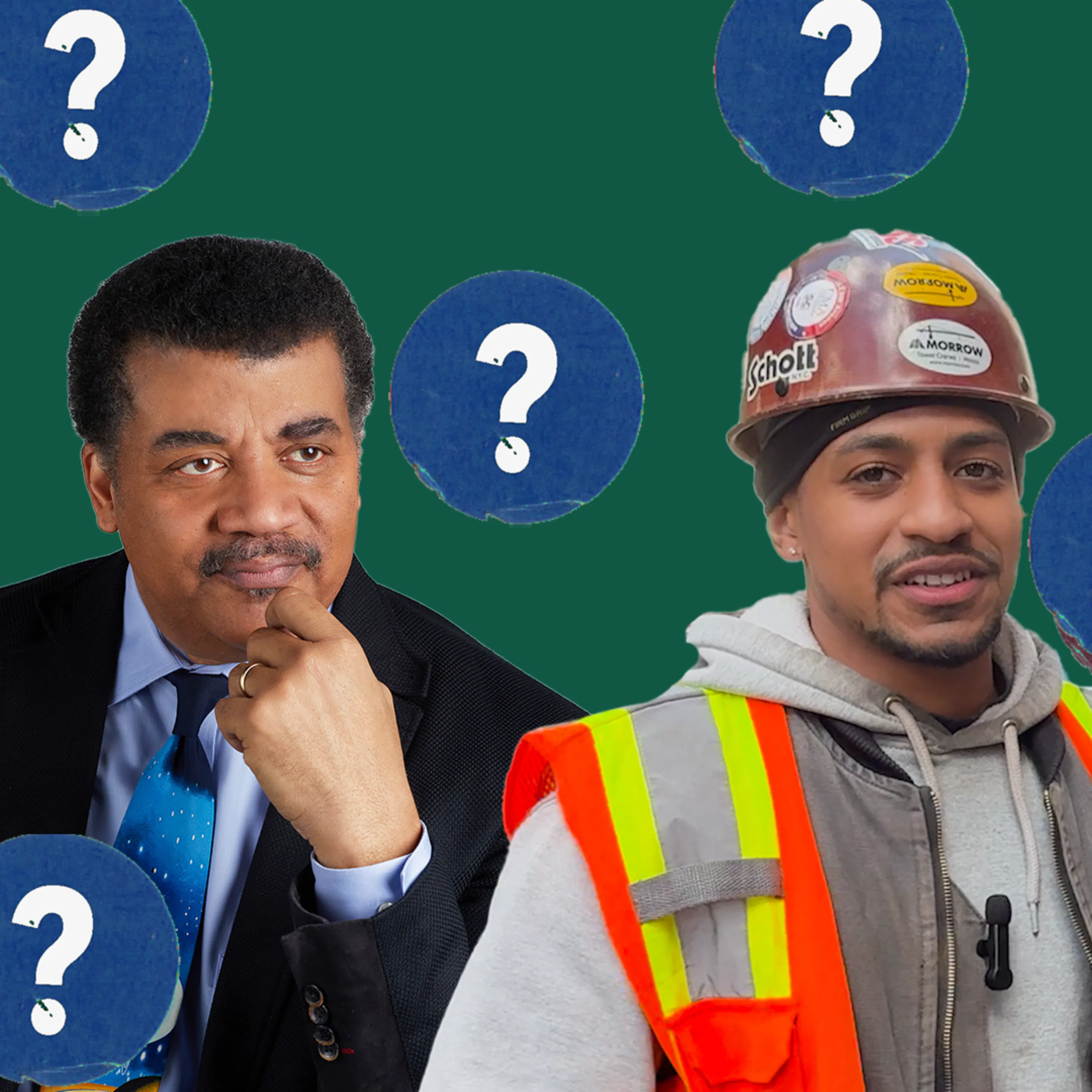
Smart Girl Dumb Questions
How Do Cranes Get Up There? An Astrophysicist & Construction Worker Walk Into a Bar
00:09:16
Nayeema puts on a hard hat and visits a building site where she finds Brandon Hernandez, a construction worker who’s able to fill in some blanks for astrophysicist Neil deGrasse Tyson.
Loading summary
Transcript72 lines
- [00:00]
Naima
Welcome to another installment of CSI Dumb Questions, where the dumbest thing you can be is a know it all. In these shorter episodes, I stand at a board that's fitting of a procedural primetime drama and answer the questions that my very smart guests did not know the answer to. This week's is from Neil DeGrasse Tyson.
- [00:16]
Brandon
Smart girl, Dumb Questions.
- [00:23]
Naima
Neil, of course, is an astrophysicist, the director of the Hayden Planetarium. And we had an hour plus long conversation about the universe. From the big bang to are we living in a simulation? To how does time and space work anyways? And after all of that, I asked Neil DeGrasse Tyson. What is Neil DeGrasse Tyson dumb about, if anything?
- [00:41]
Neil DeGrasse Tyson
Oh, anytime I'm in the company of someone who knows anything that I don't know, that's all I want to talk about. Let's say it's a construction worker.
- [00:48]
Greg
Okay.
- [00:50]
Neil DeGrasse Tyson
How did they get the crane to the top of the building?
- [00:53]
Brandon
How did they get the crane?
- [00:55]
Neil DeGrasse Tyson
At the time, I didn't see them put it up there. It's 50 stories up, just down there.
- [00:59]
Brandon Hernandez
Yeah.
- [00:59]
Naima
How do they get those cranes up there? I actually have never seen them getting those cranes up there. I wonder if it's something they do in the middle of the night when no one's watching. But I love that. This astrophysicist had a question for a construction worker. And thankfully I live in New York City, so I can just go outside and find the answer. I came prepared, obviously, with this pink hard hat.
- [01:21]
Greg
This building had the biggest windows.
- [01:24]
Brandon
Windows and all of Manhattan.
- [01:25]
Greg
And to hold my hand. Look around, look around. One window is like maybe six, seven, eight windows. One of these windows.
- [01:31]
Brandon
One of these windows is seven of those windows.
- [01:33]
Greg
Look. That's how small it is. They need. They need a crane to pick these windows.
- [01:38]
Naima
A crane. That's exactly what we need. So Greg introduced me to another person on site.
- [01:43]
Brandon
Do you know the physicist Neil Degrasse Tyson?
- [01:47]
Brandon Hernandez
Never heard of the first.
- [01:48]
Brandon
He's the astrophysicist who runs the Hayden Planetarium. Really smart guy, always on tv. And he asked, how do you get a construction crane up at the top of the building?
- [01:59]
Brandon Hernandez
How do you get one up the building?
- [02:01]
Naima
Yeah.
- [02:01]
Brandon
Do you know the answer of how they build those cranes to the top of the building?
- [02:05]
Brandon Hernandez
That is a very good question. What kind of. You said you're looking for a stupid answer.
- [02:10]
Brandon
No, I'm looking for a real answer.
- [02:11]
Brandon Hernandez
An actual answer. Okay.
- [02:13]
Brandon
Can we interview you? Do you know the answer of how they build that?
- [02:15]
Brandon Hernandez
I actually used to work for A company that used to assemble them on.
- [02:20]
Brandon
Okay, Can I give you a better microphone so I can interview you?
- [02:24]
Greg
Is that okay?
- [02:25]
Brandon Hernandez
That's fine.
- [02:27]
Brandon
The crane's not going to fall on us right now.
- [02:29]
Brandon Hernandez
I'll make sure.
- [02:31]
Brandon
Okay, thank you. So tell me your name again.
- [02:33]
Brandon Hernandez
Brandon.
- [02:34]
Brandon
Brandon. I'm Naima.
- [02:35]
Brandon Hernandez
Nice to meet you.
- [02:36]
Brandon
Nice to meet you. So, Neil Degrasse Tyson. He's a super smart guy and he did not know. How do you get the construction crane to the top of the building?
- [02:44]
Brandon Hernandez
Yeah, it's a very, very intense process where you have to first get a mobile. What's called the mobile crane, which is those huge trucks with a crane on it already.
- [02:55]
Brandon
Okay.
- [02:56]
Brandon Hernandez
So they deliver these sections from the crane.
- [03:00]
Brandon
So each of like those blocks.
- [03:02]
Brandon Hernandez
Yeah, they come in singles.
- [03:03]
Brandon
Yeah.
- [03:04]
Brandon Hernandez
So we do various rigging techniques to offload them off the trailer. We set them all up and then it's like they get assembled one by one by hand. Not by hand. So once the crane lifts one up, stands one in the air, once it's planted, then the next one goes on top. Then we secure it with bolts and everything like that. And then once it reaches a certain height, they attach was what is called tie ins? Yeah, they attach the tie ins to keep it secure onto the building, you know, just in case. But you little do you know, the crane is always swaying from 1 to 3 inches. It has to sway because that's how it keeps this balance. It's like a counterbalance. As the building reaches a certain height, the crane has to go up as well. If it's almost reaching what's called the boom.
- [03:58]
Brandon
The boom is like the elbow of the crane. Yes.
- [04:00]
Brandon Hernandez
It means that the crane will no longer be able to swing. So therefore it's the same process as when they built it in the beginning. They bring the tower sections and then the only difference now is that you don't have. There is no mobile crane in play. Now it's the tower crane just offloading the sections.
- [04:23]
Brandon
Is that more dangerous when there's no mobile crane and it's just the tower crane?
- [04:26]
Brandon Hernandez
Well, the higher it is. Yes. So what happens is that the section is lifted into the air. There are guys waiting inside the crane. They hook it onto this pulley machine. It comes into the crane.
- [04:41]
Brandon
Yeah.
- [04:42]
Brandon Hernandez
Therefore the crane then goes down and picks up a counter block which weighs roughly up to £10,000. They lift that into the air and then as the new section is secured onto the tower, the crane starts to come up slowly with a machine system.
- [04:59]
Brandon
So it goes higher and higher. Because of that counterweight that comes after.
- [05:02]
Brandon Hernandez
Each and every section, mobile cranes come.
- [05:05]
Brandon
In, they go through and they start building, block by block the crane up. At a certain height, the crane is so high that it can't be done with a mobile crane anymore.
- [05:16]
Brandon Hernandez
Exactly.
- [05:17]
Brandon
And then that.
- [05:18]
Brandon Hernandez
That builds itself out, builds itself all the way up.
- [05:21]
Brandon
It's a self building way to get yourself up and up and up. So basically like releases like a ladder more and more of itself. Yes, yes, all the way. And one thing, when the tower crane part is happening, it's going up and up and up. You need that counterbalance to keep it sturdy. Right. Explain that, like how that counterbalance comes in.
- [05:40]
Brandon Hernandez
So the counterbalance is needed because when the guys are securing the new section into the crane, it has to be able to withstand that weight of that opposite on the opposite end. It's kind of hard to.
- [05:57]
Brandon
Yeah, it's like physics. It's physics. Neil Degrasse Tyson would know the answer to this.
- [06:02]
Brandon Hernandez
I mentioned him. I actually do know who that is. Yeah, yeah, yeah, yeah, yeah.
- [06:05]
Brandon
He's gonna be excited about you.
- [06:07]
Brandon Hernandez
He's so intelligent. But he didn't know about this. Yeah, it's a very intense process.
- [06:13]
Brandon
And what time of day are you guys building these cranes? Like, is it happening at night? Is it like. Because we never see them, they usually.
- [06:20]
Brandon Hernandez
Try to wait for, let's say the work day to be over. That way no one gets interrupted or anything from doing their work. And usually what the superintendent would do is get a permit to work late hours.
- [06:36]
Brandon
Yeah.
- [06:37]
Brandon Hernandez
That way you have no workers on site. Because this is a very, very dangerous operation where nobody can be in the area when this is going on.
- [06:49]
Brandon
Yeah, there are people walking around Manhattan at all times of all days. Are they in danger or.
- [06:53]
Brandon Hernandez
I mean, they're fine. Because what they'll usually do is obviously block off one side of the block or block off traffic and everything their way. That way no one's in the area. Yeah, that's pretty much it.
- [07:05]
Brandon
All right, thank you so much, Brandon. You taught me so much. I appreciate it. Thank you very much. It was very generous of Brandon Hernandez.
- [07:13]
Naima
To be spending so much time with me at the end of his workday at a construction site that his colleague Greg told me was quote, unquote, having beef with the Empire State Building. But two reflections from that conversation with Brandon. One is that this is just such difficult work, Such dangerous, difficult work. I mean, objects of this size being lifted to such heights and being manufactured by themselves in the air is just super dangerous. And I Don't even think about that. Walking around New York City with so much construction happening all the time, let alone the people doing those jobs.
- [07:46]
Brandon
Right.
- [07:46]
Naima
And it's also extremely technical work. I mean, it's almost ironic that an astrophysicist asked this question because Brandon's answer back was all physics. His points about a counterweight needed to balance that load so that it could get higher and higher into the air. The idea of, you know, this crane constantly swaying between 1 to 3 inches as it balances the reality of the wind and the elements around it, you know, this is a massive exercise in kind of maintaining a center of gravity at higher and higher and higher heights. And all of that kind of blew my mind and will make me walk around New York really differently. That's it for this episode of csi. Dumb questions, please go. Check out the longer episode with Neil DeGrasse Tyson, who is so smart about so many things, including the potential for wormholes, for space time travel, which just blew my mind. You have to go listen. But I guess no matter who you are, you have things to be infinitely curious about, even if you're Neil DeGrasse Tyson, by the way, I'm curious about what you want to know. Send me your dumb questions. You can leave them in your reviews or comments or. Or send me an email. Naimaraza101mail.com Special thanks to my partner in crime, Holly Thiel, who edited and shot this video, as well as Dana Bellout, who provided editorial support. And of course, to Brandon Hernandez, who made the time to explain how those cranes get up there. By the way, I was at a dinner the other night and someone asked me, how did they get the cranes down? So I don't know. I'm gonna have to go figure that out now. Thanks for listening. I'll see you next week for an all new Smart Girl Dumb Questions.