← Snap Judgment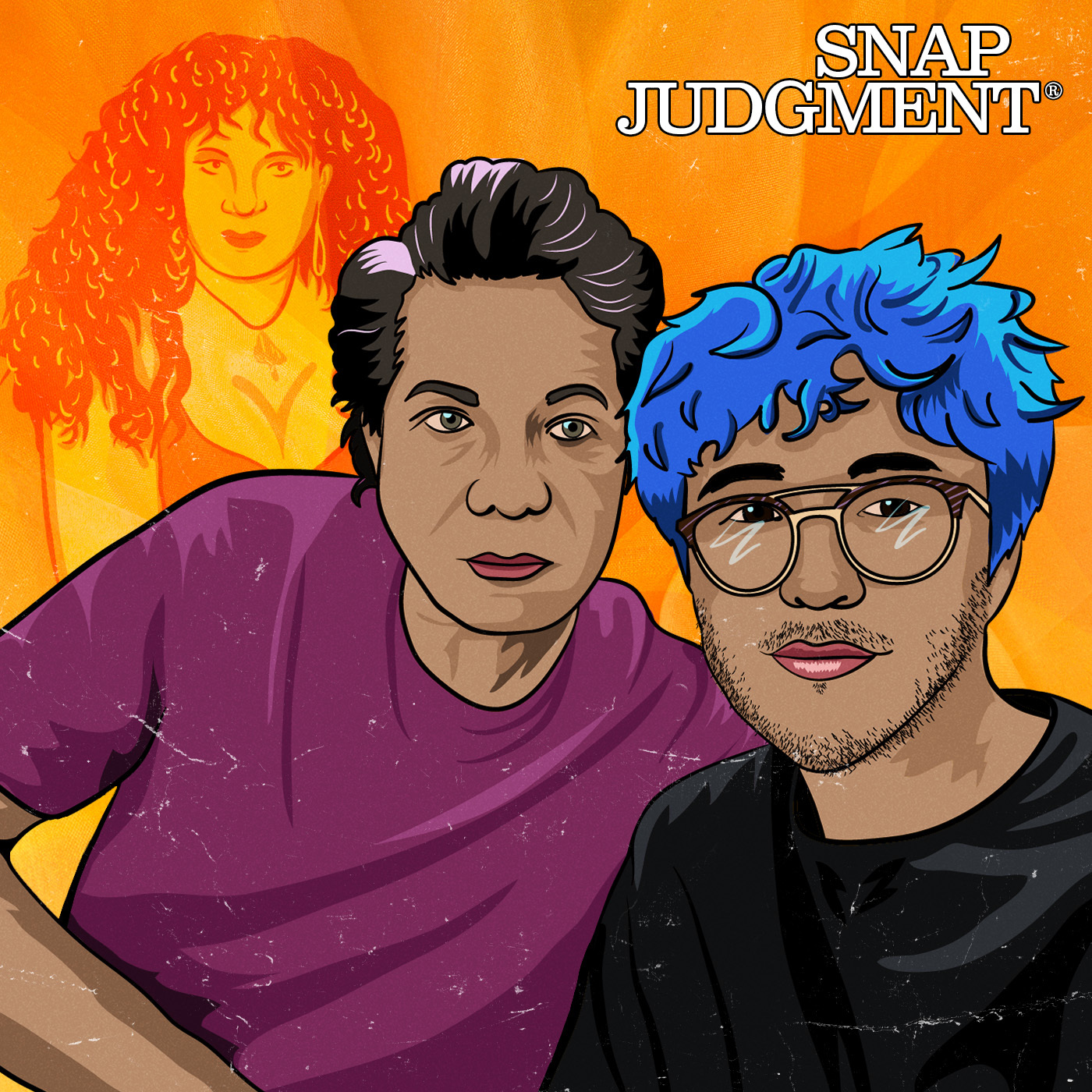
Snap Judgment
Jorge, Gina y Dante - Snap Classic
00:49:38
This week on Snap, we go to Guadalajara, Mexico where Dante meets Jorge. As they start to understand each other they soon discover that what brings them together also sets them apart.
Loading summary
Transcript104 lines
- [00:03]
Glenn Washington
SNAP Studios.
- [00:07]
Eric Glass
I'm Eric Glass. On this American Life. We tell real life stories, really good ones.
- [00:12]
Glenn Washington
My mother said, I'm sorry you weren't.
- [00:16]
Eric Glass
Here because Father Sager was here visiting.
- [00:20]
Glenn Washington
And he found a very nice orphanage for you. And I said, but I'm not an orphan, Ma.
- [00:30]
Eric Glass
Surprising stories every week.
- [00:32]
Glenn Washington
This American Life.
- [00:35]
Eric Glass
Listen, wherever you get your podcasts.
- [00:50]
Glenn Washington
There is a book, a novel that I love. It evokes this ineffable sense, one that we don't have a great word for in English. A feeling of the monumental choice you can never revisit, of loss, of consequence, of not quite regret. So when I hear the author is coming to my favorite bookstore to give a reading, I flip grab my dog eared hardcover, hoping to score a signature. Sure. But more than anything, wanting to connect with someone who's world building, whose characters, whose ideas have touched me. Reading a book the way I read this one, it creates this sense of traveling through someone's mind with them. It's intimate, revelatory, it's charged. And this particular text, for me, it's also kind of a North Star, lighting the way toward the writer I'd like to someday become. That is how strongly I feel and how disappointed I am when the author sits down in front of a crowded room, reads a few lines, says he has just enough time for a couple signatures, then stands up to leave. And I don't know what I expected from this guy, what we're gonna become. Best pals? Exchange midnight text drafts of new stories? What am I asking for? I've got his book. What more do I want? Wow. Today on Snap Judgment, we can't just leave well enough alone. SNAP proudly presents Jorge Gina Ev Dante. My name is Glenn Washington, and please remember, stories on the radio are always better than stories from books. At least when you're listening to Snap Judgment. Now I want you to meet Dante. Dante grew up in a small beach town called Los Mochis, but now lives in Guadalajara. It's the second largest city in Mexico with one of the largest gay populations. And was there he found something he'd been looking for for a very long time. Snap Judgment.
- [03:50]
Eric Glass
When I first moved to this neighborhood, I wanted to get a haircut. So I went to the salon around the corner. And that's where I met Jorge. Jorge appears to be a gay man. He's around 50. He's wearing a rainbow face mask. And the first thing I see is a big poster of Marilyn Monroe. And right next to it, there's a huge ioana inside an open Cage. Jorge tells me that it's been on tv. I don't know why, but I suppose it's because it's a very big 9 year old Ioana. I sit down, he starts cutting my hair and we start talking. And neither of us is willing to ask the other if they're queer. So we're going around in circles until I finally say I'm trans. And he asks me, so when will you start taking hormones? And I say, girl, I've already started. And he's like, what? And I'm like, yeah. He says, okay, I get it. He thought I was a trans woman. And he says, well, you pass so well that I wonder how big your dick was. So Jorge likes to joke a lot. He tells me that the neighborhood we live in has always been full of queer people. And he gives me his friends names. One is called La Flaca, the other La Modelo, he says. He showed me a photo of him when he lived in San Francisco. Back when his friends called him Gina and he was on hormones. This makes me think he's a trans woman who has detransitioned. Now that I see up close, the hormones have left their trace on his body. He has small breasts that look like mine before I had my surgery. I can't believe my luck. All these years I've wanted to meet a trans person older than me. In the small town where I grew up, I never saw queer people. The only trans person I knew was a client who would go to my mom's vet clinic. They were around 50 and I was just a kid, so I never talked to them. And now here I am with Jorge, with someone who could finally tell me their story. We keep talking, and then he says, if you had seen me back then, you would have sworn I was a woman. I'm confused now. So I ask him if he still identifies as a woman, and he tells me he does. With his friends, he's Gina, but with everyone else he's Jorge, and he uses masculine pronouns. Now I'm intrigued. I want to understand what led him to become Jorge and Gina. So I ask him if I can interview him. He agrees. The next day, I show up at the salon with my recorder. Or he's smoking a cigarette in the lobby. Or maybe that's just an image I have stuck in my mind because every time I see him, he's smoking a cigarette. He offers me some water. We sit down. I ask him where should we start.
- [07:40]
Jorge
As a kid, I thought I was the only gay person in the world. Then when I was around 14 years old, I met this gay guy. They call him Yolanda. He took me to meet some of his friends at the Plaza de la Liberacion, and I started hanging out with a lot of gay people. From there, we'd go to Los Panchos. It was the only gay bar back then. I was one of the first to start wearing makeup. I mean, I'm talking about the 60s.
- [08:14]
Eric Glass
When Jorge started going to Plaza de la Liberacion. It was a place where gay men hung out on the benches and talked. Other times, Jorge and his friends, La.
- [08:25]
Jorge
Hinda Maria, La Chanel, La ralotonga, La Chepa.
- [08:33]
Eric Glass
They would go juariar.
- [08:37]
Jorge
We call it, because with pickup guys on our street, there was a lot of flirting there. We'd mess around and walk from Juarez street to Parque Revolucion, which is now called El Parque Rojo.
- [08:54]
Eric Glass
Jorge says he had no problem hooking up with guys. And in fact, sometimes the cars would line up for him. He would step out of one car and another was already waiting.
- [09:06]
Jorge
Whenever I saw a car that wanted to approach me, I would tell the others, disappear. Go out of the way. Don't be a cockblock. Then the guy will talk to me and we go on a date. We'd get coffee, and that was it.
- [09:26]
Eric Glass
I'm gonna pause right here. So Jorge uses the word hoto a lot in Mexico. It's a slur that's used against gay people, but many in the gay community have reclaimed it and used it as a term of endearment.
- [09:43]
Jorge
Later, my friends and I would meet up again at the Plaza because there was nowhere else to go. Somebody will have a party at their house. We'd literally run. We looked like we were on a pilgrimage.
- [10:01]
Eric Glass
Back then. Flirting on the street or just looking gay was reason enough to get thrown in jail for a couple of hours.
- [10:11]
Jorge
They would send many trucks to the Plaza just to beat us up. You could hear people yelling, los madri.
- [10:17]
Eric Glass
Alo cas, il corredero Los madria locas. It's a nickname Jorge's friends gave to the police for beating up queer people.
- [10:27]
Jorge
They will grab us, beat us and tase us. It was horrible. The first time the Secret Service came for me, I said to them, give me a good service. And in secret. And they'd be like, don't be a smart ass. Or the police officers, they will arrest us. But we'd give them a favor, you know what I mean? And they will leave us alone.
- [11:03]
Eric Glass
So Jorge would spend his time strolling down Plaza de la Liberacion flirting with men in Los Panchos so that they paid for his and his friends drinks. And then one day, a friend introduced Jorge to Dragon.
- [11:19]
Jorge
They call him Tamara. He invited me to perform in a group called Les Girls.
- [11:26]
Eric Glass
And that's when Jorge started dressing up as a woman. He would do live shows at the Sahara, a place where cross dressing was allowed, but only if you were on stage. Jorge would impersonate the divas of Mexican music. Lupita d' Alessio, Amanda, Miguel, Aida Cuevas.
- [11:46]
Jorge
I come with the microphone, look you right in the eye, and I'll start singing and all the people will start laughing. One time a man kissed my legs and it made the audience go wild. But he didn't know I was a man. He thought I was a woman. Because he arrived in the middle of the show. But the audience was warned beforehand that none of us were women.
- [12:26]
Eric Glass
Police continued to raid bars and arrest anyone who they thought looked queer.
- [12:33]
Jorge
There was a bar called El Victor, and we were there one night. We were just hanging out when suddenly the place was raided. They took all of us. Well, it turned out one of the cops like me. We were in the police truck when he says, you have such pretty eyes. I said, do you like them? They could be yours. He says, if I help you go out with me. I told him, ches, of course. And then he says, do you promise? So we got off the truck and I told him we could see each other the next day. He let me go.
- [13:31]
Eric Glass
I want to know the longest time he's been in jail.
- [13:36]
Jorge
15 days.
- [13:41]
Eric Glass
I asked him what he was punished for. He tells me, for no reason, they weren't fined, they were just being punished. But I don't understand. Punishment for what?
- [13:58]
Jorge
For being gay. Luckily you didn't live in that time. Like I said to my friend Alexa, it's all thanks to us, because we were the ones who were in the gay revolutionary movement.
- [14:14]
Eric Glass
Jorge joined the big protests that were happening all over the country, in places like Mexico City and small towns.
- [14:25]
Jorge
Actually, it was real beautiful because we would go to small towns and all the gay people from Colima would already be waiting for us in the main square.
- [14:35]
Eric Glass
Jorge would go on to be a hairstylist. He lived in the state of Colima for a while and then he moved to the US in the 80s, during the AIDS crisis.
- [14:49]
Jorge
So many friends died. We'd get together and be like, do you remember so and so? Yeah, she died. Remember this other person?
- [15:04]
Eric Glass
But there's one question that I really want to ask Jorge. When did he start taking hormones? And how did he start his transition?
- [15:14]
Jorge
I went to the US With Pedro, and in the Castro, we met a trans person. And he was the one who told us I had my surgery at the Hospital de los Pinos in Tijuana. So there we go, Pedro and I, to that same hospital. But first, the doctors told us we had to wear women's clothes for a year.
- [15:44]
Eric Glass
This is, in fact, a common requirement to start hormone replacement therapy. Doctors usually ask patients to perform their desired gender for a while to prove they're committed to their transition. And only then do they prescribe hormones. But Jorge was not gonna wait that long. Just a month later.
- [16:08]
Jorge
Me and my friends started taking perlutal. In women, it works as birth control, but for men, it's just pure female hormone. And when I began to notice my body was changing, when I began to look more like a woman, that's when I decided to dress as a woman. But I always knew that there was nothing I could do to grow titties. I moved back home to Guadalajara, and that's when I met Jessica Muriel. He was the owner of the nightclub Paris de Noche. And he was the first gay that I met who had surgery. He told me, don't do it. He regrets it. He said, what did I do now? What am I? I'm not a man. I'm not a woman. Where the fuck am I? And then I met his cousin Marcia, who also had surgery. And Marcia told me the same thing.
- [17:20]
Eric Glass
Wait, I'm confused. Was Jessica a trans woman or.
- [17:27]
Jorge
She was a trans woman. The first person I've ever met who had an operation.
- [17:33]
Eric Glass
Suddenly, Jorge tells me to stop the recorder. An older man has just walked into the hair salon. Jorge introduces us. It turns out it's one of his brothers. They smoke a cigarette. Their conversation is short, awkward even. I think it's time for me to go. Jorge turns to me and says, I really like you, kid. Let's meet again. Jorge will later tell me that to this day, his brothers do not know that he used to dress as a woman and that he still does. There's so much more I still want to know about Jorge. I want to know what it means for him to be trans or to live as a trans person or to to be gay. Because when he tells me that he leads a woman taking hormones, letting his hair grow out, for me, that means he's a trans person. But Jorge doesn't seem to see it that way. When Jorge talks about transitioning, he talks about it as a surgery. It's like Jorge and I are speaking different languages. He doesn't go by the labels my generation uses. I mean, if Jorge says he's not trans, then he's not trans, period.
- [19:00]
Glenn Washington
After the break, we get closer and deeper into Jorge's life and all the things he keeps behind closed doors. Stay tuned. Okay, so my pops, when you ask him what he wants for Father's Day, he'll say, I don't want nothing. But then he'll show up for vacation with that ratty suitcase and corny shirt. So I took matters into my own hands with Quince. Now he's got this fly Quince Carry on hard shell suitcase and this sweet Quince Flex curve Polo Boy, he'll say to me, how much you pay for this? The truth is not much. Cause Papa didn't raise no fool. See, everything with quints is priced 50 to 80% less than you'd find at similar brands. So for the dad who deserves better than Basic, Quinte has you covered. Go to quints.com snap for free shipping on your order and 365 day returns. That's Q-U I N C E.com snap to get free shipping and 365 day returns. Quince.com snap snap judgment is brought to you by Progressive Insurance. Do you ever find yourself playing the budgeting game? Well, with the name your price tool from Progressive, you can find options that fit your budget and potentially lower your bills. Try it@progressive.com Progressive Casualty Insurance Company and affiliates Price and coverage match limited by state law. Not available in all states. Welcome back to Snap Judgment. The Jorge Gina Idante episode. When last we left, Jorge was interrupted. His friends told him to stop his transition. His brother stopped his conversation with Dante. But there's still so much to uncover. Snap Judgment.
- [21:03]
Eric Glass
Three weeks go by without hearing from Jorge. And then one day he calls me. He wants to show me the place where he keeps his gowns and dresses and wigs. We meet at 6 that evening, get in his car, a red sentra, and head down Calca Independencia to the house he shares with his mom. I pull out my recorder. I asked him how his dresses and wigs ended up in this house with his mom.
- [21:43]
Jorge
So I had a big room built upstairs. No one goes there but me. That's where I keep everything. I actually have to give away a lot of clothes because honestly, most of it didn't fit anymore.
- [21:57]
Eric Glass
I asked Jorge how his life would be now if he were my age.
- [22:04]
Jorge
I would have had surgery. I would. With all the choices available.
- [22:11]
Eric Glass
Now Jorge tells me that he live in the us in the Castro, probably in a commune with his queer friends. He says he will make a living putting on shows or working as a hairstylist. We get to Jorge's house. We walk past a patio full of plants. He takes me up a set of stairs and into his room. When he opens the door, I feel like I've stepped back in time. I see a full sized bed, an old tv, old photos, carnival masks. He says that if I ever need a room one day, I'm welcome to stay here. He shows me his outfits. A blue sequin dress catches my eye. I grab it and put it on. And there I am in this skin tight dress, in my lumberjack boots and a long wig that Jorge's put on me. I look at myself in the mirror and I'm like no. Besides, I have a beard. I look nothing like the person I was two years ago, before the hormones. Jorge points out that I still have a waist. He admires my ass. And then his eyes move up to my chest. He wants to know if I miss my female body. I tell him that even though there's this myth that trans people hate the bodies they're born in, that wasn't my experience. I realized that what I didn't like was how other people saw me when I had a female body.
- [24:03]
Jorge
But now anyone will say, you're gay.
- [24:06]
Eric Glass
This catches me off a guard. I'm telling Jorge what it's like to be trans. But he responds by saying that I look like a gay man.
- [24:20]
Jorge
It also happens to me. When I am a woman, my gestures are that of a woman. When I'm with my family, I act like a man. And when I'm dressed as a woman, I act like a woman. And when I'm in the hair salon, I act gay.
- [24:39]
Eric Glass
Okay, I'm definitely having a hard time understanding Jorge. What does it mean to act gay? Or to act as a woman or a man? How would a trans man act, according to Jorge? And then it hits me. Jorge and I were lost in translation. I just want to explain to him that we all possess female and male energy. And that even though I transition, I can perform femininity. And also that none of this has anything to do with who I'm sexually attracted to. But all these terms, performing femininity, sexual orientation, gender. Jorge doesn't use these words when he's talking about himself or those around him. I finally admit to Jorge that when I first met him, I thought he was a trans woman who had detransitioned that was my first impression. I tell him how eager I was to find someone like him, and how frustrating it was that the only queer stories I found were from the us. I didn't know anything about Mexico's LGBT history. I'm from Sinaloa, and it's hard to find any queer stories there.
- [26:07]
Jorge
No. And there are a lot of lesbians there. I remember being there once, and everywhere I looked, there were lesbians. And I was like, what the hell? What am I doing here? How did your parents take it?
- [26:30]
Eric Glass
I tell Jorge that I grew up with my mom, and in 2017, when I was 22, my dysphoria was getting worse. I didn't feel comfortable in my female body or with the way others looked at me, or how I saw myself in the mirror. And while in therapy, I decided to start taking testosterone, and my mom supported me.
- [26:55]
Jorge
I never had the longing to be a woman. Since I was a kid. I identified as gay, and I want to stay gay. But look, the strange thing is that a lot of my friends, Jessica, for example, I knew him for years, and he liked men. But after her transition, she liked women.
- [27:26]
Eric Glass
I told Jorge that I've always identified as bisexual, but taking hormones made me like men even more.
- [27:34]
Jorge
That's weird, right?
- [27:41]
Eric Glass
Sexuality is fluid. It can change moment to moment.
- [27:48]
Jorge
Now, why didn't we like to be touched or seen down there? Whenever I was in bed with someone, I used a towel. In fact, my first husband, Juan, we were together for about eight years, and he never saw my private parts.
- [28:07]
Eric Glass
I want to know what dad made him feel.
- [28:12]
Jorge
I was embarrassed. I was ashamed.
- [28:17]
Eric Glass
I wonder if he's experiencing dysphoria, because I've heard similar stories, but only from trans people.
- [28:25]
Jorge
I don't know. I was embarrassed.
- [28:37]
Eric Glass
I ask him what he thinks of my generation when we're celebrating pride. How does he see us? What does he think about the rights we're fighting for.
- [28:47]
Jorge
Now? These folks ask for respect, but they don't give it. There they go, flashing their boobs, showing their bare ass naked. That's not respectful.
- [29:06]
Eric Glass
I try to explain that people do it as a way of saying my sensuality is also political. We're making ourselves visible. We don't want to hide anymore. So here we are.
- [29:19]
Jorge
I don't see it that way. Why get naked?
- [29:27]
Eric Glass
I keep trying to explain to Jorge that our rage and our pain come from not being able to be ourselves. So today's activism, my activism, is about us becoming visible, that the body is the first line of defense, that this fight is for Those who have historically been pushed to the margins of society that our bodies are political, our desires too. So we take to the streets, demanding to be seen. Who better than Jorge to understand what I'm talking about? He's experienced oppression and violence himself. Night falls. I take off the blue sequin dress. And just as I'm starting to feel like this conversation is pointless, who? Jorge tells me one last thing.
- [30:28]
Jorge
One day, a man passed by in his car. He was staring at me. I thought, I'm gonna get lucky. And he wasn't that bad. He kept looking at me, and I looked back. You know, flirty as hell. Well, it turns out that he didn't want me for that. He tells me I have a problem, and I think only you can help me. And he tells me that he has a teenage son who's gay. What would you say to him? What advice would you give him? Should he accept his son, see, or should he reject him?
- [31:20]
Eric Glass
I tell Jorge that this man should obviously accept his gay son.
- [31:30]
Jorge
This man asked me, should I be okay with this? And I said, of course not. I tell him, all you can do now is turn a blind eye because I have seen friends who are accepted at home. Next thing you know, they're walking around with makeup on and dressing as women in front of their mothers, in front of their siblings. It's rude. It's disrespectful.
- [32:10]
Eric Glass
I see it differently. I'm not being disrespectful for expressing my gender the way I want to.
- [32:17]
Jorge
No, no. I'm gonna tell you why. Do you know why? Because I lived my life as I pleased. I lived as a woman. I lived as many things. It's hard enough for a mother when her son is gay, and then having to see them with makeup on or dress as a woman, that's even worse. Why not spare them that pain and do whatever you want outside of the home?
- [33:05]
Eric Glass
We leave Jorge's house, and he drives me back to my apartment. We say goodbye, and he goes back home to cook dinner for his mom. When Jorge told me the story of the man who asked him for advice about his gay son, I didn't know how to react. For me, everything he said was so problematic. It's dated and out of touch with reality. Had it been anyone else, I would have said, what kind of bullshit is that? I mean, your words can bring harm to someone else. But I didn't know how to say, you know what? I don't agree. Still, I can't just cancel Jorge. His way of thinking comes from personal Experience from the way he had to live his life. Jorge has been sharing stories that are sad and tough to hear. I hadn't realized it because he tells them almost as jokes, but at the end of the day, most of them are full of pain. When I asked him to share a happy memory, he told me about his friend La Chanel and how she drowned in Colima. Jorge and his friends took her body back home to her mother in Guadalajara. And when I ask him about his family, he tells me he hasn't really been around his family. I get it. I also have pain and fear. In this community, we know a lot about trauma, but we know very little about how to heal it. How can we heal pain with more pain? But the more I talk with Jorge, the less I understand him. It's gotten to a point where I'm not sure if I want to tell his story anymore. I think I should stop interviewing him.
- [35:09]
Glenn Washington
After the break, Dante has a change of heart. Stay tuned. Welcome back to Snap Judgment, the Jorge Gina y Dante episode. I'm just Glenn Washington, and when last we left Dante, his quest to understand horror, Jorge and to tell his story is falling apart. What do you do when the person you look up to lets you down? Snap Judgment.
- [35:52]
Eric Glass
A friend invites me to Puerto Vallarta, and since the beginning of the pandemic, I've gotten into the habit of taking my questions to the sea. Hoyes Catorce de los Miro entiones today is March 14, 2021, Puerto Vallarta. It so happens that today is the first time I go out topless in public after my surgery. And I can't stop thinking about the time Jorge came to the beach, way back when he was 17, when Lachanel drowned. I wonder what my life will have been like then. I have the privilege of passing as a CIS man. I'm lucky I had surgery with a doctor who had the right tools to do it. But what would have happened to me? Dante in the 80s, it is the first time that I come to the beach and I do not feel dysphoria. How wonderful. People are looking at me, but they are looking at me because I am standing here with a microphone, not because I am topless, without a binder, without anything. When I get back home to Guadalajara, I get an email. A clothing brand is inviting me to appear in a campaign for Pride Month. I'm not sure if I should do it. Something about using queer activism and advertising doesn't sit right with me. But at the end of the day, I accept. If I Don't take this opportunity. Then who the hell is gonna take it? It's the morning of the photoshoot. I'm feeling nervous. I don't know what to expect, what kinds of people are going to be there. But while I'm getting my face done, I start telling the makeup artist about Jorge. And he tells me that he was also on hormones for a while and then he stopped. Just like Jorge. He says this was a common thing for gay men to do. So do you consider yourself a trans person who detransitioned? I asked him and he tells me, well, people didn't accept themselves back then. There was such a rejection of homosexual people that for many, the answer was, well, I'll just become a woman because a woman can love a man. And when he says that, my head explodes. After the campaign, I get lots of positive messages from my aunts, my. My cousins and my whole family. It makes me feel seen. I'm proud to show others that it is possible for someone like me to exist in this world. In a way, I feel like I owe this to Jorge. So I reach back out to him. We're on our way to meet La Chepa, one of his friends. I asked Jorge if there's anything he changed about his life.
- [39:27]
Jorge
I regret many things. I regret not going to college. I wouldn't have fooled around so much. I would have studied and things would be different. I was just in clubs and bar bars, just hooking up. You're more mature than I was at your age.
- [39:56]
Eric Glass
Given everything Jorge has been through, I want to know if he has anything to say to someone like me.
- [40:05]
Jorge
I'm jealous. You're so free. There's so much information for people who want to change their sex. We had none of that back then. If you were pretty, you were pretty.
- [40:23]
Eric Glass
We get to La Chepa's house. Lachepa is short and thin and looks a little older than Jorge. La Chepa confirms all the crazy stories about how Jorge was the most popular popular. And how every time Jorge was asked out on a date, La Cheba went along as the third wheel. But as they are talking, I can't stop thinking about that conversation with Jorge when he told the man not to accept his gay son. So I decide to bring it up. Jorge tells me that his real intention was to protect the kid. His advice was to hide so he could live his life the way he wanted. This is what Jorge did to survive.
- [41:16]
Jorge
I didn't want to lose my family. At the end of the day, the only people who will love you and be with you are your family.
- [41:29]
Eric Glass
I ask him if his family's views have changed. He tells me that now they spoil him. Everyone loves him and takes care of him. His older brother, who used to say mean things to him later had a gay son and Jorge has been able to share his stories with him. Jorge's mom recently passed away. She was 94 years old. Jorge tells me that one day they were watching a movie and he asked her what would have happened if you had been a lesbian? And she told him, well, son, we would have gone dancing at the club, both of us with our partners. At some point she told him, oh son, how I wish I could turn back time so I could treat you better.
- [42:19]
Jorge
I said, I'm glad that you kicked me out of the house. I found a way to live my life. I didn't live a life that wasn't mine. She got sad, but I told her no, really, mom, don't worry. I was happy in my own way.
- [42:55]
Glenn Washington
Thank you Dante and Jorge for sharing your story with a snap. This story is adapted from its Spanish version, originally broadcast on Queer Historias Dicientes, a nonfiction podcast that showcases the life stories of Latino lgbtq, LGBTQ community and from people who challenge the way we think about love, identity, sex and pleasure. The show is available wherever you get your podcast. That's queer, spelled as it sounds in Spanish. The C U I R Big thanks to Terry Holiday, who provided the voice for Jorge. The original score for the story is by Renzo Gorio. It was edited by Nancy Lopez, reported by Dante Ureta, produced by Eric Yanez. Now Eric, who is a producer of both the Spanish and English version of this story, sits down with Dante to discuss the making of the story, the things that were left out, the layers of meaning within, and what, if anything, got lost in translation.
- [44:18]
Dante
What do you feel gets lost in translation? Because I feel that every time a work of art is translated, there will always be certain things that are being lost, but others are won. What do you think? We won with the story or we lost?
- [44:35]
Eric Glass
The story definitely has multiple layers, and when we translated it to English, there were even more layers on top of the first ones. One, the language barrier. The hardest thing was maintaining the essence of the words.
- [44:54]
Dante
Yeah. Jorge himself has a lot of ways of speaking and phrases that only people in Guadalajara use. He's also like a very funny person.
- [45:04]
Eric Glass
Yes.
- [45:05]
Dante
And we were like, is this being funny in English? Like, this makes me laugh in Spanish. Will people laugh in the English version?
- [45:12]
Eric Glass
Being funny in a foreign language is hard. It is, but also the original version was made for a very specific audience, queer people and social justice activists. So when we do it for a community of people who we know will understand some terminology, we don't have to think twice when we say cisgender, for example.
- [45:37]
Dante
Yeah, exactly.
- [45:39]
Eric Glass
Or dysphoria, we assume, you know, what we're talking about. In the English version, we had to rethink or define a lot of words. On top of me having to define the words I was trying to teach Jorge in the first version.
- [45:59]
Dante
It's really funny to be discussing what got lost in translation from Spanish to English, because I feel like the story itself talks about being lost in translation with someone generation wise. I mean, it's two people from the LGBT community, which is like, you know, we are a community. We're supposed to be, like, in the same page. And then suddenly you discover that this person doesn't talk your language, basically, even though you both talk in Spanish. Right.
- [46:25]
Eric Glass
Yeah. We have the age gap, we have the language gap, and the territory gap. When I was writing some of the leading points of the Spanish version, I wrote about knowing a lot about queer American history. And sometimes I think it can blur your vision so much that we can feel like their story is our own.
- [46:55]
Dante
Yeah. I was thinking this is not us talking to an American audience about a story they don't know, because we told this story to ourselves, because we didn't know it either.
- [47:04]
Eric Glass
Yeah. And explain the things we have to get through in Mexico for people who don't live here.
- [47:13]
Dante
It was very fun to find someone like Jorge who actually went through all of that himself. He suffered police violence. He also was part of all the movements that were happening all over Mexico. Jorge was part of a little bit of everything. Right. So it was like the greatest subject to tell this story, but we had to cut a lot. What do you wish had made it in the final piece in English, but didn't?
- [47:43]
Eric Glass
I think one was all the countless funny stories of Jorge or the details he gave me of the nights he spent in jail. We also lost political statements. Something that we missed was Ternua Radical or Radical Tenderness, which is a political statement of trans activists who speak in Spanish. It was in my mind, and it was around everything I did in this story, but we didn't literally mention it. And it's very complex to explain, but actually, I have the Radical Tenderness manifesto, and I can read it to you.
- [48:25]
Dante
Sure, go ahead.
- [48:27]
Eric Glass
Radical Tenderness is to be critical and loving at the same time. Radical tenderness is to allow yourself to be seen. Radical tenderness is to not collapse in the face of our contradictions is to dissent with maximum respect, to transit in spaces you do not understand. Radical tenderness is to accept the ambiguous is to not initiate all thought by navel gazing. It is to find a galaxy in the eyes of another and not break the gaze. And finally, radical tenderness is to give a narcissist the option of adapting or rethinking their position. Radical tenderness is something that is not necessary to define. It's written by Danny d' Amelia and Daniel B. Chavez to trans activists and performers and artists.
- [49:24]
Dante
That's beautiful. I love it. Thank you, Dante.
- [49:32]
Glenn Washington
Many thanks to both Eric and Dante. We appreciate it. Now then, you are a snapper. That is seriously fantastic. It's magical. Let me ask you, what about your friends, your family? Don't they deserve some snap too? Is it fair that they are left shivering out in the cold, alone, snapless, a fate worse than they can possibly imagine? How can they know unless you tell them? And the very best deal during these end times is that there are hours of amazing Snap Judgment podcasting available right now at the snap judgment podcast. Snapjudgment.org Stuff is brought to you by the team that always lets everyone have their say before making a final decision. Except, of course, Remark Kristich, the uber producer. Better that he just remained silent after that last incident. There's Nancy Lopez, Pat Mercedi, Miller, Anna Sussman, Renzo Gorio, Shayna Shealy, Taylor Dicott, Flo Wiley, John Facil, Marisa Dodge, Bo Walsh, Anyuyen Zara Norvosh, and Doug Stewart. You met Heard that? This is not the news. No way is this the news. In fact, you could finally get the signature hairdo, your fashion hero sports in all the magazines. But after a couple days decide you know what. Truthfully, not only does this make you look ridiculous, but really, it doesn't do them any favors either. And you would still still not be as far as from the news as this is. But this is PRX.