← Snap Judgment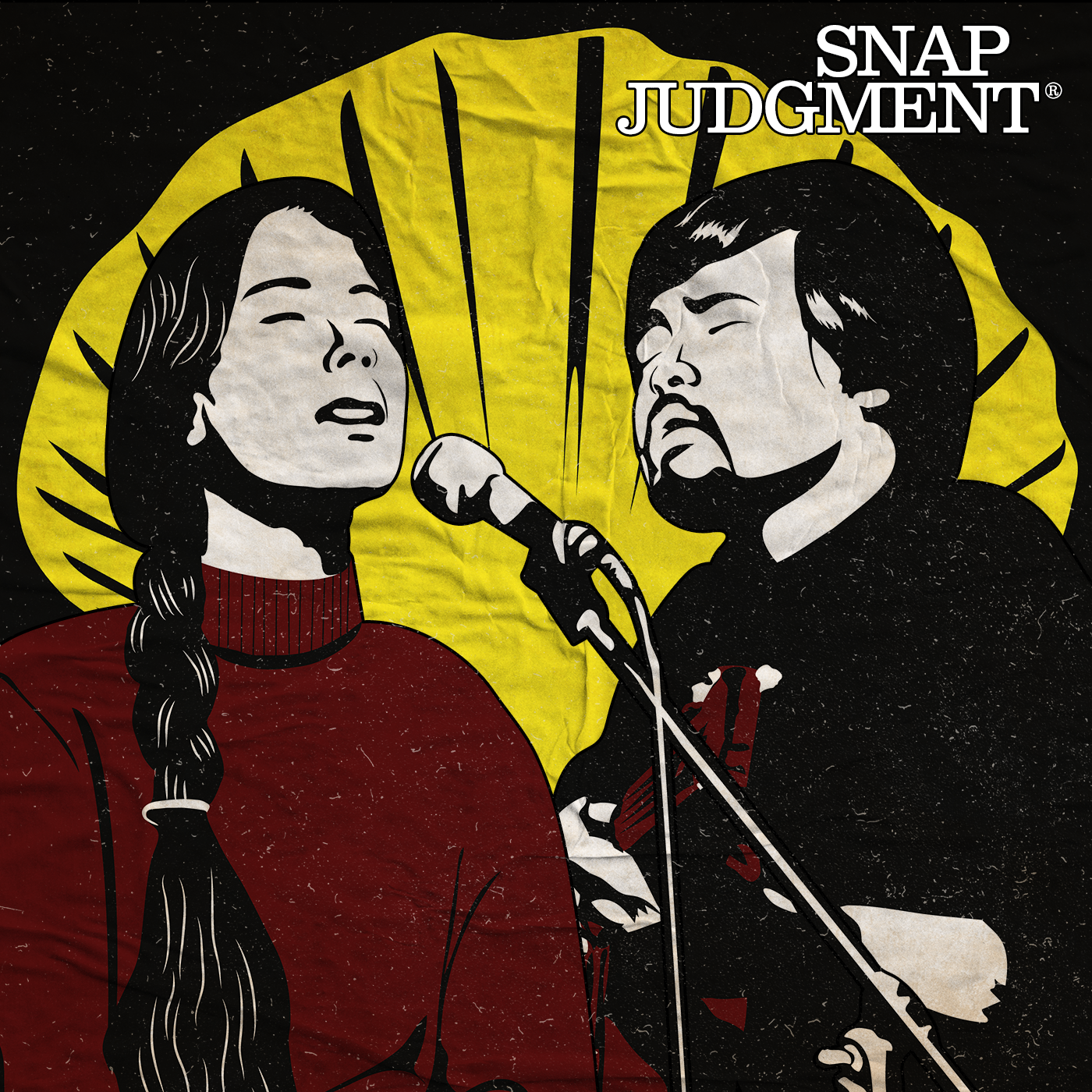
Snap Judgment
The Line - Snap Classic
00:50:00
It’s 1972 and Singer Nobuko “JoAnne” Miyamoto and her partner Chris Ijima get “the call.” It’s Yoko Ono and John Lennon inviting them to sing on national TV. What happens next is musical history.
Loading summary
Transcript76 lines
- [00:03]
Glenn Washington
Snap Studios.
- [00:07]
Nobuko Miyamoto
If you love iPhone, you'll love Apple Card. It comes with the privacy and security you expect from Apple.
- [00:14]
Chris Iijima
Plus, you earn up to 3% daily.
- [00:15]
Nobuko Miyamoto
Cash back on every purchase, which can.
- [00:18]
Glenn Washington
Automatically earn interest when you open a High Yield Savings account through Apple Card.
- [00:22]
Chris Iijima
Apply for Apple Card in the Wallet.
- [00:24]
Nobuko Miyamoto
App, subject to credit approval.
- [00:25]
Glenn Washington
Savings is available to Apple Card owners subject to eligibility. Apple Card and Savings by Goldman Sachs Bank USA Salt Lake City Branch Member FDIC terms and more@applecard.com you see it on the playground. You see it in business, in politics, in romance, in war. You see it between groups, and you see it between individuals from those that have known each other for decades and others that maybe just mad. And this dynamic, one side, for whatever reason, confuses flexibility for weakness. And they push and they push and they push and they push until they push that one step too far. And that one step changes everything. Today on Snap Judgment, we proudly present the Lie. My name is Glenn Washington. Assume nothing when you're listening the Snap Judgment. Now we begin. In the 1970s, Nobuko Miyamoto was Joanne Miyamoto. She and Chris Iijima put out one of the first folk records focused entirely on Asian American identity. But today, we're taking you to a time before all that when a surprise call from an international superstar turns into a fight. Venoba goes right to sing her own song. And sensitive listeners should know this story does contain strong language and does reference incidents of racial violence. The year is 1972, and I'll let Nobuko take it from here.
- [02:46]
Nobuko Miyamoto
One day I get this phone call out of the blue and this woman voice says, hello, this is Yoko. I didn't know any Yokos. That came to my mind. And I said, well, Yoko who? And she said, oh, no. And I went, john and Yoko. Then she went on, she said, john and I are doing this, the Mike Douglas show, and we'd like to know if you and Yellow Pearl would like to come on and sing something. I didn't know whether to say yes or no. And I didn't give her an answer. I said, let me call you back, and I hung up. It was around 1972. Chris and I had been singing a lot everywhere, East Coast, west coast, in universities and rallies, in churches and prisons everywhere. We were everywhere. There were very few Asian American performers in those days that did political music, music of Asian American consciousness. So we were, I think, pretty rare, especially on the East Coast. I'm a third generation Japanese American. My grandparents came to this country. Chris Ijima was one of the young leaders of Asian Americans for Action. A really smart guy. I really met Chris in Chicago in 1970. This is a few months after Fred Hampton had been murdered.
- [04:19]
Glenn Washington
I believe that I will be able to die as a revolutionary in the international revolutionary posterity struggle. And I hope that each one of you will be able to die in the international revolutionary struggle to live in. And I think that struggle is going to come.
- [04:32]
Nobuko Miyamoto
Why don't you live for the people?
- [04:34]
Glenn Washington
Why don't you struggle for the people? Why don't you die for the people?
- [04:38]
Nobuko Miyamoto
We wanted to convince the Japanese American Citizens League to take a stand against the Vietnam War. So we went back to the church, the Japanese church that we were sleeping on the floors. We had dinner there. People were cleaning up. And Chris brings out a guitar. Now, I didn't know he played music. And he starts doodling around and he starts singing. And I'm going like, ho, shit, this guy can sing. And he was starting to get into a groove. And he was using the phrase that Fred Hampton often said, the people's beat. Every day I can hear it like a heart that beats. It's the people spirit every day. And I just started singing with him, and it felt good. And before the night was over, we had a song. So at the big convention that we were addressing, we sang this song. And the young people start clapping. And somehow the whole place started rocking with us. To see people that look like us, see us reflected in this audience. It was a moment. A song does something to your body, it does something to your spirit. And we knew that we hit on something powerful that you couldn't do in a speech that you couldn't do in a book. We had a song. Yeah, it was the song of the moment. And there were more songs to come, but this song was really waiting to come. In a sense. We didn't have our own song. We had helped to build this country. We had not had our own song. We have been here. People looked at us as foreigners. We have not had our own song. Now we had it. Mike makes your day. He brings you the world, the stars and the songs. Mike. For the American housewife and people that watch television in the middle of the day. Mike Douglas was the bread that they ate every afternoon. You know, that was the cup of coffee. John and Yoko were going to be a host for the entire week. I think we were a little bit wary of whether we would want to do something like this. You know, we were against this kind of major media thing. We weren't just open, hey, this is a great opportunity. Hey, we weren't like that. We were going into it thinking, all right, let's see what this is going to be about. Let's keep our eyes open. Let's be aware what happened before to people like us on television. Most of the things, if we saw an Asian on television, it was the enemy, it was the waiter or the houseboy, it was the spy, you know, the guy people wanted to kill for Asian women, you know, the Houlihans, the South Islander or the geisha. But those are actually roles that I had played when I was in show business, and I wasn't going to repeat myself. I think, you know, one thing that helped convince us that it was safe to do this was that they were going to have Bobby Seale on there, that they were going to have Jerry Rubin. These were characters in the movement who were very strong, who were very clear about who they were. And we were representing another element of that radical left. And so we said, yes. We go to their apartment in the Village. Their bed was on a platform and there was a TV hanging from the ceiling. And it was like walking into a movie, in a sense. They're here, John. Yellow Pearl's here. Every time Yoko referred to us in their house, they kept calling us Yellow Pearl. And we kept saying, no, no, we're not Yellow Pearl. We're Chris and Joanne. And we were very clear about that. But it was like she wasn't listening. Media used to call us the Yellow Peril and made caricatures of Asian people as these sort of monstrous invaders. So Chris took that phrase and turned it into the Yellow Pearl, making the imagery of thinking about this little irritant in the muscle or whatever it is, clam and. And layers and layers of oppression, et cetera, and building up until you create this beautiful pearl. So it was a way of turning a negative into a positive. In her mind, she thought Yellow Pearl was a good title for us. Even though we weren't Yellow Pearl, we were Gris and Joanne. You might say I'm just a dreamer Pearls like you just don't appear. When we walked in the room, John Lennon was talking on the phone to the Mike Douglas people, and he was arguing like hell to have us on the show and saying, I don't care, blah, blah, blah. And then he said, fuck you, and slammed down the phone. And Yoko said, oh, don't worry, John. They can't do the show without us. They'll call back. And we're, like, looking at each other like, what's going on? And they were going to have to push a black singer off in order to make space for us to come on. We said to them, no, you don't have to do that. It's okay. We don't have to do the show. We clearly said that because we felt bad that somebody who would get national exposure, who really wanted it, would get bumped because of us. But it wasn't about us. It was about John and Yoko getting their say and getting their way. And finally, yes, they did call back. The network called back and they said, okay. We couldn't get out of it at that point. There was no pulling out for us. We load up into this limousine with John and Yoko, and there in the front with Bobby Sealed and Jerry Rubin. And we were sitting on the back of the limo looking at this scene in front of us, looking at each other like, nobody's going to believe this. This is like a movie. We're driving to Philadelphia and we're already late. And Chris and I are looking at each other like, what are we going to sing if we have one song to sing? One chance, three and a half minutes, how do we want to present ourselves? What is the song we want to sing? And they said, well, if we only get to sing one song, we're going to sing We Are the Children. It wasn't one of our favorite songs, but we just felt it was emblematic of who we were. We are the children of the migrant worker we are the offspring of the concentration camp Sons and daughters of the railroad builder who leave their stamp on America we are the children of the Chinese waiter Born and raised in the laundry room we are the offspring of the Japanese gardener that's me. Who leave their stamp on America I was about two years old when my whole family was uprooted and forcefully relocated in a concentration camp. We were considered a threat to US Internal security since we were on the Pacific Ocean. And before they put us into the normal concentration camp, they put us in a racetrack. Santa Anita racetrack was a place that had horse stalls and barracks. You have to understand, most of these places were dirty, windy, sandy places. Also. There was this sort of hum of people's voices. English and Japanese people who were worried and mumbling. And when we went to mess hall, it was a clatter of dishes of tin because we were eating on what soldiers ate on these tin platters. It was horrible food, and there wasn't food that was normal to us. There was no soy sauce, there was no rice. This was, you know, what white people ate. So the car, the limousine pulls up at the television station in Philadelphia, everybody's waiting. And there's a huge crowd of fans in front of the studio, blocking the doors, waiting for the car to arrive. And so Yoko and John were used to this routine. Yoko turns to John and said, john, are you ready? And so it's ready. Get set. Okay, let's go. And they go out and, you know, as much as possible, they're pushing through, and people are trying to protect them, to get them through the door. And we're sort of in their shadow, sort of pushing ourselves through as well, you know, okay, you got your guitar. Okay, we're getting through. And we get in the studio. And of course, when the door closes, ooh, it's another world. If you've ever been in a TV station, there's nothing more unreal. It's not even like a real stage because the lights are really loud, they're really bright. Everything is made for the camera. You as a person up there really don't have that much power once you're on there. And the cameras are rolling and this is live television. So they're rushing us up because we're the unknown. Chris and I are the unknown. They want to hear the song that we're going to sing. They were anxious about it, and they have two seats up there and the lights on us. And as gracefully as possible, after all that fuss, he pulls out his guitar and he starts playing. And we go into the song. We are the children of the migrant worker we are the offspring of the concentration camp. And we get to this line, watching war movies with the next door neighbor. We're secretly rooting for the other side. And the director is coming up and very nervously saying, what else do you have to sing? Well, how many songs do we get to sing? Just one. So Chris and I look at each other, and that's when I said, if we're only singing one song, we're gonna sing this one. Well, you know, there's the housewives of the Midwest. You know, they might think this watching war movies, rooting for the other side. They might think it's, you know, subversive. And I'm thinking, subversive. They've got Jerry Rubin up there. They've got Bobby Seale over there. They're worried about us being subversive. That was crazy. And so we stood our ground and. And now we want to sing this song. And then it didn't stop. He kept pressing us, well, what else do we have to sing? Well, you know, and it was getting very uncomfortable. And then John Lennon comes up. Can't you just fudge the words a bit? Wait a minute. John Lennon is asking us to change our words. Would he change his words from revolution to evolution or strawberry to raspberry? Because somebody wanted him to? You know, I think he would have said, screw you, and I don't need to do this. And then the director again comes at us. What else can you sing? Pushing, pushing, pushing. And all of a sudden, I just. I just felt red. Red, like, you know, a thermometer just filled me up. And something took over me. And I heard this voice saying, you. You put us in concentration camps, and you're saying we can't sing this song. And I see my finger pointing out in front of me, and I'm looking around and I see Chris looking at me, like, in shock. And I went, oh, my God, that was me. John and Yoko were frozen, too. Who are these people that we brought here? They didn't know what to do, but they knew. They had to know that I was right. I was going to cry. I didn't want them to see me cry. That's the last thing I wanted them to see. And I just turned around and started walking for the door, fingers still pointed in the air, still wondering what I was going to do. And before I could reach the door, the director's coming at me from behind. No, no, it's okay. It's okay. You can sing anything you want. I didn't do it. I didn't put you in a concentration camp. You can sing anything you want. It's okay. I never lose my temper like that. Never. I don't even know if I lost my temper. I just lost it. We have heard. You can't sing that song. You can't be here. We don't want you. You have to be quiet. You are the good, quiet Americans. All of those things. We have been stuffed down our throat for a century. So everything melted down and came back into real time. And then John Lennon, after, you know, this whole incident with the director happened, he was very tentative about how he introduced us. These are two young people that. They call themselves Yellow Pearl. Their grandparents were Japanese, I guess, and they're young singers called Chris and Joanna, and beautiful singers, and they have a story to tell.
- [20:41]
Chris Iijima
They're going to come on now and do it.
- [20:42]
Nobuko Miyamoto
Here they are, Yellow Pearl. But we were affected, however, by that moment. How could I not think about what had happened before? That's why I grabbed the microphone, to make it my microphone. Usually people know very little about Asians. And this Is a song about our movement, about our people's plight in America. We are the children of the migrant worker we are the offspring of the concentration camp sons and daughters of the railroad builder who leave their stamp on America. That's why I felt the ability to say, we're singing this song. No, about us, whom you don't know anything about. Watching war movies with a next door neighbor secretly rooting for the other side. Yeah, I just recently saw the whole day when we sang. And we will stamp on America oh, my God. And leave us stamp on America we.
- [22:12]
Chris Iijima
Will leave our stamp on America we.
- [22:16]
Nobuko Miyamoto
Will leave our stamp and stamp and stamp and we'll leave our stamp and stamp and stamp and we will stamp and stamp and stamp and we will stamp and stamp stamp and stamp yes, we will stamp on America oh, my God. I was like, oh. I was even embarrassed watching it myself after that. John and Mike Douglas come forward and they're just. There's no other word for it but patronizing. Some of the lines I picked up.
- [22:54]
Chris Iijima
On was foster children of the Pepsi.
- [22:58]
Nobuko Miyamoto
Generation, which is a classic line. And watching the war movies and secretly.
- [23:02]
Glenn Washington
Rooting for the other side.
- [23:03]
Nobuko Miyamoto
Now, John, you said that their grandfather was Japanese, but you're third generation, you're American.
- [23:08]
Chris Iijima
American born where in this country?
- [23:10]
Nobuko Miyamoto
La la. It must be a strange thing, mustn't it be, in either Japanese or German or even Indian here. And they're all the time watching them war movies. They don't know which side to identify with. Oh, what a great song. You know, especially those words. Watching war movies and rooting for the other side. You know, I don't know if they showed my mouth open like, are they kidding? Did he really say that? In a sense, the whole situation was a confirmation of what we already knew. We knew that we were representing young Asian Americans who wanted to revolt against this whole system that had kept us subservient, that had kept us silent. So breaking that silence was important to us. I'm here to be myself. I'm not here to be on your stage. We're making our own statement on our own stage, in our own terms. That's why we wanted to do this show. After that incident, I can't remember ever being asked to do another tv, big TV show. And strangely enough, there were never ever heard of any letters from the Midwest housewives. You know, I think they sort of absorbed it without much trouble at all.
- [24:45]
Glenn Washington
Nobuko, thank you so very much for sharing your story. After their first and last TV performance, Nobuko and Chris recorded Yellow Pearl, We Are the Children and other songs on their 1973 album A Grain of Sand, Music for the Struggle by Asians in America. And while Chris unfortunately passed away in 2005, Nobuko is still making music to this day. For more, check out our recently released memoir, Not Yo Butterfly, My Long Song of Relocation, Race, Love and Revolution. And check out what she's working on next on her website, nobukomiyamoto.org the story featured the music of Nobuko Miyamoto and Chris Iijima, as well as recordings from an episode of the Mike Douglas show that aired Feb. 15, 1972. The original score was by Daniel Riera, was produced by David Exime. Now after the break, massage therapist in Miami beach gets the business offer of a lifetime and shakes hands with the devil. Stay tuned. Acorns makes it easy to start automatically saving and investing so your money has a chance to grow for you. For your kids and your retirement. You don't need to be an expert. Acorns will recommend a diversified portfolio that fits you and your money goals. You don't need to be rich. Acorns lets you invest with the spare money you've got right now. You can start with $5 or even just your spare change. I let Acorns round up my spare change from purchases and it goes directly into an investing account. Why? Because I know me and unless it's automatic, frictionless, easy. I'm probably not going to do it. Make it automatic for your family, for your Future. Head to acorns.com snap or download the Acorns app to start saving and investing for your future today. Paid Client Endorsement Compensation provides incentives to positively promote Acorns tier one compensation provided investing involves risk. Acorns Advisors LLC and SEC registered investment advisor view important disclosures@acorns.com snap at the top of everyone's goals for 2025 is getting control of your finances. So stop spending crazy money. For Wireless Switching to Mint Mobile lets you maximize your savings with plans starting at 15 bucks a month. When you purchase a three month plan. What I didn't understand at first was that I could keep my phone. So I kept my phone, kept my contacts, kept my phone number, just ditched the high prices. You can too. To get this new customer offer and your new 3 month unlimited wireless plan for just 15 bucks a month, go to mintmobile.com snap that's mintmobile.com snap cut your wireless bill to 15 bucks a month at mintmobile.com snap $45 upfront payment required equivalent to $15 a month. New customers on first 3 month plan only. Speed slower above 40gb on unlimited plan. Additional taxes, fees and restrictions apply. See Mint Mobile for details. Welcome back to Snap Judgment and today on the Line episode, we're featuring stories from people who had or thought they had a very specific point at which they knew they would go no further. With some folk, that line, it gets a little fuzzy, before you know it, you're wondering exactly how you got where you got Snap Judgment.
- [29:08]
Chris Iijima
It was Friday night and Ephraim asked me if I wanted to go to a rabbi's house for dinner. We were just going, you know, for the free food and free drinks and to meet good looking girls.
- [29:20]
David Pakuz
David Pakuz and Ephraim Divaroli were old friends from synagogue. They had actually left the Jewish faith, but free food was free food. So they got into Efrem's old black Mercedes and drove through the streets of Miami Beach.
- [29:35]
Chris Iijima
And while on the way he was talking about his business, he said that he could introduce me to a business that would be much, much more lucrative than what I was doing now and that he could prove that he was making a huge amount of money and he could teach me how to make it. And so I asked him, well, how much money are you making? And he said, well, this is top secret information. And I said, well, you'd expect me to join you in business and you won't even tell me how much money you're making. I need to know what the potential is. And right then we had arrived at the rabbi's house and he turned off the car and he looked at me and he's like, I'm only telling you this to inspire you, not because I'm bragging I have $1.8 million in the bank. And he was 18 years old.
- [30:32]
David Pakuz
David was a part time massage therapist, putting himself through college. So almost $2 million in the bank was both totally alien and completely captivating. Their group of friends passed their time sneaking into hotel pools. To David, Ephraim was an unlikely owner of a multi million dollar business.
- [30:53]
Chris Iijima
He just seemed like a total clown and, you know, just like another stoner, he was constantly scheming about different ways of making money. So I knew he was making money. I mean, he said he was making money, but I had no idea how much. Well, when he told me he had $1.8 million in the bank, I said, holy. I couldn't believe it.
- [31:20]
David Pakuz
When Ephraim told David about how much money he made, David had only one question.
- [31:26]
Chris Iijima
So what is it exactly? What is it that you do. And he said, well, the government is always looking to buy things, for example, handguns or various common ammunition. They don't really care who they get it from as long as they get the best price and from someone who's reliable, who will actually deliver it. So they put it out for open bid.
- [31:49]
David Pakuz
Most of the contracts Ephraim won were military contracts. Basically, he was an arms dealer.
- [31:57]
Chris Iijima
My mind was swimming. I couldn't believe that he actually had made that much money. He definitely didn't live like a millionaire. And we had some drinks and pretty much I was quiet the whole time just thinking about it. And by the end, I told him, you know, I'll give it a shot. My plan was to make a few million dollars and then get out and do what I like doing in order to live the life I always wanted.
- [32:25]
David Pakuz
Efraim took David to his office, which was actually just his apartment, opened up his laptop and said, let me show.
- [32:33]
Chris Iijima
You how it works.
- [32:37]
David Pakuz
Efraim was getting contracts to sell arms and ammo From a website, fedbizopps.gov on fedbizopps, he would scan the listings for contracts he thought he could win. The listings read almost like a Craigslist ad, except instead of asking for help mowing the lawn, these ads ask for large quantities of military supplies. You can find ads for everything from guided missiles to Black Hawk helicopter landing gear to, strangely, corn cob grounds.
- [33:12]
Chris Iijima
My first contract that I actually won was for 50,000 gallons of propane.
- [33:17]
David Pakuz
Well, I would have no idea where to find that much propane. I mean, how did you know where to. How did you know where to go?
- [33:23]
Chris Iijima
Google. That's it, really.
- [33:27]
David Pakuz
Oh, okay. But can I Google where to find like 50,000 grenades or AK47s?
- [33:32]
Chris Iijima
Absolutely, of course you can. Who makes grenades? Who makes AK47s? A range of companies do it. And those companies are looking to sell as long as they think you will buy and that you're legally allowed to do so. Most companies dealing with government contracts are large companies. You have your Lockheed Martins, your Boeings, General Dynamics. These are Fortune 500 companies with tens of thousands of employees. And we were just two guys in a living room smoking weed and bidding on contracts. It's kind of like the local lemonade stand going against Tropicana. We actually won a fair amount and we started winning more and more as we kind of learned how to work the system. We were working at his desk. He had a big desk in his living room that we had two laptops on, old laptops and piles of Paper everywhere. This was 2005, 2006. There's these two huge wars, Iraq and Afghanistan raging, and the government was looking to buy massive quantities of things. They were looking to buy huge amounts of bed sheets and body armor and bullets and air conditioners and trucks, and pretty much anything you could think of, they were looking to buy. But because he had a lot of experience in military equipment, he focused on that. 80 to 90% of the business was weapons and ammunition. On a typical day, we would work around 18 hours, and that's pretty much from when we would wake up until when we would fall asleep and we would order delivery so we wouldn't have to leave to get food so we could eat while we worked. I'd never worked so hard in my life.
- [35:22]
David Pakuz
So they'd be eating Chinese noodles from a carton and sleeping on the floor and delivering weapons to Colombia and Germany. They bid on contracts for Nepal, Niger.
- [35:33]
Chris Iijima
And Chad, but most of the business was in Iraq and later in Afghanistan.
- [35:40]
David Pakuz
As they bid on these contracts, David saw the promise of really big money flash on the screen before him. If everything went well, he could be making millions.
- [35:50]
Chris Iijima
There were many moments I considered backing out, but then I would see the money, you know, coming in. I just told myself I could put up with it for a little bit longer. I just need to make some money and then I'll quit. So I was planning on retiring after that and traveling the world and buying a yacht and living the good life. That was the plan. Who is it? I forgot who it was. It was one of the robber barons, the guy who cornered the silver market in the 1800s. A reporter asked him how much money wouldn't be enough and he said more.
- [36:33]
David Pakuz
Then David got a call that promised all the money he wanted and then some. It was the call to step up into the high stakes arena of the big time arms dealers.
- [36:45]
Chris Iijima
I was driving to see my girlfriend and have dinner with her and Ephraim called me and he said, I just saw one of the biggest solicitations request for quotation I've ever seen on Fedbizopps, which is bigger than anything I've ever seen. And you have to come to the office right now. We got to discuss it. And I told him, I'm on the way to dinner with my girlfriend. And he said, he's like, well, bleep that. You want to, like, hang out with your girl. You want to get rich?
- [37:19]
David Pakuz
David and Ephraim poured over the contract. It was a deal to supply all the munitions for the new Afghan army and Police force. So they got to work.
- [37:30]
Chris Iijima
We looked at the request for a quote and it was huge. I mean, it was like 100 million rounds of AK47ammo, 100,000 grenades, anti aircraft rockets. It was enormous.
- [37:48]
David Pakuz
David spent two months working around the clock. He called every contact in the world he thought might be able to supply the stuff for the contract. Scouring the planet for lots and lots of bullets.
- [38:02]
Chris Iijima
I was calling Russia, I was calling Ukraine, I was calling Bulgaria, I was calling Kyrgyzstan and Uzbekistan, Korea calling. Most of these countries, they usually don't speak English very well. So I would just say, English, English, English. I want to buy, I want to buy. We would say, oh yeah, I'll get my sales team working on that or I'll have my accountant contact you. Or we'll get our procurement division on that right away, sir. We would act like we had like a whole staff, but of course it was just us two. We lied all the time.
- [38:46]
David Pakuz
David and Ephraim put in a bid for the afghan ammo at $300 million and they won. They were the lowest bidder by far, partly because two guys in an apartment have a lot less overhead than a company with tens of thousands of employees.
- [39:03]
Chris Iijima
It was, it was, how do I put it? It was surreal. It was very odd. I was myself on a constant basis. It was a constant state of panic. Without us, the Afghan army had no ammunition and they wouldn't be able to fight the Taliban.
- [39:30]
Glenn Washington
Oh, it doesn't stop there. Don't go anywhere. With a stunning conclusion in just a moment when Snap Judgment continues. Stay tuned. Welcome back to Snap Judgment. You're listening to the Line episode. My name is Glenn Washington and when last we left, David Pakus and his partner Ephraim were in quite a. And David, he's got a habit of going from the frying pan into the fire.
- [40:16]
Chris Iijima
Without us, the Afghan army had no ammunition and they wouldn't be able to fight the Taliban.
- [40:24]
David Pakuz
The hard part now was that David and Ephraim actually had to find the ammo and the weapons to fulfill the contract.
- [40:32]
Chris Iijima
In Abu Dhabi every year there is one of the biggest arms exhibitions in the world. I went there by myself to try to source ammunition for the Afghan contract. It was like the cantina scene in Star Wars. Pretty much every degenerate in the world was there. Or at least in my mind you'd see generals in full military gear. You know, sleazy looking businessmen, government officials. Pretty much every single country was represented. Chinese generals, Africans, Europeans. Everyone was just having cocktails together. And it was Just incredible to me because I knew some of these people are mortal enemies and they're fighting each other and here they are and they're just, you know, schmoozing over cocktails. Rumors were flying around of, you know, who was gonna go to war in where the best countries were to get the best prostitutes. During the day, you're in the exhibition halls, they had very expensive bottles of wine and champagne and, you know, caviar and hors d'oeuvres and, you know, really good looking women to serve it all. They spared no expense. Outside they had live fire weapons drills where they would have, like tanks jumping sand dunes and like blowing things up and helicopter gunships. And it was like live military drills that you could watch. There were bleachers where everyone would stand and, you know, drinks and hors d'oeuvres being passed around. And it was like being at a big football game where, you know, the sport was military maneuvers. I was by far the youngest person there, of course, because everyone in this business is military or ex military. So they're all like men in their middle ages. And they just looked at me as if I was, you know, some kid and they were wondering what I was doing there. Which is why I always had copies of our contract in my briefcase to prove that, you know, I was the real deal and actually had real, real business deals to do.
- [42:41]
David Pakuz
Was the arms business in your experience kind of more morally dubious than other industries? Was it shadier?
- [42:49]
Chris Iijima
The arms business by its nature is definitely shadier and more dubious because arms could be used for great evil. And the people that you're dealing with sometimes sell to people who use them for great evil. But at the time, did it stop me? No, it didn't.
- [43:15]
David Pakuz
David kept working to get the guns and the bullets. But as they worked, these wayward kids from Miami beach that snuck into the halls of power started to get some.
- [43:24]
Chris Iijima
Unwanted attention because we were winning so many contracts. We were upsetting a lot of our competitors. You know, they worked real hard on these contracts and they kept on losing them to us. They started slandering us to various people in Iraq. They started telling people that we were coke dealers, and that's how we got the money to fund the contract.
- [43:47]
David Pakuz
David was sending planeloads of ammo all over the globe for the Afghan arms contract. At one point, he had over 5,000 tons of bullets waiting to be loaded into cargo planes in Albania. And it was there that the two man operation began to crumble against the powerful tectonic plate of the international arms trade.
- [44:08]
Chris Iijima
Albania is famous for. How do you put it? Let's put it this way. The State Department guy told us, you know, most Third World countries are Third World, but Albania is kind of like the Fifth World. They need to be supervised.
- [44:29]
David Pakuz
He sent a friend over to Albania to check on the deal, make sure the ammo wasn't faulty, and to repackage it so it would cost less in the air freight. But when their friend walked into the underground Albanian bunker and saw the piles of bullets, he immediately called David.
- [44:46]
Chris Iijima
When he went over there, he told us, hey, you know, there's Chinese letters all over the boxes. And we had no idea. We were like, oh, well, oh, this could be a problem.
- [45:00]
David Pakuz
Here's the thing about Chinese ammo. It was illegal. Their contract said it explicitly. And while technically this ammo hadn't been bought directly from the Chinese, they knew this mountain of Chinese ammo was a really big problem.
- [45:15]
Chris Iijima
We discovered that it was Chinese ammunition. And then we figured, well, it's better not to tell the army about this. What they don't know won't hurt them. The ammunition is excellent quality, and that's all that really matters. It's not enriching the Chinese government in any way. And that's all that the anti Chinese ban was meant to be about. It'll be fine. So we took the ammunition out of the wooden crates that they were packed in and out of the metal sardine cans, and we packaged it in plastic bags and in cardboard boxes. We were very careful not to include any papers that had Chinese letters in the boxes. And so there was no more Chinese words on the packaging once we had repackaged it. And so we started delivering. And we delivered, I think by the end, close to 70 aircraft loads of ammunition, each holding around 45 tons.
- [46:16]
David Pakuz
He says anybody would have done that. He says, shenanigans like this happen every day in the arms trade. The big boys don't get caught. But David and Ephraim were not the big boys. A rival competitor, an Albanian businessman who had been cut out of a deal, started this whisper campaign against David and Ephraim. He told a Pentagon official to check him out. And soon, David and Ephraim's office was raided by the feds.
- [46:46]
Chris Iijima
And the government eventually decided that that constituted fraud, as they say, it was a conspiracy to defraud the United States of America. Well, I felt like my life was over because they said, okay, you have 71 aircraft loads that you delivered to Afghanistan, each one with a certificate saying that the point. That the point of origin is Albania. And you signed off on that. And really the origin was China. And therefore, each aircraft load delivery, each document you signed is one count of fraud. And each count of fraud has a maximum of five years in prison. So 71 counts of fraud for 71 aircraft loads. Around 350 years in prison.
- [47:38]
David Pakuz
And did you ever. I don't know. I mean, I feel like all of us in our dark moments of shame feel like, I don't know, there's some kind of, like, celestial checks and balances. Like, did you ever feel like you were caught because of greed, because you had been being greedy?
- [47:54]
Chris Iijima
I did think that when I got caught and I realized that I was facing possibly a lifetime in prison. A lot of things go through your head and you evaluate your entire life and how you got up to this point and how you could be so stupid and all the mistakes that you've made. And one of the big ones I was constantly thinking about was getting involved in the business in the first place. And I wondered why I did it. Of course I knew, but. But I thought that it was a certain. Yeah, almost like a punishment for kind of turning a blind eye towards certain things. And I wish I had never gotten involved in it in the first place, that's for sure.
- [48:51]
David Pakuz
In fact, David never saw any of the money he dreamed of. So now he was broke and a.
- [48:58]
Chris Iijima
Federal criminal like any sane person caught up in the system. I pled guilty, and they reduced my charges down to, you know, from 71 counts of fraud to one count of fraud. Eventually, the judge had mercy on me and gave me just seven months of house arrest and seven months probation.
- [49:20]
David Pakuz
He had to reset. There would be no more drinking cocktails and watching rocket launches with African warlords. Instead, after serving his house arrest, David walked out of his apartment armed with a backpack full of scented candles and soothing music.
- [49:40]
Chris Iijima
Well, I went back to doing massage, you know, to make ends meet. Would have my massage table on a cart and, you know, a little bag with all my equipment, such as essential oils and massage oil and, you know, music. But it was. It was strange. It was definitely strange. After I went back into massage, I, you know, informed all of my former clients that I was doing massage again. And the vast majority of them were very thrilled to hear that. And they asked me, so what have you been doing the last year or two? And I would say, yeah, it's a long story. It's been interesting.
- [50:44]
Glenn Washington
Big thanks to David Pakuz for sharing your story. If you want to find out the dirty, dirty, gritty gritty behind this piece. Check out the book written by Guy Lawson out in stores right now. It's called Arms and the Dudes. Find the link on our website snapjudgment.org the piece was produced by Anna Sussman and Julia DeWitt in collaboration with Guy Lawson. The original score and sound design by our own Renzo Goriot. A lot just happened. So much. And that was but one episode. If you dig it more, so many more stories await your listening pleasure and understand stories are sexy. Subscribe to the Snapditch podcasts and instantly become the sexiest person you know@ stamp judgment.org Snap is brought to you by the team that Never Crosses the line. Except, of course, for the Uber producer Mark Ristich. When he heard about that Two for One Donut special, he crossed the line quick. There's Anna Sussman, Nancy Lopez, Pat Mesiti Miller, Renzo Gorio, Shayna C. Shealy, Teo da Cott, Flo Wylie, John Facilio, Marisa Dodge, Regina Bediaco, David Exane, Bo Walsh, and Annie Nguyen. And while this is not the news, no way is this the news. In fact, you could draw a line in the sand and dare your little buddies not to cross it. And when they do cross it, you could draw another line and you would still still not be as far away from the news as this is. But this is PRX.