← Somebody Knows Something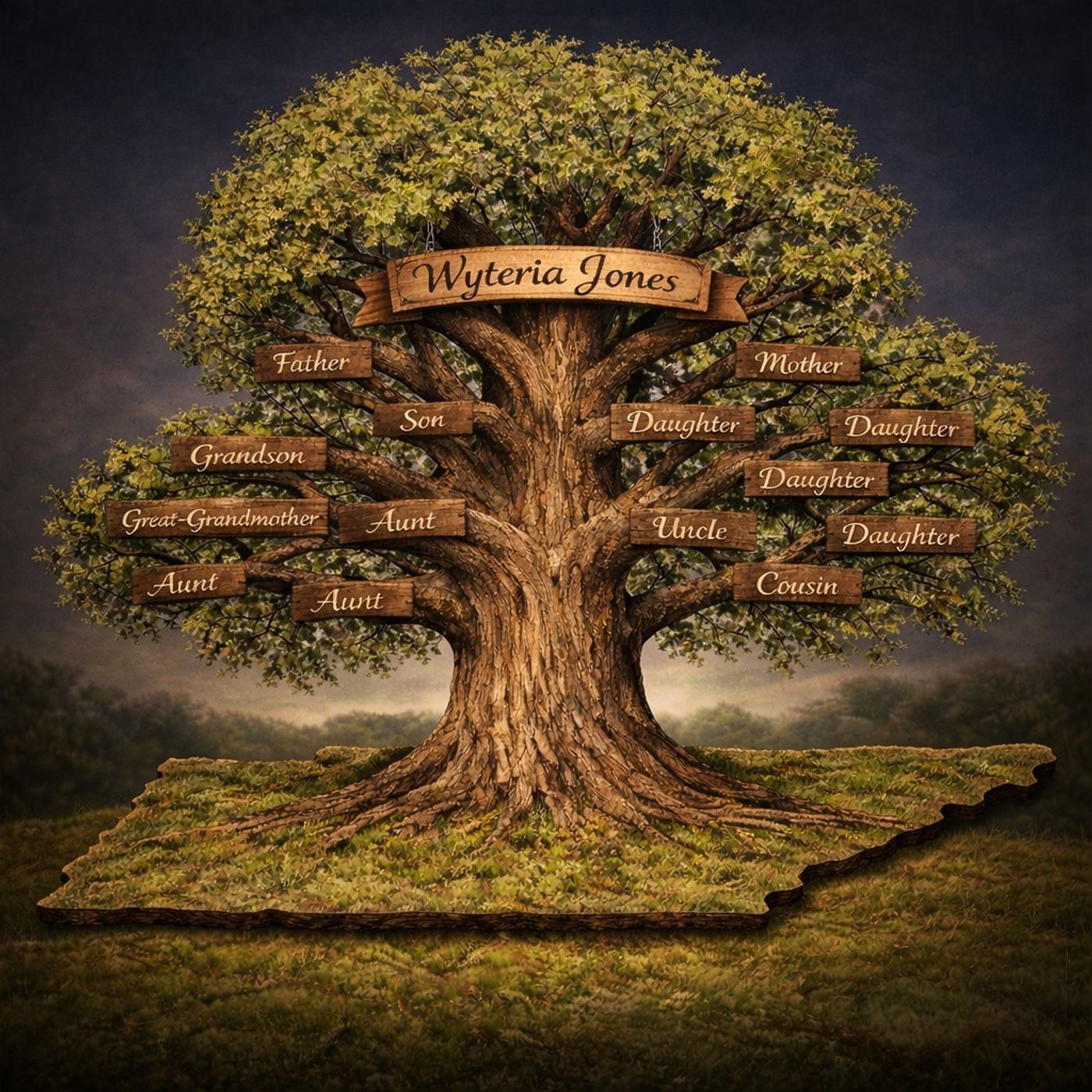
Somebody Knows Something
S3E8: Family Trees
00:25:12
In this episode, the Detectives discuss their work on Wyteria’s case as they continue their search for her. Wyteria would have turned 89 just last month on May 1st, if she is still alive. And while that is possible, it may not be very likely. So, we...
Loading summary
Transcript44 lines
- [00:01]
Narrator/Advertiser
When you're a maintenance engineer in a beverage manufacturing plant, you keep production lines moving and quality on track because there's no room for slowdowns. With Grainger's vast selection of high quality motors, sensors, belts and hard to find parts, you can get what you need fast and all in one place, so nothing gets in the way of getting the job done. Call 1-800-GRAINGER clickgrainger.com or just stop by Granger for the ones who get it
- [00:28]
Podcast Disclaimer/Voice Actor
done this podcast is based on information sourced primarily from police and media reports, but certain names and other identifying details may have been changed or altered for privacy and security reasons. While the events and cases discussed are based on real investigations, some aspects may be simplified for time and for narrative purposes. Voice actors have been used to read from statements or documents. All information presented is intended solely to inform and raise awareness. Hosts may discuss theories regarding the cases examined in this podcast, but such discussions are not intended to and should not be considered by the listener to to be legal. Conclusions all persons discussed are considered innocent until proven guilty in a court of law. Listener discretion is advised.
- [01:32]
Chief Anna Lally
This is Chief Anna Lally. Welcome to Somebody Knows Something, a podcast from the Elgin Police Department's Cold Case Unit. In this podcast, we will shed new light on cold cases in the City of Elgin by sharing untold details and by encouraging anyone with information to come forward. You will come along with real cold case detectives as they investigate active cold cases in real time and seek justice for the victims and closure for their families. We believe that the Elgin Police Department and our community can work together to bring closure to cold cases because we know that in these cases, somebody knows something.
- [02:17]
Detective Andrew Houghton
Hello and welcome to Somebody Knows Something, the Elgin Police Department Cold Case Podcast. My name is Detective Andrew Houghton and
- [02:23]
Detective Chris Hall
I'm Detective Chris Hall.
- [02:25]
Detective Andrew Houghton
Last episode we detailed our plans to use NAMUS in this case because we believe that it is possible that Whiteeria has died and has been found but never identified. Collecting and testing familial DNA is a step that we have to take in this case. Unfortunately, when we started this journey we had no fingerprints for her, no dental records for her, and no DNA.
- [02:45]
Detective Chris Hall
Myteria would have turned 89 just last month on May 1st if she is still alive. And while that is a possibility, it may not be very likely. So we have to at least consider the possibility that Wyteria Jones is dead and still waiting to be found. Foreign. As we discussed in the last episode, to really utilize NAMUS for its full potential, we need fingerprints, dental records and DNA to compare against unidentified Remains. But when we began looking at this particular case, we discovered that we had none of those for Whiteeria.
- [03:27]
Detective Andrew Houghton
Whiteeria is listed in NamUs, but listeners will recall from our last episode that NamUs has two different databases. Witeria is currently listed in the missing persons database with all the information that we have for her. But we still need forensics to compare her case to any potential matches in the unidentified persons database. Beth has been attempting to track down any fingerprint records for her, but she was never arrested. And at least at this point, we've not been able to find any job or any other situation where she would have provided fingerprints for us to compare against those unidentified remains.
- [03:55]
Detective Chris Hall
Yes, and unfortunately, we still don't have those fingerprints. And I know what people might be thinking. This case is over 40 years old, and if you did have fingerprints, would you even have prints to compare to for an unidentified body? Well, as it turns out, the answer could be yes. When unidentified bodies were recovered, even back in the 1980s, prints were often rolled in ink by the agency that located them or by a coroner's office. So it is theoretically possible that we could use fingerprints on some remains, but certainly not all of them.
- [04:27]
Detective Andrew Houghton
Yeah, for sure. A number of the unidentified remains are skeletal remains, so obviously there's no fingerprints. But NAMUS does include numerous unidentified human remains that also have latent prints. Obviously, in a perfect world, for any case, we would have all three. We'd have fingerprints, dental records, and DNA that we could upload into codis. But as we said, when we started this case, we didn't have any of those. Speaking of dental records, Matt and I had extensive dental records for Karen's case during season one. In fact, the forensic odontologist told Matt that they were some of the most complete sets of records he'd ever used to identify someone. Unfortunately, in several of our missing person cases on our current caseload, including Wyteria's, we just simply don't have those kind of records.
- [05:08]
Detective Chris Hall
Yes, it's really unfortunate that we don't have them. And after all, dental records can be more useful in cold cases, because like you said, Andrew, we often are looking at skeletal remains that have been recovered years or even decades after the person has died. So if there are dental records, we can make comparisons in cases like that pretty quickly. But sadly, we just don't have them in this case, at least for not yet. We do know from the 2014 reports that Whiteeria was reportedly missing her two front teeth. So there is some specific general information there. But again, just because skeletal remains are found and are missing teeth doesn't necessarily mean we can compare them to her. In many cases, only a percentage of skeletal remains are recovered. So a set of skeletal remains that are missing front teeth doesn't mean that they were lost prior to death. It is entirely possible that the teeth fell out after death and were simply not recovered.
- [06:00]
Detective Andrew Houghton
And so that leaves us with the best form of records for missing persons cases. DNA. Ideally, we would use direct DNA from the actual missing person. We can use things like hair from a hairbrush or other personal items like a toothbrush. But again, in this case, we don't have that option. As we mentioned earlier in the season, this case leaves us with one option and one option only if we're going to use DNA, and that is familial DNA. As Chris and I said in our first episode, Wyteria had five children, four daughters and a son. For this case, several of her children have passed away and one of those daughters was placed with an adoptive family after birth. So far up to this point, we're still working to try to track her down.
- [06:48]
Detective Chris Hall
There are unfortunately, a few other factors that make obtaining DNA a challenge in this case as well. Much of Wyteria's family is spread across the country and we have to find family members who are available and willing to meet with us to provide that DNA sample.
- [07:02]
Detective Andrew Houghton
We have used current open source searches and we've spoken with some members of Wyteria's family so we can try to track down some DNA that they could provide. But the biggest issue is the actual type of DNA also really matters.
- [07:14]
Detective Chris Hall
Yes, that's true. And for us to use CODIS and to search NamUs, we need not one, but two standards from a close blood relative of Whiteeria. And we need at least one of those standards to be a maternal relative. So not every relative meets that criteria that we need.
- [07:29]
Detective Andrew Houghton
Chris and I thought it might be useful to explain to our listeners why we need to be so specific with our DNA standard in a case like this. And basically the reason is that DNA that's stored in different locations in our body is, well, different. According to the National Human Genome Research Institute, a person has two types of nuclear DNA and mitochondrial DNA, also called mtdna. Nuclear DNA, as the name suggests, is located in the cell's nucleus and mitochondrial DNA is stored in the mitochondria. While nuclear DNA has about 20,000 genes, MTDNA contains only 37. And those genes mainly support energy production and help the mitochondria generate cellular energy.
- [08:07]
Detective Chris Hall
I think we have to apologize to our listeners it might feel like we are talking you all back to high school biology class here, but we think it is rather important to explain what these two types of DNA are and how we inherit them, because it is extremely important. In cold cases, nuclear DNA is a combination of both of your parents genes. However, children inherit mitochondria only from their mother, so MTDNA provides a direct maternal line extending backwards in time. Here's what the FBI forensic Lab says about MtDNA.
- [08:37]
Podcast Disclaimer/Voice Actor
Mitochondrial DNA is a form of DNA that is transmitted from mother to child in a complete set. Therefore, anyone in the maternal lineage will have the same MTDNA profile. This type of DNA testing can be useful on evidence items such as naturally shed hairs, hair, hair fragments, bones and teeth. MTDNA analysis is highly sensitive and may allow scientists to obtain information from items of evidence associated with cold cases, missing persons, samples from mass disasters, and small pieces of evidence containing little biological material. However, since multiple individuals can have the same MTDNA profile, unique identifications are not possible from MTDNA analysis.
- [09:21]
Detective Andrew Houghton
MTDNA is really important when it comes to cold cases because in many cases we don't have direct DNA from a missing person, but it can be used in other ways too. While we are using this technology in this case to try to identify a missing person, nuclear DNA and MTDNA are also often used to identify unknown offenders. Nuclear DNA is basically the gold standard in most situations, but something like a shed hair or a hair fragment doesn't typically contain nuclear DNA. In many situations, if we had shed
- [09:49]
Detective Chris Hall
hairs or hair fragments that we believed came from a suspect, for example, we can only use MTDNA to point us in that right direction. We could obtain a standard from our suspect and have a lab process the MTDNA in his or her standard and can then compare it to the shed hair or hair fragment. Then the lab could tell us that the shed hair came from that person or anyone in his or her maternal line. But it can't tell us 100% that that hair came from that person, just that someone in their maternal line provided the hair.
- [10:19]
Detective Andrew Houghton
People might think that a link like that is not as powerful as a direct DNA link to a specific person, but especially in cold cases, that is a huge lead. So MTDNA and genetic genealogy being used more broadly can help us provide a new lead in a case that is potentially decades old. For Wyteria, we are hoping that MTDNA can help us identify her, but we are also actively looking at genetic genealogy options and MTDNA in some of our other cold cases as well as our hope is that with these new technologies, we might be able to solve not just Wyteria's case, but some of our other homicides as well, specific to this case.
- [10:53]
Detective Chris Hall
As the FBI forensic lab says, MTDNA is a highly sensitive and extremely useful on things like bones, shed hairs, in other words, meaning hairs without a root, and teeth. As we work to try to compare DNA for Whiteeria's family to unidentified remains, that MTDNA might be the best option we have. Depending on the condition of the various unidentified remains we hope to test again.
- [11:16]
Detective Andrew Houghton
Obviously, having multiple DNA standards is the best option, and we need to get at least two for this case because, as Chris said, we may be working with extremely degraded samples of hair or bones. MTDNA is crucial in a case like this. So with that in mind, Chris and I and Beth have spent dozens and dozens of hours looking specifically for maternal relatives for Whiteeria to get those samples of DNA. To do that, we've been doing exactly what the title of this episode suggests, building a family tree.
- [11:45]
Detective Chris Hall
For law enforcement agencies out there looking into these types of cases, you certainly can use paid services and genealogists to build family trees. You can also use interviews with family, when you can find them, to help fill in those gaps. But we have found that the most simplistic ways to build a tree is using sites like Ancestry.com or other similar sites. For this investigation, Andrew and Beth have been doing a lot of work on family trees and records, and the work has been pretty extensive.
- [12:13]
Detective Andrew Houghton
Yeah, Chris, we've been spending a lot of time working on a very detailed family tree for Witeria and reading a lot of old records for her family. At this point, we have over 150 people in the family tree we've built for her, and we're still adding people. It has really been a tedious job, but it's also been really helpful for us to track down people and records related to Witeria. And there are a few reasons why it takes an extensive amount of time.
- [12:34]
Detective Chris Hall
That's true. And for one thing, while various ancestry sites don't allow us to upload DNA profiles or provide us access to the DNA that they collect from customers, we can still use the search tools and records that they have to conduct research on. Wyteria process is actually pretty simple, but as you stated, it's also very time consuming. Anyone who has done genealogical research on their own family will definitely understand what we mean. For example, we have to review each record that we come across. Just because a record might be linked to someone on a genealogy site, it doesn't mean that that actually is the person. And oftentimes we are opening up scanned copies of handwritten records to make sure that the birth certificate or census record or whatever the record is actually correlates to someone in Wyteria's family.
- [13:23]
Detective Andrew Houghton
I know we mentioned that we used ancestry.com but there are a number of other sites that you can use, and we can't advocate for one site over another. That being said, some of the sites that we've been using recently on our cases are ancestry.com, newspaperarchive.com and newspapers.com just to name a few. But before we get too far into the weeds, or maybe we should say roots of this family tree project, let's lay out what would actually qualify as a maternal relative for Witeria. Okay, so obviously, Whiteeria's own children share a maternal line with her because she's their mother. In addition to that, her maternal line extends from any of her daughters that she had onto their children. If those grandchildren are female and have children, the line continues, but if they're male, the line stops with them. I know we talked about mitochondrial DNA a few minutes ago, so we could still use that last male relative like a maternal grandson or maternal great grandson, but any children he has would not continue the maternal line that we need because he does not pass on his MTDNA to the children.
- [14:33]
Detective Chris Hall
Yes, that's exactly right. Similarly, Witeria's mother, Louise Miller, had Witeria and several other children. So any of Wyteria's biological siblings would be maternal relatives. And just like her own children, that maternal line would continue from mother to daughter through Witeria's maternal nieces. So we could also use maternal nieces or nephews for our DNA standards as well.
- [14:56]
Detective Andrew Houghton
Yeah, that's right. And as we started talking about when we started this project, I know we looked at a bunch of different sources. We could branch out as far as maternal cousins and second cousins and things like that. But we felt like, at least to start, we should try to focus on relatives that had a closer biological relationship to Whiteeria. Our thinking was basically that we've had a hard enough time tracking down relatives as it is, so tracking down some extended cousins or people like that might be even more difficult.
- [15:23]
Detective Chris Hall
And with that in mind, Beth, Andrew and I began our tree with bacteria at the center, and we went back one generation to her parents, John Walter Orr and Louise Miller. We consider going back even deeper into the Miller family side of Wyteria's family to search for maternal relatives. But Wyteria was born in 1937, and her mother, Louise was born all the way back in 1899. So we felt that working down from Louise to her children was more reasonable,
- [15:50]
Detective Andrew Houghton
at least to start, we focused our search on people that share the same mother, Louise, as Wyteria, and on sets of people that we just listed Wyteria's children, her siblings, her nieces and her nephews to try to locate living relatives for Wyteria that meet the maternal criteria that we need. As of the date of this recording, we have determined that Wyteria was likely one of nine children. But again, those old records can be difficult. Plus, some of her siblings are male, meaning if they're deceased, their direct descendants do not share MTDNA with Witeria.
- [16:22]
Detective Chris Hall
Based on the records we have so far, Wyteria had four sisters and four brothers. As far as we can tell, all of her sisters have died and at least three of her brothers have died as well. However, the fact that she has multiple sisters still provides us with a huge opportunity because some of them have children of their own and in fact, some of them have multiple children who share a maternal line with Byteria. Right, Andrew?
- [16:46]
Detective Andrew Houghton
Yeah, they do, Chris. And we're very lucky that she has so many siblings and so many sisters. We've also found that a number of her sisters have multiple children of their own. So that's why we have over 150 people in our current tree and why we are continuing to try to track down more people to add to it.
- [17:08]
Detective Chris Hall
As we continue our search for DNA and family members, we wanted to include some basic information about how NAMUS uses DNA samples so that the people and the public will consider cooperating in cases like this by providing providing DNA to law enforcement. There are very strict protocols and rules for how DNA is used in these cases. So we wanted to provide that information here in this episode. Here's a brief portion of the actual consent waiver for NAMUS that we use in our cases when collecting DNA for that system.
- [17:35]
Narrator/Advertiser
I freely and voluntarily consent to provide my sample for DNA analysis, entry into the Relatives of Missing Persons Index of the Combined DNA Index System and searching against the Unidentified person's index of CODIS. CODIS is maintained by the FBI under authority of Title 34, United States Code Section 12,592. I understand that the information I have provided may be disclosed pursuant to routine uses listed in the Privacy Act System of Records Notices for the National DNA Index System as most recently published in the Federal Register. I also understand that my sample will be destroyed if my family member is positively identified. I understand that I am not required or obligated to provide a DNA sample and that my consent to have a DNA sample taken is knowingly and voluntarily made. I further consent to the use of my DNA in the anonymous population database to aid in statistical inferences. The database will not contain my personal information and the DNA profile cannot be associated with me as a donor. I authorize the appropriate law enforcement agency listed below to collect this sample for the purpose of identifying my missing family member.
- [19:10]
Detective Andrew Houghton
Chris and I wanted to provide this disclaimer and appeal to people listening to this podcast. We are asking that people involved in missing person cases to at least consider providing samples in these cases. Your DNA sample could help solve a case or identify a missing person. So please consider that option if someone like Beth or Chris or I call and reach out to you looking to work on a case that's like waiterias, There's another way that you can help too. People often ask us, well, if I did my DNA on Ancestry.com or 23andMe or some other site like that, can't the police just use that? And the answer is no we can't. At least not with most of those companies. However, GEDmatch is an online ancestry site that does work with law enforcement and they're proud of it. While it is much smaller than Ancestry.com, 23andMe, and the other large DNA sites, you can still use them even if you use another service like Ancestry.com and
- [20:06]
Detective Chris Hall
when you mail your sample to Ancestry.com or 23andMe, you still have access to your profile. In fact, you can actually click on the site and download your own DNA data. Once you do that, you can upload the same profile to GEDmatch, where police can use it to help try to solve cold cases. Since 2018, over a thousand cases have been solved. The thanks to people who have uploaded their genealogical data to GEDmatch and chosen to be a genetic witness.
- [20:33]
Detective Andrew Houghton
I uploaded my DNA several years ago to one of the major sites, but not GEDmatch. Since I joined the Cold Case unit. I also joined GEDmatch this past year to be a genetic witness for families in these cases. The process is actually really simple to help appeal to the public. We wanted to read a testimonial from a genetic witness on their website here.
- [20:51]
Narrator/Advertiser
In this episode, my name is Chelsea and my DNA solved a 31 year old double homicide because I matched with a crime scene sample that was left behind in 1987 by William Earl Talbot II, my second cousin. This would become the first case in history to go to trial and result in a conviction due to investigative genetic genealogy. By opting in on GEDmatch, you have the ability to bring answers for family members in criminal investigations. That is an incredible tool that we all should want to be a part of.
- [21:32]
Detective Chris Hall
That testimonial is truly powerful. And we should add that becoming a Genetic witness also helps exonerate innocent people as well, which is something that is really important. For example, on June 13, 1996, 18 year old Angie Dodge was murdered in Idaho Falls, Idaho. A man named Christopher Tapp was later charged in her case and sentenced to 30 years in prison. But through a series of appeals and work with the Innocence Project, Tapp was released. Tapp and one of his biggest advocates, Angie's own mother, Carol, began working with GEDmatch to prove his innocence and to identify the real killer in angie's case. In 2019, using the genetic Witness program, Brian Drips was identified as the man who raped and murdered Angie in 1996, and he later confessed and was convicted in that case. So this technology and the willingness of strangers to include their DNA data in the GEDmatch system helped to not only identify and charge a man who raped and murdered a woman, but it also helped totally exonerate a man who had spent the last 20 years of his life in prison for a crime that he did not commit.
- [22:40]
Detective Andrew Houghton
You can join the Genetic Witness program by visiting www.gedmatch.com. if you decide to do so, you can become another witness who can help provide answers to families and bring justice to victims and maybe even exonerate the innocent. Really, the more people who provide their information in these cases, the better. Plus, time is of the essence. Each year, more family members of murdered and missing people pass away, never getting the answers they deserve in their loved ones cases. The more people who join the Genetic Witness program, the closer we can come to finding answers while those loved ones are still alive to hear that news. So please consider providing a sample to law enforcement if you have a missing loved one or if you're contacted by law enforcement as an extended relative for someone like in this case. And also please consider using the Genetic Witness program too. It's just another way you can make a huge difference in cold cases. We have to be clear. However, the Elgin Police Department has no affiliation with Gedmatch and we make no warranties or promises regarding any of their services.
- [23:42]
Detective Chris Hall
As for our case, we still need DNA from Wyteria and we need to get it as soon as possible because if we can't get DNA before those maternal lines end, we may never have the opportunity to identify and bring her home. Plus, there is a waiting list to start NAMUS searching. So even if we do get the DNA, it will still take us time to begin our search.
- [24:02]
Detective Andrew Houghton
That's true Chris, but we might be one step closer to that elusive DNA that we need. Cuz after months of searching through old records and databases and building out our family tree, we've finally identified and made contact with at least one extended relative who has the MTDNA that we need. And that person could help us break this case wide open. Next Episode Chris, Beth and I will be hitting the road one more time, but this time we won't be driving to Joliet or Aurora or Chicago. In fact, we won't even be driving to another city here in Illinois. Three of us will be making a trip to Tennessee to visit the state where Wyteria grew up, and a visit with some extended family whose DNA might just help us finally solve this case. So please join us next episode as we leave Illinois and continue our search for Wyteria Jones in her home state of Tennessee. Here on Somebody Knows Something.
- [25:00]
Chief Anna Lally
If you or anyone you know has information about this case or any other other cold case in Elgin, please contact the Elgin Police Department Cold case email@coldcasetipselgenil.gov or the cold case tip line at 847289 cold. You can also review cold case information on the Elgin Police Department's cold case page at www.elgincoldcases.com, where every cold case, homicide and missing persons case is listed with photographs and information about each case.