Loading summary
Transcript162 lines
- [00:02]
Chuck Gunderson
When you think about businesses that are selling through the roof, like aloe or allbirds, sure you think about a great product, a cool brand and great marketing. But an often overlooked secret is actually the businesses behind the business making, selling and for shoppers, buying. Simple. For millions of businesses, that business is Shopify. Nobody does online business better than Shopify. It's home of shop Pay, the number one checkout in the world. You can use it to boost conversions up to 50%, meaning way less carts going abandoned and way more sales going through. To checkout, sign up for your $1 per month trial period at shopify.com income. All lowercase go to shopify.com income to upgrade your selling today. That's shopify.com income. Does it ever feel like you're a.
- [01:01]
Robert Rodriguez
Marketing professional just speaking into the void? Well, with LinkedIn ads, you can know.
- [01:08]
Chuck Gunderson
You'Re reaching the right decision makers.
- [01:10]
Robert Rodriguez
You can even target buyers by job title, industry, company seniority, skills. Wait, did I say job title yet? Get started today and see how you.
- [01:19]
Chuck Gunderson
Can avoid the void and reach the.
- [01:20]
Robert Rodriguez
Right buyers with LinkedIn ads.
- [01:22]
Chuck Gunderson
We'll even give you a $100 credit.
- [01:24]
Robert Rodriguez
On your next campaign. Get started at LinkedIn.com results.
- [01:29]
Chuck Gunderson
Terms and conditions apply.
- [01:34]
Beatles Show Announcer / Historical Clips
Thank you very much everybody. Well, listen, hang on just for one sec. This next song now will have to be our last song for today. Well, the last song for the first show. So yes. So before we go, we'd like to say to everybody, everybody, thank you very much for coming. Thank you, thank you, thank you. We hope you've enjoyed the show. Did you enjoy it? Yes, yes. Oh no. Thank you. Very welcome. Is everybody happy? Right then we got to carry on with the song which is the B side of our latest record. And this song is called I'm Down.
- [02:29]
Robert Rodriguez
Hello and welcome to episode 309 of Something about the Beatles podcast. And there's been a lot going on since the last new show was produced. Not that we really took an extended break, but there were things that happened like the fest in Chicago which I appeared at and I got to see a lot of people, some who will be an upcoming shows. But I did want to take this moment to number one. As always, if you're not already on the Sat B newsletter SatB2010 mail SatB2010 mail get you on to the every Monday weekly newsletter, commenting on whatever's in the Beatle news, sharing some historic thing and just otherwise announcements and things you need to know. I think I do a better job of conveying through the newsletter than on social media, which I I pretty much these days only use for announcement of new shows plus whatever happens to be in the news like we've gotten in the last week or so regarding upcoming releases. And yeah, there's definitely a lot to talk about and parse out things that were announced which you will see happening. I also wanted to say, just as an aside, that there will probably be a lot more content coming straight to YouTube, but I will drop the audio into the feedback because I've got kind of a backlog of guests I want to talk to. Some that I see as suitable for full length shows and some may be less so. Some that are discussions that I don't really see as justifying a whole show necessarily, you know, an hour plus, but are good conversations worth having nonetheless. So the audio will go into the feed and the video will go on the YouTube channel. So there will be all that content to look forward to if you ever mind to but in any event, Chuck Gunderson has been on the show once before, back around the time of the release of the eight Days a Week film. And that was really more his commentary on the eight Days a Week film. And I felt like we didn't really do full justice to the book he produced in 2014. Some Fun Tonight, a double volume history of the three North American tours, richly illustrated and as thoroughly researched as you could hope for. Just everything you'd want to know about the American side of touring and Canadian as well during those years. So I had the opportunity to connect with him once again. We've known each other for probably at least that long and we had a live taping at the fest in Rosemont this August and I wanted to catch him in person while I had the opportunity to do it. And we had people in the room so it was a good situation to take advantage of his presence and much better than the last time we tried such a thing at the fest, which was with Aaron Webber a couple years back in a room adjoining the stage where music was playing non stop. This was a floor away from that and much better in terms of capturing the sound as you will hear. So, so happy to do that. But some fun tonight. A terrific book, terrific history and We've got the 60th of Shays just happened and we're sort of at the midpoint here between the 64 and 66 final tour. So I thought it was a good opportunity to talk with Chuck and just get kind of an overview. We probably have further conversations down the road because this was really kind of Scratching the surface, but so many things to explore. And I do hope if you don't already own the book, you check it out at least, because it is so damn thorough and so beautifully put together. He did a hell of a job. And anyway, this is my conversation with Chuck. Some fun tonight.
- [06:30]
Chuck Gunderson
15 years ago now, it was released in 10 years ago. Well, 11, 2014. Okay. Yeah, the 50th anniversary, right? Yeah, right.
- [06:38]
Robert Rodriguez
Which makes total sense. But you started to work on it way before that.
- [06:42]
Chuck Gunderson
Gosh, I started work about eight years before 2014. Yeah. So it was an eight year process of doing that. And back then the research was a bit difficult. Now, I think the most difficult research was Mark Lewis and when he did his Beatles Live book, I don't know how he did that. I mean, chronicling every concert the Beatles did. You know, going into microfiche stacks and looking at those dates and all that kind of thing, a lot of information wasn't out there, but especially the photographs. The photographs were so difficult to find because, you know, a newspaper would send out their photojournalism team and they would take, I don't know, whatever 10, 12, 15 pictures. They bring them back to the photo desk. Yeah, let's use that one and then just toss the rest. However, some saved them. We were talking about San Francisco 66 they sent. It was either the Chronicler or the examiner that went out of business. So when they went out of business, they made a deal with the Bancroft Library that all the photos that that newspaper ever took goes as a donation to the Bancroft Library in San Francisco. And I had heard about this photographer who had taken a bunch of pictures at Candlestick park for the examiner Chronicle, whichever one that was. And when he knew they were going bankrupt, he stole them from the archives of the newspaper and took them home with plans to auction them later on, many years down the road. Well, he passed away and then his wife found the photos and wanted to auction them. Somehow I got, when I was in the preparation of the book, got wind of that and I called the Bancroft and I said, hey, look, these really historic photos of the Beatles last show in San Francisco are going to go for public auction. They got alerted, they got their lawyers on it, and they were able to rescue those photos for future historians to study. So if you ever go to the Bancroft Library, you can go online. You can see about 34, 35 photos of that last show, which I think they're better than Jim Marshall's. There's some great shots of them on stage, close ups, really good stuff. So I'm really proud that I was able to save those for future historians to peer out and research and look at.
- [09:09]
Robert Rodriguez
Kudos to you for being the right guy in the right place at the right time. That's the kind of stories we love to hear because so much has slipped through the cracks that might have been rescued and hasn't. So that's fantastic.
- [09:19]
Beatles Show Announcer / Historical Clips
Remember this sound. This year KYA welcomes the Beatles back to San Francisco in a mammoth Candlestick park spectacular. The date is Monday, August 29, and the place is Candlestick Park. You'll see better, you'll hear better too with a special Beatles sound system. See the Fabulous Four in the last show of their biggest American tour. Be part of the fantastic, fantastic Kya reception for the Beatles. Don't be left out. Get your tickets now. Just 5, 6 and $7 including all handling charges. Send your check or money order payable to KYA with a self address stamped envelope. The time is now. The Beatles are coming and they want you there. Come on, come on, come on baby.
- [09:57]
Robert Rodriguez
Now what was it that prompted you specifically to undertake what I would think in advance you must have known to be a massive undertaking, which is a history of the Beatles North America tours. Even though there was only three of them. You're talking a lot cities, two shows a day, a lot of times. And the book is so completely, richly illustrated. Visually, it's just unbelievable. It's a staggering thing. And I would tell anybody here who hasn't seen some fun tonight, it's one of those rare things in Beatle literature that if one guy can find a niche for himself that hasn't been explored before in any great depth and writes a definitive volume on it. What comes to mind for me is Andy Babe and the Beatles gear on their instruments. It's like nobody's gonna better that and nobody's going to better some fun tonight for chronicle the North American tours. So congratulations on that.
- [10:50]
Chuck Gunderson
Thank you. Yeah, so it was really the product of coming to Beetlefest. My first beetle Fest was 1979 at the LA Bonaventure Hotel. Drove up from San Diego in my 1969 Volkswagen Karman Ghia, I thought, oh my God, I was in high school. This is like Wonderland for me. My gosh, I could only afford maybe a bumper sticker or something back then. But you know, going to the fest, knowing a lot of people, getting chummy with the authors, and really the person to break through on the Beatle book side was Bruce Spizer. He really started that whole thing, obviously became good friends with Bruce. And then other authors started coming into the mix. And I would tell Bruce, every time I saw him at Beetle Fest, I go, you know, one area that's never been explored is the three tours of North America. Because I knew Bruce did these richly published, lavish books. And I said, I love to see that. And I must have, for three, four years, told him, you got to do that. That's going to be your next book. You should do it. And he goes, I'm just too busy with these other books. And so I kind of thought to myself, I was in an advertising career, but I have a master's in history from the University of San Diego, so I kind of learned how to research and could go through library stacks and references and footnotes and all that kind of stuff. And I thought, well, why don't you do it? Why don't I do it? Never done a book before. I never had any idea. So I sat down with Bruce. How do you do this? What do you do? And one of the things I really wanted to do is I didn't want to have a publisher do it. I wanted to do it because I wanted 1,000%. And it's not like I'm a control freak, but I wanted control of the book. I wanted to show every show that they ever did. I wanted to have lots of really good photography. I wanted to have the performance contracts so people could read every word. I wanted to have the writers. I would devote a whole page just to a contract so they could read every word. Does this little thing in the corner.
- [12:58]
Robert Rodriguez
Did they change a lot from show to show, or was there a standard that the Beatles adhered to?
- [13:02]
Chuck Gunderson
So each year they had the performance contract itself, which gave out the monetary arrangements. But then they also had a rider. So, you know, if Taylor Swift goes out on concert now, she's going to have probably a 20 page rider. The Beatles rider was a page and a half. That was it. And all they demanded in that rider was clean towels, four cots, a portable TV set. And it wasn't even till the 1965 Rider that they wanted two cases of soda and they wanted mirrors in their dressing room. And then there's a couple other things spelled out with regards to the microphones, the lighting, the stage dimensions, fencing would be required if there's fans sitting behind. Obviously security. You know, we want 50 policemen in 64. Well, in 65 it changed to 100 policemen because they realized all this stuff. They didn't have backstage passes back then. That was unheard of in 64 when they toured, no one knew who was backstage. It was complete uncontrollable, whatever. So in 65, they actually Brian got smart. Or the tour company that he worked with, which was called General Artists Corporation, all three years, they were a New York talent agency. They issued a pass, it was a white pass that said Beatles id. And they gave it to the support acts, they gave it to important journalists, they gave it to anyone that needed to be back within the realm of the Beatles area. And so they had to show that pass to get around. In 1966, they added even another layer of security because they're like, we're still not getting this. There's people back there we don't know, blah, blah, blah. So along with the White Pass in 66, they also issued a red pass for the Beatles inner circle. Brian Epstein even needed to have a red pass. The Beatles didn't have any passes of any sort, but Brian Epstein had to have one very important journalist that traveled the majority of the tor leg, like Ken Douglas, he would have one. The support ax obviously still had the white pass, but the red was just the inner, inner circle of the Beatles for access in and out to them. And so, as you know, during this time, touring was just in its infancy. So many people bash on Brian. He didn't do this, he didn't do that, inventing it along the way. Luckily, he had GAC in New York who really knew the promoters. They knew the venues, they knew the hotels, they knew the air travel, the limits, all that stuff. And so that's what he did to work on this tour and how to do it.
- [16:05]
Robert Rodriguez
When you were talking about the added layer of security in 66, it reminded me of the story, I'm sure you're well familiar with, of the enterprising group of young men who decided nobody would know what the opening acts really looked like anyway, and so hired a limousine and were able to basically get access to an area that they weren't able to do. You get that story?
- [16:25]
Chuck Gunderson
Yeah, I mean, there's so many stories like that of young men trying to impersonate the Beatles. And this may have happened here in Chicago at Margie's Candies. There may have been impersonators that could maybe pull that off to get access. It's a good gag. But all the different things that people were trying to do to get access to the Beatles, whether they were hotel maids or room service or. I mean, literally, if you read Ken Womack's book, it almost seems like Mal Evans was up 24 7, just like roaming the Halls and like sleeping with one eye open, you're not getting past this door. And all the things that they had to do to kind of control that.
- [17:10]
Robert Rodriguez
I gather, knowing the way I do, that you're a very well read Beatle fan and you've been doing this stuff for years. Your fan goes back to adolescence. At least when you were doing the research for this, you probably had a clear set of expectations about at least the broad parameters. What were the most surprising things you found along the way as you were doing the research?
- [17:30]
Chuck Gunderson
One of the most surprising things is that the book was only supposed to be one volume. I'm like, I'm gonna fit everything in one volume, right? Three years of touring that many cities, like, we'll get this done. And I'd go down, you know, I had these people that I had hired to help me lay out things and things like that in the book. And every time I come to the meeting, I go, oh, I found this picture. Oh, I found this piece of memorabilia. Oh, I did this. Oh, there's this story I want to do. And he looked at me, he goes, chuck, he goes, you're not going to fit it in one volume. You can't. I go, well, look, this could be the only book I ever do in my life. They're very expensive to do if you're going to self publish. And I just decided, you know what, you only got one life to live here. I'm a fan, first and foremost. I want to do what I wanted to do in a book from something I wanted. And I know that the fans that come to the fest and things like that that they wanted to see. And so I just made this ultimate decision. Like, okay, it's going to be two volumes now. I look back and I say, I wish it was three because I found more stuff now. Will I do it again? No, no. There's not room in the expanded edition. This. Yeah, get Bruce on the case. This is kind of it. So that surprised me that I did find more information.
- [18:55]
Robert Rodriguez
Let's talk about. For the people that already own your book or will purchase it after this conversation, what's the kind of stuff that you found out afterward that didn't make it to the books? That's cool and interesting.
- [19:06]
Chuck Gunderson
Well, obviously a lot of new photos. Thanks to Sarah. I mean, Sarah Schmidt is one of my gods in this business. She runs a website. It's like my Bible ver. I'm not a religious or anything, but it's like my Bible verse every day. You know, it's like, get On Meet the Beatles for Real, Sarah runs Meet the Beatles for Real and it's a website. She doesn't get money for it. She spends a lot of her time, hundreds of hours. And go to that site every day and you'll see rare photos of the Beatles both as the Beatles as solo artists. I don't know where she finds this stuff, but I love it. Obviously she's finding new stuff from the Tor, like, oh my gosh, this answers a question I had or whatever, you know, so there's that. There's a few other people that were maybe loosely connected with the tour that I've met along the way that had some interesting stories, some myths that were busted. I mean, I think I finally further busted a myth just this weekend, which. Why are we still talking? Why are we still trying to figure this out 60 years on, why do we not know what the set list was at the Paramount Theater? We're still trying to figure out because there's a lot of talk that when they finally reached the end of the 64 Tour, they did the charity gig at the Paramount Theater. And a lot of people think they dropped. I want to hold you'd hand from that thing. Because the Beatles are the Beatles. They want to move on, they want to keep progressing. Like we're not going to sing the same song over and over and over again. Like we're going to drop it. Or the set might have been truncated because of the time I'm still waiting for a program from Kansas City. Or some girl sat there and scrolled the songs down. Did they sing Kansas City? I reported in my book they did. I think it's a mistake. I don't think they did. Now.
- [21:05]
Robert Rodriguez
I think the first place that I read that was in the Ron Schomburg book.
- [21:10]
Chuck Gunderson
You would think they would do it. They're in Kansas City. They had been doing Kansas City since the Cavern days. It's an easy song. You don't got to rehearse it. It says, hey, we're in Kansas City, let's do the song. And Charlie Finley just paid us $150,000 five times over what any promoter on the 64 tour did. Let's give him an extra song. It's two minutes. Nope. So there's a guy I know, his name's Eric Taros, lives near Boston. He is the preeminent guy that has all the video of the Beatles on tour in America. Consultant on Eight days a week. The eight days a week. When it started, Ron Howers had completely different vision. And I got involved in it very early on, way before any of the gelled and formulated. And their idea for that video or that movie documentary was to really document the Beatles touring years and showing live footage. And when they realized that it wasn't out there, or people, collectors wouldn't give it up for a princely sum of money, they decided, we can't do it this way. We got what we got. And we're going to make kind of this retrospective documentary from roughly 63 to 66. And we'll book in the later period, 67, on to the breakup. And that's it. So that's the problem.
- [22:42]
Robert Rodriguez
You open the door here to something I wanted to talk about, which is the theatrical showings of Eight Days a Week for the people who saw it then had this appendage of a Frankenstein together Shea Stadium concert. Do you know the current status of that, why it hasn't come out yet? I've heard various things. You probably are more inside track on exactly what the holdup is with that. And maybe you might even know if that version prepared for theatrical release is what we're going to get someday. Because I will tell you, as beautiful as it looked, my ears told me right out of the box, I'm hearing the studio recording of Twist and Shout. Chase am. That's not acceptable.
- [23:22]
Chuck Gunderson
I gotta say, it was still fun to see it in the theater. I mean, I was like, wow. And I was at an IMAX theater, you know, so it was even better. It was really great. But I agree with you. It's like, gosh, they got all this stuff. They gave us Hollywood Bowl. Why can't they just give us a kind of live retrospect of their live career? Why can't Peter Jackson clean up the Star Club tape? Start there. Give us that. Give us the audio. Obviously, there's no video of that. Give us the audio. And then morph it into Shea and other bits and pieces we have that we know is out there. We know better recordings exist than what they gave us at Hollywood Bowl. Better. I don't understand why they don't just let the fans participate in this process and give us a live retrospective. But I don't have any insights as to why they're not doing it. And I just hope and cross my fingers that one day they will.
- [24:28]
Beatles Show Announcer / Historical Clips
One of our finest newspaper men, the number one showman of the world, and most important of all, a truly great American, Mr. Ed Sullivan. Thank you very much, Sid. Now, ladies and gentlemen, honored by their country, decorated by their queen and loved here in America, here are the Beatles, here they come.
- [25:28]
Robert Rodriguez
Well, hopefully new blooded Apple will mean something. I don't know. I mean I thought when they did rock band in 2009 and Danny Harrison had an influence in getting the Beatles into Rock Band and suddenly thank God for that because now we've got Beatles stems things that we did not have access to before. I thought disruption represents the new generation of Beatles. Once the Beatles were on the cutting edge of technology and presentation and all that and at some point after the breakup they started lagging behind. That's why you have Rhino better serving the Monkees back catalog than the Beatles is getting served to. I would imagine being more fandom in the world but it's really sad and Apple is kind of served as this black hole where they acquire things like the quarrymen table and things that we know to exist. There's a Cavern gig apparently July of 62 we peed best on drums that you're never gonna hear as long as they have their current way with things Even though we've got the technology to make it eminently listenable as historic documents science.
- [26:34]
Chuck Gunderson
Well, I'm a person that looks at life glass half full. So I'm looking at new leadership at Apple. I mean Jeff's been there a long time. He got out and they got a new guy there, new sheriff in town, younger guy, you know, let's see what he does. I'm interested. Do I want to see more commercials for Downy Sheets with Beatle music in it or Coca Cola? Probably not. I don't think he's gonna go in that direction. I think he appreciates the legacy. Yeah.
- [27:02]
Robert Rodriguez
Then there are people that at least their line for justifying what they do is I don't want the legacy to be forgotten.
- [27:09]
Chuck Gunderson
Yeah.
- [27:09]
Robert Rodriguez
I'm looking at you Sean Lennon and.
- [27:13]
Chuck Gunderson
I think that will be a big key is having Sean Lennon invol even Julian with a word in DeShawn, Danny, the McCartney family, you know, other. Yeah, other people getting involved, you know.
- [27:27]
Robert Rodriguez
So we're up on the 60th of Shea Stadium and that gets all the glory and attention because it was filmed, it was a TV broadcast and it was the kickoff. Just imagine that as a touring band the first show of your new this year tour in North America is this stadium show before a bigger crowd you've ever played before by the way. It's gonna be broadcast for T. What is there to say about what went into the decision making of their going big in 65 is something as simple as fan demand that you were going to sell this many Tickets, therefore you have to up your game or did they want to? Did Ryan want to scale up his ambitions for these guys?
- [28:08]
Chuck Gunderson
Yeah. So I think 1964 tells us that story. Because in 1964 general artists presented Brian back in March, Aprilish of 64, mostly March, presented him a list of proposed venues, dates, gate prices, all that kind of thing. It's like a six page document. It's got like tea stains over it. It's got Brian's check marks, notes. I present that whole six page thing in my book of what Brian had to think about. And what surprised me in looking at that proposed itinerary list from GAC was that they wanted the Beatles to play large venues in 1964. So they proposed Boston's Fenway park held about 35,000 at the time. They proposed Detroit's Tiger stadium which held 50,000 at the time. They proposed the LA Coliseum with 80,000 seats. And along with that it said in conjunction with Disneyland. And I always wonder, like, what does Disneyland have to do with the Beatles in 1964? I mean, they're this clean company and they want to associate themselves with these long haired, you know, rebel guys. And I finally put that together. This is a new piece of information that I finally gathered. And I think probably what happened, it wasn't about the Beatles going to Disneyland. It was about the Beatles staying at the Disneyland Hotel while they were in la. Now, did Walt Disney own the Disneyland Hotel? No, he didn't. He owned the park, but the hotel belonged to his partner. His partner was a guy by the name of Jack Rather. So if you know the Lone Ranger, he was kind of behind that concept of the Lone Ranger, kind of an entertainment guy, wheeler dealer in la. Well, what I found out about Jack Rather was that he was also on the board at Capitol Records. So obviously he knows the Beatles are coming back. Obviously he's a publicity hound. Obviously he wants the new big thing to stay at his hotel, the Disneyland Hotel. And a lot of people think the Beatles maybe sneaked into the Tiki Room. For our Disneyland fans out there. I'm from California, so obviously Disneyland's my backyard. I don't think the Beatles went to the Tiki Room while they were there, but they did not stay at the Disneyland Hotel.
- [30:44]
Robert Rodriguez
There's an irony there.
- [30:46]
Chuck Gunderson
Yes.
- [30:46]
Robert Rodriguez
Of where the Beatles ended officially at the end of 74.
- [30:49]
Chuck Gunderson
Yes. At Disney World. Disney World breaking up. Yes. At the Tiki Room. Yeah. But I don't think they were there in 64. There's a few places that we'll talk about that. They just weren't there. There's a famous hamburger stand in LA called Bob's Big Boy and they have the booth dedicated to them. The Beatles sat here. They were never there. Sounds familiar. Never there. But anyway, so GAC is proposing to Brian all these gigantic venues. And Brian's kind of sitting here thinking, okay, well to date at this point, the Beatles had played to, I think the largest venue in the UK was 8,000 seats. They go down to Australia where they perform before 10,000. When they get to America, are we going to make that jump to 80,000 people? And this is, I think, where Brian's intuition or his lack of taking advantage, let's say most rock and roll managers seem to kind of take advantage of their artists. I think Brian was a real different type of person with that. I don't think he was really looking at the bottom line and how much he's going to make. And these guys are a flash in the pan and I'm going to make as much as I think he really cared for him. And he kind of wanted to go step by step. So instead of choosing these large venues, he chose places like the Hollywood bowl, which seated 18,000. He chose places like the Baltimore Civic Center, Cincinnati Gardens, Dallas Memorial Auditorium. You know, it's kind of in that sweet spot, 12 to 18,000. He did in 1964 though, did choose three stadiums. He chose Empire Stadium in Vancouver, which only held 20,000 people. So very small stadium. I don't really count that as a stadium. It was open air. And then he also played Kansas City Municipal Stadium, which at the time held 45,000 people. That was the Charlie Finley show where they add on show $150,000. How many people showed up? 25,000 to a 45,000 seat stadium. And they also played the Gator bowl, which at the time held 60,000 people. But I think Brian looked at that more as a regional show. Like I'm going to draw from Atlanta and from Miami and from Tampa and from all these places around. And even at the gator bowl in 64, on September 11th, they sold 32,000 seats. Now there was a hurricane Dora, which had passed through previously. You know, kind of in the aftermath of Dora, I still have some ticket stubs like raindrops on them and things like that. So who knows? The Gator bowl could have been more, I don't know. So I think Brian was really great at holding the demand, like giving the people what they wanted, but then gauging the success of the whole thing. And then obviously it Was successful, Right? They made a lot of money on that first tour. $1.2 million. I don't know what that is in today's money. It's a lot of money. They come back 65 turns around the calendar year. Brian starts thinking, okay, we got to go out and tour again. You know, I'm going to start putting everything together. They got the Europe thing going on. They got UK stuff going on. And then obviously they're going to come back to America. So GAC obviously sends them another itinerary sheet. And Brian at that point, probably feels, I'm going to do this. I'm going to kind of play bigger venues. I feel safe to do that. Obviously, Shea was the first. You know, New York is everything to the Beatles. The beating heart of the Beatles, right? Like, everything happens in New York. And of course, Sid Bernstein, being who he was, is this guy that was this promoter. And I'm gonna do this, and I'll buy the unsold seats, and you're gonna do this. Which another mystery is, why didn't Sid Bernstein get the New York show in 64? Because Brian was very lo to his promoters. He gave Eubanks all three years. He gave Catalana in San Francisco two years in a row. He gave the Triangle Productions in Chicago all three years. So why didn't Sid get anything in 64? I mean, he took a risk at Carnegie Hall. He didn't get anything. He didn't get the Forest Hills show. He didn't get the Atlantic City show. So Sid comes back in 65, resurface. I want to do this major, big thing. And so, yeah, I mean, they had proposed it in 64. Brian said, I'm not ready in 65, I'm ready. Let's do this. And of course, we all know what happened. I don't think we need to go into it. 55,600 people. The Beatles make over 300,000 gross. They take home 180,000 net. You know, it's filmed. Ed Sullivan's there, Mick's there, Keith's there. The Rascals are there. Linda McCartney's there, Barbara Box there. Meryl Streep's there. She's just being a kid in the audience, and they're interviewing kids. And Meryl Streep's getting interviewed as an unknown kid in 66. Actually, she's interviewed, but I mean, she was probably there in 65, I'd imagine. But there was a great interview of her in 66. Or she wasn't interviewed. She's just sitting there like she's the friend. She's the friend. Yeah, like that. And we all know what happened. So a lot of people think that kind of after Shea, like everything was sold out. Every stadium they went to was sold out. And that is just not the case.
- [36:30]
Robert Rodriguez
Well, it's interesting that they could have if they restricted it to a single show, but instead they were doing afternoon and evening shows for a lot of that tour. They didn't do that at Shay. Is there any particular reason you would think just because that was a singular event.
- [36:43]
Chuck Gunderson
Yeah. So the difference was if they were to do a double show that day, it would be at a coliseum. So if they're going to do a stadium, like they go to Atlanta, so they go to Shea, they go to Toronto, which is a hockey arena, an auditorium that fits 16, 17, 18,000. They're going to do two shows in those type of venues and they go down to Atlanta, which is 55,000 seat stadium. They're going to do one show. Then they go to Sam Houston, another indoor. Sam Houston Coliseum, another indoor venue. They do the two shows. Now they come up to Chicago, which they played at White Software park. And they did two shows there. And that's a stadium. Baseball park.
- [37:24]
Robert Rodriguez
Yeah. It was interesting. I looked into that because I know one show was much bigger than the other in terms of attendance, but together added together, it was more than Shay.
- [37:34]
Chuck Gunderson
Yeah. And it's interesting that kind of the afternoon shows that they did were always like less people. Like if you take Memphis in 1966, 15,000 seat arena, like for the afternoon show, like 7,000 people show up. But then the evening show, the whole thing's like 12,583 or something. It's like all sold out. I don't get it.
- [37:56]
Robert Rodriguez
Like a 1980s Cub game.
- [37:57]
Chuck Gunderson
Yeah. So yeah, it's like, oh, the White Sox are playing, I don't want to see them. The Cubs are playing. Yeah, we're all going to that type of thing. This message is sponsored by Greenlight. With school out, summer is the perfect time to teach our kids real world money skills they'll use forever. Greenlight is a debit card and the number one family finance and safety app used by millions of families helping kids learn how to save, invest and spend wisely. Parents can send their kids money and track their spending and saving while kids build money, confidence and skills in fun ways. Start your risk free greenlight trial today@greenlight.com Spotify. That's greenlight.com Spotify Mint is still $15.
- [38:34]
Robert Rodriguez
A month for premium Wireless. And if you haven't made the switch yet, here are 15 reasons why you should.
- [38:40]
Chuck Gunderson
One, it's $15 a month.
- [38:42]
Robert Rodriguez
Two, seriously, it's $15 a month. Three, no big contracts. Four, I use it. Five, my mom uses it. Are you. Are you playing me off? That's what's happening, right? Okay, give it a try.
- [38:53]
Chuck Gunderson
@Mintmobile.Com Switch upfront payment of $45 for three month plan. $15 per month equivalent required. New customer offer first three months only. Then full price plan options available. Taxes and fees extra.
- [39:02]
Beatles Show Announcer / Historical Clips
See mint mobile.com thank you very much, everybody. Thank you. We like to. I hate to look at. We've got to back some of the people up. There's been two kids crushed already. They'll have to cancel the show. They have to cancel the show. Hold it down. Everybody down or no show. The Beatles want to perform for you, but they can't do it if you don't sit down. Now let's sit down. They want to perform for you. Come on. We'd like to ask you if you'd help us with this next song. Hello. We'd like to ask you if you'll join in. Will you join in with this next one? Okay. All right, listen, it's that easy. All you got to do is clap your hands or stamp your feet, something like that. Or sing. Do anything you like. The song's called Come Buy Me Love.
- [40:08]
Robert Rodriguez
There's a lot been said about Shea. Unfortunately, we don't know what status is in terms of release. Is there any particular stories attached to it you've uncovered in talking to people that were there and doing the research you've done that aren't widely known?
- [40:21]
Chuck Gunderson
I don't think so. I think everything has been said about Shea and what the impact was on the history of rock music. We do know that the jacket that Paul McCartney wore, the Shea Stadium coat with the badge like, there's a collector at the fest that had that for many years, 20 years, got it legitimately through an auction and he sold it last year to a very well known person that we all know in this room. And it's like 50 times more than he paid for it. So we know that that coat is going to be preserved for history because the person that bought it respects the Beatles and their legacy. So hopefully one day in a museum somewhere we'll get to see that coat. We had it in our exhibit with the Grammy Museum. Ladies and gentlemen, the Beatles. We had that coat on display for 10 years. It's awesome.
- [41:20]
Robert Rodriguez
Unlike John's.
- [41:21]
Chuck Gunderson
Yeah, and we don't know where the badge is. Like, where are they? I think Julian still might have his because there's pictures of Julian wearing that chased stadium badge, the one. Okay, yeah. So I'm sure it might, might be in Julian's possession. The other badges, we don't know. And it's hard to authenticate them now because it's just a wells. There's no numbers on them. It's just a badge. So who knows where they're at after the show.
- [41:46]
Robert Rodriguez
They were told they didn't need those thinking badges.
- [41:47]
Chuck Gunderson
George was wearing his on his hat. Member in the transit lounge wherever they flew out of New York. If it was JFK or LaGuardia.
- [41:57]
Beatles Show Announcer / Historical Clips
I'd like to introduce to you a couple of extracts from recordings we made immediately after the first sensational concert in the Shea Stadium, New York, which was attended by 55 or somewhere between 55 and 60,000 teenagers. The biggest audience that any single live entertainment act has ever drawn to one concert anywhere in the world. And after it was over, we were relaxing in the Beatles hotel suite and I asked John Lennon to give us his after. Well, it was marvelous. The biggest crowd we ever played to. Was it really? Yeah. Even counting Australia. Yeah. Anywhere in the world. It was the biggest live show I think anybody's ever done. They told us. Yes, and it was fantastic. And it was just great. They could almost hear us as well. Even though they're making a lot of noise because the amplification, it was very good, actually. I must confess I could only distinguish about three of the numbers which I happen to know and could hear them. Yeah, well, the well known ones you can pick up. That's right, yeah. By Nigel. You thought it was an exciting show. Yeah, it was marvelous. It was the most exciting we've done.
- [42:59]
Robert Rodriguez
So one of the shows that fans of a certain age that grew up on 1970s bootlegs is well familiar with is the Sam Houston shows. What can you tell us about that? Because just on the audio evidence, I don't even know if it was filmed. I have no idea. I've seen a few pictures from it which are not the ones on the jacket. That's Shay 66. But this show keeps getting stopped. And there were two shows that day, different performances, and Rust Knight, weird beard, is kind of emceeing the show.
- [43:28]
Chuck Gunderson
It's on the names on the ticket. Yeah.
- [43:30]
Robert Rodriguez
What have you found out about that? More than we hear on the record.
- [43:35]
Beatles Show Announcer / Historical Clips
Please, ladies and gentlemen, please, please, would you move back? Quiet, quiet, please. People are getting hurt on the Front two rows. The show will be stopped if you don't move back. This is the Houston security Beatle division. Move back, please. I've been told to make this announcement.
- [43:58]
Chuck Gunderson
The show will be stopped if you.
- [43:59]
Beatles Show Announcer / Historical Clips
Don'T move back in the first two rows. And the fellow on my right. Okay, go on. Just move back, please. It okay. Oh, thank you very much. That was wonderful. Next song I'm going to do is the title song from the latest film we've made. It's also our new record and it's called Help.
- [44:32]
Chuck Gunderson
Not much more than what we already have. I haven't heard of any film that surfaced of it. Eric hasn't sound anything. And it's just so weird that these guys. I mean, this is the height of Beatlemania at this time. This is like Taylor Swift coming through your town now. Like no one had that kind of stuff, you know, 8 millimeters and kids bringing 8 millimeter video cameras and all that. It just didn't exist. But we know that some venues, like the staff at the venue, the team or whatever, recorded these things. Like Piers, he has the entire 1965 Maple Leaf Gardens performance. Support acts, everything we know, everything that happened. And he also has. Because the mics were on different channels. I don't know, I'm not a technology person, but they're on different channels or something. He's got multi tracks, something like that, where he can hear each beetle talking to the other beetle. Like, oh, wow, it's really hot in here. Or. Or just shit or I don't know. So Piers has this thing he was supposed to. Did you see that, Sarah, this morning? Did it break down or something? I heard, yeah. Tell us. Sound wasn't working. Okay, so he told us the whole story. Yeah, let's listen. Yeah, we heard Sounds Incorporated. So he got us all excited and then he pulled the rug under us because it was technology. Something happened with technology there. But we did get to hear sounds, which is cool, you know, that's cool. I mean, Sounds Incorporated, you know.
- [46:06]
Beatles Show Announcer / Historical Clips
Are you ready, fellas? Ladies and gentlemen, here they come right now. Let's bring on Sounds Incorporated, ladies and gentlemen. Come on, cousins. Sounds Incorporated. Here we go.
- [46:45]
Robert Rodriguez
So doing the research for the book, were there any holy grails, things out there that you desperately wanted to get access to that were just beyond reach or things that you knew to exist and no longer did?
- [46:56]
Chuck Gunderson
Yeah, so obviously I wanted to interview the surviving Beatles, you know, I mean, but they're not gonna do that. But I did get to a couple people in the inner Circle. I mean, I got to Tony Barrow, had a long chat with him before he died.
- [47:10]
Robert Rodriguez
Did you ask him about his candlestick tape?
- [47:12]
Chuck Gunderson
Oh, yeah, yeah. I mean, Paul says, I want to record this thing. And, yeah, I can do that. He goes, paul said, set it right here. You can see pictures of it in the Bancroft photos, which the Marshall photos don't show it. And it's literally right there. And sadly it runs out of tape. And I think it's just such a fitting ending to the tour. Like, we want the whole thing, but for some reason, maybe I don't want the whole thing. It kind of adds to the lore of the whole thing, if you know what I mean.
- [47:44]
Robert Rodriguez
Like missing out on in my life.
- [47:48]
Chuck Gunderson
Yeah. You know, and Diddy strum in my life. I don't know. Did they pose for pictures on stage? No. People say that they took a group photo on stage while they're in between songs. I'm like, okay, we have the great selfie of John putting his 35 millimeter on the amp and taking a fish eye picture of him.
- [48:15]
Robert Rodriguez
I'd love to see the rest of that role.
- [48:17]
Chuck Gunderson
Yeah. They never took a group photo on stage or sang in my life or I just think they did their thing and they left. That was it. They got in the armored car and they show images of them in the armored car and the Eight Days a Week movie and that was it. That was the end of the tour.
- [48:35]
Robert Rodriguez
There's bits of tipping their hand that you hear in that tape.
- [48:38]
Beatles Show Announcer / Historical Clips
Working with you, Ringo.
- [48:40]
Chuck Gunderson
Yeah. And also I always, like wonder and Sarah and I were talking about this last night. Like, why did they have this steel cage around them? No other venue did that. I mean, they're at Dodger Stadium the night before. That's the second base stage. That's totally open. Why at San Francisco did they put this steel enclosed cattle cage almost around them? And it wasn't the same promoter that did 65, Cow Palace. It was different promoter, Big Daddy donahue, that did 66. And Catalano would have gotten the 66 show had big Daddy Donahue not sued Brian Epstein. Because Big Daddy apparently in 64, was told he was going to do the show. And Epstein later gave it to Paul Catalana. And so in 65, he was served with a summons while the plane landed at San Francisco, like, threw it into the limo, like, you've been served. And so Brian had to do the 66 show with Big Daddy Donahue at KYA Radio. So was it the remembrances of other people that in 65 that cow palace show was crazy. I mean, people on the stage and pulling people off and debris and granted, it's a different type of environment. It's a arena.
- [50:09]
Robert Rodriguez
Yeah. Was that the show where you see the famous photos of the cops carrying, like, the prostate with me, yeah.
- [50:16]
Chuck Gunderson
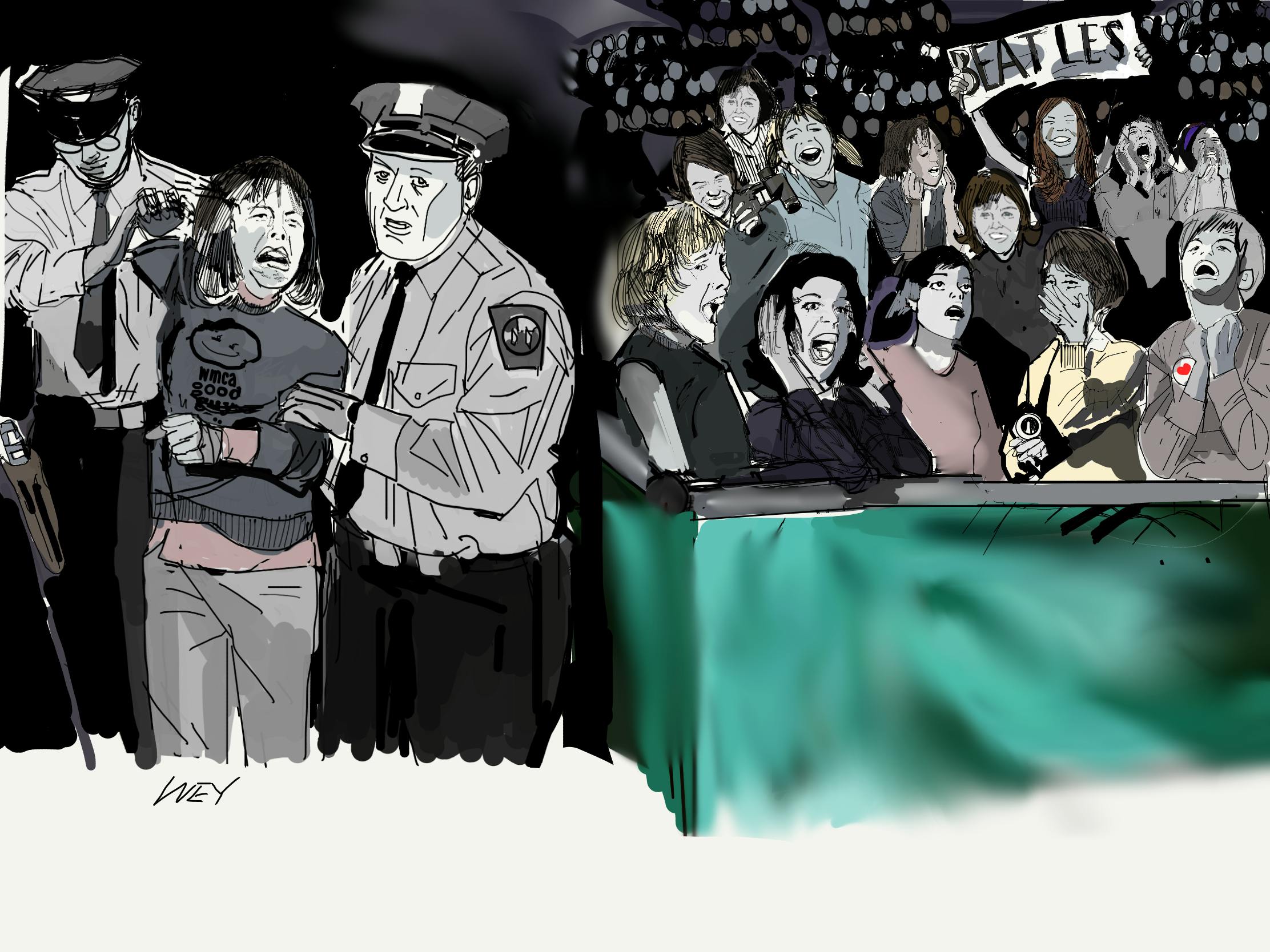
MALE and Alf up there clearing the stage and the DJs. And I have a picture of my book of a woman holding a chair above her head. I mean, it was just nuts. So maybe there were remembrances of that. Maybe people were thinking, okay, well, this is the last shore of the tour. The hysteria was most obvious in San Francisco at the final concert of the 65 tour. After it, John told how he gets personally involved, involved with an audience if.
- [50:44]
Beatles Show Announcer / Historical Clips
You can see them, you know, it does. If you've got any sort of feelings at all, you can't help being sort of moved by somebody crying. If. You know, definitely the crime for you, if somebody's sort of crying and shouting, you're not sure whether it's you, Paul, or whoever. You can't really get involved. But if it's. If you sort of catch somebody that's watching you, you do feel something, you know, I saw one little girl that was just crying and shouting. And I felt sorry for. For a moment thought, you know, she's only about 16 or something, she's getting crushed. But she was just standing there throwing handfuls of these little rocks at me. I shouted to her, yeah, well, they feel like little rocks, you know. And I shouted it. She just took no notice. And she was. Seemed to be waving at me. I was trying to say, look, I'm here, I'll smile at you, just don't hurt me. You're gonna knock me eye out.
- [51:26]
Chuck Gunderson
I interviewed so many fans that missed the 66 tour because of something in their life. And I said, don't worry, we'll see him in 67. That never happened.
- [51:37]
Robert Rodriguez
That was what I was wondering. Because we know, wasn't it due to some kind of distribution snafu that the 66 Shea show undersold? There were tickets that could have been sold that were sitting somewhere, just didn't get out there.
- [51:52]
Chuck Gunderson
Yeah. So there's a great clip in Anthology of Ringo. You know, when there's this newspaper reporter at the 66 Shea show and he goes, well, the bloom is off the Beatles. Last year, 55,000 people, this year, maybe 45. And then they go right to Ring and goes, oh, gee, the Beatles only sold 45,000 seats. We're a failure, we're miserable. It's all over for the Beatles, Remember that? It's like drawing that Many people in.66 to a rock concert was a big deal. No one else could do that. Can you name another band of the time that could have done that? Even close. You're agreeing. There's no other band. The Stones. If they came in 66 now, I.
- [52:39]
Robert Rodriguez
Mean, how many would they judge by record sales?
- [52:42]
Chuck Gunderson
Yeah.
- [52:42]
Robert Rodriguez
I mean, maybe Dylan. I don't know.
- [52:45]
Chuck Gunderson
Could Dylan attract 30,000?
- [52:47]
Robert Rodriguez
I mean, it's a different kind of audience. I don't. It wouldn't be screaming.
- [52:49]
Chuck Gunderson
Could the Stones. Could the Birds? Could.
- [52:52]
Robert Rodriguez
Yeah.
- [52:54]
Chuck Gunderson
Herman's Hermits. Herman's Hermits. I don't know. I mean, you're talking about a whole nother stratospheric level. You're talking about something you can't even compare.
- [53:05]
Robert Rodriguez
Maybe the Monkeys.
- [53:08]
Chuck Gunderson
Maybe. But the Monkees did go out in 67 or 60. 67. When they opened with Jimi Hendrix. Yeah, because I know they were playing, like, stadiums, like Forest Hills, the tennis stadium. I think they were kind of in that first year that the Beatles were in, in 64. So they're gonna play arenas and all that kind of stuff and hopefully build up to that. But they never did, obviously.
- [53:31]
Robert Rodriguez
No. Do you have any theories on why Candlestick was so undersold?
- [53:36]
Chuck Gunderson
Yeah. So it's kind of interesting. So they. Originally for 66. I have a telegram in the book that they obviously were going to do Cow palace. Two shows at the Cow palace. And then someone somewhere said, why do we got to do two shows, The Cow palace, let's do one show, a Candlestick, and we're done. I don't know if the Beatles had input to that. I don't know. Brian had input to that. But somewhere somebody switched it from the Cow palace to Candlestick. Now, was there advance warning of that? Maybe they didn't get the word out in time. Because I know this is an instance in San Diego, my hometown, like, they sell out shea Stadium, like 10 days earlier, 55,000 seats. And they come to my stadium in San Diego, which, where the Chargers play is called Balboa stadium, which held 28,000. And they sell 17,000 seats on the 65 tour. Like, why? I mean, they're at the height of why doesn't everybody want to go?
- [54:37]
Robert Rodriguez
Were there two shows?
- [54:38]
Chuck Gunderson
No, it was one show. And the reason was, is because San Diego was actually another add on the west coast promoters actually passed on the Hollywood bowl in 1964. They were the biggest promoters on the West Coast. It was Lou Robin and Alan Tinkley. West coast concerts they called it Concerts west or something. And GAC came to him, said, hey, we got this band, the Beatles. We want to put them at the Hollywood bowl in 64. And they said, 18,000 seats for this British band coming through? I don't think so. And they passed. And that's pre Sullivan and after Sullivan. This is after Sullivan.
- [55:16]
Robert Rodriguez
And So even despite 73 million pairs.
- [55:19]
Chuck Gunderson
Of eyes, they felt like they couldn't fill the Hollywood Bowl. So in steps Bob Eubanks. So eubanks gets the 64 Hollywood bowl show, he gets the 65 Hollywood bowl shows, and he gets 66 Dodger Stadium. Because Brian really rewarded the loyalty of promoters.
- [55:38]
Beatles Show Announcer / Historical Clips
KRLA disc jockey Casey Kasem, KRLA disc jockey Bill Slater, and that wild and wonderful Italian, Dick Biondi. And now here they are, the Beatles. Hello, hello.
- [56:11]
Chuck Gunderson
Oh, hello.
- [56:20]
Beatles Show Announcer / Historical Clips
Hello, hello, hello, hello, hello.
- [56:29]
Chuck Gunderson
So these west coast guys, Lou Robin and Alan Tinkley, when the tour is announced in 65 and they know LA is gone to Eubanks, they want a show from GAC. They're begging. And they're a big client of GAC's. They're like, we want a show. And, you know, it's like, well, the tour's already set. We want to please you, but let's figure this out. And so they come back to him in June and they say, okay, Lou Robin and Alan Tinkley, we couldn't get you a show. And you have a choice. You can either do it in San Diego or you can do it in Salt Lake City, Utah. Which one do you want? They decided they were going to play where the Utes play, University of Utah. It's Eccles Stadium now. But they said, well, we're just up the road from San Diego. We're obviously going to take San Diego. So San Diego wasn't even announced till June. So they only had this short window to kind of promote San Diego. And there was a lot of competing, misleading information. Plus, San Diegan's already bought their seats for the Hollywood bowl because they're doing two nights. That's 36,000 there. So a lot of San Diegans drove up to LA to see those Hollywood bowl shows. And then, of course, they meet ELVIS on the 27th in LA. It is BEL Air home. And then they come down by bus to San Diego to do that show. 17,000 people show up, 10,000 empty seats. And then they get the bus. They do the concert, they get in the bus, they're ready to take off, the bus doesn't start. And the promoters blamed It. They said, we had a bus for you, but the Beatles entourage says, we want to get our own bus. Well, that bus wasn't that great. So they're trying to start it. The fans are like running from the stadium through the infield to try to get to the bus. Luckily, it starts. It's halfway up the road away from the fans, breaks down and they park it in a back of a mortuary. The mortuary is still there in San Diego parking lot. I still see. And somehow they did something, got the bus going and off back to LA they went.
- [58:38]
Beatles Show Announcer / Historical Clips
What did you see of San Diego on the way in? We saw the freeway. The curtains were open. The curtains were open. We saw the sea. Yeah, yeah, we saw lots of things back there. In the pink. Yes. Disneyland. Oh, no. Have you enjoyed your. Your US Tour so far? Yeah, it's been good because it's just long enough for us not to get too tired and fed up, you know, it's just the right length.
- [59:04]
Robert Rodriguez
Did you get to see this show?
- [59:06]
Chuck Gunderson
No, I was too young. I was only like two and a half or something. So I was born 62. Yeah, 62. But my sister, who's 18 years older than me, she goes, the Beatles. I'm gonna go see Jimi Hendrix in 67. So she saw Jimi Hendrix at Balboa Stadium in 67. So, yeah, it's just all that kind of weird stuff that happens. So Candlestick was the last show and I don't know why 25,000 people came. Maybe it was the whole. Well, we saw him in 64, we saw him in 65, we'll see him in 67. We'll come back. Maybe we want the Cow Pals again. This is too big or something, I don't know.
- [59:47]
Robert Rodriguez
Yeah, it's interesting. They document the weather as being really unseasonably cold that night.
- [59:52]
Chuck Gunderson
But, oh, I've been in San Francisco during the summertime and I'm like, this is freezing. And you know the Mark Twain quote, obviously. And Mark Twain said, the coldest winter I ever spent was a summer in San Francisco. So it's probably one of those nights.
- [60:07]
Robert Rodriguez
I was wondering if you have any insight. You said that Bob Eubanks did produce all three LA shows, and in 66 they upscaled to the Coliseum. Was there any reason they didn't try to record that show as Capitol did the other two years of LA shows with the Beatles, since they were sitting on the tapes for 64 and 65 feeling like they hadn't got what they wanted yet, that they didn't Give it a third try.
- [60:33]
Chuck Gunderson
My only thinking is they're going from a Hollywood bowl, which is a much more confined, beautiful venue. I mean, if you've never seen a show at the Hollywood bowl, try to do that once in your life. It's just amazing. Yeah, it's an amazing place, but I think, you know, it's the upgrade. We're going to a 45,000 seat baseball.
- [60:53]
Robert Rodriguez
Stadium and not suitable for recording.
- [60:56]
Chuck Gunderson
Probably not.
- [60:56]
Beatles Show Announcer / Historical Clips
Okay.
- [60:57]
Robert Rodriguez
I was wondering how serious Capital's intense were.
- [61:00]
Chuck Gunderson
I don't even think they even gave it a thought. We kind of got our opus, let's keep that. Why do we gotta do any more?
- [61:07]
Robert Rodriguez
Up until the Beatles obviously knew, and at some point, probably after more popular than Jesus, they made the decision, we're not going to do this anymore. I think people pointed to whatever it was, the show that got rained out and they had to do two in one day. At some point Paul said, that's it. Okay, fine, I'm with you guys, we're not doing this anymore. Had there been any kind of planning for 67 that ended up being shut down by the Beatles decided we're not doing this?
- [61:36]
Chuck Gunderson
Yeah. So Mark Lewison kind of helped me out on this because we were having a discussion back and forth on this one day. And Mark's under the impression that Brian Epstein kind of almost had to kick him out the door to go on the 65 tour. They were kind of done after 64. John commented after that 64American tour, like, we'll never do another tour like that again. I'm in 32 shows, 33 days, traipsing all over America and obviously they're starting to go into the studio. They're finding the wonders of the studio, what they can do in the studio. The Beatles, as we know, they never want to stay in the same place. They want to keep going and elevating. Obviously sound technology is not keeping up with them. And obviously when you want to go out and tour, you want to play new songs, things like that. And the stuff they're recording or beginning to record at the time, it's just like we can't reproduce this on stage. We don't have the technology. So they're kind of like bootstrapped or whatever on that. And I just think touring was by 65, they're done. They got out on that 65 tour, they did it, they come back and then, you know, there's more beautiful music being made in the studio. There's more improvements in sound technology and tracking and all this stuff and 66 comes along and it's like. I mean I think the three of them, Ringo, John, George are like, yeah, this is done. I think Paul was. Had his performer mind on like, oh, we got to keep Tory keep so sharp, you know, all this stuff. And then there's that flash point. I mean he said it. I don't know if it was true he said it, but kind of around the middle of the 66, Tory threw his hat and said, yeah, I agree with you guys. Could it have been earlier? Maybe, I don't know. But they held in there, they did it, they were professional, they didn't let the promoters down. And prior to that 66 tour and after the Jesus statement, Brian was prepared to cancel the entire tour. He was totally prepared, ready to lose money, ready to give the promoters their money back. Did the flew in for the press conference before that tour, you know, at the hotel in New York and had to do the whole. Yes, exactly. Like hey, you know, it's a taken out of context but he was prepared to cancel it.
- [64:06]
Robert Rodriguez
So no from GPA or anybody else had any propositions for 67 that made it to the Beatles that were then shut down or did the word get out?
- [64:15]
Chuck Gunderson
I think after 67 that was it. I think the Beatles just put their foot, foot down and said that's it, we're not touring again.
- [64:23]
Robert Rodriguez
So you've had 11 years since the book's been out. Is there anything nobody has asked you that you really wanted to talk about?
- [64:30]
Chuck Gunderson
That's a good question. There's sex on the tour. I don't, I don't know any of that. And that's why I didn't even go there. I didn't even go in the book with their late night dallying around or anything like that.
- [64:44]
Beatles Show Announcer / Historical Clips
The Beatles tours were, were like satiricon, you know, I mean we had that image. But man, our tours were like something else. If you could get on our tours, you were in, you know, there was satiricon all right, just everywhere satirical. Just think of Satiricon only with four musicians going through it. Wherever we went, there was always a whole scene going. We had our four bedrooms separate from. Tried to keep them out of our room. And Derek and Neil's rooms were always full of junk and who was and knows what and policemen, everything so Chiricorn, you know, we really. Well, we had to do something. And what do you do? The pill doesn't wear off when you, when it's time to go, you just go. I used to be up all night with Derek Whether there was anybody there or not, you know, I just could never sleep. Such a heavy scene. It was like anybody. They're all into now, but they didn't call them groupies then. They called it something else. But if you couldn't get groupies, we'd have whores and everything. Whatever. Whatever was going, you know.
- [65:41]
Robert Rodriguez
Who would arrange for all that stuff?
- [65:42]
Beatles Show Announcer / Historical Clips
Derek and Neil. That was their job. And Mal. But I'm not going into all that. Oh, sure it was. I mean, when we hit town, we hit it, you know, we're no pissing about.
- [65:54]
Chuck Gunderson
And Margie's candy's like, hey, it's here in Chicago. Maybe we should end with Margie's candy. Yeah, sure. Okay. So as you know, Margie's candy is pretty popular back in the day, maybe still is today. Ice cream candy shop in Chicago. It's in between White Sox park and where the Beatles stayed at o' Hare Sahara Inn. Manny Scars. Yeah, that Sahara. Yeah, Manny Scar. He's a gangster. Okay? Manny Scar, like two weeks after the Beatles stayed there, got assassinated because he wasn't up on his construction loans or gambling. I don't know.
- [66:32]
Robert Rodriguez
That place had been bombed more than totally.
- [66:34]
Chuck Gunderson
Exactly. I don't think.
- [66:35]
Robert Rodriguez
Who the hell is putting them up there?
- [66:37]
Chuck Gunderson
I have no idea. For their safety. Why didn't they put them in the loop?
- [66:41]
Robert Rodriguez
Right?
- [66:42]
Chuck Gunderson
I have no idea. Astor Towers are there the next year. I don't know why. Maybe it was close to o'. Hare. It's in Schiller Park.
- [66:50]
Robert Rodriguez
Yes, but it's still gangland.
- [66:53]
Chuck Gunderson
Yeah, right. So they're staying in this weird kind of hotel. So Margie's right in the middle. Makes sense. White Sox Park. Get on the Kennedy Expressway, stop at Margie's, go back home. Right back to the Sahara. And so I thought, well, I'm going to go to Margie and check this thing place out, you know. So we got some beetle friends, won Beetle Fest and said, let's go to Margie's. And we did. And the story is, as they stopped there, they got out of their limousines, they went in and they had these things that Margie's was famous for called Atomic Blaster Sundays. Gigantic Sundays. And several girls came along and we're able to sit in this booth, you know. And I'm kind of looking at this booth because they have the dedicated Beetle booth there, the plaque and all that, like Bob's Big Boy does, which they were never there. And there's like. It's on a corner, so there's like windows on one side of Margie's Candies. And there are windows on the other side of Margie's Candies. And I'm thinking, how do they pull this off? Like, you're talking about the height of Beatlemania. Tight neighborhood. Not a lot of space, a lot of viewing area. A lot of people would have been there. A lot of people would have been taking photographs. I'm assuming there's nothing discreet about that place. Nothing. Exactly.
- [68:08]
Robert Rodriguez
Like down on State Street.
- [68:09]
Chuck Gunderson
Yeah. So I walk in, you know, at some point, I had a long conversation with the owner, who wasn't the original owner. It's the son goes, oh, I got pictures of it. You do? Like, I'm coming down this weekend. Can I see him? Sure. I'm super excited. Like, okay, I'm gonna finally figure this out, right? I get there, talk to the guy, Peter, and he goes, yeah, here's the photos. And I'm looking at him going, well, these are photos of them in England. Like, just stock photos. Well, they were here. I was a kid and they were here. I'm like, okay. I didn't wanna, like, get into it with them, like, have your memory, you know what I mean? But, okay, there's no photos exist. I researched every Chicago newspaper, you know, like the gossip columns and things like that. A guy about town or. I read through all of those. You would think Beatles are at Margie's Candies. Nothing. So I met the Sing along last night. It's 2 in the morning. And this woman by the name of Georgiana. What's her last name? Who knows? Georgiana. She got befriended by mal during the 64 tour. Sarah. Okay.
- [69:20]
Robert Rodriguez
Is that a euphemism?
- [69:21]
Chuck Gunderson
Could be a euphemism, I don't know. But she became friendly with Mal and he felt comfortable with her. They became pen pals, and Mal got her in to see the Beatles, right. In 64, did she get into the room? 65. Okay, 65. She didn't. I have pictures on my phone of that. And there's pictures of her in the room with the Beatles at the Sahara o' Hare Hotel. Manny Scar. So I'm asking her, last night, two in the morning, I go, georgiana, I go, like, you went to the evening concert at Whitestock park, right? She goes, yeah, of course I was there. And then you went back to the hotel room and got inside the building because. Pictures of you, right? And she goes, yeah. And I have the picture, so I know she's telling the truth. And I said, did you leave, like, right after the concert? She goes, yeah, pretty much a little bit later. You know, you had to traffic and all that stuff. And I said, okay. And when you got back to the Sahara, were the Beatles there? She goes goes, yeah, they were there. Like, George had just gotten out of the shower. He'd washed his hair. She'd remembered that much. He'd washed his hair. And I'm thinking, okay, well, gosh, he must had a really fast Sunday at Marty Candy, you know, and like got out and like got in the booth and they're eating with the ladies and fooling around and all that stuff. And they get back and they go, sahara. Like, okay, the timing's not working here. Like that. To me, last night at 2am After 11 years of wondering about this finally came home to me. Like, that didn't happen. None of the Beatles ever talk about it. And the gossip columns of the newspapers, photos, other people coming forward besides the Margie Candy owner. Like, yeah, I was one of the girls. Or, yeah, I was outside on the street. Nobody. So I kind of put it to rest. I mean, the whole thing about the segregation thing, that's a whole other podcast. We don't have time for that. But the segregation thing is absolutely. I completely debunk that. Like, everybody thinks the segregation started. The insertion into the rider was for the Jacksonville show. Nothing of the kind. It was in the rider In April of 1964, five months before the show. Everyone knew that show was going to be integrated. And the Beatles had that segregation statement in their rider clause in their rider.464, 465, 466. The Beatles only needed that clause for America. Only. No other place they played in Europe. Europe, Asia, Australia. Did they need the segregation clause? It was only in North America. Did it hold in Philly. Did that hold in Philly? Did they adhere to that? Yes, they had to. There's blacks and whites intermixed with crowd photos in Philly now, is it mostly a white audience? Absolutely. It's majority white kids that read stuff.
- [72:28]
Robert Rodriguez
About Frank Rizzo, who had been the police chief that became the mayor, that he wasn't having the segregation thing. He wanted it segregated.
- [72:35]
Chuck Gunderson
Yeah.
- [72:35]
Robert Rodriguez
Okay.
- [72:36]
Chuck Gunderson
Yeah. Good evening, 11pm Here is the late hour news.
- [72:39]
Beatles Show Announcer / Historical Clips
Ed Pettit reporting. What began as a minor traffic dispute last night in a Negro section of Philadelphia has since resulted in rioting and looting with damage running to more than half a million dollars. The mayor has imposed around the clock curfew with penalty of two years in jail for violation. But it's being largely ignorant.
- [72:58]
Chuck Gunderson
Trouble continues in spite of the best.
- [73:00]
Beatles Show Announcer / Historical Clips
Effort of Negro leaders who say it's hoodlum inspired. Here's a late report from the scene by John Schuback. Despite the efforts of more than 1500 law enforcement officers, efforts to quell rioting and looting in North Philadelphia have not been successful. A rash of police injuries have been reported and the arrest total has now climbed above the 200 mark. But as yet, it's been impossible to prevent outbreaks of rock throwing, looting, window breaking and attacks on police. This is John Schubek reporting from Philadelphia. The Beatles had the kids jumping again tonight at Forest Hills, Queens. But aside from the noise, it all passed without incident. And welcome relief. It was for police who for two days now have been trying to keep the girls from invading the Delmonico Hotel at Park and 59th to get a glimpse of their favorites. Next stop, Atlantic City. Lucy Baines Johnson says she'll head back to work, Washington before the Beatles invade.
- [73:51]
Chuck Gunderson
And Frank Rizzo got tickets because he said, I'm Frank Rizzo, I can get any tickets I want. But yeah, I mean, they adhered to it in every city. And the Gator Bowl, I mean, they were having integrated football games. Blacks and whites were sitting together as early as 1960. Now, that was the first rock concert at the Gator Pole ever. So I imagine back in the day, and this is when the tour was planned. You're talking the spring of 64, before the civil Rights act passed. It's just now starting to get introduced in Congress. The discussions for the Civil Rights act began on February 10, 1964, the day after the Beatles performed on Ed Sullivan. The first discussions on it. And by July, all the tour and everything's set by April, contracts are signed. April, it's done. Mid April, it's over. It's set in stone. Everyone knows you're going to have an integrated concert. Civil Rights act doesn't pass till July. So prior to that, everyone's still operating under Jim Crow laws in the South. From February to what they've done prior to July, the Civil Rights Acts passed. Now, does every town in America in the south adhere to the Civil Rights Act? No. It's slowly eroding. That's why Bryan couldn't do a show in Montgomery, Alabama. He had checked that on the list. I want to do a show in Montgomery, Alabama, right after Jacksonville. That show didn't go off because there was a governor at the time by the name of George Wallace, who was a strict segregationist. He just didn't want to cause this flap up. Like he probably legally could have done it, but with George Wallace being the governor, probably wouldn't happen. And he just scrapped it. Same with Charlotte, North Carolina. They wanted to do a show there. Charlotte, North Carolina schools didn't get integrated until 1970. They just didn't want to cause this big flap up in America. And so that's why some of those things were done. So what I imagine what happened at the Gator bowl was that was a city owned, municipal owned stadium. And I imagine the city council, the mayor at the time were kind of segregationists and like, yeah, they can have their Civil Rights act, but we're slowly kind of of getting this Jim Crow law wrote it. And by that time it was like, we don't have any power over this. The promoters already knew it was going to be integrated. Back in April they signed a writer and so the show went off. But there was this big flap up in Vegas and you know it's going to be integrated. And then the Beatles obviously took a stand on it. But the people that don't get the credit for the integration clause in the contract that never get talked about. Brian Epstein and Norman Weiss. Norman Weiss being the vice president of General Artists Corporation, a Jewish man, Brian Epstein, a Jewish gay man. Those two planned the tours, not the Beatles. The Beatles were told where they were going to go. Norman and Brian did it. And what's interesting is all during this time, during the planning of the tour in March and April, the first stories start appearing in the New York Times of African American artists wanting to play before desegregated audiences and white artists finally backing them up. People like Vladimir Horowitz, Leonard Bernstein, people like that, that had a lot of clout. So it's so interesting that all this was going on in New York. Of course, Norman Weiss is right there in New York. He's in the entertainment business. He's dealing with us all the time. And all of a sudden black artists are standing up and they're saying, we're done with segregated audiences. We want to play before integrated audiences. So I'm thinking it's kind of was in the thinking of Norman to put this clause to present it to Brian and say, I think we should do this. And Brian, being a gay Jewish man facing his own discrimination in his life, said that's a great idea. And then the Beatles backing them up because we're not used to this, like why we play before integrated audience in England. This is totally foreign to us. We've had black artists on our stage, whatever. And they toured with an African American touring act The Exciters, Frogman Henry. And they told the people at the Jacksonville Hotel they were going to stay at. It's the George Washington Hotel. Hey, if you want to allow everyone to stay here, guess what? We're canceling our reservations. Which they did. And they flew to Boston that night.
- [78:53]
Beatles Show Announcer / Historical Clips
I understand you're pretty against segregation down there in Jackson. If you have Jubilee Hotel.
- [79:01]
Chuck Gunderson
Pardon?
- [79:02]
Beatles Show Announcer / Historical Clips
We understood there were some problems about the hotel you might stay in in Jackson. I don't know. You know, we don't know about our accommodation at all. We don't arrange that. But, you know, we don't appear anywhere where there is no, you know, we want to. I mean, half of our.
- [79:19]
Chuck Gunderson
Anyway, Gosh, we got that through. I thought we were just going to. Anyways. Brilliant.
- [79:26]
Robert Rodriguez
Anybody who hasn't seen Sunday Best, the documentary on Netflix, Ed Sullivan, another guy who's just getting credit for what he did. Fighting that good fight, ahead of his time and a great personal risk. Absolutely. So well done for adding those two names to the conversation. But thank you, that was wonderful.
- [79:44]
Chuck Gunderson
You're welcome. Thank you.
- [79:51]
Beatles Show Announcer / Historical Clips
How are the beaches enjoying their tour here in America? Very much, thank you. Hello. Hello. That's great. Having a great time. Me too. How come you're not hitting more southern cities on this tour? We don't know. You know, it's not up to us where we go. We just climb in the vans. Question here for Ringo.
- [80:12]
Chuck Gunderson
I'd like to ask Pringle.
- [80:13]
Beatles Show Announcer / Historical Clips
I understand that you like country and western music. I was wondering if the Beatles have any plans of recording in Nashville. I do like Clemson Western and we.
- [80:22]
Chuck Gunderson
Have no plans of recording in Nashville.
- [80:24]
Beatles Show Announcer / Historical Clips
If the Beatles could attend someone else's concert, what artists would they go and see? There's lots of them, you know. Lots. Yeah, I like to go to the Apollo and see everybody that goes there. I had a question for all the beagles here would be if you were sitting at home listening to someone record album of other recording artists, who are some of the American recording artists that you prefer? Otis Reddin as well. There's lots of them. There's hundreds of them. There's many, many. Is this the people's last tour? No, no.
- [81:10]
Robert Rodriguez
Something about the Beatles created and hosted by Robert Rodriguez, executive producer Rick Way title song performed by the Corgis. Something about the Beatles is an evergreen podcast.
- [81:36]
Beatles Show Announcer / Historical Clips
When I'm down telling people.
- [81:52]
Chuck Gunderson
Want to live better. We got a lot of work to do. Join Chris Hemsworth in National Geographic New Disney plus original series Limitless Live better Now I'm diving head first into cutting edge science to uncover three powerful secrets to living better Right now. The growth that occurs through any challenging experience is really what we see. Chris Hemsworth stars in Limitless Live. Better now, now streaming on Disney plus and Hulu. It's Showtime.