Loading summary
Transcript91 lines
- [00:00]
Andrew Feldman
The demand for AI has outpaced everybody's expectations. Everybody's forecast. And so everybody's chasing. They're chasing chips or they're chasing memory, or they're chasing data centers. OpenAI we announced in January a huge partnership, one of the biggest deals done in Silicon Valley history. We'll be doing more than $20 billion of hardware for them over the next several years. I'm concerned that there are ways frequently for Nvidia to exercise market strength. There are ways for Nvidia to use their balance sheet to limit competition. We have a ch chance for our children or the next generation not only to not die from cancer, but to not know anybody who died from cancer.
- [00:49]
Host of Sorcery Podcast
Andrew Feldman, welcome to Sorcery.
- [00:51]
Andrew Feldman
Well, thank you so much for having me.
- [00:53]
Host of Sorcery Podcast
We are out here in Paris at Raise.
- [00:57]
Andrew Feldman
Pretty okay, huh?
- [00:58]
Host of Sorcery Podcast
It's pretty okay. I also heard you're one of the most popular people here.
- [01:03]
Andrew Feldman
That would be first in my life, so it's nice of you to say.
- [01:09]
Host of Sorcery Podcast
A big theme, though, is, and we were talking about this just off camera, is hardware is cool, Semiconductors are cool. Everything is in fashion now.
- [01:17]
Andrew Feldman
We are in fashion. We're in demand. We're hard to get. It's a big change. I think what's happened is the demand for AI has sort of outpaced everybody's expectation, everybody's forecast. And so everybody's chasing. They're chasing chips, or they're chasing memory, or they're chasing data centers. There's an opportunity to invent new things, different architectures. It's really a time of sort of a cambrium explosion of ideas, and that's really fun.
- [01:51]
Host of Sorcery Podcast
So you were at Rays last year? I remember this because I think you had the biggest booth here. There was a fence around it.
- [01:58]
Andrew Feldman
Yeah.
- [01:59]
Host of Sorcery Podcast
And a lot of people. What is the biggest difference between last year and this year?
- [02:03]
Andrew Feldman
Oh, I think last year was their first year. Right. And I think there are more people here. There are more participants, so there are more attendees. The more companies participating. I think people are participating in a bigger way. I think the dinner last night at the secret location, the secret location called Versailles was sort of awesome. We spent a lot of time in the digital world, and the people we talk about AI to go look at something that illiterate Masons made 400 years ago, and to sit in it and to enjoy the grandeur is extraordinary. This wasn't AI, this wasn't EDA Design or cad. These were guys with pen and paper communicating with, you know, masons and other tradesmen who couldn't read. And they built something unbelievably beautiful and that was really fun.
- [03:02]
Host of Sorcery Podcast
And so you're going to be on stage this year. What are you mainly going to be?
- [03:05]
Andrew Feldman
I'm on stage with Sachin from OpenAI. You know, we announced in January a huge partnership, one of the biggest deals done in Silicon Valley history. We'll be doing more than $20 billion of hardware for them over the next several years. We'll talk a little bit about deploying hardware and fast AI and how important fast inference is in the emerging sort of inference AI landscape.
- [03:34]
Host of Sorcery Podcast
Inference is a hot topic. Everyone loves inference.
- [03:37]
Andrew Feldman
Yeah, we make AI with training and we use AI with inference. And so as the models and as the AI we made becomes useful, everybody wants to use it. And inference is the mechanism through which we use it. And so now we have smart, smart AI. People want to use it and when they want to use it, they want to use it and they want to be fast. And that's sort of where we come in and where the fast is not by a little bit, but by 20x. And so everybody's using their AI, they're trying new things, they're deploying, you know, GPT or cloud code or one of these supermodels. And um, it's sort of an explosion of, of, of building, of trying new things, of a new way to work. It's pretty fun.
- [04:29]
Host of Sorcery Podcast
So we're nearly two months after your IPO and there was one post that I thought was really cool. You posted that you had a very large chip on your shoulder and it was quite literal and physical.
- [04:46]
Andrew Feldman
I hope that you know, now that we're running a public company that I wouldn't lose sort of the self deprecating humor, whatever, that I enjoy the sort of tone in my social posts. And so we put a giant chip, we put this sort of on my shoulder like this and we built a harness for it. Yeah, that was a fun one. I think that people assume that as a CEO or of any size or an entrepreneur, that it's sort of always peaches and cream and it's just not the case. There's an enormous amount of hard work, there's sacrifice that you make and that your family makes. They see you less. It's not for a little bit, it's not like a weekend or two weeks in a row. You work hard, it's for years. And so sharing that a little bit is something I thought would be well received.
- [05:51]
Host of Sorcery Podcast
So what's been the biggest difference for you post ipo?
- [05:55]
Andrew Feldman
The number of People who want something.
- [05:57]
Host of Sorcery Podcast
Really?
- [05:58]
Andrew Feldman
Yeah. Has exploded of one form or another and we get a little better at triaging those between my executive assistant and chief of staff and just if you get 80 emails a day of different people asking you for something, that's not work, that's just this range of people who want something of one form or another to meet you, your time, for you, to present for you, to donate to their cause. For you too.
- [06:29]
Sponsor/Announcer
Whoa.
- [06:31]
Andrew Feldman
That was a little unexpected.
- [06:32]
Host of Sorcery Podcast
Your last company you helped create, 100 millionaires. This company you have, I don't know, countless more.
- [06:42]
Andrew Feldman
Maybe a thousand.
- [06:43]
Host of Sorcery Podcast
Maybe a thousand. Maybe in the future. A thousand right?
- [06:49]
Andrew Feldman
At IPO is more. It was about a thousand.
- [06:52]
Host of Sorcery Podcast
Would that be investors and employees or employees really?
- [06:56]
Andrew Feldman
Current informer.
- [06:57]
Host of Sorcery Podcast
Okay.
- [06:58]
Andrew Feldman
Wow.
- [06:58]
Host of Sorcery Podcast
And so what lesson do you learn from that as a CEO? Like what is in your mind?
- [07:04]
Andrew Feldman
I think a couple things. I think to, to do the job, you gotta love to build. I think making money is really great. And making money for people you care about is really, really great. And when you get a chance to deliver for people who bet on you, who bet chunks of their career, your investors, it's great to deliver for them. They bet on you, but they're diversified. They bet on you and 20 other companies. When someone bets five or seven years of their career, and a career is 30 years, right. They're betting a sixth of their professional career. And when you get to deliver for them and they get to achieve the financial goals that they wanted there, that's a great feeling and one I'm proud of every day.
- [07:53]
Host of Sorcery Podcast
It's a very selfless position on that. I mean, it's really interesting because today in the backdrop, we are in a hyper super cycle, whatever you want to call it, of AI. And so these companies that are coming up, whether they're in semiconductors or they're in, I don't know, models or coding agents, there's a lot of companies that are rising up really fast and hitting that billion dollar mark. Some are having liquidity events like OpenAI and Anthropic to Come, but others are getting that paper markup and they're, they're seeing that kind of wealth creation event. How do you maintain a healthy mindset around that?
- [08:32]
Andrew Feldman
I think you bring it. It's not a change, Right. For the type of people I love working with, they like building stuff and they like building hard stuff. When it paid a little, when it was out of fashion, when hardware was uncool, they were still building hardware. Cause that's what they like to now that it's in fashion. They like to build hardware and they're sort of even keeled about that that their passion is the building. And I think in Silicon Valley, which sort of is what I know that chasing money is not the path to money. The path to happiness is working on projects you like with colleagues that are interesting for people with integrity. And if you do that, the money will come. But even more importantly, you work on things you like and you'll work with people you learn a little something from and you can teach a little something from. And if that's the way you set about pursuing your career, I think when things are really bad, you're on even keel. And when things are really good, you're uneven keel because you're enjoying what you're doing.
- [09:46]
Sponsor/Announcer
This episode is brought to you by Brex, my favorite. You become what you spend on and I refuse to spend my time on work that shouldn't exist. Expense reports, receipt chasing and manual closes the companies building. What's next? From Vercel OpenAI, Anthropic Granola and Deepgram all made the same call. They all run on Brex. BREX is the intelligent finance platform that combines cards, expenses and banking into a single stack. With agentic finance built in AI agents that handle expenses automatically enforce policy before spend happens and close your books in minutes. That's why sorcery runs on Brex, so I can spend time on building and not busy work. It's time to get Brex AF. Learn more at brex.com sorcery that's B-R-E x.com s o u r c e r dash y bye.
- [10:45]
Host of Sorcery Podcast
So looking forward, I'm sure this is also just a mark in your journey because you're a builder. So what are you most looking forward to over the next couple months? As we said across this year, getting
- [10:58]
Andrew Feldman
to an IPO is not the end of a journey. It's sort of a plateau. It's sort of the arrival at corporate adulthood. It is the achieving one plateau so that you can climb others. And our opportunity has gotten bigger. We have more resources, we're better recognized, we can reach more people and we can sort of prosecute our vision and our ambitions with more fuel. And so that's what we're excited about every day. Building more chips, building more data centers, inventing technology that moves the industry forward. That's what drives us and gets us out of bed every day.
- [11:46]
Host of Sorcery Podcast
I think I was listening to a Harry Stemmings episode that you did and talking about data centers and the demand for Them and how we're actually not trying to meet future demand, we're actually just really behind.
- [11:58]
Andrew Feldman
We are behind on where we are.
- [12:00]
Host of Sorcery Podcast
So could you explain where we are with the data center build out?
- [12:04]
Andrew Feldman
Right. So what happened is data centers had historically moved at the speed of real estate. Somebody would decide to build a building and two years later, after permits and they poured concrete and the building would go up. And two years ago, nobody cared about AI. Two years ago we were at the beginning of this. And the AI explosions happen so quickly. There's so much demand for compute. We've outstripped the demand for compute, for memory. And where do these things go? They go to these buildings and we haven't made them fast enough. And so people are chasing data centers around the world and that's what's happening. And so it is a major limitation for everybody right now.
- [12:56]
Host of Sorcery Podcast
We just had Tony Kim on and we were talking about the new architecture of data centers. So how are you working with other companies? Whether it's through your build outs, creating the right stack and architecture.
- [13:11]
Andrew Feldman
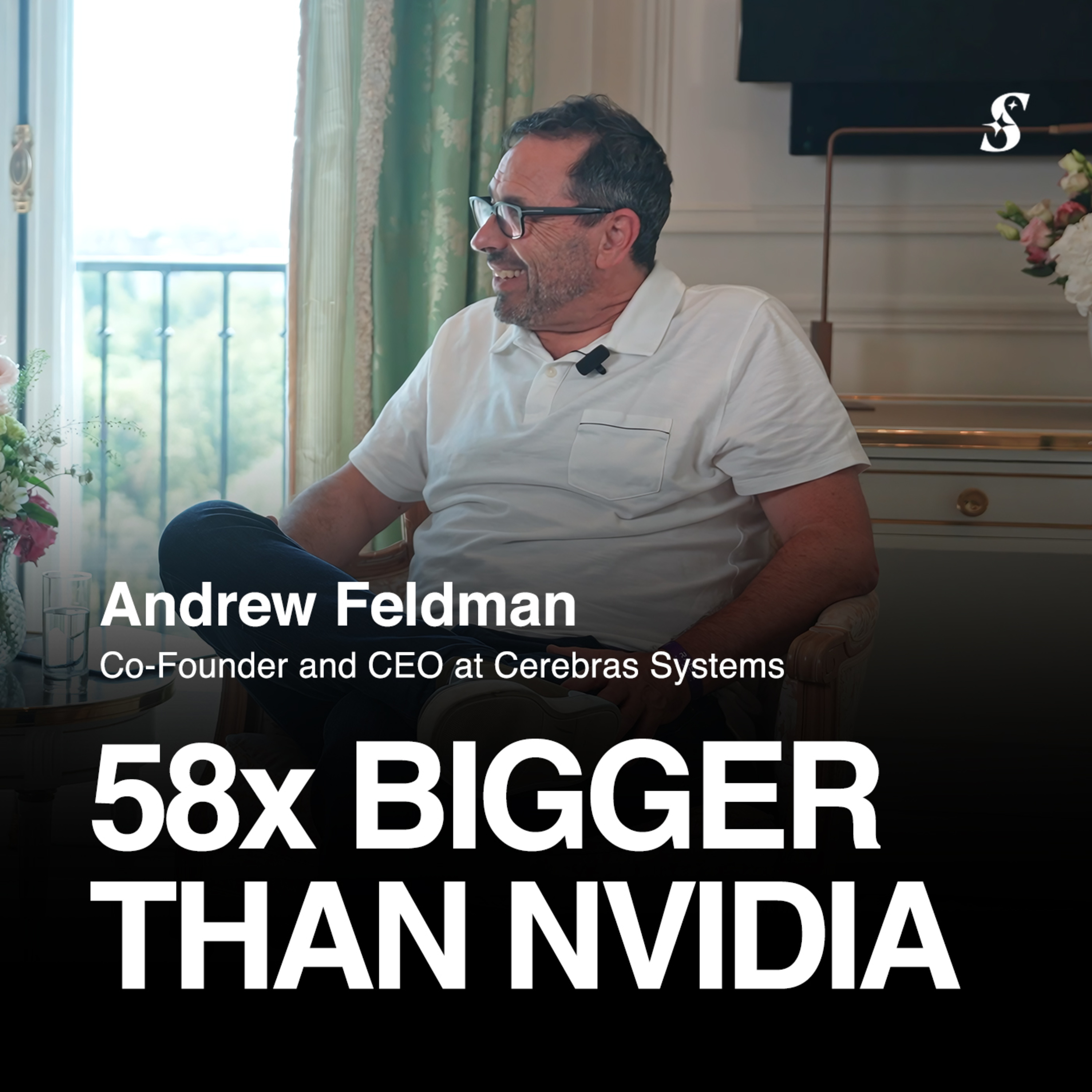
Sure. So, you know, the interesting about, you know, data centers hadn't changed a lot in 20 years and a lot of the infrastructure in them hadn't changed. I mean, the generators that we use for backup have been unchanged for about 20 years. The type of batteries we used for backup, the chillers and the, the CDUs and the. And suddenly there's this sort of intense demand and sort of people are looking to innovate and they're using fuel cells and guys are using jet engines like boom. To generate power for these data centers. And the turbines are being rethought of. And so there's sort of an innovative push in the data center now for us while we build this sort of super big chip, the chip that's like 58 times larger than any other chip, it goes in a server, it goes in a metal enclosure that's about the size of a fridge for a dorm room, little fridge. And we put a couple of those in a standard rack. And so the physical requirements weren't very different from if you're going to deploy a competitor's product. What Tony's really talking about is sort of these buildings were sort of unimproved for a generation and now they're part of a factory that makes AI and people are trying to optimize every part of that factory.
- [14:44]
Host of Sorcery Podcast
Yeah. And now they're also putting them in space.
- [14:47]
Andrew Feldman
Yeah, well, they're talking about putting them in space. I think like a lot of technology you talk about it For a long time before it happens.
- [14:56]
Host of Sorcery Podcast
Do you have plans?
- [14:58]
Andrew Feldman
You know, I'm. We, we are really good for space because one of the hardest problems in space is getting all these little chips to talk to each other. And because we're a big chip, we don't have that. That problem. I don't think we're in danger in the near term of having a data center in space. I, I think it's more than five years away.
- [15:20]
Host of Sorcery Podcast
Five years.
- [15:21]
Andrew Feldman
Five years.
- [15:21]
Host of Sorcery Podcast
Okay.
- [15:22]
Andrew Feldman
And that's a long time in our world, right? I mean, three years ago, nobody was using AI, Right? And so I think we got a lot of work in building data centers on Earth before we actually have big production data centers in space.
- [15:38]
Host of Sorcery Podcast
I'd love to talk about how chip design has changed.
- [15:43]
Andrew Feldman
Sure.
- [15:43]
Host of Sorcery Podcast
Co design has become an important part of how do you create that kind of platform for the next three years? Because you're, you're building for the next three years. So how do you think about that and how do you go about chip design?
- [15:56]
Andrew Feldman
Well, I think historically you made chips and you ran software on them, and there wasn't surprisingly, a close interaction because there was a layer called an operating system that lived between the chips and the software. And so intel and AMD made chips and people wrote software for the operating system or for the chip. AI has gotten so large and speed is so important that what they're doing is they're thinking about sort of the design together. What changes could we make in software that would advantage the hardware? Or as we're designing the hardware, what changes could we make that would make the software easier to run? And so they're being designed sort of at the same time. And like anything, when you sort of design things together, the advantages are enormous. And so this is something that's really taken shape right now. One of the advantages of our relationship with OpenAI is we get to see exactly where the frontier is going, and we get a chance to roll that into our designs. One of the advantages Google has is their TPU can be designed in collaboration with the team building Gemini or the team of DeepMind, and so they can inform their choices back and forth. And that's an enormously powerful thing that is surprisingly relatively new in our space.
- [17:39]
Host of Sorcery Podcast
What do you think that the biggest misconception with that process is? And the challenges are?
- [17:45]
Andrew Feldman
I think that the misconception is that it's easy and all you need to do is get in a room and it's a, it's a very hard problem. You know, the software guys think one way the hardware guys think a slightly different way. You know, anything you do to make it easier to write the software makes it harder to do the hardware. Right. And these are really hard trade offs and so bringing them together and means these sort of compromises where it will be harder here to make it easier here. And that means somebody's schedule is going to be impacted, somebody's got to add resources. Those discussions are enormously difficult.
- [18:32]
Host of Sorcery Podcast
I'm really curious because I come from an outside perspective, you have an inside perspective. There's a lot of big deals that are being thrown around left and right and I don't know what's actually under the headline. So when SpaceX comes out and they say they now have multi billion dollar deals with Google and also with reflection, like what does that actually mean? Like what are they selling them?
- [18:54]
Andrew Feldman
It's tough to tell. It's tough to tell inside as well.
- [18:58]
Host of Sorcery Podcast
Really?
- [18:59]
Andrew Feldman
Yeah. I think there have been announced some sort of deals that didn't have teeth, deals that could have teeth later. I think X had available capacity and you got to ask why they had available. They had available capacity because the Grok model wasn't used very much. So they had these GPUs that were sitting around and that's a bad idea. And so they sold a whole block of them or released a whole block of anthropic and they looked up and said, well that's a pretty good idea. Right. We had all these GPUs, our model wasn't a success, but whoa, we can have a great business by sort of stepping into what is a constrained market. Very hard to get lots of GPUs and lease these. And then they looked around, said, well what else can we, who else can we lease to? And so that's how it started. Now the specifics of those deals I'm not super familiar with.
- [20:06]
Host of Sorcery Podcast
Are you concerned at all about the circular deals that are going on?
- [20:13]
Andrew Feldman
I'm concerned that there are ways frequently for Nvidia to exercise market strength. Right there. Ways for Nvidia to use their balance sheet to limit competition. Right. That if they invest in a NEO cloud, the NEO cloud is less likely to use a non Nvidia chip. If they invest in a model builder, there's pressure not to use other people's chips. That's what I'm more worried about.
- [20:54]
Host of Sorcery Podcast
Yeah, this is happening in the token world with all the free tokens that are being offered to these startups.
- [21:00]
Andrew Feldman
That's exactly right. Think these are drug pushers here, little girl. Try a little bit, just a little bit. And I think what the startup should do is they should take it and then never be dependent and take some from AMD and come to us and see if we can get you some as well. And avoid dependence that never ends well.
- [21:27]
Sponsor/Announcer
If you're building what's next in AI, you need to know MongoDB, the database platform developers love and built for the agents you're running. MongoDB stores searches and reasons over your data in real time with vector search and embeddings from Voyage AI all in the same system. No separate pipelines, no stitching together 10 different tools. It's why 75% of the Fortune 100 and leading AI native startups run on MongoDB. Build and scale from your first user to billions of vectors. Go to mongodb.com AI to learn. That's mongodb.com AI to learn more. Bye. Assembly AI is a voice AI infrastructure layer millions of developers build on. They build the industry's best speech to text, voice agent and speech understanding models that serve as critical infrastructure for companies like Granola, Heygen Ashby and ClickUp. Their speech to text models lead the industry in accuracy and quality, and their speech understanding models help you go beyond transcription by uncovering insights, identifying speakers and highlighting key information from voice data. You can get started today@AssemblyAI.com sorcery and get $50 of free credits to start building Voice AI products. That's AssemblyAI.coms o u r c e
- [22:51]
Host of Sorcery Podcast
r dash y I mean this is actually a good transition into something that Karp said not too long ago on cnbc. He was pretty much talking about sovereign AI and how every company should own the full stack and so whether it's their data for their products and everything in between and models too, because you don't want to sell that, then the models will recreate it. And then about a new Figma. How do you feel about sovereign AI and this like the shift over to owning the full stack?
- [23:21]
Andrew Feldman
Well, I think the notion of not being dependent, I mean you shouldn't be dependent on Nvidia, you shouldn't be dependent on one model maker. I think that rarely works out well. What you'd like to be as a nation or as a big company is you like to have choices. And I don't know if you need to own all the stack, but you like choices at each layer of the stack. I think a different way to think about what Alex said is you want to think about where your advantage is. If you have unique data, be sure you don't Give that away. Be sure you have multiple choices in different parts of the stack, but you get the credit for your data and it doesn't help make somebody else's model better.
- [24:18]
Host of Sorcery Podcast
As we look forward, I guess more on the macro lens, the proliferation of AI and everything that we're able to now create and build and do. What are you excited about on the externalities that come with all of this?
- [24:35]
Andrew Feldman
Okay. I think that we have a chance for our children or the next generation not only to not die from cancer, but to not know anybody who died from cancer. I think that is a real achievable goal in 25 years. Wouldn't that be something? When we think about what AI can do, writing better code is cool and there's a huge market for that. But I think what it can do to better humanity is rid us of the number one killer of adults. And I think that's when I think of what we're all doing this for. It's an outcome like that. Pancreatic cancer had a huge breakthrough recently. I think the opportunity for breakthroughs right now is, has never been better. And AI is an extraordinary tool in, in pursuit of, of, of knocking down major, major human killers. Right. I mean if you think if you, if you took out cancer and you took out automobile accidents, you're taking out huge numbers of deaths a year and you say to yourself, well, that's a lot of good that we did. And I think, you know, self driving humans are terrible drivers. Horrible, horrible drivers. It's not just when we're 16 or 18 or when we're not paying attention or our parents in their 80s or you know, we don't pay attention. We're on the phone, we're talking to our wife, we're worried about work. That's even before people drink or do all sorts of things that are obviously bad, but we just not good drivers and machines can drive better than we can today. And so that's the number one killer of people. Whatever 15 to 40 is car accidents. You take that out through self driving, you take out a major killer like cancer, you're going, whoa, that's a pretty good 20 year run of technology.
- [26:49]
Host of Sorcery Podcast
Are you a Peptide fan?
- [26:51]
Andrew Feldman
I'm a Peptide fan.
- [26:52]
Host of Sorcery Podcast
You are?
- [26:52]
Andrew Feldman
Yes. I think not in the specifics of there is a peptide, but rather in that our opportunity to, to advance our knowledge about the biology of our bodies and, and how to achieve performance and how to achieve longevity. And we're just beginning. Yeah. And we're going to make some big strides and whether it's with peptides or something else, or, you know, the next GLP1 inhibitor, whatever. We're going to make giant strides.
- [27:26]
Host of Sorcery Podcast
Yeah, it's been really cool to see all the new drug discoveries and new drug discovery companies. Brian Armstrong just came out with this company called New Limit. That's one of them. I think their goal is to eradicate all diseases.
- [27:38]
Andrew Feldman
Yeah, that's a good one. But that's not right. I mean, even if that's a little hubris, I mean, it wasn't even hubris. That was thinkable a decade ago.
- [27:47]
Host of Sorcery Podcast
Yeah, right.
- [27:48]
Andrew Feldman
I mean, we're now in a realm where, wow, that is sort of crazy big, but not insane. Right. I mean, how cool is that?
- [27:58]
Host of Sorcery Podcast
Yeah, I mean. Well, a lot of people like to talk about the doomerism of AI, but we're. I think we're entering a new mix of talking about the actual outcomes with it. And so to your point of what you're talking about, Whether it's with AVs or drug discovery, it's really good.
- [28:15]
Andrew Feldman
I think the problem with the doomers is they're only looking at one side of the ledger. I think to look at this with clear eyes, you got to look at both sides of the ledger. You got to say, look, we're going to use a lot of power. It's true. AI has some real risks. It's true. On the other side of the ledger, here's some things it can do really differently. Here's some things it can do that take education. We've known for 2000 years the right way to educate children, and we never do it ever. I mean, we knew that the right way to educate Alexander the Great was to have a tutor, and the smartest tutor Aristotle was, and that you teach each child differently and you think about their way of learning. And we never do that. You throw them in a classroom, you teach to some sort of middle level. Each shell does not get sort of any different teaching for their different way of learning. With AI we can do that. We can get you tutored that's right for you. And what's more, the tutor can be running in the background saying, Look, 3% of students make this type of error, and the best way to teach them to overcome this weakness is with this approach. How cool is that? We've been screwing this up for 2000 years, and now we can bring it to every child. Right. You can put it on the positive side of the ledger and look at clear eyes, at both the negative and the positive, and see if we're doing right by Society.
- [29:46]
Host of Sorcery Podcast
So one of our sponsors is Brex. And I bring this up because our questions around performance, they are all about spending smarter, moving faster, but performance in terms of like for your finances. I asked this question in terms of your personal side of things. I do believe that performance for individuals is kind of who you surround yourself with or who you're inspired by or mentored by. You know, you've had a great run at building companies and have had great success. So I'm really curious who those people are for you.
- [30:16]
Andrew Feldman
There was, there are a couple mentors. There's. There was a venture capitalist named Pierre Lamont and he's now in his 90s. He, he invested in us at, at Cerebras when he was in the ripe age of 84. Oh my gosh. And was on our board and he's forgotten more about making chips than I'll ever know. There's a CEO, former CEO named Mark Leslie. He was CEO of Veritas. They invented the file system. These were sort of wise people and they had extraordinarily high standards and they, they taught me a lot about being a leader, about demanding a great deal from myself and from others. They were people who were exceptional, I think sort of on a day to day basis, sort of. My co founders, there are five of us. Five is in almost every case too many founders. They all worked, we all worked together at my last company. I've learned an enormous amount from them. They challenge me and I'm excited to think with them. And that's an okay way to go into work every day.
- [31:42]
Host of Sorcery Podcast
It's amazing. Well, thank you so much, Andrew. It's a pleasure to have time. I know we covered a lot of ground with this conversation.
- [31:50]
Andrew Feldman
Covered a lot of ground.
- [31:51]
Host of Sorcery Podcast
So many topics. I didn't think we were going to get to Peptides. I'm going to be honest, I just had to ask.
- [31:57]
Andrew Feldman
Well, thank you for having me on your show. I really appreciate it.
- [32:00]
Host of Sorcery Podcast
Thank you.
- [32:01]
Sponsor/Announcer
Huge thank you to the entire Raise team for an incredible event. And thank you to Brex, MongoDB and Assembly AI for making this trip and series possible. If you enjoyed this conversation, you're going to love the rest of the Raise series with Tony Kim from BlackRock, Scott Wu from Cognition, Andrew Feldman from Cerebras, Rodrigo Liang from SA Nova, Michael Hurlston from Lumentum, CJ Desai from MongoDB and many, many more. Like our hot takes that we did at a secret location that you can find on X, YouTube and Instagram. Subscribe to Sorcery on YouTube for more conversations with the people shaping AI and join the free newsletter. You can also do paid at Sorcery VC for weekly insights on AI, robotics, enterprise software, consumer semiconductors. Did I say AI? AI again. And everything that's coming next like funding announcements and all big things in tech. Thank you. Bye.