← Sourcery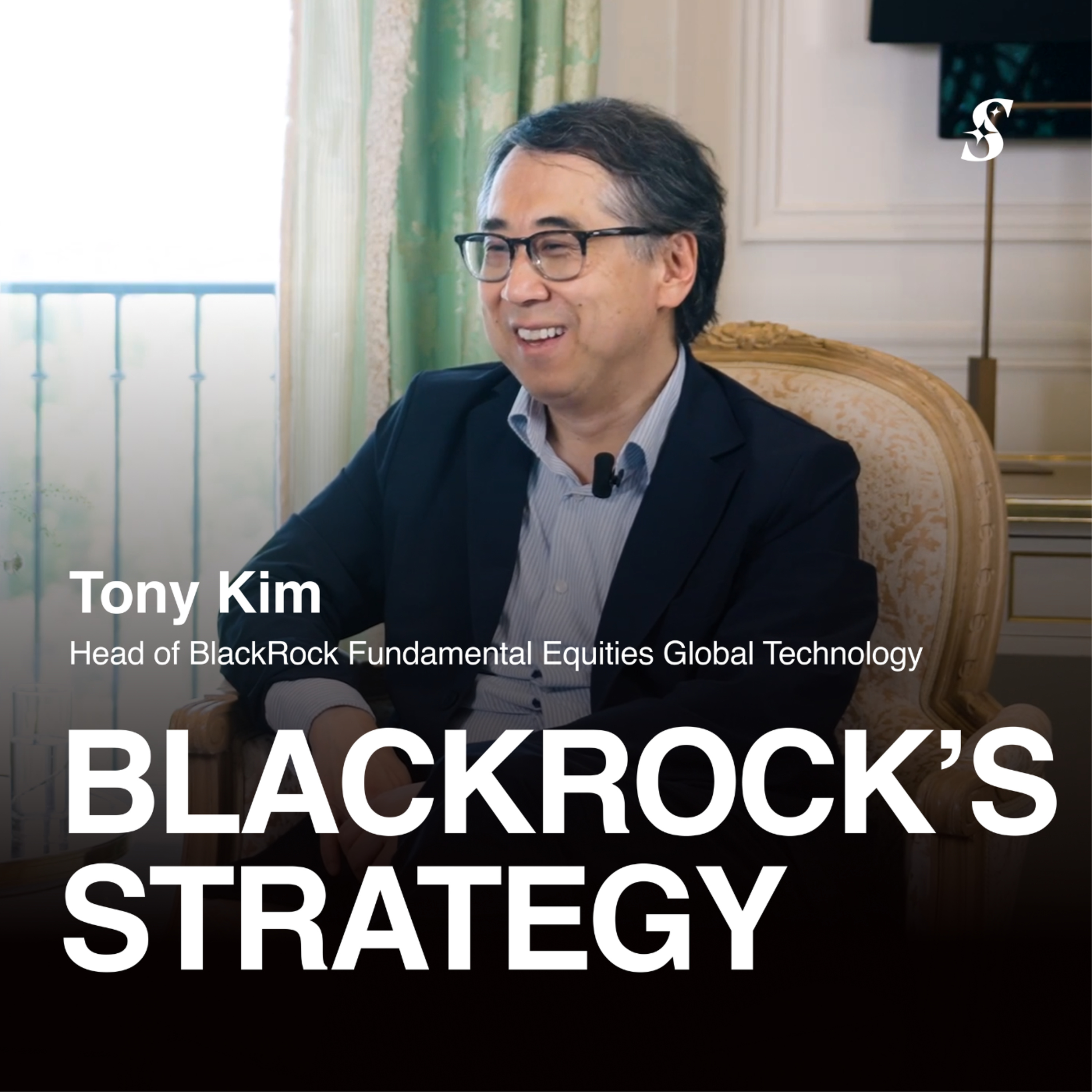
Loading summary
Transcript104 lines
- [00:00]
Interviewer
Tony Kim.
- [00:01]
Tony Kim
Tony Kim.
- [00:01]
Interviewer
Tony Kim.
- [00:02]
Tony Kim
Tony Kim from BlackRock who runs the global technology team there. AI happens. It's like BCE Anno, Dominique and Bam. 23 happens. Everything changed. So the base layer of compute went up 10,000 x $10,000. Server is a million dollar server. There's roughly 10 trillion market cap in software and services and Internet. There's 22, 23 trillion in MAG7 and then there's another 30/ trillion in chips and hardware. I don't think people would realize that we are that compute hardware centric before BCE era it was probably reversed. And so you've seen in the last four years a transformation in value that has systematically been happening for the last four years. The realization came to me that when we hit AD era, AI era that you needed to rethink everything. The Chinese are trying and there's 130, 140 robotics companies in China. I see 30, 40 potential IPOs this year in China alone. This year. And there's what, 012 in the United States merger this year.
- [01:10]
Interviewer
Tony Kim, welcome to Sorcery.
- [01:13]
Tony Kim
Thank you. It's a pleasure to be here in Paris.
- [01:15]
Interviewer
In Paris at the race summit. We're in a, we're in a secret off location that has AC and some croissants. So it's, it's quite nice.
- [01:23]
Tony Kim
It's beautiful here. It's so, so classic French. I love it. It's fantastic.
- [01:28]
Interviewer
So you're on stage a bit this year. What are you covering?
- [01:32]
Tony Kim
I am doing four panels. My involvement with Ray, so one on accelerators with D matrix, kind of the next gen computer architectures. Another one with Psiquantum and around quantum computing, a third with Lumentum and kind of bringing optics to kind of next gen data center design. And then finally with Broadcom and XPU and AI code design for chips.
- [02:07]
Interviewer
Light agenda.
- [02:08]
Tony Kim
Light agenda, yeah.
- [02:11]
Interviewer
So as the head of Global Tech for BlackRock, what brings you here? How did you get involved with Raise?
- [02:17]
Tony Kim
So I got involved last year one of my companies. I was involved with Sambanova. Lippu was supposed to be one of the speakers and he couldn't make it. So I decided to fill in for that. And then I saw Ray's this thing in Paris at the Louvre and I was like, oh, this is interesting. It was the second year of development that Henri had kind of pioneered and built this event. I saw something there. I saw a lot of my colleagues and friends from San Francisco all congregating here in Paris and I thought, well, I'd like to help foster this get it going. Last year I was here, then this year it's, I don't know, probably tripled again in size. It seems to be Europe's biggest or most targeted AI conference. So, yeah, so I continue to help and do what I can to help build an AI presence in Europe.
- [03:27]
Interviewer
It's massive. I don't know how they get all the names that they get, but I remember last year seeing Eric Schmidt on stage and like I had not heard of the conference before. No, I was just amazed.
- [03:37]
Tony Kim
And I think they're outgrowing it. After next year I might outgrow the Louvre even. So it's, it's really becoming something and well, you're here. Testament to where it's come.
- [03:48]
Interviewer
Well, they're amazing. So I'm happy to get involved in any way that I can.
- [03:51]
Tony Kim
Yeah.
- [03:52]
Interviewer
So between all of the panels that you're doing, you're doing four panels, what are the through lines and the macro themes?
- [03:59]
Tony Kim
Through lines, macro themes. Okay. Well, I think one of the big ideas obviously, clearly is, and we see that in the stock market and we see it in the investment market is that the primacy of compute and how actually you're seeing it already, how much the stock market and the capitalization in Silicon Valley has changed. We went from a, let's call it a software centric world to a compute centric world. And you're seeing the emergence of companies. So that's number one, this move to compute. And to me, in my opinion, the models and the compute are kind of symbiotic and synonymous with each other. So the primacy of compute within that secondly is since now that is the dominant theme, it is a dominant where the CapEx, where the money, where the capitalization is all gone, it then engenders a whole rethink of the data center. So I think there is a redesign of the data center and we're going through stages of the data center rebuild. So we had think of data centers pre AI, kind of like the scramble to build data centers today where there's a massive shortage of computer. But on the other hand, then we're hitting the laws of physics are driving yet another transformation of data center design going forward. That's the second. The ramifications of this data center redesign kind of flow through every layer of the AI stack. Third within that, then you go another layer deep in this data center redesign. One of those is around power density. It's incredible. What's happening is that the data centers, as we put more and more computation because the requirements of these Models are requiring more and more compute density. You need to pack more and more bits into a smaller, smaller footprint. And when you do that bandwidth, power, heat. And so you have these logarithmic effects of, of the data center design driven by AI necessity. And effectively the data center is changing from before we would transmit data kilometers and now building to building and then it's within the building and then rack to rack and then now it's within the rack and then next is within the chip. And so you're going from kilometers to meters to centimeters to millimeters. And so as you go one order of magnitude smaller in distance, the bandwidth goes up, the power goes up, the heat goes up. So this is the irony of it all, that the trillion dollars of CapEx this year and the 10 trillion over the next five years that are coming is to move data centimeters and millimeters. That's AI. When you think of it in that context, how does the data center need to change? It's not just one of those things. Everything being done is to optimize around these new physics. A lot of the action is going to be around the energy and the power density and the grid. Another will be around the chip architectures and then another one will be around the movement of data. And so we're going from a regime of copper to a regime of light. And these things help address this power density and energy and the laws of physics that are pushing data center design to this very limits. So that's another one. And then one more thing I would say around, around AI and this conference and things is around my first comments around the symbiotic relationship between compute and LLMs and AI models. I think what you're seeing is that the best models obviously are trained on and built on the best compute and most optimized inference. But this co design, this notion of co design, of tightly integrating the design of your silicon to match the parameters and the specs of the model and the model specs informing the design of the compute. And then this kind of co design is the new path that many of the leading foundation labs are pursuing. And this is what I'll talk with Charlie at Broadcom about. Obviously they did that with, with a new jalapeno chip that recently came out. So, so those are some of the big ideas. My panels are today mostly all focused, as you can tell, on the physical layer of AI, the compute stack and the CO integration. Not so I'm not doing panels on the, on the software layer at this conference.
- [09:31]
Interviewer
It's okay software, you know It's a little sleepy right now.
- [09:36]
Tony Kim
Yeah. So yeah, a lot happening. It's interesting. And you know, and then, and then one more thing I would say is that there's this whole nother revolution going on in the energy and the power side around, you know, around grid, behind the meter, all kinds of new generation sources. You know, I'm sure you've done stuff around nuclear SMRs and things and then a new power architecture. The rise of 800 volt is going to have a transformative effect and then ultimately a solid state transformers. And so again this goes to the point around not only is the chip layer, the energy layer, every time you have these step downs in voltage you lose efficiency and energy. So again things around making it more efficient, packing more in reducing the distance, getting things up. And so this is like kind of a sub narrative that is going around in the future design of data center. So that's interesting and I think you mentioned one thing. Ramp. Did you say Rampocalypse earlier You said that.
- [10:45]
Interviewer
By the way, we were on a call beforehand and you brought up Rampocalypse.
- [10:49]
Tony Kim
Well, somebody. Yeah, it wasn't my call.
- [10:52]
Interviewer
I won't take credit for that.
- [10:52]
Tony Kim
I won't take credit. Somebody took credit for it. There's a lot of the memory companies here. But this goes to also. Maybe I'll add a fifth or sixth topic on this around the data center design of the future is again back to this co design element around the model and the compute. From my observation, again I'm not building the models but I observe the compute architectures and what model guys are going to. Increasingly more and more of chip and model development is starting to mirror the human brain. In the initial early days you notice that we had a ton of compute, ton of parallelism compute and the models didn't have much memory. Now we were adding memory to the models. You know, it's remembering things about your behavior, what you're doing. And then you look at the future. You know, everyone talks more and more about having AIs that your personal AI that will, you know, these agentic harnesses that build in the institutional context within an enterprise and memory and storing memory. And the human brain has a lot more storage of memory than maybe compute. You know, it depends on how you look at synapses and neurons and things. But the human brain is very memory intensive and today is more compute intensive. But as you see it with Rampocalypse, the memory intensity is just skyrocketed and going forward you will see more and more and more memory and then when you look at the chip architectures, it is all about arbitrating memory in some form with your compute. Different kinds of memory, SRAM or DRAM or stack, DRAM or HBM or high bandwidth flash. All of these memory and storage are methods tightly packed with your chip, your compute architecture so that it aligns to how maybe these AIs will be built that start to emulate more and more human brain. I think that's what's fueling the ram, the RAM apocalypse, the shortage of ram. The other thing about that is that there's a mismatch of what I call duration. Because it takes three or four years to build a chip fab for memory fabric. But yet everyone is a shortage today. So yet you're trying to build for a future you got to build and it takes three or four years to build the capacity. But what do you do about today's demand? But yet you got to spend so much money to get chips output. And so there's this mismatch of demand, supply duration and this is causing a lot of angst in the market. But underlying all that I think we are going to more and more memory or let's just say memory in concert with compute. Today we're all talking about compute, compute, compute. I think the primacy of memory will become even more important.
- [14:24]
Sponsor/Announcer
This episode is brought to you by Brex. My favorite. You become what you spend on and I refuse to spend my time on work that shouldn't exist. Expense reports, receipt chasing and manual closes the companies building. What's next? From Vercel OpenAI, Anthropic Granola and Deepgram all made the same call. They all run on brex. BREX is the intelligent finance platform that combines cards, expenses and banking into a single stack. With agentic finance built in AI agents that handle expenses, automatically, enforce policy before spend happens and close your books in minutes. That's why sorcery runs on bre. So I can spend time on building and not busy work. It's time to get Brex AF. Learn more at bre.com Sorcery that's B-R-E-X.com S O-U R C E R Y Bye.
- [15:22]
Interviewer
So we've been seeing this trend in a lot of our conversations and on the macro side, news and everything. We had a conversation with Jamin from cotu, he's a CIO of public markets over there and they were talking about with the proliferation of agents, memory is only increasing more. They also talked about the chip flip which we'll Talk about a bit. But on the memory side, to your point, there's only three main players.
- [15:47]
Tony Kim
There's only three.
- [15:48]
Interviewer
And SK Hynix is about to go public. And I don't know if by the time we put this out it might be public. But the big questions around that are, right, like how do you underwrite that because the demand premium is massive, because there's limited supply and how long does that last and how do you catch up to that? And so I would love to go deeper into all of these topics a bit more, but I guess to start more on the macro side. So we are entering and we have entered the new era of AI. This has increased an entire rebuild of everything that's going on in tech because we need inference, we need things faster and agents are now coming to market. It's no longer just chat. So I'm curious, from your standpoint, on the investor side, how do you think and how has your strategy evolved to now play offense on this type of field?
- [16:39]
Tony Kim
I like your framing. It is a complete rebuild. So let's start with that and then how we play offense as an investor. So you're absolutely right, it is a complete rebuild. So the Internet as we know it was built, let's just say 2000 to 2020 ish in one framework, which is basically around, basically the birth and the dawn of cloud computing. And in cloud computing you necessitated a certain kind of data center. You remember the good old classic data center, megawatts, not gigawatts. So we had an order of magnitude increase today. And then these data centers were small and they were, at the end of the day, cloud computing. Everyone says it's software, but it was really reselling CPUs with hard drives. That was the compute stack, a CPU with a hard drive, and it was considered a commodity. And server prices were tens of thousands of dollars, thousands of dollars. And now those compute servers are millions and tens of millions of dollars. So compute was an afterthought. And so when you think of the other way I think about it is that and then these clouds built these classic compute stacks and then they resold that as platform services databases and then SaaS built on top of that. But if you think about the base unit to create a cloud was relatively small CPUs and hard drives, basically that was it and some databases then. So SaaS was, was King and the margins went to that because the cost of compute was so low. And therefore everyone said compute is free, it's cheap, it's a commodity. And all the value went to this layer because that's what cloud computing was. You're reselling, you're building this massive application on a very, very thin layer of compute that fueled the 20 year run in cloud and SaaS. That all of that data center infrastructure that was built, even with AWS and GCP and Azure, that was built for that, that was built to basically bring on PREM software to to hosted cloud services. And so that was a great business. Everyone was very happy and data centers were built for that spec. AI happens. It's like BCE Anno Domini 2023. It's going from BC to AD and BAM 23 happens. Everything changed. So that what was called the base layer of compute went up. I don't know. 10,000x a $10,000 server is a million dollar server. Small HDD, big HDD. By the way, DRAM was a commodity only used in smartphones. I need to pack all the DRAM HBM I can, which is expensive. DRAM onto this AI thing. This data center is now it was megawatts, now it's gigawatts. It's small data centers in cities to giant server farms in Texas. That is the data center and cloud of tomorrow. And they're selling tokens. The data center of past is like this old cloud, but yet it facilitated high margins. And now that is what I call that still exists, but it's not going to grow like this. But this business will facilitate radically more capital. A complete rebuild. This is an alien data center to this data center. But that requires massive capital investment. But it also engenders a very different rethink of the margin stacking. Because before you would resell this base layer of low compute and massive SaaS app margins on top of now you've got this massive compute stack and they're reselling those as tokens, right? So that compute factory is creating tokens and then the model guys are then selling their tokens. And that just takes a lot of what I call takes a lot of margin out of that top layer of the stack. And so this is also facilitating, this is driving what you just said, a complete rebuild like these. You must build these new data centers because at some point all of your revenue will become here. And this revenue over here in the old data center that was asset light, high margin is now moving to asset heavy, lower margin, big dollars. But it's a completely new data center. And then that, because of this new rebuild, it then has triggered a reexamination of value. So if you look at today, the tech stock market today And I'm going to make some approximations. There's about 1500 companies globally over a billion dollars or more market cap, maybe 2000 depending. If you add China. Not in China, China in the U.S. let's just talk a global stock market. There's roughly 10 trillion market cap in software and services and Internet. They were the classic industry where most of the market cap was in the pre AI era. That's 10 trillion plus or minus. There's 2222 trillion in max 7. So I just put max 7 as a new category. So Microsoft in the max 7 it's not. I just have a non mag 7 software service in the Internet category of 10 trillion 22 trillion in max 7 and there's another 30 plus trillion in chips and hardware. So 1020, 30 something like that. Okay, 10 trillion in software, service, Internet, 20 trillion in mag 7, 30 trillion in non mag 7 compute chips, hardware. That's a. I don't think people would realize that we are that compute hardware centric now. 10, 20, 30 before AI BCE era it was probably reversed. You've seen in the last four years a transformation in value that has systematically been happening for the last four years that follows the data center transformation. Because the primacy of compute, the plurality of the dollars, the creation of the models themselves. The models themselves, like it or not, have consumed the market cap out of software and services. It is just like the Borg, it is consumed. For those foundational models to exist, it needs to live on the compute stack. That has happened to be offensive in this structure. You need to. I needed to. The realization came to me that when we hit AD era, AI era that you needed to rethink everything. And then you need to align offensively as you say, an investment philosophy and capital allocation philosophy that would mirror what is becoming the new reality where these intelligence insatiable demand for intelligence. And as a function intelligence begets compute and intelligence for compute equals basically revenue. And then if you think that the basis of many companies is around this compute factories and and then your ability to resell that intelligence and then that makes you rethink kind of the margin stacking and kind of where the value sits for companies and the market is trying to adjudicate that right now. And so that's why you saw SaaS Apocalypse earlier this year, end of last year. That's why you're seeing the rampocalypse. There's a lot of apocalypses. The thing if you believe these scaling laws and intelligence is getting better, I'd say at one order of magnitude a year. I mean 10 times 10 times 10, that's 1,000 times in three years. It's not like these AIs are getting less capable. They're getting more capable. And more capable means more compute. If they can do more things, then there's a rethink around where the margins are. Where's your defensibility, where people use the term moat a lot. Moat is a very defensive. Moats are always the breached, aren't they? So it's more about offense, in my opinion. Can you move faster? And so. Yeah, that's a broad topic. I hope that kind of. Yeah, that's how I think about the macro. Like you said, this complete redesign, that redesign facilitates and you rethink. And that rethink also has huge implications on the business models and the moats of companies. What my thesis is now we talk again in six months. It might be completely different, but that's kind of my current thinking.
- [27:49]
Interviewer
Because to your point earlier, we are investing in new areas or we're investing in areas that have three to four to five year lead times, even 10 years. If you want to talk about Quantum, I mean that's always 10 years, whatever year you're talking about it to be clear. But in, in terms of those types of outward investments and strategies, how do you think about where you're gonna spend time and which one of those is most effective right now? Because you're obviously taking a risk on that. And I kind of bring that up in the point of Quantum as well.
- [28:24]
Tony Kim
Yes.
- [28:25]
Interviewer
And with these new chips and building them specific for models. So like how do you think about that and how do you weigh the different kinds of risks that come along with it?
- [28:35]
Tony Kim
Yeah, Investor, portfolio manager. At the end of the day you're allocating capital. Right. So you have only so many bullets. And so I'm a public investor, I'm a private investor, I do both. But at the end of the day, you're allocating capital and the creation of whatever portfolio you're creating for your mandate for your clients. At the end of the day, you're trying to arbitrate between risk, like you said, what is the today and what is the tomorrow. And a lot of the things around this AI today. There's a lot around it today, even the three year duration mismatch of let's say dram and foundries. So I call that kind of like the now. This is the now. The vortex of AI is like the now. And so in this kind of three year window, that is probably where 90 plus percent of my investment. Well, 90ish percent, something like that. The majority is going in within this three year window. Who's winning, who's losing, what is on the ascendancy, what is on the decline, what is stagnating. And then you're arbitrating between these ideas. So that's one. The second thing, even in this three year window, let's call it is there life after the three years? You have to believe that this continues five plus years because the belief in a future has a huge impact on your multiple. If they do not believe in that future, even beyond the two or three year horizon that most investors and and Wall street can forecast to, there is an implicit understanding that do you have a future or not? I always feel like you must be betting on the future as well. So things look cheap but you know it's atrophying and maybe in decline or growth is decelerating. And so is that the best allocation of capital put to that versus like the next three years? It's going to be great for memory or compute or data centers. But will that continue four, five, six years into the future? Question mark, yes or no. But then there's also you got to be betting on the frontier of the frontier. I made some of these AI investments pre gen AI like pre 2000, 2019, 2021, you know where you didn't know that this LLM thing was going to happen. Some of these things gestate longer. My intuition was that we will need AI compute of some for maybe machine learning AI. And so I didn't know that this LLM the wave would happen. But you're thinking about future architectures. And so now we sit six, seven years later and the AI accelerator wars have begun and the compute has taken off. And so I think about that in that kind of longer term context. And so the next set of companies that have this longer context is around let's say you mentioned Quantum. I think 2030. We will see. I was starting getting involved in 2019 so I'm already seven years in. You got another five more years to go. But that's a decade long. You have some bets on where the frontier is coming next. Space, these orbital data centers. That's also targeting 2030. It's very interesting when you look at these long dated technologies. All roads converge to 2030. It's like quantum computing utility scale logically error corrected million Qubit Quantum Computer 2030 SMRS fusion Small nuclear reactors with regulatory approval. You talk to these companies 2030 when you say well when was AGI happened for classical computing. 2030, 2029, 2028, whatever. Then you say when will we hit 800 volt power architectures? Late 2000 and twenties. 2030, will we have solid state transformers? 2030, will we fusion longer but many data centers in space? 2030 when it starts to really scale. So you're sitting here, obviously you have the now this AI train that is consuming everything, all my time and energy. But that's 80, 90% of it. But you must be always betting on the tomorrow. And some of these are long dated things. I spend time on the future, allocating X resources of my time on that. What will really be transparent, not incremental. I want nonlinear asymmetric potential. And then I bet on what is the primacy of today with not only a three year financial forecastable window, but with then relevancy beyond and then everything else that doesn't fit in that window. Is it worthy of your time and the opportunity cost to keep investing in that? There are other strategies, other portfolios, other things that can pursue those. It's just not my focus really. So I hope that kind of gives you a sense of, of where, how I, this is my, my opinion, how I frame capital allocation, portfolio decision making.
- [35:11]
Interviewer
Yeah, that's a super helpful explanation. I'm sure a lot of your investment memos have 2030 on them.
- [35:18]
Tony Kim
2030, you know, actually it's not. 2030 is not far away.
- [35:23]
Interviewer
No, it's not.
- [35:25]
Tony Kim
Yeah, absolutely. I mean, you know many companies, right, you got to look 2031. I mean 2031 is five years, 10 years, 2036. So I mean 10 years is almost an impossible forecasting, but five years, a lot of companies will not even have free cash flow by 2031. So you then need to have a belief system that could flip positive beyond. But yeah, I'd say at least a five year window. You always want to be betting on not what's cool today. Will you still be cool in five years? Because if you're still like, because you become yesterday's news in five years even though you are cool today. So there's a little bit of that happening too because that really has a huge impact on your exit multiple if you're just following the trend of today. But you know that there's a half life to this, it might be difficult to get a good return on the exit because it will not be what you think it is in five years and the multiple that people will pay will go down and, and your growth rates are decelerating and now you're in a bind.
- [36:51]
Sponsor/Announcer
If you're building what's next in AI, you need to know MongoDB, the database platform developers love and built for the agents you're running. MongoDB stores searches and reasons over your data in real time with vector search and embeddings from Voyage AI all in the same system. No separate pipelines, no stitching together 10 different tools. It's why 75% of the Fortune 100 and leading AI native startups run on mobile. MongoDB build and scale from your first user to billions of vectors. Go to mongodb.com AI to learn more. That's mongodb.com AI to learn more. Bye. Assembly AI is a voice AI infrastructure layer millions of developers build on. They build the industry's best speech to text voice agent and speech understanding models that serve as critical infrastructure for companies like Granola, Heygen Ashby and ClickUp. Their speech to text models lead the industry in accuracy and quality. And their speech understanding models help you go beyond transcription by uncovering insights, identifying speakers and highlighting key information from voice data. You can get started today@AssemblyAI.com sorcery and get $50 of free credits to start building Voice AI products. That's AssemblyAI.coms O R C R Y
- [38:17]
Interviewer
It's been really interesting to see how this new era has breathed life into older categories or categories that have just been around, whether it is chips, whether it's quantum. But it's cool to see how entirely new opportunities have formed and I'm curious of your takes on those. So in that respect, you did mention orbital data centers that really didn't exist before. And that is a huge weight and a big weight, especially with Space SpaceX coming and the whole IPO on that. But there's also fun categories. I recently visited Figure AI, the humanoid robotics company, and I was just at Config Figma's conference and Boston Dynamics was there and one of their head of designs for human robot interaction was talking about their humanoid robot Atlas. And they're different. The Atlas 1 is hydraulic, so it can pick up like a fridge. Figures is more of like daily use, package sorting, commercial stuff, making cars and that sort of thing. But of these new categories, which ones are you paying attention to? What are you excited about?
- [39:29]
Tony Kim
So robotics. Yeah, I mean the first comment around these older categories, you know, like you said, semiconductors have been around a long time and I don't understand why people, you know, it's called Silicon Valley for a reason. People forget, but people forgot it was kind of like the ring of power, it was lost and then it was found. And people always said chips are a commodity, but yet they have the highest profitability of any company in the world of the sector is chip companies. They're higher margins than software, pharmaceuticals, industrials, telecom, anything. So this notion that they were a commodity was just a false notion in my opinion. It really never was. And the other thing is that this industry, it's very interesting, there were hundreds of chip companies and then systematically over 20 years, now there's just a few. And so in every category you have duopolistic power. By the way, venture capital, that is Silicon Valley until recently never funded these companies. So there's no money going in. And therefore if you have no money going in, you have very new companies. So in fact what you have is a shrinking effect. The number of companies have collapsed and then those that have survived are behemoths with huge pricing power, the complete opposite of commodity. And by the way, all those people are engineering nerds. So I always say it's the revenge of the nerds. It's not the revenge of the nerds. It's the lost ring of power that was found. And so, but it was always there. And so their time to, to shine is now. That said, you're right, these other industries, you know, it has spawned a renaissance. And hardware, right? You know, when you look at that market cap shift I was talking about, a lot of those go into, you know, servers are cool, fiber is cool, power is cool. You know, rack design is cool.
- [41:52]
Interviewer
People love rack design.
- [41:53]
Tony Kim
People love it. They're going crazy about rack design. It's like, you know, it's like bending metal, copper, you know, heat, you know, material science is cool because you need all kinds of new materials, you know, and then substrates and packaging. It's the physical world. These are all what I call the physical world, the physical sciences. That's cool. Again, going to school to study material science is probably cool. It's very cool. There's not enough chip designers in the world. People in the lost art, you know, like analog computers is like being blacksmiths. It's like very few, you know, how many friends of yours go in to study new memory design? You know, I was talking to dinner last night here at Raise with one of the biggest memory companies. Like we cannot get people to design custom memory because remember this custom co design with the chip. They want to co design the memory. Well, where are the people? There are no people. We got to repurpose some of these software programmers into memory co design architects. All of this has happened and the physical, what I call the physical world, this is the next unlock that AI will do. Obviously, we're going to go hard in cognitive work and cognitive labor, and you got to build these models for that. But then those models then can be repurposed and implemented in robotics. The robotics chain is very interesting to me, but it is just a parallel to what was going on in AI. Because if you really think about it, what is robotics, right? I mean, you got a brain that will be built and the brain will have, I mean, kind of two parts to it. It'll be a baseline LLM that you and I will communicate as a translator, translate and talk to the robot. But then there will be. It's like the human brain, but you also have the brain for the motor functions that control our muscles and our bodies and our reactions, and then the brain for language and memory. So they'll have two kind of like a world model, like that's kind of one of the new world model for to perceive the world in motion and things and then really obviously embodiment of intelligence and like an LLM. So you're going to build these brains, two brains into one, you know, and then you take the brain and then those are like labs, right? They'll be like labs. And many of the big labs are working on robotic brains. And then you'll embody those brains into the body. But then the body, arms, legs, limbs, hands, Hands are the probably the hardest thing, as you, I'm sure, you know. But the body, the physical embodiment, that is a manufacturing hardware business. And when you think about that, the Chinese are coming and there's I think, 130. 140 robotics companies in China. I'm looking at the current pipeline. I see 30, 40 potential IPOs this year in China. Yes, yes, alone this year. And there's what, 012 in the United States, maybe this year. And the reason for that though is also the US the lack of depth in the private markets in China. So they're using public markets as a funding mechanism, unlike in the U.S. so they're earlier, they're going to come earlier. And they're coming in waves. There's 140 of them. And the thing about China is in that physical layer, the body, the motion, maybe the robotic brain development, the world model they may be behind. Right? That's probably. Most people would say that the west is ahead on the model development, but make no mistake, Chinese in Asia. And you mentioned Atlas robot, that's Korean, actually. That's Hyundai, that owns Boston Dynamics, but the Asian manufacturing complex, Japan, Korea and China. I mean, and it's also an extension of kind of EV platforms. Right. If you have the physical scale manufacturing, you then avail yourself to potentially have lower cost to manufacture en masse these robots. And then what you might have is ultimately you can mix and match Chinese physical robot with a Western brain. And I know that's happening. I just want the robotic. Those Chinese robots are amazing. So why don't we stick a Western brain in there inside and permutations of this will continue. And so I think it's a wild West, a lot happening, but it will be a huge market, huge market. And I have a soft spot. I mean my view is one of the things I'm most interested in, in the robotics side is around not so much the manufacturing robot, of course that will. And you're seeing this coming out of China already. It's around, around loneliness, around social embodiment, around, you know, around education, around elderly, around young people. And to bring consumer and or commercial like social robots more so than industrial use.
- [48:13]
Interviewer
That's kind of a hot take.
- [48:16]
Tony Kim
Well, I think that's, I mean, I think if you think about aging populations, when you look at Asia in particular, you know the birth rates are well below 1.0 and you need 2.1, 2.2 to stay even. So you're facing demographic population cliffs around the world. You look at, actually some of the best performing companies in the world are nursing home companies. When you look at elderly, they really want companionship. Even amongst young people. There's loneliness epidemics and things like that. I think robots, even though you don't mind having that perfect motor function, but if you could embody some intelligence, empathy, it could be many different form factors too. It does not have to be the Terminator. I think that could unlock a really, really interesting market. A really big market. So that's my view.
- [49:24]
Interviewer
Yeah, that's interesting. I've seen, and I know this doesn't really count, but, but I saw videos on Instagram of like a long distance relationship and there was like a tiny little like pet robot on the ground. It was like a ball of some sort. And it was like the girlfriend like yelling at the boyfriend and she's like in an entirely another country like following him around in the house.
- [49:46]
Tony Kim
I mean you, I'm not sure you. Have you seen Star Wars? You've seen Star Wars? Yeah. Okay, and who are two of your favorite. Did you like C3PO and R2?
- [49:56]
Sponsor/Announcer
Yeah.
- [49:56]
Tony Kim
Okay, now imagine and Then you have the current embodiment of Optimus and many other, the figure robot and all these sleek, you know, amazing Westworld like things. But like I hearkened to like R2 and C3PO. What if you had like half size robot, even half size, it doesn't have to be full size. That is approachable, friendly, not masculine. You know, something that, and then that robot, but that has the intelligence of Shakespeare and Einstein and speaks every language like C3PO. And then you interact. You know, I always often think about the elderly. You know, it's like imagine them having conversations with my mother and others and then also empathetic to their stories. And then you can record their stories, record their life histories. And you know, I think do you need to have a fully figured, perfect motor function with, you know, all the hand articulation or could you get something that can appeal to that? And I think that's possible. I think that will be a fascinating market to see. So yeah, I think that'd be a very new use case besides building, using robots to build the lunar base, which I think also that would be cool.
- [51:31]
Interviewer
Really cool. Yeah. It's been interesting to see because I cover a lot of high growth companies in Silicon Valley. The proliferation of course coding agents is a big thing, right?
- [51:42]
Tony Kim
Absolutely.
- [51:42]
Interviewer
But to your theme of the brain speech model, companies are crushing it. They are growing faster than most other companies out there. There's a company called Assembly AI that is like growing incredibly fast and they're great. And then it's interesting to also see the downstream effects of all this. Okay, so we talked about, we didn't really cover at all any software because it is what it is, but the downstream effects of it now hitting the data layer because now we are, we have so many agents that are just creating so much data, it's coming downstream. And so like the data bricks, the snowflakes, they're hitting some of that extra premium in the market and they're getting some attention. And then you go downstream, like more app size. And then so as agents create More Apps Now MongoDB is, those databases are reaching. So it's really interesting to see how like it's streaming downstream. Are you looking at any of the downstream winners?
- [52:33]
Tony Kim
Yeah, I'm invested in many of those companies. Streaming downstream or streaming upstream? I don't know. It's down or up? I don't know either.
- [52:40]
Interviewer
So I could be opposite.
- [52:41]
Tony Kim
Well, no 100% in supply chain hardware. Is it upstream downstream? Okay, I'm thinking vertically. So it's like compute models Apps or compute models, data apps, something like that. I'm going up the stack.
- [53:01]
Interviewer
You're going up, I'm going down, running
- [53:03]
Tony Kim
down the stack, whatever.
- [53:04]
Sponsor/Announcer
Okay.
- [53:04]
Tony Kim
So, absolutely, like this whole data center redesign thing, I think the whole enterprise is redesigning and the enterprise itself. If you really think about the future of what a big enterprise will be like, it'll be on one hand, you'll be, you're bringing intelligence tokens, you're bringing tokens in and you will have data layer. Because that intelligence will need to interact and be orchestrated around this data layer. And this data layer will be the embodiment of your proprietary data and all your external third party data. And then companies will ultimately. What is a company? Well, it's people, it's distribution, it's a brand. But at the end of the day it's also, can you embody all of the knowledge of your company in a, what I call like a context layer, A layer of the secrets and the ways of your company? You embody the cumulative knowledge of your employees into some context layer.
- [54:28]
Interviewer
I think Palantir calls this ontology.
- [54:30]
Tony Kim
Ontology, exactly. Yeah. Yeah, exactly. So you have this ontology layer, this context layer, sitting on the data foundation with tokens in, and then that's it. And then everyone builds agents, agents go wild, right? And agents will interact through the context into your data with tokens. That's it. That is the enterprise. And then what I call that is a token flow. Follow the flow of tokens. Either you create tokens, compute, you then serve the tokens, foundation labs, and then you put a harness package context around the token, app, services, et cetera. So you must be in this token flow to either resell or repackage the tokens with your context. In your very specific application, you serving the token with your intelligence, is it the proprietary closed source token, is it the open source token sitting on a compute foundation that's creating and firing up the token? If you're not in that flow, it's a problem. Then you mentioned these voice APIs and you mentioned the data foundation. They are in token flow. So I think the app companies are struggling to find their place, but some companies have moved into. You're seeing the rise of what I call, I don't know what you call it. Inference clouds, edge clouds, edge AI. They're basically kind of that last mile token. They're providing tokens and developer kits and things so that smaller businesses, medium businesses, could take it kind of out of the box. So they've inserted themselves in this token flow and yeah. And so that's to me, that's why I go back to this base foundation where can you earn your margin? Or you do the whole thing, you do the whole thing and you just say, I will provide, I will do all of your claims processing, I'll do all your insurance processing. And so you don't you abstract away all of that, all of those layers of the stack and just say, I will do all of you, I'll take on all of your insurance. Pay me X. Pay me X. And so you don't know, what are you, are you an app company, a service company, Are you a computer company, a token reseller? No, I'm just selling you the whole solution. Today you used to pay 100, I'll charge you 20. And then now you're seeing this, you're seeing certain private equity firms, you're seeing some venture firms saying, you know what, let's take an old industry, let's buy these companies and let's bring in this whole new stack, reimagine the stack and just sell a whole new solution.
- [57:57]
Interviewer
Do you think? I mean it's really curious with those PE roll ups because I think at the end of the day they're just creating a new product. But they're buying the customers.
- [58:04]
Tony Kim
Yeah, they're buying, they're buying, they're buying. They're getting customers or they're buying companies with customers and they want to, they're basically trying to restructure the whole delivery of services and there's a lot of inefficiencies, fat cost in there and then you can rip it all out. Okay, maybe, maybe that's a business. Let's see. I mean, I know people doing that are starting to do that. Let's. Yeah, that's interesting.
- [58:34]
Interviewer
I don't know, it's, I mean it's working quite well. We've talked to a couple of them.
- [58:38]
Tony Kim
Okay.
- [58:38]
Interviewer
Some on camera, some off camera.
- [58:39]
Tony Kim
Yeah.
- [58:40]
Interviewer
We talked to General Catalyst Creation Fund and they've been doing a lot of PE roll ups and creating companies. One of them, Long Lake, just bought Amex Global.
- [58:50]
Tony Kim
Okay.
- [58:51]
Interviewer
Their travel, I think their travel business. Oh, well, which is interesting because you have a small player buying a large player.
- [58:58]
Tony Kim
Yes.
- [58:58]
Interviewer
Which was really interesting to see.
- [59:00]
Tony Kim
Yeah, I mean, you know, there's, you know, there's other, this other, you know, framework rubric that is emerging is, you know, when you have these traditional industries and you have a new company with 500 people that can do or generate the revenue of 10,000 people, they're just approaching it in A radically rethought process. And so the efficiency, maybe this is what you're kind of alluding to. Maybe that's the new framework for these newer companies that are going to really just go at traditional industries. It'll be up to can the traditional company, the incumbent adjust in the face of these kind of companies coming. And yeah, I think jury's out. I think it's very, I'm very intrigued by that. I'm watching it. Yeah. You mentioned some of these. It could be quite disruptive. So I think that's the next, the next little shoe to drop is all of these traditional industries that have very little adoption of AI that are still the business workflow, how they've organized themselves. They could be all completely rethought and refactored with a new kind of. But that would require like you say, maybe it's so hard to sell products pieces and then have your old employees drive that change versus if you just buy the company. I'll do the change and then so it's an interesting idea. It's an interesting idea. I, I, yeah, it's all new. I'm watching it. It's something to look out for. Yeah.
- [60:48]
Interviewer
We only have a few minutes.
- [60:50]
Tony Kim
Okay.
- [60:50]
Interviewer
Left but I'll leave you with two questions.
- [60:53]
Tony Kim
Sure.
- [60:54]
Interviewer
First, what are you most excited about in the next 12 months? I know 2030 is a big date, but let's talk about the next 12 months.
- [61:01]
Tony Kim
Oh boy. Next 12 months between now and June27. Well, I mean obviously these big foundation labs. What am I most excited about? More concerned about take it either way. I mean I just, I think it's a continuation of the same what I would, I know like there are these, it seems like every six months there's a scare.
- [61:36]
Interviewer
Yeah, yeah.
- [61:38]
Tony Kim
Ex Apocalypse X Apocalypse war. Interest rates, too much capex, not enough financing, on and on and on. But I think through it all I am optimistic that this compute wall, the memory wall, the compute demand, this data center redesign that it will just plow through and then our fears will be subsided. And so therefore we will be sitting here a year from now and we'll be talking about many of the same things continuing on. So that's number one. I hope that's, that's what I'm optimistic for. The second thing is the emergence of, is the progression along this, what I call this whole data center reimagination thing. I'd like to see more of the just continued proof points along that path. I'm hopeful, excited to see the big labs go public in the next 12 months, I think that will be. I think that'll be. I think it'll be interesting, it'll be exciting. And I think there is huge market appetite for it. And I would love to see in the next 12 months. What I'm excited for is the next forward step toward orbital data centers because that also engenders a radical change in data centers. If you keep pushing on that progression could open. It could unlock a rethink and moving the burden of terrestrial compute into space. And that can have huge implications of how current data centers are even being built. So I'm looking at that to see if the progress being made there. So it's going to be interesting. 12 months.
- [63:40]
Interviewer
Amazing. Also sounds like a little bit of a manifestation going on over here.
- [63:44]
Tony Kim
Manifestation. Yeah.
- [63:45]
Interviewer
You're manifesting.
- [63:47]
Tony Kim
I don't know. I'm just. I contemplate.
- [63:50]
Interviewer
I contemplate.
- [63:50]
Tony Kim
Yeah.
- [63:51]
Interviewer
Okay, so as we close out.
- [63:52]
Tony Kim
Yes.
- [63:53]
Interviewer
Final question. Okay, so one of our sponsors is Bricks, and they're a performance platform for spending smarter and moving faster. Corporate.
- [64:02]
Tony Kim
Yes.
- [64:03]
Interviewer
Credit card. So with this question, it's on the topic of performance. I take this on a personal bend, so no pressure here, but I believe performance personally really revolves around who you surround yourself with. I mean, people say you're a result of your five closest relationships and that kind of thing. But also, I'm curious, from your standpoint, you've built out a legendary career. Who are some of the people. It is true. Who are some of the people that have inspired you or mentored you along the way?
- [64:33]
Tony Kim
Wow, what a question. First of all, I'm not. I'm no legendary career. I just. I'm just trying to survive. But who. Okay, so there, you know what, what? I wouldn't say I had mentors, but you know what? I had. I had people that believed in me at certain points in my life and basically gave me the freedom, the latitude, the keys to the kingdom, and said, you know what? I see something in this guy and I will give you the latitude. And so there was a guy who brought me into blackrock who basically gave me carte blanche. Carte blanche and the freedom and latitude to. He believed in what I could do. So that's one. And you know, I actually did investment banking long ago and there were a couple people there that took a shot on me. You know, some engineering kid out of the Midwest growing up in the Midwest. And, you know, I thought I'd wanted. I wanted to go to consulting back then and no consulting firm would hire me, so I wasn't good enough for them. And so there's some. Some of these investment banking. Somehow I found a fit there. And then someone else said, go west, young man. And this was right. Like before dot com. So, you know, certain people that made a bet and just had faith and it wasn't like they were mentoring me per se. They just had a belief. And so I try to do that. I try to always work with lots of young people to not mentor them, but just try to encourage them, give them a break if they can, or give them a shot. But then the mentors I have are all dead. My mentors are, you know, I like to study. I'm a huge study of student history. So Caesar, Alexander, Napoleon, Beethoven, Churchill. I like to in many in these kinds of historians, leaders, people that created their own destiny. That's who I. Those are my mentors, you know, because growing up where I did, you know, I was not a. Was not a social kid. I was somewhat ostracized. And so I grew up in libraries and those historical figures in libraries became my mentors. And then when I went to the real world, some people gave you a shot. They just believed in me or the kindness. And so I'll never forget those people. But yeah, so there you go. It's kind of dead people and kind people. How's that?
- [67:38]
Interviewer
That's beautiful.
- [67:39]
Tony Kim
Yeah.
- [67:39]
Interviewer
Wow.
- [67:40]
Tony Kim
Yeah.
- [67:40]
Interviewer
Great place to end it.
- [67:41]
Tony Kim
Okay.
- [67:43]
Interviewer
Thank you so much, Tony.
- [67:44]
Tony Kim
It's a pleasure.
- [67:45]
Interviewer
Amazing.
- [67:47]
Sponsor/Announcer
Huge thank you to the entire Raise team for an incredible event. And thank you to Brex, MongoDB and Assembly AI for making this trip and series possible. If you enjoyed this conversation, you're going to love the rest of the Raise series with Tony Kim from BlackRock, Scott Wu from Cognition, Andrew Feldman from Cerebras, Rodrigo Liang from Samanova, Michael Hurlston from Lumentum, CJ Desai from MongoDB and many, many more. Like our hot takes that we did at a secret location that you can find on X, YouTube and Instagram. Subscribe to Sorcery on YouTube for more conversations with the people shaping AI and join the free newsletter. You can also do paid at Sorcery VC for weekly insights on AI, robotics, enterprise software, consumer semiconductors. Did I say AI? AI again. And everything that's coming next, like funding announcements and all big things in tech. Thank you. Bye.