Loading summary
Transcript104 lines
- [00:00]
Soren
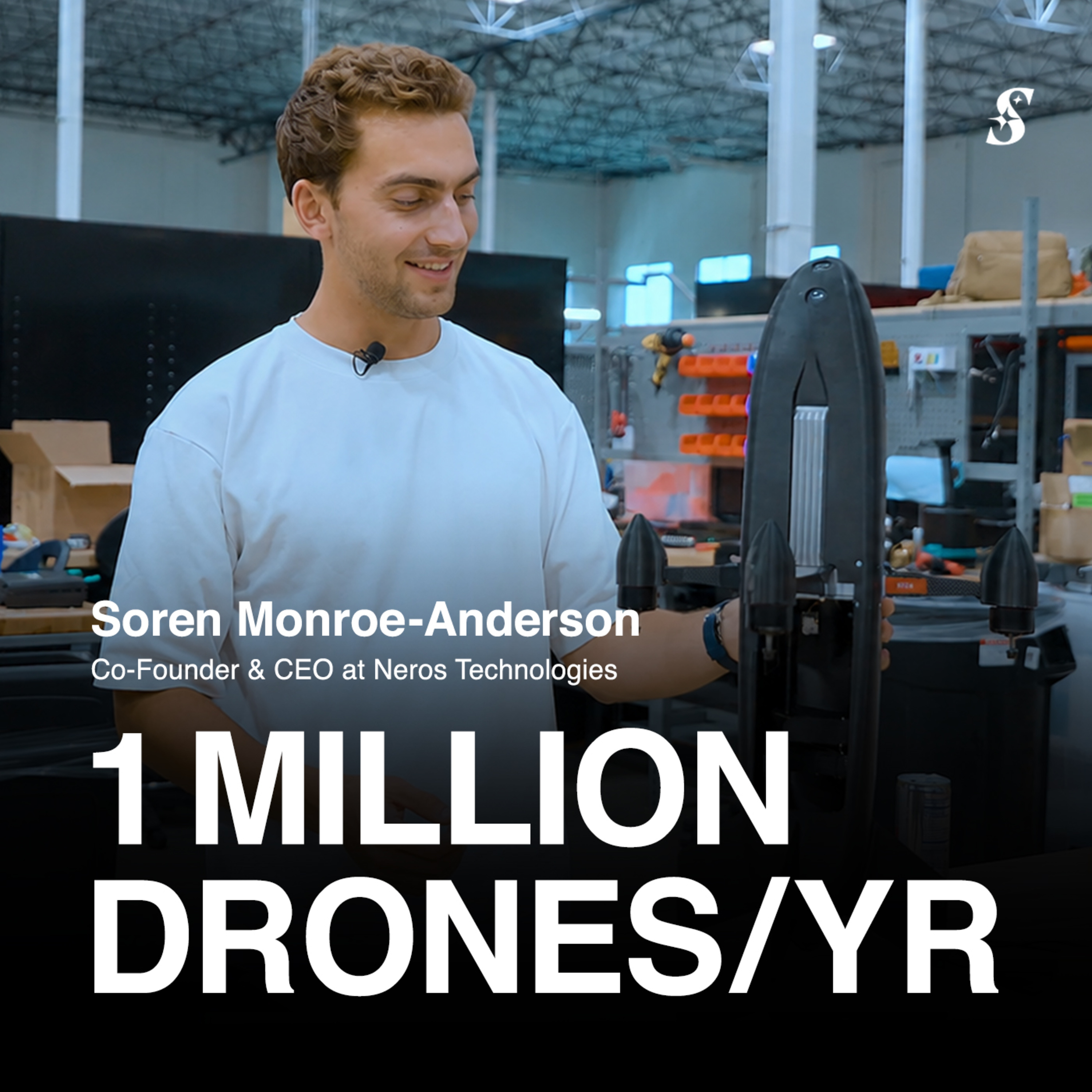
This is our Millennium One facility. This is the factory that we moved into a few months ago. We sized this building to be big enough to do a million drones per year. In our previous facility, we had 100 people and manufacturing in 15,000 square feet. We were just fighting to even get drones out the door. The newest version of the Bandit Interceptor, still a pretty rough prototype, honestly, but this one goes about 40 kilometers an hour faster. We're doing about 300 kilometers an hour with this drone right here. We wanted with this facility to not have to. To have multiple sites, not have to move. We've got all the space we need to actually vertically integrate everything and then get to that million per year target.
- [00:39]
Interviewer
Amazing. We're here at Neros and we're going to do a little factory tour with Soren. Soren, thanks for having us.
- [00:56]
Soren
Absolutely. Let's do it.
- [00:57]
Interviewer
What are we going to see today?
- [00:58]
Soren
Okay, so this is our Millennium One facility. This is the factory that moved into a few months ago. We sized this building to be big enough to do a million drones per year. And so we're going to see a lot of stuff from engineering to production, and then also empty space that is waiting to get filled. So a lot of fun stuff. We'll try to check out the engineering labs first.
- [01:20]
Interviewer
What are we going to be looking at over here?
- [01:22]
Soren
Okay, so we are coming up on the flight test teams area here. So we have a team of 10 people right now that is constantly out in the desert every single day testing our products. So you can see there's a bunch of drones on these racks that are at some point in the testing process for engineering development. So we'll see flight tests, our end of line flight test later on, which is for production. This is all for development purposes, but one of the things you can check out here is one of the interceptor prototypes. So this is the V1 of the bandit Interceptor that we've been flying out in the desert. We have a newer version of this now that hopefully we'll get to look at too. One of the other things here is the Archer AI drone. So all of this stuff has been just getting beat to hell out in the hot desert and surviving. So that's the goal, but really we're just trying to push everything to its limit and see where it breaks.
- [02:21]
Interviewer
How far in the desert do you go?
- [02:22]
Soren
We're like two hours away from here.
- [02:24]
Interviewer
Okay.
- [02:24]
Soren
Yeah. And we usually have two teams out every day, so in two different locations.
- [02:30]
Interviewer
Cool. Okay. So one of your friends thought it would be good for me to Ask you why you don't 3D print these in the battlefield.
- [02:42]
Soren
Oh, I see. I think I can guess which friend. Yeah. So really we are focused on mass production. 3D printing is generally good for making a few of a thing, making lots of different things. We are mostly focused on making a lot of one thing or a really consistent process. So there's an idea that you can go and 3D print drones in the battlefield. Generally, factories are really efficient when they are large and centralized. And 3D printers can be very useful for adapting drones to various mission sets. But you'd only be 3D printing like the airframe or a payload adapter. What we're trying to solve for is the really, like, core components and manufacturing process. So you're not going to be 3D printing your circuit boards, your motors, your radios, any of that stuff out on the battlefield. So it does not solve the supply chain problem in the ways that maybe are claimed in some of the posts today.
- [03:40]
Interviewer
We were at Anduril and we went into their R D building. It's huge.
- [03:46]
Soren
Yeah.
- [03:46]
Interviewer
And macrim showed us the castings that they have for their drone bodies, which seem a lot heavier.
- [03:52]
Soren
Yep.
- [03:54]
Interviewer
So what's the main difference between using something like that versus what you're using?
- [03:58]
Soren
So our airframes right now are mostly made out of carbon plates. So carbon is really light and really strong, but it doesn't have some of the advantages of what they were doing with those metal bodies is that you get to use it as a heat sink. So we actually do this on our drone now, where the bottom plate is an aluminum plate and we contact the motherboard and the radios with thermal interface material when we close out the drone with that bottom plate. And so that acts as a big heat sink. But we're still using. It's just a flat plate that's cut into a shape in 2D versus having to be cast or CNC'd, which is just a lot cheaper for mass manufacturing.
- [04:41]
Interviewer
Got it. Okay, what are we doing now?
- [04:42]
Soren
Okay, so we're walking past the engineering labs or engineering spaces. So everyone, as you can see, has a lot of stuff at their desks. They have hardware, they have test equipment. It's really just whatever they need to be most effective at their workstation. And then right next to them, they have a bigger lab area. So as an example here, this is our electronics lab. So this is where we're doing bring up on new boards, doing testing of various things. And really what we want to be able to have for each engineering team is just the ability to iterate extremely quickly and do as much of this in house as possible.
- [05:21]
Interviewer
It's so cool you have all of this under one roof.
- [05:24]
Soren
Yeah. I mean, this is like the advantage of having a facility this size is that the engineers here are sitting right next to production and the teams that are sitting close to production are the ones who are most impactful to production. So we have the mechanical engineering team, the manufacturing engineers, the supply chain team. They are sitting close to the line and also sitting interspersed with each other. So there's really good communication between the full, you know, all the teams for the full lifecycle of the product, not just design, which is where a lot of things tend to get left and just thrown over the fence if you don't have this really close collaboration
- [06:02]
Interviewer
following along with you here. So this is a 250,000 square foot facility, if we didn't mention that already. It's pretty big.
- [06:10]
Soren
Yep. So this is the mechanical engineering department here. There's a couple fun things that we can. We can look at running away. Yeah, it's okay. So this is actually the newest version of the Bandit Interceptor. You can see it's a lot more sleek than the previous prototype. Still a pretty rough prototype, honestly. But this one goes about 40 kilometers an hour faster. So we're doing about 300 kilometers an hour with this drone right here.
- [06:39]
Interviewer
Oh my God.
- [06:40]
Soren
And this is just a couple months of development so far. So really excited about where this is going.
- [06:47]
Interviewer
How fast do you want them to get?
- [06:50]
Soren
So 300 is actually a pretty good spot for taking out like typical Shawhead drones. To go after jet powered Shawhead drones, we need to be closer to like 400 miles, 400 kilometers an hour. So that would be kind of the ideal end state.
- [07:03]
Interviewer
How do you make it faster?
- [07:05]
Soren
Bigger motors, bigger battery, more aerodynamic. This one got a lot more aerodynamic, but there's still a lot of places that we can improve on that.
- [07:14]
Interviewer
Okay.
- [07:15]
Molly
This episode is brought to you by Brex. My favorite. You become what you spend on. And I refuse to spend my time on work that shouldn't exist. Expense reports, receipt chasing and manual closes. The companies building. What's next? From Vercel, OpenAI, Anthropic Granola and Deepgram all made the same call. They all run on Brex. BREX is the intelligent finance platform that combines cards, expenses and banking into a single stack with agentic finance built in AI agents that handle expenses automatically, enforce policy before spend happens, and close your books in minutes. That's why sorcery runs on Brex. So I can spend time on building and not busy work. It's time to get Brex AF. Learn more at brex.com Sorcery that's B R E X.com S O U R C E R-Y Bye.
- [08:13]
Sponsor Representative
Turing is training the next generation of AI with tasks that require real expertise and real world judgment. That's why companies like Nvidia and Anthropic, Salesforce and Gemini partner with Turing.
- [08:26]
Molly
Turing builds realistic reinforcement learning environments and
- [08:29]
Sponsor Representative
data systems based on real operational traces. The kind of infrastructure Frontier Labs need to train superintelligence. Visit turing.coms o u R C E
- [08:41]
Soren
R Y All right, let's keep. Let's keep trucking.
- [08:44]
Interviewer
By the way, we didn't mention this in the beginning, but this is a super fast tour for a reason. So. So we're just going to keep on going fast between different places. I made sure to wear my sneakers.
- [08:55]
Soren
So right now we are in the in between engineering to production. So you can see this is all boxes of drones that are getting shipped out. And then we have the line here. So on the left side is the drone assembly line, on the right side is the ground station assembly line. What you'll see is that a lot of the stations are manually operated, but there's a lot of work to be done to make it easier for the operator. So, like as an example, you see all the parts are preloaded into these bins and then fed in from the back. And so then they're perfectly accessible for the operator. There's a lot of tooling, there's a lot of drivers with preset torques, things like this, that should make it relatively easy to operate each station. We also have manufacturing software deployed across the line that does a few different things. One is we're tracking the serial numbers of all the critical components as they go into airframes. We're also keeping track of the station time and we're able to see across stations, like, where are we losing time? What is the bottleneck? And then that tells our team where to go and focus.
- [10:09]
Interviewer
How are you tracking time?
- [10:10]
Soren
So if you see over here, the tablets on the stations, every time they complete a drone, they're just tapping it and then that resets it and that data then goes back to our database.
- [10:23]
Interviewer
How hard is it to automate some of these tasks?
- [10:27]
Soren
Right now this would be pretty difficult to automate because this version of the drone was not designed around automation. Really to get to an automated line, it takes a, a pretty significant redesign of the product itself. So that's Something that we will be going towards with the ground up redesign. But for the rate at which we are iterating, it actually makes a ton of sense to have manually operated stations.
- [10:53]
Interviewer
Is this how fast they actually produce this, or do they know that we're here?
- [10:56]
Soren
No, no, this is. This is normal rate.
- [10:58]
Interviewer
Oh, my God.
- [10:59]
Soren
We're doing a little over 250 drones a day right now.
- [11:04]
Interviewer
That's crazy. So when do you outgrow this space?
- [11:08]
Soren
We don't know, which is a good thing. If we knew when we were outgrowing, then we. We'd be sad because we really tried to get a big enough facility to not have to move for a long time.
- [11:17]
Interviewer
You'd have to get a bigger American flag.
- [11:21]
Soren
Yeah. This one, I think is 30 by 60, which is, as far as I know, the largest in the South Bay. That was really important to us, but yeah, next facility needs to have higher ceilings so we can go even bigger.
- [11:33]
Interviewer
Do you have the largest flag in South Bay?
- [11:36]
Soren
That is, as far as I know. Yeah.
- [11:37]
Interviewer
As far as you know.
- [11:38]
Soren
As far as I know. All right, let's keep going. You can come on into our testing room.
- [11:45]
Interviewer
Cool.
- [11:48]
Soren
So right now we are flight testing every single drone that we make. So before this station, there is an automated test station, and that screens for a lot of the issues that previously we would catch at flight test, but today we're still doing 100% flight test. And so what they're doing is putting a payload on the drone and then basically just trying to stress the drone as much as they can in a relatively short flight. Just a mass simulation. So you can see they really, really whip the drone back and forth.
- [12:22]
Interviewer
Wow. And that's all manual?
- [12:26]
Soren
That's all manual.
- [12:27]
Interviewer
When are you going to automate that?
- [12:30]
Soren
It's really a process of collecting a ton of data here and collecting a ton of data at the previous test station and then trying to get to a point where we don't have to flight test all of our drones because we know typically there'd be such a high rate of catching any issues at the test station that we'd just be sample testing. So we're probably still a little ways away from, from that. But it is what we were trying to get to in the future, and we're collecting all the data to get there.
- [12:57]
Interviewer
Now, we've been to a couple different drone companies. Most of them are commercial, more consumer use, not defense based, but they all have wind tunnels. Why don't you have one?
- [13:10]
Soren
You know, we do so for our types of drones. You know these quadcopters, they're much less affected by wind than a fixed wing drone. We've never really we do a ton of testing in very windy conditions, but we've never needed to specifically put something in a wind tunnel and simulate like an exact wind profile. We just do a lot of real world testing and get our information that way.
- [13:35]
Interviewer
Do you see yourself going into fixed wing drones?
- [13:37]
Soren
It's possible. It's not something that we are working on today, but it is an area where I think a lot of the same stuff that's been figured out in fpv. Like we can make lower cost systems that are really effective. Like that applies in fixed wing too. And that is what Neuros wants to build. So at some point okay, all right.
- [13:56]
Molly
Today's episode is sponsored by VCX by Fundrise, the public ticker for private tech allowing investors of all sizes to invest in venture capital. Learn more@getvcx.com Some of you may not
- [14:11]
Sponsor Representative
have heard this yet, but our sponsor Public just launched something called Generated Assets and it brings AI into investing in a way I've honestly never seen before.
- [14:19]
Interviewer
Here's how it works.
- [14:20]
Sponsor Representative
You type in an idea like AI powered supply chain companies with positive free cash flow or defense tech companies growing revenue over 25% year over year. Publix AI then dispatches a swarm of agents that scan every single US stock, evaluates them and instantly builds a customer index around your thesis. What really stands out is how clearly it explains why each stock is included. And before you invest, you can even backtest your idea against the S&P 500. So you're making decisions with real context, not just guessing. And beyond Generated Assets, Public lets you invest in stocks, bonds, options, crypto all in one place. They'll even give you an uncapped 1% match when you transfer your investments over from another platform. If you want to build a portfolio that actually reflects your your thesis, visit public.com Sorcery paid for by Public Investing Full disclosures in the Description Founders scale faster on deal, Set up payroll for any country in minutes, hire anyone anywhere, get visas handled fast and get back to building. Visit deal.comsorcery that's D E L.comsorcery so
- [15:27]
Interviewer
do you fly them over here too? What's the is this just more like scale out space?
- [15:32]
Soren
So the I guess the last thing we'll walk through here first is the new product introduction line. So we looked at the main production line. This is where we develop process for new products. So before anything goes to the main line, it has to go through an extensive NPI process and we figure out how to build it. So this is what we're doing right now with the Archer AI product before it goes into main production later this year. So one of the things that this
- [15:59]
Interviewer
has never been seen before is that
- [16:01]
Soren
what you're saying, never been seen before. And it's one of the things that we have been able enabled to do by having this new space where in our previous facility we had 100 people and manufacturing in 15,000 square feet. So we were just fighting to even get drones out the door. Now we are able to do things like having an entire production like this is bigger than our old production line, just dedicated to new products. So it's a big upgrade and then. But what you can see beyond this is massive open space.
- [16:35]
Interviewer
Yeah.
- [16:36]
Soren
So our plan and what we're starting to do this year is do component manufacturing in house that then feeds into our systems. So we wanted with this facility to not have to have multiple sites, not have to move. And so we've got all the space we need to actually vertically integrate everything and then get to that million per year target.
- [17:02]
Interviewer
And so you guys are scaling rapidly. You're hiring new roles. We mentioned this in our longer form interview, but what are you hiring for?
- [17:09]
Soren
Yeah, I mean we're hiring for every engineering discipline. We're hiring for. Supply chain. We're hiring for. I mean we're hiring for pretty much every department at the company, but especially hardware engineers and engineers who are really capable of being like full system responsible engineers and really can take on just a ton of accountability.
- [17:32]
Interviewer
So the name Neros is an old wives tale, isn't it? Where does that come from, the name Neros?
- [17:39]
Soren
Yeah, I don't think it's an old wives tale. I don't know. I say it's up to the, up to the viewer to figure it out.
- [17:47]
Interviewer
You should all figure it out. Hold a mirror up to the logo, see what you can find. So now we're going to the super secret facility that has blackout curtains all around it.
- [17:59]
Soren
Yeah, yeah. This is surprisingly the most secretive part of the nearest facility by the way.
- [18:05]
Interviewer
You don't see this, but there's people scootering and skateboarding in the background.
- [18:09]
Soren
Well, you got to be able to get around this place.
- [18:19]
Interviewer
This looks pretty intense. Oh my God.
- [18:28]
Soren
So you know this is one of our employee benefits.
- [18:31]
Interviewer
You guys have your own Equinox?
- [18:33]
Soren
Yeah, right. It's a little more powerlifting, focused, but
- [18:38]
Interviewer
it's a lot of powerlifting.
- [18:39]
Soren
It's a nice thing to have.
- [18:40]
Interviewer
This is awesome. Do you guys do group workout classes here?
- [18:44]
Soren
We don't do classes. Maybe we should start. You should, but usually in the morning there's like three to five people in here, like jamming out to music, lifting. So it's pretty cool.
- [18:53]
Interviewer
Not much cardio.
- [18:55]
Soren
Hey, there's a bike.
- [18:57]
Interviewer
Oh my God. Okay, so as we close out, Soren, I have to ask you, what is your hottest take right now?
- [19:04]
Soren
My hottest take right now? This is a hard one. I think the one that maybe upset a lot of people is what we talked about in the long form interview. But I would say, yeah, maybe my hottest take is that a lot of the defense tech, maybe the majority of defense tech products that are being put out right now by startups are not very effective and maybe even like completely useless.
- [19:40]
Interviewer
They're fake.
- [19:41]
Soren
They're fake.
- [19:42]
Interviewer
Damn. Thank you very much.
- [19:44]
Soren
You're welcome.
- [19:45]
Interviewer
Cool.
- [19:45]
Molly
Hey, it's Molly.
- [19:46]
Sponsor Representative
If you enjoy our interviews, check out our newsletter, Sorcery vc where we deliver a once a week top deals and tech headlines. Email and also go deeper on our podcast and subscribe to Sorcery Today.
- [19:58]
Interviewer
And don't forget to subscribe to the
- [20:00]
Sponsor Representative
podcast on YouTube, Spotify, Apple or wherever you listen. Link in description to sign up.