← Sourcery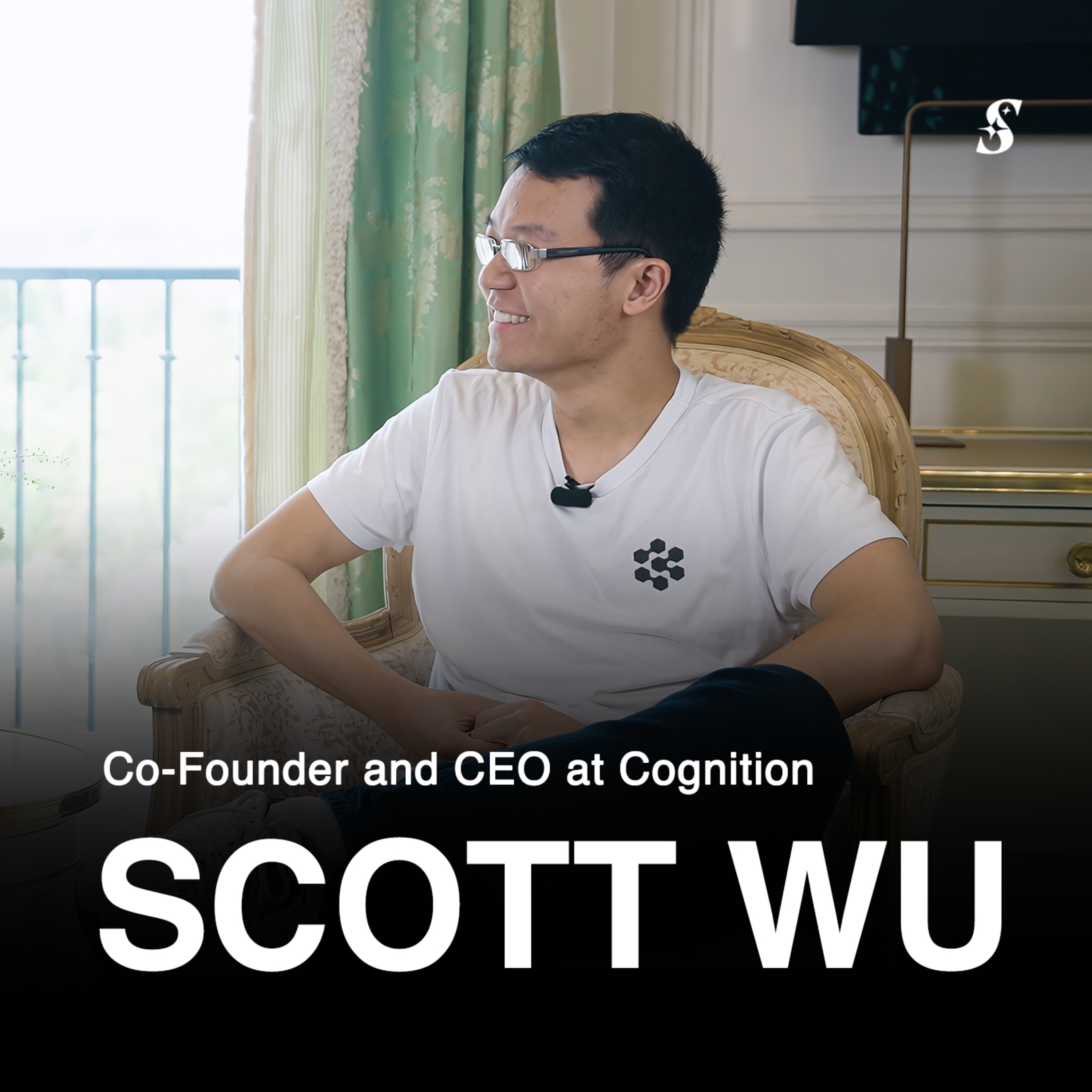
Loading summary
Transcript70 lines
- [00:00]
Scott Wu
Cognition has raised over $1 billion. First, AI software engineer Devin Microsoft and Cognition.
- [00:06]
Interviewer
Cognition and Mercedes Benz, Goldman Sachs, Mercedes Benz, Citi, Dell Santander, NASA, the U.S. navy, and the U.S. army. We've raised over 2.5 billion to date. At a last valuation of 26 billion. In less than three years, you got to 500 million in revenue. That's crazy. Half a billion in revenue in less than three years.
- [00:25]
Scott Wu
Our customers in the last six months or so have also grown their usage in the range of like 11 to 12x. Once you've solved AGI, you just over the entire world, and then there's just one entity that rules the world. I just don't think that's the right feature for us. There is nothing that humans do that AIs can't do. Maybe you can just have like an AI engineer buddy that can just do work for you. But that was like, the very first moment that we believed it was possible. I think the Abundance era is real. And I think we'll be like,
- [01:01]
Interviewer
Devin, welcome to Sorcery.
- [01:02]
Scott Wu
Yeah, great to be here.
- [01:05]
Interviewer
Do you get that a lot?
- [01:08]
Scott Wu
Yeah, yeah, yeah. Like, I'll be in the elevator in my, like, building, and like, I'll just come down and be like, are you Devin? And then, you know, like. Well, I'm actually. I'm actually not Devon. But yes, I understand what you're asking me.
- [01:24]
Interviewer
Oh, gosh damn. Well, Scott, welcome to Sorcery. We are in Paris, which is pretty cool. We're here for the Raise summit. It's like this huge AI summit. I think this is like their second or their third year. You're going to be on stage?
- [01:39]
Scott Wu
Yeah, I'll be on stage tomorrow. I just landed an hour ago. We came straight here.
- [01:43]
Interviewer
Well, it's awesome to have you on. I'm excited to talk through the state of cognition and autonomous coding agents today. It's very pressing. Did you know that?
- [01:54]
Scott Wu
I did, actually, yeah. I mean, I can't even keep up with it at this point. No, Things have been going, like, crazy. I mean, even for us internally. Like, one of the craziest things is obviously we use a ton of Devin to build Devin. In fact, we almost exclusively use Devin to build Devin at this point, like 95% of the code or something is written by Devin.
- [02:12]
Interviewer
Really?
- [02:13]
Scott Wu
But the crazy thing is, even in the last six months, you know, if you ask people, oh, like AI code.
- [02:17]
Interviewer
Yeah.
- [02:17]
Scott Wu
It's been going on for, you know, three, four years now, which is true. It has been. But even in the last six months, I think the Number for us was like, our total amount of code shipped is roughly 7x in that time. And so it's like the number of PRs we've shipped, the amount of code, and obviously literal output. There's different ways in terms of how you actually measure the productivity that you get out of it. But I think in practice we're just able to do so much more and get so much more leverage in even this period of time. The models just keep getting better. I think there's more and more that's been kind of fleshed out, I would say, with the product experience. And so, yeah, things are flying. It's crazy.
- [02:55]
Interviewer
So how do you measure the productivity of it?
- [02:58]
Scott Wu
Yeah, it's a great question. So a couple of things I'd say on this. First of all, I think obviously literal tokens is just not the right answer, really. I mean, lots of people talk about that. I think the token. I say the token maximum era lasted from January to May of 2026, roughly.
- [03:17]
Interviewer
RIP.
- [03:18]
Scott Wu
Yeah, RIP. It was a fun time. But no, I mean, I think we're now at this point where obviously what you care about is outcomes and what you're actually delivering. And so we see how much we're shipping, we see how much we're doing. Obviously what we care about is where are we getting to with the products, what are we actually delivering to our customers and our users? And I think that's roughly the same for every business. There's no kind of secret trick or there's no kind of like easy way out in terms of measuring actual roi, productivity and so on, but. But a lot of it comes down to just actually looking to each of the outcomes that you're driving. And so for us it's, you know, obviously we have all the KPIs of the business that we track and that we kind of follow. And you know, when we think about our outcome output, like a lot of what we think about is obviously it's like, you know, how quickly are we growing those numbers as opposed to anything that we actually look at in terms of tokens or spend or something like that.
- [04:18]
Interviewer
Did you ever think you'd be growing this fast?
- [04:22]
Scott Wu
It's a good question. So what I always think about with this is, I think on the one hand, I think relative to businesses, and by the way, it's not just us, it's like our customers have seen this where similarly, our customers in the last six months or so have also grown their usage in something in the range of like 11 to 12x of Devin and The way I'd say it is, yeah. On the one hand I think you just think about businesses of the past. You think about the growth of all these tech companies in history and obviously it's pretty crazy. On the other hand, when I kind of ask the question, like the first principle of the question, okay, how many people are using coding agents now? How much are they using it for, how much are they getting out of it versus like what do we think they're going to be using and how much of it are they going to be using in three years or something? I think the rough answer, especially if you look, if we rewind a bit like a year ago, rough answer a year ago was roughly zero. And the rough answer for two, three years from now is roughly every software engineer in the world and probably a lot more than just the software engineers because I think a lot more people will be able to produce code and produce products and so on. And so then when you take those two points on the curve and you just extrapolate out what has to happen, I think there has to be massive adoption, massive growth. I think what that looks like in practice often is like, of course there's the virality itself, there's a ton of great content that I think a lot of different folks are putting out in terms of educating people and showing people how to use the tools effectively. And then there's real organizational change that has to happen. All these companies to, to make that happen.
- [06:03]
Interviewer
But it's insane. Like of all the categories, there was an interview I did way back when with Naveen from Mayfield and he laid out the three fastest growing categories. And I know it's like, it's really, obviously it's, it's quite easy to kind of forget about these things when you're in it and like when the whole market is moving with it. But it's insane how fast this new category, in less than three years you got to 500 million in revenue. That's crazy. Half a billion in revenue in less than three years. That's insane.
- [06:34]
Scott Wu
Yeah, no, it's, I mean it's, I think we're very fortunate and I think that the, like, obviously, I mean, AI as a whole has moved like crazy in the last few years. But like the way that we think about it is like we have to move this fast. You know, it's, it's like if we frankly, if we only 3x year over year or whatever it is, you know, we'd be, we'd be lagging the market. Right, in terms of how fast all this adoption is happening and I think it's, I would say it's more a reflection of just how meaningful the technology is. It's like everybody in enterprise or just building products in general. The hardest part about building any product, selling a product, all that is just explaining to people why they should care. It's like, hey, I've got this payroll optimization thing, I've got this usage based billing thing, I've got this whatever. But here's why this is really meaningful and here's why you should be thinking about this. The nice thing about this with AI that can write code by itself and build self driving products for you is I think it's kind of obvious why you should care.
- [07:37]
Interviewer
Right.
- [07:37]
Scott Wu
And so a lot of it is just like figuring out how you solve all the practical problems of getting the technology there and then getting it out to people.
- [07:46]
Interviewer
You're at half a billion in revenue and you have customers that entail. I'm going to list them out because these are some pretty big customers so far. Goldman Sachs, Mercedes Benz, Citi, Dell Santander, NASA, the U.S. navy and the U.S. army. And you've raised over 2.5 billion today at a last valuation of 26 billion. I want to go back in time because Cognition played a pretty big role in redemption story of a company called Windsurf. So can you bring us back to that moment and how M and A has played a role in the growth?
- [08:27]
Scott Wu
Yeah, it's a fun time. I mean it was all of 11 months ago, but so we. And by the way, it's kind of topical because I think recently there's similar news with cursor. We at the time kind of heard this news roughly around the same time as everyone else that hey, this company Windsurf, which was building a really great ide that a lot of folks used, individuals, companies and so on. Some of the team was going to Google and so there was kind of like Aqua Hire deal almost where a number of the researchers on the team were going to Google. Right. And there was a company kind of behind that that still had all the customers, that still had a ready to go go to market team. A lot of the platform engineering product itself itself, all the details there. But obviously it kind of was trying to figure out what to do and that was announced that Friday afternoon. And we at cog, at Cognition, we were talking about that internally and we're kind of joking about it at first and kind of interesting. And then as we actually thought about it seriously more, we were like, actually this is really interesting. For us, because if you think about where we're at, we've always been focused on obviously the research, the product itself, really making progress with the agent product. I think as time goes on, it's become more and more clear that the really good coding, IDE products, the tool that you're kind of sitting in and using to look at the code itself versus the agent product, which is kind of almost the engineer that you can delegate. You obviously want those to be very hand in hand, like a lot of the same information on understanding your exact code base. Obviously you want the same knowledge to persist across a lot of how you even go and do your work and manage sessions is very common. You're looking at the code yourself and then you figure out there's something you want to go do, and so you hand that off to a remote agent. So ton of synergies in the product. Similarly, in terms of go to market, Windsurf had an amazing enterprise traction. Already had a team that was really, had a lot of expertise in going and selling to these folks and kind of like figuring out how to actually deliver and so on. Like a really, really amazing deployed engineering motion, all the pieces that you would need, basically. And so we got in touch with the Windsurf team that evening. So it was Friday evening. And then basically over the course of that weekend, we worked out the entire acquisition together. So by Monday morning, we had the announcement ready to go. It was a fun announcement. Both myself and Jeff and honestly, our entire team, we all got very little sleep that weekend. But we put everything together and yeah, it's great that we were able to do that. I think it made a lot of sense for us as a company. I think it was also, obviously a really great team that was just figuring out what to do. Um, and I think over the last, like, year, you know, there's. I remember saying this. It's like. It's like peanut butter and chocolate. Honestly, for us, like, it's been. It's been a lot of fun. And at this point, it's like, I think the first few months, a lot of little details, as you can imagine, to figure out, like, some of the same customers or companies. You know, it's like, yeah, we had somebody on the cognition side who had a relationship with them. We had somebody on the windswift side who had a relationship. There's tons of stuff to figure out, right? All the product stuff. You know, it's like we're talking at the high level about what the synergies are. Ton of detail involved in Actually going and plugging that in and making billing work and thinking about how you actually hand a session off from the local environment to the remote environment and all these other things. And then similarly, even like the teams, the offices, all of that, you know, stuff to figure out. But, but today I would say it's like it's all, you know, it's all one product. It's all one kind of clean. You know, you come to see our office and it's like you wouldn't know at all. Like, okay, is this person from the old Cognition or the old Windsurf or do they join after that time? And it's kind of like it's been really nice in that time.
- [12:28]
Interviewer
This episode is brought to you by Brex. My favorite. You become what you spend on. And I refuse to spend my time on work that shouldn't exist. Expense reports, receipt chasing and manual closes. The companies building. What's next from Vercel, OpenAI, Anthropic Granola and Deepgram all made the same call. They all run on Brex. BREX is the intelligent finance platform that combines cards, expenses and banking into a single stack. With agentic finance built in AI agents that handle expenses automatically, enforce policy before spend happens and close your books in minutes. That's why Sorcery runs on Brex. So I can spend time on building and not busy work. It's time to get Brex AF. Learn more at brex.com sorcery that's B-R-E x.com s o u r C E R Y Bye. What was it like merging the teams together?
- [13:28]
Scott Wu
Yeah, no, that was a real process. And by the way, one of the things that was tricky about that process is cognition at the time was all of 35 or 40 people and we had a meaningful business with real traction. We were doing in the range of 70 or 80 million of revenue run rate at the time. But it was a very small team. Windsurf, on the other hand, because it had kind of scaled up, go to market and set all that up, is around 200 people at the time. And so a lot of details to figure out obviously. And so for a few months, I mean the immediate day of or week of all of us were just like, okay, let's just write the ship. Let's make sure folks know, customers know that we're gonna be there for them, we're gonna be shipping, we're gonna be taking care of both sides of the product and doing that well. And let's just go and deliver over the first few Months, obviously, a lot of it was just figuring out how we kind of get into a good state. And then, as with all things, it's kind of like it's much easier to go build these things and do all this with some time. And so we had a lot of little fun off sites, which helped, I think, for people getting to know each other. Ton of strategy sessions, obviously, working out all the details and so on. And then pretty soon, at the end of last year, we got to kind of like we were looking for a bigger SF office space, obviously as soon as possible, just as a tactical matter, because we needed an office that could fit everybody. And so. But by the end of last year, we got that office space, and then we're able to put everyone in one space and all kind of like work together. And those were, I would say, kind of the big milestones that made things super, super smooth.
- [15:12]
Interviewer
How did you work through the product integration?
- [15:15]
Scott Wu
I mean, it was a lot of steps, for sure. No, I mean, I think the one way I'd put it is, like, not trying to overly force it. And so for the time being, it was like, there's a Windsurf product, there's a dumb product. Both those are great. Let's work on both of those and kind of do the obvious next steps on each of these things. And then as we kind of had pieces of overlap, just naturally building them in together, and so it wasn't like one month later, Windsurf is gone. And that's was like, over the course of the last year, even we've been building all these things. And now it's kind of like Devon Cloud and Devon Desktop are super, super nicely paired together. You can start sessions from one and hand them off to the other. You can work with them all in the same systems, whatever, but it's much more of a gradual thing. And I think one of the things that was interesting for us was a lot of the users of either product were kind of already naturally looking for the other side. We had a ton of people, for example, who were on the IDE framework. And obviously right around this time that we're Talking about late 25, early 2026, is right around when these asynchronous agents were really starting to get big. And so all these folks were thinking about, okay, well, what should my strategy be? And obviously it's great to be able to work with a single team and somebody that already understands your code base and has all the details kind of figured out and deployed. And so that was nice. And then on the reverse side, obviously. Similarly, for a lot of folks who are adopting the cloud agent, it's very nice to say, okay, yeah, the local side of it is there too for any of the developers who still want to use the local form factor and who want to have that. And so I think it's kind of like maybe the simple way to put it is rather than force it and say, okay, over the next 30 days or 60 days, we have to integrate these products. It was much more of letting the actual usage and the new features that we're building, the kind of next paradigms that we're getting to, letting those pull the products together more gradually rather than forcing it.
- [17:23]
Interviewer
How are you getting advised during this? Were you just making it up as you go or were you like, who were you turning to?
- [17:29]
Scott Wu
It's a good question. A lot of making it up. And I think for us, I mean, it's one of the things about cog, honestly is like, we. And you know, we've talked before about how like a lot of our team are former founders. Our first, like, you know, 56 people, I think like 30 of us were, had founded a company before this. And so obviously a lot of us together were people who liked being ambitious and entrepreneurial and thinking from first principles. But yeah, also, I mean, I think the. No, I mean, I mean it was a real team effort. I specifically remember that weekend, there was a point. So there was the initial kind of discussions which were with myself and Russell from our side and then Jeff and Graham, you know, from the Windserf side. But then obviously as soon as we got past like the very first initial discussion, there was a question of like, okay, but like, what are we actually going to do? And so then there was like every single kind of like part of the business that, that Saturday was. It was one of my favorite. Like, honestly, one of the funnest days of my life really was like. And because, you know, we had our kind of like, you know, technical team, we had Steven and Walden and so on, who are like engineering product leaders, like my co founders going in sitting with their team to understand, okay, what's going on with Windsurf, what do we do to get out wave 11? What are the things, what are the specific features which we need to make sure to deliver on time and the things that we've promised folks that we obviously want to live up to, what are the next first steps on how we would start kind of getting towards an integration? Similarly, on all of the, on all the go to market stuff, we had folks There kind of working with, across teams, making that happen. There's just kind of a feeling, I think, for all of us of, like, we just love figuring this kind of stuff out. You know, I think sometimes people kind of describe it as, like, oh, like, I just want to, like, build my product in peace. And everything else about building a company is, you know, that's just like, I'll put up with it, but it's. It's not my cup of tea, I think for all of us, like, yeah, like, you know, the experience of building the company is like. Is a lot of the fun of it. And so it was a really fun weekend for us.
- [19:48]
Interviewer
Wow. Yeah, I would imagine. I'm sure it's something else every week, so.
- [19:52]
Scott Wu
Yeah, yeah, yeah, it's fun. I mean, we've had all sorts of. Yeah, we've had. We've had a lot of more fun weeks since that one, too. And so it's always us.
- [20:02]
Interviewer
Yeah. Well, speaking on the backdrop of M and A with Cursor and their deal, their $60 billion deal with space, X, M and A is floating around and there's all those kinds of, like, fun stories that are happening, but cognition remains independent. So much so that you spent Independence Day at DC in dc.
- [20:22]
Scott Wu
Yeah.
- [20:22]
Interviewer
So why were you guys in DC for Independence Day? And what's the DC play here?
- [20:27]
Scott Wu
Yeah, yeah, for sure. No, I mean, it's. Look, I think it's like a really. Obviously it's a really topical thing right now. And I think especially because code is, I think, in some ways, like, you know, the most kind of, like, mature vertical. I think a lot of folks look to code as kind of like an expectation of what's going to happen in the rest of the industry and all these verticals. And yeah, I think there's been a narrative out there that, oh, like, in order to win, you have to be a lab yourself or you have to go sell to a lab. And obviously we've just always believed that there's a lot of value and a lot of power in being independent. And you see that in how we work with. We're completely model neutral. We work with all the different providers, we work with OpenAI, Anthropic, Google, so on and so forth, but also just in our approach with companies or with all the orgs that we work with. So DC is really exciting for us for a couple reasons, I think. One, because frankly, it's like you talk about places that need software and that have things that they want to build, but not enough software engineers to build them, D.C. and government in general might perhaps be the single biggest kind of point of that. All of these orgs have so many things that I feel like the one liner is, imagine going to the DMV and. And it actually worked. And why doesn't it work? It's because there's all this archaic software. It's all these crazy processes. It's because the website kind of doesn't really work or you're not able to see these things and track all these things in advance. And government software doesn't have to be bad. All these things can be good. And I think it's a really important thing for us to work towards. I think the other thing and the other reason why it's so important to us is frankly, I think AI itself is just going to be a pretty fundamental policy issue over the next few years. And you think about the early days of the Internet, for example, and there were all these discussions about, okay, what's going to happen? Are there going to be a handful of corporations that control the entire Internet? Are there going to be whatever. Obviously we ended up with the open Internet and now all the businesses of the world are built on the Internet. But there will come a day where all the businesses of the world are built on AI. And I think it's something that we should be thinking about sooner rather than later. And so we wanted to give our thoughts to that conversation as well.
- [22:59]
Interviewer
It's awesome to see the new admin just embrace technology so much. The amount that they've done in the last year has been incredible. But from your standpoint of being independent, you mentioned a couple reasons. But why do you think in the long run it's more important for you to build this company as big as you can independently than under another umbrella?
- [23:21]
Scott Wu
Yeah, yeah. No, I mean, I think the. I guess a few things I'd say. I think there's a world that folks sometimes talk about where there's the full recursive superintelligence and then everything is all owned by like a single entity, or maybe there's two entities or something, but they have the. And it's like everything all collapses. Once you've solved AGI, you just take over the entire world and then there's just like one entity that rules the world. I mean, I just don't think that's the right feature for us. And I think AI will get to that level of capabilities and I think we'll see it do even crazier and crazier things. I've always felt that there's in terms of just pure knowledge work, there is nothing that humans do that AIs can't do. Partly because humans, our brains are just computers like the AIs are too, and they're literally called neural networks because they were inspired by how our brains operate. And so I think we will solve all these problems, but I think we want that to be done in a way that, that people can control their own intelligence, can have access to all these things and so on. And I think more than that too, I think that it can be done which is obviously an important part of any mission that you want to bet on. But I think there is a lot of room and I think there is a lot of appetite from everyone out there, individuals and businesses and so on, for, you know, truly like independent tools that they can use and you know, for, for things that really innovate at the product and the value layer rather than just the pure intelligence layer.
- [25:10]
Interviewer
I mean. So on this topic, Christian Garrett, I asked him for some questions 137. They're big fans. They talked about you in their interview we just did with them with Justin Fishner, Wolfson, Justin and Krishna. They're great. So Christian, Christian asks why do enterprises want third party providers or open source and won't solely rely on the labs, thus their coding tools?
- [25:33]
Scott Wu
Yeah, yeah. I mean, I think several reasons. I think first of all, obviously the way enterprises work is they want to have long term partnerships and frankly it's just hard to know what's going to happen in the long term. Right? Like who even is going to have the best model in six months or 12 months or whatever. And I mean, I think that's very reasonable. You don't want to teach all of your engineers or your entire team how to use one particular suite and one particular product and then find out, oh, actually it's turns out people aren't using this one anymore because everyone says this other one is better or something. Right. But I think the other reason that it's important too is because as we said, you know, I think for every company or for every team, like what they care about is not how many tokens they're using, it's how much value they're driving. Right. And I think it's very important for there to be a player that is going and helping them drive all that value and turning that into reality. I think in practice it's how you organize your teams, how you think about planning, how you think about specs or design, how you do user research. All of these things should be Different. In the era of AI, it's not as simple as throw the tool over the wall. Here's your chatbot, try that out. Hopefully it's good for you. It's like there's a lot of fundamental questions that you have to think through and work through. And these obvious basically require organizational change, right? And so like, I think from their perspective, they want to work with somebody who's thinking a lot about that, who really understands that and is like, excited to go help them with all those details.
- [27:07]
Interviewer
If you're building what's next in AI, you need to know MongoDB, the database platform developers love and built for the agents you're running. MongoDB stores searches and reasons over your data in real time with vector search and embeddings from Voyage AI all in the same system. No separate pipelines, no stitching together 10 different tools. It's why 75% of the Fortune 100 and leading AI native startups run on MongoDB. Build and scale from your first user to billions of vectors. Go to mongodb.com AI to learn more. That's mongodb.com AI to learn more. Bye. Assembly AI is a voice AI infrastructure layer millions of developers build on. They build the industry's best speech to text, voice agent and speech understanding models that serve as critical infrastructure for companies like Granola, Heygen Ashby and ClickUp. Their speech to text models lead the industry in accuracy and quality. And their speech understanding models help you go beyond transcription by uncovering insights, identifying speakers and highlighting key information from voice data. You can get started today@AssemblyAI.com sorcery and get $50 of free credits to start Voice AI products. That's AssemblyAI.coms o u r c e r dash y so you're based in Silicon Valley?
- [28:34]
Scott Wu
Yeah.
- [28:34]
Interviewer
Do you believe the whole six months to singularity thing? What's your take on the whole singularity?
- [28:41]
Scott Wu
Six months is very short.
- [28:43]
Interviewer
Yeah.
- [28:44]
Scott Wu
I mean, so look, the recursive thing, here's what I'd say. There is obviously some version of the recursive thing, which is literally. I mean, I even just said that like Devin writes most of the code of Devin. So it's like, on the other hand, I think the question of. Whether humans will be rendered irrelevant and all science problems and all societal problems will be solved six months from now with the ultimate intelligence. I don't quite believe that and I think there's a few reasons for why that is. I think for one, there's a lot of practical problems out there in the world that are not actually necessarily just purely intelligence soluble. Right. There's just organizational things that have to be done, there's processes that take time that have to be figured out, there's hardware components of how much GPU compute can you get and so on. And so I think all those things obviously exist for two. I think we see more and more that in the model training landscape. I think the vibe today is almost like you can teach the model pretty much anything as long as you know exactly what you are trying to measure or what kind of outcome you're trying to get out of it. And so benchmark scores, for example, are obviously every time there's a new model, people release benchmarks. The thing that's kind of almost like counterintuitive is we're kind of getting to the point where you can solve basically any benchmark, right? Because what does it mean to have a benchmark? It means you've already defined the task, you've clarified what success or failure looks like, you've given a bunch of examples of what that task looks like and what the right behavior should be. And the truth kind of is, well, if you do that, then you can teach the model to go do that. RL works. It's incredible how much it works. But obviously not all of the tasks of the world today cleanly fit into that description. And there's lots of things that are, that are super, super amorphous, that don't really have clear definitions, that it's hard to say what counts as success or failure, that have really long time horizons where it takes a long time to find out whether it was the right decision. And so it's like if you're asking it to write a simple program that goes and does a thing, super easy to run the program and say, okay, it got the right result or it didn't. If you're asking it to make a 10 year strategic decision. Well, it's kind of hard to get the data on whether you did that right or wrong until you've waited 10 years out and seen that. Right. And so I think we will solve all of these things to be clear. And I think we'll. I really don't think that there are like intelligence problems that AI will not solve in the long term. I just don't think of that as like it's going to be all over in six months. Okay, I could be wrong. I don't know. Maybe, maybe it is all over. But you know, it's. If it is all over and we had it, we had A holiday. We had a good time. There is a certain. I actually think that there's a certain nihilism there, which is like. I agree, there's some point at which there's almost like this event horizon in AI, Right? There's some point in which the AI gets so smart that it's hard for us to even kind of reason about what that world will look like. Will humans still. We still have desire. I think we still will have desire. We still have passions and things that we want to explore. I think we will. But who knows, you know, like, maybe, maybe, maybe, like, I will just like, solve all of those problems for us too, or something. But like, so, so the event horizon does exist. And I think past that point is hard to predict, but it's just like, you just got to stay sane, you know, it's like, like you just. You got to make reasonable decisions, you got to build, and maybe it all ends in six months.
- [32:34]
Interviewer
But.
- [32:34]
Scott Wu
But, you know, I don't currently think that's the case.
- [32:36]
Interviewer
By the way. I think most of these people are already insane. I don't know if you read the beginning part of your Colossus piece. Yeah, but what is up with the Silicon Valley tech community? Like, I read that and then I commented below, and I'm like, what the. I can't unread that. Thank you, Jeremy. What was going on there?
- [32:57]
Scott Wu
There's some of that, for sure. No, I mean, it's, it's, it's, it's crazy. You know, obviously it's like we're saying, like, these companies are growing faster than ever before. These capabilities are clearly like. I think it's. I think it's true that the AI paradigm is on another level compared to, you know, the mobile phone or the Internet or something. It's not just the technology that people use every day. I think it will, like, fundamentally reshape our lives. But yes, you're right. It's just got to stay sane.
- [33:27]
Interviewer
So the first task that Devin did was spin up MongoDB. I want to understand why you picked that.
- [33:33]
Scott Wu
Yeah, so MongoDB, it wasn't on purpose or anything, by the way. We were literally, we were playing around with. I guess there wasn't a term for a coding agent back then, but the idea of what it would look like to have a coding agent. This is end of 2023. There were not any of these that existed. But we made these little things. It's kind of funny, one of my co founders, Steven, and another co founder is Walden. We were all like, okay, we're going to make the dev version of our cell like that. The. The AI debt, right? So there's like a Dev Steven, you know, in our Slack and then there's like a dev Walden in our Slack. And then eventually, obviously, we took all those ideas and, like, made it into a single, you know, single product. And that was Devin, naturally, as the kind of culmination of all of these. But yeah, we had each of these and people were building them and just messing around and trying to get them to do cool things, right? Like, what can you do if you can actually, like, test your code and not just LLM completion your code? What can you do if you hook it up so that it can actually run commands in the terminal or have a super basic browser use thing? We were messing around with these and then we actually just needed mongodb ourselves. This is actually what happened. So Walden was setting up MongoDB and then it's like sometimes with these, when you're trying to set up a developer tool, it's kind of like this, or like a database or any of these things where it's like you just ran a bunch of commands, you pasted in the things that it told you to go and do, and then it's just like, not working and there's some error, oh, this port, or whatever. And maybe it's because one random dependency package is on the wrong version and that messes up everything. Maybe it's because you have some other process that's open on your computer that's hogging it or whatever. But for whatever reason, MongoDB, Walden was just not getting it set up. And you do what you always do, you just Google the error message and you see what that says, and you try that command of whatever this person on Stack Overflow said, and it didn't work. Back in the day before AI, you had to go do that and he spent some time on it and he was just like, yada. So then he had his Devin at the time, basically, and he's like, all right, Devin, just go try and make it work. And it turned out to be a really great use case. Because if you kind of think about, what do you need? You need, number one, you just need encyclopedic knowledge of all the different errors that you can run into and what would cause each of them. And then, number two, you need the ability to actually run and diagnose things. It's one thing to just have the error message and nothing else, but it's another thing to be able to go run Commands to go, look at the other running processes to go, and whatever else you need to go do. And obviously those two things like the encyclopedic knowledge and the ability to actually go and run command, I mean, that's literally what a coding agent is. And like, Devin just ran a bunch of stuff for a few minutes and then fixed it and then sent Walden a message like, hey, I got it, it's up now. He didn't really believe it at first. I think we still have the video recording of that.
- [36:37]
Interviewer
Really?
- [36:38]
Scott Wu
So unbelievable. And that was like. I remember I couldn't sleep that night. We were just like, shit, maybe it does work. You know, maybe you can just have like an AI engineer buddy that can just do work for you. But that was like the very first moment that we believed it was possible.
- [36:58]
Interviewer
I would say that's amazing. Thank you, MongoDB, for giving something engineers can go after.
- [37:07]
Scott Wu
Yes, thank you for the complicated yet solvable documentation pages. It was just right in the cusp of what it needed to be in December of 2020.
- [37:17]
Interviewer
Oh my gosh. What do you think the biggest question people should be asking right now that they're not?
- [37:22]
Scott Wu
You know, it's kind of interesting. I think there's actually an important question to ask about what we would do with abundance. And maybe like, I don't actually, I don't actually know what went down in all the industrial revolution. You know, I wasn't there, but.
- [37:39]
Interviewer
Really?
- [37:40]
Scott Wu
Yeah, I wasn't there. What but, but. So I assumed that there was some phase where it was kind of everyone was farming, they were. And then there was a point where it was kind of like, oh, wow, we can actually just mass produce. And obviously in the time since then we have all. There's different things that we all want, there's things that we care about, there's self expression, there's all of these kind of knowledge work and so on that's come about since then. And I think there was a middle period obviously where it was kind of like the abundance was there, but it was like figuring out those things. I kind of think we're about to enter something like that in AI and I see this. The reason I say that is because with software, obviously the first thing that people think about is, okay, how can I be more efficient? It's like all this work that I'm doing now, I can do that work in a third of the time. And it's true, you can. It's amazing. It's really cool, right? And obviously that's worth a lot already. That means you can do. But I think the real unlock is not in efficiency, but in capacity, right? It's like, what can we do if we can build so much more, right? And obviously, I mean we gave the example of, okay, maybe the DMV is going to actually work, you know, in the post software abundance or maybe, you know, all of your, you know, logging into your bank account or checking your medical record, like all of this would be like really smooth product experiences. But I actually think there's just so many more things like, you know, software is eating the world. This is a famous line. Obviously it was true already. You know, here's how we'll look back on this in 20, 20, 31 or something. You know, it's like it was true already back when you had to go and manually write every single piece of software, every, every line of code that was going to run, and yet still it was correct for software to eat the world and to turn all these processes in software. Imagine how good it is and how much more you can do where you can just generate software on the fly to go do anything. Like single use software is going to exist. Like self driving software is going to exist, right? So like anything that you want to go do or want to turn into reality, like probably involves doing anything that involves using a computer in some form is ultimately some kind of software. And when all the software drives itself, like what do you want to do, what do you want to create? And so that's the first thing that comes to my mind honestly is like, what are we going to create with all this abundance? And I think we're starting to get to that question.
- [40:00]
Interviewer
So last question. What was it like beating Peter Thiel in chess?
- [40:04]
Scott Wu
Oh, I didn't beat him in chess. No, I would not recommend playing against Peter Thiel. I don't think that's like a good, you know, you gotta, you gotta pick games that you can win. But, but I did challenge Napoleon pulling to a poker match. I think there was like, somehow there was like both, but it was just a poker thing that actually happened. There was a round that, it was one of the earliest rounds of Kagu. So this is like, this is like, this is like the seed basically. And kind of got to a point like we were clear with that, you know, to their credit by the way. They were always super, super upfront and super heads up about like, you know, kind of how they negotiated with us too. But like we were at the point where like, look, we want to go and do this. Here's the numbers that would make sense for us. And they were like, here are the numbers that make sense for them. And we were kind of like close enough that you kind of felt like it should work in some form, but it's just a question of like, okay, what do we land on? And I was like, you know, it's interesting you're such a big fan of poker. We could just play a heads up poker match for that and we can have the winner decide whose terms we actually sign. It would have been for, in retrospect, it would have been for like 1% of the company or something, which. But I put it up with Napoleon. Napoleon was kind of down and then Peter shut it down. Peter, you know, I don't really think that's the right way to do this. And he said that, you know, and so then that didn't end up happening. You know, we worked it out anyway and we came to a deal and it was all good. And then we've been working together since. Yeah.
- [41:25]
Interviewer
What are you most looking forward to in the next 12 months?
- [41:29]
Scott Wu
Yeah, um, you know, I'm honestly just really excited about us getting closer to this era of abundance. And I think we'll see a lot of that happen in the next, like, not just as somebody, you know, in AI, but like as, like a, like as a spectator, also, like, as a consumer. Like, I'm excited for AI to, you know, to be there for me for all of my, like, tough personal decisions that I had to go make. I'm excited to have AI like, handle all these different, different like little details in my life. I'm excited to have like, AI that like, basically just like, allows me to like, spend all of my time and focus on the things that I care about and take care, take care of the rest. I think, like, I think the abundance era is real and I think we'll be there pretty soon.
- [42:11]
Interviewer
Amazing. Such a positive, optimistic way to end it. Thank you so much, Scott. I really appreciate it.
- [42:17]
Scott Wu
Thanks for having me.
- [42:18]
Interviewer
And maybe we'll get some hot takes at Versailles. Yeah. Okay. Thank you so much. Okay, cool. Huge thank you to the entire Raise team for an incredible event. And thank you to Brex, MongoDB, and Assembly AI for making this trip and series possible. If you enjoyed this conversation, you're going to love the rest of the Raise series with Tony Kim from BlackRock, Scott Wu from Cognition, Andrew Feldman from Cerebras, Rodrigo Liang from Samanova, Michael Hurlston from Lumentum, CJ Desai from MongoDB, and many, many more. Like our hot takes that we did at a secret location that you can find on X, YouTube and Instagram. Subscribe to Sorcery on YouTube for more conversations with the people shaping AI and join the free newsletter. You can also do paid at Sorcery VC for weekly insights on AI, robotics, enterprise software, consumer semiconductors. Did I say AI? AI again. And everything that's coming next like funding announcements and all big things in tech. Thank you. Bye.