Loading summary
Transcript75 lines
- [00:00]
Justin Fisher Wolfson
137 Ventures. 137 Ventures.
- [00:02]
Podcast Host Molly
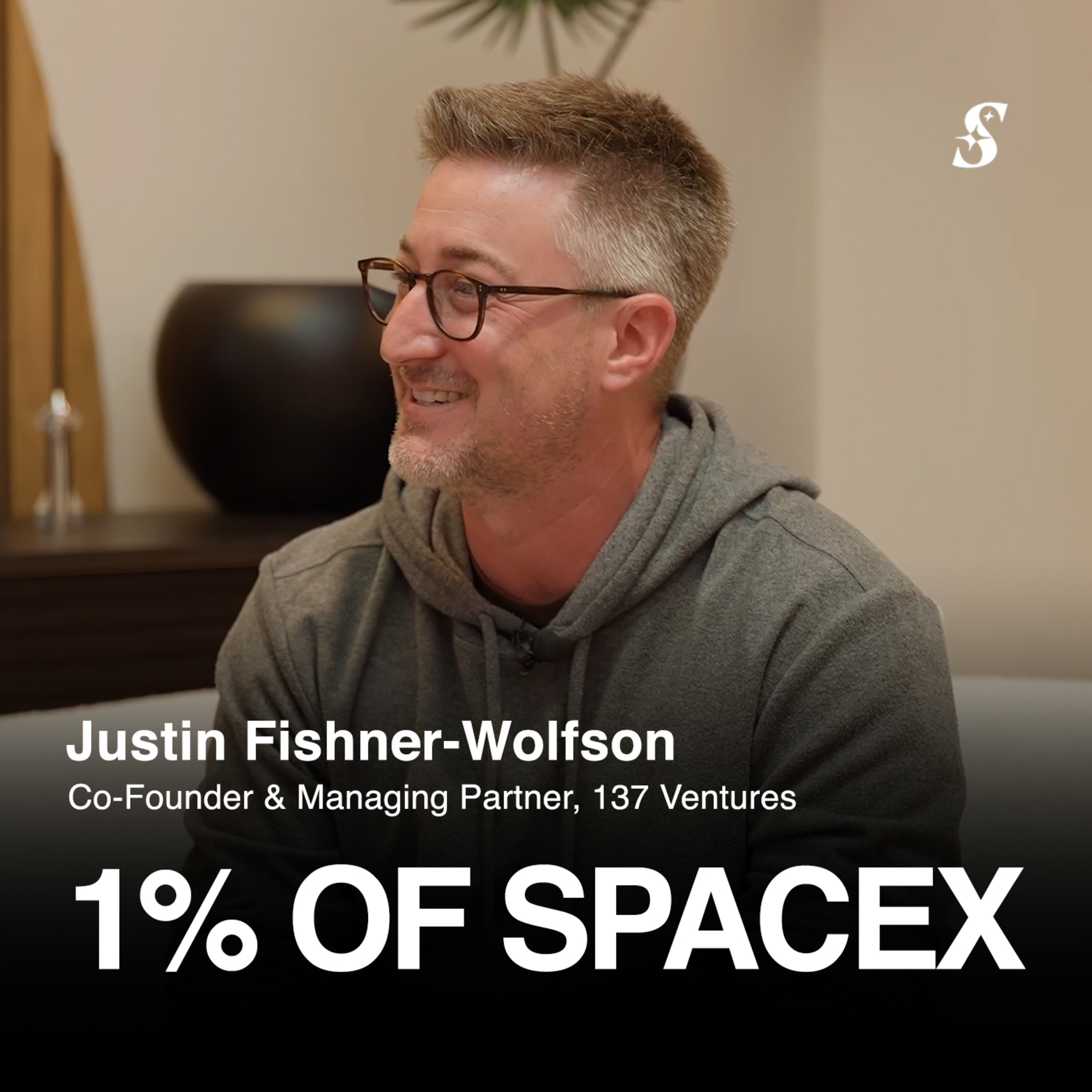
Justin Fisher Wolfson, co founder and managing partner, 137 Ventures.
- [00:06]
Podcast Host
137 Ventures. You have 15 billion AUM you invested into SpaceX, Palantir, Uber, Anduril, Gusto, Cognition, Ramp and Hadrian. Those are some of the bigger positions. Tell me about the story of SpaceX.
- [00:18]
Justin Fisher Wolfson
Back at Founders Fund, we did the deal in 2008. At that point, Elon had mostly funded it himself. We were really the first outside institutional capital. We've probably made two dozen investments in the company since we started the firm. It's been a great run. Companies from a life cycle perspective are starting to go public again. SpaceX is the big one to kind of start this, but OpenAI and Anthropic are both out there. S1s confidential, so it's going to be a pretty interesting few quarters in the public markets.
- [00:51]
Podcast Host
Justin Fisher Wolfson, also known as jfw, apparently. Apparently everybody I've been talking to is just keeping your name short.
- [01:02]
Justin Fisher Wolfson
I mean, most people don't use my full name when they call me.
- [01:06]
Podcast Host
Well, welcome to Sorcery. I'm so excited to have you on today.
- [01:09]
Justin Fisher Wolfson
Thank you for having me.
- [01:10]
Podcast Host
You just got fresh off of a New York Times interview.
- [01:13]
Justin Fisher Wolfson
Yeah.
- [01:13]
Podcast Host
So you're all warmed up, right?
- [01:16]
Justin Fisher Wolfson
Sure. Let's see how it goes.
- [01:17]
Podcast Host
Okay, so I recently interviewed the team at Impulse Space. We had Tom Mueller on, and then we also had Eric Romo, the first employee and the 13th employee. And the one thing that Eric Romo said was, if you don't know 137 Ventures, you will know it very soon.
- [01:35]
Justin Fisher Wolfson
Well, he's a good hype man. I guess.
- [01:38]
Podcast Host
So, 137 ventures. You have 15 billion AUM, you've invested into some very large names. You have over 60 portfolio companies. And I'm going to name some of the big names. Okay, so you invested into SpaceX, Palantir, Uber, Anduril, Gusto, Cognition, Ramp and Hadrian. Those are some of the bigger positions. The one I want to talk about first before we get into everything. And obviously your differentiation going in on the secondary angle is SpaceX.
- [02:09]
Justin Fisher Wolfson
Sure.
- [02:10]
Podcast Host
Okay, so tell me about the story of SpaceX. You got in it quite early. You were first exposed to it at Founders Fund. So what was the story there?
- [02:18]
Justin Fisher Wolfson
Well, back at Founders Fund, we did the deal in 2008. That was sort of the beginning because at that point Elon had mostly funded it himself and we were really the first outside institutional capital and so obviously got to know the Company back then was very excited when we started 137 Ventures. We continued to invest really many times over the last 16 years. So I don't actually know what the total count is, but we've probably made two dozen investments in the company since we started the firm. So it's been a great run.
- [02:50]
Podcast Host
And why did you go after the secondary angle? How did you have conviction in that early on?
- [02:56]
Justin Fisher Wolfson
I think the insight that we had, if you kind of roll back the clock to like 2011, that was right before Facebook had gone public. And, you know, our belief was companies were going to stay private longer. Facebook stayed private for a relatively long time. But the major reason why Facebook ended up going public was this 500 shareholder count rule that basically required companies, once they hit a certain shareholder account to publicly report. So it's sort of all the negatives of being a public company with none of the positives. And ultimately that's why Facebook went public. They changed the rules with the JOBS act and so that pressure to become a public company sort of went away. And I think our view was very simply that companies were going to end up staying private longer. And what that meant was there'd be a lot more opportunities to invest in those businesses. And especially if they were great companies, then that was just a lot more time they could compound. Going back to the SpaceX point, like SpaceX always sort of allowed liquidity for their employees and they were running tenders, you know, once a year probably back then, and then that kind of sped up to twice a year. And so like these were always company organized programs. It wasn't like you're trying to find some random person who happens to, you know, be affiliated with the companies. Like you're just dealing with the founders and executives of these businesses who are trying to, you know, facilitate liquidity for people to buy their first house or pay off their student loans or whatever it happens to be.
- [04:15]
Podcast Host
I mean, that's a huge theme that's happening right now because there's so much locked up capital. We're obviously having some major IPOs, whether it's Space X, the new S1s with Anthropic OpenAI and a lot of the AI companies here in the Valley. We're in San Francisco right now with massive valuations and a lot of people that are rich on paper, but cash poor. And like, strategically, what does that mean to a founder? Not just to take off money for fun money, but like after working for a while.
- [04:49]
Justin Fisher Wolfson
Honestly, I don't think anyone, I don't think I've ever seen anyone take money for fun. For fun money. The best story is actually like from Will Brewery because he was, he's the founder at Varna, but he was also at SpaceX. And so he sold in a tender a very long time ago. And I made butcher the story, but it's approximately some version of like he went to a Lakers game and he, he got some cash from the tender, went to a Lakers game and bought parking passes. And those parking passes are now very expensive parking passes given how well SpaceX has done. But like, you know, it's just like a small thing for him to be like, okay, this is real, like it matters. But most of the time it really is. It's helped people buy their first house or you know, student loans or like, I mean sometimes there are unfortunate stories where it's like people have medical issues and so I mean the money is important because people have life events that matter.
- [05:39]
Podcast Host
How did you have so much conviction to spin this out of Founders fund and do this whole strategy? I mean, I think more deeply
- [05:48]
Justin Fisher Wolfson
it helps not to know that much. Right? Like if you're going to go start something, you have to know enough to have a chance and not too much. Otherwise you'll never do anything. And so we thought it was, you know, the right, it was sort of the right intersection of some big trends. And I don't think it was. I thought it was pretty obvious that companies were going to stay private longer, but I don't think that was obvious to people who weren't like on the ground and paying attention. Because, you know, when we went out and talked to institutional limited partners, like they were not necessarily of the mind, but the industry was changing, that this was going to be a thing. And so at this point we've more or less won the argument, but that was not true 16 years ago.
- [06:23]
Podcast Host
The stat was last year 2025, over 240 billion was via secondaries. 31% of venture volume was all secondaries.
- [06:33]
Justin Fisher Wolfson
Yeah, and there's some constraints on the industry too because you know, they're, you know, you have to be a registered investment advisor depending upon. It's like there's a bunch of rules around this as well. I think from our view it doesn't matter if it's primary or secondary. Like we're just focused on trying to be in companies that we're excited about, that we think can, can continue to grow for extended periods of time and that are defensible. And if you can keep building your positions in those companies, then everything works out and Whether or not it's a primary investment, a secondary investment, like it honestly doesn't matter that much.
- [07:02]
Podcast Host
So what Was it about SpaceX then? Was it the team? Was it the launches?
- [07:06]
Justin Fisher Wolfson
I mean, the team's great. I mean, the team has been together really for a long time. I think if you look at the leadership, I mean, Brett is probably the most recent addition and it's been 50 teen or 16 years or something that he's been at the company. So the team is absolutely fantastic. Gwen's been there for like 22 years. So like it's just, it's a good team. I mean, they also really built something that worked, right? They flipped the business model in the industry because historically it had been cost plus and they had transitioned to a firm fixed price model. And so a combination of a business model shift and then making, you know, the Falcon 9 partially reusable fundamentally change the economics of the business. And so they've just built things on top of that over the years, like Starlink, which has been amazing.
- [07:52]
Podcast Host
I want to talk about that further. Like the economics of the business. It's so efficient. It was so efficient. I had Christian on last year kind of like around this time and it seems like it was like five years ago because the company was valued at 300 billion and hadn't raised as much capital as it has now, I think had raised $10 billion so far. Around that mark, it might have been like 12 or so. What did you see? I guess could you walk through kind of like the economics and how they remained, how they remain so economically fit?
- [08:24]
Justin Fisher Wolfson
Well, I mean they were, I mean they were profitable for a very long time and the launch business was, was. I mean, they were doing things that no one in the industry had accomplished.
- [08:35]
Podcast Host Molly
Right.
- [08:35]
Justin Fisher Wolfson
They were launching not just cheaper, but way more frequently. Right. They're going to launch. I don't know what it can be this year, but like something close to 200 times, like no one else in the world is launching even 15, 20 times. Right. So what they've accomplished has really not only increased the access space because it's cheaper, but because you can actually get there faster. Right. And that's been true for a long time. And launch was, launch was profitable for them. And so they just never needed to raise that much money. And that's been, that's been great.
- [09:05]
Podcast Host
And now they have Starlink, which we are loving on our airplanes.
- [09:10]
Justin Fisher Wolfson
Oh yeah. No, it's really kind of incredible that you can be on a United flight now and you actually can. I mean, you can make Phone calls. Now I think we're gonna have to figure out how what the, what the etiquette's gonna be on this stuff. But you can totally do zoom calls if you want on any flights these days.
- [09:28]
Podcast Host Molly
Assuming they have Starlink Sorcery is brought to you by Brex, the financial stack trusted by more than 30,000 companies, including 1 in 3 venture backed startups in the U.S. nearly 4, 40% of startups fail because they run out of cash. Rex is literally built to help founders avoid that. Unlike traditional banks that let your money sit idle chipping away at it with fees, Rex is designed to help you spend smarter and move faster. Their all in one solution combines checking treasury and FDIC protection into one powerful account. You can send and receive money globally at lightning speeds, get 20 times the standard fit FDIC coverage through their partner banks and even high yield from day one with same day and even same hour liquidity. Access your funds anytime. Companies like Scale AI DoorDash, Service Titan, HIMSS, Anthropic, Flexport, Robinhood and Plaid Trust and use Brex. Start today@brex.com sorcery that's B-R-E-X.com sorcery. Turing is training the next generation of AI with tasks that require real expertise and real world judgment. That's why companies like Nvidia, Anthropic, Salesforce and Gemini partner with Turing. Turing builds realistic reinforcement learning environments and data systems based on real operational traces. The kind of infrastructure Frontier Labs need to train superintelligence. Visit turing.coms o u R C E
- [10:58]
Podcast Host
R Y When did you see Starlink as a really great push for the business?
- [11:06]
Justin Fisher Wolfson
I think everybody knew that if you could build the Constellation then it was going to be a good business. The question was like, could you build the Constellation economically? And it was probably 2019 or so when they launched probably a couple of Starlink satellites. And it was I think pretty clear for people who had known them for a long time that like they'd figured it out so this was going to work. And therefore you could sort of just start to model this like very understandably. It's like, okay, cool, this is going to work. Like who are all the people who don't currently have access to high speed Internet, right? And I mean in the US it's like tens of millions of people and like that's in the U.S. like forget globally, right? Like there are tens of millions of people who don't have. Not that they can't afford it, they literally just can't buy it. And so there's some intersection between people who can't afford it and people who can't buy it. But there's also plenty of people who can afford it. And I think Starlink has been really transformational globally in terms of, like, access to healthcare, access to education. Right. It's not. I mean, I'm sure some people are using it to watch Netflix too, but, like, it's it. You know, I think what Covid taught everyone was like, the Internet really was everything for people. Right. It was jobs, it was, you know, it was healthcare. And so Starlink has really made it way more possible in places that were otherwise cut off.
- [12:20]
Podcast Host
It's really still very underrated in commercial aviation, and it probably should be on literally every airplane. We flew up this charter company craft, we did an episode with them, and I talked to the pilot about it. I was like, well, tell me about Starlink. They're like, we love it. We have a backup. We have it all over. We're totally fine with having the planes on the ground for three weeks to get it on, because one clients really like it. Sure. Passengers, but also for the pilots when they're crossing over into different countries, you don't lose wi fi, you don't lose service, you don't lose access to the weather communications. All this kind of reporting that you normally do.
- [13:01]
Justin Fisher Wolfson
Think about boats. Same thing, right? I mean, it's just any place where you're going to be in the middle of nowhere, you now have Internet. It's great.
- [13:08]
Podcast Host
Tom Mueller, I, I asked him about this. Like, did you, like, when did you know that it was going to be really big? He said, oh, we knew it, like, immediately. And we immediately wanted to get out as many as we could.
- [13:20]
Justin Fisher Wolfson
And look, Tom. Tom's the guy you want to. You want to use if you're trying to get things to move in space. Right. If you want to put up a constellation, Tom's good guy to talk to.
- [13:29]
Podcast Host
So as the firm started with Space X, how did you get kind of like the confidence to continue to build out those positions? I mean, it's like, are you going to retire now? Like, what are you going to do?
- [13:41]
Justin Fisher Wolfson
No, I think we're going to keep building the firm, but I actually think our first investment was in Palantir. I might have to go check with that, but I actually think our first investment was actually in Palantir. Yeah, look, we've been building the firm for the last 16 years. I mean, you know, other people here, and I think we're really focused on continuing to do that, and this is, you know, we're in the middle, like, this is part of the journey for SpaceX, for us, whatever. But like, as you mentioned at the beginning, like, there are a lot of great companies that we're invested in that we're excited about. Right. Impulse Space, Hadrian. Right. Like, there's a ton of, there's a ton of good stuff going on.
- [14:09]
Podcast Host
You've backed a couple of Space alumni. So how did the impulse investment come to be?
- [14:16]
Justin Fisher Wolfson
I mean, obviously we've known them for a long time and I think we got excited about what they were doing and kind of the unique capabilities that they had and how that was specifically relevant for commercial, but also for government as well. And so just, it just seemed like a, it just seemed like a logical investment.
- [14:33]
Podcast Host
So with these IPOs, do you think the secondary market is going to continue to get big?
- [14:39]
Justin Fisher Wolfson
Yeah, I mean, the market has expanded by a couple orders of magnitude since when we started the business. I think as companies stay private, all sorts of different people end up being in liquidity. It starts with the employees, but eventually you end up with the investors. And we're sort of at the point where companies from a life cycle perspective are starting to go public again. SpaceX is the big one to kind of start this. But as you mentioned, OpenAI and Anthropic are both valid, they're S1s confidentially. So it's going to be a pretty interesting few quarters in the public markets. There's a lot of capital that people are raising.
- [15:15]
Podcast Host
Where do you think the market is shifting categorically?
- [15:19]
Justin Fisher Wolfson
Yeah, I mean, I think a lot of people, they think about categories, we think about companies. And so if you looked at, just going back to SpaceX example, it's like if you looked at SpaceX, you would think, oh, gosh, there are all these great space investments. There were not. Right. We looked at probably every SpaceX or every space investment for 15, 20 years, and the good investment was SpaceX. And I think a lot of people thought, well, we should go invest in all these other things. And the answer is you should invest in SpaceX. You know, Android might be like maybe a little less extreme version of that, but it's just like there's a category, but really there's a company that's, that's incredibly successful and that you should continue to invest in that company. So it's less sectors and more companies, and will there be a company that ultimately, you know, ends up with a really large fraction of the market? And so that's kind of what we're focused on and we're looking for the companies that are durable. Right? Because what you don't want to do is have a thousand different companies that kind of all sound the same and they're all duking it out to end up with like a small piece of the market. Like, that's not, that's not a great investment. So there's always some confusion between like, what is a great company and what's a great sector. And all I really care about is like, is it going to be a great company?
- [16:26]
Podcast Host
With all these AI companies though, like, how are you discerning the hype from long term durability?
- [16:31]
Justin Fisher Wolfson
I think it's a hard question. I mean, in all honesty, like, we haven't invested in any of the big foundational models. I think it was just always sort of hard for us to understand which one was going to be the best model at any given or not really at any given point. I mean, in the long run, right? I think that's really the question is like, which one is going to be the win that the one that is the best in 10 years. And I don't know how to answer that question. I mean, I think the technology is super valuable. It's clearly, it clearly is getting massive adoption. So like, it's not that it's not useful, it's just how do you know which one to pick? Right? That's, that's the hard question. I think cognition is in a really interesting spot right now because they're sort of the last independent, you know, company in the space. And I think there's a lot of value, right. Enterprise customers really don't want to get locked into, you know, a single foundational model. In the same way that when you sort of thought about cloud, it was like people really, you know, they weren't sure if they want to put their data in the cloud. They really weren't sure, you know, whether or not they want to be locked into a single cloud provider. So people were like multi tenant and things like, you know. So I think cognition kind of sits in a really important part of the market right now where if you're an enterprise customer, it's like these are the only guys who can give you access to all the underlying models without the lock in that comes from that. So that's why, I mean, that's one of the, I mean, there's a lot of reasons to be excited about cognition, but that's one of them.
- [17:47]
Podcast Host
How is the firm structurally different from a traditional vc?
- [17:51]
Justin Fisher Wolfson
We've been really flexible and that served us well, right? Whether or not it's a primary investment or a secondary investment, that's, that's sort of given us the ability to build positions over time. And so, you know, like I mentioned, you could go back and look at how many investments we made in Space X. But like that's not the only company that we made, you know, a number of investments in. And so like whether on a T re and we've probably written, I don't know, four, maybe five checks there at this point, right? Like we want to keep, we want to keep investing in the companies that we have conviction in and really get concentration in those businesses. And I think that's a little bit different than how the industry works, right. Most people are trying to write like one large check at the beginning. You hit a certain ownership percentage and then maybe they do their pro rata or something. But they tend not to continue to follow on and concentrate over time. We've learned a lot about how you might structure tenders and things like that, which really makes people's lives easier. I don't think they won't be successful otherwise. But it's like you can do it the easy way or the hard way. And if you're really busy doing a lot of other things, maybe you want to pick the easy way. And all of these things really kind of boil down to access to capital, right? You want the best companies to have good access to capital because that's going to give them the ability to work on the hard problems. And if you can solve those problems, then they turn out to be incredible businesses. A lot of this is just incentive alignment and expectations management. If you run a tender, it turns out your employees are going to assume that you're going to run another tender. And for the most part, people don't really like it when prices go down, right? And so you want to think about, like, how frequently are you going to do these things? Who are you going to allow? Are you going to allow current employees, former employees, like, what are the things? And I remember there was like, there were like funny dynamics from Facebook, right? So this was in the old days. There was a right of first refusal at the company and there really weren't transfer restrictions because no company had ever gotten that big in the private markets before. So it sort of never mattered, right? You could just have a right to first refusal on any share sales and the company could buy it back and it sort of all worked. But then Facebook got big and it turned out that the company kind of couldn't buy all their shares that were, that people were selling because the dollar amount just got so big and the volume got so high. And they basically started telling people, like, if you sell shares, we're going to fire you, right? And so people just started quitting, right, because they wanted to sell. And they're like, so it created this very perverse incentive of like, okay, well, if you're a current employee, you have to become a former employee to sell. And so this just kind of comes back to like, how do you want to include people? You know, I would argue you probably want to include your current employees and, you know, maybe you want to include your former employees. But if you're going to build this over time, maybe you don't include them on the first one. You include them over time, right? So a lot of it's just kind of expectations, management and building a good process.
- [20:35]
Podcast Host Molly
Today's episode is sponsored by VCX by Fundrise, the public ticker for private tech allowing investors of all sizes to invest in venture capital. Learn more@get VCX.com Some of you may not have heard this yet, but our sponsor Public just launched something called Generated Assets and it brings AI into investing in a way I've honestly never seen before.
- [20:58]
Podcast Host
Here's how it works.
- [20:59]
Podcast Host Molly
You type in an idea like AI powered supply chain companies with positive free cash flow, or defense tech companies growing revenue over 25% year over year. Publix AI then dispatches a swarm of agents that scan every single US stock, evaluates them, and instantly builds a custom index around your thesis. What really stands out is how clearly it explains why each stock is included. And before you invest, you can even back test your idea against the S&P 500. So you're making decisions with real context, not just guessing. And beyond Generated Assets, Public lets you invest in stocks, bonds, options, crypto all in one place. They'll even give you an uncapped 1% match when you transfer your investments over from another platform. If you want to build a portfolio that actually reflects your thesis, visit public.com Sorcery paid for by Public Investing Full disclosures in the description Enterprise AI runs on Merge, the AI infra platform for integrations and agent tooling and model orchestration so your teams ship product, not plumbing. Mistral, Dropbox and Drata already trust Merge in production. Start building at merge.dev. founders scale faster on deal. Set up payroll for any country in minutes. Hire anyone, anywhere, get visas, handled fast and get back to building. Visit deal.comsorcery that's D E L.comsorcery there's
- [22:20]
Podcast Host
obviously a lot of unique things about SpaceX in this picture because they run tenders every six months. They have a pool of employees that are not just software engineers, but people who are welding machines, that are electricians. And these are traditional blue collar jobs that have not seen tech like equity exits. So I'm curious on SpaceX's standpoint because they also buy back their shares. So like, what are the dynamics internally?
- [22:49]
Justin Fisher Wolfson
I think it's great that they've, I mean, they've really shared equity across the entire company, which is incredible. And to your point, they have lots of people on the shop floor who literally make all of the stuff that matters. So the fact that this is life changing for so many people I really think is incredible. You know, the tenders are an opportunity, like no one has to sell anything, right? It's just an opportunity for people to sell something. The company has bought back shares, I think just to manage dilution. Right? If you look at public companies, they buy back shares and that's relatively normal. So the only difference is that this was a private company.
- [23:24]
Podcast Host
Do you worry at all about ownership percentage or do you just care about cash on cash return?
- [23:29]
Justin Fisher Wolfson
I mean, for us, all I care about is cash on cash returns. I think people get really focused on ownership percentages because it was a heuristic that sort of made sense. That said, well, if you had a company that would exit for, you know, a billion dollars and your fund size is 200 million, like you needed to do some math there and like you could sort of figure out what your ownership percentage needed to be, I think that's fine. But like, I look back at, you know, sort of what, you know, what Peter did with Facebook, you know, I think a lot of the reason that he originally did that deal was because most people wanted a much higher ownership percentage and he was okay getting 10% of the company, which obviously was like clearly the right decision. And all you had to do is sort of adjust your expectations on what the exit could be. And all the math totally pencils. And so, you know, for us it's like you don't really want to get dogmatic on the things that don't matter. You want to stay focused on things that do matter, which is just, you know, what are the returns to the funds to your LPs, and as long as you're hitting that cost of capital, you absolutely want to invest. And like, getting to an argument about ownership percentage is like sort of distracting.
- [24:31]
Podcast Host
What has been one of the most Memorable moments. Since starting the firm, I've been to
- [24:35]
Justin Fisher Wolfson
a lot of SpaceX launches. I highly encourage everyone to like go to one because you don't, you don't need like any special invite. You can literally go watch these things by the side of the road. And if you go down to South Texas now, like, like, and I've been down there and like sometimes when they launch in the morning, it's like dark when you're driving down towards the launch pad and you'll just see everyone like lined up on the side of the road, right? Just like just thousands of cars, right? People have just, you know, come from the local community, people have flown in from all over the place just to watch these things. And it's really impressive. Like you can go watch the videos and they have really great production value but to like viscerally feel the rockets take off. And then I remember I was standing next to a friend of mine at the launch and like the first stage is coming back. I'm just looking at him like, looks like it's kind of come a little close to us, right? Because when it's far away and it's coming down, it kind of looks like it's coming towards you. And the launch pad was like, you know, it's a few miles away but, but still it looks like it's coming towards you. Anyway, that was, that was one of the times they caught it but, but like that was, it's a very, very memorable experience and it's, it's open to anybody.
- [25:43]
Podcast Host
Have you experienced any of the launches with any of the SpaceX team?
- [25:46]
Justin Fisher Wolfson
Oh yeah, I mean my friend was one of the engineers at SpaceX. Right. I mean I like, you know, there were some of the, you know, the old launches. Like I remember going down to Hawthorne for like the third Falcon 1 launch. That was like the first launch after we made the investment at Founders Fund. And so actually that flight, I remember flying down there because you never quite know when the launch is going to happen. And like the flight was like slightly delayed and whatever and I'm literally like running into the building literally as like, I think they said one and then like the rocket took off. Like they were like, they were like 10 minutes delayed, which is perfect. And I caught the launch and you know that was the one where the second stage had hit the first stage and so it wasn't fully successful. And I remember, I think I was standing next to Gwen or something and she, I was like, oh, so how are you guys gonna fix this? And she was just like I think we just need to add a delay between on the stage separation and like Steve Davis I think said it was like seven and a half seconds or whatever. And so that was it. That was the only change they had to make. And then on the fourth launch, everything worked, worked perfectly. So. And then they scrapped the Falcon 1 for the Falcon 9.
- [26:55]
Podcast Host
Well, it's like the media will take those headlines and we talked about this at Anderol, this was like a little bit after when they got roasted by whatever magazine or publication about testing failures. Like they were testing Fury somewhere. And you know, the media is like, oh, we're pouring all this money into these companies but their tests are failing. Like what is going on? What should we take away from these tests? Test failures, like why is that actually not a failure?
- [27:23]
Justin Fisher Wolfson
I think it's not a failure as long as you're learning something, right? And so, you know, you look at all these things, these are complicated systems and the best way to learn is actually to launch them, right? And whether or not it's, you know, Fury or whatever or you know, Starship, right. Or you know, anything for Impulse Space, right. Like you actually just need to test these things because you can't, you can't sit in a clean room or run a model that will predict all of the possible issues. And so as long as you're getting enough data from the process, it's incredibly valuable. And I think SpaceX has done it incredibly well where it's like you launch and you learn and then that ethos has kind of gone out to a large part of the ecosystem. So I mean, I don't know, I think what makes America great is like you can fail, right? But as long as you can take something away from that to, you know, get to the later success, like that's what matters. I do think the government's an important partner to our companies. And yes, venture capital does, does put up a lot of dollars, but so does the government. So like it's, it does, you know, having having a really good long term partner is incredibly important for these companies. But a lot of them also have, you know, big commercial business as well.
- [28:32]
Podcast Host
What is the biggest lesson that you've learned from both Elon and Gwyn?
- [28:36]
Justin Fisher Wolfson
I mean, I think Elon's probably like a, it's, it's just a first principles approach to everything and a flexibility that when you have new data you can, can easily change your mind. That's kind of the core of it. And gosh, Gwen really just doesn't. There's no problem that you just can't work right. It's just like no matter how stressed everyone is, it's like if you can be the calm person in the middle who can just help people get to the right answer, that's incredibly valuable. And I don't know, she's done that so many times.
- [29:07]
Podcast Host
As we close out, what are you most looking forward to in the next 12 months?
- [29:12]
Justin Fisher Wolfson
I guess we're going to get a bunch of earnings calls with Brett. It's going to be, it's going to be fun seeing him as a public company cfo.
- [29:19]
Podcast Host
It'll be fun.
- [29:19]
Justin Fisher Wolfson
Everyone at the company and I'm sure a lot of investors. I'm sure everyone will be clicking refresh on their stock ticker for a while. But you know, then people will get used to it and everyone will go back to work.
- [29:29]
Podcast Host
Awesome. Well, thank you so much, Justin.
- [29:31]
Justin Fisher Wolfson
Absolutely. Thanks for having me.
- [29:33]
Podcast Host Molly
Hey, it's Molly. If you enjoy our interviews, check out our newsletter Sorcery bc where we deliver a once a week top deals and tech headlines. Email and also go deeper on our podcast interviews. Subscribe to Sorcery Today and don't forget to subscribe to the podcast on YouTube, Spotify, Apple or wherever you listen. Link in Description to sign up.