Loading summary
Transcript58 lines
- [00:00]
Michael Hurlston
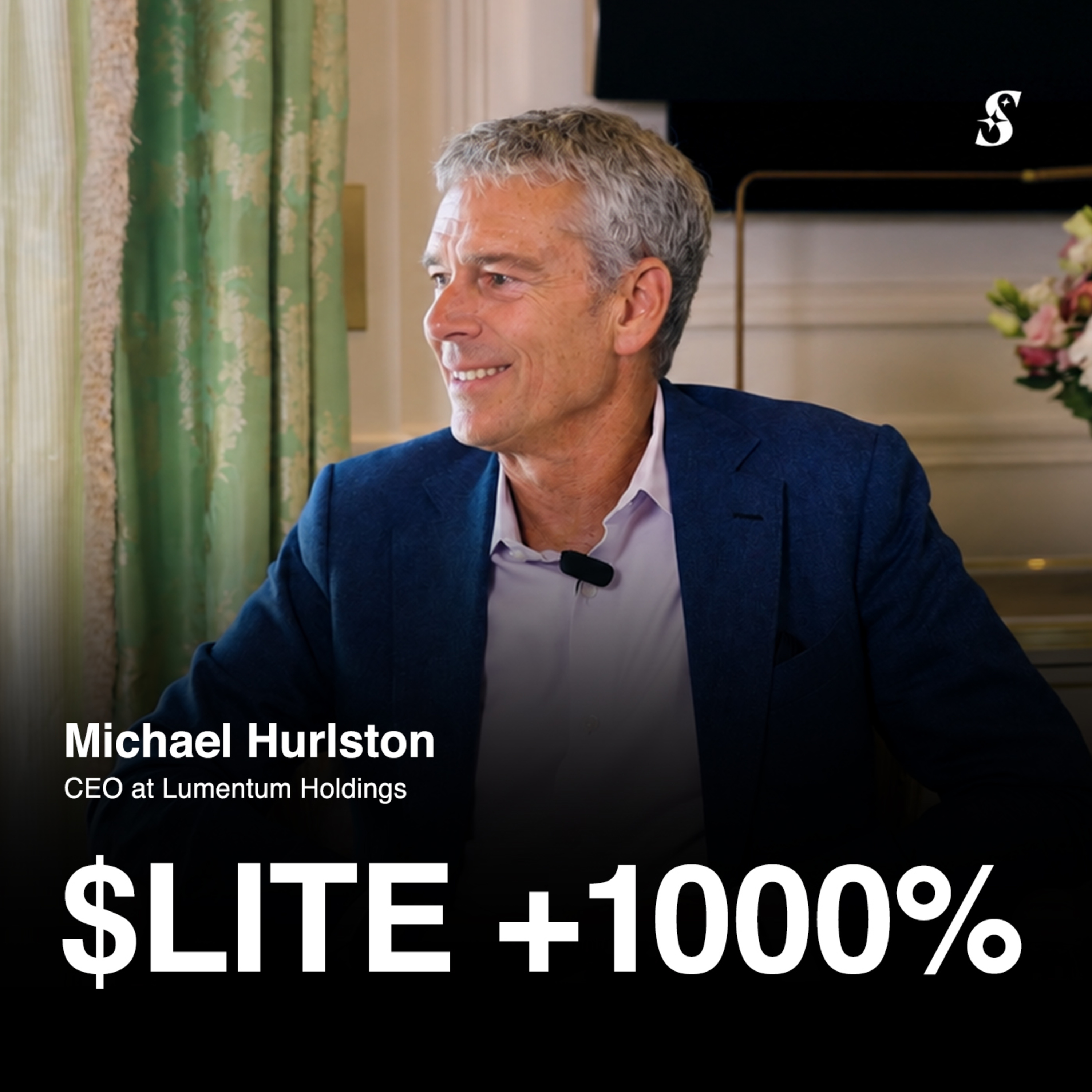
I joined Lumentum at a time where board of directors showed me a forecast and they said, hey, here's what we think the company is going to do. And I of course discounted it by about 50%. And it's been probably 4x over what they even showed me. I've been there about five quarters now, and in those five quarters we've tripled our top line revenue. So the stock price has gone up 10 or 12 times. One point it was up over $1,000. We have a high performing stock largely because people are seeing the future. Now we're being asked by these hyperscalers to deploy in millions, tens of millions of units. So it's really changed the dynamic in our industry, not just for Lumentum. Every single optical company now is dealing with different scales than we ever had before. The question we get all the time, and I think you've asked many of the people on your show, is, is this a bubble?
- [00:53]
Sponsor Announcer
Foreign.
- [00:59]
Molly
Welcome to Sorcery.
- [01:01]
Michael Hurlston
Molly, thanks for having me on. Really a pleasure.
- [01:03]
Molly
So we're here in Paris at Ray's. Were you just on stage? What were you doing over there?
- [01:07]
Michael Hurlston
I was on stage. I gave a keynote with Tony Kim and I think Tony Kim was over here earlier today talking to you. So you got all the celebs, I guess.
- [01:15]
Molly
Yeah. He's a big fan of you, by the way. I didn't know if you knew that
- [01:19]
Michael Hurlston
he's a big fan of yours too. He told me. He goes, this is a great setup. You'll enjoy it. I've like a lot of fun talking to Molly. So there we go.
- [01:26]
Molly
So what did you guys talk about on stage?
- [01:28]
Michael Hurlston
Optics is becoming a big thing right in the data centers. And Tony was, was trying to sort of framing. We have all these funny terms, scale across, scale out, scale up, scale in. And Tony was walking the audience through what all of these different things mean and what Lumentum's role is in all of that, which is we're in the middle of a pretty exciting time right now as the data center uses more and more optical connectivity.
- [01:54]
Molly
So for people who don't know what optical connectivity means, can you explain that? We're moving from copper wires to optics and transferring data with light. But what does that mean?
- [02:05]
Michael Hurlston
Obviously there are fibers, and fibers are essentially glass. They're just conductors. Instead of having wires, copper wires, you have fibers. And fibers basically contains the light, just like a wire or a copper strand contains electricity. And so what you get with fiber optics is the ability to move data faster over longer distances with Less heat and less power than you get with electricity. So if you think about the way data centers are architected today, it's mostly copper wires, right? Ethernet cables are essentially copper wires and copper wires. The physics of copper is there's a resistive property. So as data tries to move across the wires, it gets hotter and the resistance prevents it from going all that far. So now inside the data center, you have speeds are increasing, bandwidths are increasing, and copper can no longer carry these signals the distances they need to go. And so you have more and more optics now coming into the data center. And optics essentially is just light, right? We're just shining light along a fiber. And that light is modulated, meaning it turns on and off and at really, really high speeds. And that's what creates the transmission.
- [03:31]
Molly
I think it was Tony, we were on a call before our interview, and he was pointing out the great irony of spending $10 trillion over the next couple years on data center build out, to move data from meters down to centimeters and millimeters. So how is this process and this build out, how are you managing it?
- [03:53]
Michael Hurlston
Yeah, look, I mean, you know, fiber optics has been the backbone of the Internet for years, right? So when the Internet first came in, was the sort of the first great wave of the optical companies. And what happened was you're digging up the earth in the United States, in Paris, in London, wherever it might be, and installing these fiber optic cables. Because the Internet now is traveling over huge distances. And so the first real optical sort of the big wave was now building the backbone of our Internet infrastructure across the world. And you actually have fiber optic cables today that run under the ocean. So if we want to have communication that goes between Paris and New York, there are fiber optic cables that are actually buried in the ocean. And those fiber optic cables conduct these signals. But as I said a minute ago, what's happened is now you're going to faster and faster speeds. And when you go to faster and faster speeds, the physics say the copper can't work or it doesn't work as well. And so what you have now is this Internet, this big backbone, this big infrastructure that we've played in for numerous decades. And those volumes are actually relatively modest. You're talking about volumes of, let's say, 1,000 units a quarter. And now we're being asked by these hyperscalers to deploy in millions, tens of millions of units. So it's really changed the dynamic in our industry. Not just for Lumentum, but I think every single optical company now is dealing with different scales than we ever had before.
- [05:38]
Molly
What is it like? And I'm sure there's lots of challenges, but like what is it actually tangibly like getting spun up in these new data centers? What actually goes on behind the scenes?
- [05:49]
Michael Hurlston
There's a lot of manufacturing. I mean, I think if you, you know, you obviously know the industry super well. When you talk to companies like Nvidia and Broadcom, they manufacture most of their products at tsmc, so they essentially outsource the manufacturing problem. The optics industry doesn't have that luxury. Right. It's a very sort of niche industry. It's one that's, that's grown up over, you know, multiple decades. And so for us, we actually operate our own fabs. So in some respect, we're like the TSMC of the optical industry. Optics depends on a different material. Semiconductors use something called cmos. And all of the semiconductors that you know well are built on CMOS. Memory is built on CMOS. TPUs are built on CMOS. The Nvidia GPU is built on on CMOS. But lasers and fiber optics are built on a different material called indium phosphide. Kind of a mouthful, but it's this indium phosphide and that's a very boutique thing. It's a little more of a niche. And so we actually have to make our own indium phosphide products. We have to manufacture those ourselves. And that requires pretty long lead times. Right. It takes us multiple years to build a fab and it requires a lot of expense. So we're a very capex heavy company. We spend a lot in trying to build out and manufacture our products and it takes a while. So there's a bottleneck that's developing. I think you talked about it with Tony. And as, as these fiber optics becomes more and more prevalent in the data center, it's creating an ever tighter noose around the industry because there's only so much we can do so quickly.
- [07:41]
Sponsor Announcer
This episode is brought to you by Brex. My favorite. You become what you spend on and I refuse to spend my time on work that shouldn't exist. Expense reports, receipt chasing and manual closes the companies building. What's next from Vercel, OpenAI, Anthropic Granola and Deepgram all made the same call. They all run on Brex. Brex is the intelligent finance platform that combines cards, expenses and banking into a single stack. With agentic finance built in AI agents that handle expenses automatically, enforce policy before spend happens and close your books in minutes. That's why sorcery runs on Brex. So I can spend time on building and not busy work. It's time to get Brex AF. Learn more at brex.com Sorcery that's B R E X.com S O U R C E R Y Bye.
- [08:39]
Molly
That supply constraint is creating a lot of demand, but it's also creating tremendous demand for the stock, which is crazy to see. The stock was up, I think almost a thousand percent at one point. How do you handle that mentally as a CEO when you know that you are constrained?
- [08:56]
Michael Hurlston
It's tough. I mean they, you know, the, the interesting thing that the question we get all the time, and I think you've asked many of the people on your show is is this a bubble? Right. And what's interesting about the optical industry is if there are no more data center buildouts, if you don't see this crazy rate of construction that we've seen over the past three or four years still, you're going to have a shift within the existing properties from electrical signaling to optics. Right. And so we our growth rate, which has been astronomical, we've grown three times, been with the company only a short period of time. I've been there about five quarters now. And in those five quarters we've tripled our top line revenue. So the stock price has gone up, you know, 10 or 12 times. As you correctly point out. At one point it was up over $1,000. It's come back, I think on a lot of the concern around AI over the last couple of weeks. But we have a high performing stock largely because people are seeing the future and seeing the future start to play out where you have more and more optical components going into these data centers. It's driving super high demand for products.
- [10:13]
Molly
So you joined a CEO in 2025. What is it like to take the reins in the craziest market ever and also give a little bit of your background of where you were before?
- [10:26]
Michael Hurlston
Yeah, I mean this is, you know, an interesting thing. I think if you look at most CEOs, they either retire or somebody retires them for them. You don't see too many CEOs change jobs. And I've actually been lucky enough now to be CEO of three different public companies. The first public company I was a CEO of is a company called Finisar that was optical. That's now the heartbeat of one of our biggest competitors, but also one of our biggest partners in coherence. Coherence built around the engine that was Finisar that we ended up selling to them. Then I was a CEO of a semiconductor company. I'm mostly a semiconductor guy and I was CEO of a company called Synaptics for five or six years. And then I joined Lumentum, as you're pointing out, at a time where the board of directors showed me a forecast and they said, hey, here's what we think the company is going to do. And I of course, as one does, discounted it by about 50% and it's been probably 4x over what they even showed me. So we've just hit the company with the right products at absolutely the right time. Really. Our team team. Before I got there, the previous CEO set it up well, right products, right roadmap, and we have all of the goods that people are looking for now as they convert their data centers to more and more of the fiber optics.
- [11:52]
Molly
How do you manage that plan and keep pivoting the strategy as you over perform?
- [11:58]
Michael Hurlston
You know, actually what we've tried to do, Molly, is simplify. Right. So I think when I came into the company there was a lot of products that were geared toward the old telecom industry selling still to AT&T, to Verizon. There were products that we were doing that were around industrial lasers. Interestingly enough, their lasers are used to cut metal for car doors. They're used to machine different parts. And we had a business in that. And what I've done is said, okay, look, let's focus on our efforts on the data center. There's enough here going on that we really want to simplify our business as much as we possibly can, focus on where we think the biggest opportunities are, and that's the data center. So we've almost become a pure play data center. Got some risk, right? If the data center ends up rolling over in that market, hiccups a bit will be, we'll be caught. But I don't think that that's going to happen. And even if, as I said a minute ago, you start seeing a slowdown in data center builds, we're in really, really good shape because you still see a conversion inside the data center from, from electrical to optical also.
- [13:11]
Molly
They're going to space.
- [13:12]
Michael Hurlston
They're also going to space. Yeah. Our buddies at SpaceX are trying to do these build outs and obviously lasers are super important for all the same reasons. If you can put a laser in the ocean and transmit across the Pacific, you can certainly put lasers in space and create this reality of an Internet in space. Right. It's going to be necessary. There's a lot of, there's a high Degree of difficulty outside the lasers, but we can help enable that.
- [13:41]
Molly
It also sounds super cool.
- [13:44]
Michael Hurlston
It is super cool. I mean, lasers are used today, as you likely know, in things like the Iron Dome, right? Lasers you use to shoot down enemy missiles. So they have been deployed in space. These are not nearly as powerful.
- [13:58]
Molly
Right.
- [13:58]
Michael Hurlston
As those things, but we've had a lot of experience as an industry and certainly our company and deploying products in space.
- [14:07]
Molly
That's a really good point. Okay, so we did this interview with Tom Mueller, who was the first employee at SpaceX and we were talking about data centers in space and we put out the videos and in the YouTube comments, you know, there's a lot of fear mongering about birds and killing birds with the lasers and all, all that kind of stuff. So can you dispel some of the misconceptions about lasers and their strength?
- [14:29]
Michael Hurlston
Yeah, look, it's all about power. I'll give you a really good example, right? The iPhone with the face id, that's a laser product that beams lasers onto your face. And you know, one of the concerns of course Apple had was hey, I want to have people's eyes burning out.
- [14:44]
Molly
Right?
- [14:45]
Michael Hurlston
So the power of those lasers are relatively modest and you're never going to burn somebody's eye out. Similarly, you're not going to have birds burning up as these laser shoot data down to the, to the earth. Right? It all has to do with the power. You can have these super high power lasers that can shoot down missiles that can cut through metal. You can have modestly powered lasers that power the Internet backbone and you can have these super low powered lasers that do things like the face ID.
- [15:14]
Molly
It's pretty cool.
- [15:16]
Sponsor Announcer
If you're building what's next in AI, you need to know MongoDB, the database platform developers love and built for the agents you're running. MongoDB stores searches and reasons over your data in real time with vector search and embeddings from Voyage AI all in the same system. No separate pipelines, no stitching together 10 different tools. It's why 75% of the Fortune 100 and leading AI native startups run on MongoDB. Build and scale from your first user to billions of vectors. Go to mongodb.com AI to learn more. That's mongodb.com AI to learn more. Bye Assembly AI is a voice AI infrastructure layer millions of developers build on. They build the industry's best speech to text, voice, agent and speech understanding models that serve as critical infrastructure for companies like Granola. Heygen Ashby and ClickUp their speech to text models lead the industry in accuracy and quality. And their speech understanding models help you go beyond transcription by uncovering insights, identifying speakers and highlighting key information from voice data. You can get started today at AssemblyAI.com sorcery and get $50 of free credits to start building Voice AI products.
- [16:35]
Molly
Products.
- [16:35]
Sponsor Announcer
That's AssemblyAI.com S-O-U-R C E R-Y okay,
- [16:42]
Molly
so thinking about the future, what do you mostly, I don't even know if you could plan out this far to be honest, but what are you most looking forward to in maybe a time horizon that makes sense for you? But I usually say 12 months.
- [16:54]
Michael Hurlston
12 months. Look, I. One of the things that, that we will see within the next 12 months is this opportunity idea of we call optical scale up. Okay, and so what is optical scale up? I know you talked to Tony earlier today and he's one of the bright minds in the industry, very lucky to get that conversation. Optical scale up. If you look at a rack, you look at one of these servers that gets deployed by a hyperscaler and you go creep around the backside. There are a ton of ethernet cables. I mean, you probably use ethernet in your house today, maybe to wire your PC as you're doing all your work at home or in the office. There's an ethernet cable that plugs into the side of the PC, right? And if you look at a rack, there's tons and tons of these ethernet cables, miles and miles of wire that run in the back of the servers. And in the next 12 months, we'll see some of those copper wires move to optical. Now the reality, and Tony and I were talking about it earlier today over at the conference, optics is more expensive. So people don't want to do it if they, if they don't have to. It's a more expensive medium than is copper. Copper is a well trod path. People understand it, people understand the expense that there is and generally they'll try to avoid using optics. But it's getting to a point where the physics of the back of that rack, that connectivity that sits in the back of the rack is such that you have to do it. And so we already have a lot of fiber optics in the data center we don't have yet. We don't have deployments in these racks themselves. We have a lot of connections inside the data center that go out. We call scale out, but we don't yet see scale up. I think in the next 12 months we will. And that's going to Drive volumes that are unprecedented in the optical industry. Right. Volumes of tens, hundreds of millions of units where again, we're sort of used to dealing in scales of thousands.
- [19:00]
Molly
Where is the craziest place that this has taken you?
- [19:03]
Michael Hurlston
Yeah, that's a good question. I mean, you know what's interesting and you probably appreciate this, most of the hyperscalers and the strength right now is in the US Right? So US Market has been incredibly strong. Our business is very heavily centered on the US China is a difficult market. Right. And you've talked about this, I think, in some of your previous shows. The geopolitics of China are very tricky. Between the US Optical component suppliers and how much we supply into the Chinese data centers, very little. We don't supply very much gear into the Chinese data centers. Whereas Chinese optical component suppliers, some of our competitors, have a pretty big footprint in US Data centers. So there's been a lot of push and pull around the geopolitics of the situation. Are we going to see a world where it gets mandated by either the government or by the customers themselves to use more U.S. content? We'll see. Right now, China has a pretty. Chinese suppliers have a pretty big presence in the U.S. market.
- [20:16]
Molly
Okay, well, as we close out, I have one question dedicated to one of our partners. It's Brex. They're a performance credit card, corporate credit card. So they're all about spending smarter, moving faster. But I take this in a personal lens. So I'm really curious. From your standpoint, you've built up a tremendous career. You've been CEO of three public companies. I like to think performance component of that is like, who you surround yourself with, who you're mentored by, who you're inspired by. Those types of figures along the way. Who are those figures for you?
- [20:47]
Michael Hurlston
Look, I've been super lucky. I mean, you know, you talk about Brex and performance and I think you, you've got the right theme and the right partner for what you're doing. I've been been very lucky. My father, interestingly enough, was an electrical engineer. He was one of the first electrical engineers that came over from Europe. He actually was based in the United Kingdom and came over just shortly before I was born. And he had a tremendous influence. He told me as I was growing up, you can have any major you want in college, just as long as the last word is engineering. Electrical, mechanical, civil, I don't care. Gotta be an engineer. And he had tremendous impact, I think, on me. And then as I got in my career, I spent a lot of Years at a company called Broadcom, which I know you've covered pretty extensively. Broadcom was a very interesting company in that it was bought by Avago, and then the name stayed. The Broadcom name was the surviving name. But there was a gentleman at Broadcom, a guy called Bob Rango, that I worked for for years and years. And Bob served on several boards and had a long and prestigious career. But he had a lot of impact on me, sort of as a business guy and how I think about business problems.
- [22:07]
Molly
It's amazing. Tony. Tony said dead people.
- [22:11]
Michael Hurlston
Okay, that's a different one. That's a different one. See, Tony's a historian, right?
- [22:15]
Sponsor Announcer
He.
- [22:16]
Michael Hurlston
You know, I asked Tony about the World cup, and he. He's like, who's playing? Right. He focuses on very much on history and art and things like that. He's got a place here in Paris.
- [22:27]
Molly
Yeah.
- [22:27]
Michael Hurlston
So he's a very erudite gentleman, so I can't compete with that, Molly.
- [22:31]
Molly
He said Caesar and Napoleon, and we're like, all right, you're on another level over there.
- [22:37]
Michael Hurlston
When you win. Yeah, you win. He's a. He's a brilliant guy.
- [22:41]
Molly
Amazing. Well, Michael, thank you so much. Appreciate you taking the time.
- [22:44]
Michael Hurlston
Thank you. Thank you for having me in this beautiful. A beautiful place here in Paris, overlooking the Le Tuileries. Right? Not too bad.
- [22:52]
Molly
I didn't know that's what it was called, but now I know.
- [22:55]
Michael Hurlston
There you go. You guys learned. See?
- [22:57]
Molly
Thank you.
- [22:58]
Michael Hurlston
Thank you.
- [22:59]
Sponsor Announcer
Huge thank you to the entire Raise team for an incredible event. And thank you to Brex, MongoDB, and Assembly AI for making this trip and series possible. If you enjoyed this conversation, you're going to love the rest of the Raise series with Tony Kim from BlackRock, Scott Wu from Cognition, Andrew Feldman from Cerebras, Rodrigo Liang from Samanova, Michael Hurlston from Lumentum, CJ Desai from MongoDB, and many, many more. Like our hot takes that we did at a secret location that you can find on X, YouTube and Instagram. Subscribe to Sorcery on YouTube for more conversations with the people shaping AI and join the free newsletter. You can also do paid at. Sorcery VC for weekly insights on AI, robotics, enterprise software, consumer semiconductors. Did I say AI? AI again. And everything that's coming next, like funding announcements and all big things in tech. Thank you. Bye.