Loading summary
Transcript365 lines
- [00:00]
A
Not flying blind. My name is Israel Slatowitz. I'm the founder and CEO of Craft OpenAI just announced that they're going to be public. We're seeing like not just insane wealth creation moment, probably the largest we've seen in the history of humankind, but we're also seeing shift in how people spend their wealth. The most sought after thing once you make some money is start flying private. It's like the one thing everybody looks to do. It's truly a unique tool that nothing else replaces.
- [00:26]
B
What does like a Jeff Bezos have? What does Elon Musk have?
- [00:29]
A
So when you think about like the Jeff Bezos of the world and Lar, Larry Page and Sergey brin, they're typically G700 global 8000 category, that's like the top of the line. If you buy a 10 million dollar airplane, you could take a 10 million dollar business deduction the year you bought the plane.
- [00:44]
B
This is why people are buying 75 million dollar airplanes.
- [00:47]
A
That's exactly what people are buying. There's no other reason.
- [00:59]
B
Izzy, welcome to Sorcery.
- [01:00]
A
Good to be here. Thank you.
- [01:02]
B
What are we doing right now? Where are we?
- [01:04]
A
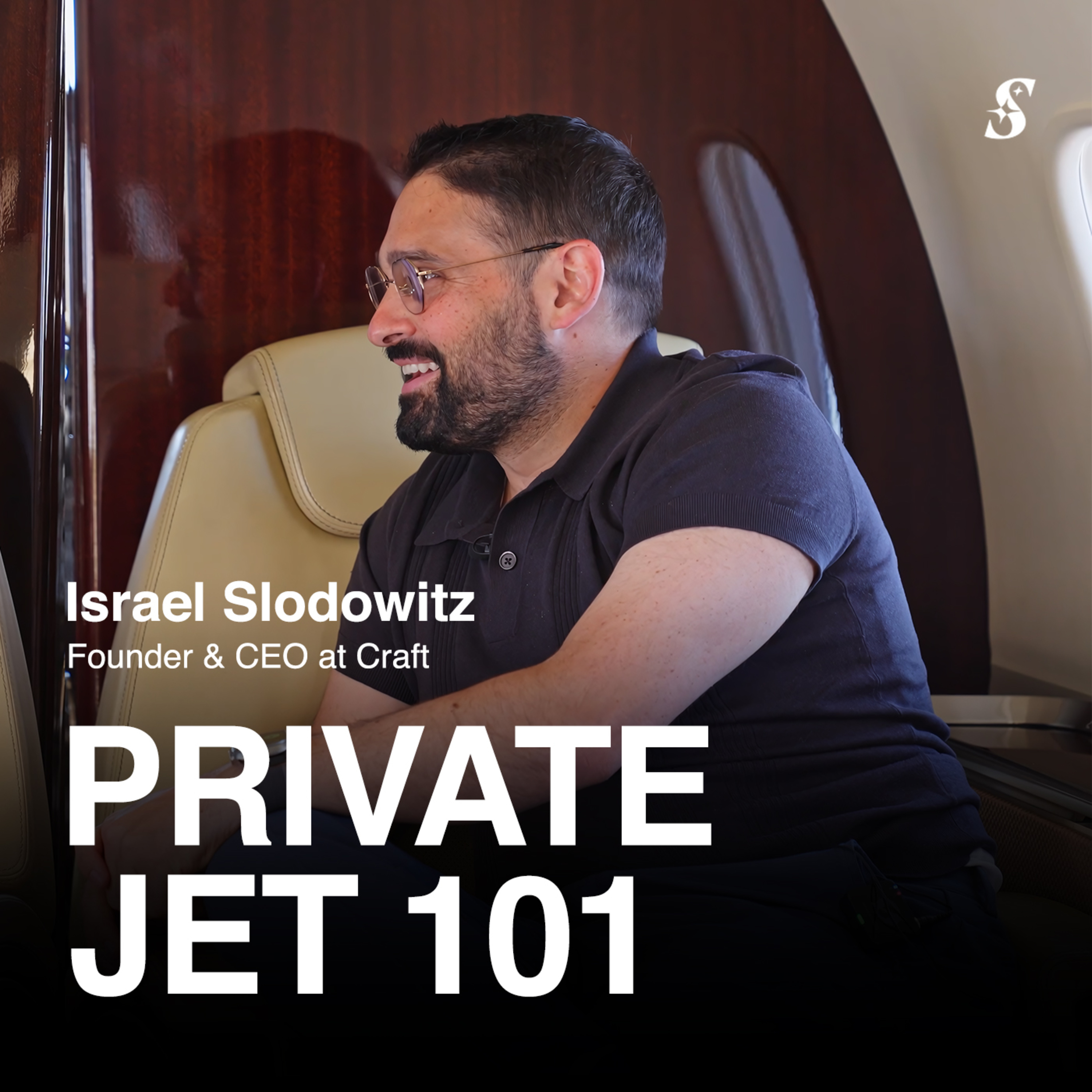
We're sitting on a Challenger 350. This is a super mid aircraft that can fly coast to coast, New York to California. You can fly California to Hawaii or to Europe. This is one of the aircraft that we operate in our charter company. I operate a Part 135 charter company that I started six years ago while I was still in college. We now operate a fleet of these. We have pilots and we fly them all year round. We do a lot of supplemental flights for NetJets and Flexjet and wheels up and all the large providers. And I'm excited to talk to you about what we're building and about the industry.
- [01:40]
B
I'm excited. I came across you guys through LinkedIn and these posts. You were doing some collaborative posts with some of the interviews that we've done. I did this amazing series with Michelle del Buono of a 16Z perennial, which is Mark and Ben's multifamily office. We did two episodes so far and it's all centered on the major wealth creation event that's happening right now. We're about to have more millionaires and billionaires minted than ever before with the OpenAI SpaceX IPO, anthropic IPO, the Cerebras One that just happened and all the secondaries and tenders that are going on also behind the surface. But right now we're in this crazy period of time where where a lot of people are going to be making a lot of money. And so with these conversations I've been trying to get down to, okay, what do you do once you have that wealth? How do you manage it? And one of the topics in the conversation on wealth management is private aviation. So I'm really excited for to talk about this today and I'm just really curious, so are we seeing more private jets? What's the state of the market?
- [02:49]
A
Yeah, I mean, so it's like you said, it's absolutely insane what's going on right now. We're sitting here on a Sunday. SpaceX is supposed to IPO this Thursday. So some of our clients and a lot of our investors are going to be in New York for this iconic ipo. It's probably the largest IPO by twice as much as the last one. And this is just the first of many. Right? OpenAI just announced that they're going to be going public and we're seeing like not just insane wealth creation moment, probably the largest we've seen in the history of humankind, but we're also seeing a shift in how people spend their wealth and their priorities and also the type of wealth that they are generating. It's not the same wealth that was generated historically where people kind of built a business over many, many years and they slowly diversified new money. This is just like completely new money. So, so there's like this massive tsunami that's hitting and we're seeing it in our business, we're seeing it in the preferences of what people are choosing, how they're accessing private aviation. And of course, like, of course the most sought after thing once you make some money is to start flying private. It's like the one thing everybody looks to do. It's truly a unique tool that nothing else replaces.
- [04:09]
B
So how is that changing? Who's buying jets versus who's chartering them? What is the difference?
- [04:15]
A
First of all, we're seeing people entering the market buying bigger airplanes. So this airplane for an example, this is a Challenger 350. It's considered a super mid. It's considered what I like to call a proper jet. It has a flat floor. Normally people would sort of enter the market by starting to charter or they would start with getting a light jet. And people are now going straight for the super mids, straight for the heavy. They're going straight towards buying like the, you know, or buying or even chartering the latest and greatest. So we're just seeing like this big sort of skipping of steps that we are accustomed to in our industry. The other thing that I'll say about our industry is, you know, if there's almost 8 billion people in the world, if 0.0001% of them are flying private today and that doubles, which I think it's going to more than double to 0.0002, that has like a huge cataclysmic effect on our industry. Like why?
- [05:15]
B
What do you mean?
- [05:15]
A
So our industry is just not really built for like the manufacturers, the OEMs, the supply chain, engines, parts, the speed at which these factories are able to build airplanes, the speed at which you can train pilots.
- [05:26]
B
Are we going to have a shortage?
- [05:27]
A
There's going to be a huge shortage, yeah.
- [05:29]
C
Yeah.
- [05:29]
A
I mean these are obviously depreciating assets. Airplanes, you know, airplanes are equipment. Right. They don't go up in value normally, but we're seeing them go up in value for the first time almost ever, especially in the higher end of the market. So that like small little change in wealth, which I think is actually huge, is something this industry is not at all ready for. And I think we're going to. There's going to be a lot of adjustment and price fluctuation and uncertainty until, until like the, the new, the new wave sort of takes effect, I guess
- [06:00]
B
to give more of like the 101 behind all the sizes and pricings and that kind of thing. Could you walk through, you mentioned it before, but like can you walk through all the sizes and then up to like, okay, what does like a Jeff Bezos have? What does Elon Musk have? Drake has a very weird plane, but that's just him. And that was a deal. But I'm curious, could you like walk through all the different planes and like when you should start at which one and then obviously we can talk about the different kinds of financing options for those. But I guess first let's start with the sizes and the prices on them.
- [06:34]
A
Yeah. So typically like the, the entry level, what was the entry level would be something like a, maybe a light jet. So like a Phenom 100 or a Phenom 300. It seats about six. You can fly about an hour, two hour flight. Step above that you go into the mid size category. Citation Xls or Latitude are like the popular ones. Step above that we go into the super mid category. This is like as I call it, the proper jet, which is what we're in today. Super mid category. You have like the Challenger 350 like we're in today. And then there's the Praetor 600, also a phenomenal airplane. Above that we go into the heavy jet category. So think of like a Gulf Stream G450. People are flying these heavy jets quite frequently, even on short missions. So we're seeing people who have large families that want to travel that they're like, we don't even want the light or super mid. Like they're going straight for the heavy, even on a two or three hour flight. And then of course if you want to go to Europe, you would do something called an ultra long range. Something like a Global 8000 is like the top of the line. So when you think about like the Jeff Bezos of the world and the Larry and Sergey Brin or Larry Page and Sergey brin, they're typically G700 global 8000 category, that's like the top of the line.
- [08:08]
B
And you fly too?
- [08:09]
A
I fly. I'm a pilot as well. I'm a certified pilot. I only mostly fly for fun now I have a full company to manage and, and keeps me quite busy. But I am certified in this, in this airplane actually.
- [08:19]
B
You're flying today?
- [08:20]
A
I'm not gonna be flying today. Yeah, yeah, we have two great pilots on board, but I'll be flying from back here.
- [08:26]
B
So walking through all of those different options, when does it make sense to buy a plane versus charter?
- [08:34]
A
So the traditional logic is somewhere between 150 hours a year to 250 hours a year is when you want to start thinking about owning a plane. But I think it's important to really understand why and it's important to understand what are the reasons you really want to own a plane. The first reason is the flexibility. So when you charter or when you even own a fraction of an airplane, there's usually like long call out, usually at least a 24 hour notice call out. And they're not very flexible on changing your time when you want to leave. So I have an example of a customer of ours that flew to, he had a bunch of warehouses in the Reno area. He lived in San Francisco and, and he flew, and he owns a plane and he flew his plane to, to Reno to go visit his factories. And initially his scheduled like return was supposed to be for 6pm but by 1pm he was done his tour. So he decided, hey, text my pilots and see if they're ready to go. And by the time he got to the airport, the plane was all buttoned up and they were, they were out four hours early. When you're chartering or when you look at like a fractional ownership, it's a lot more difficult to do that. So there's like some flexibility I think in owning a plane. And even if you're flying less than 150 hours, you might want to consider owning just because if you need that like 4 hour less sort of call out. On the other side of the spectrum, owning a plane is extremely complex. It's basically running a little mini airline. You're dealing with pilots, you're dealing with maintenance.
- [10:04]
B
Do you have to put that in an llc? Like does that, how do you actually make that like tax advantaged?
- [10:09]
A
Yeah, I mean typically all aircraft are in a single purpose LLC like an spv and they'll usually be like under the business. So an llc, it's owned by the business and then the LLC will have a lease agreement in place with the business for tax efficiency. But yeah, so I think like on the, on the other side of the spectrum, owning airplanes complicated. There's a lot that goes into it. We'll talk more about that. So we're seeing people that are even flying 300 hours a year. They're like, I don't want to deal with owning a plane. And I think actually like that's one of the big differences in this new generation of wealth. These people don't want complexity. Most of them are able to book well in advance. They're not last minute people. They are willing to book seven days in advance, two weeks in advance. They don't need that four hour call out most of the time. If they do, they can file other options. And those people would rather simplicity, ease of use. They don't want to deal with the complexity of owning a plane. So in some cases even above 300 hours, it doesn't always make sense to own. But typically in that sort of range, the second reason you own a plane is for cost efficiency. So once you start hitting the 250 hour range, the cost of owning and spreading the pilot costs and all the fixed costs around around one aircraft flying $300 a year starts to make much more sense.
- [11:24]
B
Okay, let's go through a scenario. You just bought a Global 8000. Walk through the financing of that and the maintenance. So this is an extreme example.
- [11:33]
A
I'm aware it's extreme example, but like
- [11:35]
B
let's shock the people.
- [11:36]
A
Yeah, Well, I think like first of all, Global 8000 is like a $75 million airplane. Right? Just to put things into perspective. So that's like extremely expensive airplane to buy. It's really like the, you're, you're going for the, for the top of the line. Most people don't actually buy brand new. Even if they can, they don't. Right. So the maintenance for a brand new airplane looks very different than a maintenance for maintenance on a used airplane. Most people tend to buy used aircraft. Aircraft that are pre owned, that's what it's called. Whereas a new aircraft, you'll have like warranties and all sorts of. The manufacturer will give you all sorts of stuff like that. Make the maintenance cost a little bit less expensive. But say you bought a global $8,075 million, typically the first thing you have to think about is depreciation cost. So the aircraft do generally go down in value, right? They generally do not go up in value. So if you factor in a 10 a year reduction in value, the when you go to sell the plane, you're not gonna be able to get as much money back. So a lot of people kind of ignore that. But you really want to bake that into the cost of running the plane. Then you need to hire pilots. So you'll have to go out and find pilots. Typically you'll want at least three pilots, especially if you're going to fly longer missions. Pilots get sick. Pilots need to go on go to training twice a year. So you'll need to hire three to four pilots. That might run you one to two million a year. There's insurance costs, there's hangar costs and then there's maintenance costs of course. Right. And maintenance cost is kind of where everybody gets, they buy the plane, they think it's like it's great investment. And then they're like now the plane's down for six months because the windshield breaks or they can't get a part for the engine. So maintenance is like another area and this is kind of where people maybe try it out and then swear off after doing it for, for some time.
- [13:31]
B
Go through the different prices of citation G 450. We obviously just went through Global 8000 but maybe just talk through the starter kind of prices.
- [13:43]
A
First of all, there's a journalist called Doug Golan who has a website called Private Jet Card Comparisons. He does a great job. If you are very serious about flying private and you do want to get like the latest pricing on jet cards on different aircraft categories. Highly recommend looking into Doug Golan but I think the pricing is somewhere around 7, $500 for entry level light jet per hour to fly about $9,500 an hour for a mid size. So most people are actually you know, buying not, it's not that they can't buy New, they don't buy new because buying new is like very, very expensive. But if you're buying sort of pre owned airplane, a light jet will run you around 3 to 5 million bucks. A mid size something like this will be anywhere from 10 to 20 and a heavy jet, maybe 20 to 30 million dollars. Just the sticker price just to get into the airplane. Buying the plane is just the beginning of the journey. Right. That's the cheapest part of owning a plane. Then you have the pilots, the fixed cost, the mains cost, the fuel cost. You're probably looking at anywhere from 2 to 4 million bucks a year to run the plane, just, just, just to keep it running for you. So as you can see, it's very expensive. And unless you really have a need for it or a good, a real business need for it, it's something that a lot of people will, will do and then they'll swear off of it.
- [15:08]
B
Since we just went through what full ownership looks like, let's get more to like what people really most people actually do. And so there's a couple different options where you can charter, you can get a jet card and then you can also do fractional ownership. What can you just define for people who don't know, like define what each one of those are and then how the pricing changes.
- [15:30]
A
Yeah. So typically the way people first experience private aviation is maybe they've heard of like an empty leg. Right. They've jumped on an empty leg. What an empty leg is, is where the plane maybe has one trip landing in la, another trip the next day is departing out of San Francisco. So the plane will need to move reposition between LA and San Francisco. And sometimes companies will sell that as an empty leg and for a significantly reduced price because they have to go anyways. So sometimes people get experienced to private aviation through these empty legs. But I think it's probably worth glossing over because it's not really the utility. And the reason people fly private, Right. Like an empty leg is more of a luxurious, more of an experiential type of transaction. People buy airplanes or people fly private, they typically do it as a utility, as a way to conduct business or for, for like ease of comfort with their family. And they want to be able to go on their schedule. They don't want to be flying on someone else's schedule. So typically the way somebody will enter the market is through, through charter. Usually the first taste they'll have a private aviation. We operate a charter company, we charter our airplanes out. Chartering a plane can be Great. But could, because you don't have all the commitments, but you really have to be careful of, like, safety. It's very hard to know what you're going to get. And the prices can fluctuate quite drastically. So one day it might cost you like $12,000. The next day it's costing you $24,000 for the exact same flight. Right. So a lot of times people will charter and then say, you know, why are the prices fluctuating so much? And then they'll upgrade to what's called jack card. I'll explain to you what a jack card is. A jack card is essentially prepaid charter. So you're giving a deposit to somebody and they are essentially sourcing charter for you at a fixed price. So rather than one day paying 12,000, the next day paying 24,000, they'll charge you 18,999. Right. And, and you'll pay for both flights $18,900. So actually, you're actually paying a little bit more than you would have paid during charter, but you at least know when you want to fly, it's going to cost you 18,099. So you're really getting essentially more expensive charter. So it's, it's. And, and also jet card is typically like where you'll first maybe get a taste of a netjets or a flexjet type of experience, because they offer jet card services as well. So that's typically where you'll maybe first enter into the, the bigger leagues of flying private.
- [18:08]
B
And then where does fractional come in?
- [18:10]
A
So fractional comes in really at the next, the next step. Right. So fractional. So you've maybe, maybe you flew some charters and didn't like that. You got, kept getting different airplanes and different prices. You got a jack hard and, and you just gave them a massive deposit and you realize it wasn't that much better than charter. So you decide, okay, now I want to like, maybe move to the ownership side of the aisle. And fractional is really on the ownership side of the aisle. So the main difference between the two is that on the fractional, you know, you're, you are carrying the residual risk of the plane. So if the airplane depreciates that, the cost of the depreciation, the cost of capital, essentially on your dime, not on the charter company side. So you're getting a more consistent experience. You're getting an ownership type of experience. So you're getting a premium sort of product, but you're also paying a premium for it because you hold the essentially the residual risk of the aircraft. So fractional and the two largest providers is NetJets and then second largest is Flexjet. Do a phenomenal job. And you can essentially buy a 18 or a 1 16th of a plane. They'll manage all the operations. The pilots you'll never have to worry about. Maintenance plane will be there at hours or 24 hours notice and you're sort of getting a taste of, of ownership.
- [19:31]
B
You run a charter business. How is it different?
- [19:34]
A
Basically there's two, there's two sides to craft. There's like our operating business, which is like somewhere in between. The fractional and the Jacquard were mostly like a B2B company. We sell to all these other larger companies which are brokers on these platforms. But what makes it interesting is that we actually, because it's an operating business and we generate cash, we are able to run this exchange fund which is a completely separate financial product that's designed for people that have low basis stock exchange funds. Are you familiar with exchange funds at all? Yeah. So exchange funds, you know, a simple way to explain it is like, you know, 10 people come together with 10 different stocks and they all contribute the stock into a fund and they all get the benefit of owning. What people don't realize is that unless you have an operating business to run it through, like you have a business, right? You have income, you have cash flow, right? So you have a business you're running, you're, you're running everything through. Unless you have an operating business to run it through, you're, there aren't really any tax benefits. If you're like a SpaceX employee and you have a lot of stock, right? You're not, you don't have a business to run this airplane through. So not only are you paying like sticker price for the flights, but you're actually paying almost double that because you have to sell stock to fund it. Right. So this is, I think one of the problems with this sort of new massive wealth creation and just the onslaught
- [20:55]
B
of Silicon Valley becoming so big and all these people with like huge equity values.
- [21:01]
A
Yeah, it's, it's insane. And, and the, the legacy models of like putting your, buying an airplane and running it through your business and taking tax write off, like it doesn't quite work for these people. Their net worth is in capital gains, not in ordinary income. Yeah, right. So we actually built an exchange fund which is a very old financial product or financial structure where people can diversify. People, bunch of people can contribute their stock into a fund pool Together. Kind of like a potluck, right, where everybody comes with a dish and they walk away with a meal. And. And one of the requirements, one of the rules for these funds to exist is that there needs to be an operating business in the fund as well. And historically, exchange funds have used real estate and public storage units in Albuquerque, right? And like self storage, like things that people don't care about. And what we did was we took an already existing thriving operating cash flow business, right? And we basically layered an exchange on top of that. And what that allows us to do is it allows us to offer the members in the fund access, premium access to these planes. They wouldn't be able to get otherwise.
- [22:10]
B
Wow, you have VCs on your website. Did you raise venture capital? Like, how did this start?
- [22:17]
A
Well, it actually just started by understanding that my problem was their problem. My problem was that I realized that when I had a single airplane, I had a very volatile P L profit and loss statement, right? So like one month we had, like, very profitable. The next month it was like, very unprofitable because there was some sort of maintenance issue or a pilot left. And. And what I realized is, like, as I started adding more airplanes to my fleet, I realized that the volatility started to come down. And then while one airplane was down, four airplanes were flying. And one airplane was down, six airplanes were flying. And I realized that the customers that I was flying had the exact same issue. They didn't really have a private aviation issue. There are many options when it comes to private aviation, all very good ones. But what they did have was a stock problem, right? Big part of their net worth was concentrated in a single company. They were one article, one news report away from losing 13, 14% of their net worth in a day. Right? IBM lost 13% of its value in a single day. I think Broadcom just now, just this past week, lost like 10% in one day on a single earnings call or a single article that Anthropic is building some sort of software, right? So people who have now built this, like, sort of generational wealth for the first time were also had a volatility issue. And I realized that I had the same problem my customers had. And that's when I started to, like, learn about exchange funds and understand how they worked and their mechanics and do deep dive. And ultimately, like, came to my customers and said, hey, this is like what I'm building. And. And they were like, immediately very interested. And that's kind of how we, we've pivoted into this exchange Fund model Sorcery
- [24:04]
C
is brought to you by Brex, the financial stack trusted by more than 30,000 companies, including one in three venture backed startups in the U.S. nearly 40% of startups bail because they run out of cash. Rex is literally built to help founders avoid that. Unlike traditional banks that let your money sit idle chipping away at it with fees, Rex is designed to help you spend smarter and move faster. Their all in one solution combines checking treasury and FDIC protection into one powerful account. You can send and receive money globally at lightning speeds, get 20 times the standard FDIC coverage through their partner banks, and even high yield from day one with same day and even same hour liquidity. Access your funds anytime. Companies like Scale AI, DoorDash Service Titan, Hims Anthropic, Flexport, Robinhood and Plaid Trust and use Brex. Start today at brex.comsorcery that's B R E ex.comsorcery Turing is training the next generation of AI with tasks that require real expertise and real world judgment. That's why companies like Nvidia, Anthropic, Salesforce and Gemini partner with Turing. Turing builds realistic reinforcement learning environments and data systems based on real operational traces. The kind of infrastructure Frontier Labs need to train superintelligence. Visit turing.coms o u R C E
- [25:33]
B
R Y okay, Izzy, we are now flying. We're in air. It's actually not that loud. I was really worried about that.
- [25:41]
A
It's pretty quiet.
- [25:41]
B
There's pilots in the cockpit. You just walk through the different types of financing and ways to fly private. But what is the most economical way to fly private?
- [25:55]
A
On a friend's airplane.
- [25:57]
B
Okay, it's free. How do you find these friends?
- [26:03]
A
That's the key question. I think like the, the, the truth is like flying private is not economical. There is no real economical way to do it. It's a very expensive thing and it's really a matter of like priorities. If it's something that is important to you, if you see like the utility of it as important to you in life. But flying private isn't cheap. There is no, there is no cheap way to do it.
- [26:24]
B
Yeah. Last year in 2025, I think it was publicly reported that Alex karp spent around $17 million on flying. And it, if you, if you kind of like do some of the math on the price and the per hour, it came out to around three months in the air.
- [26:43]
A
Yeah, yeah, I think I, I saw that, that report and it's probably like, I think they have like two airplanes. I think Maybe the way they, they leased it back from, to the company. They, they, they did some, they probably structured it as like a dry lease or something. But yeah, that's, that sounds like they're in the air a lot. I mean you see like SpaceX, Elon Musk, like they're, he's flying like. Yeah. I mean I'm sure you've seen that clip of like, you know, one year of his flights. Like you just, there's just things you can't do without private aviation. You just can't do it. Like what we're doing today, just being able to go to San Francisco for the night, have a few meetings tomorrow, and then come back when we're done. You just can't do that.
- [27:18]
B
LA is the best commuter place for people in San Francisco. You don't live in la, you don't get it, but it's very beautiful. Okay, I have a really fun question. Who do you think flies more Elon Musk? Alex Karp, Jeff Bezos, Taylor Swift or Jensen Huang?
- [27:37]
A
I think if the answer is easy, Elon Musk. Elon, absolutely.
- [27:41]
B
Even though it's mostly domestic.
- [27:42]
A
Yeah. But I mean, I think first of all he flies international as well. But like, I mean he's running what, how many companies? A lot going between each company. And he like goes in office and, and is there in person. I remember when I was like, just get like starting to, starting to fly out of Hawthorne Airport. I used to see his plane come in and land and see him get off and on and it was just very inspiring.
- [28:01]
B
So Preston makes a lot of content around the financing of Preston private aviation. What does he mostly cover? Like what should people be reading?
- [28:11]
A
Yeah, so, so Preston Holland, he has a podcast, he talks about aviation finance in general. He's a broker, so he's good. If you're looking for, if you're looking to buy a plane, you're looking for a loan, he'll help you find a bank. Financing a plane is kind of like financing a car. Right. The bank, a bank will want to securitize the aircraft, the file lien on the airplane, and then they'll also want to look at your personal financials and make sure you have the ability to repay the loan. Financing fractional is a little bit more difficult. So if you go to like NetJets for an example, they have their own in house financing department so you can get a loan there. But most other fractionals, there's only a select few banks that will, that will do finance. Actually a fun fact is that only 30% of aircraft have loans on them.
- [28:56]
B
Really?
- [28:57]
A
Yeah, 70% of people closing cash. And a lot of it has to do. It's just very difficult to go through the process, get a loan. A lot of people don't want to like personally guarantee these loans. And how are they just closing cash? Don't want to deal with the hassle. I'm working on a company right now called Radar, which is focused on providing financing for people who want to do asset back. Like no pg, non recourse type loans for aircraft because they are really good assets to finance against.
- [29:26]
B
So what are the biggest mistakes people make when they're buying a plane?
- [29:32]
A
It's a great question. A lot of times people think that they'll find like a better price on the market for a plane. So sometimes people won't sign an exclusive with a broker, like a reputable broker though. They won't sign an exclusive and they'll say, you know what, whoever brings me the best, best price, I'll buy their plane. And what ends up happening is you have all these sort of like back to back shady transactions that happen sometimes where, where somebody will bring you an airplane and they buy it for much cheaper and they flip it to you and you don't really know what's going on. When you have a reputable broker that you have an exclusive you sign with, they will, they will tell you if you're overpaying for the plane, right. Because they are like interest is making sure you get the best airplane for the best price. So a lot of times people think that they're going to save some money and they're going to, they're going to find some good airplane. They find some like off market airplane. They think it's a really good deal. They buy it and they realize there was like four transactions before. So I think that's like a pretty big mistake people make.
- [30:24]
B
What questions should they be asking in any of these processes from chartering to buying, whether it's the year of the plane, what kind of inspections they should be looking for, insurance, that kind of stuff.
- [30:35]
A
I think corrosion is like really the big thing that gets you when it comes to buying airplanes. There's nothing that will be more expensive than corrosion.
- [30:43]
B
Because that sounds terrifying.
- [30:44]
A
It is very terrifying financially terrifying because like if you discover corrosion in an airplane, sometimes they will have to re engineer an entire component for an actual part of the plane. That could take months and cost like hundreds of thousands of dollars. There's probably nothing that will cost you more money on an airplane than a Problem with regard to corrosion, especially with regard to the engines.
- [31:07]
B
What about insurance? Like, what do you. Or inspections and that kind of stuff. Like, what are you.
- [31:12]
A
Yeah, I mean, aircraft have engine insurance. It's called engine program is what they're. What they're called where the manufacturers insure the engine. I've heard stories of people not enrolling in these programs. I think David Sachs said that he wasn't enrolling his aircraft in engine programs. I guess if you have the balance sheet and you want to and you're willing to withstand, you can afford a pretty big event. If something happens and you're willing to. You could afford a few months of downtime. You could do that. But really, you know, these engine manufacturers, they really have a monopoly on the supply chain of the engines. So if you're not on a program and something happens, you get to the bot. You go to the bottom of the list for the parts. It is a big issue. And the companies like us and other companies that can get together and they have some negotiating power, can go to these, These manufacturers and get. They have some leverage. But if you're buying. You're a single person buying an airplane on your own, a single airplane, you don't have a lot of leverage, and things can get very expensive. We're in a cockpit.
- [32:12]
B
Okay, you were talking, or as we call it nowadays, a flight deck, you were talking about. Wait, really?
- [32:18]
A
Yeah, they changed it.
- [32:18]
B
They changed it?
- [32:19]
A
Well, I guess.
- [32:20]
B
Why did they change it?
- [32:21]
A
I don't know. Maybe it's, like, a little bit more politically correct.
- [32:25]
B
I don't understand why. Well, cockpit's not politically correct.
- [32:29]
A
I don't know. It's. They also changed. It used to be called airmen is what they. A pilot was considered an airman, and now it's maybe air person. I don't. I don't know. Yeah. So, yeah, pilots have to go every. Every six months into simulator training. It's about a week long. And you sit in something that looks just like this. So everything's about the same. It's full motion. So you feel turns and everything. And you, You. You go over all sorts of emergencies and different sort of stuff. But I think something interesting that I found going from being a pilot to being a founder, that's really helped me as a pilot. You know, when you're. When you're flying the plane maybe over Las Vegas and you're, you know, an hour out from L. A, you're already starting to think ahead about the landing in L. A, you're thinking about what the weather's like there, what Runway you're going to be using, what the, the sort of arrival is going to look like. So even though you're still over Las Vegas, you're kind of really thinking, thinking an hour ahead of time. And I think that running a business is very similar. Right. Like you're, you're. Even though there's stuff you're dealing with today, you're, you're, you're dealing with things that are happening on the day to day, you're also thinking ahead and making sure that you're planning for, for the arrival. So I think that's, that's something that, you know, just the training of being a pilot help helps in some ways with being a founder.
- [33:48]
B
What's been your favorite part of being a pilot?
- [33:52]
A
Getting to meet all very incredible people.
- [33:54]
B
Really?
- [33:54]
A
Yeah, absolutely.
- [33:56]
B
How many people have you flown?
- [33:57]
A
I've flown quite a bit of people. I think it's like, you know, there's the celebrities and, and everybody wants to hear about the people we fly. But I think that really getting to know on intimate level people that like building like these good relationships with the businessmen, like the venture capitalists, people that really see private aviation as like a utility and a tool for them getting to spend time with them, getting to talk to them, talk to them about my business, like, these are just like an incredible experience that someone like me who dropped out of high school would never otherwise get to interact with. So I just think like meeting some really incredible people. I would say.
- [34:39]
B
What do you think the biggest misconception is about private aviation and the glamour about it?
- [34:45]
A
That's a great question and I have a great answer for you.
- [34:48]
B
Okay.
- [34:50]
A
People think it's a luxury. People think of it, they sort of, they compare it to like a yacht. Right. But like, you know, you cannot, you, you go on a yacht for. You could spend a week on a yacht. You don't spend a week on a private jet. Yeah, right. They think that private, a private jet is a luxury. And in reality, this is a tool to allow people more time to do more. Today we're going to go to San Francisco. We got some meetings. We're going to come back tomorrow. Right. Like, we wouldn't be able to leave on our schedule, come back on our schedule and get so much done without private aviation. I think that there's a common misconception that it's a luxury and it really isn't. And I think that a lot of times private aviation companies tend to mask what they're doing with luxury because of how cake the pricing is because of how expensive it is, and it's very expensive to fly private. There is no cheap way to fly private. People like to mask that with this idea of luxury when it really isn't. It's just a tool.
- [35:49]
B
How big of a difference did it make on the business or at least the experience when you guys got Starlink?
- [35:54]
A
A huge difference. We've been operating Starlink from basically the moment that they came out. We started off with the Starlink minis and then eventually when they got the full certification, we installed the full certification right away. But it is a, the only, the only way to describe it. It's a game changer. Like, people today won't fly if you don't have Starlink. They won't get on the plane to be able to continue what you're doing. Like, if you have zoom calls, just be able to have that continuity. You know, these other, the other, the other systems out there, like, they're, they have good connectivity when you're in the U.S. but they kept, they, they have lags. They, they work and they stop working. They work, they stop working. Starlink is just like an absolute game changer. And all of our aircraft have Starlink. And I think there's a, a dish right there.
- [36:36]
B
Oh, my God. Yeah, there's literally. It's just a dish.
- [36:39]
A
No, no, we have an actual Starlink on top of the.
- [36:41]
B
Oh, yeah, this is just an extra.
- [36:43]
A
This is like a backup.
- [36:44]
B
Yeah, this is a backup. Backup star.
- [36:46]
A
Yeah, we fly. We fly lots of fintech companies, founders of fintech companies that are, need to
- [36:53]
B
be on the market.
- [36:54]
A
They are on like, they, they don't take their foot, their head out of their computer the moment they get on the plane to the moment they get off. Right. So, like, having the best of the best is.
- [37:04]
B
I have a hard question for you that's very important. How long and what is the process like for installing Starlink and why are the commercial planes taking forever? Because I think majority of planes, their wifi is a scam. So, like, what it, like, what is the actual truth there?
- [37:21]
A
Yeah, well, I mean, it's good. We're seeing some airlines now say they're gonna, they're gonna install Starlink. I think United and American both signed an agreement signed for their whole fleet. I'm not sure why Delta didn't do that. I suspect they're probably gonna lose some customers because of that. I think right now Starlink is changing their whole assembly line for their new version of the disk, which has like, the ability to download Much more like it has, has higher bandwidth than, than the current dish that we have right now. It's almost double. So I think that they've decided that they were gonna stop production, upgrade the production line, and then now they're starting to roll out with the new one. So I, I think, I think we're going to see it start, start to roll out quick, quickly. Of course, commercial aviation seems to get a priority over private aviation sometimes.
- [38:05]
B
Really, I feel like none of them even have it on any of their planes. Like I, So I, I interviewed Jake Paul. He just got a beautiful new plane and I asked him if he had Sterling, and I think he said he doesn't yet. And it takes three months to get it installed, so you have to ground it and that kind of thing.
- [38:20]
A
Yeah, we, well, not to ground the plane. That's a little extreme. But we, maybe there's something else going on there. But we, I mean, we, we have orders for Starlink kits all the way through, like end of next year, all the way through end of 2027. So yeah, you have to put down, put down deposit, and then they, they start, they come about three, three months apart. So, yeah, so we have like all throughout next year, Starlink kits being sent. It's about 3, a $300,000 cost to install on an aircraft like this, very slightly on a bigger aircraft or smaller aircraft. But to me, if you're flying private, if you're flying private and you don't have Starlink, why are you flying private?
- [38:55]
B
Exactly. It's a good place to leave it. Anything else we should talk about while we're in the cockpit? No. Or the people pit or whatever you call it now?
- [39:02]
A
The cockpit. The people pit. The flight deck.
- [39:04]
B
The flight deck. Anything else? Do you have a favorite button?
- [39:09]
A
Are you going to put that one in? Yeah, absolutely.
- [39:12]
B
We're keeping that in.
- [39:13]
A
Oh, no. Favorite button?
- [39:14]
B
Yeah. What's the favorite button?
- [39:16]
A
Well, this is the autopilot disconnect button.
- [39:18]
B
Okay.
- [39:19]
A
This right button here. And this is when you actually start to fly. Pan. Fly it yourself. So it's always nice to every once in a while take over and, and, and fly. I try to stay away from the buttons that have red on them in general. Not quite sure why they just, they say don't touch scare you? Yeah, don't, don't touch the red buttons.
- [39:36]
B
Okay.
- [39:37]
A
This is like our, our power lever. So this is like when you want to, when you're ready for takeoff, you push that forward. That's like hitting the gas pedal in
- [39:44]
B
your car and you can just touch that while we're.
- [39:46]
A
Well, right now, right now the engines are not running.
- [39:48]
B
Okay.
- [39:49]
A
So. So, yeah, so but when the engines are running, when the engines are running, that will, this will produce all the, all the power. So you can watch on takeoff as the, the pilots advance. This, this is, this is the lever of where we put the landing gear up. So once, once the airplane's in the air and we have a safe distance from the ground, the pilots put the landing gear up and then these three gears is the left gear, the right gear, and the nose gear will come up. My favorite button is probably this button, the autopilot.
- [40:13]
B
I feel like I shouldn't have asked you this question because I'm getting so nervous whenever you touch anything.
- [40:19]
A
Yeah. So, yeah, so my favorite button is the autopilot button. It's one. Once we get in the plane and once we're up, once we're, once we're off the ground, you push the autopilot button and autopilot and chill.
- [40:29]
B
So one of my friends got their pilot's license a couple years ago and I, I asked, I was like, when you got your pilot's license, was it like getting your driver's license and like feeling the freedom? And he was like a thousand times more than that.
- [40:44]
A
Yeah.
- [40:44]
B
Did you like, Is that how you feel?
- [40:46]
A
I got my pilot's license before I got my driver's license.
- [40:49]
B
Really?
- [40:49]
A
Yeah. I got my pilot's license on my 17th birthday.
- [40:52]
B
Okay.
- [40:53]
A
Which is the legal age to get it actually, at this airport right here, Van Nuys Airport. And, and I got my, my permit maybe when I was 16 and a half, but I think I got my driver's license at 17 and a half. So I was flying airplanes by myself before I was driving a car by myself. And it is one of the greatest feelings of agency that you can have, especially as a 17 year old, to fly an aircraft on your own. And I think that that maybe is another thing that has led me towards continuous agency in my life and continuously wanting to build and do more things.
- [41:38]
B
More pilots. We need more pilots.
- [41:40]
A
We do need more pilots.
- [41:41]
B
Okay, cool.
- [41:43]
A
What do you think of the cockpit?
- [41:44]
B
I think this is really fun. It's very intimidating.
- [41:47]
A
What's your favorite button?
- [41:48]
B
I feel like I shouldn't be sitting here. I don't have a favorite button because I don't really know what any of them do.
- [41:56]
A
You can push this button in if you want.
- [41:59]
B
Why?
- [42:00]
A
Just to see what it does.
- [42:01]
B
I push it?
- [42:02]
A
Yeah, just push it down.
- [42:03]
B
No, I don't want to Too scary. Is that going to make the plane
- [42:06]
A
go,
- [42:10]
B
I have to get out of here. What's the most common cause of downtime and not being able to use the aircraft? Because I know people who have bought recent aircrafts. I don't know the model or the year or anything like that, but then they're all of a sudden stuck servicing it, or the plane's been down for like a year or more and that kind of thing. Like, so what are the most common causes and how do you avoid that?
- [42:36]
A
I mean, an airplane like this, there's tens of thousands of individual parts on the plane. 80% of the parts, if they're broken, the plane's down, you can't fly. So there is like 20% of them that we get exceptions that we can fly certain amount of flights until it can get fixed. But almost the vast majority of the parts on this plane, if they fail, if any of these components fail, planes grounded. And sometimes, like we were talking earlier about the supply chain in this industry because of all the demand of all the aircraft coming in, these manufacturers are trying to build as many airplanes they can as quickly as possible. And their priority is the newer airplanes that they can sell to brand new customers. Right. So their priority is not supporting the existing fleet. It's more on delivering as many new airplanes as quickly as possible. So you can sometimes find yourself down for several months because of a windshield that breaks. We just replaced a lav panel for the toilet in the back of the plane. $25,000.
- [43:41]
B
No.
- [43:42]
A
Yeah. Just for, like, a little laugh, paddle a set of brakes on this aircraft. Over $100,000.
- [43:48]
B
What is the deal with people talking about the windows popping out?
- [43:52]
A
What do you mean?
- [43:53]
B
That I've heard from a couple of people, like, there are stories that the windows will pop out and people will get crushed lungs.
- [44:01]
A
I've never seen that.
- [44:02]
B
You've never heard that? No, I've heard it. And now they're making planes without windows.
- [44:07]
A
Well, I think the plans without windows is actually a very interesting idea. And that has more to do with like, the. The airframe shape. Right. They're like. There's one company, I think, that's building a newer, like, design for these airplanes. It's supposed to be more efficient. I don't know much about it, but it sounds pretty interesting. And they're like, hey, I don't know why we need the windows. They can just do screens on the side. But I don't think that has to do with windows being crushed in.
- [44:29]
B
That's like, not like the whole Fun
- [44:30]
A
about is looking outside, looking out the window.
- [44:32]
B
Like right now we're looking at like beautiful California. California, best place on earth. There's farms down there, there's lots of mountains. You can't see it. Sorry.
- [44:41]
A
But yeah, I don't know. I think I would want to have windows in my plane. Seems to, it seems to me like
- [44:47]
B
we'll have to put up a poll.
- [44:48]
A
Yeah.
- [44:49]
B
How many people?
- [44:51]
A
I would be curious to see what they're what? People. People.
- [44:54]
B
So I wanna, I guess like this is an interesting point because you, you mentioned that there's going to be a shortage of planes and, and everything as more demand increases. Right. As more demand increases, I assume all the prices are going to go up.
- [45:08]
A
Buying a plane is really just the beginning of the torture, right?
- [45:12]
B
Yeah.
- [45:12]
A
It's everything that comes after buying the plane that really makes you maybe regret your decision.
- [45:17]
B
Are you gonna like, like are netjets, Flexjets? Are you are like is Aero, like are they. They're just all gonna increase their prices substantially? Like how does that work?
- [45:27]
A
Yeah, I mean, I think there's, we're already seeing like massive wait lists at these fractional programs. Like the, the, the line to get a ticket, to get into an aircraft is maybe two, three years ahead of time. If you wanted to order a plane right now, a brand new plane from a Bardier, they'll probably take you three to four years until like I think they're delivering now into 2030. Right. You can always find like you can actually buy a slot from somebody so somebody else who got. Was in line. People are actually like reselling these slots because people want like planes sooner. So there's already like a huge, huge demand for these aircraft and we are seeing the market price of them trade a little higher over time. But again, like at the end of the day, they do depreciate. It's not. The aircraft are not like real estate. Right. They do depreciate over time. They get wear and tear, they get fatigue. And then at some point there's a newer airplane with a better, a better like sound system or something, you know, that people like and, and zero windows. Zero windows, yeah. And over time the value that airplanes will go down. But we have been seeing in the last couple of years like a very weird phenomenon where the price, like we bought this airplane and now it's worth like more than we paid for it.
- [46:36]
B
Really?
- [46:36]
A
Yeah, like almost $2 million more.
- [46:38]
B
What?
- [46:38]
A
Yeah.
- [46:40]
B
Why?
- [46:41]
A
Just because there's like such a lack of, of supply, like of good airplanes.
- [46:46]
B
That's Crazy.
- [46:47]
A
Yeah. Another thing that's worth talking about is like, there's just different types of aircraft are some are better than others. Right. So like sometimes people think, okay, I'm gonna buy this airplane, it's cheaper. But we're on like the Challenger 350. This is like one of the most sought after airplane. This was the first airplane when I started my company seven years ago. I started with the Challenger 300 and we still have that Challenger in our fleet today. But flying just as much as it was flying back then. Certain airplanes have better, like parts availability, better pilot training engines if you need, like if you need to put on rental engines on the plane. So it does matter what type of aircraft you buy, especially if you think you're going to start flying like heavy volume.
- [47:25]
B
Have you seen people make the wrong decision in buying a plane by buying too small of a plane? Like, at what point do you realize that? Yeah, so I know the trend now is buying heavy and buying really large. But do you see like you obviously come across people, extremely wealthy that probably buy tiny planes too and you're like, what are you doing?
- [47:46]
A
So, so I know someone who, who just recently had a liquidity event and he exited about $500 million. And he decided first thing he's going to do is spend 400k on a global 8000 or 7500 charter to Europe. You know, and he, and he, and so, you know, he, he spent 400k, but 400k is still significantly less than 75 million, which is what it would cost to buy that plane. Right. And he flew to the flight and he's like, you know, that was nice, but I don't know if I need this airplane. Like maybe, maybe I'll get like I'll go one step down. So my advice to people is really maybe charter a couple times. The plane you think you might want to see if it's really what you want. Because the cost to have to buy a plane and realize it's too small or too big and then you have to sell it could be very expensive. It's much cheaper to charter a couple times, see how it goes. And, and then if you like it and you really want to buy the plane, you can buy the plane.
- [48:44]
B
We haven't talked about this yet, but it's a huge deal. It's actually a very big beautiful deal. The big beautiful build. But can you talk about, I think they renamed it. Did they really?
- [48:55]
A
I think so. I don't know what they remained.
- [48:57]
B
Well, that's what I don't know.
- [48:58]
A
Yeah, yeah.
- [48:59]
B
But can you talk about how the government is now helping write off aviation?
- [49:07]
A
It's really writing it off in a huge way. The big beautiful bill is not the first time we've seen this. In 2017, Trump announced the Tax Cuts and Jobs act, which was the first bill that introduced bonus depreciation. And then it phased down over time and it was reintroduced in 2025 with a big beautiful bill. But essentially what bonus depreciation is, is it allows you to expense the entire value of the plane the year you buy it. So if you buy a $10 million airplane, you can take a $10 million business deduction the year you bought the plane. Even if you financed 80% of it, maybe you only put down $2 million on the airplane, you get to take a $10 million expense in your business. And if you're in California and Your income is 51%.
- [50:01]
B
My ears popped.
- [50:02]
A
Yeah, we're, we're in our descent to San Francisco. If you're in California and you're paying 51% taxes, right. You're essentially, rather than paying the government $5 million in taxes, you can buy a $10 million airplane, put down $2 million, reinvest the other three. So this is like, as you can imagine, a huge unlock for people.
- [50:23]
B
So this is why people are buying 75 million dollar airplanes.
- [50:26]
A
That's exactly what people are buying. There's no other good reason.
- [50:29]
B
That's amazing.
- [50:30]
A
Yeah. The, the only thing is that it does need to be used in a true business purpose. You have to have a defensible business purpose for the plane, and you have to use it 51% or more in business use. Now, this brings up a very interesting conversation because most of the liquidity and the wealth being created today, specifically with the SpaceX IPO. Right. And in the tech world is not from people who have businesses. These are employees at companies that have been working there their whole life. They, they skipped like five steps in the wealth, in the wealth generation phase, and now they want to start flying private, but they don't have a legitimate business to run their aircraft through. Right. And on top of that, they're also, most of their wealth is in the stock market, which is capital tax, capital gains, which even if you had a legitimate business purpose to buy the plane, to write off a plane against, you would only be writing off if you write off, if you write off your capital gains, when you sell the plane, you have to pay something called recapture. And recapture is where you basically have to tell the government, now, I sold the plane and repay the taxes on whatever you sold the plane for because you told the government it was worth zero when you initially bought it. Recapture is always taxed at ordinary income rates. So if you buy an airplane and try to offset capital gains, right, which is like, let's say your SpaceX shares, and then you sell it five years later and you recapture at ordinary income, you're essentially taking a very high interest loan from the government. You saved some tax today, but you paid way more taxes when you sold it. So this, So I think this is going to be a big headwind for this new era, this new generation of wealth and the current model, the traditional fractional ownership models. I think this is going to be a big headwind because the current structure does not quite fit this type of consumer.
- [52:46]
B
What kind of background checks do you need to do with new clients, new flyers?
- [52:51]
A
Well, when we, Whenever we fly someone on an airplane, they go through standard, like tsa. We run their name against the no fly list. If you're gonna buy a plane, you're gonna get a loan. There's gonna be like KYC and aml. So like standard, like, no different than if you were opening a bank account. But that's really it.
- [53:10]
B
Did you see the Mr. Beast winner who got caught smuggling drugs?
- [53:16]
A
I think I saw it. That was pretty ridiculous.
- [53:18]
B
What was? It was like, how does anybody.
- [53:20]
A
Was it on the plane that he won or was it on a different plane?
- [53:23]
B
I think it was on the plane that he won.
- [53:24]
D
Huh.
- [53:25]
B
I would imagine, yeah. That's crazy.
- [53:28]
A
Well, like I said, when you buy an airplane, buying the plane is the cheapest part of the equation. You have to maintain it. So maybe, maybe he needed some cash flow to keep it going.
- [53:37]
B
Maybe that's what incentivized him to get the plane in the first place. Maybe he had a big mission ahead of him and he. It was his job to win the Mr. Beast contest in order to complete the mission.
- [53:45]
A
Yeah, I think like every once in a while you see these, these things. But that, that was, that, that was pretty crazy when I heard that, that
- [53:50]
B
story this pretty wild. How long do you think it would take to sell a jet Today I've
- [53:56]
A
seen as, as quick as one hour.
- [54:00]
B
One hour?
- [54:01]
A
Yeah. There was a G650 that just sold in one hour.
- [54:03]
B
To who?
- [54:04]
A
It hit the market and then it just sold an hour later. I, I have no idea.
- [54:07]
B
Where's the market? What's the market?
- [54:08]
A
There's, there's an auction.
- [54:09]
B
Is there like a Sotheby?
- [54:10]
A
There's like brokers and they, they talk to each other and. Yeah, so I mean we're, we're seeing like stuff as short as one hour. And then like sometimes if it's a bad airplane, it could take six months. But it's a pretty, it's a pretty liquid market today.
- [54:23]
B
Damn. Okay, I'm really curious about this. I fly a lot. Is it true that if you fly private you have less jet lag?
- [54:32]
A
I think the best benchmark in the commercial space is the Boeing 787. And the Boeing 787 has a cabin altitude of just under 8,000ft. If you looked at the sort of the best example in the private jet market, like the Global 7500 that has a cabin altitude about 3100ft.
- [54:53]
B
What does that mean?
- [54:54]
A
So it means that your, your, the, the altitude that it feels like you're at when you're flying is significantly lower.
- [55:02]
B
Oh wow.
- [55:04]
A
Than on the commercial airline, which makes a big difference for fatigue. So I actually think this is the one area that actually especially on long missions can make a very big difference if you're going, if you're flying somewhere for a business meeting and you don't want to be groggy the whole day and then on the way back having like a caveat. And there's all sorts of cool things happening. Right now we're seeing airplanes that have like circadian rhythm lighting. So they'll actually, you program your destination and it'll figure out you know where you are, where your destination is and it will change, change the lighting, careful lighting around the time of day so that you can adjust your body. So maybe we don't need windows in aircraft as long as the, as long as the lighting adjusts. But yeah, there's all sorts of interesting things that could happen that do make a difference on long trips. Especially if you're flying a lot and you're high functioning person like Elon Musk or Jensen and you need to be places.
- [55:55]
B
I genuinely like, I get jet lag from flying LA to New York. I did it back to back for two weeks and then after that I was like, I need an iv.
- [56:04]
A
Yeah.
- [56:04]
B
And then I ended up in the hospital. Do you do lie flat sometimes? If I can afford it. But what, what is surprising to me is I will get so jet lag from that, doing that twice a week. And then sometimes I'll go to San Francisco in between and then I'm completely dead. And then you see videos of Jensen Huang. He's in San Francisco one day, he's in Taiwan the Next. He's in China, he's in D.C. like he is all over the place. It's crazy. What is the secret?
- [56:34]
A
Well, I mean I think he's an incredible, he's an incredible entrepreneur and founder and business leader. But no, I think you're obviously running a business and you could see the difference between like losing, losing days, right? And I think that's why privatization is really such a tool that allows you to do so much more, unlock so much more and like really unlock like save days like full days that otherwise you would have been like sleeping or, or groggy because like, because you know you got, you got stuck in the system. It's really like a incredible I think in some ways non negotiable tool.
- [57:07]
C
Today's episode is sponsored by VCX by Fundrise, the public ticker for private tech allowing investors of all sizes to invest in venture capital. Learn more@get VCX.com Some of you may not have heard this yet, but our sponsor Public just launched something called Generated Assets. And it brings AI into investing in a way I've honestly never seen before. Here's how it works. You type in an idea like AI powered supply chain companies with positive free cash flow or defense tech companies growing revenue over 25% year over year. Publix AI then dispatches a swarm of agents that scan every single US stock, evaluates them and instantly builds a custom index around your thesis. What really stands out is how clearly it explains why each stock is included. And before you invest, you can even back backtest your idea against the S&P 500. So you're making decisions with real context, not just guessing. And beyond Generated Assets, Public lets you invest in stocks, bonds, options, crypto, all in one place. They'll even give you an uncapped 1% match when you transfer your investments over from another platform. If you want to build a portfolio that actually reflects your thesis, visit public.com Sorcery paid for by Public Investing Full disclosures and in the description Enterprise AI runs on Merge, the AI infra platform for integrations, agent tooling and model orchestration. So your teams ship product, not plumbing. Mistral, Dropbox and Drata already trust merge in production. Start building@merge.dev founders scale faster on deal. Set up payroll for any country in minutes. Hire anyone anywhere, get visas handled fast and get back to building. Visit deal.comsorcery that's D E L.comsorcery so you're a pilot.
- [58:53]
B
You've been flying for over 10 years. You fly a lot. What are your biggest health hacks?
- [58:58]
A
I don't know if I'm the healthiest pilot, but exactly what people want to hear. Well, I think. I think, you know, you know, flying around is, like. Is not the healthiest thing in general. Like, flying so much, sitting in a chair for that long, you know, like, probably not good. So I'm. I don't fly that much.
- [59:16]
B
You're sitting in a chair, Flying a plane versus people sitting in a chair, like, commercially doing ad sales. Like, totally different.
- [59:23]
A
I guess it's true. But sometimes I think, like, the. When you keep changing time zones, it really messes with you. Right? Like, you're going. You're going across the. You know, you keep changing your circadian rhythm. You're flying coast to coast or across the. Across the Pacific. Like these. These things, over time, they start to really, really, really mess with you.
- [59:40]
B
How do you stay hydrated?
- [59:42]
A
I drink a lot of water.
- [59:43]
B
Just water? You don't add any fancy electrolytes?
- [59:45]
A
I don't know. Am I supposed to really?
- [59:47]
B
Yeah, you're supposed to. That's a whole thing.
- [59:48]
A
I didn't get all the. I didn't get all the. All the tips. Yeah, but no, it's. Wow, look at that. I tell you, there's just nothing like California.
- [59:59]
B
I know. Brad, I wish you were getting B roll of this.
- [60:01]
A
Got to get some B roll of that mountain there.
- [60:03]
B
We haven't covered this yet, but what are the hidden fees that people encounter when chartering?
- [60:08]
A
This is like a whole, whole episode.
- [60:10]
B
Really? Yes, actually.
- [60:11]
D
Why?
- [60:12]
A
And because I'm very passionate about it.
- [60:13]
B
Oh.
- [60:13]
A
The easy one is de icing. So a lot of times, you know, when you fly charter, if the plane has to de ice, sometimes you don't even realize. Maybe it wasn't even snowing, but the plane got in the night before and snowed overnight. And then before you got to the airport, they needed the ice. Sometimes that could be more than twice the cost of the actual flight itself.
- [60:30]
B
Seriously?
- [60:30]
A
Yeah, we've seen it, like, $24,000 de ice bill in Aspen. So deicing is something that charter companies will typically pass along to the broker, which will pass along to you. And it could be a surprise because a couple weeks later you get the bill. You're like, wait a minute, I thought I paid for this flight. And if you read the contracts specifically says they could pass it along. When you work with, like, the fractionals, like netjets, flexjet. Right. Typically, they'll bake it into the price. So they'll include it in the price and they'll sort of absorb it across the system and this way nobody gets any support prizes. The second one and the one I'm much more passionate about is the, is the event fees. So recently we've seen private equity come into the private aviation space they bought, they're buying these FPOs. They're called FPOs, the fixed based operator.
- [61:16]
B
Yeah.
- [61:17]
A
Where you park the planes.
- [61:18]
B
People just sling that term around all the time.
- [61:19]
A
Yeah, people just, people just assume that, you know, but it's, it's basically where the planes park and they overnight where people get on and off the airplanes. And what the private equity companies have kind of realized is that, you know, they can't really adjust the fuel price so much because everybody knows what the fuel price should be. Right. Based on like oil prices. But what they realize is that they have this monopoly on ramp space on the ground and that their only way to really squeeze additional margin out of, out of these businesses is to, to sneak in these event fees. And they've really in the last year or two gotten very egregious. I mean you'll see event fees for, I saw an event fee for Harvard graduation. Like that's not a special event, right? Like, you don't need a special event fee for Harvard graduation. Of course there's super bowl and there's like all those. And sometimes those can get ridiculous. They could be in the 20s or 30s or $40,000 just for a short slot to drop off or pick up again another area where going fractional really helps because these, these companies like they'll buy, they'll Pre, Pre commit 500,000 square foot of ramp space knowing that the masters are going to have, you know, hundreds of arrivals. So it still costs you something, but it's significantly less. But event fees is something that like is really caught everybody by surprise. And I think there needs to be some correction where, where these, these businesses are significantly taking advantage of, of, of their industry.
- [62:39]
B
What's the craziest thing that you've seen
- [62:41]
A
in terms of like a vet visa?
- [62:43]
B
Anything?
- [62:44]
A
Oh, I had Kanye west fly with us and take a picture of my co pilot shoes. What walked into the cockpit said, can I take a picture of your shoes?
- [62:53]
B
Is that how they modeled off the Yeezys?
- [62:55]
A
I guess so.
- [62:56]
B
Really?
- [62:56]
A
I think he was wearing his like big, his like his big boots or whatever. Yeah. So I mean there's like, you know, we see some, some, some pretty crazy stuff, but I think for the most part, like we fight a lot of very normal people, like people who are Just like live their life. They look at this as a way to get more done. And typically really solid people, solid experiences, nothing too crazy.
- [63:25]
B
What kind of safety protocol do you have to keep up with? And especially when people are looking at these planes or these different services, I think it's like netjets that's never had a death. That's how they run their marketing. But what should people be asking or kind of be comforted by on safety standards?
- [63:47]
A
I think Warren Buffett said you should spend every penny you can on safety and then more. Right. So I think the large providers understand the importance of safety and they run very, very safe operations. They understand how much more scrutiny private aviation gets over commercial aviation. And so like safety is like something that is like ingrained in the DNA. When you're chartering a plane, it's a little bit more difficult to, to discern what the safety standard of the plane that you're flying. Like, like you don't really know. If you looked at all the hours flown in 20, 25, 35% were flown at the top five providers and then all the rest was done with all the rest of the hours flown. We're like small charter operators that have five, 10 airplanes, maybe sometimes even three airplanes. So it's a very long tail of operators out there. And when you're looking for a flight, you really don't know what you're getting. So having good broker is very important. Having a broker, a charter broker, not a sailor broker, charter broker, who, who knows the industry, who's visited these operators. They've gone to these like in the hangars and met the, Met the staff, the safety people. I think it's very important having a broker you can trust to help guide you. There is some like online data you can look up. Like the FAA has, has some guidance about, you can see like if the aircraft is on a 135 certificate, if it's like legal and charter charter legal. I think I saw Chamath Polyapatiya posted that he only flies on a plane with Argus Platinum. So I'll talk a little bit about Argus. Argus is like a third party safety rating that comes in and does like an audit. It's really like a pay for play, right? Like you basically pay them money and then they give you a certification. Especially at their like gold rating. Their platinum rating is a little bit more of a in depth. They come to your office, they do an audit. And I think that like, you know, certainly it's better than, than nothing. But I do think we need More. I think we. I do think we need a better system. I'll. I'll. I'll. I'll say I think we need a better system for helping unknown travelers, like from figuring out which aircraft are safer versus which aircraft are not. And I think that's. That. That's a big gap right now in our industry.
- [65:59]
B
Do you have any particular flight rules around safety? Like times you can fly in certain areas or, like, sketchy. I don't know, like Aspen. That airport is sketchy as hell.
- [66:10]
D
Oh, yeah.
- [66:10]
B
I don't like flying there. It's freaky. Do you have any rules around locations like that or. Or what's that one island in, like, St. Bart's like.
- [66:19]
A
Yeah.
- [66:19]
D
Yeah.
- [66:19]
A
So say. I don't think any. Anybody really flies to Saint Bar except for, like, the small little propeller airplanes. There's St. Martin, which is. Which is nearby. Aspen's a very tricky airport, and of course, it's a very popular airport. People like to fly. People like to fly to. It's. I think our fifth busiest airport is Aspen.
- [66:33]
B
Really?
- [66:34]
A
Yeah, maybe sixth actually, behind White Plains. So people. People fly into Aspen a lot. Aspen has its own unique, tricky set of constraints. We don't fly into Aspen at night. We won't do it.
- [66:47]
B
Okay.
- [66:47]
A
Yeah, we're. We're, like, not even allowed to. Like, even if you want to, you shouldn't be flying into Aspen tonight. There's no. There's no good reason to do that. Telluride is another airport that we have some restriction restrictions around. Yeah, I mean, there's a couple of them out there. Jackson. Jackson Hole, Wyoming, Sun Valley. So there's certain airports that we have an extra set of standards that our pilots operate by. We, our pilots use something called a gom, a General Operations Manual, which is like, basically where they have the rules of what they can and can't do within our company. And we have very strict rules about certain airports.
- [67:20]
B
Sounds like mountains are a big issue.
- [67:22]
A
Mountains are a big issue. Mountains and airplanes don't. Don't. Aren't very friendly with each other.
- [67:26]
B
So you mentioned busy airports. So what are the busiest airports that you guys run out of?
- [67:31]
A
I mean, New York, of course, is the busiest. Teterboro is like, where everybody's coming in and out of. From a charter perspective, I think, like, maybe Miami, which is where our main maintenance hangar is and our home base is. Is probably our second busiest airport. Van Nuys, where we took off today, is our third busiest. We have a lot of demand of la, San Francisco, White Plains, then Aspen,
- [67:51]
B
San Francisco Is about to get a lot busier.
- [67:53]
A
About to get a lot busier.
- [67:54]
B
A lot busier, yeah. What do you think that pass off is going to be like? I'm so curious. Are you getting a lot of demand from people in San Francisco? Have they been reaching out yet?
- [68:03]
A
Yeah, they are flying to San Jose. Flying San Jose a lot. Oakland, San Francisco a lot. A lot of people going to Hawaii from there. I guess, like, far. Far enough away to vacation. But San Francisco is, I would say five years ago, was probably not even in our top 10.
- [68:24]
B
By the way, we are landing right now, and I really just wanted to keep on rolling because I wanted to see if Brett could handle this. Right now we have two cameras set up and we're about to touch the ground. What do you think's gonna happen?
- [68:37]
A
Rhett's got a big smile. Well, voila.
- [68:43]
B
Well, we haven't hit it yet.
- [68:45]
A
So we are.
- [68:46]
B
There we go.
- [68:46]
A
We have just touched down in San Francisco.
- [68:50]
B
Brett is still standing. There's a little bit of shaking, but overall, I think you can see it was a pretty smooth landing. We don't have Navy pilots over here.
- [68:58]
A
This is a great flight. This was a great flight and a great conversation.
- [69:00]
B
The best part about living in California and living in LA and coming up to San Francisco for work all the time is it is literally the most gorgeous flight ever.
- [69:10]
A
There's nothing like it.
- [69:11]
B
I try to fly around the sunrise and sunset because you get the real view. Although in the foggy season, you can't really see much, and it's scary. I hate flying in zero visibility. I don't know how pilots do it. Doesn't make any sense to me.
- [69:23]
A
Yeah. Someone very wise once told me that every day in California is a happy day.
- [69:27]
B
You could live here.
- [69:28]
A
Yeah, Every day.
- [69:30]
B
It's a choice.
- [69:31]
A
Unfortunately, it is a choice.
- [69:33]
B
Taxes are brutal, but it's really pretty.
- [69:37]
A
Might be worth it, but who am I to say?
- [69:39]
B
So I think, like, after everything we talked about today, one of the biggest takeaways that I got from you is that flying private is a utility. You save time, you get more hours in the day. We're seeing so many hardcore work maxing types of cultures here in San Francisco, too. It's not just 996, but it's like 24 7. Elon Musk does this. He doesn't even have a time zone. That's what Ashley Vance said. So what's your view on where you think work's going to go with all these liquidity events? And do you think people are Going to work harder or the less.
- [70:13]
A
I think like certain people will, it's like in their DNA they will always work harder. And I think that you're going to see like certain people, especially the people today that are like building, continue to build and for them like having the ability to do be in multiple places in one day, that like, that's going to be extremely important. Having Starlink, we talked about having Starlink on board. I think that's going to be extremely important. Right? To be able to be like connected the entire way and. But I, I think like, I think certain people are not going to work, but I think it would seem to me that the people and they don't
- [70:45]
B
get the tax write offs and then
- [70:47]
A
the tax write offs. I think we're going to see the people who are working hard today will work even harder and we'll do, will be able to do even more.
- [70:53]
B
You're seeing that with your clients? Yes, with Starlink too.
- [70:56]
A
With Starling too.
- [70:57]
B
Okay, so as we close out, thank you so much for everything in the flight up to San Francisco. If people want to reach you, how should they get in touch?
- [71:05]
A
You can come to our website, flightcraft.com you can reach out that way.
- [71:09]
B
Please don't take my LA to SF flights. I would like them.
- [71:13]
A
Yeah, thank you so much. I will see you on the way back.
- [71:16]
B
Okay. All right, so we're now here in San Francisco. We flew all the way from la and I have Izzy with me and Captain Roz. Okay, so Captain Roz was kind enough to fly us. Captain, how did you get your pilot's license?
- [71:31]
D
I started flying in the Air Force, started in the flight academy, got most of my training there. And then I went to a different role in the Air Force. But I always knew I want to be a pilot. So finishing the military service, I went straight to flight school, got my civilian licenses, started as a private pilot. That's where everybody starts. It was just for fun back then. And then eventually I decided to make this a career. So I went back to flight school, professional training and I made it to here, anybody's dream job really. And it's the best office view I can ask for. And that's really the reason why I like doing it. Every time I'm in the air, it's like meditation for me.
- [72:24]
B
What's the longest flight you have flown?
- [72:28]
D
Longest flight, we go coast to coast quite often. The longest that I have flown was probably Hawaii to the East Coast. So was about nine hours of flight challenging?
- [72:43]
B
Do you get cramps in your Legs, you get up.
- [72:46]
D
So these size of airplanes, you always have at least two pilots in the cockpit. So every once in a while you can get up, stretch your feet, go to the restroom if you need a break, maybe nibble on something just to get your blood flowing. It's actually very important to do so on the long legs because the cockpit can get a little cramped. Yes. But we try to also interact with our passengers, which is a whole different aspect of being a corporate pilot, which is very nice.
- [73:16]
B
So I asked Izzy what his health hack is when flying so much. How do you avoid jet lag and how do you not get dehydrated? What's yours?
- [73:26]
D
Drink a lot of water during and before flights. And lotion. A lot of lotion. The air can get pretty dry up there. Jet lag, It's a challenge. Pilots work by Zulu time, right. So international coordinated time. You just get your breakfast, lunch, dinner according to that clock. So it doesn't matter on which coast you're in. You just get your schedule. Because you can find yourself on the east coast and then the next day on the west coast and then even Alaska or Hawaii. It feel it, it you feel it
- [74:04]
A
can be quite challenging.
- [74:05]
D
It is challenging mostly for my wife. When I get back home on the east Coast, I'm jet legged. She doesn't like it, but. But it's part of the job.
- [74:14]
B
So there's a hot take and it's with flight attendants. I want to ask you both, do you need flight attendants on private aviation?
- [74:24]
D
So it really depends on the customers preference. This plane is totally certified to fly without one, and we usually don't have a flight attendant. But as soon as we get up to altitude away from the ground, we're pretty much free. Right. So we have three pilots on this plane. A captain, a first officer, and an autopilot. As soon as we're not task saturated, one of us can get out. And the passengers should never feel that they don't have a flight attendant. We cater, we make drinks, we clean, we entertain them. Everything that a flight attendant will do, we do the same.
- [75:01]
B
What do you think?
- [75:02]
A
I mean, that's exactly right. And I think that what we found is that most of our customers actually prefer not to have a flight attendant. We've had times where we've offered them, like for free. Hey, we have a flight attendant on board. And they're like, no, we prefer not to have one. People want privacy. People like to just have their own space. You know, it's part of flying private, part of the convenience of Flying private is just having, having your own space, being able to just kind of be in your own element, you know, and, and prove your own rhythm. And I think having a flight head as much is small but fade down.
- [75:31]
B
Jsx.
- [75:32]
A
Jsx. That's JSX landing right there.
- [75:35]
B
Yeah.
- [75:35]
A
So I think people just don't, people prefer like quiet. I, I, so that's, I think what we see a lot. Some aircraft, like the bigger aircraft are required to have flight heads. So above a certain number of like seats on board for safety reasons, you have to have flight attendants to have like emergency exit training and stuff like that. Also like when you do long flights, making beds, meals, you know, it's nice to have. But 90% of the missions we have like people prefer no, no. Flight attendant.
- [75:58]
B
I'm really curious for both of your answers on this. I think I know your answer for sure. But what is the favorite type of plane that you've flown?
- [76:06]
D
I never had a bad plane.
- [76:08]
A
Okay.
- [76:09]
D
I like them all single engine props. I still tend to fly them quite often just to keep the skills sharp. This is an amazing plane. I owe my career to it. It will take you far and wide and also to places where you really can't go with anything else. It's great. It will go coast to coast. It will go into the mountains, it will go in the islands. This is the plane I like the most and I have my most experience
- [76:38]
B
on it and has two of everything. So it's super safe.
- [76:42]
D
Two of everything. If, if something fails, we can get safely anywhere, no problem. If we're flying over mountains, over water, this plane is super redundant. They made over a thousand of these, which is tremendous in airplane terms. It's, it's crazy popular. Everywhere we go there's at least another one parking right next to us. So it's a really good plane.
- [77:07]
B
What do you think people should look for when they're chartering or buying planes?
- [77:14]
D
There's a lot of technical stuff, but when you charter, small details. I like to say that when you go to a restroom at a restaurant, if the restroom is not clean, the kitchen isn't clean. So if the planes look good and they're tidy and they're clean, you can count on the people in the cockpit.
- [77:32]
A
That's a very good point. Like, you know, a lot of times when you go on a charter, you'll open the drawers and stuff. You should do this on your next flight. You open the drawers and stuff and you just see like, it looks like a Walmart super center. There's just like, you know, like there's just like every type of snack there and like, there's just no, there's no like rhyme or rhythm. There's nothing. There's nothing. You know, people just kind of. It's like a complete disaster. If you look at our plane, you'll just see everything is super clean. Everything's itemized. It tells you a lot about the company behind the scenes running it based on like how the drawers look. And, and so it's just like something that we've been really drill. Drilling in our, in our, our crew for a very long time.
- [78:04]
B
So what is your favorite type of plane?
- [78:06]
A
Well, you said you think you can guess, so what do you, what do you, what would you guess?
- [78:08]
B
I'm serious.
- [78:09]
A
There you go. Well, I, I've had definite aircraft. I mean I flew the Gulfstream G550. It's an American built airplane. You could tell it's American built. It's like driving a gmc. Oh no, everything is just so big. Everything is like the throttle lever is like this big. It's like, you know, everything is just like. You think they have double, they have quadruple for everything. So I really love that airplane. The Challenger is just an amazing airplane. I mean this was, this is my first like real job I ever flew. And it's such a capable, mission oriented airplane. But there's nothing like taking on a small little cirrus and flying around the mountains and going to, going to small little airports and you know, there's nothing like really getting to experience and enjoy flying. You know, in these airplanes you don't really enjoy flying as much because it's very, very process oriented. You get in the cockpit and they have a, there's a script and a checklist and you file the flight plan, the autopilot, fly. Most of the time it's very, very like man, you know, not, not very manual. You don't really get to enjoy flying.
- [79:03]
B
Okay, so we're on the tarmac. What is the most challenging plane to fly? What is the most difficult one?
- [79:10]
D
Challenging? Yeah, I would guess a tailwind tail wheel. Sorry. A plane that has. This is a tricycle. So it has one gear in the front and two in the back. Other most small airplanes, they have the one gear in the back and that's very challenging, especially during taxi and landings. I don't have much experience on them, but I've tried it a few times. It is very challenging.
- [79:36]
B
By the way, I could tell when we landed that you were an Air Force pilot.
- [79:40]
A
Was it A good landing.
- [79:41]
B
Yeah, it was beautiful.
- [79:42]
D
Not Navy.
- [79:43]
B
It was great. I mean, we have it on film. We can show. You couldn't even feel it. But, I mean, we were joking because there is a certain. I'm not going to name names, but there is a certain airline around here that is a Navy landing every single time. It is so hard.
- [79:59]
D
It's called professionally firm.
- [80:02]
A
Professionally Firm.
- [80:04]
B
What do you think is the most challenging to fly?
- [80:06]
A
Yeah, I don't know. I flew on, like, a G150 once.
- [80:11]
D
They're pretty old.
- [80:12]
A
That was a pretty old airplane. I was like, I didn't fly it, but I saw the pilots flying it. It looked like they were sweating.
- [80:17]
D
Would I do anything? No, I wouldn't do anything else.
- [80:22]
B
Really?
- [80:22]
D
Yeah, it is challenging. It's being a lot outside of the house. On the road, you get to learn how to live out of a suitcase. A small carry on. But it's always dynamic. It's always new places, new cultures. I've flown this to Sao Paulo, Brazil, and I've flown it to Nome, Alaska. You do have to make stops sometimes for other considerations. Like, we could. We could make it, but we really don't want to end up at the very far end of Alaska with minimum fuel. So we take this into consideration. We made a stop on the way, but this was one hell of an experience. We saw polar bears there. It was pretty cool.
- [81:04]
B
Sam.
- [81:05]
A
Another area, by the way, that's like, quite. Quite crazy is like the catering on airplanes. Like, people order, like, the airline catering, and. And it's, like, so expensive. And it's like, such bad food.
- [81:14]
B
And, like, such bad food.
- [81:15]
A
Everybody just orders doordash. It's, like, way better. It is get, like, in and out or get like, chick fil A. Like, people just prefer that. Like, you. You'd be surprised. You think you're flying, you know, flying private is all about, like, you know, fancy, fancy dining, but there's nothing like a good chicken.
- [81:29]
D
In and out is always priced the same, whether you take it on an airplane or in a car.
- [81:34]
B
That's funny.
- [81:36]
A
And passengers love it.
- [81:37]
B
Like, they. They really like.
- [81:38]
A
They. They just don't. They just don't care.
- [81:40]
B
Okay, that's a good tip. Catering. Don't do it.
- [81:42]
A
Don't do it.
- [81:43]
B
Uber Eats or doordash. Okay, cool. Well, thank you so much. Thank you for flying us.
- [81:48]
D
You're very welcome.
- [81:49]
B
Lovely flight.
- [81:50]
D
It's our pleasure, always.
- [81:51]
C
Hey, it's Molly. If you enjoy our interviews, check out our newsletter, Sorcery vc, where we deliver a once a week, top deals and tech headlines. Email and also go deeper on our podcast interviews. Subscribe to Sorcery Today and don't forget to subscribe to the podcast on YouTube, Spotify, Apple or wherever you listen. Link in Description to sign up.