← Spa Marketing Made Easy | Spa Business Growth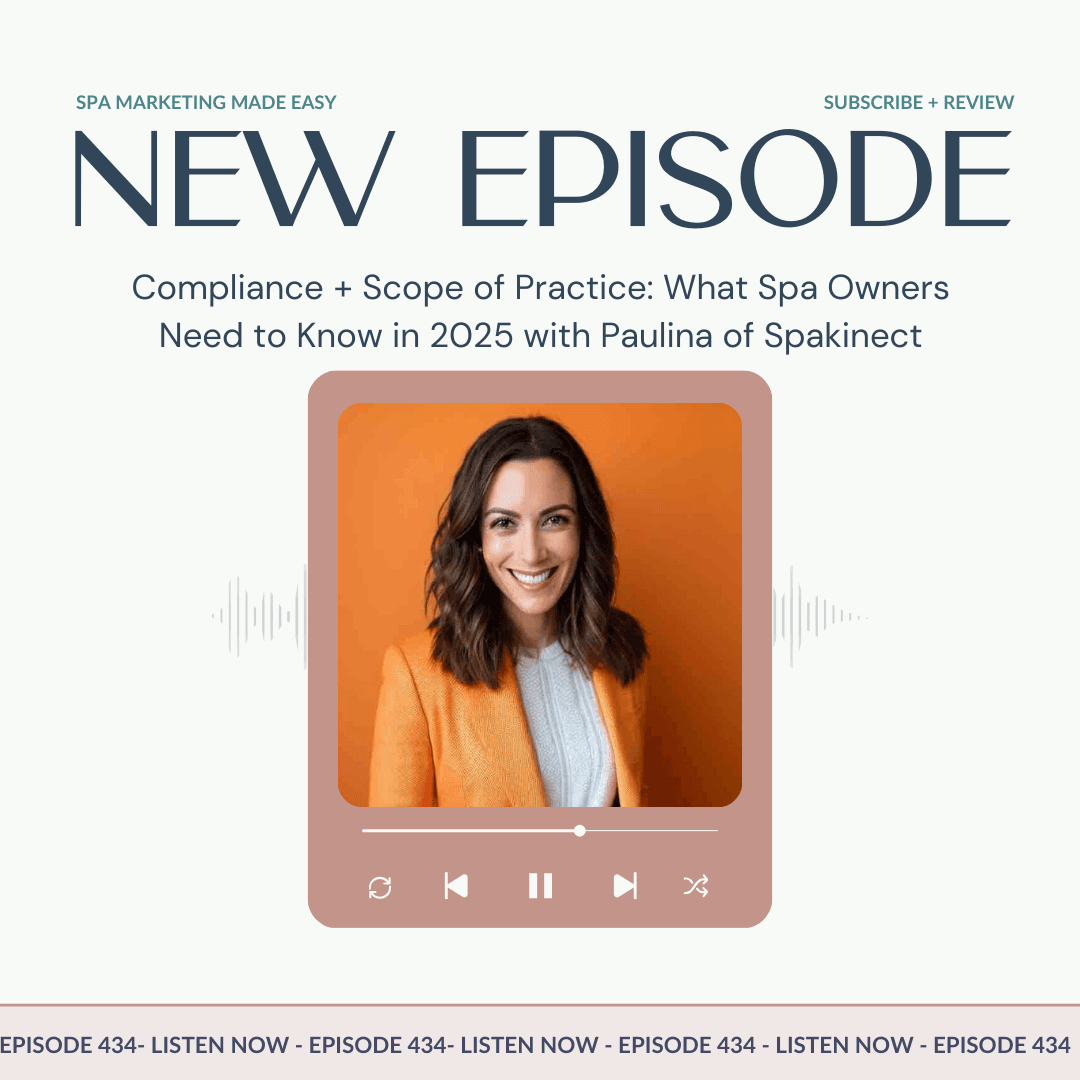
Spa Marketing Made Easy | Spa Business Growth
SMME #434 Compliance + Scope of Practice: What Spa Owners Need to Know in 2025
00:30:47
Compliance + Scope of Practice: What Spa Owners Need to Know in 2025
Loading summary
Transcript52 lines
- [00:01]
Daniela Warner
Kids are getting out of school, the weather is beautiful, and summer is nearly here. And with that, many of us feel a little dip in our businesses. That little dip is the perfect opportunity to tackle one of those big projects that you've been putting off because you never had the time to do it. So if an updated website is on your list, I want to encourage you to head over to the partners page at attoesthetics.com, click on the HLM tab. HLM has been a trusted partner of ours for years and even built our website. Let's make this your most strategic summer yet.
- [00:42]
Welcome to Spa Marketing Made Easy, a podcast for spa owners who want to step up their leadership and business skills and step into the role as spa CEO. I'm your host, Daniela Warner, CEO of ATTO Aesthetics and founder of the Growth Factor Framework program, where we teach, coach, and guide spa owners in skills, scaling their spas to the next level of growth and unlocking freedom in their life and their business. I'm so glad you're here. Now let's dive into the show.
- [01:12]
Hey, Daniela here. And welcome to the Spa Marketing Made Easy podcast. I want to just take a minute to say thank you so much for listening. I am sitting in here. I record these episodes in my office. I'm talking into my microphone, and it's so meaningful when I get a message from you or I see a review, or I find some way to connect with you and have the conversation on the other side. So I want you to know I am so grateful for this platform. I want to make sure that I am continuing to show up and serve you in the way that you need in your business. And one of the ways that I feel really proud and really excited about that is with this episode. So the episode that we have for you today with my new friend, Paulina, we are fast friends. We became fast friends. Do you know when you meet somebody and you just start talking like you've known each other for a hundred years? It was that level of ease. And so shout out to Jaclyn from pdomax for introducing us. This interview that I'm going to share with you today. If you own a med spa, it could quite possibly change your life. And I say that, you know, with a little bit. There's a little bit of truth in every joke, but it's actually something that you need to be aware of. I learned something new in terms of how we need to operate our med spas to be in compliance. So definitely give this a listen. Paulina is incredible. She's got a company called Spa Connect and her company, as of today, is active in 30 different states and she provides virtual good faith exams. So an NP or a PA will do a virtual good faith exam in any of these 30 states that they are operating in right now. Now, when you listen to the episode, you're going to hear why that is such an important piece of being in compliance. We talk about a whole other slew of things, what's been going on in Texas, which has been very impactful in our industry, and what you can do to get involved. So I really encourage you to listen to this one, to share this one. This is one that we want to share in the different Facebook groups. Share, just email it to a friend, whatever you can do to spread the word about this, because compliance is absolutely essential. We need it to elevate our industry as a whole, and that is what is going to benefit at us all as a whole. So let me go ahead and read Paulina's bio and then we'll jump into the actual interview. So Paulina is a visionary leader in the telemedicine space and the co founder and CEO of Spa Connect, where she created a brand new industry in the world of aesthetic medicine, virtual good faith exams. Now in its 13th year of business, Spa Connect has helped over a thousand medical spas in the United States to streamline their operations, stay compliant, and gain the freedom to thrive. Prior to starting SpotConnect, Paulina worked as an RN in gastroenterology. I had to pause on that word. Rheumatology and IV infusion centers. So she's an incredible person. She's an incredible leader, and I really hope that you enjoy this interview.
- [04:48]
Paulina
All right, Paulina, welcome to the Spa Marketing Made Easy podcast. I'm so excited to have you here. I'm so excited to have this conversation. You know, in the past year, I've been talking a lot with different people around scope of practice and compliance issues. And I feel like, especially in the past year, and maybe this is just my awareness of it has increased, but I feel like there's a lot of changes going on. Is. Is that the case for you or is it just now? This is like on my radar and a whole new level.
- [05:19]
I think you are spot on. There are so many changes happening in our industry because we're evolving, which is great. The industry is booming. There is a lot of interest from patients and then, then comes interest from, you know, more private equity groups, more business owners wanting to start businesses into medical aesthetics. And with that comes eventually regulations, and we were in fact, lacking in some of these regulations in certain states for many years. And so I'm not anti regulation. I think it's. It's a very good thing to make sure that everyone understands what's in their scope. But so you are not wrong. There is a lot coming in right now, and there will be a lot more to come in the following years.
- [06:06]
So let's kind of go through just to give people, like, an awareness. I want to talk about Texas, because that is the most recent. You know, there was a bill that was put through. I'll let you tell the story. So from start to finish, around scope of practice, that was essentially with good intention, but was essentially going to wipe scope of practice even from NPs.
- [06:38]
Exactly. So what happened was, as many of your listeners probably know, there was unfortunately a very tragic event that happened two years ago in Texas where a patient who went to get an elective IV hydration ended up passing away. And the outcome of that was, obviously, a lot of people are upset. And what happened as we investigated as, as things started to come to light, is that the person who did the IV was actually not a licensed medical professional. And the physic who was overseeing this professional really was not doing any oversight whatsoever. And they had only been on site one time since the facility had opened. So there's a lot of things wrong, a lot of really red flags, glaring errors here. But of course, there's people who would like to get their agenda, you know, across. And this opportunity was just that for, for some groups to say, hey, you know, we don't like that all these med spas are starting to pop up and unfortunately use this to their advantage to pass a bill, tried to pass a bill that encompassed not just, hey, how do we prevent this from happening again, this tragic, terrible thing, but then added in a lot of other things that really didn't need to be there. Right.
- [07:54]
And it makes sense to have regulations around. Like, we want patient care to be 100%. There has to be, like, there's a reason that we go to school for things. There's a reason that there's scope of practice for things that you learn. So I fully agree that there should be, you know, clear regulations around, especially things. I mean, all things, but especially things that can cause a death, you know, 100%.
- [08:23]
And that was, you know, one of the things I think that came to light is that there was a bit of a loophole, if you will, for this, this thing to. To sort of take place. Even though Technically, what happened was it was ille, but there was this loophole for them to be able to get away with it. And so I think as providers, I'm an RN myself, it's heartbreaking. You're outraged to hear that this, whatever happened, and you realize that we need to have better regulations in place. And not just regulations, but also enforcement of those regulations. Because it's one thing to post a speed limit, but if there's no highway patrol enforcing that speed limit, everyone's just going to go over the speed limit. Right. So we need to make sure that there's actually enforcement going on so that people continue to practice within their scope, especially to your point, when it comes to something that can be potentially fatal. Um, and so I think it was a huge, huge wake up call for the industry and myself included. I felt like, how could this have happened? You know, what are, what is the loophole? And we spent a long time trying to figure out, how do we prevent this from happening again? And that was really the question that was at stake here. And everybody has differing opinions as to how do we do that. Right. And that was really the discussion that happened over the past several months. When legislative session in Texas started this year, the bill was encompassing not just IVs, but also who can order elective cosmetic procedures. So Botox, filler, lasers, all of that was kind of lumped into this bill. And we had to step in and we said, well, look, we wholeheartedly support regulation and we want to make sure that we fix this issue and prevent this tragedy from ever happening again. But we also want to make sure that lawmakers are educated on the differences between IV therapy and Botox and fillers and who should be able to do what within their scope and not sort of jumble everything together. And that's really. Now my call to action for people I speak to in the aesthetic industry is that we need to be able to communicate with these representatives because at the end of the day, they have a lot on their plate, right? They're having, they're in a legislative session now. They're having to review bills from the last two years, and they're having to do them really quickly, like several, several in a day. And so they can't possibly have all the context for every single bill. And that's why it's so important to get involved with your local community, your local representatives, if there's a group or an association in your specific scope of. Of practice, get involved, can have collectively a voice to educate. And that's what I realized in this situation is that they do, they want to listen to you, that lawmakers want to hear. Oh, we thought we were fixing this issue, but we didn't understand the repercussions, you know, so let's, let's help them understand that so they can make better decisions for all of us.
- [11:25]
Daniela Warner
Yeah.
- [11:25]
Paulina
And I think, you know, when we talk about the things that we do and we think about when we're giving a patient consultation, we have to educate so much on what these different things are. And so when we think about someone that's writing legislation and, you know, there was a state where they were banning the ultrasonic scrubber from estheticians because they thought it was ultrasound and was, you know, so there's things like that, that it's like, okay, this, this is not logical. You know, like, we want patient safety, but the way that the bill is written, we want to make sure that it makes sense long term also for the patient. Because if we get to a place where it's literally only MDs that are able to do anything, that's going to increase the price of everything. And it's not going to, it's not.
- [12:21]
Daniela Warner
Going to be beneficial for the physician.
- [12:23]
Paulina
There's a reason that we have NPs and RNs and estheticians, you know, and everybody, like, should be doing what they're legally allowed, as defined by scope, to run a profitable business that ultimately benefits the patient. Because if we put so much legislation that we can't use an ultrasonic scrubber or something, you know, that's like a big, you know, example. But if it gets to that point, then we're really going to see a decline in the industry and we're not going to be able to support our patients in a way that they'll be able to afford it.
- [13:06]
100 and that's exactly right, because there is a shortage of physicians that we're facing in the United States. And so if we were to restrict more and more the scope from estheticians, RNs, NPS, PAs, that makes the availability of these treatments slimmer and harder and fewer to come by because there are just not enough physicians to even, you know, to even facilitate all the other facets of healthcare, let alone we're talking about elective, you know, procedures, cosmetic procedures. So it's, it's not feasible. And not everybody understands that. And so I like the analogy that you made to educating your patients. It's exactly, it's exactly that a lot of these people that are writing legislation, they're not health care professionals. They're not estheticians. They didn't go to school for cosmetology. They don't understand all of the ins and outs and they're doing what they think is right, what they might, may have heard or been told or what they think just from their sort of surface level knowledge. And so it's, it's our job to make sure that we address that knowledge gap. And in my experience this may not happen all the time, but in my experience over the past few months, they are very appreciative to have that when you approach it just as such that I want to educate and give you some more information so that you can make a more informed decision. Maybe you didn't have all this data or insights before and that's really, really helpful and so just encouraging more people to do that.
- [14:40]
So would you recommend, you're saying reach out to your state legislator, your state representative.
- [14:46]
Daniela Warner
What about the boards of cosmetology?
- [14:48]
Paulina
Like how are we defining those two?
- [14:52]
That. So it's really interesting and every state's a little bit different. But I'll speak on Texas because I've just been working in Texas for the past several months. But the board. So there's TDLR in Texas that handles cosmetology and laser. And so that board is separate from your state legislature. They do sometimes promulgate rules together, but the legislature has specific language that they can pass. And then once that's passed, then the different boards like medical board, nursing board, TDLR will amend their rules based off of what legislation has come through. But those boards are also able to self govern. So meaning tdlr, the licensing agency can say, well, you know, they define the scope for their license holders. So for estheticians they're going to say here's what the scope is. But there is legislation that can influence that scope. So it is important to also be involved with, with both with the board and with legislature. But the interesting thing is that boards technically can't get involved at this, at this point and this point in the game with state legislature, they're actually technically not allowed to lobby. So that's just an interesting sort of caveat that I found out recently. So I was under the impression, oh, you know, the nursing board will get involved here early on, but they actually can't technically by law they're not allowed to. So it is important to have both.
- [16:33]
And it's, and I think that makes it even more important for us as providers to be able to get involved with our state legislator to influence or.
- [16:45]
Daniela Warner
At least have Our voices heard.
- [16:47]
Paulina
Exactly.
- [16:48]
For them to be able to, to make the, the new legislation that's going to support our industry and define our scope.
- [16:56]
Exactly. That's 100% right. And the licensing agencies will, will review bills. So if, if they're, if the state's trying to pass something that maybe, you know, doesn't make any sense, is totally out of scope for a particular lice, they can ask that board to come and weigh in on this particular bill and on the language, which they often do. But they can't, so to speak. They can't lobby for any particular bill in any way. They can just be a very objective third party to review.
- [17:32]
So I'm recalling this experience that I had with a med spa that I was working with. And when they opened their med spa, they were compliant and they did everything by the book. And legislation changed and it required in their state they were not able to be a non physician owned med spa and they had to transition to an mso. They did not even know for like.
- [18:02]
Daniela Warner
A year and a half after.
- [18:04]
Paulina
And so they were operating out of not compliant. But it wasn't intentional.
- [18:09]
Right.
- [18:10]
So I imagine there's a lot of things like this. What is the best way for a.
- [18:17]
Daniela Warner
Med spa to make sure that they're.
- [18:19]
Paulina
Staying compliant when legislation change? That's a big example, you know, but like, I'm sure there's other little things that these spa owners, they don't want to break the rules. They don't want to. But I think it's an educational piece that they're not aware of that something has changed.
- [18:37]
Yes. And that's so tricky, right, because you're busy running your business, you know, and there's a lot of other compliance aspects of your business you have to be aware of, especially if you have a team of people. There's simply not enough time for you to, you know, be researching online all of the different bills that are being proposed and passed and all that. But this is exactly why I think it's incredibly important for anyone in this industry to join some type of association or coalition. So every, every state will generally has one. If they don't or you don't have one for your particular scope, I recommend starting one. You don't even need. You, you need three people. You might know, another esthetician. Let's just use that example, right? You find one more and you can start your own coalition. But the purpose of these groups is exactly to do what you said, to make sure that they are staying aware of what bills are coming about. To inform all of their members about what's happening in the state and to have people come and testify if need be, give expert opinions. But that, and they're, they're non profits. So typically, you know, you'll pay an annual membership fee and that will give you access to the, the community that is specifically going to be not only staying involved but also potentially lobbying if something does come up. And, and you feel that you need to put your efforts together and then go and lobby to get your, your voices heard. So that I think is crucial. Not enough people that I speak to are part of these groups. And so if more and more people can, can become part of groups like that, then we can make sure we're staying abreast of what's, what's going on.
- [20:24]
And so you know, just to fully make sure that we're clear on the, the question, the, the best way to understand is to be like would they do an audit? Would they do, you know, I, I know there's going to be people that are listening and like oh my God, am I breaking some rules?
- [20:42]
Like yes, I'm a real follower. I can't yes, break the rules.
- [20:46]
So it's those alliances or, or they are going to have an awareness of what the rule changes or law legislation changes are within that particular state.
- [21:00]
Right. But if you're to your point, if, let's say you've been practicing for a couple years and maybe you are out of compliance, but you don't are organizations that will do audits for you like that for compliance that I think are well worth the money and then some just for your own peace of mind to, to have somebody come in and, and who knows your specific state rules. Right. Because as we all know, every state is different. It's best to go to somebody who understands your particular state and has worked with people in your particular scope so they can say okay, here's what you're doing. Right, here's what we need to improve. And those things again, well worth money to, to invest into because most of the, it's still important to join some alliance because most of those are non profits again. And sometimes they, they have, I've seen a couple where they might do an audit if they're a larger organization. But generally the groups that I've been working with are, you know, a bit smaller in size and can't really offer something like that.
- [22:01]
In your experience, what do you see as the most common violations of compliance?
- [22:07]
So I think you touched on one is more states are coming out with explicit rules around who can own and operate a med spa. So being a non physician owned med spa in a state where you need to be physician owned med spa and use the MSO model, that's starting to become more common. People who are not doing good faith exams before treatment that still to this day is a, it's what we call the widowmaker in the industry is a very, very easy way to yourself into an investigation. And what happens oftentimes unfortunately is that a competitor or an upset patient or maybe an angry old employees can make a, a claim to a board and say this person is, you know, this person bruised me or this person, you know is practicing illegally or something like that and the board has a right to investigate. And once they come in and they start to investigate, that's where I see oftentimes people calling me saying, you know, we weren't doing good faith exams and the investigator came in and that's what they were charged with. I also don't like to scare people. I think as you grow and as this industry grows, everybody will eventually get some type of investigation or you know, like the board is going to come and visit your facility at some point. So it's just, it's best to have a, all of your, your sort of ducks in a row. But just know that I don't think anybody is ever 100 compliant. You know, there's a, there is sort of a spectrum because as you said, rules are changing and it's hard to make sure you're staying abreast of those. But there are very important ones that you want to make sure you're paying attention to like physician ownership, like good faith exams because that's where you get yourself in trouble with practicing outside of your scope. And that's what boards really don't like.
- [24:00]
So talk to me a little bit more about what is a good faith exam and what would be an example of where you would need one for those who are unaware?
- [24:10]
Sure. So good faith exam is an evaluation of a patient prior to them getting treatment. So any patient who's getting a injectable like Botox or filler, any body contouring energy devices, you do need a good faith exam or an order, otherwise known as just an order for treatment. So nurses, RNs can carry out a lot of these procedures as well as you know, in some states estheticians can do some of these procedures, but you need to have an order from somebody who is able to prescribe someone who has prescriptive authority in their scope. And in most cases all states their NPS and PAS and mds, those are the only people that can actually prescribe a treatment. So you want to make sure that when you're doing these treatments, you're doing them with an order. Otherwise you are practicing outside of your scope. So if you're a nurse, you're an rn, and you're doing Botox and you're doing that without a good faith exam, you are technically practicing medicine without a license. And the way I explain it to people is, especially nurses, they understand, because a lot of them came from the hospital, is that, you know, when you work in the hospital, you cannot go to the pyxis and, you know, pick out a medication for your patient. You must have an order in there first to be able to get a medication and deliver it. And it's the same thing with aesthetics. You need that order.
- [25:37]
And so many nurses, med spa owners, they probably believe that if they have a medical director, then they're compliant. But if the medical director is off site and not really involved, which, you know, let's be real, that happens in a lot of places, then they are potentially, you know, depending on the laws in their state, acting out of compliance.
- [26:06]
Correct? Yeah. Just having a medical director is not enough. If you are not a nurse practitioner or a PA yourself, then just having a medical director is not enough. You do still need somebody, whether that's your medical director or whether that's another person at your facility or somebody that you hire. Or if you outsource those good faith exams, you do need somebody who has that authority to give an order to be doing that for every single patient that comes in. Now, most states, best practice states that the good faith exam is good for up to 12 months unless the patient's health history drastically changes within those 12 months. If they're diagnosed with a new health condition or they start taking a new medication, then you would want them to be seen again by that provider. But majority of the time, those good faith exams are going to be good for 12 months. So if that patient comes back in for their repeat Botox in three to four months, you don't have to do it again, but you want to make sure that you're getting those done every 12 months.
- [27:09]
And would they need a new good faith exam for each new service? So if they were doing one for Botox, if they came in for Botox and the next time they wanted to do filler.
- [27:19]
Right. So oftentimes people will sort of lump all of those treatments into one. And I think that that's the best way, the easiest way. And the most efficient way really to do it is that when your patient comes in for the first time, you just have them evaluated for the treatments that you offer. So if you are offering injectables, laser and body contouring. Right. Just have that patient evaluated for all of those things because that gives you the ability to build a treatment plan for them down the road. Because as you know, Right. Patients come in for one thing, but they might not know that they also actually need this other thing or what they're coming in for. You know, if they come in for Botox, that's actually not going to really fix the issue. We need to build more comprehensive treatment plan. And so getting them evaluated for all of those things upfront allows you to build that treatment plan throughout the year.
- [28:13]
That's an incredible thing. I'm glad we're learning every day.
- [28:16]
Yes. Yeah. It's efficiency. Right. I know that you talk to your, your clients and your community members about that all the time. It's like, how can we just save ourselves the most time upfront and just be efficient with our businesses?
- [28:30]
So anything else that you want to add around compliance that you think would be relevant for this episode to help our listeners? Things that I may not be asking, we want to make sure, like I'm thinking too, you get a HIPAA violation, you're supposed to notify every single patient in your practice. Right. Like, does the same thing happen with a compliance issue? If you have a compliance.
- [28:55]
Yeah, it depends on what the, what the issue is. So there's a couple things. There's two things that I recommend. First and foremost, for anybody who's, especially in this day and age, right. We're in 2025, and the way that the industry is going, you need to have one, an attorney who understands the landscape of your scope and your state. There's a lot of attorneys now who offer very, very affordable monthly memberships so that you don't have to be paying these big retainers. It used to be really cost prohibitive, but now that model has really changed. So there's several that really specialize in this because if anything happens like that, exactly what you just said, you can call them and say, hey, you know, I just got a violation for xyz. What do I do? And sort of just have them on call for you. The second thing is join that association because you'll be able to talk to other people who have likely gone through something similar to what you're going through today. And that is just such a valuable resource. So Google, if You're in, you know, New Hampshire, Google and New Hampshire Aesthetic Coalition. And if there's not one, just consider starting one.
- [30:11]
Add one more thing to your plate.
- [30:13]
Why not?
- [30:16]
Oh, all right. Well, this has been so much incredible information. We are going to include a whole ton of links under, including your company, Spa Connect. Do you want to give some information around where our listeners can find you and follow you if they want to get in touch with you further?
- [30:35]
Yes. So Instagram is a great place to follow us. We post a lot about the things that we're seeing in the industry, so trends as well as regulations and things that are coming out in different states. So it's a great place to hear firsthand about what is coming about. And then our website, spotconnect.com you can reach us there and book a discovery call with one of our, our specialists if you're interested in using our services.
- [30:59]
Wonderful. Thank you so much for your time and your expertise and listeners. Be sure to click those links. This is really important, important information for our industry. So you want to make sure that you are staying compliant, that you are following the rules. It will help you to grow. It will help you to be more profitable. Very, very important stuff. So thank you so much and we'll catch you on the next episode.