← Spa Marketing Made Easy | Spa Business Growth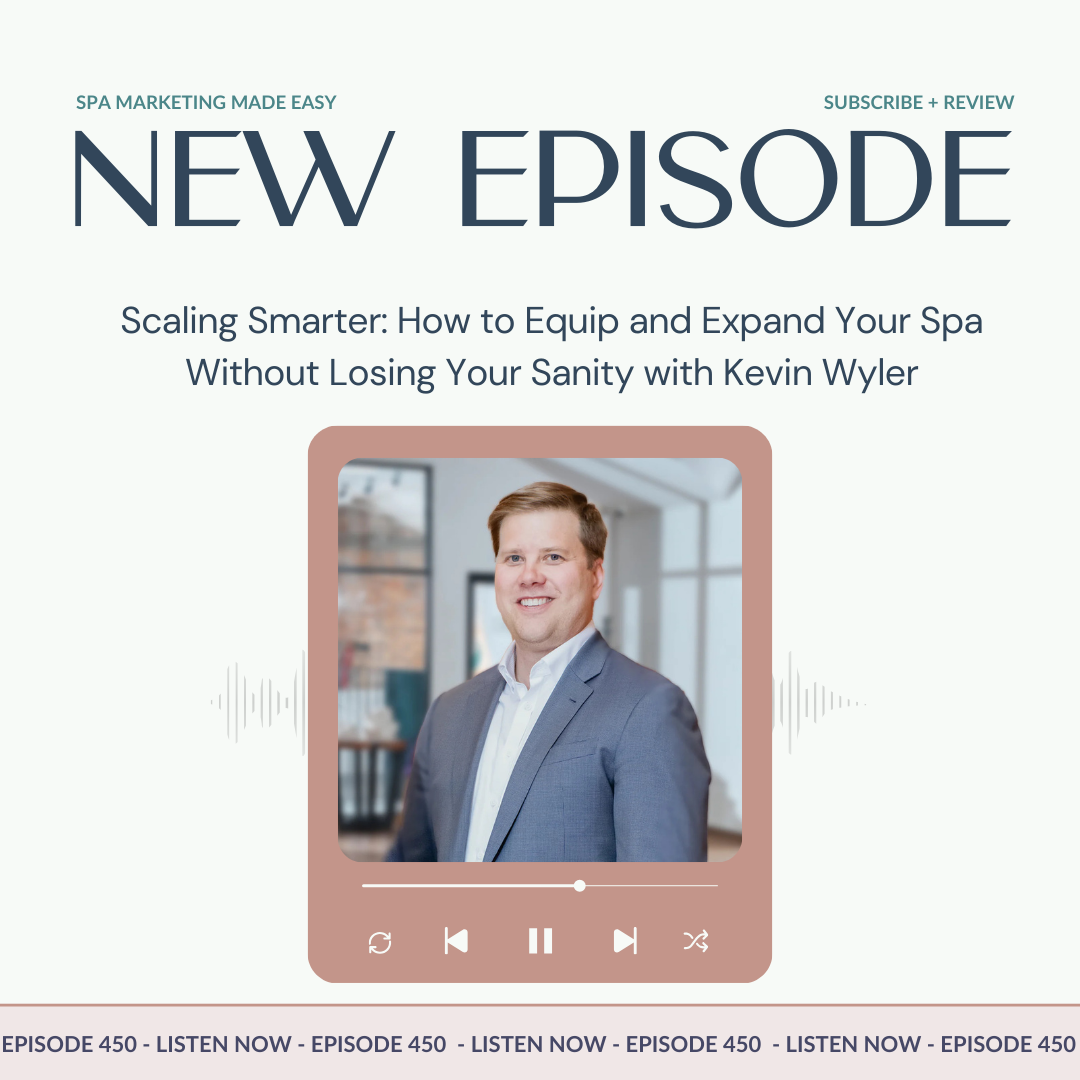
Spa Marketing Made Easy | Spa Business Growth
SMME #450 Scaling Smarter: How to Equip and Expand Your Spa Without Losing Your Sanity
00:30:01
Scaling Smarter: How to Equip and Expand Your Spa Without Losing Your Sanity
Loading summary
Transcript33 lines
- [00:01]
A
If you are an ambitious spa owner committed to making 2026 an incredible year, I want you to mark your calendar from 12 to 4pm Eastern Time. On September 29, we are hosting our Next Level Growth workshop. And this is not some death by PowerPoint training you have heard a million times. This is a true planning workshop where we will be getting things done in real time so that you can walk away with a strategic business and marketing plan. 2026. Head over to our Instagram attoesthetics to get registered today. I cannot wait to see you there. All right, Kevin, welcome to the Spa Marketing Made Easy podcast. I'm really excited to have this conversation with you today. I believe that, you know, we, we love talking about working smarter, not harder, and we're going to talk about scaling smarter today. And I think that that is such an important conversation, especially for those spa owners that are looking to either optimize their current location and rooms with proper equipment or scaling to multiple locations, however that looks. So why don't you just give us a little bit of background. Start wherever you want as to how you got into this industry and how you kind of started your company.
- [01:33]
B
Sure. Well, first, Daniela, thank you so much for having me today. Really appreciate the opportunity to speak to your, your group and, and you and just for some background on myself. So I, prior to this, I worked for the largest privately held medical distributor in the US for over 20 years and I left there. And part of the reason that led me to leaving is I was speaking to a number of my customers and we kind of spoke about this before that were going into medical aesthetics, starting med spas. And I had never really heard of a med spa before. Of course, my wife certainly had. And one of the things that I had heard from them was that there were great options as far as getting equipment and supplies geared specifically towards the industry. And so my partner and I, Brad, looked at that and we decided that this would be a great area for us with our expertise. He's got a background of 20 years in medical distribution as well to get into and to create a company dedicated specifically to the medical aesthetics and what we would call the medical wellness industry.
- [02:58]
A
That's actually really interesting because it's been almost 20 years for me that I've been in the aesthetic space. And we have been seeing this trend towards wellness little by little. Where when it started out, almost all med spas were with plastic surgeons or derms. They were in that kind of setting. It was still very clinical and you didn't have the wellness Component incorporated. And now as the industry has continued to evolve, we're seeing an influx. I'm seeing a lot of supplementation being sold in addition to retail. I'm seeing, you know, mindfulness and there's these different aspects of the practice, not only making it more soft and kind of bougie in a way of like what we think of as, you know, a very self care, relaxation environment, but really incorporating overall health and how you feel. I think especially as we're seeing the introduction with IVs and with HRT, hormone replacement therapy, it's a big trend. Even though those are medical services, it's really focused on how you feel. And we of course want to look good as well, but it's not just the appearance factor as it was before. So I just thought it was really interesting that you use that language.
- [04:33]
B
Yeah, I think it's a very exciting time to be in the industry. It's been three years now since we founded this company, Medical Spa Supply. And exactly some of the things that you're talking about and the direction that you see the industry going into, again, I think you put it really well. It's about looking good, is feeling good. But also on the other side of that as well is looking at treating conditions, I would say conditions and things differently and kind of looking at care outside of the box versus just the traditional interventional. Okay, you don't feel well, here's this medication or get the surgery or get looking at and also looking at your entire medical history and what your body is doing, things like your gut and how that's interacting with your health and things like that. So I think it's a very exciting time to be in the industry right now and it's fun to see how the industry is evolving and how quickly it's evolving.
- [05:42]
A
So talk to me about scaling and some of the common challenges that you see with spas. So you're working. One of the primary verticals that you help med spas with is if they're scaling or expand, if they're starting a med spa or if they're scaling or expanding to multiple locations, you're kind of giving them an all in one place to get their equipment and helping support them with kind of a white glove, you know, concierge approach to ensuring that everything's coming from one place, they have everything that they need. They're not like, you know, trying to make millions of lists to figure out, you know, what did I forget? And that's a great service because we actually get asked all the time like okay, I'm opening a new spa. Is there like a list of everything that I need or, you know, am I going to just go, do I need Q tips and softs and the jars? And in addition to, like, the bigger equipment that we're looking for? So what do you see as some of the most common pitfalls or obstacles that practices come up against when they're going through this process of either initially opening up because they're transitioning from medical into medical aesthetics or scaling their locations?
- [07:02]
B
Yeah, that's a great question. So one of the things, I would take it a step back, Daniela, because I know so much of what you do is about lifestyle and about trying to achieve not just success and financial success and business success, but also that carrying over to your building a business.
- [07:25]
A
That supports the life you want to live.
- [07:26]
B
Yeah, perfect. You said that very well. Thank you. And, you know, one of the challenges in that type of process is it's a very stressful time if you're going from, you know, having one location and looking to scale to, say, even two locations. What I'm specifically talking about more with regard to the scaling is a lot of the clients that I speak with, as an example, when I was at amspawn, speaking to different people, they're talking about, hey, we have one location. It's a proof of concept. And we're looking to scale to multiple locations in multiple cities and really kind of almost franchise, either a franchise model or a corporate model of expansion for their businesses. And that can be really challenging and especially when it comes to equipment. Right. And that can also lead to. And going back to that lifestyle can. Can lead to the process becoming very stressful and overwhelming and taking. Taking into that time that you would be spending with. With your family and doing other things that you want to do.
- [08:48]
A
Yeah, exactly. And. And I imagine with the support of a company like yours, could this task. Is this something that the CEO is personally involved in? Or could their spa manager, spa Director be handling 80% of the interactions and they're just doing the finalization? How does that work as they're going through?
- [09:11]
B
Yes, I would say in larger organizations that are looking to scale, typically we would be working with if they have someone that does operations. And I think that's an important thing that if you're going to scale to think about who is going to handle the operational aspect of your business, either a chief operations officer, or it could be your practice manager or someone in a position like that. But as an owner. Yeah, it's something that you would need to have involvement in. But it's important to also be able to kind of give up some of that control and allow a team member to take on that piece of it. And that's part of the lifestyle piece of that. That. And actually one of the pitfalls that I would say that some, some owners run into is they get a little bit too involved in the process, in the scaling process.
- [10:12]
A
Well, as entrepreneurs, we're all a bit control freaks. So we.
- [10:17]
B
100%. 100%.
- [10:20]
A
It's in our blood. It's in our blood. We like to have our hands in everything. But it's. It's one of the kind of growth markers that I look at for myself and for the people that are in our programs is like, how much can you delegate, how much can you pass off, how much can you trust your team that you are developing incredible leaders that understand the vision of your company?
- [10:43]
B
Yeah, you're absolutely right. So one of the things I would say on it is just from the top is you really want to make sure that you properly scale and when it comes to equipment, to have consistency, because inconsistency can lead to a creep in issues with, with staff performance, with patient experience, with patient safety. And at times those things can be traced back to fragmented or reactive equipment decisions.
- [11:15]
A
Right, so you're talking about just that. I am clear that I understand, like, say you have three locations. You want to offer the exact same services and exact same equipment at all three of those locations so that we're giving the same messaging. So if we, if a patient goes to location A and they get a consultation, they can receive the same services at the other locations, same protocols, all of that.
- [11:45]
B
Yes, and that's. And that's important. And you know, what you can run into is things just like as an example, I have a client who is opening up. They have three locations. They're opening up a new kind of flagship location. And we were speaking. They're looking for an example of a safety. Right. They're looking a safety issue. They're looking for an autoclave and they have an older model autoclave. I look at it and say, well, this has been upgraded since that time. But then we start to think about it and I say, well, wait a minute. What autoclave are you using at the other locations? You know what, let's get you. Even though this is an older model, it's fine. Let's get you the same model that you have to keep the consistency across locations. So also, if a staff member was going from one location to another, There is not a different protocol for something.
- [12:39]
A
SOPs utilize it so they're trained across the board and. Yeah, okay, that makes sense.
- [12:45]
B
Exactly. See, you don't want to, you want to take out that potential inconsistency that could lead down the line to a potential safety problem. Right. So that's just a small example of one of, one of the ways and one of the, and I'm going to say one of the ways that people can get themselves in trouble, so to speak. Right. By having inconsistent equipment across locations that leads to some of that inconsistency.
- [13:15]
A
Let's kind of dive into this concept of the McDonald's model that they're kind of the, the start of franchising and standardization and systemizing, which is all things that I love. I think it, you know, when we talk about building a business around the life you want to live and understanding that, you know, you and I both have small kids and those different seasons of life, you're available in different ways. So there may be seasons that you're less available, there may be seasons that you're more available based on what's going on. Maybe you're caring for an elderly parent or, you know, there can be a variety of different things that come up in life that we want to be our top priority. And so whether you're franchising or not, whether, you know, whatever it looks like, it's by operating your business in a systemized manner as if you were a franchise or as if you were building to sell is going to give you that freedom. And I think that the pitfalls that you were kind of talking about and alluding to with the, the benefit of standardization really falls into this model in a sense.
- [14:29]
B
Yes, I agree. I mean, what you don't want to end up with is really, you know, procurement chaos. And what I call that is you're at the end of, end of opening up a location and you have this sort of last minute rush to procure items. You can't get the things that you need in order to be consistent. You don't have anywhere to store them. If you run into construction delays or anything like that. And then you're, you know, I've heard the horror stories, and you're spending your weekend putting together equipment for your, for your opening or, or, you know, dealing with, with forgetting to order something and having, having that effect. You were, you're open, you're now not compliant because you forgot to order something like step on trash cans or a medical refrigerator or something like that. So it's important to and going back to sort of the McDonald's model of franchising is, you know, McDonald's has their, their opening playbook, right. Standardized layout and design, pre approved vendors. You know, they have their staff training, launch timelines and checklists and they do a soft opening, a grand opening and they do follow up review. Right. So keeping in mind that way of sort of operating it all sort of goes back to at the very beginning. What can you do is planning this out from the start. And it all begins with having a solid list of treatments that you're doing and then building a list of equipment around those treatments. That's really what I would say is the start of how you kind of do this.
- [16:17]
A
You said something really interesting around delays with build outs. And we have gone through numerous delays with our clients that have been going through build outs, especially post Covid where it's permitting or and I always say like add six months to whatever the deadline is just to be prepared. So number one, are you seeing that as well with practices that are doing build outs and if so, how does your company handle a relationship like that? If you have a practice that is investing in equipment with you but they have building delays or like what is the solution around that?
- [17:01]
B
Sure. What I would say is, and I tell this to everybody, it's same, same thing, you know, is just to anticipate delays in construction, I would say probably 9 out of 10 times I hear of some delay from what the initial estimate is for, for an opening. And I think part of that just comes down to look, we're, we're not in the construction industry. Our clients aren't in the construction industry. They understand how to diagnose usually the permitting it.
- [17:32]
A
So it's like everything will get done. And then it's like the permit office can't come in for, you know.
- [17:38]
B
Sure, sure. Permitting. So what we do and what I would recommend to business owners is you need to order your equipment in advance in order to make sure that it's there on time. But at the same time it's a little bit of the Goldilocks situation. Too hot, too cold. If you bring everything in too early, you run into a scenario where now your equipment's coming into a construction site and that can't happen if something gets damaged. Who damaged it? Did it come that way? Was it the construction company? A lot of times you can't even store things in your site like that. So what we do is we will work with you and we will take multiple equipment items from multiple different manufacturers, consolidate them and send them to one of our partners locally who does the logistical piece of it. They will receive everything in. They will make sure that nothing came in damaged and they'll hold everything until you're ready to receive it and then they'll deliver everything. And you talked earlier about white glove delivery. So working with partners that handle medical equipment and understand needs that are a little bit outside of the box than just a traditional say like TaskRabbit or your traditional delivery company. So we're working with solid vendors locally that will bring those items to your new location and work to have them set up for you so that you're ready to go and that you're not having to deal with that piece and going back to that lifestyle standpoint, having to, having to deal with that, that stressful part of who's going to put all this stuff together and how is it going to get set up and having that sort of part of that procurement chaos that I spoke about earlier.
- [19:29]
A
How is your company dealing with tariffs and supply chain issues and these kind of unpredictable things that so many people are talking about or concerned about? You know, after Covid, there were supply chain issues and people were not able to get them. There's the question of tariffs. And we're seeing already, you know, I saw two different med spa companies increase prices in the past week. How do you deal with making sure that like you can get what you say you're going to get and also like the entire pricing structure, like, how's your company navigating that?
- [20:15]
B
Sure, it's, it's definitely a challenge. Going back, I'd say starting with. But the supply. You're right. During COVID there were major challenges with, with getting supplies that has ironed out and gotten. Gotten a bit better. One of the things that has still been, still is a challenge and certainly was, was even more of a challenge, say like six months ago, things like IV fluids, where there was the hurricane that had taken out one of the largest IV solution manufacturers in the US and so that, that, you know, is still, we're still kind of dealing with the effect of that, the way that we kind of work around those, those types of issues. And then I'll kind of talk about tariffs. Let me say about the tariff piece as well. You know, the, the tariffs have also been a challenge. It's in the news. We know about it. The way that we've kind of worked on those, those two pieces is number one is just having multiple suppliers for different items. Right. So we have to be nimble and we have to be able to kind of work between. Between suppliers. And what I would say is, number one, the suppliers that we work with, we try to work with suppliers that have an interest in the industry and want to grow in the esthetics industry with us, because maybe they're not really. Not really focused heavily in the industry right now. Maybe they are more of a company focused on acute, the acute care market or post acute market. So this is sort of an opportunity for them, them to. To enter the market. Being nimble and being able to move between suppliers is important. That also goes with the tariff piece and the pricing is just being able to. What I would first say is being honest with customers, explaining to them what's going on. We put out some newsletters earlier in the year about what effect tariffs might, might have on pricing. And some people didn't like that. Some people said, hey, you're. You're just using this as a way to raise prices. But what I would say is of all of our newsletters, that was the one that we got the most amount of interaction on because it was such an important topic to people. And being honest with them, rather than just just ignoring the topic or just raising prices is not the way to go about it. So we've just tried to be very upfront with regard to what we're facing from, from a tariff standpoint. And then the other side of that, being honest, if things shift and change in the other direction, to start to bring, bring prices down for customers is important as well. We will do that if we see changes in the market as well.
- [22:58]
A
I love the transparency piece, and I think it's just, it is a kind of a hot button item because there's a lot of, like, uncertainty and a lot of just not understanding how it's going to affect your business and what that means. So really being open and honest and clear in kind of, you know, how is this affecting, I think is great. So I want to get back into, you know, we. I said in the beginning that you kind of had this concierge service and focused on white glove customer service and delivery and all of that. When a practice comes to you, how are you helping them? I know, I know you have this, like, standard equipment plan. Is someone coming in and doing like a call with you and telling them, telling you kind of their niche and their vision for their company, and you guys are helping put together an equipment list or are they coming with, like, here's the idea of what I think that I need. Like, what is that process like?
- [24:12]
B
Yeah, especially for when we get to scaling and we're talking about multiple locations, they typically have a list of items that they, that, that they're using or at least some semblance of a list. We like to take that and refine it and also get that down to, to more of is this something that, and there can also be opportunities in that list, meaning, hey, we're using this item. And we'll look at that and say, okay, are you open to alternatives on, on this item, things that could potentially, you know, be more affordable, save you money? Again, looking at vendors that are maybe on the outside of the industry looking, looking in that want to grow in the industry and are willing to, that have a great product and willing to take, take on business for, you know, for, for a lower price than maybe whoever the name brand company is. So we'll work through that. Now there also are scenarios where our, our clients will say, for this particular item, yeah, I'm willing to look at alternatives, but for this, I have to have, have this item and there's reasoning behind it and that's fine. But then what we'll do is we put together a list of, of items really calling, like, calling that like a master model. Think of it almost as a blueprint for a new location. And then we also have to be prepared to expect for the unexpected. Right. So you're going to run into that scenario where one, you know, locations two and three have a certain setup and then location four has that one room that's, you know, smaller than any other room and has to have a different making of it has to have a different table or different type of equipment, equipment set up. And it's all about understanding that and being able to sort of adapt to, to those, those situations and again, trying to keep things as consistent as possible for your, your business.
- [26:14]
A
And what about a practice that is just starting out? So we have a lot of CRNAs in our world that say, you know what, I don't want to do anesthesia anymore. I'm going to move over to the medical aesthetics died. I'm starting my own practice. Someone like that that comes and says, what do I do? Where do I start? How do you go through that process with them?
- [26:39]
B
Sure. Yeah. That really comes down to defining the clinical offering. What are the services that you, that you want to offer? And also keeping in mind what do you want to offer today versus maybe, you know, a year in the future as your, as your business grows? Right. So once you start to define the clinical offering, we can sort of work together on the items that you would need in order to open up a new location. And we do that a lot with folks to help them. Them open. I think that's a really challenging piece. You know, like you said, somebody coming from being a CNRA and then. And then, you know, entering the aesthetics industry, it's a little bit different when you're at the hospital and everything is just provided to you. Now you have to work to do that on your own. But we're really good at kind of working with folks at that fate, at that phase of their business when they're opening. We look at all of our clients as, look, this is their business. They're entrepreneurs just like we are. And our whole goal is to help them and to help their business thrive. Right. And feel like if we can do that well, then our businesses is. Will continue to grow and continue to do well.
- [27:51]
A
That's great. So any other questions that a new practice or a scaling practice would ask that comes up that I haven't thought.
- [28:00]
B
Of to ask, I would say the main thing is you really need to be intentional in what you're doing. I would say putting together a solid plan, looking at. Also looking at timelines of when to order. Right. I think is another important piece. Right. So having your plan, understanding timelines, and what I would say on timelines are often much longer than what people typically think. When you really want to finalize your service, excuse me, you finalize your service offering 12 to 16 weeks out and start the process of ordering equipment 10 to 12 weeks out. Right. And the reason I say that, 10 to 12 weeks, people say, well, that seems like a long period of time. But when you're 10 to 12 weeks out, you really have the opportunity to order anything that you want. Anything is available to you. If you need something customized or something, as you start to get closer to your opening date, that window starts to close a bit. And again, if you're working with a partner that will store equipment for you and deliver it when you need you, you have the time to do that. You don't have to try to time everything out in order to get it there for a projected opening. And then really two to four weeks out is when the point where you want to schedule your delivery and set up and then the final week and into your soft opening. You know, the staff training and the equipment in servicing and things like that are really the point. So I think where a lot of people struggle with that timeline is they shrink it a bit. They think it's a much shorter, shorter timeline and you really want to make sure that you leave yourself enough time to make things successful and not run into a chaotic situation when you're ready to scale and open.
- [29:57]
A
Great advice, Great advice. Well, thank you so much for your time and your expertise. Your company is Medical spa Supply. We'll include the links below this episode for anyone that wants to check you guys out. And really interesting information. It's, you know, we, we love talking about systems here at Attoesthetics when we're thinking about operational efficiency. But when we're moving to this next step and we're scaling the systems, get involved there as well. We want to do it in a streamlined way, in an efficient way to make sure that you have as much time, time as possible. So, great, great insight. Thank you so much for that. And thanks for being on.