← Spa Marketing Made Easy | Spa Business Growth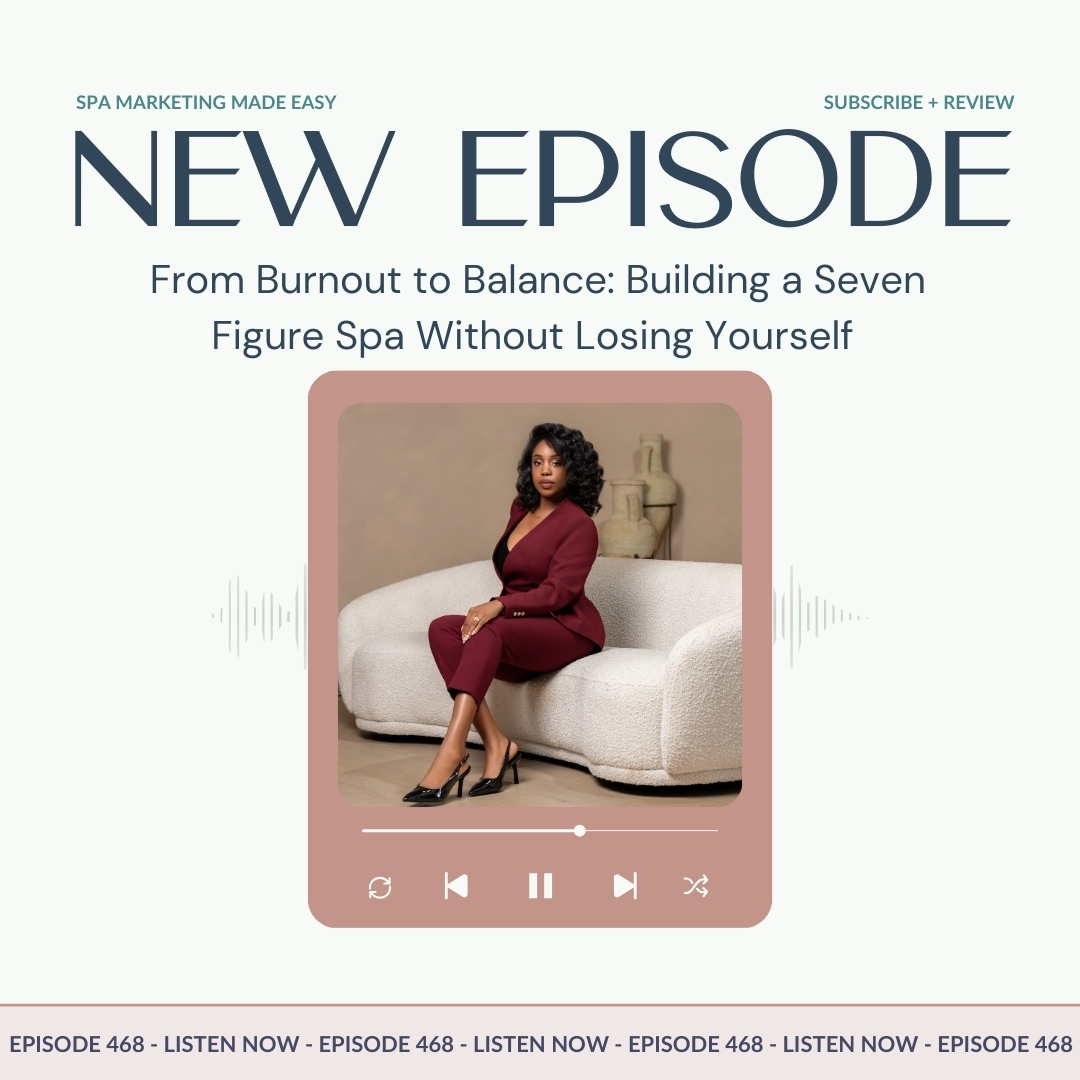
Spa Marketing Made Easy | Spa Business Growth
SMME #468 From Burnout to Balance: Building a Seven Figure Spa Without Losing Yourself
00:29:04
Loading summary
Transcript56 lines
- [00:01]
A
Hey, real quick. I want to personally invite you to something very special happening next month. I'm hosting a spa CEO intensive on February 15th and 16th in Fort Worth, Texas. This is a two day in person event where we are going to be going deep into the sales and social phases of the growth factor framework. We are essentially diving headfirst into the role that AI will play in these two phases. So we're talking automations, we're talking agents, all, all of the things. So if you've been curious about how AI can help your business grow, this is the event for you. Head over to auto aesthetics.com events, click on the in person events tab there and you will find all of the details for Fort Worth. I cannot wait to see you there. Hello, my dears, and welcome to Spa Marketing Made Easy. I am your host, Daniela Warner, and if you're new here, welcome. We are so happy to have you. If you are a longtime listener, thank you for tuning in. I am so grateful for you. So I was on a call with my team last week and I remember saying to my coaches, our clients are not paying us to be their friends. They are paying us to get them results. And I believe that, I believe that deeply. That's an important part of, for us to stay extremely focused on. We have a responsibility to our clients to ensure that we are focused on their profit. But when you're blessed to work with so many incredible entrepreneurial women, and yes, we've got guys in our world too. We love you too. I know whenever we have guys pop on, they're like, hey, you're always talking about women. But we love our guys too. But for the most part, we are serving female founders. When you're blessed to do that work with so many incredible women, deeper relationships, personal relationships are bound to form. And that is exactly what happened with my guest today, Fola. So I met her a few years ago when she joined our Growth Factor program. And gosh, talk about being an action taker. Like, from day one, she showed up for the call. She was open to feedback. She was able to take what she learned and apply what, what was relevant to her business, to her vision, to her goals, so that she could build a business around the life that she wanted to live. That goal is different for every single person. Right. So Fola is the founder of Giselle Atlanta. It's a luxury skin health and aesthetics clinic in Atlanta. And she went from zero to seven figures in three and a half years. Yes, you heard that right. Seven figures in three and a half years. And she did almost burn out getting there. But through a deep belief in herself, which you'll hear her talk about a little bit in this episode, and a lot of personal development work, she learned the difference between working hard and working yourself into the ground. So today we're diving into what it really means to give yourself grace as a CEO. We're talking about the guilt that comes with rest, the pressure to prove yourself, and the moment when you realize your business has stopped bringing you joy and what you're supposed to do about it. So if you've ever felt like you're running on empty, if you've ever struggled with people pleasing in your leadership, or if you're trying to figure out how to scale without losing yourself in the process, this episode is for you. All right, my dears, let me go ahead and play that interview. Huge thank you to the incredible Fola for sharing her expertise, her time, her energy on this episode. I know you're gonna love it. All right, Ms. Fola, welcome to the Spa Marketing Made Easy podcast. I am so excited to have you here. I'm so excited to share your story of inspiration and growth and continued development in what it is that you're building and this incredible life that you're building that is being provided in part to the incredible business that you have been building. So thank you so much for being here.
- [04:28]
B
Thank you. I'm excited.
- [04:31]
A
So we were talking a little bit before the show or before you started recording, and one of the things that I want to just acknowledge about you, that I want you to be able to receive, and sometimes we don't see ourselves as other people see us. And you have always, in the time that I've known you, been so focused on personal development, on reflection, on looking at yourself, on self care in general. And that's such an important part of leadership in a business. I think often, you know, you said, oh, sometimes I like being a girly and doing my hair and getting a massage and all those things. And it's almost like people think that you can't have that and also be an incredibly productive and effective CEO because it's equating time with money instead of money as a tool. As you said, I like to look at money as a tool. So I want to kind of start there and dive into how did you develop that kind of approach to life? Were you around other entrepreneurs? Is this something that was just you were self driven? How did you get into the space to be able to have that relationship with yourself, with money, with success?
- [06:05]
B
That's a Good question. I will always say my upbringing is the reason I am who I am. I think I have natural talents. I also have a calling on my life. I'm in deep relationship with God. And I grew up seeing entrepreneurship. My father was an entrepreneur or is an entrepreneur. My grandfather was an entrepreneur, my grandmother was an entrepreneur. I have a very value driven mother. So I think growing up I had people pour into me a lot, a lot of just values, education, being hardworking, you know, living life. And my mom will always tell me to, to dance to my own drums. And you know, life was, I could, I could do anything that I wanted to do in this world. Right. And so I think that you were.
- [07:02]
A
Told that from a young age, From.
- [07:03]
B
A young age, my mom, my, my mom was always like, I remember even when I applied to nursing school, I applied to this very competitive school. And I'm like, you know, some people don't get in. And my mom would say their problem is not your problem. Like, just because they didn't get in doesn't mean you won't get in. And so my mother, all of my life, she was just like that, you know. And then I had a father that was very hardworking entrepreneur, and taught me a lot about going outside, getting what I needed to get out of life. And I think that is truly the essence, like resourcefulness. Yeah, it's just, you go get it, it's your life, you live it fully. I always tell people I'm here for a good time, not a long time, might as well. What does that look like?
- [07:57]
A
You know, one of the things I'm really interested in life in general, because we're both mothers, we both are deeply dedicated to our family. We talk about building a business around the life we want to live. And that means having time to be fully present with our kids, our spouses, et cetera. And, and when you look at raising children and we're looking at, you know, you obviously had a great upbringing, you, the, the self confidence is something especially with girls that we want to instill because when you have that self confidence, then the girls, they, and we want it for boys too, but we, it's like when you believe in yourself, you do go out and start that business. You do believe that you're a numbers person or that you can solve whatever type of problem. So for you being raised around so many entrepreneurs, what did that like, I get the bigger picture, but in the day to day, in the tactical, like how you're raising your, your children, your daughter, like, are you applying things from an entrepreneur mindset that you're like, I want my daughter to think differently or act differently or, you know, like, how do we raise this next generation of kids that not everybody has to be an entrepreneur.
- [09:30]
B
Yeah.
- [09:30]
A
But I feel like it's such a important part in helping you live the life that you want to live.
- [09:38]
B
Yeah. I actually think entrepreneurship is a gift. Right. I truly believe it's a gift. And with my daughter, I think the biggest thing is teaching her the same values that were taught to me. You live life on your own accord. You can do whatever you put your mind to. My daughter is very. She's very bright, very analytical, very deep thinker. And those are her gifts. I think children are born with natural gifts. And then as a mother, you see those gifts and you nurture them. And so with Giselle, she's very matter of fact, she's very driven, naturally on her own. Like, the child literally will check her own grades and say, oh, I have a 92, I need a 96. But I also, honestly, too, I'm Nigerian, my father is Nigerian. And there are certain values that, cultural values that just are passed down from generation to generation. So I'm doing the same with my daughter, but trying to be a little bit less. Less tough, like some balance. Right. Teaching her that rest is okay. Just because if you got a 92 and you did your best, then that's okay as long as you do your best so that she can still give herself grace as well.
- [11:09]
A
So let's talk about how that applies to you and your leadership style with your spa, because I remember you are a seven figure spa owner. How long did it take you to get to seven figures?
- [11:22]
B
So this is. August would be four years. So three and a half years.
- [11:26]
A
Three and a half years. Okay, so when we first met, that was your number one goal. And it was. It was above all else. Like, I was like, would you be happy if you hit 900,000? And you said, no.
- [11:46]
B
Like, yeah, I'm.
- [11:47]
A
Gonna go with you, Daniela. I want a million. And I was like, yeah, okay. But it's. I see this, like, this drive, this passion, this commitment to growth, to reaching and attaining your goals, and yet you're here talking about being gentle with yourself and being gentle. So how do you. How do you talk to yourself? How do you, you know, the internal voice or the. The way that we feel about ourself now you've crossed the million dollar mark. So you made it there.
- [12:23]
B
Yeah.
- [12:24]
A
Are you giving yourself some grace? Are you giving yourself some peace? Or do you have, like, the next goal, because I think this is a battle with entrepreneurs, is It's. You hit 1 million. All right, let's go to 10. You know.
- [12:39]
B
Yeah. I also, I'll be honest with you, I remember when we first met and you kept asking fall, are you sure you want a million dollars? You sure you want a million dollars? Like, is it? And I was like, why does this woman not want me to have a million dollars? I remember when we first met.
- [12:59]
A
Was that in D.C. it was in D.C. yeah.
- [13:02]
B
And you were like, fola, give yourself some grace. I was like, give myself some grace. And I think in that season, or a lot of seasons in my business or in my life in general, I've always been, the harder I can work, the harder I can work, the harder I can work. Which as women, I think it really puts you in your masculine.
- [13:25]
A
Well, yes, 100%. And those first couple years of business, I think really up to the 250 to $300,000 mark, you're hustling like you.
- [13:36]
B
Oh, absolutely.
- [13:37]
A
You. You gotta figure it out, you know, like. But there has to be a. You can't sustain that pace.
- [13:45]
B
It has to be a balance. Because the hard work is not the issue if you are still pouring into yourself and pouring into the things that are important. The hard work is an issue when it holds you captive. Right. And so I would feel guilty when I would rest. I'm like, oh, I have something to do. I have something to do. I have something to do. And I think that time that we had in D.C. is when it hit me like a bus. Fuller, you're not giving yourself grace and you're going to burn out. You're going to become resentful of this business, which did happen for a short period of time. I had to take some time off to just. And this is where the personal development piece comes in. Right. Why do I feel the need to run myself in the ground in order to be successful? And at the time, we weren't a seven figure business, but, I mean, you.
- [14:39]
A
Were still doing great.
- [14:40]
B
We were doing really well, but I was so stressed. I was so stressed. I was so unhappy at a certain time. Like, originally when I created the business, it brought me so much joy. I felt like so much. I had so much passion and purpose for it. And somewhere where I noticed, oh, wow, I'm doing this, I started to put so much pressure on myself instead of giving myself grace. And then I started resenting it. You know, the switch came that day. You said, fola, give yourself some grace. And Then we kept having that conversation, do you really want that million dollars? And I had to ask myself, is it the million dollars, or am I operating in a space where I feel like I have to prove something? And when I let go of the need to prove and just let it be. Like, you have seasons sometimes where you're just maintaining. You have seasons where there's growth. And as long as my family and I remember you asking me, follow, write down what is most important to you. My business was last. It was.
- [15:49]
A
You had a whole page. I made you guys write for five minutes, and you had a whole page, and every single thing was your family.
- [15:57]
B
Mm.
- [15:58]
A
And I was like, where? That's why I kept drilling you on it, because there's a disconnect happening here. There's nothing wrong with wanting a million dollars. I believe that there is so much abundance in this world that every single spa owner, every single business owner that wants that. Especially today, with the tools that we have with AI and the like, you. You can have that. Like, if that is truly your desire. There is more than enough for all of us.
- [16:27]
B
But at what cost?
- [16:28]
A
At what cost? And that's the thing is, like, when we talk about building a business around the life you want to live, it's actually going much deeper and understanding what brings you joy, what makes you happy, and disconnecting the dollar amount that your business brings in with your worth and value and success as a human being. And that's a big problem, which is why I kind of started with the family and the morals and the values, because I think that so often we get that I did where I equated my success when I was in my 20s with the amount of money that I made. If I don't make six figures, I'm a loser. Like, that was ultimately the story that was going on in my head. And I mean, I didn't say it to myself that bluntly, but that was my belief. Like, I was. I missed out on a lot of things in my 20s because I was so focused on hitting six figures in revenue. And I think that's a problem. I think it's a problem in today's world. So you were able to. And this is also an incredible skill that I want to acknowledge you for, is like, you can have a coach, a friend, a family member. You can have someone say, give yourself some grace, but most people will not actually do that. You know, it's your. You have a well enough developed and established self worth that I deserve rest that, you know, that you actually allow yourself to have that. And I think that that spills into your leadership, your. And ultimately your success as a business owner.
- [18:34]
B
Yeah.
- [18:35]
A
Because if something fails, which it will, I mean, I fail every day at something in my.
- [18:41]
B
Absolutely every day.
- [18:42]
A
And if I were to be like, I suck.
- [18:44]
B
I'm.
- [18:45]
A
I am messing up every single day, you would just quit. There would be like, so you have to have that understanding. And like, oh, that didn't work. Let's go to the next thing, you know, to be able to reach the goal.
- [19:01]
B
Yeah, I think it's important. One thing I realize, and personal development is so important to me. Personal development, I think is important for entrepreneurs to do therapy. You'll find that whatever is hiding in your closet with, you know, just pain or trauma or whatever the case may be, if you have not dealt with that, I promise you, it show up in your business. Your business can only be as healthy as you are. And I realize the healthier you are, the better leader you are. You have to be very good at conflict management. And if you have not dealt with yourself, you cannot. You cannot run a healthy business. And I think the biggest thing for me was I do not have to be superwoman. I can be human. It is okay to be human. It is okay to drop the ball. It is okay to not feel like it. It is okay to fail. And I'm the oldest, right? So I'm the oldest girl in my family. I have eight siblings. I've been responsible for people for a very long time, right? And my family, I am, They're. They love me. I'm their. I'm their joy. You know, my father, my mother is always like, oh, look at your sister. You know, and so pressure would come from that as well, because you're like, I as much as Giselle, I want to make her proud. I want to make my family proud. I want to make my siblings proud. And I realized they never asked me to run myself in the ground. They actually, like, when I'm healthy, I have time to spend with them. You know, I'm in a good place.
- [20:42]
A
And so, yeah, so when we talk about this kind of aspect of being everything to everybody and how your own stuff is going to show up in your business, I see it a lot.
- [20:56]
B
In.
- [20:58]
A
Kind of the people pleasing tendencies that. So we don't want to disappoint our team. We don't want to, you know, and so we'll go in and we won't. There's this fine line between taking ownership and I very much believe. I love the book Extreme Ownership I love taking responsibility for what is mine. But at the same time that can be a double edged sword where if you're like, oh, well, I hired them, so it's my fault. But it's also like, yeah, but you still have to do conflict management. You still have to develop that person. You still have to. And it's also your fault if you keep them there if it doesn't work as long. So how has that been with you in your journey? Because I know that part of growing a successful business, you've got to hire a team. You have a team of eight now. But when I most spa owners that I'm talking with, they go through turnover 2, 3, 4, 5 times before they find the right fit. And it's because they're trying to understand their own leadership style. What did that look like for you and what kind of came up for you in that growth?
- [22:24]
B
Yeah. So I'll be honest, the part that I did not like or enjoy in the beginning was hiring especially for me. I'm like, I can do it myself, I can do it myself, I can do it the way I want to do it. It was very difficult to kind of give away some control, give away some power. However, if we're talking about scaling a business and truly scaling it, you cannot do that on your own. Right. One of the challenges was definitely around one people pleasing. I think a lot of women deal with that, that challenge being very knowing balance between being nurturing and being assertive. And like, I just need you to get this done. And that was a challenge for me in the beginning. Now I'm in a stage where I've had so much turnover, I'm like, it's just, it happens, you know, I'm no longer tying it to, oh, it was my leadership, I did something wrong. However, every single time I do have turnover, I look in the mirror, where can I grow? What did I miss? What did I see in their interview that I looked past?
- [23:51]
A
And then sometimes I think also like, sometimes you hire someone that's a great fit for a $500,000 business. Yes, it is not a great fit for a million dollar business.
- [24:03]
B
Absolutely. I think that sometimes, just like the person you were that got you to a 500,000, the person you need to be for a hundred. I mean a million is different and the same thing with the team. So sometimes people will grow with you, sometimes they won't. And sometimes we're just hiring people without truly knowing what it is that we want. So now I have a very good idea about what kind of employee fits. Giselle, Atlanta what kind of employee supports me and my needs versus just feeling a body? Right? So my interview process in the beginning was kind of all over the place. Now I have a very extra or intense hiring process, and I'm okay with that. I have think four steps to an interview. My VA will screen the hire to make sure they're a fit. My manager will bring them in for an interview, and then after that they will interview with myself, my manager, and after that we have a practicum. And whoever doesn't fit, they just don't fit. I don't make people try to fit anymore. And I think in the beginning I try to make people fit, and now I don't. I don't have a scarce mindset around employees or staff. And I lead with confidence in knowing that I'm not always going to get it right. And that's okay. Just like my staff is not going to always get it right. And if I need to fix something, I will look at myself and say, okay, we need to adjust here. But now I'm no longer. I would at first try to. Someone would have responsibility and I would put myself in the mix to kind of take that responsibility off of them. Now I'm like, this is what I expect of you. This is what I need. You have to get it done. And if they don't get it done, then I know this probably person is probably not a fit for my business, and that's okay.
- [26:07]
A
So at this stage that you're at now, how are you defining success?
- [26:15]
B
Success for me is about my freedom. I feel most successful when I don't have to go into my business.
- [26:23]
A
So time freedom. We've got time freedom. We've got financial freedom, you know, so.
- [26:28]
B
The time freedom, time freedom, money freedom, freedom is just my jam. I'm a free spirit. If I want to wake up tomorrow and say, hey, can you reschedule my patients for such and such day? Because I'm just, I need a mental health day, then that's what I will do. And I wasn't doing that before. So now I make sure every month I get my massages, I take myself on a little Sephora trip. If I. If I want to buy a new body butter, I'm just really into making sure that I am taken care of. And then that allows me to pour into my family and be really present in my marriage and my relationship with my daughter and my. My parents, my extended family. That is what success feels like to me. Of course I like money. Okay? I'm Nigerian. We like money.
- [27:19]
A
I saw that money dance. I saw that money dance at the wedding. That was.
- [27:25]
B
We like money. There are some things that just will never change. However, I'm not strapped. I'm just like, like, oh my God. I've kind of just let it be.
- [27:35]
A
And so, so I love that for the personal aspect of your life and, and, and even the business, but you're with the business still relatively new. It's not new, but it's moving into that more mature stage. Where do you see, like, where do you want to take this, this business? What is exciting and has you kind of, you know, when you come up with an idea for your business, you said in the very beginning, I'm like obsessed with it. Until you get to the burnout point, there's always something new that's like, oh, I really want to get this. What is that for you in the next five years?
- [28:14]
B
That's a good question. I think for me, from a financial standpoint, one thing I've learned is, you know, when you first come into the med spot industry, you have all these people, they're trying to sell you this and sell you that. And for me is just like, I'm debt free. Personally, I would like to be debt free in my business. Right. I've just paid off one of my big devices, my Airlace laser. That felt amazing. So that's my goal for the next couple of years. I'm kind of open. Right. I think I used to think like, I only had a certain amount of time to live out this dream, and now I realize as long as I'm alive, I have, I can be a 6 year old med spa lady if I want to. Right. And so.
- [29:00]
A
And you'll still look the same.
- [29:02]
B
Yeah. You know, now I'm doing Botox. I will. So we'll see what happens.
- [29:10]
A
I love that. Well, Fola, thank you so much for. This is such a beautiful gift to share with our industry, with other spa owners. I think it's so important to go back and remember the importance of why you're building the business in the first place. Remember the joy of it. Remember that it's a gift, as you said, which I think is so incredibly beautiful. I love sharing stories like yours to reignite that passion, that excitement and remember that it truly is a gift. So thank you so much for taking your time for sharing with us and I'm so excited to see what you create. Thank you.
- [29:50]
B
Thank you for having me.