← Spa Marketing Made Easy | Spa Business Growth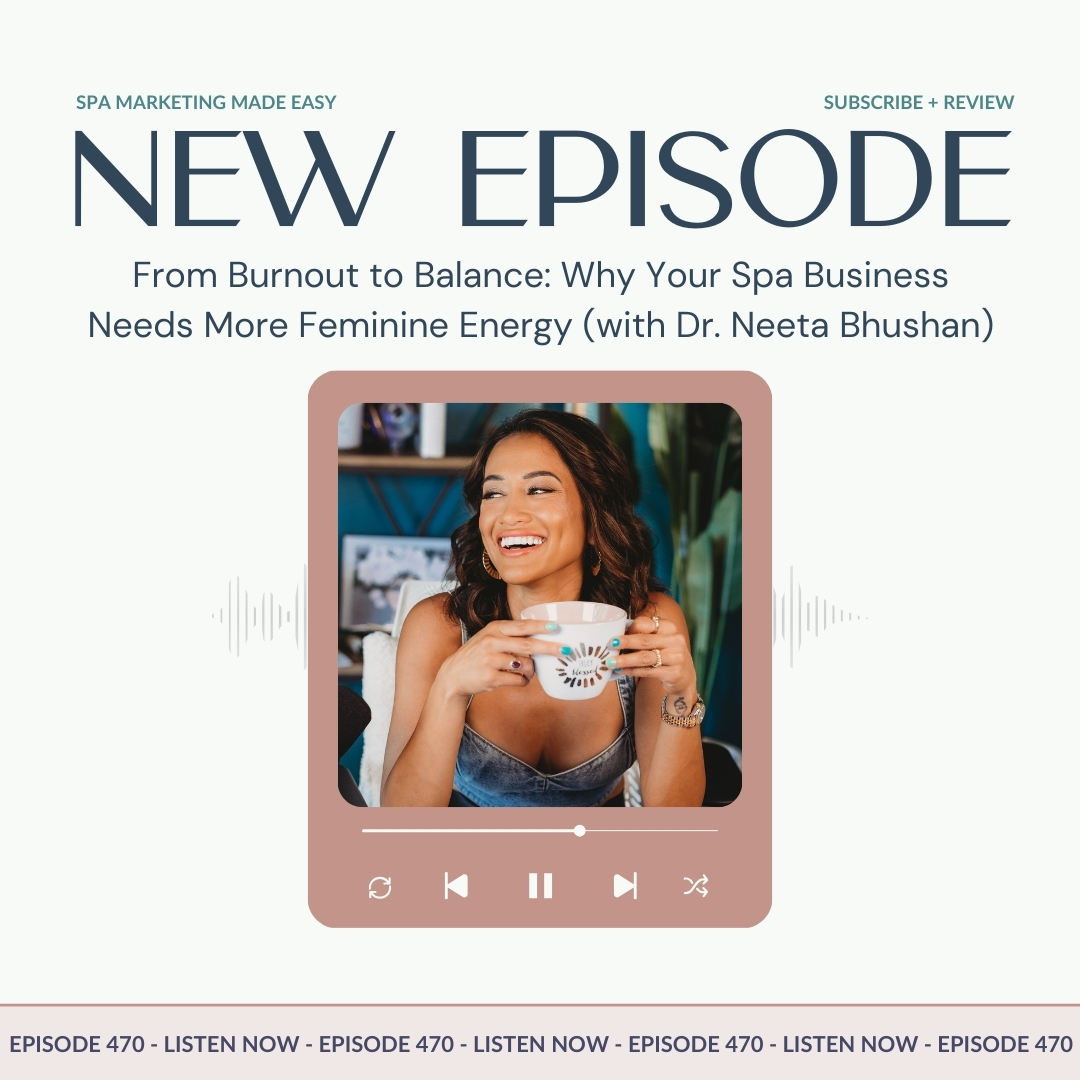
Spa Marketing Made Easy | Spa Business Growth
SMME #470 From Burnout to Balance: Why Your Spa Business Needs More Feminine Energy (with Dr. Neeta Bhushan)
00:32:25
Loading summary
Transcript76 lines
- [00:03]
A
Well, hello my dears and welcome to.
- [00:05]
B
Another episode of the Spa Marketing Made Easy podcast.
- [00:08]
A
My name is Daniela and if you're.
- [00:10]
B
New here, I want to welcome you to our community. We talk a lot about marketing systems, operations, leadership and entrepreneurship, but a big piece of success in all of these areas. The thread that ties everything together is personal development. It's taking good care of yourself so that you can show up as the best version of yourself. You don't want to operate your company from an overworked and overwhelmed space. If you're doing that, you can't think clearly. You react to situations rather than responding to them. Instead, you want to lead your company and your team towards the directions of the goals that you have set for yourself. You don't want to get stuck in this like hamster wheel cycle. That happens when you don't take good care of yourself, when you don't show up as the best version of what you are truly capable of.
- [01:07]
A
And that conversation, how you do that.
- [01:12]
B
That's exactly why I invited back one of my favorite humans, Dr. Nita Bhushan. Nita and I were in a pure form to Mastermind several years ago. We became close during that year and we've stayed in touch since and I invited her on to talk about self care, to talk about rituals, to talk about pausing and how to do that when you're a busy working mom and or entrepreneur wearing every single hat in the business.
- [01:41]
A
So I'm going to go ahead and.
- [01:42]
B
Read her bio and then we will jump right into the interview. Dr. Neeta Bhutchan is a TEDx speaker, former cosmetic dentist and a world renowned emotional health advocate. She's the author of multiple best selling books including her five time award winning title that Sucked. Now what? Endorsed by Jay Shetty as the founder of the Global Grit Institute, dedicated to helping people reframe life's toughest moments and the Dharma Coaching Institute, a leading organization training coaches and becoming the highest version of themselves. Nita is a transformative force in personal development. Nita has shared her thought leadership on grit, resilience and emotional well being on international stages and is the host of her top rated podcast the Brave Table. Her expertise has been featured in Forbes, abc, NBC, cbs, Grazia, OK Magazine, Verve Magazine and Toddler. After realizing how unfulfilled she felt running her multimillion dollar dental practice, Nita embarked on a life changing journey across 45 countries studying the intersection of human behavior, ancient wisdom, Eastern philosophy and therapeutic psychology. This deep exploration combined with her personal experiences of overcoming adversity including being orphaned at a young age, surviving an abusive marriage, and navigating profound loss has shaped the powerful message of resilience that she shares with the world. Today, Nita lives in Dubai with her husband and two children. She's an incredible human. She's one of my favorite humans, and I hope that you enjoy this interview with her.
- [03:25]
A
All right, Ms. Nita, welcome back to the Spa Marketing Made Easy podcast. I'm so excited to see you. I'm so excited to have you here, and I just loved our pre show conversation, and I wish I would have recorded that, but this episode, I really wanted to bring you in because for me, when I look at you, we've known each other, we've been in each other's worlds for a couple years now. I don't know, maybe five years now.
- [03:49]
C
Something.
- [03:50]
A
Yeah.
- [03:52]
C
Today, the day that we're recording it marks three years of that suck. Now what? Of my book.
- [03:58]
A
That's so. Really?
- [04:00]
C
Yes. And when you came, you came to the launch. How crazy is that? So that's so crazy. Three years.
- [04:08]
A
There's all these different chapters that we have in life as humans, as women. And you know, where I was going is you started with a. As a cosmetic dentist. You were in the aesthetic space. You moved into coaching. You then became an author. As we talked about, that sucked. Now what. Which, by the way, I gave my mom the book for Christmas, and she's, like, listening to it on audible on audio, and she's like, wow, this is lady is. I was like, that's one of my good friends. And she's like, she is so good. So I was like, oh, I'm gonna make sure that I tell her that.
- [04:45]
C
Oh, thanks, auntie.
- [04:50]
A
But you have now moved into. I was so proud of myself that I got the chai time.
- [04:57]
C
Oh, my goodness.
- [04:58]
A
I have them here. Both of them. I've got my chai here. And for me, this is your main cup. My moon cup. Yes. Because it's my reminder to stay focused on the feminine. But you created this company that it's not just chai. I mean, chai is so much of who you are. And what, like, every time I would come to your house, we would make chai. That was, like, what we would do. We would have the rose petals. It was like this whole vibe that I loved so much.
- [05:32]
C
It was a whole ritual.
- [05:33]
A
It was a ritual. Yeah.
- [05:36]
C
And I think it's. It's kind of. I mean, in the, you know, in the traditional Ayurvedic culture, Indian culture, anything that we do as a Ritual, you know, and obviously, when you. And the whole idea for rose petals or any sort of intention behind what you're doing is, you know, the adornment is the intention of, okay, how. What am I going to fill my cup with? Literally, is it going to be positive words or a mantra or something that really, you know, speaks to me in the. In the way that I need it for it to land for me today? And it's only for me, not for you, not for anybody else. But what does it mean to you, particularly for, you know, the time of the month that you're doing this for or just the seasonality of where life is. And I think that, you know, these types of things, rituals and times and moments in our life can be so sacred. And for me, this was a sacred homecoming for many, many years since, you know, obviously, as you know, I lost my parents when I was young. And the one thing that kept me really just coming back home to myself was a ritual of chai. And then, of course, in the throes of early motherhood, when I wrote my book that suck now what? The only thing that could keep me sane, that during all the craziness of, you know, motherhood, you know, serial entrepreneurship, writing a book, all of these things, moving, you know, cross country to a different home, in a different city in a different state, and then, of course, doing it, and then not even cross.
- [07:15]
A
Country now, moving across the world, subcontinents.
- [07:19]
C
Continents, I think, because we just did that a year ago and we'll get into that a little bit. It has always come back to the ritual, you know, And I think so many people talk about their meditation rituals and, you know, going to the gym, all of these things. But what if you don't have that time because you are super busy and you have things going on.
- [07:41]
A
It's not even super busy. It's like there is something that you can only understand. The chaos of the mornings. Wonderful chaos, the best chaos, but the chaos of the mornings. When you have small children like you, if there's so many things, anything can happen, anything can happen between 6 and 8am and so.
- [08:04]
C
And all of it can happen between 6 and 8.
- [08:07]
A
So you never know. And so the idea of, like, I'm gonna meditate and I'm gonna cold plunge and I'm gonna exercise and I'm going to do all these things. You could get pooped on or vomited on or like, God knows what, and it's all just totally normal, totally normal.
- [08:26]
C
And you're just like, I'm gonna roll with the Punches. But you know what, you know, what they cannot take away from you? They cannot. Yeah, and you can have your chai. And, and, and, and here's the thing. You know, the reason why I think I've always been a health nut as well as, you know, I mean, obviously, you know, losing both of my parents to cancer, losing my brother to, you know, an asthma attack, I think that I was just primed from a young age to just say, okay, what is going into my body? And I've, I've been so I think.
- [08:57]
A
Well, and being a doctor too, like that.
- [08:59]
C
Well, and then adding on to the mix of just like, add on, add on, add on. You know, you can't take the girl away from, from her medical training. So, I mean, I wanted something that was going to feel good in our bodies, in our nervous systems. And, and that was kind of the place that I arrived at even writing the book. And, you know, getting burnt out from the book, doing 200 plus, you know, interviews for the book, doing a whole book tour in several different cities. I mean, it was a beautiful time. And of course the book reached, you know, tens of thousands of people and. But, you know, at the end of it, I was burnt out. And, you know, we can talk a little bit about just the, the idea of burnout and how badly I needed ritual for myself. And while ch. And the making of the chai, the sacred moment of the five to 10 minutes, you know, even if the kids are screaming in the background, I always had that. That was my meditation. And I know some people have their ritual of coffee. You know, the aroma, smelling it. And of course, in the ancient cultures of the Japanese cultures, the Chinese cultures, the Indian cultures, they all have this reverence to a tea ceremony which is, you know, this metaphor of, you know, you're, you're brewing the hot water, you're steeping the tea, you're, you know, you're crushing the, the, you're pouring it in a cup. I know we don't have that much time, obviously, because a lot of us do have so many things, but I wanted to make it sacred. Okay, how do we do this without getting all of these things? But this is a metaphor to take five minutes out of our day to have something. And I kind of call it an upgraded chai because it has all the adaptogens and the one that you're drinking has its focus flow. So it has lion's mane, it has Brahmi for mental clarity. Lion's mane obviously is a nootropic, supports, you know, neuroplasticity as well as saffron for mood, which obviously there's so many studies for. And then it actually tastes like chai and it's vegan and it's only one gram of sugar. So I've taken out all of, you know, kind of the. The messiness and the grunt work, and I wanted to make it super easy for women to literally come back home to herself so that she can carve out that five minutes or 10 minutes to just pause and reset her nervous system and pour back into her before she goes on with her day.
- [11:29]
A
I think it's such an important conversation to have for women who identify as kind of leading with the masculine. When you're that type A personality, when you are like, go, getter, hustle, like, you want all the things and you're smart and focused and committed and you have all, all of this. But it's so. It wasn't until I. I think it was when I turned 40 that I really started to become aware of the feminine and the masculine and, like, how I had been leading up to my. Up to 40 with only masculine. So I was, like, severely out of balance. And it's my natural state to be like, something needs done. Like, I'm going to go just do it. I'm not going to, you know, like, I'm going to figure it out. And I like that about myself. But I also know that, like, everything needs to be in balance. And there's beauty in being able to receive, and there's beauty in just knowing. Like, I. I think it impacts our leadership in our companies, how we engage with our team. And. And so for someone who leads with masculine creating, it's not like you have to become a different person, but just like you're saying, you create these times and spaces for you to actually pause and reset the nervous system. Because if you do wake up, grab your phone, start checking slack, go. You know, you're running downstairs. There's, you know, kids running around everywhere. You're going to lead into the start of your workday with, like, chaotic energy or stressed energy. Instead of coming from a grounded place, your default is going to be like, if a problem comes up, you're going to be in, like, grumpy or angry or why did this happen? Instead of trying to understand the bigger picture and be able to solve that problem in a better way.
- [13:36]
C
Oh, 100%. And I feel like you just kind of, you know, hit the nail on the head when, when you're sharing about the grounded energy. And I think it's so Easy for us to just kind of be in go mode because the masculine energy is the go mode, is the doing mode, is the let's get it done mode. And it's like, okay, let's. Let's slay the day. Whereas the feminine energy is more so this, you know, it's the soft power, it's the. It's the being. It's the, you know, kind of observing and just being present and seeing, okay, what. What else can I create? And, you know, it kind of is reflected in taking that pause. Well, if we're leading with our masculine, we forget to take that pause because we think, okay, if I don't get all of these things done, if I don't do everything that's on my to do list, then I'm going to be behind, I'm not going to, you know, be able to serve my team, etc. Etc. And it's this frenetic energy, you know, for lack of a better word, of this, like, angst and anxiety that's like leading the day versus, okay, I'm gonna have, you know, I know you love the rose ritual. I'm gonna have the rose ritual. And it is this feminine. I call it the nervous system reset in a cup because it's so beautiful. It's pink, it's floral. It's, you know, it's obviously, it just reminds me when I'm leaning in my masculine, especially in the middle of the day when I don't want heavy caffeine. This has, you know, green tea. It has all of the adaptogens in it that supports calm and just taking a rest in our day. However, it's also that kind of time where you're like, okay, I am going to pause and remember that I can actually be for five minutes and then I can go and slay the rest of my day. And to your point, can we remind ourselves to actually lead with our feminine and how much better our team members and our families can benefit because of that?
- [15:38]
A
So tell me about that journey with you of learning how to lead with your feminine when, you know, from the, like, dental era to the coach era to the book era to now. I mean, like, I feel like as we age, we just get better and better. I, I love a woman in their 50s. They're like my muse right now.
- [16:06]
C
I, I love women in their 50s, too. I'm like, oh, my gosh, you're. You're my spirit animal. You know, I, I think there's this. There is this idea of, you know, I, I have so much More reverence for spaciousness and time. And you know, I think there's this discerning factor of okay, what's what gets to be on my plate and what, what doesn't. I think as someone for myself who's always led in her masculine and you know, it hasn't been until having children and multiple to really say okay. And that's one of the reasons why I wrote the book and of course from that really birthed this idea of becoming a, you know, founder again in a full cpg, you know, consumer product, good business. That's completely different than, you know, starting a coaching enterprise, a coaching institute, you know, coach training business all together, speaking, etc, writing and you know, I think.
- [17:15]
A
That'S your brain though to challenge yourself and to try, you know what I mean? Like if you just keep doing the same thing that you're good at over and over, like you're brain, you're not like building those brain muscles. I think it's amazing.
- [17:29]
C
You're so right. You know, I recently spoke to a VC and he's like Neeta, with all the things you did and hopefully this adds value to, you know, whoever needs to hear this today. But you know, sometimes being a multi hyphenate, he was saying that you're actually a builder and that's just who you've always been, you're a builder and then you take it to a certain point and because he's a VC and he invests in a lot of these, you know, stuff startups and early stage startups that there are certain founders who they take it to a certain point and then they hand it off to, you know, the team that manages it and runs it until they want to exit. And so it's interesting because for me I get really excited about projects and that really fuel me. And then, and I'm in this build mode, in this go mode. So it's very much in the masculine. And so to your point, your question of how have you been able to manage the feminine? Honestly, in my early, we were talking about early, early, early pick way back when, you know, before kids and, and when you're in your 20s and early 30s, I was just, you know, in the go, go, go and I think it's taken many iterations of being burnt out, you know, health scares or health situations obviously, you know, and recognizing that, you know what, my, my nervous system needs more prioritization. And so I think becoming smarter and more wise in my 40s, it's a whole new game because now I was just sharing with Another group that I was speaking with today, I have my playlists of, of the songs that really turn me up out on, whether it's my 90s hip hop playlist, whether it's.
- [19:24]
A
I have an amazing 90s hip hop playlist.
- [19:28]
C
Whether it's some Michael Jackson, whether it's Whitney Houston, I don't care, you know, some edm, whatever it is, I will just turn it on. And if I'm having a slump in the day, especially with my chai, I will have it and I will sip it and it will be the most luxurious party.
- [19:47]
A
It's a kitchen dance party.
- [19:48]
C
It's a kitchen dance party. And you, if you dance parties are.
- [19:51]
A
The ultimate mood lifter, ultimately they are.
- [19:53]
C
They are the best. And, you know, I've done it with my teams and it's great. And if we're having a team meeting and, you know, I challenge this to whomever has not had a dance party on their team meeting. Just start the call with a song, I guarantee you, everyone, and play the song for the three minutes, the full three minutes, and dance it up and do what you got to do. But I guarantee you the mood of your team meetings will fully change. You will fully shift, the energy will fully shift. And because you are more in your feminine and. And because we've dropped into our heart or because we've gotten, you know, we've got the energy shaken up in our bodies. Oh, we're coming more from a grounded place than more from this, like, logical headspace. And. And it just, it just shifts the energy. So I am such a big believer that if you can, I highly recommend carving out those spaces where you can add more of, you know, the feminine side. So it's, it's adding things like dance. I. There was a time where I put a, you know, pole in my. In my garage. I remember because I wanted to. And this was not for anybody else but myself. This was for me to get more into my feminine. And then I realized that pole dancing is actually not feminine because you have to, like, you have to be very strong.
- [21:22]
B
Yeah.
- [21:22]
A
I mean, it's a huge workout.
- [21:24]
C
Masculine sport.
- [21:25]
A
You know what I want to do? Belly dancing. Have you ever done belly dancing?
- [21:29]
B
Right. Of course.
- [21:29]
C
Oh, yeah. Oh, of course. It's.
- [21:31]
A
That's like my next. That's my next, you know, adventure is belly dancing.
- [21:36]
C
Oh, yes. I think, I think that's a. Okay. You and I both. That'd be great.
- [21:42]
A
So tell me what your vision or your focus is as you're building chai tonics. Like, what is the, you know, when we're looking at coaching or when we're looking at, you know, business education, being an author, these different types of things, there's a very clear focus or message or mission that you're trying to accomplish. And this is a completely different business model. So going into this, how were you thinking about, like, the impact that you wanted to make for the end user?
- [22:16]
C
Yeah, well, you know, first and foremost, this is, this is your chai. But upgraded, you know, I wanted to not necessarily compete with Starbucks, I feel like, but everybody knows, you know, chai or chai lattes. And there hasn't been something that is, you know, not the sugary, syrupy Starbucks or any sort of chaise that are so sweet. It's so sweet. And it's funny because we polled in our pre launch, we polled about 500 people on, you know, what kind of chai they like. And not just people from the Diaspora, like everybody, like, whoever drinks chai, why they like chai or why they don't. And there were a lot of people who said, I don't like chai because I've tried it and it's so, so sweet. And I'm like, okay, that's just not chai. You have not tried chai. If it's like a cinnamon sugary, syrupy bomb, it's just, that's just not chai. And so I wanted something where, of course, you have all the grounded spices like the cinnamon, the cardamom, the ginger, the fennel, which is great for digestion. It's great for, you know, Ayurveda has been around for 5,000 years. It's the oldest science, and it supports our nervous system, it supports our gut, it supports our glow. So I wanted to be able to use that. But also, you know, the main mission is to teach women in every season and stage and era of her to come back home to herself, to come back home to a ritual. And a ritual that's easy, a ritual that's great for you, a ritual that reminds you that it's a hug and a cup, a ritual that takes five minutes. So, yes to, you know, all of the things that's really holistic, wholesome and great for not just you, your body and your nervous system. It's vegan, you know, it's powered by coconut milk. The focus flow has MCT oil, so it's great for brain fuel. So not only did I want to make a really amazing, beautiful, holistic, clean, you know, product without any of the artificial ingredients and, and, and, or any natural Quote, unquote, natural flavorings that has endocrine disruptors in it. But I wanted to make something where it is a ritual to come home to ourselves, because in this day and age where we are, we have so many things on our plate where there's just all of the to dos. Can we actually give women permission to pause? And that is my mission. I feel like it's always been that underlying mission with everything in the through line. And all my work is to, you know, obviously, I love bringing people together. I've been doing live events in every single aspect of my life in the last decade of doing, you know, coaching and writing and speaking. And that's the beauty. I mean, you. You've come, you've stayed at our home. You've seen kind of just, you know, the gatherings. And I wanted to make this, in a way, chai as a way to have that circle with other women. You know, whether it's in your own home, whether it's with your team, but also as a way to connect with other people because, you know, that's. That's the human element right there.
- [25:28]
A
One of my favorite things to do whenever I'm on a trip with another woman, and we've done this before, is the walk and talk, right? Like, you go for your morning walk. And I feel like the best conversations happen during the walk and talk. And if you're not in a. Like, the other time that the best conversations happen is when you're having a chai or having a. Like, let's have a coffee or let's. And with. We bought a farm. I don't think I told. Or did I message you. Yeah, we bought a.
- [26:01]
C
No, you bought a farm. Oh, my gosh. I'll tell you about that after.
- [26:07]
A
But Christy on my team, her family came down to the farm, and our kids are great friends, and I adore her and her husband, you know, on a personal level as well. And my favorite moment from that whole weekend was 20 minutes that she and I got to have some alone time. We sat on the porch. We were overlooking the water, and we just had the chai. And it was like such a deep, connective moment. It was the rose ritual. I put the rose things on the top. She loved it. That was the reason that I got the idea to get everybody the chai as a. As a gift to pause and have those moments, those. Because we don't have them as much, you know, because women are working or we're, you know, a lot. I know. I'm sure this is the case for you. But a lot of my deepest, closest friendships are not in close proximity.
- [27:07]
B
Right.
- [27:07]
C
Yeah.
- [27:08]
A
And so I have women that I am in and, you know, deep friendship with, but I only see them once or twice a year.
- [27:18]
B
Right.
- [27:18]
A
And so when you get that 20 minutes to actually sit with them and have those conversations and feel seen and see them, it's such a connection point that is so, so vital. And I know for me, coffee is my ritual in the morning, but I got rid of the afternoon coffee and I'm drinking this. And for me it's so important. Like, again, turning 45 this year, I think anybody in their 40s, if you're dealing with perimenopause or any of those types of things, like, you really have to be aware of your sleep, your exercise, what you're putting into your body. I, I feel the best I've ever felt. And. But I'm also like, keenly aware of the foods that I'm eating, the exercise, the, like, extremely limited alcohol, which are all like, that's what works for me. And figuring that out, you know.
- [28:18]
C
No, and actually, because you're loving the rose ritual. I mean, rose ritual has Shatavari in it, which is really supportive for postpartum. It's great for pregnancy, it's great for fertility, and it's also great for perimenopause and menopause because they. The. The Ayurvedic herb Shatavari is great for just women's hormones in general. And so. And then it also has holy basil, which is like the anchor of. If you go to anybody's house in India, they will always have a tulsi or holy basil plant. Just from a spiritual aspect, it literally grounds the energy of the home. And so we put that in the rose ritual to help ground the energy of you. So it's no wonder that you are going to have this grounded, sustained energy. Rhodiola is also great because it, while it's activating, it gives you that kind of sustained energy. So you can have it in the middle of the day without having this crazy crash. It's not going to keep you up at night. So, yeah, it's a nice little. It's a nice little treat.
- [29:25]
A
I have a question as a non Indian person, but isn't chai just the Indian word for tea? Or is there something that's different because there's so many different types of teas? Yeah, like, but when I think of chai, I think of this, like a particular drink. But isn't it all tea, please? Educate.
- [29:53]
C
Yeah, yeah, yes, yes. So when you say chai tea. Okay, so this is, this is. We're gonna school everyone. We cannot say chai tea because it's just tt and you would just be saying tea tea. But for any, any. For anybody from the diaspora, traditional chai. And there's different names for chai. You know, there's karak chai, there's. There's all different kinds. Other ak Chai, which is ginger chai, Eli Chichai, which is cardamom chai. And so you're absolutely right. It just means tea. But when we're thinking just the word chai, of course, it's always associated with a lot of the herbs and spices. And, you know, I like to call it the upgraded chai because it's obviously with adaptogen superfoods that really support our nervous systems and, you know, our focus and our energy.
- [30:49]
B
But.
- [30:50]
C
But, yeah. So I'm glad everybody is getting a master class on chai.
- [30:53]
B
Thank you.
- [30:57]
A
All right, so for our listeners that want to learn more about tritonics, want to follow. You want to follow the brand. Where can we send them?
- [31:07]
C
Yes. So if you are curious, definitely Chitonix. You can follow our journey along. If you would like to carry it at the spa, we have a wholesale deal at Fair, which is F A I R E. Oh, we know all about fair.
- [31:23]
A
We know all about fair. Yeah, yeah.
- [31:25]
C
So we're, we're on Fair. A lot of spot people love our products on Fair and so you can get wholesale deals there as well as tritonics.com we are on Shopify and we are soon going to be on Amazon.
- [31:39]
B
So. So.
- [31:41]
A
Wow, that's exciting.
- [31:42]
B
Yes.
- [31:43]
A
Thank you, Neitha. I love you. I'm so glad that for this next chapter for you in business, and it's going to be incredible.
- [31:53]
C
I'm super excited. I'm super excited. I mean, this is the whole. The whole idea is to, you know, come back home to yourself in one way or another. So if I can leave anybody with, you know, whatever is going, going on in life, I hope you find that thing, whether it's shy, whether it's some sort of practice for you. I mean, it'd be great if it's shy, but if it's something else, just find something that you can come home to you at the end of the day.
- [32:19]
A
Yeah, Love that.