
Podcast
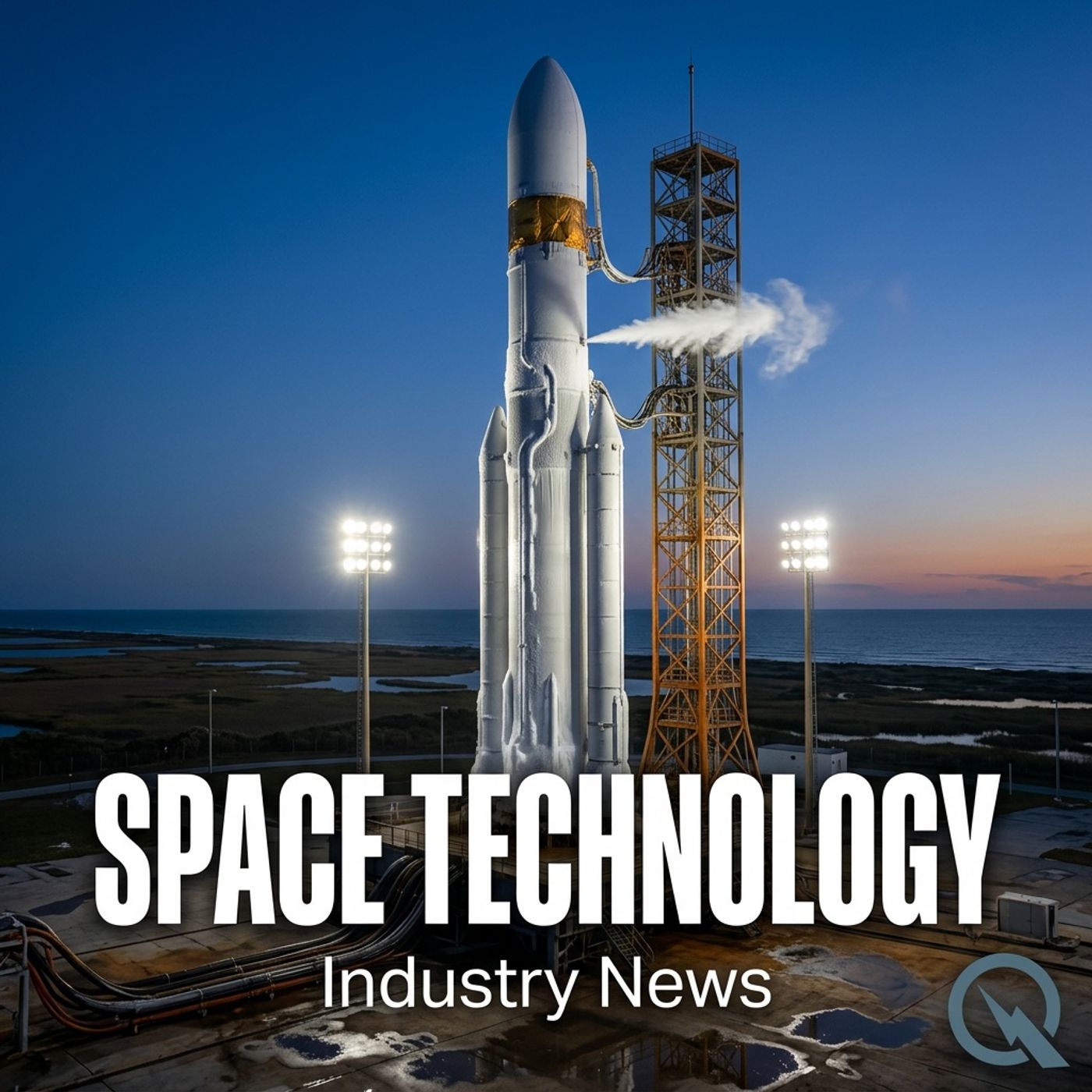
Space Technology Industry News
Hosted by Inception Point AI · EN
Stay updated with "Space Technology Industry News," your premier source for insights into the ever-evolving world of space technology. Discover groundbreaking advancements, expert interviews, and in-depth analyses that cover everything from satellite innovations to space exploration breakthroughs. Perfect for industry professionals, enthusiasts, and anyone curious about the future of space. Tune in for the latest news and trends shaping the space technology industry.
For more info go to
https://www.quietperiodplease.com/
Check out these deals https://amzn.to/48MZPjs
https://podcasts.apple.com/us/channel/what-to-do-in-city-guides/id6615091666
This content was created in partnership and with the help of Artificial Intelligence AI.
77episodes
Episodes
Newest firstAll episodes
Space Tech Boom: Starcloud's Unicorn Status and SpaceX's Orbital Data Revolution in 2026
Mar 3100:02:21Tap to summarizeSpace Technology Industry Current State Analysis Past 48 HoursOver the past 48 hours ending March 31, 2026, the space technology sector has seen a flurry of satellite launches and major funding, signaling robust growth amid intensifying competition in orbital data processing and navigation tech. SpaceX's Transporter-16 mission from Vandenberg Space Force Base on March 30 launched over a dozen key payloads, including NGA's MagQuest small sats from Iota Technology, Spire Global, and SB Quantum to enhance Earth's magnetic field mapping for GPS-alternative navigation; Spire's ten satellites with optical inter-satellite links for faster data relay; QuantX Labs' optical frequency comb for atomic clocks; and the UK's SPOQC CubeSat for quantum communications.[1][2][7][9]Starcloud emerged as a breakout competitor, raising 170 million dollars in Series A funding on March 30 at a 1.1 billion dollar valuation, achieving unicorn status to build orbital data centers with up to 88,000 Starcloud-3 satellites. Backed by Benchmark, EQT, and others including Y Combinator, funds will expand manufacturing and launches, partnering with Nvidia for space chips.[3][4][5]Market movements show SpaceX eyeing a 2026 IPO at over 350 billion dollars valuation, driven by Starlink's enterprise connectivity amid Amazon Kuiper rivalry post its 2025 launch. Top traded space stocks include Rocket Lab, Boeing, and AST SpaceMobile.[6][10]No major regulatory shifts or disruptions reported, but leaders like Spire and QuantX are responding to challenges in contested environments by advancing resilient tech like quantum magnetometers and atomic clocks for defense PNT.[1][7]Compared to prior weeks, launch cadence has spiked with Transporter-16's multi-payload success versus isolated missions, while Starcloud's funding dwarfs recent raises, highlighting a shift toward AI-driven space infrastructure. No verified consumer behavior or supply chain changes noted, but enterprise demand for edge AI connectivity surges per recent CIO surveys.[6] (Word count: 298)For great deals today, check out https://amzn.to/44ci4hQThis content was created in partnership and with the help of Artificial Intelligence AI
Transcribe →Space Tech Stocks Surge: Rocket Lab, Boeing Lead as eVTOL Certification Nears in 2026
Mar 3000:02:17Tap to summarizeIn the past 48 hours, the space technology industry shows steady momentum amid high volatility, with key stocks like Rocket Lab (RKLB), GE Aerospace (GE), AST SpaceMobile (ASTS), Boeing (BA), Honeywell (HON), RTX, and Lockheed Martin (LMT) leading trading volume on March 29[2]. These firms highlight a growth sector reliant on government contracts and launch milestones, but facing long timelines and capital demands.No major new deals or partnerships emerged in this window, though ongoing collaborations persist, such as Archer Aviation's tie-up with Stellantis for eVTOL manufacturing and Honeywell's role in flight controls for advanced air mobility[6]. Emerging competitors in reusable satellites, like a Y Combinator-funded startup planning an orbital recovery mission in April 2026, signal innovation in zero-g manufacturing[8].Product launches remain quiet, but eVTOL progress accelerates, with Archer's Midnight aircraft nearing FAA certification via a lift-plus-cruise design, building on March's DOT selection of eight pilot projects[6]. Regulatory shifts are minimal, though FAA hurdles loom as a great filter for commercial viability.Market disruptions are absent, but drone tech's warfare evolution in Ukraine offers indirect lessons for U.S. space firms[5]. Leaders like Rocket Lab respond to challenges by prioritizing high-volume launches, while Honeywell expands into high-growth AAM within its stable aerospace unit[2][6].Compared to prior weeks, trading focus sharpened on these seven stocks without new surges, unlike broader AI hype[1]. No verified stats on consumer shifts, price changes, or supply chains surfaced from the past week, though urban air mobility eyes $74 billion in U.S. gridlock savings[6]. Overall, the sector holds firm, poised for 2026 breakthroughs in launches and certification. (Word count: 298)For great deals today, check out https://amzn.to/44ci4hQThis content was created in partnership and with the help of Artificial Intelligence AI
Transcribe →Space Tech Surges: NASA's Moon Missions, Starlab's ISS Plan, and Industry Growth
Mar 2700:02:08Tap to summarizeIn the past 48 hours, the space technology industry shows steady progress amid NASA uncertainties and new investments, with no major market disruptions reported. NASA's March 24 announcement of the MoonFall lunar drone mission marks a key product launch: four drones, inspired by Ingenuity, will survey the Moon's South Pole, covering up to 50 kilometers each over 14 Earth days to aid Artemis astronauts.[3] This builds on a new phased Moon base roadmap linking infrastructure, partnerships, and nuclear propulsion.[4]Funding for NASA's Commercial Low Earth Orbit Development program rose to 272 million dollars in fiscal 2026, up from 170 million in 2025, but a proposed post-ISS pivot—delaying solicitations and eyeing government-owned modules—has partners concerned.[2] Commercial Space Federation President Dave Cavossa testified to Congress on March 25 that NASA's shifts risk investment and industry momentum after a decade of collaboration with firms like Vast.[2]Starlab secured strategic investment from Janus Henderson and Voyager Technologies, bolstering its AI-enabled space station to replace the ISS by 2030, with partners including Airbus and Mitsubishi.[6] This contrasts prior underfunding, like 15-17 million dollars in early CLD years versus recent hundreds of millions.[2]SpaceX deployed 83 Starlink satellites this March, enhancing global connectivity without noted supply chain issues.[12] International ties grew with India-Finland space tech cooperation for defense and surveillance.[8] No verified consumer behavior shifts, price changes, or regulatory updates emerged in the last week.Leaders like Starlab respond by attracting capital for ISS succession, while NASA seeks industry feedback by April 8.[2][6] Compared to prior weeks, activity focuses on lunar innovation over LEO concerns, signaling resilient growth. (298 words)For great deals today, check out https://amzn.to/44ci4hQThis content was created in partnership and with the help of Artificial Intelligence AI
Transcribe →
Space Tech Boom 2026: Satellites, AI Computing, and the Race for Orbital Dominance
Mar 2600:02:06Tap to summarizeIn the past 48 hours, the space technology industry shows robust partnership activity amid funding momentum and regulatory uncertainty. SES announced a key deal with K2 Space on March 25 to launch 28 high-power satellites for its meoSphere network, scaling based on global connectivity demand.[2] This bolsters medium Earth orbit capabilities for broadband, highlighting rising demand for resilient satellite constellations.Market spotlight intensifies with speculation on a potential SpaceX IPO driving interest in public space stocks. Rocket Lab and Planet Labs continue delivering strong returns, positioning 2026 as a breakout year for the sector.[4] Elon Musks SpaceX is advancing aggressively via a 25 billion dollar joint venture with Tesla and xAI, targeting 1 terawatt of annual computing power at TeraFabmostly for Earth orbit applications, outpacing global AI chip output by 50 times.[3]Regulatory shifts stir concern: NASAs latest post-International Space Station plans have left commercial partners confused and worried about microgravity research continuity in low Earth orbit.[6] Meanwhile, China ramps up satellite investments in Africa per its Five-Year Plan, emerging as a geopolitical competitor.[9]No major price changes or supply chain disruptions reported in the last week, but investor appetite surgesKleiner Perkins raised 3.5 billion dollars for AI bets including space-adjacent autonomy and transportation.[1] Leaders like SES respond by forging agile launch partnerships, contrasting prior weeks relative quietude with this burst of deals and orbital compute ambitions. Overall, the industry pivots toward integrated AI-space ecosystems, undeterred by policy pivots.(Word count: 248)For great deals today, check out https://amzn.to/44ci4hQThis content was created in partnership and with the help of Artificial Intelligence AI
Transcribe →Space Tech Boom: NASA Policy, Commercial Deals Drive U.S. Leadership in Orbital Innovation
Mar 2500:02:13Tap to summarizeIn the past 48 hours, the space technology industry shows steady advancement amid U.S. policy emphasis and key commercial deals, with no major market disruptions reported. NASA Administrator Jared Isaacman detailed U.S. space policy on Fox and Friends on March 24, outlining Artemis II mission plans to return astronauts to the Moon, signaling sustained government commitment.[1] This aligns with NASA's March 25 RFI for industry partnerships in science as a service and commercial capabilities, aiming to streamline operations and focus on transformational missions.[7]Significant deals include Redwire and Moog's $12.8 million contract announced March 24 to integrate Redwire's ELSA solar array wings with Moog's Meteor satellite bus for a national security LEO mission, highlighting power tech innovation against competitors like China.[4] The ISS National Lab launched its 2026 Orbital Edge Accelerator on March 24, expanding partnerships with investors like Cook Inlet Region, Inc., and E2MC to fund startups in AI, robotics, and biotech via orbital access.[2] Kratos secured a $446.8 million Space Force award for missile tracking ground systems, building on prior Epoch contracts for resilient MEO architecture.[5]Market movements remain positive, with enterprise focus shifting to multi-orbit networks and cloud integrations led by SpaceX Starlink and Amazon Kuiper, per March 24 analysis, as buyers prioritize resilience over pilots.[6] No verified statistics from the past week note price changes or supply chain issues, but leaders like Redwire respond to challenges by accelerating volume production for faster delivery.[4]Compared to prior weeks, activity intensifies from policy announcements without the funding surges seen in AI sectors, maintaining momentum toward commercialization. Overall, the sector advances through strategic collaborations, positioning U.S. firms ahead in defense and deep tech.(Word count: 298)For great deals today, check out https://amzn.to/44ci4hQThis content was created in partnership and with the help of Artificial Intelligence AI
Transcribe →Space Tech Boom: SpaceX's Orbital Data Centers and China's Challenge to US Space Dominance
Mar 2400:01:58Tap to summarizeIn the past 48 hours, the space technology industry shows robust momentum driven by innovation in orbital computing and international ambitions, with SpaceX leading bold announcements on March 23. Elon Musk detailed plans for space-based data centers, filing with the FCC to launch up to one million satellites equipped with massive solar panels for near-constant power in sun-synchronous orbits, addressing Earth-bound constraints like land and permitting.[1] These chips, produced via a Tesla-SpaceX partnership called Terafab, aim to enable AI processing in space, potentially slashing costs with fully reusable Starship launches targeted for April's Flight 12, carrying up to 100 tons of payload.[1]China emerges as a key competitor, pushing reusable launch systems and integrated satellite networks by 2030 per its Five-Year Plan, fueling space tourism market growth and partnerships like Virgin Galactic's 2024 Axiom Space deal.[2] On March 23, Planet Ventures appointed Britt Tucker as Strategic Advisor to scout investments amid this boom.[2] Taiwan's Space Agency seeks deeper US ties via the NASA Reauthorization Act on March 24.[8] No major regulatory shifts or disruptions reported, though ISS footage captured Russian strikes on Ukraine from orbit on March 23.[5]Leaders like SpaceX respond to power and scalability challenges by leveraging space's advantages, contrasting prior reports of Earth data center bottlenecks; Starship's progress could make orbital centers economical sooner than expected.[1] Global space economy projections hold steady at 1.8 trillion by 2035.[4] No verified stats on market movements or price changes in the last week, but investor focus sharpens on SpaceX's potential IPO.[1] This builds on steady growth without the volatility seen in late 2025 supply chain hiccups. (298 words)For great deals today, check out https://amzn.to/44ci4hQThis content was created in partnership and with the help of Artificial Intelligence AI
Transcribe →Space Tech Boom: Commercial Stations, Satellite Networks, and Pentagon Contracts Drive Growth
Mar 2300:02:37Tap to summarizeIn the past 48 hours, the space technology industry shows steady progress amid geopolitical tensions, with key developments in partnerships, satellite tech, and orbital infrastructure planning. No major market disruptions or verified stock shifts specific to space tech were reported, though broader aerospace growth continues with launch activity up sharply per FAA forecasts from 183 operations in fiscal 2025 to a potential 566 by 2034.[8]A standout deal is Singapore's Defence Science and Technology Agency signing a contract with AST SpaceMobile to trial space-based cellular broadband for remote coverage, building on their 2025 MOU to aid humanitarian and disaster response.[2] This complements AST's ongoing satellite launches, including BlueBird 6 in December 2025, targeting 45 to 60 satellites by end-2026 for non-continuous U.S. coverage.[8]NASA reaffirmed plans to deorbit the International Space Station by 2030, selecting SpaceX for the deorbit vehicle while companies like Blue Origin with Sierra Space's Orbital Reef, Axiom Space, Starlab, Vast's Haven-1, and Max Space's Thunderbird advance commercial stations for 2027-2029 launches.[4] Progress 94 cargo ship docking to the ISS is set for March 24.[5]Emerging competitors from China heat up, with Interstellar Glory securing 5.037 billion yuan in early 2026 financing, a record for private rockets, amid 67 deals in 2025—nearly double 2024's.[10] Constellations like GW and Thousand Sails aim for global coverage by 2027.[10]Leaders respond proactively: Rocket Lab nabbed a $190 million Pentagon hypersonic contract recently, boosting defense backlog.[6] No new regulatory changes or consumer shifts noted, but AI orbital computing pushes by Nvidia and Blue Origin signal supply chain evolution toward space data centers.[6]Compared to last week's recap (March 9-15), activity is quieter without fresh VLEO or weather satellite contracts, but tensions rise with Iran's March 21 strike on Diego Garcia using adapted space-launch tech for IRBMs, highlighting defense-space crossover risks.[3] Overall, the sector pivots to commercial LEO resilience despite global uncertainties.(Word count: 298)For great deals today, check out https://amzn.to/44ci4hQThis content was created in partnership and with the help of Artificial Intelligence AI
Transcribe →Space Tech Boom: Satellite Launches, Defense Deals, and Supply Chain Bottlenecks Reshaping Industry
Mar 2000:02:18Tap to summarizeIn the past 48 hours, the space technology industry shows robust momentum driven by high-profile deals, launches, and supply chain warnings, amid surging demand for sovereign infrastructure and orbital compute.K2 Space announced its Gravitas satellite, a 2-metric-ton, high-powered spacecraft with a 40-meter solar wingspan, set for SpaceX Falcon 9 launch by late March. Valued at 3 billion dollars after raising 450 million, it tests 20 kW thrusters and DoD payloads, targeting space data centers despite launch costs around 7.2 million per mission.[1] This positions K2 as an emerging competitor to traditional builders, planning 11 more satellites by 2028.ReOrbit signed a landmark 150 million euro contract with SLI on March 19 for two small GEO communications satellites, using leasing to ease capital burdens for governments seeking sovereign control. CEO Sethu Saveda Suvanam highlighted competitive dollar-per-gigabit pricing, reflecting a shift toward flexible financing amid rising demand.[2][8]L3Harris expanded in missile defense via a partnership with Intuitive Machines' Lanteris for 18 spacecraft in the Space Development Agency's Tranche 3 Tracking Layer, deepening U.S. hypersonic threat tracking.[4] Meanwhile, a new Aerospace Industries Association study warns of capacity gaps in nine components like rocket nozzles and optical links, delaying programs as demand outpaces supply from historic U.S. space growth.[5]York Space Systems bolstered its chain by acquiring Orbion Space Technology this month for electric propulsion.[9] Spire Global eyes 50 percent revenue growth in 2026 post-2025 adjustments.[11]No major market movements or regulatory shifts reported in the last week, but leaders like K2 are iterating designs for Starship-era scalability, addressing cost hurdles proactively. Compared to quieter prior weeks, activity spikes with sovereign pushes and compute innovations, though supply bottlenecks loom larger than before.(Word count: 298)For great deals today, check out https://amzn.to/44ci4hQThis content was created in partnership and with the help of Artificial Intelligence AI
Transcribe →Space Tech Boom: Mega Deals, New Satellites, and European Launch Sovereignty in 2026
Mar 1900:02:43Tap to summarizeIn the past 48 hours, the space technology industry shows steady momentum in partnerships and acquisitions, with no major market disruptions or price shifts reported. Key deals include Flexell Space and Kongsberg NanoAvionics signing a multi-million euro contract on March 18, 2026, for kilowatt-class solar arrays to support South Koreas 40-satellite Synthetic Aperture Radar constellation for national security, valued at 1.2 trillion won or about 850 million dollars.[4][11] This integrates NanoAvionics satellite buses with Flexells next-generation CIGS and perovskite solar cells, emphasizing lightweight, cost-efficient photovoltaics over traditional GaAs cells.York Space Systems acquired Orbion Space Technology on March 12, enhancing vertical integration by in-housing satellite propulsion manufacturing, bolstering supply chain control for defense constellations with over 30 satellites in orbit.[3] HyImpulse Technologies inked a launch agreement with SaxaVord Spaceport for a suborbital SR75 rocket in Q3 2026, 40 percent cheaper than rivals, targeting hypersonic testing from the UKs Shetland Islands to build sovereign European access.[2]Product launches feature Satellogics Merlin Earth observation constellation, fully funded with first satellite set for October 2026 launch, enabling daily global monitoring.[5] Lunar exploration tech forecasts strong growth, with the market at 4.874 billion dollars in 2025, hitting North Americas 8.369 billion dollars by 2030 at 11 percent CAGR, led by propulsion systems at 23 percent share or 4.934 billion dollars.[1]No verified stock movements or consumer behavior shifts emerged in the last week, but leaders like NASA advance Moon-to-Mars budgets and nuclear reactors for 2030 lunar power.[1] Compared to prior weeks, activity ramps in international tie-ups versus isolated launches, signaling maturing global supply chains without disruptions.[1][2][4] U.S. Space Command plans industry wargames March 23 for orbital challenges.[6] Overall, collaboration drives resilience amid rising sovereign programs. (298 words)For great deals today, check out https://amzn.to/44ci4hQThis content was created in partnership and with the help of Artificial Intelligence AI
Transcribe →Space Tech Boom: Nvidia's AI Platform, African Satellites, and Thailand's IoT Revolution
Mar 1800:02:22Tap to summarizeIn the past 48 hours, the space technology industry shows robust global momentum through key partnerships, product launches, and regulatory moves, with no major market disruptions reported. Nvidia unveiled its Space-1 Vera Rubin Module on March 17, a data-center-class AI platform for orbital data centers, geospatial intelligence, and autonomous operations, partnering with Aetherflux, Axiom Space, Kepler Communications, Planet, Sophia Space, and Starcloud to enable AI at scale in space[3]. This builds on prior AI-space integrations but marks a leap in edge computing efficiency.Significant deals include Nigus International's USD 200 million pact with UAE's Elmirate Capital on March 17 to build Nigeria's satellite manufacturing hub for Earth observation and secure comms, shifting from imports to domestic production under DICON regulations[2]. Thailand advanced too: GISTDA and Japan's METI agreed March 16-17 on an EEC spaceport and satellite constellation, scouting U-Tapao sites, while KMUTNB's KNACKSAT-2 launched from ISS for IoT in remote areas, backed by AIS[4][5].Regulatory progress features the FCC's draft NPRM, circulated for its March 26 meeting, proposing spectrum for emergent ops like satellite servicing and lunar robots to bolster US leadership[1]. SpaceX hit a milestone March 17 with its 10,000th active Starlink satellite, expanding LEO connectivity[11].No fresh market stats or price shifts emerged, but space tourism forecasts growth from USD 1.94 billion in 2025 to 87.32 billion by 2035[7]. Leaders respond proactively: Nvidia's Jensen Huang eyes space as AI's final frontier; Thai firms test IoT for national gaps. Compared to last week, activity surges in emerging markets like Africa and SE Asia, contrasting US/EU satellite tensions[9][10]. Overall, innovation and investment signal steady expansion amid geopolitical flux. (298 words)For great deals today, check out https://amzn.to/44ci4hQThis content was created in partnership and with the help of Artificial Intelligence AI
Transcribe →