← Split Zone Duo: College Football Podcast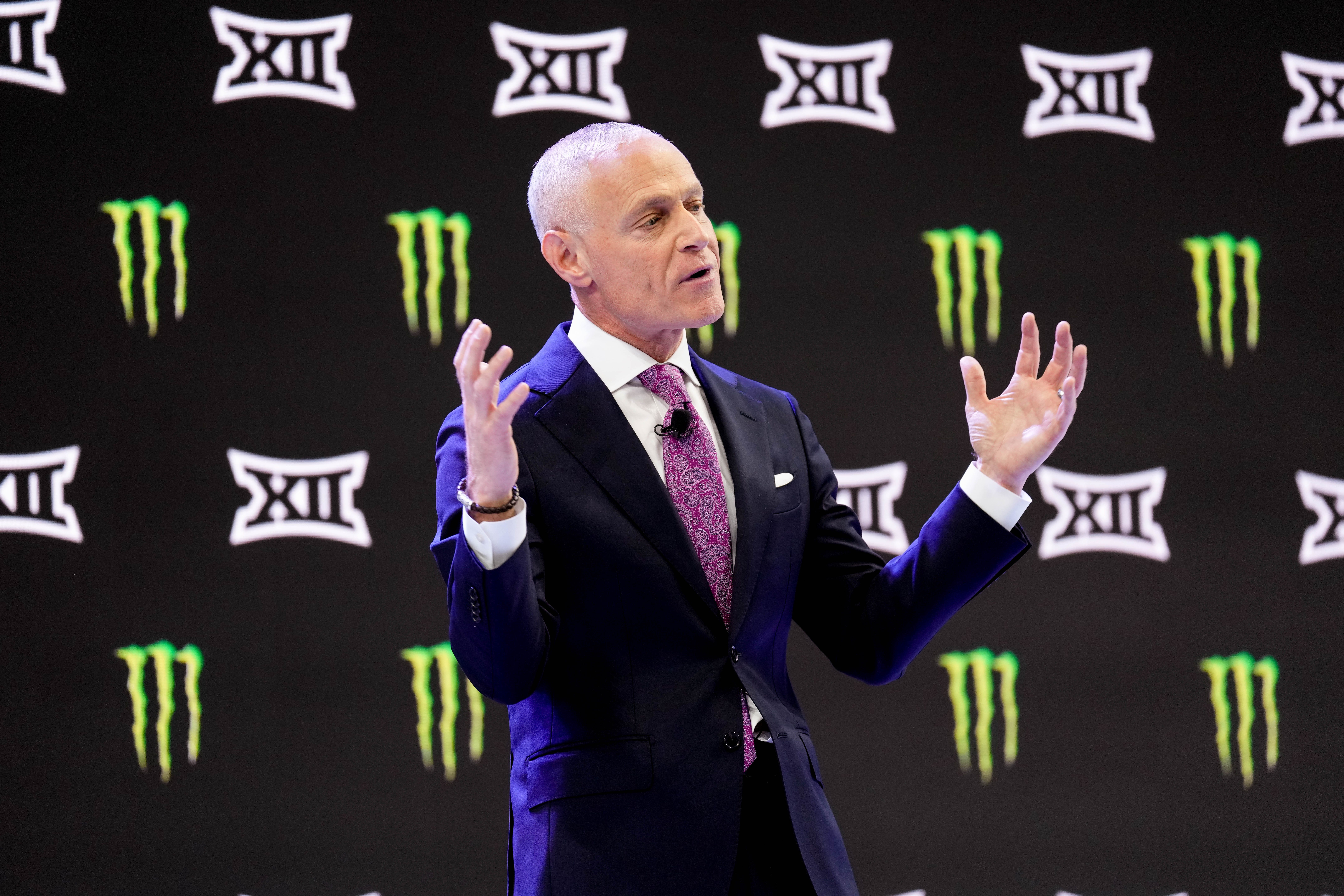
Loading summary
Transcript20 lines
- [00:00]
Stephen
We're coming, and we ain't backing down. We don't need a bunch of cats in here looking in the mirror. Everybody just do your job. You understand that? Hey, will you shut up? I'm bitterly disappointed with the officiating today. Guys being dudes, and they run through our. Like, through a tin horn, man.
- [00:16]
Alex
Thank you, Lee. Thank you to our Splitzoneduo.com subscribers. For this week's subscriber special, I'm joined by our co founder and host emeritus, Steven Godfrey. Godfrey, I've been trying to pitch from, for a few months some kind of way into conference media days because they're this big kind of cultural event around the sport. But I feel like vaguely, a lot of us can sense that they've been losing juice for a while and they don't matter in the same way that they once did.
- [00:46]
Stephen
Yes, I would agree with that.
- [00:48]
Alex
The one exception to that is that I feel like for conference commissioners, who now all kind of want to be seen as thought leaders and big movers and shakers, these events are still really big because it's their chance to tell the world that they're doing something. And so these press conferences tend to have agendas like, you know, the leagues are really trying to message something most of the time almost in the way that you might catch a senator holding court on Capitol Hill between votes. And now there's, you know, a little too much overlap maybe between those two parties. But it put this idea in my head that we're in this period of time in the late summer where all the conference commissioners want you to pay attention to them and listen to them, especially for a day or so at a time. They're. They're all trying to get a day or two of news cycle about what they're up to and why their league is great and why their leadership is so great. And so I thought it was in order that we would talk about how the commissioners are doing and talk about conference health one time before the season starts, because once college football is actually being played, I really have no interest in conference health and realignment business and how a commissioner's job performance is doing. I'd rather talk about the players and coaches, but you want to hold press conferences. Okay. Have you. Have you found any interesting press conferences of late?
- [02:21]
Stephen
I think what you're trying to get at here is a sort of unofficial stance or kind of like it was the way that former SEC commissioner Mike's Live would had kind of repurposed SEC media days a long time ago, 15, maybe 1520 years ago. And Slive was instrumental in building up the event when it was just at the Hoover, the hotel that changed names a couple times, the Winfrey. For a while. The hotel is connected to a shopping mall that doesn't exist anymore in Hoover, Alabama. And you could really credit slides SEC for building talking season into what it is and stretching out these events to an interminable length where people are just like, crying to get out of a hotel ballroom by day four. But I think what you're going for, Alex, is that Slive saw the opportunity to essentially create a State of the Union, even though that Mike Slive was not the commissioner of college football. He recognized that college football didn't have a commissioner and that the NCAA was never interested in sort of like creating a state of address. Like, I. Like, I. I don't know if you've ever been to the NCAA convention before in the winter.
- [03:34]
Alex
I have skipped.
- [03:35]
Stephen
They don't really have anything. Yeah, it's. It's dry. Slive, I think, very wisely saw the chance to set the tone on all the conversations that would occur until toe met leather. Right. And so at the time, it was various initiatives or complaints, and like, some of it, most of it seems pretty quaint. If you go back and like, read his address or listen to his keynote in like 2007 or something, you know, it was mainly about the playoff structure, the arguments over the bcs, like that kind of stuff, right? Then you get into expansion and like, that kind of stuff. But he was always up front, and he was the one who kind of set. Set what the discussion would be. And I always thought it was really interesting because it was ground that Jim Delaney and the Big Ten just sort of seated. And it was back in the kind of peak library era of the Big Ten, where the emphasis just was not on being cutthroat and competitive. And so I think that set the tone to where, when I started as a national reporter, everybody was trying to sort of cop Mike's live style and like, giving their own weighing in there on their own State of the Union. Like, this is what we feel. You saw that a lot with like, Larry Scott's Pac 12, where he was also trying to either like, rebuke or modify what the conversation would be. And then over time, it's changed to where it's really just like, well, the Big Ten and the SEC are kind of holding these referendums in perpetuity as there's so much change in college sports. So, like, Greg Sankey didn't necessarily have an Earth shattering state of the union address at SEC media days. Was it two weeks ago as we record this?
- [05:12]
Alex
Basically, yeah. About a week, maybe two by the time this. No. Yeah, about a week ago. About a week ago.
- [05:16]
Stephen
Okay, so. But that's also because we hear from Greg Senki a lot more often, Alex. Like, it's not. It's not the annual thing anymore. We just hear from these guys more often. The one I want to start with was, what was your reaction to Brett, your mark? Because I've never seen a conference commissioner like, you know, history has spoken its piece about Larry Scott, but he understood the assignment. When it came to, like making a public address, like whether or not what Larry Scott wanted to accomplish occurred or what he believed in was fact. He understood the assignment. I just watched Brett, your mark completely whiff in a way that I've never seen a conference commissioner whiff in my entire career.
- [05:54]
Alex
Well, I think Yormark's a really good example of what we talk about when we discuss commissioners trying to make themselves events. Because in the core function of this guy's job as Big 12 commissioner, I think he's been an undeniable success. The Big 12 still exists and is pretty stable. Like, we don't worry about it the same way, though. It can always change that we do. The ACC right now, the PAC 12 as it was, died instead of the big 12. And there was some really smart maneuvering by the Big 12 cutthroat as it was, villainous as it may have been in some ways to make that happen. But the problem is, Stephen, you did that like it was done. You sign a long term media rights deal. So then what do you do after that when you're the conference commissioner? I'm not saying that you have nothing to do but a lot of a conference commissioner's work after you've done that key thing. Media rights dealers and realignment that are glove in hand together is basic day to day maintenance of the conference. Making sure that there's officials, staff to work games all year round and making sure that you have an office staff that is putting out your press releases and communicating with coaches and athletic directors of the schools to make sure everything's running in a certain way, doing logistics work to play in conference tournaments, all that is, you know, important. But that's not really why you got into this. No one is. I'm not going to Big 12 media days to ask Brett Yourmark. So, Brett, how do you feel about the way the tailgating setup worked outside the Big 12 championship game last year? You know, were there enough tents? So you have to do something a little bit more exciting. And Yormark loves doing this, but he
- [07:31]
Stephen
also was like completely flat footed on. So this was my thought at the time when I saw it.
- [07:37]
Alex
Are we talking about the Monster thing?
- [07:39]
Stephen
No. Well, kind of, but that's not where I was headed. So. Yeah, but like, the Big 12 announced a big partnership deal with. With Monster, which I think has been misunderstood because people are comparing it to the other jersey patches. But you can still have a jersey patch in the Big 12 with Monster. I don't think people realize that it's the Big 12 logo. Like, everybody's conference logo is on their uniform anyway. And so what they did was they sort of subverted the Big 12 logo into a Monster logo. And that's on there. But like, I know BYU has their own patch. I think other Schools, the Big 12 have their own advertiser patch. So, like, yeah, he made a big deal about Monster Energy. And so here, this is what I'm getting at. Alex, he walked out there and I think in his brain he was holding a keynote. And at a keynote, you control everything. It's like if you've ever watched an Apple keynote, when like Tim Cook or Steve Jobs or somebody would walk out there and Talk, or like E3 in the video game world where like, you know, Reggie Fils Aime at Nintendo would walk out and be like this. These are the games we're excited about. You control every aspect of the presentation. The media might get to ask questions later, but it's thought of as a sort of like narratively controlled presentation, like a mark, a sort of breathing marketing deck. Your mark. Alex had like, I think he was legitimately shot that everybody started asking him about Brendan Sorsby and Texas Tech.
- [09:06]
Alex
That.
- [09:06]
Stephen
Yeah, what the hell was like, what
- [09:09]
Alex
did you think was gonna happen?
- [09:11]
Stephen
Yes. Yeah, I've never seen that before in. In all the time I've been doing this where it's one thing that, like, I've definitely seen a conference commissioner say, I don't want to talk about that. Very famously, I was at the Big 12 media days in the media gang before the key, before the main speech, where Bob Bsby was just getting. Just killed for what was going on at Baylor. And then he sort of like stutters out, hey, guys, we're gonna, we're gonna do expansion. Like, this is right when you started Espionation, where, like, it was like, hey, guys, don't look at the sexual assault over here. And whether or not we're gonna Fire, like potentially, maybe excommunicate Baylor from the league. Hey, we might take ucf. Like, I've seen some dumbass stuff before, but I also can understand him pivoting in real time because he was panicking. It was amazing. The hubris of Brett Yourmark was amazing to me because he walked out there like, did. It's a room full of reporters. Well, at least. At least labeled. Like, I think journalism's taken a step back, but, like somebody was going to ask you about the biggest off season story in your league and he was like, genuinely shocked that someone asked.
- [10:19]
Alex
I think that he leaves himself a bit liable to this because he loves to announce stuff and sometimes he wanted a keynote. Sometimes the actual stuff doesn't match what was announced. Or if it does, it doesn't actually stay around long term. There are so many examples of this. Just in the half decade, not even that he's been the Big 12 commissioner. We did like an episode about Big 12 Mexico in 2023. Big 12 Mexico has not occurred. They talked about setting up this, like, beachhead for Big 12 basketball in New York. They did do a couple clinics, as I understand it, a couple years ago in New York City at Rucker Park. Haven't seen that continuing long term. There was the time when he was really pushing UConn to get into this conference and the membership didn't buy it and so they didn't join. There was a moment where the Big 12 office seemed to be pushing Gonzaga as a basketball member. That didn't really happen. There was the time that they were talking about how they might rename the conference the All State 12. Do you remember that a couple of years ago they did end up selling sponsorship title for Big Ten Big 12 football. But still like Big 12 football. Monster Big 12 football. Not literally the Monster 12. There's a big difference. The difference being that it affects what it's actually called.
- [11:28]
Stephen
And no one call it's the NASCAR difference because we called it the Winston Cup. So much when I was a kid that I thought I didn't understand it was even named after the cigarette.
- [11:38]
Alex
And it's Outback Bowl. Same thing. Like you need the name to be the name. There was the time that the Big 12 was talking about basically selling a big chunk of itself in a private equity deal. And they didn't wind up doing that because the presidents didn't approve it. That came from the league office. They did wind up doing something just recently where they have some money coming in to the league office and that was offered to the schools in the league, but almost all the schools, if not all of them, have said no to it. I think there's just a lot of desire and we can move on from your mark. But he's just the perfect example of where this starts to eventize your press conferences, to be dealing, to be doing stuff. Because media rights deals are five to 10 years at a time. And it's not that you have no core function once you've figured that out, but you know, we're starting to strain a little bit because that's the most important thing that you can do. Thank you for listening. This has been a free preview of a subscriber episode for our subscribers@splitzoneduo.com if you'd like to become a paid subscriber today, you can do that@www.splitzoneduo.com. subscribe.