
Podcast
Startup Hustle
Hosted by Startup Hustle · EN
Startup Hustle is a podcast for entrepreneurs, by entrepreneurs. With the mission of telling the real story of startups and entrepreneurs, topics range from funding to failure and beyond. If you want to start, own, or build a business then you're in the right place.
42episodes
Episodes
Newest firstAll episodes
Creative Engineering at Scale What Big Companies Get Wrong and Right with David Mitchell
Feb 500:33:07Tap to summarizeWhat happens when you mix creative agency chaos with world-class engineering? You get teams that don’t just write code—they own the product.In this episode, I’m talking with David Mitchell, CTO at VML, one of the biggest creative agencies on the planet. With thousands of engineers and global clients like Wendy’s and United Airlines, David’s teams are building things that most devs only dream of—and doing it without getting buried in bureaucracy.We break down what it really takes to foster creative engineering inside a massive org, how to keep engineers out of the ticket-taking trap, and how AI is reshaping what engineering leadership actually looks like.If you lead teams and want to stop micromanaging, or if you're just tired of pretending Agile is still helping... this one’s for you.⏱️ Episode Breakdown[00:15] — What is a "creative engineer" and why don’t we have more of them?[06:00] — Why software engineering should be creative work[07:40] — The evolution of engineering: From basement coders to business thinkers[11:20] — Ownership vs. ticket-taking: How VML trains teams to lead[13:30] — Journey-Driven Development and the myth of “API-first”[20:45] — Is AI changing how we build software—or just hyped?[24:00] — Hackathons, prototyping, and the rise of “vibe engineering”Links & ResourcesConnect with David on LinkedInProduct Driven - Get the BookSubscribe to the Product Driven NewsletterWhat Smart CTOs Are Doing Differently With Offshore Teams in 2025Subscribe to the Global Talent SprintFull Scale – Build your dev team quickly and affordablyIf you’re trying to get your team out of the basement and into real product ownership, this episode is your playbook. Stop being a ticket factory. Build teams that think, create, and lead.Follow the show, rate it, and send this to someone who’s still trying to do “real Scrum.” They need it more than you do.
Transcribe →
Engineering Clarity in the Age of AI with Seth Rosenbauer
Jan 2900:32:39Tap to summarizeEngineering Clarity in the Age of AI: How Docs, Context, and Product Thinking Shape Better SoftwareSeth Rosenbauer is the founder of a tool that uses AI to help engineers create better documentation—and, more importantly, the right thing, faster.But this conversation isn’t just about tooling.It’s about how context is the new currency in engineering. Why your team’s ability to understand what to build and why is more critical than ever. And how AI is changing the shape of product communication, technical documentation, and engineering ownership.Whether you lead a growing dev team or are trying to ship more with less, this one’s for you.Key Discussion PointsSeth’s journey: From PM to founder to doc tool builderWhy traditional documentation fails engineersThe real cost of unclear requirementsWhat AI can (and can’t) fix in engineering communicationHow better docs lead to better productsThe problem with "done"—and how teams miss the last 10%Building a culture of engineering ownershipLinks & ResourcesConnect with Seth Rosenbauer on LinkedInJoggrProduct Driven - Get the BookSubscribe to the Product Driven NewsletterWhat Smart CTOs Are Doing Differently With Offshore Teams in 2025Subscribe to the Global Talent SprintFull Scale – Build your dev team quickly and affordably
Transcribe →
Fixing the Language Barrier Between Engineers and Executives with Karell Ste Marie of The Serious CT
Jan 2200:37:02Tap to summarizeMatt is joined by Karell Ste-Marie, founder of The Serious CTO YouTube channel. Together, they tackle one of the biggest hidden challenges in software companies: the language and cultural barrier between engineers and executives.Karell and Matt break down why innovation is so rare in large organizations, why engineers and business leaders often talk past each other, and how the CTO role often becomes the critical bridge between the two worlds.Key Discussion PointsThe cultural resistance to change inside enterprisesHow introversion and communication style shape engineering cultureWhy the best CTOs speak “both languages”Lessons from mistakes made on the path to leadershipResources & LinksThe Serious CTO on YouTube – Karell’s channel where he shares insights on engineering leadershipProduct Driven - Get the BookSubscribe to the Product Driven NewsletterWhat Smart CTOs Are Doing Differently With Offshore Teams in 2025Subscribe to the Global Talent SprintFull Scale – Build your dev team quickly and affordably
Transcribe →
Prompt Prototyping, AI Vibes, and the New Rules of Product Management
Jan 1500:29:25Tap to summarizeProduct management is being rewritten in real time, and AI is doing the editing.Matt sits down with Jerel Velarde, product manager at Full Scale Ventures, to discuss how AI is reshaping the relationship between PMs and engineering. We dive into what Jerel calls prompt prototyping, how expectations for product velocity have changed, and why the best PMs today are blending design, strategy, and code—all while staying laser-focused on validation over output.If you're a founder, CTO, or product leader trying to navigate the new frontier of product development, this one's for you.Key Discussion PointsIs “Product Manager” even the right title anymore?The new definition of PM: focused on outcomes, not artifactsHow PMs are using AI to validate fasterHow to lead product in a startup vs. a scale-upHow to think about MVPs when AI can build anythingResources & LinksConnect with Jerel on LinkedInProduct Driven - Get the BookSubscribe to the Product Driven NewsletterWhat Smart CTOs Are Doing Differently With Offshore Teams in 2025Subscribe to the Global Talent Sprint
Transcribe →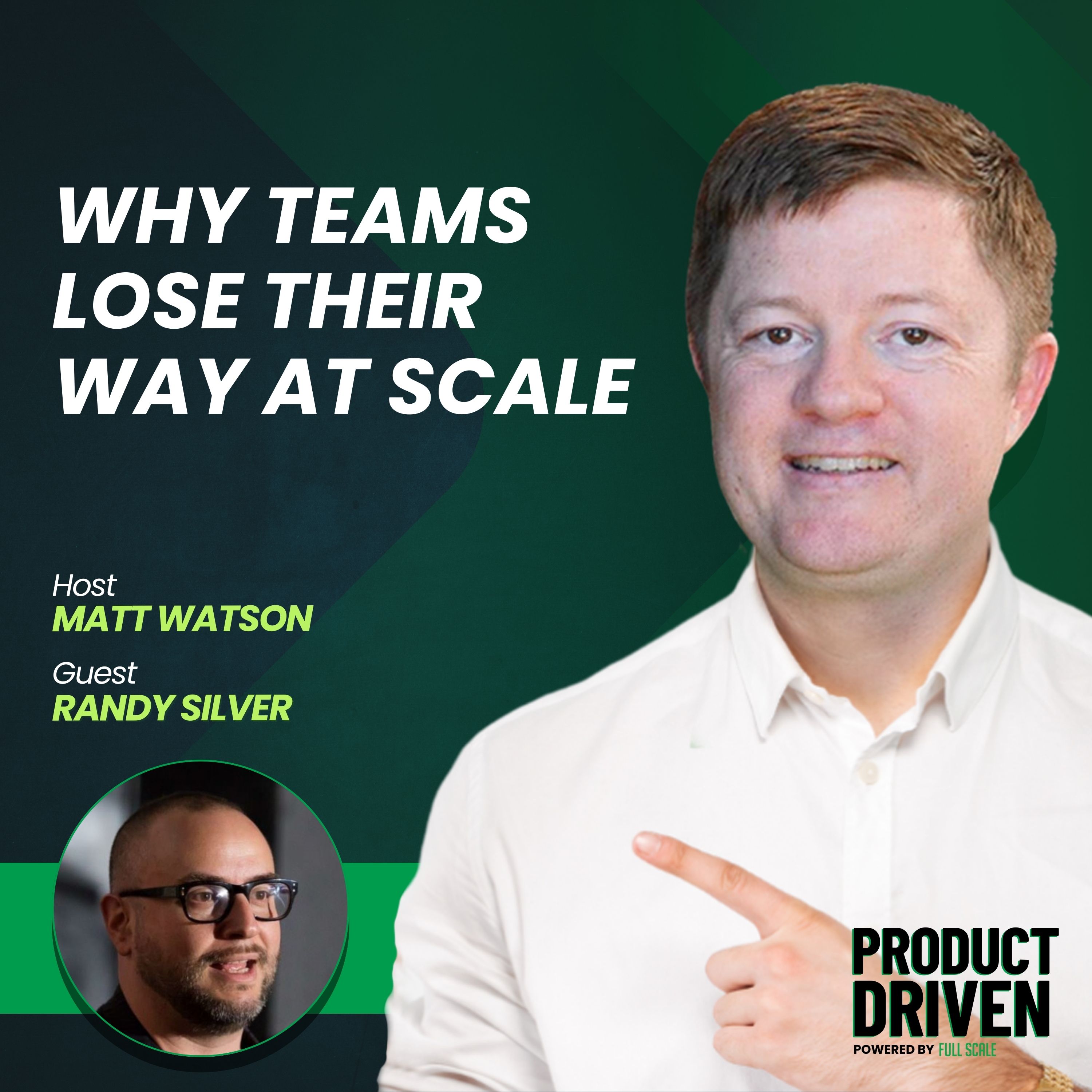
Why Teams Lose Their Way at Scale with Randy Silver
Jan 800:31:34Tap to summarizeMatt is joined by product and leadership consultant Randy Silver to unpack one of the most frustrating problems in product organizations: everyone knows where they want to go, but no one knows how to actually get there.Together they explore what causes this breakdown in execution, how companies drift from product strategy to dysfunction, and what strong leadership really looks like at scale.Key Discussion PointsWhy strategy is easy—execution is the problemWhy in-shitification happensThe three organizational dysfunctions Randy sees mostWhy autonomy without alignment failsThe real root of dysfunction: unclear product strategyWhat leaders can do right now to fix the messResources & LinksRandy Silver’s consulting work https://randysilver.comFollow Randy on LinkedIn Randy SilverGood Strategy Bad Strategy by Richard Rumelt Link to BookSubscribe to the Product Driven Newsletter: https://productdriven.com/newsletterWhat Smart CTOs Are Doing Differently With Offshore Teams in 2025: https://hirefullscale.com/offshore-hiring-guide
Transcribe →
The Best Startup Pitch Framework
Dec 11, 202400:44:31Tap to summarizeIn this episode, Matt Watson interviews Rajiv Nathan, the Startup Hype Man, who shares insights on how to pitch a startup to investors and customers effectively. Rajiv discusses his journey from a marketing background to becoming a pitch expert, emphasizing the importance of understanding the pitch landscape beyond just raising capital. He introduces the K-PASA formula for crafting elevator pitches and highlights common mistakes founders make, such as focusing too much on features rather than the problems they solve. The conversation also covers actionable steps for creating compelling pitches and the pricing structure for Rajiv's services. TakeawaysFounders often struggle to articulate what their company does.The best pitches focus on the customer's problem, not just features.Rajiv's K-PASA formula helps structure effective pitches.Investors want to see how you communicate with customers.Common mistakes include being overwhelmed with information and using jargon.A strong elevator pitch can open doors to further conversations.Lead with emotion to engage your audience effectively.Tailor your message to resonate with your target audience.Your pitch should evolve as your company grows and changes.Effective messaging can significantly influence investor interest. Find Startup Hustle Everywhere:https://gigb.co/l/YEh5 This episode is sponsored by Full Scale:https://fullscale.io/ Learn more about Startup Hypeman here:http://www.startuphypeman.com Learn more about Rajiv Nathan here:https://www.linkedin.com/in/rajivnathan/ Sign up for the Startup Hustle newsletter:https://newsletter.startuphustle.xyz/ Sound Bites"You need to get this together.""I accidentally quit my job.""Investors are not the people who buy your product." Chapters00:00 Introduction to Pitching Strategies01:04 Rajiv's Journey to Becoming a Pitch Expert07:24 Understanding the Pitch Landscape12:47 The Importance of Problem-Focused Pitches15:15 Common Mistakes in Pitching16:34 The K-PASA Elevator Pitch Formula22:57 Crafting the Approach and Solution31:39 Action Steps in Pitching35:03 Pricing and Services for StartupsSee omnystudio.com/listener for privacy information.
Transcribe →
Targeting the Midmarket, Growing with SEO
Dec 4, 202400:42:26Tap to summarizeIn this episode, Matt Watson interviews Ben Taylor, founder and CEO of Soft Ledger, about his journey in creating accounting software. They discuss the challenges of building a product in a competitive market, the importance of identifying gaps in existing solutions, and the lessons learned from the startup experience. Ben shares insights on their go-to-market strategy, the role of AI in accounting, and the impact of funding on their growth. The conversation highlights the complexities of product development and the future of accounting software. TakeawaysBen Taylor identified a significant gap in the accounting software market.Soft Ledger was built to address the inefficiencies in financial reporting.The journey to acquiring the first paying customer took 10 months.Product readiness is crucial before launching to customers.Surviving as a startup often means focusing on cash flow management.SEO has been a key driver for customer acquisition for Soft Ledger.AI is expected to enhance efficiency in accounting tasks.Funding allowed Soft Ledger to invest in product development and marketing.The accounting software market is evolving with new entrants and technologies.Positioning against competitors like QuickBooks requires a clear strategy. Find Startup Hustle Everywhere:https://gigb.co/l/YEh5 This episode is sponsored by Full Scale:https://fullscale.io/ Learn more about Softledger here:https://softledger.com Learn more about Ben Taylor here:https://www.linkedin.com/in/bentaylor8/ Sign up for the Startup Hustle newsletter:https://newsletter.startuphustle.xyz/ Sound Bites"I called up my longtime friend, Jeff Ostrega.""It took about 10 months before we got our first paying customer.""We thought we had something, but it wasn't ready." Chapters00:00 Introduction to Soft Ledger and Its Founding03:09 Identifying Market Gaps in Accounting Software05:56 The Challenges of Selling Accounting Software08:54 Building a Robust Product: Lessons Learned11:59 Navigating the Startup Journey: Surviving and Thriving15:08 Go-to-Market Strategy and Inbound Marketing17:54 The Role of AI in Accounting Software21:04 Funding and Growth Strategies for Startups23:54 Future of Accounting Software and Market PositioningSee omnystudio.com/listener for privacy information.
Transcribe →
Starting vs Growing a Business
Nov 27, 202400:43:32Tap to summarizeIn this episode, Matt Watson and Sean Beckner discuss the journey of entrepreneurship, investment strategies, and the evolution of business growth. Sean shares his experiences transitioning from a startup founder to an investor, highlighting the importance of timing in business exits and the dynamics of customer engagement in the digital age. They explore the challenges and rewards of acquiring businesses, the balance between equity and cash in exits, and the future of investing through a family office model. The conversation emphasizes the need for purpose and passion in entrepreneurship, as well as the potential for growth in existing businesses. TakeawaysEntrepreneurship involves phases: founding, acquiring, and investing.Transitioning from operator to investor can feel boring but offers freedom.Building businesses profitably allows for better optionality in exits.Customer engagement strategies have evolved with technology.Timing the market is crucial for successful business exits.Acquisitions can provide a win-win for founders and investors.Balancing equity and cash in exits is a strategic decision.Investing through a family office allows for more control and flexibility.Purpose and passion are essential for long-term entrepreneurial success.Growth in existing businesses can be more manageable than starting anew. Find Startup Hustle Everywhere:https://gigb.co/l/YEh5 This episode is sponsored by Full Scale:https://fullscale.io/ Learn more about Sean Beckner here:https://www.linkedin.com/in/sean-beckner-558a916/ Sign up for the Startup Hustle newsletter:https://newsletter.startuphustle.xyz/ Sound Bites"It's hard. It's hard.""We all need some sense of purpose, right?""You can still get those types of returns." Chapters00:00 Introduction to Entrepreneurship and Investment02:56 Transitioning from Operator to Investor06:56 Early Ventures: From Startups to Exits10:28 The Evolution of Customer Engagement13:31 Viral Nova: Riding the Wave of Social Media19:41 Timing the Market: Selling at the Right Moment25:04 Acquisitions: Finding the Right Fit31:02 The Balance of Equity and Cash in Exits36:10 The Future of Investing: Family Office vs. Fund40:32 Conclusion: The Importance of Purpose in EntrepreneurshipSee omnystudio.com/listener for privacy information.
Transcribe →
Boutique VCs & The Effect of AI
Nov 20, 202400:45:22Tap to summarizeIn this episode, Matt Watson speaks with Joseph Ruscio, a partner at Heavybit, a venture capital firm focused on investing in software development-related companies. They discuss the evolving landscape of venture capital, the unique value niche VC firms provide, and the impact of AI on software development. Joseph shares insights on the challenges developers face, the importance of finding product-market fit, and how AI can enhance developer productivity. They also explore Heavybit's recent investments in AI startups and the future of software development in an AI-driven world. TakeawaysAI is not going to replace developers but will enhance their capabilities.Niche VC firms like Heavybit provide specialized support to early-stage companies.The pressure to integrate AI into products is significant for developers.Finding product-market fit is crucial for startup success.Developers are increasingly seen as the key decision-makers in technology.The cost of software development varies widely across different markets.AI tools can help reduce the toil in software development processes.Investing in specialized AI models is essential for enterprise applications.The landscape of AI investments is rapidly evolving with new startups emerging.Understanding the unique challenges of selling to developers is vital for success. Find Startup Hustle Everywhere:https://gigb.co/l/YEh5 This episode is sponsored by Full Scale:https://fullscale.io/ Find out more about Heavybit here:https://www.heavybit.com Learn more about Joseph Ruscio here:https://www.linkedin.com/in/josephruscio/ Sign up for the Startup Hustle newsletter:https://newsletter.startuphustle.xyz/ Sound Bites"AI is going to make developers more valuable.""The pressure to build AI functionality is real.""Finding product market fit is crucial." Chapters00:00 Introduction to Heavybit and AI in Software Development03:01 The Evolution of Venture Capital and Specialization05:58 The Value of Niche VC Firms09:01 Challenges in Selling to Developers11:48 AI's Impact on Software Development14:46 Investments in AI Companies17:51 The Future of Software Development with AI20:54 The Role of AI in Developer Productivity23:53 Investing in Emerging AI Startups27:08 The Importance of Specialized AI Models30:12 The Landscape of AI Investments33:06 The Economics of Software Development35:54 Conclusion and Future OutlookSee omnystudio.com/listener for privacy information.
Transcribe →
Scaling with Affordable Talent from the Philippines
Nov 13, 202400:42:32Tap to summarizeIn this episode, Matt Watson and Yoni Kozminski discuss the intricacies of hiring talent in the Philippines, exploring Yoni's journey from creative advertising to building a recruitment agency. They delve into the challenges of scaling a business, the importance of value creation in sales, and the need for clear job definitions and onboarding processes. The conversation highlights the evolving workforce in the Philippines, cultural nuances in communication, and the economic factors influencing hiring decisions. Yoni emphasizes the importance of having in-house expertise and leadership when hiring remote talent, while also acknowledging the incredible capabilities of Filipino workers. TakeawaysHiring in the Philippines can provide high-quality talent at competitive rates.Value creation is essential in every interaction with potential clients.Understanding business needs is crucial before defining job roles.A clear onboarding process is key to employee success.Cultural nuances can affect communication and understanding in remote teams.The Philippines has a rapidly evolving workforce with increasing capabilities.Investing in emerging world talent is beneficial for both parties.Sales growth often comes from existing clients and referrals.Defining success metrics for roles helps in effective hiring.Building a strong company culture can enhance employee satisfaction. Find Startup Hustle Everywhere:https://gigb.co/l/YEh5 This episode is sponsored by Full Scale:https://fullscale.io/ Find out more about MultiplyMii here:http://www.multiplymii.com Learn more about Yoni Kozminski:https://www.linkedin.com/in/yonkoz/ Sign up for the Startup Hustle newsletter:https://newsletter.startuphustle.xyz/ Sound Bites"We could help a lot of people if they just understood.""You really have to have visibility across how each of the pieces connect.""How do we focus on adding value at every single stage?" Chapters00:00 Introduction to Hiring in the Philippines02:59 Yoni's Journey into Recruitment06:04 Scaling the Business: Challenges and Strategies09:13 Sales Growth and Value Creation12:03 Understanding Roles and Hiring Needs15:04 Defining Success in Hiring17:58 The Importance of Onboarding20:49 Expertise and Leadership in Hiring24:02 The Evolving Workforce in the Philippines26:58 Opportunities and Economic Factors30:08 Cultural Nuances in Communication32:57 Conclusion and Final ThoughtsSee omnystudio.com/listener for privacy information.
Transcribe →