← Stronger with Don Saladino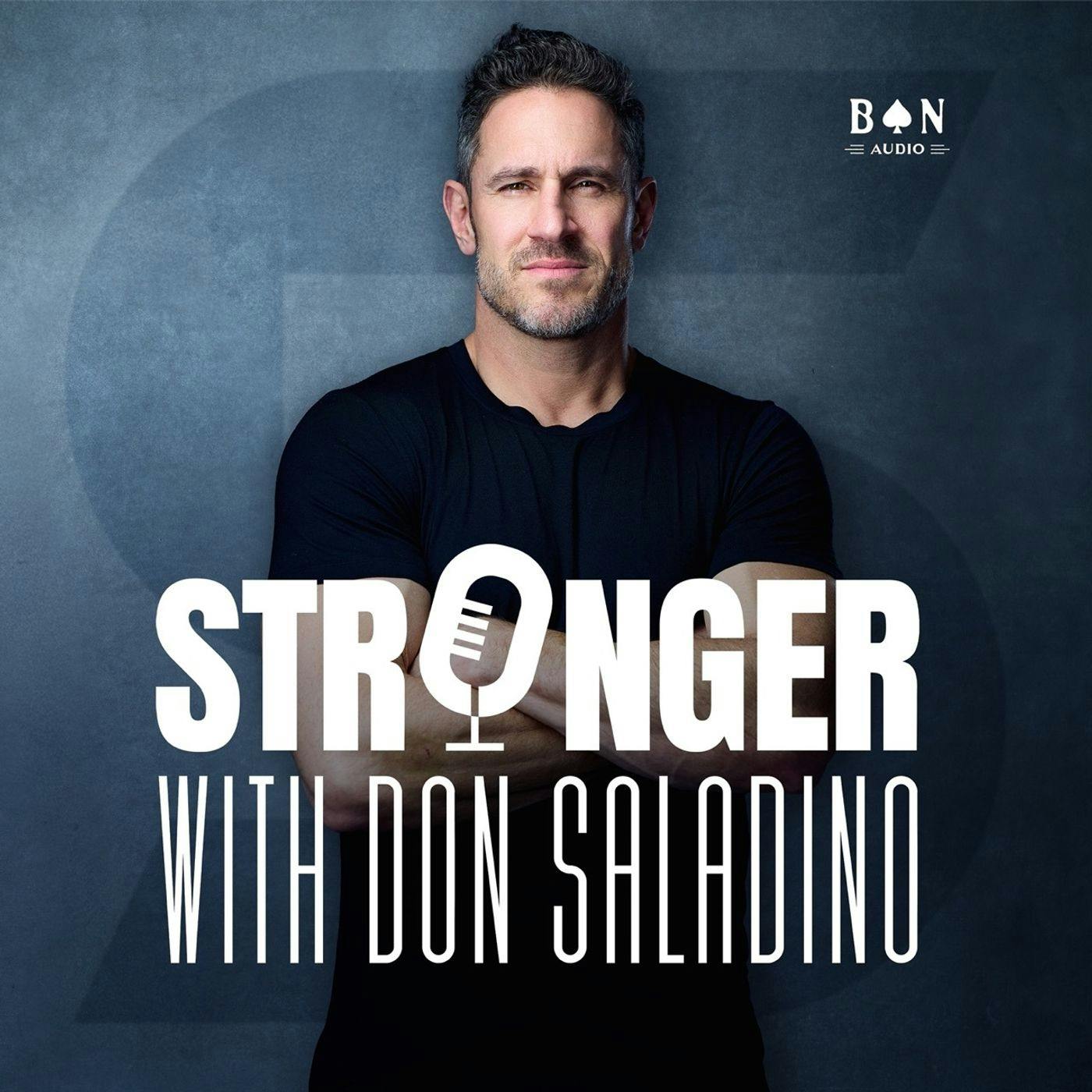
Stronger with Don Saladino
Why Motivation Fails (and What Actually Works) with Psychiatrist Dom Sportelli
00:52:38
Loading summary
Transcript173 lines
- [00:01]
Commercial Narrator
Good sleep is everything. That's why Ollie's science bag support is made with a blend of melatonin and L theanine for both kiddos and grownups. So when your mind won't switch off, you've got something that can help your racing thoughts and restless nights won't stand a chance. Find Ollie sleep solutions for the whole family@ollie.com that's o l l y.com
- [00:25]
Don
now
- [00:25]
Dr. Dominic Sportelli
at McDonald's a McDouble is $2.50.
- [00:27]
Don
So you can get your gym gains
- [00:29]
Dr. Dominic Sportelli
on or just get lunch for only 2:50.
- [00:32]
Don
Get more value on the under three dollar menu.
- [00:35]
Dr. Dominic Sportelli
Limited time only. Prices and participation may vary. Prices may be higher for delivery.
- [00:40]
Don
Hello everyone and welcome to Stronger. On today's episode, I just welcome Dr. Dominic Sportelli. Dr. Sportelli is a double board certified psychiatrist with an emphasis on adult, child and adolescent psychology. I mean this is an incredible human being that has really built his specialty on mindset, whether it comes to life or exercise, whatever it may be. If you're one of these people that are struggling to just want to get the work in, this episode with Dr. Sportelli is an absolute masterclass and I think this is going to help you and teach you how to rewire your brain so you can get in, do the work, improve and find happiness. Guys, let's get started. First off, Dr. Dominic Sportelli could not be any more excited to have you on. I first heard you at Dr. Gabrielle Lyons event forever. Strong event might have been in Houston.
- [01:40]
Dr. Dominic Sportelli
Houston, Houston. It's a great time.
- [01:42]
Don
And it's funny because her event, she's one, she's one of my best friends. Birds of a feather flock together. They all attract good people. I'm sitting there listening to you. You're brilliant. Your education, your grind, all these things I want to get into. But that's not what like drew me to you because we hear a of lot, a lot of all these doctors are smarter than I am. So it's like you, yes, you are brilliant. But, but it's, but no but it really is the type of person you are. And I think how you were delivering that message on stage is what drew me to you. There was such a level of like, I don't say friendliness but relatability to where you just got up and right there. I think that is something you could teach a masterclass on that to physicians because I think that's where a lot of them struggle. They struggle with bedside matter. Everyone's coming to a doct because they're in some type of a situation or they're vulnerable. I'll actually disclose some interesting information I've never told. I actually went in for my first mammogram and sonogram the other day. I noticed a lump on my chest. All right. Feeling some pain. It was there for about a month. I'm like, what the hell is this? So I go to my dermatologist and he's like, go get it checked out. I go in to get this testing done, and when I walked into the office, I'm the only guy, and I'm walking in the back room and I'm in a gown. Women are in gowns, and it was the first time. No, I'm not on their level. I'm not a woman. I understand. But to see the fear in a lot of their faces, to see the situation they were in, allowed me a perspective that I would never have had unless I went through that situation. So had the test done. They said it was gynecolomastia. Never taken a performance enhancing substance. Then Dr. Gabriel's team dove in and found there's a cream I've been using from a specific that had the estrogen a bit. My estrogen levels were. My estrogen levels were at 30. They were fine. They were right in the. They were right in the norm. They said, this cream has been known to give people lumps in their chest. I'll send it to you. I got off the cream two weeks later, and now the lump is starting to go away. It's not gone. It's going away.
- [03:53]
Dr. Dominic Sportelli
Incredible.
- [03:54]
Don
I would never. I'm so happy I went through that situation. Even a little bit of the fear of, like, what is this? What's going on? Because it gave me a perspective. And I think people don't realize that when you're in a situation and you have to see someone in your position, it's life changing. The message that you receive from a doctor, I don't care how smart they are. They need to be able to deliver that message. So you are a double board certified physician. I think you specialize, I think, adolescents, child psychology and adults.
- [04:27]
Dr. Dominic Sportelli
Yeah. Yeah.
- [04:27]
Don
So, okay, so explain a little.
- [04:29]
Dr. Dominic Sportelli
Yeah, of course. Yeah. Just a quick background. So went to medical school and. And we got to talk about that story. But first of all, thank you for the introduction and thank you for acknowledging what you did about relatability. And you know what, Don? I think, and I will talk about this, hopefully, is that I didn't go to med school until I was 30. I didn't set foot into med school. Until I was 30. I was a fitness trainer before that. We have a lot in common. We have a ton in common. And I'm gonna be honest with you. I don't think what you and I do is very different. And I'll talk about that, too. Appreciate that. But I was 30 when I set foot in med school, and I had a ton of life experience. And not all great life experience. And I struggle with mental health problems myself. Totally cool with that disclosure, because I think that's important because we're all human, right? And I get it. Just like when you went for that mammogram. How could you possibly understand how scary it is for a woman that feels a lump and potentially faces this life threatening crisis if you didn't experience that yourself? How can I possibly listen to a person that's depressed if I didn't experience it myself, which I have. Want to hear somebody talk about panic attacks, or when I hear somebody talk about something like that?
- [05:39]
Don
I get it.
- [05:40]
Dr. Dominic Sportelli
I've been through it.
- [05:41]
Don
I get it.
- [05:42]
Dr. Dominic Sportelli
And I know what works and I know what doesn't. And talking about bedside manner, Don, I don't want to get too tangential.
- [05:49]
Don
No, no, please.
- [05:50]
Dr. Dominic Sportelli
I'm really trying to keep this up. No, no, no.
- [05:51]
Don
Let it go, Let it go.
- [05:53]
Dr. Dominic Sportelli
I'm trying to keep this up. Here, let me see your pen for a second.
- [05:56]
Don
Here.
- [05:56]
Dr. Dominic Sportelli
Go. So true story. True story. I'm 18, 19, 20, struggling with some mental health issues, and I'm seeing a psychiatrist. He used to fall asleep on me every session. Wait, the reason I asked you for the pen was this is what he would do. This is a true story. He would sit there like this with his pen, and when he would fall asleep, he would drop his pen and it would, like, kind of be like a. Like this. It would wake him up. So he'd pick up his pen and be like, oh, okay. And he start taking notes again.
- [06:24]
Don
You're like, oh, thanks.
- [06:25]
Dr. Dominic Sportelli
And he'd go, this is a true story, right? Oh, my God. Imagine I didn't experience that. And. And now I'm the psychiatrist and I'm listening to people and I see their troubles and their pain and their struggles. I couldn't even imagine if I fell asleep on them.
- [06:43]
Don
Right?
- [06:44]
Dr. Dominic Sportelli
And I never want to be that. Never, ever, ever want to be that, because I know how it made me feel. So anyway, talking about how life experiences shape perspective, Ridiculously important, right? So you asked about my background. So terrible student in high school. Just had a lot of fun. And my guidance counselor told me, yeah, Dom, I don't think you're college material. True story. And I was like, yeah, I don't know. I really want to go to college, so I'm gonna go. So I did go to college. I went to a state college. I'm in college and love medicine, love science, love the human body. I'm gonna go be a doctor. Pre med advisor. Yeah. Dumb. I don't think you're gonna get into med school. So I've been told no so many times. And I had to figure out ways around that. No, around the person telling you who you are. And I figured it out, and I'm so glad I didn't listen to him. So what I think about is imagine those young kids that actually listen to those people. How is that shaping their life? Right? It's terrible. Yeah. So anyway, and I'll make this brief. So guess what? They were right. I didn't get into med school first time around. So I went and got a master's degree in biology and I did really well. I did awesome.
- [07:55]
Don
So you just got a master's degree in bios?
- [07:57]
Dr. Dominic Sportelli
Yeah, it was work. No, it was work, you know, no big deal. Reapplied to med school, got put on a wait list, died on the wait list with a master's. So then I'm like, crap, what am I going to do? And again, thinking, not going to give up. I'm persevering. I'm doing this. This is what I want. I don't care how many times I've been told no, this is what I want. Nobody's going to tell me that I'm not going to be good at it. So I said to myself, what is the hardest class in med school? It's. Well, you can argue this, but most people will say it's biochemistry is brutal. It's just nasty, right? So I go, okay, I'm gonna enroll in a biochemistry course as a non matric. I'm gonna pay for it. Not looking for a degree. Just give me the course, I'll pay for it. I'll sit there, I'll take the tests. And I did it and I aced it. Then I reapplied, and then I got an interview out of med school. And this is great. This is the greatest thing, because I'm sitting across from the interviewer, just like you and I right now, and he's got my file and. And he's looking at me and he goes, so, Dominic, I see that you applied. You got rejected once, you got wait listed. The next time you're Reapplying again. And he closes the file. This looks amount of a movie. And he closes the file and he sits back and he goes, so what are you going to do when you don't get in this time? And he just looks at me, right? And without a beat, Don, I was like, that's actually a really easy question. I'm just going to find another way to prove myself and reapply. And he said, okay, thank you. And he shook my hand. Then a week later, I got an acceptance letter, right? So don't give up, boys and girls.
- [09:29]
Don
But by the way, could you imagine if he. You're telling me the story, and I'm like, I would have. He should have turned around on the spot. Be like, welcome to medical school. That would have made the story even better.
- [09:37]
Dr. Dominic Sportelli
That'll make me tough it out for a couple of weeks, I guess. But.
- [09:41]
Don
But could you imagine? Could you. This is what's fascinating. There's this line. I did not invent this line. But for every time in life I was being rejected, I got redirected to something better. Right? Could you imagine not having that story to tell now? Right. And I think the sad thing about the story is there's so many people that couldn't take that and use it as fuel. It deflates the balloon and they go sit in the corner and they end up doing something in life that they're not happy doing. I had a conversation with my son yesterday. I said, there's really three things I want you to do in life. I want you to be a good person. You've got that knocked up done. You're an incredible person. I said, I want you to work hard, right? And I want you to find something you're passionate about in life. And if you could do those three things, buddy, I said, I think you're 90 yards down the field already. And it really is. And it's. And that's my thing, is that we waste our time in life chasing things that I just don't think are important. When I became a trainer, it wasn't to become a multimillionaire. It was like I became a trainer to. I wanted to help people, and I focused on helping people. Now other things happened in life that allowed me to go in a good direction, and I'm proud of that direction. But if. If I sat there and my parents didn't say, what type of career is there? My mom said the opposite. I said, I'm not sure if there's a lot of money in that. Am I being a smart Adult. She goes, you'll figure out the money. You're going to be great at this. Go do it. That was 1999.
- [11:01]
Dr. Dominic Sportelli
So good. That's so good. That's such good advice. And you know what's really, really cool? That I can say, I'm really proud to say this, that when I went into medical school, I was an idealist, right? And I was a reductionist. And I was very scientifically minded. And I was so naive that I thought that medical school was going to teach me everything about how we work and how our mind works and how the neuroscience of the brain works. And then I go to four years of psychiatric residency training thinking it's going to teach me the human mind and how it works. And you know what that was at the end of it all. Don't. It was the biggest smack in the face, cold water dumped over my head. Dude, you just went through the most rigorous training of the human mind and body. And we don't know. Blank. Yeah, you know, and I'm going, what?
- [11:56]
Don
What?
- [11:57]
Dr. Dominic Sportelli
So talk about a piece of humble pie, man. Now here's the coolest part, right? Is that. Yes. And, and we could talk about my, my, you know, my practice of psychiatry and behavioral health.
- [12:08]
Don
No, there's plenty of stuff.
- [12:09]
Dr. Dominic Sportelli
And trying to help people with depression, anxiety and motivation. And one of the problems, I believe, and this is. To your point, this is coming full circle. To your point, is that physicians are reductionist thinkers. They like quick fixes. Just like a surgeon, right? If you have appendicitis, man, cut that appendix out, send you home, sew it up, you're good. If you have an infection, you go to the doctor. Hey, it's strep throat. Take some amoxicillin, you're good. Hey, you're depressed, Take this pill, you're good. And I don't agree with that. Having come full circle, I don't agree with that, at least in behavioral health.
- [12:48]
Don
But think of an example I just gave recently was if I'm to go into Goldman Sachs and sit with a financial advisor, I'm making this up right now. Obviously, I'm gonna take their word for it, right? Like they know what they're doing. He's wearing the watch. He's at Goldman downtown in New York City. He's supposed to be good. He speaks the lingo. I'm not a financial person. I know finances, but I'm not at that level, right? So I'm going to trust this person. I think that's a big problem that we find on social media. We're trusting clickbait. You're going in to see your doctor at such and such wherever and you're assuming that they're going to give you the right advice. And a lot of times they're not.
- [13:30]
Dr. Dominic Sportelli
Right.
- [13:30]
Don
Like, I mean, I'm not to bash it, but like, how do you, how do you. And I don't want to put the question there to downplay doctors. I'm not, I'm not doing that. You've got good ones and you got bad ones. I am. How does someone filter the noise is what I'm asking.
- [13:42]
Dr. Dominic Sportelli
Yeah, it's hard. It's really, really hard. So, you know, I, I'm on faculty at a large medical university and I teach and one of the courses that I teach is appraisal of the scientific literature.
- [13:55]
Don
The same guy who didn't get into medical school and got sold not to do not Great.
- [13:59]
Dr. Dominic Sportelli
Good job.
- [14:00]
Don
I want to, I want to meet those guidance counselors now.
- [14:02]
Dr. Dominic Sportelli
Well, no, you want to know the best part is now I'm doing the interviews for the people trying to get in.
- [14:06]
Don
Right. But it's banana.
- [14:06]
Dr. Dominic Sportelli
It so crazy.
- [14:07]
Don
I don't want to use the language, but it's almost upsetting. But I also love the story, so keep it coming. Sorry to interrupt.
- [14:13]
Dr. Dominic Sportelli
So. So I teach a, I teach a course called Appraisal of the Scientific Literature. And basically what I'm doing here is teaching these young medical students and residents. How do you weed through the ridiculous amount of information out there and make a good clinical decision? Because there is so much garbage out there. So much garbage out there. And unfortunately, Don, we are still in. And dude, there's so much neuroscience behind this. Which if you want to, I'm happy to dig into it, please. I'd love to, but why are we such a quick fix society? So I think, I think that that's a huge question with a lot of answers. I think that we're a quick fix society. I think that we're very biased by fame, by who's got biggest followings, who's got this, who's got that. I think we're biased by our own internal kind of beliefs. Like, I went to a doctor, I hated doctors. Now I don't like now, now I don't like traditional medicine, who knows, whatever. But we're so internally biased. Like, how do you, how do you kind of, you know, filter through that? It's really hard. Education, man, education. Educate yourself, educate yourself. Stay open minded, but educate yourself. Learn how to read the literature yourself.
- [15:24]
Don
Yeah.
- [15:25]
Dr. Dominic Sportelli
You know, understand bias in Literature. And unfortunately, I think that's at a point where we're at where we can't really rely on anybody else for information. In a lot of cases, we have to do the research ourselves.
- [15:34]
Don
But also second opinions. I mean, how many times do you hear that horror story of someone going to a physician? I hear it a lot with physical therapy or specific chiropractors. And they've been going to this person for two years and there's no real improvement. Now, I don't know the full story because I don't know if this client's doing what they need to be doing at home or what are things that they're doing in their life that could be counterproductive to the work that the physical therapist or the chiropractor is doing. But second opinions aren't the worst thing in the world to go for.
- [16:01]
Dr. Dominic Sportelli
I think it's a real smart move, actually. Yeah, it's a really smart move. Especially if you're getting something done invasively or God forbid you're treating some sort of life threatening issue. A second opinion, Absolutely. What is it going to hurt? Get a second opinion. Undoubtedly. Even if it's behavioral health, get a second opinion. Because guess what? Doctors are human too.
- [16:21]
Don
The stronger podcast would not be possible if it weren't for our incredible sponsors. Cozy Earth has been supporting us pretty much since day one. So, guys, thank you. Cozy Earth's brushed bamboo jogger set. This company continues to wow me over and over, right? I never thought I'd wear pajamas. I never thought I'd wear a robe. The sheets, Cooling sheets. Unbelievable. Now they're brushed bamboo jogger set. Next level. It's a mic drop. Soft enough to sleep in, but put together enough to answer the door. Typically, I used to answer the door shirtless. Now my wife's happy that I'm not all right because I would embarrass myself. But this completely fixes that. Jogger sets are lightweight, breathable, and the kind of software that only gets better over time. I mean, that just. It just feels good. A tapered fit with a relaxed waistband and just enough structure to feel intentional. This spring, give yourself the kind of comfort that lives with you all day, not just the moment you get home. Head to cozyearth.com and use my code stronger for an exclusive 20% off. That's the code stronger for an exclusive 20% OFF. And if you see a post purchase survey, mention that you heard about Cozy Earth right here, because it always helps. And we want to continue working with them. Guys, thanks. Today I want to Give a special shout out to Timeline. Their mitopure supplement has been the biggest addition into my nutritional regimen in the last five years. When your mitochondria works better, everything works better. That is the power plant that feeds your body in reference to muscle and aging. Maintaining muscle gets harder with age.
- [18:04]
Dr. Dominic Sportelli
Age.
- [18:04]
Don
I'm 48 now. It's my number one focus is maintaining and actually, to be truthful, building muscle and still continuing to move well. But cellular energy plays a major role in strength and function. So every morning I take four Mitre Pure gummies and it actually tastes like a bit of a treat, which is why I like leaning towards the the gummies more. It's just, they're just fun to eat, Support your cells and how you age with might appear gummies. From timeline. Visit timeline.com stronger to get 20% off your might appear gummies. That's T I M E l I n e.coms-t r o n g E R Guys, thanks. I love it. So if mental health were treated like strength training, what would a weekly mental training program look like? Like, what would you like? Yeah, pull it up.
- [18:55]
Dr. Dominic Sportelli
I do. I took some notes. I love this question. I love this question. So. Well, first of all, first of all, let me say something here. Mental health, and this is why I said this to you initially, Don. I said, you know, what you and I do is not very different. It really isn't. Having been a personal trainer, I'm telling you this. What you and I do is not very different. And this is what I want people to understand that. Why do we think that if we're overweight or if our cardiovascular fitness is terrible, or if our oxygen saturation, our VO2 max is terrible, why would we think that going to the gym and running on the treadmill one day a week is going to do anything? Okay? So that being said, mental health is training your brain. So why would we think that? All right, you know what, if I go kind of meditate for 20 minutes once, I'm going to be good. No, it's just like the overweight person that's trying to get in shape by going on the treadmill once, 10 minutes a week. So my point is, you need a regimen. You have to treat your mental health just like you treat physical health and vice versa. And when I was thinking through this, because I think this is an incredible question, I put together something called a mental training split.
- [20:23]
Don
Ooh, right. I like this.
- [20:25]
Dr. Dominic Sportelli
I mean, it's pretty basic, right? So you periodize the body. Personal training 101, periodize. So you're gonna do something similar with your mental health. You need to address it and periodize it. So when we're in a state of fight or flight, right, Everybody, A lot of people are aware that that's the sympathetic nervous system. The sympathetic nervous system is activated and it's rocking and ro. So what you need to do from time to time is bring yourself into a parasympathetic nervous system phase. And one of your favorite things to do, not when you're in an acute panic attack, but of course it can help. But as a practice, five to 10 minutes of parasympathetic activation every day. So I don't care when it is. After work, before work on your lunch break, slow nasal breathing, the good old four to six breaths per minute, slow and controlled. Guess what activates the vagus nerve. I know. People know that. Five minutes a day, guys.
- [21:24]
Don
Simple, so easy, so simple.
- [21:26]
Dr. Dominic Sportelli
Nobody does it, number one.
- [21:28]
Don
So you do it anywhere too, activating
- [21:29]
Dr. Dominic Sportelli
your parasympathetic nervous system. Okay? 10 minutes, distraction free, all right? Meaning put your phone down, go for a walk. 10 minutes. I don't care what it is, do something. Distraction free, meaning screen time free.
- [21:48]
Don
What about music? Would you categorize music as a distraction?
- [21:51]
Dr. Dominic Sportelli
No.
- [21:51]
Don
No.
- [21:51]
Dr. Dominic Sportelli
Put on some tunes that you love. Ten minutes, right? Okay. And then. And this is important to talk about too, is a little bit of voluntary discomfort exposure, right? And we could talk about how dopamine works and how the mental.
- [22:06]
Don
Voluntary discomfort exposure, right?
- [22:08]
Dr. Dominic Sportelli
Well, it could be anything. It could be. Is that a cold shower? Is it a cold plunge? Is it something like that? So see if you can do a voluntary bit of discomfort, something that you really don't want to do, but you can do it in a very quick short period. That's smart, right? And there's. And there's a lot of neuroscience behind that. A lot of neuroscience behind that. We can talk about that. And then I call this social connection reps, all right? In person, not digital. Make a social connection every day, but a real social connection. I talk to people about this all the time. And you have no idea how powerful this is. And I'm gonna, I'm gonna. This is gonna sound tangential, but it's an important piece. Robert waldinger study Harvard, 75 year study. Happiness. What is happiness? What makes people happy after 75 years following people? Not money, not status, not your job, not the big house, not the Ferrari in the garage. You know what it is? It's connection. It's meaningful connections with people. Being a part of a community. Oh, my God. Did we just realize that in 2026? Seriously. So wait, so now I'm getting back to the social connection. I literally practice this, and I never used to do this. I would go through my day, and it'd be so superficial every day. Today, I. The parking garage attendant. Parking garage attendant that I would have normally just given my, you know, ticket to and walked out. Yeah, I made sure. I'm like, let me see if I can just get to know this guy a little bit and just chat him up. Hey, man, how are you? What's going on? Cool. Yeah, it's weather, whatever.
- [23:49]
Don
In New York. He definitely found that weird. He's like.
- [23:52]
Dr. Dominic Sportelli
He was like, this guy wants something. This guy wants something. But he started telling me how blessed his day was.
- [23:58]
Don
Yeah, nice.
- [23:59]
Dr. Dominic Sportelli
We're blessed, man. Things are good. And it was 90 seconds.
- [24:02]
Don
Yeah.
- [24:03]
Dr. Dominic Sportelli
And I walked away from that.
- [24:04]
Don
You feel good? Yeah. You feel good.
- [24:06]
Dr. Dominic Sportelli
Good.
- [24:06]
Don
You feel good.
- [24:07]
Dr. Dominic Sportelli
So social connection reps.
- [24:08]
Don
So. So for. So just to reiterate, breathwork. Five minutes. Simple nasal breathing. You know, four to six seconds of breath. Right. Distraction. Going for a walk, maybe putting some. Putting your headphones on for 10 minutes.
- [24:22]
Dr. Dominic Sportelli
No.
- [24:22]
Don
Something that we should. No phone. Something we should do. No screen time. Social connection. Doing what you did in the parking garage today. Just being able to connect with someone on a specific level. Non, you know, non social media or texting, but actual real connection. And then one thing, you know, find getting yourself a little uncomfortable for a few minutes.
- [24:41]
Dr. Dominic Sportelli
Something a little uncomfortable. And that's really, really important, because right now, more than ever, we are in a society of this really quick dopamine hit society. And I think we can all catch ourselves kind of getting into that cycle. And the more uncomfortable we are with discomfort, Don, the more avoidance we have in our lives and the less productive we're going to be. So you have to experience discomfort. You have to experience some level of discomfort. I'm not saying be sadistic. I'm saying a little level of discomfort and a cold shower does that. I want to add a couple. A couple more things. That's every day, one time a week, I want people to do what I call a cognitive audit one time a week. In that distraction free time, when you're sitting down, I want you to ask yourself three questions. What stressed me this week? For real? Like what? What got me triggered or upset? What stressed me? What happened? Think about it. Question number two. What did I avoid? I know I avoided something. What was it? What did I avoid? Because it was uncomfortable. And question number three. What did I tolerate well, and what did I do well? Three easy questions to ask yourself once a week.
- [25:50]
Don
So what did you avoid? What did you tolerate?
- [25:53]
Dr. Dominic Sportelli
And what stressed me out?
- [25:54]
Don
And what stressed easy.
- [25:56]
Dr. Dominic Sportelli
Right.
- [25:57]
Don
And you should put together a manual on this stuff.
- [25:59]
Dr. Dominic Sportelli
I'm telling you, man, you really should.
- [26:01]
Don
But like, but still, like a little, A little, like you should put together a little checklist, kind of like a quick cookbook to follow. Something very like, you know, readable and friendly and not where it's overwhelming. And I think these are great. So now let's hold that thought because my next question leads into these two little systems that you created, big systems that you created. Not all these are going to pay dividends. What mental health habits separate people who stay consistent from those who burn out or quit? So these are two things that you just listed to me that are so easy. Two systems that are so easy to implement in during the week. It should not be a problem. Why is it that people are either consistent, but why is it that most people aren't?
- [26:47]
Dr. Dominic Sportelli
Right. Incredible question. And you know, now we're talking about the psychology of motivation and consistency. What I just listed for you previously, just those simple things to do every week. How many people do you think are going to do them as easy as they are?
- [27:02]
Don
Not many, unfortunately.
- [27:03]
Dr. Dominic Sportelli
Is that crazy?
- [27:04]
Don
Unfortunately?
- [27:05]
Dr. Dominic Sportelli
Isn't that wild? I mean, it's common.
- [27:07]
Don
Well, I also think it's because there's so much noise out there and there's so many things to incorporate and they're just so overwhelmed with everything where. Just start with one thing and what
- [27:16]
Dr. Dominic Sportelli
is it that you're prioritizing and your brain is prioritizing other things. But you're asking an incredible question, is, you know, what are the mental health habits of consistency and what do we see psychologically in a consistent individual? And I broke it down when I just took some notes before I came in. Is identity conflict. All right, now this is wild. Think about this. And I know it sounds simple or maybe it even sounds too psychological jargon. Identity conflict. Right? Who you believe that you are is what you're going to excel in. And most people have a significant discrepancy between who I am and what a fit, healthy person is. So an identity conflict between that. Right. So are you able to attach your identity with that person that does that action, for example? Yeah, I try to train three times a week, or I'm a person that does train three times a week. That's a. That's a very big difference.
- [28:16]
Don
Powerful.
- [28:17]
Dr. Dominic Sportelli
It's very powerful because Bandura did some ridiculously awesome research back in the day on self efficacy. And when people believed that they were good at something, when people identified with what they wanted to do, guess what? They succeeded more. Duh. They succeeded more because they were less likely to quit. They tolerated discomfort more, and they were much more resilient just because they believed that they could do it, not because they had any specific skills. So this whole thing, right, like, you could read books, the Secret, and you can go online and somebody will probably talk about, like, some Eastern mysticism of, like, the universe is all one and, you know, ask what you want and you'll get it. No, it's neuroscience. When you believe in yourself and you identify with what you're doing, you're more likely to succeed at it. And I think a lot of people, when they're trying to get physically fit or get in shape, there's a fight. There's an internal fight inside, right? I don't know that I identify with this. I would love to be that person, but I don't know that I am. And as long as you say that to yourself, it's going to be that much harder. So there's an identity conflict, number one. Number two, People that are consistent know how to decouple mood from action. People that are consistent. I'm going to say that again. Know how to decouple mood from action. Now, you want to know what the difference is with that? The difference is I really don't feel like training today. Man, I'm in such a bad mood. I'm not going to. I'm not going to the gym. This sucks. Or the person that says, I'm not feeling that great today, I'm gonna do it anyway. That's got nothing to do with it. So they decouple their emotion with the action. Right. A lot of people are enmeshed with their emotion and their action.
- [30:03]
Don
Because I'm feeling this way means I shouldn't do it.
- [30:05]
Dr. Dominic Sportelli
Right?
- [30:05]
Don
Where it's actually the other way around. Right?
- [30:07]
Dr. Dominic Sportelli
Exactly right. And then understand. Ready for this? Talk about discomfort tolerance. Expect boredom. Expect some boredom. Right.
- [30:19]
Don
Doesn't that fall into the category of doing something uncomfortable?
- [30:22]
Dr. Dominic Sportelli
Yes.
- [30:22]
Don
Like. Yes, you count that. I'm glad you got. I am not gonna say that. Every day I wake up and I want to do it, but I can't tell you the last. I actually can tell you the last time I walked out of the gym or I was supposed to do it, I didn't do it. It was 1996. That's how long it's been. No, but think about that. I remember I didn't sleep. I went in, I did a set, I said, I'm out. I walked out. I'm not saying I haven't been in the hospital since then or I haven't, but 10 out of 10 times. Not 9 out of 10, 10 out of 10. If I go in and I'm not feeling it, I leave feeling it. And that's what we try and train, right? I mean, isn't that what we want? Isn't that the goal, in a way? Isn't that what you want, to try and train people to believe and think?
- [31:06]
Dr. Dominic Sportelli
So good. I'm so glad you brought this up. And that's why we train discomfort. And that's why we train the distraction, free time. And that's because. Okay, here's the neuroscience. If you want to get nerdy a little bit, here's the fact everybody talks about dopamine. I mean, every podcast in the world's like, dopamine, dopamine, dopamine, Right. And it kind of makes me nuts. But here's. Here's the fact. This is what people get wrong about dopamine. Dopamine is the motivator that's waiting for the reward. Okay, so let's just picture this for a second. Dopamine is secreted in the brain to give you the motivation to get the reward. Again, the reward is actually the endocannabinoid system and endogenous endorphins, not the dopamine. Now, if your dopamine is secreted because it motivates you, and you get that, and. And then you get that endogenous reward from the cannabinoid system. Endogenous. Your own body makes this stuff. And endogenous endorphins. The dopamine goes, oh, okay, I only have to be motivated for 30 seconds to get that reward. Guess what does that. Your cell phone does that. So quick rewards, quick fixes. Quick fixes. I need a little spike dopamine. And then I get my reward. I get my reward. I get my reward. You don't have any dopamine saliency. You have no dopamine latency. So the dis.
- [32:21]
Don
What does that mean? I'm sorry.
- [32:22]
Dr. Dominic Sportelli
Totally. So. So. So what happens is you want to teach your brain that you can secrete dopamine to give you motivation and know that the reward is a little further down the line. It's not going to come so fast without totally shutting down. Now, guess what happens when you're used to quick fixes. Scrolling, you know, whatever it might be. You're used to these quick dopamine hits. What ends up happening is if that dopamine doesn't get the reward, it shuts off. Then you lose motivation. So now you've trained your brain for quick fixes. Otherwise, I'm not even gonna do it. That's the neuroscience circuitry behind this. I know that sounds crazy and complex, but I'm gonna simplify it for you. Do some small tasks that feel uncomfortable, push through it a little bit, get yourself some small wins over time. Lengthen that out a little bit. Your brain is gonna adapt to, say, okay, it takes a little longer to get what I want, and that's okay. And that's why boredom is okay.
- [33:24]
Don
Yep.
- [33:24]
Dr. Dominic Sportelli
That's why feeling uncomfortable is okay and necessary sometimes because you want that. You want that resilience in that reward system.
- [33:34]
Don
How does chronic stress show up physically in the body and brain? I mean, and I want to. Stress isn't a bad thing, right? Like the right amount. Like, we need to stress our bodies. We do. But chronic stress, to the point where we're just not giving it that break. What are the things that are going to happen long term?
- [33:51]
Dr. Dominic Sportelli
So I want people to understand that you're absolutely right. Stress is necessary. Stress is necessary for change. Right. Your body's not going to change, your brain's not going to change unless it experiences discomfort or stress. This is the way I look at anxiety or stress. It's analogous to physical pain. And this is what I mean by that. If you have lower right quadrant pain and you don't go to the doctor and you have an appendicitis, you're going to die. What do you think happens to people? There is a very rare pathology where nociceptors, your pain receptors aren't functioning properly and you don't feel pain. What do you think happens to people that don't feel pain? How long do you think they live? It sounds like an awesome life in a way. Hey, I don't feel physical pain.
- [34:30]
Don
Probably not long.
- [34:31]
Dr. Dominic Sportelli
They do not hardly ever make it to adolescence because they don't have a warning system. Okay? So that being said, anxiety and stress is a warning system, okay? You have to listen to it the same way that you listen to physical pain. Like, dude, my shoulder hurts. You know what? We're going to not train your shoulder today. We're going to. It's the same thing. Why don't people listen to it? Nowadays we have this and this. This is a little Bit of a pet peeve I have. Or frustration with this stoicism movement. Right.
- [34:59]
Don
Tough it out.
- [35:00]
Dr. Dominic Sportelli
You're good. Grit. Look, I mean, yeah, that all sounds good. It all sounds good for Marcus Aurelius, right? And I get it. And listen, those philosophers did teach some brilliant stuff. But you have to treat your mind the same way that you treat your body because that emotional stress constantly and consistently is going to break your body down. And we kind of touched upon this previously. The HPA axis is going to be completely disrupted. Your growth hormone is going to decrease, your gonadotins are going to decrease, your cortisol levels are going to spike. Wait a minute. Listen. When you're under constant stress, your hippocampus shrinks. It's a part of the brain that's necessary for memory. When you're under constant stress, your prefrontal cortex gets a different blood flow. So you don't think, well, you're foggy, you can't make decisions. Your brain literally atrophies.
- [35:53]
Don
You know what it reminds me of? It reminds me of the, I want to say influencers, the people with influence that glorify getting up at 2 or 3 in the morning, right. And there's a line I've always used. No one's ever won that battle, right? Like it had. Like, I remember there were years, there was like a six to eight year span where I had to get up at 3am to open my club at 3:45. Guess what? I never glorified that. No. I wanted to sleep till the sun came up, like I would love to have. Was it good for me? No, it was not good for me. I had to do it because it was my responsibility. But the fact that we glorify these things as if it's something everyone should be doing, I think is where we're missing the message. And no one has ever won the battle. Meaning when you get sick or your body starts breaking down, you're suddenly not such a tough guy anymore because it's pretty hard to pull it out of that if you don't change those habits.
- [36:47]
Dr. Dominic Sportelli
Absolutely. And we do glorify, and it's a great word, we glorify. And society holds in high esteem somehow that stoic mindse, the grind of, you know, waking up in the dark and doing this and doing that. There's a lot to that. And from a psychological perspective, this is what I'm going to say about that, number one, is that's called suppression, right? You're, you're suppressing a lot of the emotional issues and you might be potentially running from stuff that you're not facing, because when you slow down, you're stuck with who you are and your thoughts and your vulnerabilities.
- [37:22]
Don
That's interesting, by the way. Hold on. That's really interesting what you just said. I just want to take a second. You basically just said that when someone gets themselves so busy, it's to ignore their problems. Maybe it could be right, but that's something that I don't hear people talk about much.
- [37:39]
Dr. Dominic Sportelli
It's important to talk about, Don, because, you know, I deal with addicts, I help addicts, alcoholics. But I also see similar patterns in workaholics. Right. You're avoiding something. Now, look, let me make this incredibly clear. Not everybody that's driven and motivated and nurtured is not running from some psychological issue. That's really important to say. But if you're overdoing it and you're never slowing down and you have this like, go, go, go, go, go, go, go. If you're that person that can't relax, I think it's worth at least investigating sitting down. Because if you can't sit quietly with yourself because your own emotions are too challenging, you're run that. That a substance use individual is running from. And that's the problem that I have with the whole stoic mindset. Like, you know, I hear influences, influencers out there and I'll watch pods and stuff and they're like this and that
- [38:31]
Don
and don't stop and go and go
- [38:32]
Dr. Dominic Sportelli
and go and go. And I'm, from a psychological perspective, I'm going, man, I never met this person, but I bet they're so unhappy. Yeah, like they're distracting themselves with all this stuff, man. They're just distracting themselves.
- [38:45]
Don
But we do see that a lot on social media. I do hear, and I know this firsthand, a few of them have called me with issues and, you know, they're, they're speaking on social media like they have those issues figured out. And, you know, it's very difficult to take advice from someone who's 24 when they're talking about life's work or life's challenges. And like, I get it, we all have problems. I don't want to devalue those people, but I also think it gets into the conversation of there's so much noise and find a few people online that you value. Do your research, as you said earlier, fire them off a dm, maybe they'll actually give you, you know, give you an answer. And I always say, be polite when you're firing those message off. Not well, I have this problem. Fix it. Hey, tell us a little about yourself and you know, ask in a very kind way to where, you know, sometimes I'll send a voice memo back. I enjoy doing that. But when someone's like 5, 10, 150 pounds, need to put on muscle, I'm like, I kind of be honest, I delete it because I, I want us, I don't want to start the relationship that way. And I am here to help, just like you are.
- [39:44]
Dr. Dominic Sportelli
Yeah. Understood. Understood completely. And you know, one thing I would also look for in people that you're, that you're looking at as your mentors. Please look for humility. Yes, look for humility. And I'm telling you this from somebody that's been to a lot of schooling. And as I told you when I first started, the more I learn, the less I realize. I know, Don. The more I learn, the less.
- [40:07]
Don
That's what I love about that was, that was the thing that drew me most to you, that you said that on stage in front of everyone. And I do think it takes a humble person to say this. Now I have some not rapid fire questions, but questions I like to kind of pick the pace up on. Right. And I just, I want to try and just a quick answer on it. We're going to move on. We're trying to bust out a couple of these and then what I'd like to do is, I'd like to take. I know you got a couple questions, Dom, I'm so grateful and I know this isn't going to be our last time doing something like this because I already know you and I are, you know, we're on the same wavelength here. So what do you see in high achievers who train hard but never recover mentally?
- [40:43]
Dr. Dominic Sportelli
All right, so these are high discipline individuals that are potentially suppressing some emotional stuff and they're overworking and over training and they are not treating the mind and the body in a periodization where they need to relax and recover. You'll say this as a trainer, you need to. Your recovery is just as important as your training.
- [41:10]
Don
100%.
- [41:10]
Dr. Dominic Sportelli
Your recovery is just as important as your training. And if you don't stop, you're never going to recover. And high performance people, it's, it's, it's really amazing because they do have a lot of resilience and I respect them. But what does high performance even mean? Right, so, so what does that mean? Are they, are they, are they an Olympian? Are they just are making A billion dollars on Wall street, like, what does that even mean?
- [41:34]
Don
And I think it's different for everyone.
- [41:36]
Dr. Dominic Sportelli
It's different for everybody. But happiness and meaning is your ultimate goal. Okay, let me just answer this. There's a balance. There's a balance. And somebody that's super high performing and incredibly motivated and overdoing themselves and burning themselves out is doing it wrong. And I think that there's a very natural and realistic balance to do it right and still be high achieving and even better if you know how to recover mentally and physically.
- [42:05]
Don
So second part to that question, what would be the fastest way to give advice on someone like this? To downshift.
- [42:13]
Dr. Dominic Sportelli
Insight. Okay. Insight. And I say that word meaning, pay attention to yourself. Pay attention to what's motivating you, what's meaningful for you. Ultimately. True meaning, what is meaningful for you. Align yourself with those meaningful goals. Right? Downshift. Think about that. Think about you for a second. Don't think about all the external stuff. Don't think about all the reward. Think about you for a second in regard to what's meaningful for you. And then of course, listen, the slow, the stuff that I said before about that, that regimen of mental health care, all of those things that I say, if you want to downshift, do that.
- [42:52]
Don
Focus on breath, work, focus on distracting yourself. Focus on social connection. Focus on getting yourself a little uncomfortable for a few minutes a day, right? Those are things.
- [43:01]
Dr. Dominic Sportelli
Distraction free. Is that always distraction free? Like no cell phones, time without the cell phones. All those things we talked about, that's how I would say downshift and think about meaning. Think what's meaningful for you, really meaningful, which is we've lost that. I'm telling you, I was just about
- [43:16]
Don
to say we don't talk about that. My grandfather, my mentor, God rest his soul, I used to, he would look at me at a young age, 14, 15 years old, and he goes, you know what my goal in life is? And I go, what? He would go, peace of mind. And I would look at him, I'd roll my eyes, I'd be like, yeah, it's easy for you to say, you've done well. And you know, I want to be a millionaire and I want to make money. This is at a young age, you know, and I want to be successful. And now, yeah, 48 years old, I'm like, someone said peace of mind was all of that. It's having your health, it's having some financial stability, it's having your family, it's having connection, peace of mind for Me, it's like, it's almost. It reminds me of like when I said sleep and it leads to everything else. Peace of mind with my definition leads to everything else. I love that.
- [43:57]
Dr. Dominic Sportelli
I want to tell you something really quick, please. And I'm probably running out of time. No, but this is important. Something we do with people that are struggling with addiction is called motivational interviewing. And the first part of motivational interviewing, Don, is aligning meaning to their goals. Right? And this is exactly what you just said. Now, I'm going to give you a quick story. Ready? Quick story. Guy goes to the doctor. He's a two pack a day smoker. I'm going to make this quick. The doctor says, hey man, you got to stop smoking. You're going to get copd. You're going to get lung cancer. This is really bad for you. You're smoking two packs of cigarettes a day. Guy goes, I know, doc, I know, I know. I'll quit. I'll quit sometime. I'll quit. He goes, doc goes, man, this guy's not going to quit. Let me show him some pictures of a black lung. Ooh, scary stuff. Guy goes, yeah, Doc, I've seen those pictures. Yeah, yeah, I'll quit someday, don't worry. Then he pulls up data, he says, hey, man, look, you know a certain percentage of smokers die of lung cancer. Look at this study. And the guy goes, yeah, I know, Doc, I'll quit. I know it's bad. Guy goes home, still smoking a cigarette on the way home, smokes his last cigarette, looks down. He's picking up his son from school as a made up story, by the way, but it'll drive the point home. Looks at his son standing out in the rain at where he needs to get picked up, Looks down, smoked his last cigarette and goes, I gotta go get another cigarette. I gotta go get a pack. My son's cool. So he passes up his son and he goes to buy another pack of cigarettes. As he pulls in to buy that pack of cigarettes, he goes, I just left my son out in the rain to buy another pack of cigarettes. And he crumbles up that damn pack of cigarettes, throws it out the window, never smokes again. What was the difference between the guy that just quit or the guy, the same guy that was told by the doctor, all of this scary stuff? You know what it was? He aligned meaning.
- [45:34]
Don
Yeah, it was meaningful.
- [45:37]
Dr. Dominic Sportelli
Meaning is motivational.
- [45:39]
Don
Right, but not everyone scares themselves into motivation. It's true, but. And this.
- [45:46]
Dr. Dominic Sportelli
And I can tell you why. Neurologically.
- [45:47]
Don
Well, yeah, that's gonna be. It's kind of my next question. That story was perfect. And it's leading to my next question, why people know what to do but can't do it.
- [45:57]
Dr. Dominic Sportelli
Okay. Because you can't out think your limbic system. I know that sounds weird and it sounds neuroscience.
- [46:02]
Don
Yeah.
- [46:03]
Dr. Dominic Sportelli
You cannot outthink your limbic system. Your limbic system is the primitive brain. All right? It's safety, it's comfort, it's survival. Right. We kind of talked about this before. That is what's going to drive you. And the limbic brain is emotional, and that's why meaning drives you. If you're emotionally attached to something, you're more likely to do it. The prefrontal cortex is more like the. Hey, okay, let me think this through. Let me balance the equation a little bit. It. But I promise you that the limbic system is faster than that prefrontal cortex. And that makes sense, doesn't it? Because again, survival and biology and evolutionary biology. If you're being chased by a lion, your limbic system is going, dude, run. As opposed to, hmm, let me see. Is that a lion? Is it a big cat? I don't know.
- [46:54]
Don
Right.
- [46:55]
Dr. Dominic Sportelli
Let me think that through a bit. Right. No, run. And that's driven by emotion and fear in that case. Right. But your limbic system can also be driven by meaning and relationships and love and interpersonal connectedness and what matters to you and what you're passionate about. Your limbic system can still be driven by that. And that's what you have to tap into, Don, because your limbic system, if it feels like. And this is going to sound weird to some people, but sometimes physical fitness is threatening. It's like, that hurts. I don't want to do that. I'm comfortable on the couch, you know,
- [47:34]
Don
I don't want to be seen in the gym.
- [47:36]
Dr. Dominic Sportelli
I don't want to see the gym. If I go to the gym and I'm like, and I don't look as good as the person next to me. Oh, that's embarrassing. That's shame. You know what? I'm probably going to quit anyway. What's the point? That's all the emotional attachment that you have to that. Right? And it's important. Right? It's important stuff.
- [47:52]
Don
100%. Well, thank you. That was perfect.
- [47:54]
Dr. Dominic Sportelli
Closing.
- [47:54]
Don
Chris, I want to take those questions now, if you don't mind. Dom, this is phenomenal. I don't even know where the hour went. I started getting nervous. Like, could have kept going, oh, my God.
- [48:02]
Nathan (Caller/Question Asker)
Okay, I'm going to read this one, this is from Nathan in Denver.
- [48:06]
Don
It's a little long, but let me
- [48:07]
Nathan (Caller/Question Asker)
just read it to you here. So a couple years ago, I found myself completely addicted to my phone to the point where I was spending more time on it than I was with my family. I can now look back on that time and recognize that I was using it as a coping mechanism to avoid difficult conversations and interactions. I was able to go cold turkey on social media and my life improved dramatically. But I find that I need to add certain apps back into my life for work. So here's the question. Have you dealt with phone and dopamine addiction before, which you talked about a little bit earlier today. And what are some tips you recommend to help people regain balance without going completely cold turkey on apps and certain things on their phone?
- [48:45]
Dr. Dominic Sportelli
Absolutely. Thank you so much for that question. It's a great question and I want everyone out there to know that if you are picking up your phone constantly and scrolling when you don't think like you're walking down the hallway for 30 seconds, you're like, I gotta pick up my phone and scroll. That is neuroscience. That's not a failure on your part. The way that apps run, I mean, we know that they're addictive. It's like a slot machine, right? It's how they work. You're getting those dopamine hits. It's meant to become, it's meant to be addictive, right? Because you're getting that reward circuit reinforcement constantly. So congratulations for being able to go cold turkey. But here's the truth. You know, phones aren't like alcohol, where we could say, you know what, I just can't drink anymore. Phones are not like a gambling addiction. Like I'm staying away from casinos. Phones are necessary because we use them for communication. We use them for work, we use them for emails, we use them for everything in day to day communication. So what I would say is this, this, this great question. You have insight that you are at risk for this potential addictive behavior. But what's important here is you've realized that it was a coping strategy for something. Right now I'm hoping out there that you've realized what the coping strategy was for, right? What were you relieving? What were you running from? What were you escaping from? What were you avoiding and addressing? That is going to be the best thing that you can do while you sort of reincorporate your phone for very practical tasks, right? I would honestly stay off the social media stuff. Like that's really just scrolling type social media and try to limit yourself to maybe the Facebook stuff, the family stuff, the emails, obviously, that kind of thing. But stay away from those quick scrolling reel type apps for now. But more importantly, address that underlying aspect of your life that you are avoiding by doing that. Because if you can get to that, then you're gonna be a stronger, more resilient person to not need to scroll. And then when you do scroll, it's not gonna relieve that much so it's not gonna matter and you're not gonna get stuck in that loop.
- [50:52]
Don
Do you agree with people who are giving themselves specific limitations on the phone? Like I'm giving myself 30 minutes? Yes. No, yeah, absolutely.
- [50:58]
Dr. Dominic Sportelli
Absolutely. There's plenty of apps that'll do that too that'll say, hey, look, you just want 20 minutes of just random scrolling and stopping the alarm. Absolutely. Set that.
- [51:06]
Don
That's smart.
- [51:07]
Dr. Dominic Sportelli
It's structured.
- [51:08]
Don
Yeah. I love it. Well, Dom. Dr. Sportelli. Yeah, man. What a, what a, what a. What an honor. Thank you. What a privilege to have you here. I can't thank you enough for coming down. And again, I know I'm sure you and I are gonna do a lot more together in the future. It's fantastic. I'm honored that you're here. And for everyone else who is listening in, thank you guys. I want to thank Christian Ponder at the Post. This is just a great little hub for me to be able to escape to and and host guests and hope you guys enjoyed that episode. Thanks again.
- [51:39]
Dr. Dominic Sportelli
The views, information or opinions expressed in the series are solely those of the individuals involved and do not necessarily represent those of Chip and Joanna Gaines by Nail Audio nor Magnolia.
- [51:49]
Don
Hey Mama.
- [51:50]
Dr. Dominic Sportelli
Thanks for making all my favorite recipes.
- [51:52]
Don
Hi Ma.
- [51:53]
Dr. Dominic Sportelli
Thanks for your unfiltered advice.
- [51:55]
Commercial Narrator
Hi Mom.
- [51:56]
Dr. Dominic Sportelli
Thanks for always being by the phone. Hey Mom. Happy Mother's Day.
- [52:01]
Commercial Narrator
When you ship UPS Air at the UPS Store, your items arrive on time or your money back, guaranteed at no extra cost. Exclusively at the UPS store US retail locations. Visit theupsstore.com airshipping for full details. Terms and conditions apply. Send your Mother's Day gifts at the UPS Store and we'll get your gratitude there on time.
- [52:19]
Don
Wanna keep up with everything trendy? From breaking news to shareable jokes, pop culture bites to viral food spots.
- [52:27]
Dr. Dominic Sportelli
It's all on TikTok. Download TikTok now to explore.