Loading summary
Transcript82 lines
- [00:02]
David Luis Suave Gonzalez
Futuro.
- [00:07]
Maria Hinojosa
Season 2 of Suave was made possible by the Mellon Foundation. Mellon makes grants to support visionaries and communities that unlock the power of the arts and humanities. To help connect us all more@mellon.org When I founded Futuro, I imagined a home for journalism with radical transparency. I wanted a newsroom where I wasn't the only Latina behind the mic. Now Futuro is becoming a home for more voices than ever. Help grow this future by joining our new membership program. You'll get exclusive interviews, whole season binges behind the scenes chisme shape the future of storytelling. Join Futuro Plus Visit our website FuturoMediaGroup.org JoinPlus et not Eva Yes.
- [01:08]
Maggie Freeling
Suave is brought to you by Progressive Insurance. Do you ever find yourself playing the budgeting game? Well, with the name your price tool from Progressive, you can find options that fit your budget and potentially lower your bills. Try it@progressive.com Progressive Casualty Insurance Company and affiliates Price and coverage match limited by state law. Not available in all states.
- [01:35]
David Luis Suave Gonzalez
Riv, we gotta get a couple of million dollars and build bigger studio. This is like, this is like a prison cell.
- [01:43]
Maria Hinojosa
Oh, sweetie.
- [01:44]
David Luis Suave Gonzalez
Are you boxed in? Double locked in. This is like solitary confinement at his best.
- [01:51]
Maria Hinojosa
I'm glad to see you laughing about being in a small studio because you, you, you, you remember the first time, right?
- [01:59]
David Luis Suave Gonzalez
Yeah, I'm claustrophobic.
- [02:01]
Maria Hinojosa
Right.
- [02:02]
David Luis Suave Gonzalez
I'm still, I am closer phobia being boxed in.
- [02:05]
Maria Hinojosa
Right. But you remember the reaction you had? Do you remember?
- [02:08]
David Luis Suave Gonzalez
Yeah, I almost had a break then.
- [02:11]
Maria Hinojosa
But you're feeling okay today?
- [02:12]
David Luis Suave Gonzalez
Yeah, I'm good.
- [02:13]
Maria Hinojosa
Yeah. You're kind of laughing about it a little bit, which is. Makes me actually really happy.
- [02:17]
David Luis Suave Gonzalez
It's too small. You can pay me to sleep in it.
- [02:27]
Maggie Freeling
From Futuro Studios and prx, this is Suave, a podcast about juveniles sentenced to die in prison, told through one man's journey. I'm Maggie Freeling. David Luis Suave Gonzalez was sentenced to mandatory life in prison without parole for a crime committed when he was 17 years old. He was found guilty of first degree homicide. This is his story of incarceration, redemption, and an unusual relationship between a journalist and a man convicted of murder.
- [03:09]
David Luis Suave Gonzalez
Yeah, we got to, we got to make up right or left on me. This is one of them trips that I don't not too happy to take straight. Is we going straight? Yeah.
- [03:30]
Maggie Freeling
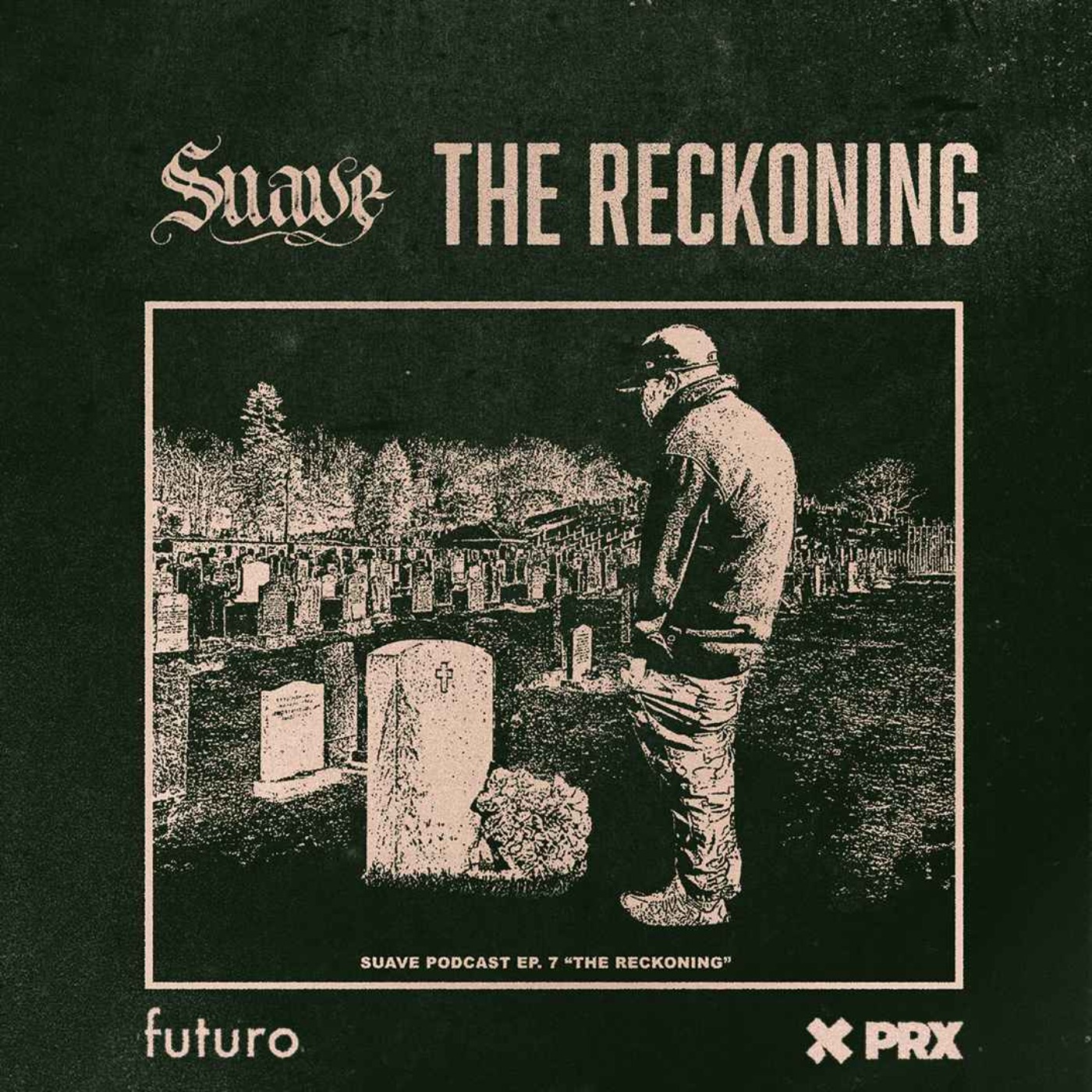
It's a gloomy rainy day and Suave sits in the front seat of a large black SUV looking out the window. I'm in the back seat I'm sitting between Maria and producer Julieta Martinelli, making our way through a huge cemetery in Queens, New York, trying to find a grave. It's raining so hard that it's difficult to read the street signs. But we've been told to keep an eye out for a giant cross as a guidepost. I think, look, there's a cross.
- [03:56]
David Luis Suave Gonzalez
I see it. Yeah. We had to go straight over there. Oh, my God.
- [04:00]
Maggie Freeling
This is range 43, St. Peter, and we're going to Holy Cross for.
- [04:05]
David Luis Suave Gonzalez
Surround it around here somewhere.
- [04:11]
Maria Hinojosa
Okay, got it. We get out of the car, and all around us, there are rows and rows of tombstones, back to back. And this is the first time that Suave is visiting his mother's grave alone since his release. And she died in 2009, eight years before he got out of prison. And Suave always told me about this. He never got to say goodbye to his mother, was never able to go to her funeral, never actually got to mourn her. And so he wants to do that now.
- [04:47]
David Luis Suave Gonzalez
This is 43, but that was 45.
- [04:50]
Maggie Freeling
So this should be 43.
- [04:51]
David Luis Suave Gonzalez
This is 44. No, I'm saying if. If that's.
- [04:57]
Maggie Freeling
The rain is coming down so hard now, and puddles of mud are forming in the grass. We do our best to read the etchings on the gravestones. We have some trouble finding it. And then.
- [05:42]
Maria Hinojosa
You hear, swabby, you made it. You made it.
- [05:52]
Maggie Freeling
The four of us try to huddle under an umbrella as the rain pours around us. Suave steps out into the downpour. He takes out a stack of his published novels from his book bag and lays them against the tombstone.
- [06:07]
David Luis Suave Gonzalez
My mother always thought that I'd be a good writer. Even when I couldn't read or write, she used to always say, oh, one day you're gonna learn.
- [06:22]
Maria Hinojosa
Your mom lived a really rough.
- [06:25]
David Luis Suave Gonzalez
Yes, she did. Yeah. My mom was a child. She was raped. She was raped, molested. And as an adult, she was abused. My father sexually assaulted my mother. You know, and I'm here, but that's the way she did it, you know, she was stronger than all of us. I tell you that I grew up being hateful, and I tried every day not to let that hate come out because that hate could turn into anger, and then it get. Then it could get real nasty for somebody, you know? But that's the way we grew up. I think that that is what made me, when I went to prison, hard, like, survive in the sense that you can't take advantage of me, period. Because I will. I will kill you. And it was because of that. Because when I went to prison, you saw a lot of young guys getting raped, a lot of young guys getting abused. And in my mind was, I dare you, like I dare you to just cross that line. Like I. And I dare anybody. You know, I went to the hole cuz I cut a God up like 32 time with a razor blade. You know, this was in 89. He touched my ass. And I told him, when I see you, I'mma kill you. And I went after him with a, with a toothbrush and a razor and cut him like 32 times, you know, and when I was cutting him, you know what I saw? I saw my father doing that shit to my mom. We can go.
- [08:14]
Maggie Freeling
It's like suddenly Suave has deflated. He walks off alone towards the car. He doesn't look back once. We trail behind him in the pouring rain. And as we drive off, I look back one more time at Suave's graveside, offering a stack of books soaking in the grass. Over the course of this podcast, we've followed Suave from prison out into the world, then back to prison. We've traveled to Philadelphia and back in time to the night that brought him a life sentence at age 17. But now Suave's looking inward. A few days after our visit to the cemetery, Suave calls you Maria. And he tells you he's been seeing his therapist again. His return to prison, all this time we spent talking about his past, it stirred up a lot. She's been helping him put words to how he's been feeling.
- [09:31]
Maria Hinojosa
And on this day, Suave wants to talk about his mom and that trip to the cemetery.
- [09:37]
Julieta Martinelli
You know, seeing my mother, the choice of man that she selected in her life, you know, that is traumatic and, and I never realized that I was holding on to that, that kind of stuff, like. Like it never happened. But it kept popping up in my daily relationship with people. There's no winners in this.
- [09:58]
David Luis Suave Gonzalez
Everybody, I'm a victim.
- [09:59]
Julieta Martinelli
I fixed the most other people because I'm hurt. And it goes on and on. It's like a circle. They go on and on, you know, till we see multi generational people in prison. We see grandfathers and fathers and uncles all in one cell block. It's embedded in our neighborhood. You know, it's almost. When you go to a public school in our neighborhood, it's like a jail. You gotta go to metal detective bars, pat downs, pat searches. Let me see your bag. That's the type of stuff they do in jail. So by the time we hit junior high school and we 13 and 14, man, we like, oh, shit, Joe ain't nothing.
- [10:35]
Maria Hinojosa
Suave tells me he never got a chance to just be a kid. And the problem is, neither did his mom. And Suave wants that cycle to end.
- [10:46]
Julieta Martinelli
I came up in a household where my mother always told me, you the man in the house. And what that meant to me was I could do what the heck I want to do, you know, but the psychological damage to that was. And I really wasn't the man of that. I really didn't know what the heck I was doing. I thought I did. You know, I was really hurting, but I didn't know how to say, yo, I need to go to therapy. You know, part of it is that we don't have the same resources that other communities have. You know, they don't know how to navigate through the system.
- [11:36]
Maggie Freeling
We may know suave as a 50 year old man, but the bigger story here is actually the story of a boy, of several young boys.
- [11:46]
David Luis Suave Gonzalez
I went in when I was 17, and I came out when I was 22. That's how it feels, but I'm really 50. That's how it really feels.
- [11:57]
Maggie Freeling
And Suave says he was one of the more fortunate ones for me.
- [12:01]
David Luis Suave Gonzalez
Luckily, I had my brother, this New York City cop. When I called him, he said, I got that from this end. So he got my id, my Social Security card, and he got all. All the paperwork I needed, but other people don't have that. I came home and I can say this, that I had pretty much everything I needed to be all right. You know, I had a state rep, his chief of staff gave me an apartment. I had a job. I thought I had it made, and I didn't because I was dealing with. And even today, I still deal with the trauma of being in jail. It shows in relationships, it shows how I don't trust a whole lot of people. Even in the workplace. I work with a wonderful cast of people, but I never get that close. You're never gonna get that close to me because I'm still thinking jail. And then you see a lot of juveniles coming home and they got that same mentality. And I always tell them, yo, that's gonna get you in trouble. You gotta deprogram yourself. But how do you tell somebody that's been in prison 40 years, you gotta deprogram yourself and adapt to society.
- [13:34]
Maggie Freeling
There are also a lot of juvenile lifers dealing with trauma behind bars too. Despite Montgomery vs. Louisiana, that's the 2016 Supreme Court decision that led to Suave's freedom. And that's because not all states have released people at the same rate.
- [13:51]
Maria Hinojosa
And one of the things we learned is that as challenging as it's been for Suave, things have played out very differently for him than they have for juvenile lifers in other states, right?
- [14:01]
Maggie Freeling
I mean, Pennsylvania is far from Perfect. Since the 80s, they sentenced more minors to life than any other state. But they seem to have really committed to re sentencing as many cases as possible, too, and getting them in front of a parole board that is open to their release. But across the country, some parole boards are delaying or even flat out refusing to release juvenile lifers.
- [14:27]
Maria Hinojosa
And then there's this other issue, right? Which is that the Montgomery Supreme Court ruling did make it unconstitutional to hand down mandatory life sentences without parole for juveniles. So what many states did was to take out the word mandatory. But they're still sentencing juveniles to life.
- [14:46]
Maggie Freeling
Only 24 states have completely banned the life without parole for minors. That means that in more than half of the country, children can still be sentenced to die in prison.
- [15:00]
Maria Hinojosa
You know, and that's despite the fact that more and more research really is showing that young people who commit crimes can, in fact, turn things around. And the proof is in the juvenile lifers who have gotten a second chance at freedom.
- [15:18]
Maggie Freeling
Years after their release. Studies show that recidivism rates for juvenile lifers in Philadelphia is just 1%. Numbers don't lie. And what they tell us is that in the vast majority of cases, people do, in fact, age out of crime. We'll be right back. Scott Payne spent nearly two decades working undercover as a biker, a neo Nazi, a drug dealer, and a killer. But his last big mission at the FBI was the wildest of all. I have never had to burn Bibles, I have never had to burn an American flag, and I damn sure was never with a group of people that stole a goat, sacrificed it at a pagan ritual, and drank its blood. And I did all that in about three days with these guys. Listen to Agent Palehorse. The second season of White Hot Hate available now we're back. Just a couple of weeks before COVID 19 changed everything, Suave came to visit Maria, Julieta and I in Harlem. This will be the last time we all spend together in person. Suave's in town because he's been invited to meet with a well known producer who is interested in documenting his journey. But while having dinner at Maria's house the night before the meeting, Suave tells us he's decided not to go through with it because well, all he'll say is he's just ready to focus on other things in his life besides the time he spent in prison.
- [17:04]
Maria Hinojosa
I feel you getting frustrated with, like, the pace of things. With, like, it's not. You're not where you want to be.
- [17:13]
David Luis Suave Gonzalez
No, that's. That's. I wouldn't say impatient.
- [17:16]
Maria Hinojosa
There's a part of you right now that at 50 years old, you're like, shit, yes, yes.
- [17:22]
David Luis Suave Gonzalez
You know, like, I want to be able to have kids one day. Like, you know, I'm a late starter at everything in life. What's patient, Take your time for other people. I don't have that time, you know, and the more I study the life expectancy of Latinos in America and all that, I'm like, oh, I don't have a lot of time left in this world. I gotta do something. And seriously, I. You know, and I think that that's part of it. Like, I think about it like, yo, you're not young no more. Even though I act like I'm young. Right. The reality is I'm 50. I'm gonna be 51. I've wasted 31 years and 85 days. I don't have time for somebody to say, well, I'll do it tomorrow, when I could do that myself to death. So, yes, in that sense, yes, I'm impatient in that sense. I want certain things. I need to be in my own house.
- [18:19]
Maria Hinojosa
You want to buy a place?
- [18:20]
David Luis Suave Gonzalez
Yes. I want to feel what it is to be a homeowner. I want to feel what it is to have a car of my own and not have to call Uber or take the train or ask somebody, can you give me a ride? To me, that's normal. That's normal. Wanting them things. I don't want nothing crazy. I want regular things in life.
- [18:55]
Maria Hinojosa
That conversation was almost a year ago, and Suave is still waiting for that regular life. Recently, we had a conversation, and he told me he had gotten a new job offer for a recovery center after working at a shelter for some time, and he was really enjoying his new job. But then Suave says they called to rescind the offer.
- [19:18]
David Luis Suave Gonzalez
I'm serious. Like, I'm so mad that I left my job, a 40 hour, a weak job, sweet job to go be a case manager, and then they resend it because now I'm out at a job. And that's what I told the people. It's just fucked up. You put me in a position where I gave up a job thinking I would work for y'all, and Two weeks later, y'all gonna tell me y'all resent this.
- [19:41]
Maggie Freeling
So some context. Pennsylvania is a, quote, ban the box state. And that basically means that it's illegal for employers to ask about criminal backgrounds during a job application process. This is really a positive step forward for formerly incarcerated folks so they have a fair shot to reenter the job market.
- [20:03]
Maria Hinojosa
But Suaved learns that there's actually very little protection for someone like him. Employers can still find ways to use his record to rescind his employment even after he's been hired.
- [20:16]
David Luis Suave Gonzalez
It's my turn to go through this little segment of discrimination in the workplace. You know, I'm really. I never experienced this. I never. I heard it happens to a couple of people, but I never experienced it myself. And it's not a good feeling.
- [20:35]
Maria Hinojosa
A couple of weeks later, it happens again. Suave tells me that he's been interviewing for a job he's really excited about. He'd be working with Southeast Pennsylvania's transportation authority. He tells me the job would be to accompany police to mental health calls. And he says the person knows about his password record. But then he loses that job offer, too. Suave says he was told that they can't work with him because the Philadelphia chief of police has to approve his hire, and the chief turned him down because of Suave's record.
- [21:11]
Maggie Freeling
Suave worries about what this will mean for him. Lifetime parole means he has to continue to pay fees to the state for his supervision for the rest of his life. It means he's required to keep a job even as his record makes it so much harder for him to get one. It's demoralizing right now.
- [21:32]
David Luis Suave Gonzalez
I'm at a point in life where I don't feel human. I don't feel, like, normal, you know, like, it's always like. Like, I gotta walk a straight line every day. Every day. It's almost like I'm still in jail. I gotta ask parole for everything. Can I go such and such can I do this? You know, it's like, that's not. That's like being in jail. So in a sense, I'm free, but I'm still locked up. And, like, that's not normal. That's not normal. Like. But I think that the more I'm exposed to this side of the world, it's like, damn. It's like, damn. You know, maybe it's just me that I want too much, you know, Is it wrong for me to want normal things? I don't know. I don't.
- [22:35]
Maria Hinojosa
Of course it's not wrong for Suave to want normal things. In this series, we've asked a lot of questions, but maybe the most important is what are the moral consequences for us as a nation of locking up kids for life? And we've explored that by looking at the personal consequences for one man, a man who has put in the work for decades to turn around his life to. To atone for his bad decisions and to overcome the circumstances he was born into, to overcome a life sentence in prison and the cycles of trauma at the root of it all. Over the last two decades, I've seen Suave grow and change and redeem himself under the most difficult of circumstances. But if we've learned anything on this journey with Suave, it's that there is no escape from prison. Even if you're no longer behind bars. Once you're in the system, you can't really get away, not entirely.
- [23:50]
David Luis Suave Gonzalez
I don't think people understand that being on parole for life. You know, sometime I wish I would have never taken that deal. And I know it's. It may sound crazy to people, like, but you free? I'm not free. And I'm not free. You know, I can move around, but I'm not free. And yes, I think about it sometimes. Like, did I make the right decision taking a deal to get out of jail? Because I'm in the jail. I'm really in the jail. Like, can't do what you want to really do, you know, Everything you do, it seems like you got to do to please other people. Everything you do in life on parole, you got to please other people. What the heck? I got to please somebody else to accept me. You either accept me the way that I am or get up, get out my way, like, for real. And that's how it feels being on parole, like, especially for life. Like, I'm living for other people. I'm not living for myself to please people that probably don't even care about what I do. But I had to show I got to put up that front. Like, you see, I'm one of the good ones. I'm one of the good ones, you know, I'm one of the good one, boss. And that's the way it is. This is like slavery all over again. If you study the history of slavery, what they did with kids, and put them in the plantation, this is the same thing. You put a bunch of kids in jail for decades, and now we come out and now we in a bigger plantation. That's not the way I want to be.
- [25:52]
Maggie Freeling
There was really only one thing left for us to do in this story with Suave to say goodbye to someone else. So we take one last trip back to Philadelphia. We're only a couple of miles from the corner of 8th and Somerset and we visit one more grave. Julieta and I search for it while Maria and Suave hang back alone.
- [26:17]
David Luis Suave Gonzalez
You know, going to see my mom was different. But coming to the cemetery to pay respect to somebody that.
- [26:30]
Maria Hinojosa
That didn't deserve respect.
- [26:32]
David Luis Suave Gonzalez
No, they didn't deserve to die.
- [26:47]
Maggie Freeling
We finally find it. It's a windy fall day and bright color leaves blow in the air between rows of gravestones. In the distance we can hear a leaf blower. It's sunny and the cemetery is quiet. Suave walks to a small gray stone and leans over it. He runs his hand over the etching. Daniel Martinez 1972-1986.
- [27:37]
David Luis Suave Gonzalez
Man, I just hope that if anything come out of this, man, that people, young kids, learn, man, that's. I mean, to be standing on the grave site and to be the one whole responsible for that. I. I live with that every day. I mean, I owe my life to that. To hell, I. I really do.
- [28:32]
Maria Hinojosa
Yeah.
- [28:35]
David Luis Suave Gonzalez
And being here just reinforced that. I could never go back. Somebody lost their life for nothing.
- [28:51]
Maggie Freeling
Suave shoves his hands in the pockets of his sweatpants. He stands there for a minute, looking at the tombstone quietly.
- [29:02]
Maria Hinojosa
I want you to know that it could have been a total, complete, absolute loss. It could have been. And somewhere along the line you made a decision to turn this around. And I know how upset you are, but you turned it around.
- [29:22]
David Luis Suave Gonzalez
Thank y'all for bringing me here.
- [29:27]
Maggie Freeling
We turn around and walk off the cemetery green. Maria and Suave are a little bit ahead of us and she reaches her arm up to his back as they walk together.
- [29:42]
Maria Hinojosa
You stop the cycle.
- [29:49]
David Luis Suave Gonzalez
It.
- [30:16]
Maggie Freeling
Suave is a production of Futuro Studios and distributed by prx. It's produced by me, Maggie Freeling and Julieta Martinelli. Additional field reporting by Aaron Moselle, Michael Simon Johnson, Zoe Malik and Zakiya Gibbons. We are edited by Audrey Quinn. Our executive editor is Marlon Bishop. Our director of production and operations is Natalia Fidelholtz. Our engineers are Stephanie Lebeau and Julia Caruso. Maria Hinojosa is the executive producer. Our fact checker is Amy Tardif. Original music from Taka Yasuzawa and Alex Segura. Production help from Lita Halwell, Juan Diego Ramirez, Maya Cueva, Sam Bernitz, Fabian Caballero and Lily Hershey Webb. Special thanks to Marsha Levick at the Juvenile Law Center, David Santi Suave's lawyer, Shannon Atala, Jill Settlemeyer and Claire Fitzpatrick, David Bohm, our private investigator Jodi Kent, Karma El Moussa and Heather Renwick at Campaign for the Fair Sentencing of Youth. Support for this podcast is provided by the Art for Justice Fund, a special project of Rockefeller Philanthropy Advisors and the Heising Simons Foundation. Unlocking knowledge, Opportunity and possibilities. More@hsfoundation.org.
- [31:44]
Maria Hinojosa
From PRX.