← Sunday Sitdown with Willie Geist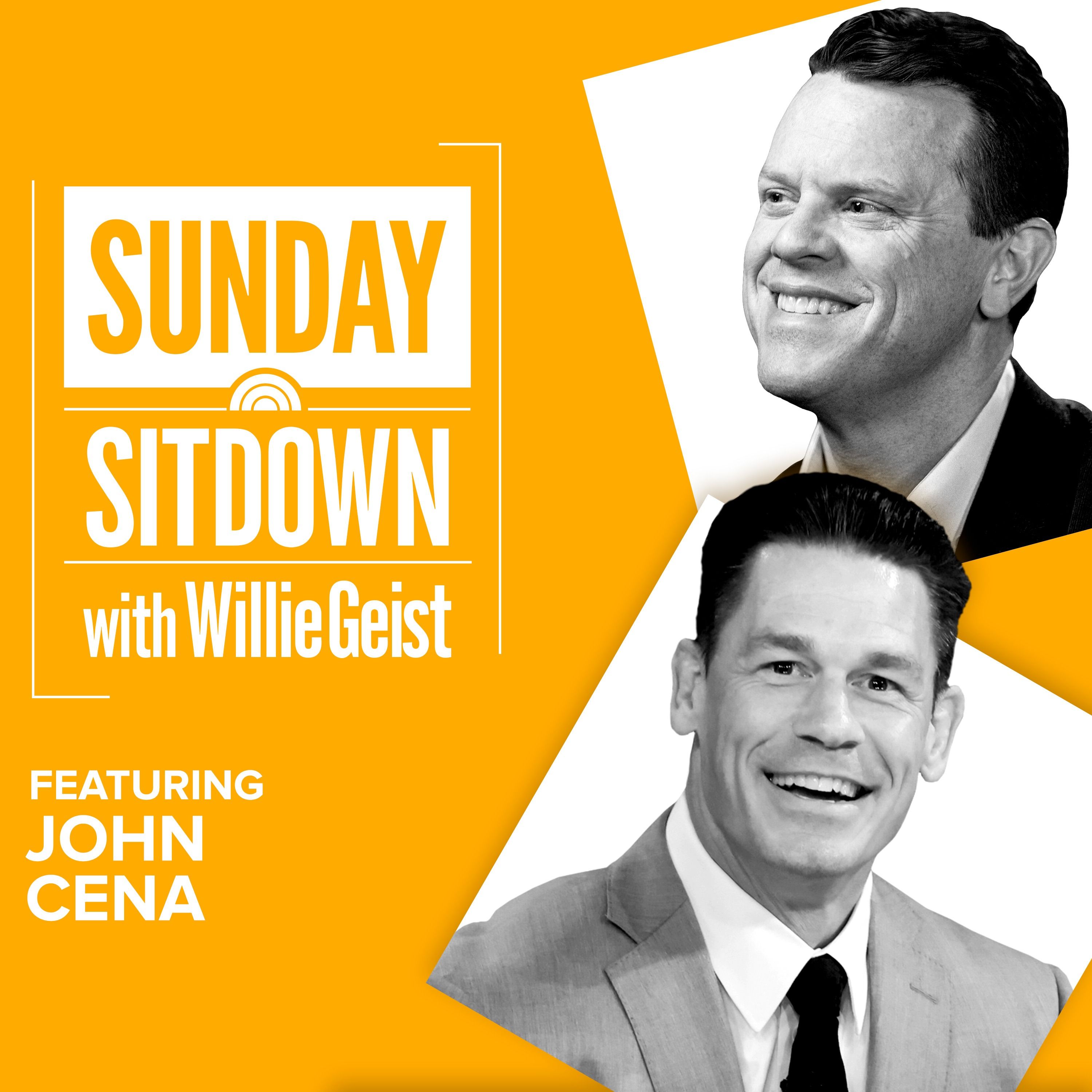
Sunday Sitdown with Willie Geist
ATHLETIC GREATS: John Cena on Championship Mentality, Reinvention and Never Giving Up (October 2019)
00:55:52
John Cena is a WWE legend whose career has expanded far beyond the wrestling ring into acting, writing, and philanthropy. In this conversation from October 2019, the WWE champion joins Willie Geist to discuss his evolution from wrestling star to Hollywood actor and his children’s book "Elbow Grease vs. Motozilla." Plus, he reflects on perseverance, giving back, and why his motto of never giving up still defines everything he does.
Loading summary
Transcript209 lines
- [00:00]
John Cena
USAA knows dynamic duos can save the day like superheroes and Sidekicks or auto and home insurance.
- [00:06]
USAA Representative
With usaa, you can bundle your auto and home and save up to 10%.
- [00:10]
John Cena
Tap the banner to learn more and.
- [00:11]
USAA Representative
Get a'@usaa.com bundle restrictions apply this Valentine's Day. Say it with M&Ms. You can personalize your M and Ms. By choosing from 20 colors and printing photos, dates or custom messages right onto the candy. Favorite photos, sweet messages, even a proposal. Let M and Ms. Be your love language this Valentine. It's fun, fast and turns a simple gift into something unforgettable. Visit mms.com and use code giftmms to receive 15% off your first order. That's code G I F T MMS.
- [00:47]
Willie Geist
Hey guys, Willie Geist here with another edition of the Sunday Sit down podcast. My thanks as always for clicking and listening along. I got a good one for you.
- [00:55]
Interviewer
This week and I think it shows.
- [00:57]
Willie Geist
The range of our podcast, if I.
- [00:58]
Interviewer
May be so bold.
- [00:59]
Willie Geist
Last week, Tony winner Ben Platt, a man of the stage, a man of song and dance. This week, something completely different. An icon of professional wrestling and now a movie star. John Cena, the biggest star in professional wrestling. I grew up on Hulk Hogan. John Cena is that guy to an entire generation of kids. We had a great conversation about his children's book. It's called Elbow Grease versus Motozilla, the latest in his bestselling series. I'm joined, as always, by the producer of this fine podcast, Maggie Law. Hello, Maggie.
- [01:31]
Maggie Law
Hi, Willie.
- [01:33]
Willie Geist
John Cena. And this has been my experience because I've met him a bunch before. Cause he does a lot with the.
- [01:37]
Interviewer
Today show is so he's this big.
- [01:39]
Willie Geist
Muscle bound, menacing dude. Of course he gives out attitude adjustments. That's the name of his move.
- [01:44]
John Cena
Okay.
- [01:45]
Willie Geist
He gives you an attitude adjustment. I can see you're nodding because you know all this already.
- [01:48]
Maggie Law
I was gonna say this is definitely a different Sunday sit down for us. Not your wheelhouse, wwe. Not my particular wheelhouse, no. But I know that it is yours.
- [01:58]
Willie Geist
Well, it was, it was like in the 80s, I was a Hulkamaniac. And John and I are about the same age. I'm like, so we both grew up on Hulk Hogan. We had the Hulkamania T shirt that we wore to school every day, all that kind of stuff. But Cena is, yes, he's that guy in the ring, but out of the ring, he is effusively polite and kind and generous.
- [02:20]
Maggie Law
I know he's on the Today show all the Time. And I feel like everyone says he's just the nicest, most humble guy.
- [02:25]
Willie Geist
Yep. And a professional. He comes to do a job. He showed up to our. We met in a little coffee house. I will say, just as a bit of color. No people, no publicist, no manager, just him. No assistant, no security guard.
- [02:38]
John Cena
I love it.
- [02:38]
Willie Geist
Just Cena rolling in hot to a coffee shop.
- [02:40]
Maggie Law
It's perfect.
- [02:41]
Willie Geist
And that is unusual for these. And he was wearing a three piece suit. The hair is quaffed perfectly. I mean, it was all working for me.
- [02:49]
Maggie Law
I was gonna say you mention off the top, the outfit that he had. It's just two weeks in a row now that they've shown up.
- [02:55]
Willie Geist
I know, I know.
- [02:57]
Maggie Law
Different clothes than what you're wearing.
- [02:58]
Willie Geist
I think I will say I think it's good to let the guest shine in a TV interview I'm not a believer in. I'm gonna have a stylist pick out a look for me.
- [03:08]
Chase Sapphire Reserve Announcer
You're gonna be the one.
- [03:08]
Maggie Law
You just wanna blend in. And then they'll be the stylist.
- [03:10]
Willie Geist
But in this case, since you're listening, I have a button down shirt and a light fall sweater.
- [03:15]
Maggie Law
Yeah, it was a very coffee shop.
- [03:17]
Willie Geist
Yeah, it was a very coffee shop. And then he comes in hot with a beautifully tailored three piece suit.
- [03:21]
Maggie Law
Three piece suit.
- [03:22]
Willie Geist
So, yeah, he talks about his movies. Of course, he's evolved now out of. I think the big breakthrough was Trainwreck.
- [03:29]
John Cena
Trainwreck, right.
- [03:29]
Maggie Law
With Amy Schumer.
- [03:30]
Willie Geist
Yeah. 2015. There's some literally revealing scenes of him. We saw a lot of his backside in that mov. He talks about that like what a Amy Schumer calls like, hey, I think you'd be good in this part.
- [03:42]
John Cena
Right.
- [03:42]
Willie Geist
So he started movies and he was good and now he's in. He was in Bumblebee. Starred in a Transformers movie last year. He's in the new fast and Furious 9 movie that comes out. Yeah. Next year. So he is also one of the things we should say as you listen to the interview, you'll hear the name Chevy.
- [03:57]
Maggie Law
Yes.
- [03:58]
Willie Geist
Who is a young boy who is the son of one of our cameramen, Callan.
- [04:03]
John Cena
Okay.
- [04:03]
Willie Geist
And he showed up because John Cena is his hero. He had his John Cena action figure. So he came along with dad to work. And Cena's fans are overwhelmingly kids. And he talks about that. He's like the positive hero of wwe.
- [04:16]
Maggie Law
And you said he leaned into that sort of. Once he realized that was his audience, you just gotta go with it.
- [04:21]
Willie Geist
And you could just see how good. He walked in that coffee shop and went right to the kid.
- [04:25]
Maggie Law
I love it.
- [04:25]
Willie Geist
Got down on his knee, shook his hand, listened to his story, took pictures, talked about him in the interview. So he knows who his fans are. In fact, he talks about. You can hear if you go to one of his matches, the pitch.
- [04:37]
Maggie Law
I know, I love that it's higher than his opponent usually.
- [04:40]
Interviewer
Yeah.
- [04:41]
Willie Geist
He gets the high pitch because it's.
- [04:42]
Maggie Law
His booze are usually.
- [04:43]
Willie Geist
And the boos are from the middle aged men.
- [04:45]
Interviewer
And he says they'll come up to.
- [04:46]
Willie Geist
Him and say, I hate you, but my son loves you, so we're gonna come say hello.
- [04:50]
Chase Sapphire Reserve Announcer
I love that.
- [04:50]
Willie Geist
So I think he'll be. Even if you're not a wrestling fan, there's a lot here. He's a fascinating guy.
- [04:55]
Maggie Law
Fascinating guy. Agreed.
- [04:56]
Willie Geist
Grew up in a house with five boys in Massachusetts. Didn't feel like he fit in, which is sort of the idea behind this book, that there's elbow grease as the truck that doesn't fit. And that's him.
- [05:06]
Interviewer
Love it.
- [05:07]
Willie Geist
So I think you don't have to love wrestling to be interested to hear this conversation with John Cena, WWE icon, movie star, children's book author, the great John Cena, right now on the Sunday Sit down podcast.
- [05:19]
Interviewer
John, thanks for doing this, man.
- [05:21]
John Cena
Thank you for having me, man. I appreciate it.
- [05:23]
Willie Geist
Absolutely.
- [05:23]
Interviewer
I feel like, I mean, again, you've always dressed well, but you've outdressed me again and I bow to your three piece.
- [05:29]
John Cena
Soon you're a little more cat, you know, Here we are with the Chesterfields and books and coffee.
- [05:33]
Interviewer
Exactly.
- [05:34]
John Cena
I show up looking like I'm gonna trade banana futures. I'm sorry. So sorry.
- [05:38]
Interviewer
Just two guys, big guys at a tiny table with some breakfast pastries.
- [05:41]
John Cena
Yep.
- [05:42]
Interviewer
I got a lot I want to ask you about, but obviously wanna start with the book and the series.
- [05:46]
John Cena
Thank you very much.
- [05:47]
Interviewer
The New York Times bestseller.
- [05:48]
John Cena
Thank you.
- [05:49]
Interviewer
This is the latest edition, Elbow Grease versus Motozilla.
- [05:52]
John Cena
Yeah.
- [05:52]
Interviewer
First for people and families who aren't familiar with the characters in the book. How did you set out on this project and this journey? What did you want to say?
- [06:00]
John Cena
So it actually all starts with wwe and we have some fans on the other side, but some young people. The audience in WWE was mostly. My audience specifically is mostly young kids. And sometimes I kept hearing some parents say, well, you know, I don't think my child is yet ready to watch wwe. Which is a. That's a perfectly logical statement. But all of these young kids were drawn to this philosophy of never Giving up. And in doing a little more research and digging a little more, the concept of growth, mindset, or never giving up is a really important concept to teach young people, because if they don't learn that when things get hard just to kind of stick with it and you can make it, they'll literally just begin to give up easy and only stick to things that they're good at. And they'll never get out of their comfort zone and really never achieve the growth that they're capable of. So after doing that personal dive, I wanted to take the WWE personality and put it in, like, this whimsical universe where young readers especially could have fun with a story. It's not hitting you over the head with the message. It's in a wonderful world of, like, destructive monster trucks. And, you know, I chose a family of monster trucks because I grew up with four brothers. And we kind of each have our distinct personality of, like, one being super intelligent and one being super crazy and one being super fast. And then there's Elbow Grease, who is different and whose outstanding quality is perseverance and never giving up. So I kind of try to take this message and put it into a fun atmosphere, and it really has been a tremendous success. People enjoy the book, and they get all the underlying themes, and it's not forced at all. And it's a fun read, and young readers enjoy it.
- [07:51]
Interviewer
I think it's important, too, as a parent to our society and sports and school and everything else has become so hyper competitive that you gotta be the best or the fastest or the strongest. Are all those categories of brothers that you talked about? And in the case of Elbow Grease, he's got something else that's not as obvious to everybody, but it's equally important.
- [08:08]
John Cena
Yeah, it's absolutely. So, like I said, I think it's, you know, earlier and earlier now we kind of identify strengths in young people. This young person is good at math or baseball specifically. And although we nurture success in those fields by younger, more competitive associations and leagues and clubs, you never want to prevent somebody from trying something that they may fail at or trying something new or being a little bit different. Like we were talking before we started rolling. Perseverance is the quality that I have. I've never really been outstanding at anything except sticking with something. So it's a message I really wanted to send, and I think it's important.
- [08:54]
Interviewer
So you talked about your family. Does that make you. Because there are five monster trucks in here. You have five boys in your family?
- [09:00]
John Cena
Yes. Are you elbow grease 100% I am elbow grease. I think the only difference between elbow grease and myself is size. Because of my five brothers, I am the largest. But I really wanted to create an underdog feeling about elbow grease. I was completely different than all my brothers. I dressed different, I acted different. Like they kind of all are the same and I was the one standout. And although they had their individual traits, they still all shared commonalities. Like the monster trucks. Elbow grease is electric. They're all gas powered. Elbow grease is smaller. And like I said, his one quality is gumption. And that was just one thing, that at an early age, I just chose to go with something and stick with it.
- [09:44]
Interviewer
There's also a great message in the book about teamwork. As you say, there's hyper focus on individual achievement and all that these days. At the end of the day in this story, without giving too much away.
- [09:54]
John Cena
No. So I'm. I'm very, very happy to share that. The newest installment, Elbow Grease versus Motozilla. So I wanted to begin to tackle the concept of working well with others. And I think anyone out there who is in tune to anything that's going on, both nationally, globally, locally, we're at a giant space of divide. And I think if people were persistent with their values and beliefs and able to work well with others, man, we could accomplish some really, really cool things. So the story of Elbow Grease versus Motozilla is the benefit of being able to listen to those around you and work well with others. And I think persistence and working well with folks are two pillars of success that can be instilled in young readers in a fun environment that they'll carry with them for their entire life.
- [10:51]
Interviewer
You also, I noticed, sneak in. The mechanic is a girl, absolute girl. That sends a whole other message.
- [10:56]
John Cena
Yeah. So that, like I said, the messaging in the book is as you want to take it. I can sit here and tell you that that's the theme of the book, but you may read the book and be like, I like Tank. You know, I like Tank and how he crushes other monster trucks. That's all fine, but simple subtleties like the mechanic being Mel the mechanic. And she's this unbelievably gifted mechanic that has crafted together this family of monster trucks and eventually crafts the giant apparatus which will be competitive against Motozilla.
- [11:25]
Interviewer
Yes.
- [11:25]
John Cena
So, and she has a larger role to play each and every installment of the series.
- [11:32]
Interviewer
So I think some people from the outside will know you as John Cena from the WWE and the movies and everything else. Big strong guy putting the attitude adjustment on people and go. Children's book, huh?
- [11:43]
John Cena
Yeah, well, you know, I think, I don't think the connection was too far fetched, especially those people who know me from the wwe. If some of the folks who've seen me in some of the adult comedies that I've done, maybe there's a bit of, maybe there's a bit of a disconnect.
- [11:56]
Interviewer
I have some images flashing through my mind, but go ahead.
- [11:59]
John Cena
Can't unsee that stuff. But everybody who's, I think, familiar with my work in wwe, the next thing that comes up is the work with the Make a Wish foundation. So they can kind of correlate who I am with trying to connect and inspire young people, which makes the transition to a children's book fairly easy.
- [12:19]
Interviewer
Was that a conscious thing for you to connect with kids as you talk about it? I think you've made more wishes with the Make a Wish foundation than anyone, more than 500. But as a performer with the WWE, was that a thing you thought about, like right out of the gate, like, I'll be the guy who connects with kids.
- [12:34]
John Cena
In trying to build a relationship with the audience, you never think about that. Step one is like, hey, do you guys know who I am?
- [12:41]
Interviewer
Right?
- [12:42]
John Cena
And my personality started very, very different. My audience was teen, adult, like, and young adult males. And that was our core audience. So that's who I try to connect with. It wasn't. It was just me having good perspective on what was going on. In 2004, 5 and 6, I began to see not only more people attend our events, but younger people attend our events and families attend our events. And younger people wearing the John Cena stuff and bringing signs like, that's what's great about wwe. People wear their Superstar with a badge of honor. Like it's an allegiance thing and you can spot them out. So in doing that, I actively stepped forward and said, I need to change my personality because of supply and demand. This is my audience and it may not make me as cool and edgy as I started out, but it's going to benefit the people who are actually showing up to pay money to see me. So it just became a situation of supply and demand. And because of that, because I was vulnerable enough to kind of drop a very successful act and evolve into another phase of my personality. That's when like the Make a Wish request started to pour in and I could tangibly see the effect of like, wow, this fun sports entertainment performance is having a profound effect on people's lives. And Make a Wish was a vehicle for me to see, you know, the effect of WWE on people's lives. And then it stretched beyond that. Every single night, I could shake hands and talk with people like Chevy, see you over there. Every single night I could talk with those people and connect with those people. And it was, it just ended up being the same audience over and over and over again. And to even reinforce that, those who know me from wwe, when I come out, half the audience is happy to see me and half the audience is not happy to see me. And you can literally tell by the pitch. The pitch of those people cheering for me is a higher pitch. And the pitch of those people despising me is a low adult male pitch. So it's kind of telling you, like, hey, you could try to convince these people, but they're going to be a hard sell. Why not just cater to the people who already enjoy you? And by the way, you enjoy catering to those people anyway. So it was, it was really quite easy. It just took a little bit of bravery on me realizing that I wasn't probably going to be the edgiest or coolest character on tv.
- [15:18]
Interviewer
Well, to your point, I told you earlier that I told my 10 year old son last night that I was gonna see you. And for the first time ever, he was impressed by what I do for a living. So thanks for that.
- [15:28]
John Cena
I appreciate it.
- [15:28]
Interviewer
Cena popped his head off the pillow.
- [15:30]
John Cena
How'd you get Cena? But it's just, it's being aware of your surroundings. So many parents come up. I've had parents literally being like, listen, I hate you and I'm the one who's booing you out there, but keep doing what you're doing cause my kid loves you and like that. Instead of just being offended by that, just taking that information in and being like, wow, I could kind of turn this into something and something really special. And I think the correlation with Make a Wish is really strong. Because my ethos, not only in WWE but in life, is never give up. And those families are going through some pretty difficult circumstances. And if the person they see and they're inspired by on television every week is saying never give up, that's something they can take with them through those difficult times.
- [16:18]
Interviewer
Thinking about you as a kid now, and based on the book and other places I've heard you talk, just imagining that household in Massachusetts when you were a kid, five boys. What's it like in those four walls?
- [16:31]
John Cena
It was energetic. It was really awesome. Because I grew up in a small town of like 1200 people. So your next door neighbor was acres away, which means we had to use our imagination, which has helped me create vehicles like this or be a WWE Superstar, because you cannot succeed without imagination. But it also, I mean, at a very young age, I was taught the lessons of failure. I have lost my share of fights in my day, so I know what it feels like to be knocked down, but I also know what it feels like to get back up. You know, it was a very, very competitive household, and each of our brothers kind of vying for their spot. It's something is like dinner time when they set the food down, there's five of us. And, you know, my folks did just well enough to feed us. So when the food hit the table, it was a competition to eat, you know, so things as simple as that, it was just a very competitive atmosphere. So it taught me the lessons of failure very, very easily. I wasn't always the best at everything. My brothers would kick my butt, or essentially they would get to the food first, or just a myriad of things that would instill that failure is essentially okay and you can learn from it.
- [17:46]
Interviewer
And so if you're elbow grease in that family, you're a little bit of the outsider in that group. Is that the way it was? Did it feel that way to you?
- [17:53]
John Cena
It was weird. So I'm the second oldest and I kind of was oddly the trendsetter, but no one was brave enough to follow. So in the late 80s, early 90s, I gravitated towards hip hop music, which became the foundation of my initial WWE Persona. And, man, I just loved the rebellious nature of the music. I was perfect for me. I was a teenager and here is this music that is completely rebellious, that my parents are like, don't ever listen to that. Which is immediately like, I'm going to listen to that. And I embraced all the style and like the pop, hip hop style. So I had like the airbrushed overalls, the hammer pants. Much of my wardrobe was rayon and polka dots. Wore my jerseys backwards and all that. And like, that's. I think my brothers appreciated my statement of rebellion, but I was the only one. You were the only one to have that fashion sort of fashion sense.
- [18:46]
Interviewer
So you're kind of like, this is the way we're dressing now, guys. You look behind you and no one's.
- [18:50]
John Cena
Like, yeah, you're with me. No, no. So I really just. If something resonated with my personality, I wasn't afraid to lean into it. And I think that's the one thing that separated me from my brothers. Like, I would be going to the gym. I just leaned into that and that culture at a very young age. Like, this is what I do now, and this is gonna be fun. Style is another thing. Musical preference is another thing. Like, I just wasn't afraid of what my peer group thought, whereas my brothers were a little more reserved. And, like, I got a good social circle at school. I don't wanna rock the boat where I just didn't care.
- [19:27]
Interviewer
What do they think, watching your rise and where you are now?
- [19:30]
John Cena
So I'm very grateful that my family is who they are. They just will not allow me to be anything else but me. And success in any sort of level of relevance or finance is just a moot point. Like, they remember me as the kid who had whooping cough and couldn't stop throwing up when he was like 11 years old. Or, you know, just all the embarrassing stuff that I did. And they just refused to let me lose sight of who I actually am. And I'm so, so grateful for that because the entertainment industry is. Is based on relevance and ego. And if you. If you let it take you over, it will. And you can get consumed with all of your surroundings and actually start believing all this. WWE is sports entertainment. But I have a great perspective of that. One, because my brothers taught me how to lose a fight the hard way. And two, because the people I keep closest to me do keep me grounded. It's like, hey, man, this is who you are. This is where you're from. We support you 100%. But no one person is above or below any other person. And never forget that. And I'm very, very grateful that that's kind of their mindset. And they help me manage that every day.
- [20:51]
Interviewer
Gotta have somebody to let the air out of the balloon every once in a while when it gets a little too big, Right? Yes.
- [20:55]
John Cena
Yes.
- [20:55]
Interviewer
We were just talking about wrestling.
- [20:57]
Willie Geist
We're about the same age.
- [20:58]
John Cena
Yeah.
- [20:59]
Interviewer
So this career you found yourself in didn't come from nowhere. I mean, you were into wrestling?
- [21:03]
John Cena
No. Yes. So growing up as a kid in the 80s, especially in the Northeast, this was when then WWF became larger than life. Truly became a national and on its way to becoming a global phenomenon. And Hulkamania hit in the mid-80s.
- [21:18]
Interviewer
I was a Hulkamaniac.
- [21:19]
John Cena
I think if you were a. A child of the 80s, it's an icon you looked up to. It's a name that transcends wwe. It's a name that's known throughout the world. And Hulk Hogan just captivated A generation. He was everything the 80s were, you know, and it was. He was one of my heroes as a kid. And, you know, I always had moments of imagining I would win the World Series or throw a touchdown pass, the Super Bowl. But equally, if not greater, I had moments of imagining that I would win the World Heavyweight Championship in the middle of Madison Square Garden. Crazy so. And my brothers all loved it as well. So we would recreate those moments at a very young age. There's an iconic shot of me holding a paper championship that I crafted myself, that I had finally won a championship that I made from my brothers in our, you know, fictional wrestling story league that we came up with. But it was. Yeah, I was captivated by it at a young age.
- [22:13]
Interviewer
You took home the belt that day.
- [22:14]
John Cena
That day. That day I did that day. I don't know how long I held it for, but that day I did.
- [22:18]
Interviewer
So who were your other guys? I mean, Andre the Giant was out there with the Villains, of course. Iron Sheepfly, Volkov.
- [22:24]
John Cena
I could rattle off names forever. I just think those that leave a lasting impression are the ones that are important. Now, me being in the industry, man, I like certain people for different reasons. Andre was kind of the measuring stick of if Andre approved of you, he truly was like the godfather of the industry. And the first name that transcended the industry, Gorgeous George is also in that. I liked. I just liked Hulk Hogan. Like, he was my end all, be all. And then you hear about situations at like, WrestleMania 3 where everyone talks about Randy Savage, Ricky Steamboat, and like, they stole the show. I'm speaking from a young person's perspective. I showed up and I watched, and my dad paid money for us to see Hulk Hogan slam Andre the Giant and that's that. And looking back at it now, as an older person, I can understand why people like certain contests on the card, but that was indeed the reason I watched. So he's that one name that sticks out. We could talk WWE for all the data you have and all these cameras, but I think he was the one that left a lasting impression.
- [23:32]
Interviewer
I had the Hulkamania T shirt, the red with the yellow writing. I mean, I was all in. I told you. I was at Hulkamania 1 and I got a chance to meet him and I still to this day can see his face as I 10 year old looking up at him.
- [23:44]
John Cena
Yeah.
- [23:44]
Interviewer
And I'll never forget how big his hand was when he shook it.
- [23:47]
John Cena
I think that's what WWE does so well in a day and age where, you know, going into Movies now there's, there's massive amounts of visual effects and we create these superheroes that essentially you can't really see. WWE creates personalities that are real, that walk through the airports, that, that meet people at the arenas. And those moments are like, whoa, this dude just won the main event at WrestleMania. And he just shook my hand. That's real and it's really him. You know, WWE does a great job of creating realistic, real life superheroes.
- [24:26]
Interviewer
Yeah. He had just finished, he'd come out of the shower, he was in jeans. And I was like, wow, you're a real person.
- [24:31]
John Cena
What? You're a superhero.
- [24:33]
Willie Geist
So you go on to college, you.
- [24:35]
Interviewer
Become an all American football player. Talent, but a little grit too.
- [24:39]
John Cena
Much more grit than talent. We were kind of speaking of this off camera. First of all, not to be taken out of context, I was not. I was an all American Division 3 football player.
- [24:49]
Interviewer
Don't talk yourself down now.
- [24:50]
John Cena
There is a Americans, All American. I do appreciate that. But there is a giant discrepancy between level of play as you go up and up. Yes, it was not Alabama. And I had great perspective on I would play in college and that would be it. So I didn't have any aspirations of playing in the NFL or the CFL or anything like that, but I found a school who was looking for relatively smaller offensive linemen. And I say that I was a 6 foot, 245 pound offensive lineman, but that's very small. But they ran an offense which is called the triple option, which like Navy and Air Force run. And if you watch them on television, their offensive line is really small, quick. So I found a home and I really enjoyed the coaches and I just, I really just worked my tail off. And by my senior year, I was actually good at doing the repeated task of being at a point and hitting somebody in a different colored shirt. So it was four years of practice, ended up being okay.
- [25:48]
Interviewer
So you did want to play in the NFL so you get out of college.
- [25:51]
John Cena
It's not that I didn't want to play.
- [25:52]
Interviewer
You didn't.
- [25:53]
John Cena
I had a great realization that I just would not be able to play. I was made to be an offensive lineman. And if you're not 6, 7, 300 pounds, you don't even have a chance. That's right. So that's me being realistic with who I am and who I'm not.
- [26:08]
Interviewer
Right. So with that in mind, you graduate college. What's sort of the plan? Like, what are you thinking? What do you want to do with your life?
- [26:14]
John Cena
That was kind of the first time that life was in a gray area. You know, as a young person, you're just imaginative. And then as a young adult, you kind of go through that brief period where you find out essentially who you are. And then if you follow the path, it's like, okay, go to college, get a degree and then enter the workforce. My degree was in kinesiology and movement studies. So basically learning how the human body works in the health and fitness industry. At that time, right around the year 2000, the Mecca of Fitness was in Venice, California. I wanted to go, and I remember my dad in what I still think maybe a brilliant reverse psychology move was like, yeah, go ahead, you'll never last more than two weeks. And perseverance kicked in and I was like, first of all, I'm going. Second of all, two weeks, I'll be back whenever I want. Like, I knew I was gonna last longer, but I didn't really. You know, I came from humble means as a kid. I left for California with two army duffel bags and 500 bucks and landed with an internship of a company that would assemble gyms. So a company that like LA Fitness, buys all this equipment, right, and then they bring in a bunch of laborers to set the equipment up. That was me.
- [27:29]
Interviewer
And you were an intern?
- [27:30]
John Cena
Yes. So I was kind of doing it through a connection with college and it was a low paying internship, so I could receive college credit and still kind of get enough money to pay my rent. And it was a very, very tough job. And I hung in there for as long as I could, but there was really no way to apply my degree and no room for advancement. So I bounced around and ended up at actual Gold's Gym, Venice. And I was kind of the mayor of the place. I would work the front desk, I would work the supplement station selling protein bars and water. I would sell T shirts, I would help the maintenance department because of the job I just came from. So essentially I would clean the bathrooms if needed. But I loved it. I loved it. And at one point I didn't have enough money to do anything else except live in the back of my 91 Lincoln Continental and use the gym as like a home because I would work all day there. And Gold's was open from 4am to midnight. So I would work as many hours as I could to make as much money as I could because I loved the place. It literally was like Grand Central for health and fitness. There's always photo shoots going on. There were big names in the health and fitness industry walking through the doors this was right before Gold's IPO'd, so their strategy was a little different. Right. And I would just sleep for a few hours in my car, use the locker room as a shower. And I'm not saying that as like a. I loved it, man. Yeah, I was happy.
- [28:50]
Interviewer
Yeah.
- [28:51]
John Cena
So I don't know, I just, I don't look back on those days with like, never again. Like, I was super happy doing what I wanted and trying to figure out who I was. And then I realized that like, this has, this is not a sustainable model for long term success. Right. So what's next? I was like, okay, I gotta get a real job with some longevity. I took the California Highway Patrol exam and failed because I had no passion. I just was like, ah, this is a job. But I wasn't prepared. I didn't invest any time, failed miserably. And then I was about to join the Marine Corps because the Marines have a massive recruiting center and a presence in San Diego. And a week before I was going to go, a friend of mine, we had always just talked about Monday Night Raw. And that was right between the conflict of Turner's WCW and WWE's product. And they were like, man, you're always talking about wrestling. You want to try it out? We're training down in Orange County. I was like, what? You can be a wrestler? Then I didn't know that there was like schools and a path to action. It just wasn't publicized. So immediately I said yes. Leveraged my already over leveraged credit cards to pay a shady promoter to train in Orange County. And I told myself, hey, I'm gonna stick with this dead end job because I'm happy there. But it also has flexible hours enough so I can be a superhero on the weekends. No aspirations to ever make it, like just work during the week. My go out on the lake in the boat is pro wrestling. And that would be my existence for as long as I could keep the balance. And it just so happened that very shortly after that I got a very small opportunity and took it.
- [30:30]
Interviewer
So what happens at wrestling school for people who don't know? You show up, what do they teach you?
- [30:34]
John Cena
So before they even teach you anything about the entertainment aspect, there is remedial training of like certain ways to do the physical actions. It's a general knowledge that every single performer should have. So if I were to say a certain maneuver, like there's a small list of certain technical abilities that every performer must have. Body slam, body slam, arm drag, suplex. Falling backwards, falling forwards, running around in the ring just pretty much getting you awareness. It's almost like football as well. You do body stance drills, tackling drills, footwork drills based on your position to learn your position. Baseball is no different. You do batting practice, but everyone's swing style is different. Baseball is a great example. Golf the same thing. You hit the ball, but everybody has little subtleties that define their swing style. So basically that practice is to get you the basics, and you can develop your own style from the basics. So when you essentially graduate to, like, now we come up with the personality, it's assumed that you know what you're doing and have ring awareness or office awareness. So if you plan a story with somebody, you're aware when somebody says, I'm going to clothesline you or I'm going to slam you, et cetera, et cetera, right? Yeah.
- [32:01]
Interviewer
So you gotta have that basic foundation. So you're speaking the same language before you go forward.
- [32:05]
John Cena
Yes. And that language is universal, which is awesome because it gets different people from different styles or different areas to immediately communicate. So you can essentially, if someone knows what they're doing, and this is hopefully known with wrestlers in any promotion anywhere, that basic knowledge is universal. So you can essentially perform around the world once you have it, if you become successful.
- [32:27]
Interviewer
So I think you rolled out first as the prototype.
- [32:30]
John Cena
Yes.
- [32:30]
Interviewer
Do I have that correct?
- [32:31]
John Cena
You do.
- [32:31]
Interviewer
And you were a little more robotic.
- [32:33]
John Cena
Than you are now. Yes. So, like, do you have a say.
- [32:36]
Interviewer
In your first Persona?
- [32:37]
John Cena
Yeah, kind of. And it was easy for me to get. Like, I was always the first to show up. I would never miss a workout. I was very regimented with my diet, and people literally thought that I was a robot. So I'm like, okay, that's. That's easy. And the Terminator was one of my favorite movies, a very successful character. So I was like, yeah, I'll just kind of be the Terminator. And it was. It should have remained a movie. I never, ever should have tried it. I think people were enamored by my physique. But the character was such a failed attempt at, like, trying to bring the T1000 into a semi realistic fictional setting. It was not. It was not well received.
- [33:15]
Interviewer
So do you worry after that, like, oh, I blew it. Like, people are not into my character. Do you feel like I can pivot out of this?
- [33:21]
John Cena
I think I was just so new that I was just happy to be wrestling and having matches. We would work outdoor barbecues, flea markets, Indian reservations. Like, this is in front of five to 15 people. Is that right? Yeah. So I mean, I was just happy being out there, you know? So it wasn't until I moved. I got relocated by the WWE from Los Angeles to Kentucky. That was when the promoter in Kentucky was like, listen, you're dropping that awful personality. We're gonna keep your name, but this is the new you. So they had one of the top bad guys who fancied himself. His character was the role model. And of course he would act like a role model, but then fight dirty. That makes him a bad guy. I was supposed to be his protege. So they kept the prototype, but basically had me emulate this cocky style of this role model guy. So I would attempt to be a role model but not be. And that was much more me. Like, I could at least see someone to mimic and someone to copy and. And it was easily absorbed and I could get it. And that's when it really started to click.
- [34:33]
Interviewer
So at what point do you feel like, not only am I a regular, I've made it wwe, I got the job. But, like, now I'm rising to the point where, like, I'm the guy in wwe. When did you feel that?
- [34:46]
John Cena
I've never felt like that.
- [34:47]
Interviewer
Well, you are. I'll just inform you of that. But when did you feel like, okay, I've made it, I'm here to stay?
- [34:54]
John Cena
I never feel like that.
- [34:55]
Interviewer
Really?
- [34:55]
John Cena
Honestly, never. I guess early on in my career, I saw the WWE make some personnel moves that I thought people were untouchable and they were just replaced. So I realized that everyone is replaceable on any given night. And I adopted the philosophy as you're only as good as your next one, because we can have these great performances and dwell on them, but there is a new consumer tomorrow night who pays their hard earned money to see a wonderful show. And if you're still lingering on the wonderful performance you had last night or the moments a month ago, that was awesome. You're not doing justice to the person that took time and money out of their pocket to see something they want to be excited about. So I've never. I've never ever once thought that. I always just look forward to the next one.
- [35:48]
Interviewer
I don't want to give away any secrets as a fan of wrestling, but I think people watching are interested of, like, how it works behind the scenes.
- [35:55]
John Cena
Yeah.
- [35:55]
Interviewer
You've got a big match against somebody. You guys talking before the match, how does it work?
- [35:59]
Chase Sapphire Reserve Announcer
Well, this is.
- [35:59]
John Cena
You're. I appreciate the respect, but essentially WWE has come to grips with what it is.
- [36:05]
Interviewer
Yeah.
- [36:05]
John Cena
And its fan base clamors for that. Information so you can. You can absorb WWE how you want to. You can pull back the curtain as much as you want, because through the WWE Network, all of that information is available. So we are sports entertainment, and it's a great message to send because we don't want young people at home trying to emulate what we do. So saying that this is for entertainment purposes is important because it lets adults be able to be like, hey, this is a show. These are characters. Just enjoy it for what it is. But the great thing about WWE is they adopted that philosophy in the mid-90s, and everyone that goes into the arena or everyone that watches at home knows it's sports entertainment. And the most rewarding feeling is when you can craft a narrative that has the live audience on the edge of. There are goosebumps under my coat right now. It's the most rewarding feeling. Performing in front of an audience that knows what you are doing is entertainment. But for that one moment in time, making them believe. And there's no better feeling like it. Like, it is the best. It is the most rewarding because you give enough of yourself to let the people, young and old, be like, this is something special. And I'm believing what's happening right now right here. It's awesome. And it's what keeps me bound to that industry and that company and the McMahon family, and I'll never leave. And I'm just. I'm attached to it.
- [37:46]
Interviewer
And the audience knows what it is they do.
- [37:48]
John Cena
So it's not like. It's not like people don't know that process. It is scripted. It is structured. But once again, it all depends on the performer. People are like, mouth open, surprised at how improvisational I am. I don't like to structure performance. This is the reason why we can talk out every single thing you want to do. You can be like, okay, I'm going to hit you three times, and on the third time, it's going to be the real big one. So I'll wind up and I'll hit you, and then you duck and double duck, and then I'll catch you in a thing and do whatever. So we can craft this beautiful labyrinth that we think is entertaining. And then the consumers come in, and if you don't stop and look around at your audience and look who's there. We go out and do our narrative, and everybody's like, what? It's like a standup telling the first joke of their routine and no one laughing and then telling the second joke and no one laughing. You cannot stick to the narrative that you planned, you have to adapt to entertain the audience in front of you. So I just go out there basically with an. I love to know the story. Why are we doing this? Why do people want to see this? Did you steal my girlfriend? Did you step on my foot when it was illegal? When I had my back turned? Did you hit me in the back? Have you always thought that you were better than me and maybe I took your spot? Like, these are things that people can attach themselves to. This person fights dirty and thinks they're good. This person is overconfident, man. This person is an underdog, and I really wish they could get a chance. Those are things that will keep people at the edge of their seat, and those are things that I invest in. If you've watched any of my performances, it's not about the efficiency and the perfection of movement. They call me unorthodox for a reason, but I literally just go out there and look and listen and allow the biggest superstar in the wwe, the audience, to play their role. And I think that's what's kept me relevant throughout the years, is I listen to what they say and I react on the noise that they give and pretty much reward them with the performance that they're wanting. When they make noise, they essentially tell you what they want to see. And all you have to do is listen and be able to think on your feet and use the remedial knowledge I just talked about to be like, okay, try this now, and then when you do it, listen again. And if it doesn't work, change it up. And in a split second, not only change it, why didn't it work? What are the options now? What can I do? This is how we move forward. That's another reason why I love it, man. You have to be laser focused when you go out, and that's why every time. And I'm working myself up into a frenzy right now, but every time I come out of that ramp on wwe, I am amped, and it's nothing more than me getting myself ready mentally to see every single person, to hear the 1 comment in the 300 section. Does it spread? How far does it spread? What's the noise like? Is it pensive silence? Like, are they watching? Or is it boredom if they're bored? Why? What have we done? Why aren't we telling the right story? Why are we telling the right story? Hold on. Press forward. This has to be done now. We missed it. Wait. Like, all of those things go through your head so fast, and then at the End. Hopefully you tell a story that they understand.
- [41:15]
Interviewer
You gotta improvise a little bit.
- [41:17]
John Cena
But a lot of performers don't do that.
- [41:19]
Interviewer
Yeah.
- [41:20]
John Cena
Because it's uncomfortable. You risk failure. And I have failed in that venue so many times. And people don't understand. They think that, like, wow, you've had this amazing career. Everything's just a home run. No. In the 20 years, I probably batted around 200. Come on. No, for real. For real. But I'm brave enough to try. And the moments people remember are the wonderful narratives. And I'll try. I love tackling new stories and trying to tell new stories, and I'm brave enough to lean into that. And I also understand that sometimes you're not. Most times you're not the center of the story. It's to put light on someone else or light on another piece or to help this vehicle move forward to the next piece. So I just have always had a great perspective. Not because I love wwe. I confidently love me in a way of like, I look at the guy in the mirror and be like, you know what? I'm okay with you. But it's not about, what can this thing do for me. It's always like, man, I love this. What can I do for this? How can I help leave this place better than when I found it? And that's always been my approach.
- [42:33]
Interviewer
I love your passion. 20 years in and you're still talking about it. Dude, I see you talking about it, man.
- [42:38]
John Cena
And in the past few years, just because of movie commitments, where movies won't, insurance wise, they just won't let you do both. The WWE has been close to where I've been filming, and I go as a fan and I make sure to sit in the audience. And when I'm dressed like this, I sit. There's a section of WWE production folks where I can just slide in and sit. I love watching live. It's the. It's the. Because I then become a vehicle to make noise.
- [43:04]
Interviewer
Right.
- [43:04]
John Cena
You know, and I listen from a different perspective. So it's. I just. I can't get enough of it. I'll never get tired of it.
- [43:09]
Interviewer
You mentioned the movies. Trainwreck, Daddy's Home, Bumblebee, Fast and Furious movie coming up. At what point in your career and your success in wrestling did you say keep doing this, obviously, and doing it well, but I'm ready for a different lane in my career.
- [43:23]
John Cena
Well, once again, I think it's perspective. I love my message and the character that WWE has allowed me to form. But I also know that that character probably will not take a turn, and that's for the best. When you can give hope to people struggling and essentially clinging on to life, when you can give them hope and buy them time with that hope, there is nothing. There is no financial gain that equals that. There is no exciting new narrative that equals that. I will stay in that lane as long as I can because that provides people with time, and that is our most precious gift. So I am so cool with that. But after 20 years of essentially telling the same story and evolving the character, nonetheless, I had to ask myself, why are you still doing this? And it's not because I pride myself on being a stuntman or, like, I can go out there and punish my body. It's. I love telling stories. I love it. I love to be able to sit with you and tell a story, and hopefully the people behind the camera and the people watching at home are entertained. I love the concept of a narrative. So when I tried movies early on in my career, it was a business decision. My boss said, hey, we're gonna make this company, and we're gonna turn you guys into movie stars. And if you're movie stars, more people will come into the arena to see you. And if more people come in to see you, more places we can go. And because I loved the arena, I was like, you're damn right we're doing this. Let's go do movies. And it was just not for me. At the time. I was still trying to find myself. And then once I found my groove and also dug deep into why I do what I do, I then became enamored with, like, well, maybe I can play a different character. And that led to the choices that I. That I've been making so far as to not be the dude who saves the day. That's who I am on Monday Night Raw. That's who I am on Friday Night smackdown. Go against that, because that's. There's a part of me that wants to do that, and I'll never be able to do it in that medium. So movies offered me a great place to continue to tell stories and be different, show different sides of personality. That combined with the fact that I'm 42 and still of really good health, like, I've taken care of myself, and it is a punishing profession. I know what I'm signing up for, but you gotta. You gotta know when to say when. I'm sure NFL athletes, NHL athletes, amateur wrestling people, people in mixed martial arts, they'll have to go through that same process. This is A contact endeavor. When do I walk away and when do I walk away with essentially a sense of mental and physical sanity? And I'm right at that precipice. Like, I. I feel great. I'm in the best shape of my life. It's not that I couldn't continue, but I think at this point on me continuing, I run the risk of tipping that balance the wrong way.
- [46:32]
Interviewer
So you feel like you may walk away from WWE sometimes?
- [46:36]
John Cena
No, I will never walk away from wwe. I will never performer though. So that's the great thing about wwe. You can perform in any capacity. And as long as I've made a promise in the in ring aspect of things, as long as I can keep up with the current product, I will perform. Now the opportunities that I've been awarded keep me from being in the ring. And I. I actually think that's good because it makes any time that I can. I'm invited back to WWE super, super special. And that's the way it should be. If I didn't have these opportunities, I still would be taking. Actively taking more time off because my body just can't handle the schedule anymore. It's a. It's a lot of performances a year and I love it so much. I don't want to ever take time off, so I want to perform. You know, you can essentially take as much time off as you want. But when I turned 40, I really honestly looked in the mirror and said, hey, man, I know you really like this, but instead of 250 performances a year, from here on out, just do it 100 times and do it well. And then it became like, just do it 50 times and do it well. And now it's like, hey, you really have to prepare to get ready to perform and then really recover after a performance. So it's not that I. It's a country song. I'm not as good as I once was, but I'm as good once as I ever was. So I still, I still can go it just now. The main heavy lifting of the program and the continuation of the narrative is for the new generation. It's for the now generation. And it should be. I've been there 17 years.
- [48:14]
Interviewer
Yeah. One of the things I love about your movie choices is those sometimes can feel when somebody comes from a different universe, like a stunty cameo, but you have real parts and you can act a little bit. So let's take Trainwreck for example, with Amy Schumer calls you and says, hey, I think you'd be great for this. What did you think about being in that kind of a movie?
- [48:33]
John Cena
So when someone that funny says, I think you'd be funny in a funny movie, I'm floored because I love making people laugh and I don't mind the joke being on me. So then I'm auditioning in a room with Amy and Judd Apatow and all these funny people, and kudos to them for not making me feel nervous or uncomfortable. Very familiar to a WWE environment. When you're trying to define yourself, there's a really good group of. Of veterans that will help you and not be like, you'll never make it, kid. They provided the same environment, and when you provide a comfortable environment, people will take chances and people aren't afraid to fail. So basically, that's what happened in the audition. They're like, you know what? There's the basis of something here. We can work with this. And one thing led to another, and what Amy described, the part that Amy described and the part that you see in the movie, 100% different.
- [49:30]
Interviewer
Oh, really?
- [49:31]
John Cena
100% different. The part that was described was strictly large and physical. She had an experience in her life where she was outmassed and pretty much worked out to a point of exhaustion in a relationship. And she was like, I kind of want to showcase that. But then it became like, wow, I'm with this dude who really wants to commit because he sees that as the next stage of life, but is essentially confused about who he is because of the profession that he has. And it became this really cool, funny moment. But that's all because of them and the team around me creating an environment that's comfortable. So when I make my choices, one, I have to like the stuff. I read it and want to know that I like it, because if I like the story, I'll be as passionate as I am when I run down the ramp. And two, I really try to surround myself with people who are better than me. I don't ever want to be the most experienced person there, because if I'm. That we're. It's not going to be good because I don't have a lot of experience. So every other choice that I've made since the opportunity that I was given in Trainwreck has been. Doesn't matter the size of the part, how many lines you have. That's all foolish. It matters who's around you, who's involved in the project, the project itself, how passionate they are about it, and how you can learn from these people. And that's really, really helpful.
- [50:53]
Willie Geist
Stick around to hear more from John Cena on the Sunday Sit down podcast, including what he thinks of the comparisons to Dwayne the Rock Johnson. Welcome back to the Sunday Sit down podcast. Now more of my conversation with John Cena.
- [51:08]
Interviewer
There are a lot of people who watched your moves, Hollywood moves over the last few years and thought, oh, I see, he's going down the Dwayne Johnson path. Yeah, from professional wrestling to become this movie star. Is he a guy whose career you look at and say, I'd like to do something like that in my own way?
- [51:22]
John Cena
First and foremost, Dwayne Johnson, like the first of anything, is always the toughest. He has made it palatable for someone in sports entertainment to go beyond sports entertainment. Guys like Hulk Hogan made sports entertainment a word and a thing. Dwayne the Rock Johnson has made it okay for you to have aspirations to do something outside of sports entertainment because he's the most successful actor in Hollywood. Like there's. That is a non arguable point. And to be the first at something like, early on in my career when I was very confrontational to Dwayne, I didn't understand that I was extremely selfish. And I spoke to Dwayne like a WWE fan. I didn't understand his vision and what he was doing. His success has allowed me the opportunities that I have because there's no people typecast what we do, and I don't hold it against them. Hey, you're really good at doing this. That's probably all you can do. I don't put that past anyone. When somebody's on an extended sitcom for a long period of time and it's awesome, it's really tough for them to play a different character because you know them as that character. WWE's a sitcom, a weekly sitcom with no breaks. So when you're on it for 15 years straight and you only play one character, everybody's like, yeah, you're good at that. But to say that I want to emulate the career of Dwayne Johnson is true in some aspects because he was brave enough to be the first one to be like, no, we are more. And damn it, I'm going down swinging and I'm going to prove that we are more. And in doing that, he literally is connected to a world of people who he inspires every day and does these massive larger than life products and projects. And he's a tremendous success. The sky is the limit for him simply because he was like, yeah, the sky's the limit. It's not just about winning a WWE Championship. It's about really showing people what I can do and like just not taking no and never giving up. So in that aspect, I absolutely want to emulate the career of Dwayne Johnson. But I also know that if you are a copy of someone, that is all that you will be. So I just try to. We share a lot of personality traits, but he is also his own human being and I am mine. And I try to showcase my strengths and gifts and that puts me in different positions than his path of action. As far as these are parts that I choose, these are methods that I use, and these are decisions that I make. I think that's where we differ, but I think we both have the same goal. I just. I'll be forever grateful to him, especially now, because of what he did as a pioneer. He has. He has made it okay for me to sit here today and talk about this.
- [54:18]
Interviewer
It's so true. You never want to be the next something, right?
- [54:21]
John Cena
That never works. Interestingly enough, I. I started when Dwayne left. Stone Cold Steve Austin and Dwayne the Rock Johnson were the most popular superstars in the wwe. And they both left. And I had to deal in 2002-2005 with are you the next Rock or who will be the next Rock? And right now the now generation of WWE is dealing with who will be the next John Cena. And my hat's off to them. They take the same approach as I did. I'm not going to be the next anybody. I'm going to be the first me. And my path to success in WWE was very different than Dwayne's, very different than Steve's, very different than Hulk's. And a guy like Seth Rollins or Roman Reigns or a lady like Becky lynch or Charlotte Flair, their paths to success have been different than mine. And that's a really good way because it's such a long standing program of like Hulk Hogan just left. Who's the next Hulk? No one is. No one is the next Dwayne Johnson. You just have to be the first. You.
- [55:24]
Interviewer
Well said. Thanks, man.
- [55:26]
John Cena
That was great. Thank you.
- [55:27]
Interviewer
Appreciate the time.
- [55:28]
Willie Geist
My thanks to John Cena for a great conversation. His latest children's book, Elbow Grease vs Motozilla, is available on October 8th. I thought the Dwayne the Rock Johnson stuff was so interesting because they sort of had beef back in the wrestling days.
- [55:43]
John Cena
Got it.
- [55:43]
Willie Geist
I think like real life beef, not just show beef.
- [55:46]
John Cena
Interesting.
- [55:47]
Willie Geist
But you could hear in that interview he goes out of his way to say there's no me without him in terms of jumping out of the ring, right?
- [55:54]
Maggie Law
But then I loved his right at the end. You know, you don't want to be the next so and so. You're just you. And I was like, wow, I love John Cena.
- [56:00]
Willie Geist
That's honestly a great way to think about life.
- [56:02]
Maggie Law
You don't want to be the next anybody. You just want to be the first.
- [56:04]
Willie Geist
Of you because then you're always compared to that person and often you're waiting in line to be that next person and that moment never comes.
- [56:10]
Maggie Law
Never comes.
- [56:11]
Willie Geist
So just be you. Good advice from John Cena. Maggie, thank you very much and thanks to all of you as always for listening.
- [56:17]
Interviewer
If you want to hear more of.
- [56:18]
Willie Geist
The full length conversations with my guests every week, be sure to click subscribe so you never miss an episode. And don't forget to tune in every Sunday to Sunday today on NBC. I'm Willie Geist. We'll see you right back here next week on the Sunday Sit down podcast.
- [56:38]
Chase Sapphire Reserve Announcer
This is the table, the one with the view. This is how you reserve exclusive tables with Chase Sapphire Reserve. This is your name on the list. This is the chef sending you something he didn't put on the menu. This is 3 times points on dining with Chase Sapphire reserve and a $300 dining credit that covered the citrus pavlova and drinks and the thing you didn't think you liked until you tasted it. Chase Sapphire Reserve now even more rewarding.
- [57:02]
John Cena
Learn more@chase.com Sapphire Reserve cards issued by JP Morgan Chase bank and a member FDIC, subject to credit approval.