← Sunday Sitdown with Willie Geist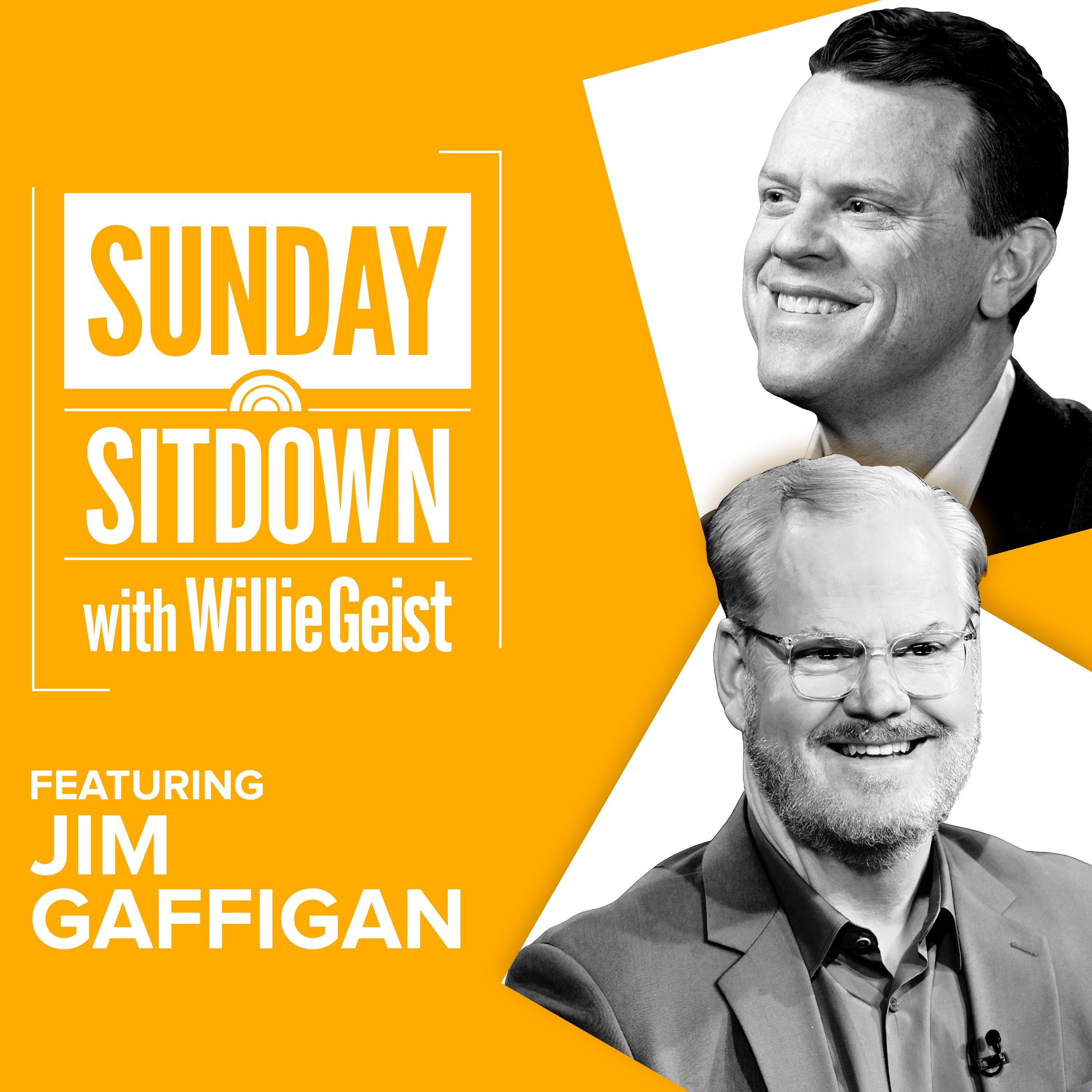
Sunday Sitdown with Willie Geist
Jim Gaffigan on the Craft of Comedy and His Bourbon Born Out of Chaos
00:53:18
Jim Gaffigan is a stand-up comedian, bestselling author, writer and acclaimed actor whose 11 specials and countless viral bits have made him one of the most beloved voices in comedy. Jim sits down with Willie Geist in front of a live audience to look back on his unlikely journey from a small town in Indiana to selling out arenas and starring in films and television. Plus, he opens up about the moment David Letterman helped launch his career, the inception story of his Fathertime Bourbon, and why the creative process still drives him after more than two decades on stage.
Loading summary
Transcript259 lines
- [00:01]
A
For adults with Crohn's disease or ulcerative colitis symptoms. Every choice matters. Tremphya offers self injection or intravenous infusion from the start. Tremphya is administered as injections under the skin or infusions through a vein every four weeks, followed by injections under the skin every four or eight weeks. If your doctor decides that you can self inject Tremphya, proper training is required. Tremphya is a prescription medicine used to treat adults with moderately to severely active Crohn's disease and adults with mild, moderately to severely active ulcerative colitis. Serious allergic reactions and increased risk of infections and liver problems may occur. Before treatment, your doctor should check you for infections and tuberculosis. Tell your doctor if you have an infection, flu like symptoms or if you need a vaccine. Explore what's possible. Ask your doctor about tremphya today. Call 1-800-526-7736 to learn more or visit tremphyaradio.com when it comes to gifting, everyone on your list deserves something special.
- [01:03]
B
Luckily, Marshall's buyers travel far and wide.
- [01:06]
A
Hustling for great deals on amazing gifts so you don't have to. That means your mom gets that cashmere sweater, your best friend, that Italian leather bag, your co workers unwrap their favorite beauty brands, and your nephews the coolest new toys. Go ahead.
- [01:20]
C
At prices this good, you can grab.
- [01:22]
A
Something for yourself too. Marshalls we get the deals you you gift the good stuff. Shop now@marshalls.com or find a store near you.
- [01:36]
B
Hey guys, Willie Geist here with another episode of the Sunday Sit down podcast. My thanks as always for clicking and listening along. Got an extra special one for you this week, a Sunday Sit Down Live conversation with the hilarious Jim Gaffigan. You might remember we had a Sunday Sit down live with Nate Bargetze earlier this year and then one with Ina Garten. All in front of a live audience of you, the viewers at City Winery in New York. City City Winery is our gracious host and sponsor for these events. We love having a good comedian in there. Nate was hilarious. We thought Jim would be the same and man, does he deliver. As you're about to see, Jim's got his own line of bourbon out. That's the level of his success right now. He loves bourbon. Discovered it over the pandemic as about to hear and so decided, hey, what does it take to get into the business? It's called Father Time Bourbon. So we thought we'd sit down, have a long conversation about his life, career, about his Family and food, which tend to be the two most prominent subjects of his own comedy, and do all that over a glass of Father Time bourbon. He also had a little surprise for the audience of you, the Sunday Today viewers who came. Once again, we were so moved from far and wide. People coming from Texas and California and Atlanta and Chicago and Canada and Florida, all over the country to come see us and to see Jim Gaffigan. You know who Jim is. I don't have to tell you. He's one of the most popular standup comedians in the world. One of that rare collection that includes Nate Bargazzi of guys who can just sell out not only theaters, but arenas as they go on these tours. So just one of the all time great guys. Famously has a large family of five. Those kids are the source of much of his comedy and is the youngest of six himself. So he knows from big family. So a great conversation at City Winery in New York City right now in front of a live studio audience. A Sunday Sit down live with Jim Gaffingen right now on the Sunday Sit down podcast.
- [03:50]
C
I feel kind of bad that we're up here drinking the finest bourbon that's ever been made, so I have a surprise.
- [03:57]
B
Oh.
- [03:58]
C
Every audience member here is going to receive a new car. Wow.
- [04:06]
B
What a moment.
- [04:07]
C
Well, instead of a car, we're going to give you a sample.
- [04:11]
B
Oh.
- [04:12]
C
Of Father Time bourbon.
- [04:13]
B
Wow.
- [04:15]
C
And now if you. If you have a drinking problem, understand that. I'll give you a couple more.
- [04:28]
B
This is the real stuff, guys.
- [04:29]
C
This is the real stuff bourbon.
- [04:31]
B
You can drink it now or not, whatever you want to do. Save it for later. Oh, I see some people are diving right in. There's been no hesitation whatsoever.
- [04:39]
C
The important thing is to keep it smooth. Yes, it's smooth. And this is. This is an American whiskey.
- [04:46]
B
Oh, you're getting a lot of thumbs up on the front row here.
- [04:49]
C
It's good stuff. Good stuff.
- [04:50]
B
How is it, guys? We like it. I saw your face. Good.
- [04:53]
C
Yeah.
- [04:54]
B
Delicious, right? Yeah.
- [04:58]
C
There you go.
- [04:59]
B
She doesn't drink bourbon, but she loves it. Fantastic.
- [05:02]
C
I'm bringing people together.
- [05:04]
B
Yes, you are. Yes, you are. So, guys, as you enjoy your bourbon, I want to hear the story of this bourbon, which is called Father Time. It's Jim's Bourbon. It's not Father Time. Like the guy who controls time and the guy who never loses all that stuff or even.
- [05:22]
C
It's different or even that special time that a father will spend with their child. This is the father time that someone enjoys when they're away from their Kids.
- [05:36]
B
Oh, it's father time.
- [05:37]
C
It's father time. Oh, it's that time. And the slogan is, a father's joy is earned. Because how I ended up here is during the pandemic, my wife and I, we were in a house with all these kids. We have five kids. They're now 13 to 21. I'm living in a psych ward. And we started this ritual of having a bourbon every night. And so I was so inspired by that that I wanted to share that ability to enjoy a bourbon with the world.
- [06:15]
B
And so how does one begin to create his own bourbon? Cause we've all had that thought. Be fun to create my own bourbon. Well, step one is what?
- [06:25]
C
The most important step is acknowledge that you need help. And the reality is there are a lot of celebrity spirits. But I was lucky enough. My college buddy, Stu Pollard, he is from Kentucky, and he had some contacts in the bourbon world. And so I went down and sampled multiple bourbons, which is a sacrifice. I was trying. I tried, like, 100. And so then we selected a couple. We got, again, we got a lot of help, and we developed a precious batch. This is our fourth batch. There's different. And I feel like it's getting better and better, which is super exciting, because obviously there are celebrity spirits, and some of them are garbage.
- [07:16]
B
Yeah. And you were gonna list some of them that are garbage. I know you were listening.
- [07:19]
C
No, I mean, it's like some people go into things for different motives. I truly love the American whiskey world. I love every aspect of it. You know, my bourbon obsession is less about having a drinking problem. It's more of. I find it fascinating.
- [07:35]
B
Yes.
- [07:36]
C
And as I look out in the audience, I see there's some guys who either drink a lot of bourbon or have stopped caring what they look like.
- [07:45]
B
Or both.
- [07:46]
C
Yes. Yeah.
- [07:46]
B
Those are not mut exclusive. So you go down there, you do the tasting, you get this thing up and running. And were you ever worried about the critics who were gonna say, you're just another handsome Hollywood actor trying to create a buck on the back of his fans? Clooney with Casamigos, Ryan Reynolds with aviation. Did you ever worry about that stereotype?
- [08:08]
C
You know, I was very mindful of that. But I also did not approach this as a money making exercise, Meaning I certainly don't want to lose money. But it's not like I'm working with some big investors. It's really just me and a college buddy that are focusing way too much time and energy on this project to the annoyance of our wives.
- [08:33]
B
Well, and, you know, Jim's committed to this because he's got a comedy special that's going to stream on YouTube on 23rd November, the same day that this interview airs on Sunday today on Live at Old Forester. This is the bourbon set.
- [08:49]
C
Yes.
- [08:49]
B
And I watched it today, and it's an entire set, 30, 40 minutes of all bourbon jokes, and only he can pull that off.
- [08:58]
C
Yeah, it's one of those standup is all self assignment. But there was no one that was like, hey, when is a comedian gonna do a show about bourbon? I just have, you know, I. I've always obsessed on certain topics, whether it be bacon or Hot Pockets or bacon. And so then I had, like, 10 minutes of bourbon jokes, and I was like, you know what I'm just gonna do? See how long I can go. And so it's around 43 minutes. But it's also. It's so niche that I didn't even approach the Netflix or the Hulu or the Amazon. I was like, I'm just gonna, you know, put this on YouTube for people that might be interested, because, again, I want people to know it is just about bourbon. So if you're not interested or you're looking for brandy or tequila jokes, there aren't any. But if you like whiskey, I think you'll get a kick out of it.
- [10:07]
B
It's very funny. And you pull it off. And you're at home with these barrels behind us, too. Cause that's kind of the energy of this special as well. I love it. There's a story in there, if you don't mind retelling it. I don't want to blow it. Below the host special about your love of bourbon and now your appreciation for fine bourbon.
- [10:21]
C
Yes.
- [10:22]
B
You're out on the road on this arena tour. You and Jerry Seinfeld walk into a hotel bar, and what happens?
- [10:28]
C
And Jerry, you know, doesn't really drink. I don't know if you're aware, but Jerry Seinfeld is very poor. He kind of is check to check, really.
- [10:42]
B
He's an industry seeker.
- [10:43]
C
Jerry did very well. Jerry doesn't really drink, but he knows that I enjoy bourbon. And when we were checking into our hotel, I think after the Charlotte show, there was a bar in the lobby, and Jerry said, hey, why don't we get a drink? You can get a bourbon. And Jerry actually sounds like that. Right. And so as we walked over to the bar, we've seen it. Here we are at, you know, at City Winery. They have beautiful walls of all these bottles. And this this bar had probably 100 bottles. And at the top, I saw a bottle of King of Kentucky, which is a very rare. Initially, it was only release in Kentucky. And I thought, maybe I should get that, you know? But I knew it would be expensive. Maybe 70, 500 bucks. But then I realized, you know, Jerry Seinfeld can handle that. So as we sat down, Jerry said, get whatever you want. And I thought, oh, I'm gonna. You know. And Jerry got a Courvoisier, and I ordered the King of Kentucky. And I watched this bartender climb this ladder up. She grabbed the bottle, she brought it down, she poured it, and she handed it to me, and I tasted it. And it was pure euphoria. You know, I felt like I was the King of Kentucky, which is kind of ridiculous because we all know that's Colonel Sanders, right? And so I had an epiphany in that moment. I was like, I should have Jerry Seinfeld try King of Kentucky. Jerry will become a bourbon drinker because of me. And then Jerry and I can go out drinking expensive bourbon, and Jerry can pay for it. So I said, jerry, you gotta try this. And he tasted it, and he goes, I don't like it. It's not good, but get another one if you want. And I thought, oh, I'm gonna. And I got another one. And then the check came, and I noticed Jerry was looking at it kind of strange. And I was like, is there an issue? And he goes, you, King of Kentucky's cost 500 bucks a pop. Wow. Now, there are a couple things you can do in that situation. And I should also point out that Jerry is a friend, but someone I respect. So I could have said, jerry, that's ridiculous. Let me pay. But all I said was, sorry, Jerry, you know? And that's a true story. That's a true story. The only thing I made up is I've never met Jerry Seinfeld. You know.
- [13:13]
B
By the way, after watching that today, I looked up King of Kentucky, and if you can find a bottle.
- [13:18]
C
Yeah.
- [13:19]
B
Wow. It's three grand or something like that.
- [13:21]
C
Yeah, it's a really. It's a real special one that I feel about King of Kentucky how most parents feel about their children. Your mom before this was like, stop being so mean to you out of your kids.
- [13:37]
B
Where's my mom? Mom, are you up there somewhere? Jody, where are you? I said, mom, look, it's Jim. She said, stop being so mean to your kids. Yeah.
- [13:50]
C
The good news is that my children, all the things I see, I don't have to Feel guilty. Cause they have no interest in my comedy.
- [13:58]
B
Right. They're not gonna see it.
- [14:00]
C
They're never. I'm more concerned about accidentally posting a photo where they appear in it on Instagram than me saying something in my standup product. Right.
- [14:10]
B
That millions will see on Hulu or wherever it is. I wanna talk about your kids in a minute and how they fit into your act. And Jeannie, your wonderful wife. But I'm interested in the genesis of your comedy, which is youngest of six kids, Chesterton, Indiana.
- [14:26]
C
Yes.
- [14:27]
B
Previously known best for the wizard of Oz Festival, I believe.
- [14:30]
C
Yes, there is.
- [14:32]
B
And now they have Gaffigan. So they got rid of the wizard of Oz Festival.
- [14:34]
C
Did they get rid of. I don't get rid of.
- [14:38]
B
So was it being the youngest of six that made you funny in a call? It's an old story.
- [14:44]
C
Right.
- [14:44]
B
Like you needed attention in the house and you had to act out a.
- [14:47]
C
Little bit, you know, I don't know. I mean, there is a lot of youngest kid comedians. But then again, I think Chris Rock is the oldest. Right. Of a large family. So, I don't know. I mean, I feel like it's. You know, And I grew up in a small town, so there was not anyone in the entertainment industry. There was not even a newscaster or, you know, someone from a local affiliate thing. It was. Chicago was a good hour and 15 minutes away. So it was. The closest thing to the entertainment industry was the high school marching band, which was very prestigious.
- [15:29]
B
Yeah.
- [15:31]
C
But. Yeah. So I don't know how I ended up here. I think that I did always love comedy. I grew up loving Letterman. I remember laughing at Phyllis Diller on the Mike Douglas show, you know, like. So I've always had an affinity for it, but I didn't think it was a realistic pursuit.
- [15:52]
B
And you come from a family where your dad works at a bank and you wear a tie and you go to work, and that's how life works.
- [15:58]
C
Absolutely.
- [15:59]
B
You're certainly not gonna be a comedian.
- [16:01]
C
No, no. Like on Father Time, on the bottle of Father Time is my grandfather, Joseph Patrick Gaffigan. And he was. He made dentures. And I remember growing up thinking, okay, he made dentures. That's great. But in a way, the reason he's a hero is because he had stopped this cycle of Gaffigans kind of working in coal mines. Not that there's anything wrong with working in a coal mine, but Joseph's father said, you can do anything, but you can't work in the coal mine. So because of my grandfather, Joseph My father was able to go to college, and so then my father going to college allowed me to be a comedian that tells diarrhea jokes. It's a real American story.
- [16:51]
B
This is the dream. This was the dream out of the coal mines and here telling these jokes. But you did kind of stay on the path of a. You majored in finance at Georgetown of like, okay, comedy's fun, but I gotta get serious about life.
- [17:06]
C
I was definitely raised to seek security and, you know, success was wearing a coat and tie. But, you know, the great irony is all my siblings that went into finance, I make a lot more than them, you know, so, you know, and I was. I was the weird sibling, like, oh, Jimmy and his hobby for a long. For a good 20 years. Because of course, there was a lot, you know, and my brother Joe was nice enough to fly me home for Thanksgiving many times and I've never paid him back. No, but it's. It's. Yeah, it's. I feel very fortunate, you know, but, you know, it really comes down to the creative fulfillment, which is so rewarding, which is why I did this bourbon set is. Hopefully people will enjoy it, but in the end, it was the process that was so rewarding to me.
- [18:08]
B
Hey, guys, thanks for listening to the Sunday Sit down podcast. Stick around to hear more from Jim Gaffigan. Right after the break.
- [18:16]
A
Went to Rome. I thought that my boyfriend was going to propose to me. He wasn't. I did use my sapphire reserve for the flights, so the points did make up for the whole no proposal.
- [18:24]
C
Earn 8 times points when booking through.
- [18:25]
B
Chase Travel with Chase Sapphire Reserve now even more rewarding. See more rewards@chase.com reserve@cards issued by JP.
- [18:29]
C
Morgan Chase Bank North America member FDIC.
- [18:30]
B
Subject to creditors approval terms apply.
- [18:32]
A
We're interrupting this podcast to ask you a very important question. Have you had your Hershey's? When you need to brighten up your day, put a smile on your face with the classic creamy texture and pure milk chocolate flavor of Hershey's milk Chocolate. Whether you're eating it on the go, breaking off a few pieces for s' mores night, or just treating yourself to something sweet, Hershey's Milk Chocolate checks all the boxes. Shop for Hershey's Milk Chocolate now at a store near you found wherever candy is sold.
- [19:00]
B
You know what a girl's best friend is.
- [19:01]
A
Not diamonds.
- [19:02]
B
Her lawyers.
- [19:04]
C
From executive producer Ryan Murphy comes a fiery new legal drama.
- [19:08]
A
It's our own boutique women representing women.
- [19:11]
C
You can't afford to miss.
- [19:13]
A
Make it rave. Showtime, ladies. Stand up Straight and breeze into that room like a storm no one saw coming.
- [19:23]
C
Hulu Original Series All's Fair now streaming on Hulu and Hulu on Disney for bundle subscribers.
- [19:28]
B
Terms apply. Welcome back. Now more of my conversation with Jim Gaffigan. So you go. You start in state, you go to Purdue, you play football for a couple of days. Was it weeks?
- [19:40]
C
I think it was. I think it was 10 days.
- [19:42]
B
10 days?
- [19:42]
C
Yeah, 10 days.
- [19:44]
B
All time leading rusher in school history.
- [19:46]
C
All time. I mean, yeah. I mean, Drew Brees went there, but, like, who's a better football player? I don't know. Yeah, so it was.
- [19:58]
B
But then you go to Georgetown, you transfer to Georgetown, major in finance, and you come here and you're out in the world. You're working in advertising, doing the job with the suit and tie. Yes. So when does the idea of getting up on a stage become real for you? When do you start doing that?
- [20:12]
C
I had a very romantic notion of being a comedian, but I didn't know anyone in the entertainment industry. I remember the night before I graduated from college, I was talking to a friend of mine and I was saying, you know, secretly, I want to be a comedian and an actor. And she was like, well, you should do that. And I'm like, but everyone wants to do that. And she was like, I don't want to do that. And I was like, you're lying. And so it was this kind of process of really kind of embracing it. And I also, I am very risk averse. So I did keep my day job for a long time, but then I became comfortable with the notion that I was just gonna be the weird uncle because it did not look like I was gonna be able to make a living. You know, I thought, all right, well, at least I enjoy doing standup. I enjoy auditioning for things.
- [21:10]
B
So you were like, you said you kept your job and you're doing stand up sets at night, sometimes late at night. Hamburger Harry's, I think you.
- [21:20]
C
Gladys Simon, if she's watching. Thank you, Gladys.
- [21:22]
B
There you go. Yeah. She helped you on your way. But there's a story that you can either tell me is true or false, which is you were a little tired. When you go to work, sometimes you might take a nap at your desk.
- [21:33]
C
Yes.
- [21:33]
B
And you actually had to be woken up to be fired. Is that true?
- [21:40]
C
That is definitely true. That is definitely true.
- [21:43]
B
So glad it's true.
- [21:45]
C
And I was, you know, I was definitely, you know, thankfully, advertising is, you know, the type of where, you know, kind of eccentric or creative behavior is kind of embraced. So it's like, oh, my gosh, Jim showed up two hours late to work today, and it was kind of considered interesting if you produce. Like, I don't think you could do that on Wall street. Like, just show up and. But, yeah, no, I was. You know, it was. You know, the great irony of that story is that a friend of mine, Dave Attell, had that as a joke, and then it happened to me. So whenever that comes up, I have to say, you know what? That's also a Dave Attell joke. Because, you know, he's like Nostradamus or something. But it was. Yeah, it actually happened. And my boss, who fired me at the time, shoot, it was one of those things where I couldn't quit because I needed to get the unemployment and the health insurance and stuff like that. And so I had. You'd lose an account in advertising. You're like, all right, here we go. They're gonna get rid of me. I'm the guy who sells sleep in his office at lunch. And it just like, finally came to the point where she was like, all right, now you're free, right?
- [23:12]
B
Fly away, fly away. So you decided to pursue comedy full time, especially given your background and your family saying, it's not really a serious job. And I think this is applicable to a lot of people in a lot of different businesses who have a dream or something. What kept you going when, like, you said, you probably couldn't always pay your rent or eat the way you wanted to eat or all of those things? Why did you stay with it as long as you did before you hit it?
- [23:37]
C
I think that I had. I never was, because I had a career or the normal path prior. I knew that I wasn't interested in that or a corporate position. Wasn't. Even though I look like a Republican, it wasn't right for me. And so the alternative was I would rather scrap by than. You know, there came a point. I did a. You know, I went through therapy and all this stuff, and I was like, okay, I'm gonna be comfortable with the fact that I'm not going to be on TV or successful. And that was kind of this really breakthrough moment for me, emotionally, where I could process that. But, yeah, so, like, I didn't foresee giving it up because I do find it so creatively fulfilling. You know, stand up. And being rejected for acting roles is so fun.
- [24:45]
B
That ended at some point, too, though. There's this. You say you grew up idolizing Letterman. There's this breakthrough moment when you're actually on Letterman in 1999. What did that mean to you? To be on his show and to be embraced by him afterward?
- [24:59]
C
I mean, it was so huge because being from Indiana and obviously Letterman is from Indiana and this icon, and you don't know. I mean, his influence on my sensibility or my approach to comedy was. Was very obvious. And so it was a goal to get on the show. It was when I first heard him laugh at one of my jokes, that was amazing. And then afterwards, when his executive producer, Rob Burnett, was like, we wanna do a show, it was just like, it was amazing. And then like anything in the entertainment industry, it's a little bit like, come here, come here, come here. Slap.
- [25:42]
B
Yeah.
- [25:42]
C
So it was. But I've also. I think I have a healthy perspective on it in that it's, you know, it's always two steps forward, one step back, and you have to kind of keep a healthy perspective on it.
- [25:57]
B
And you kept grinding. You kept grinding. You get this Comedy Central Special in 2005, I think, which maybe actually was the breakthrough. Cause people really started to know you after that.
- [26:06]
C
Yes. I mean, it is. You know, the hour special on Comedy Central transformed my career and also my, you know, like, I could have. I have five children that, you know, I've been able to raise because of standup. And from what I've observed, they're not gonna make any money, so they need this. And it makes. Makes me realize. And I don't know if there's any other parents out there. It makes me realize that my final task of parenting is to leave them with nothing. You know, maybe it's a romantic notion, but I want them to pay for my casket. Jesus, your mom's not gonna like that one.
- [27:00]
B
So that does get us back to. To the question of how your family feels about being the center of your comedy. Since you really broke through and found your voice. They were. You got married to Jeannie.
- [27:10]
C
Yes.
- [27:11]
B
You know.
- [27:11]
C
Yeah, no.
- [27:12]
B
27 years ago. And the kids were little when you really broke out. How do they feel about being the story?
- [27:17]
C
I. I don't care. No, I mean. No, here's what I would say is that my. You know, the benefit of having five children is I can talk about a story that occurred with one of my children, and you can't be sure which one I'm talking about.
- [27:38]
B
Oh, right.
- [27:39]
C
But most importantly, they're not interested. So they're not kind of like, dad, I watched your special. You know what I mean? Like, I have this book, dad is Fat, where my son came up with the Title. He still hasn't read it, you know, like, it came out 15 years ago. He doesn't. And he's. And in some ways I understand. Do you know what I mean? And I also think that it's healthy that they're not interested in my material and stuff like that. And so it's. Yeah, it's all good. And, you know, obviously I try to be respectful and I think anyone who's a parent is, like, aware that we've all made mistakes. Like, you know, there's, you know, not only do I wish I never gave my children a phone, I wish that, you know, like, there's sometimes maybe I should never have posted a photo of them, you know, like the whole thing. But, you know, parenting is, you know, you try your best and then you as a parent, you become the receptacle for all the blame. Right.
- [28:46]
B
I like it. In one of your acts, you say they kind of approach you like you're a bank teller. Yes. They have this sort of like unemotional, detached conversations with them.
- [28:57]
C
Yeah. I think like Apple Cash, like that obviously was the idea of some child. Right. How am I going to get Starbucks money from my parents? They came up with Apple Cash.
- [29:15]
B
Cash without cash talking to them?
- [29:16]
C
No, just a direct transfer, simple request, a text message. The parent has an opportunity to show love and the child receives a limited amount of money. Right.
- [29:29]
B
And they'll be back soon for more. Yes, this we know. So when, Jim, did you find this voice, this comedic voice that you have? When did you kind of, you know, the inner voice thing you've become famous for, which is your sort of your inner monologue.
- [29:42]
C
Oh, yeah.
- [29:43]
B
Like, when did the. The act that we all know or the delivery that we all know. When did you kind of land on that? When did it start working for you?
- [29:51]
C
I mean, there's so many experiments along the way when you start standup. And some of it, everyone knows that, like the point of view or your authentic self is the answer. But you're often trying to. You're learning lessons on what is approachable and what is, you know, palatable to the audience. So, like, you know, I'm kind of this doughy white guy or. And so like me being angry is not that appealing to an audience. Do you know what I mean? Whereas me being. I've always been self deprecating, but like. Or me being edgy or it's like you find you really end up with your most authentic self, if that makes sense.
- [30:41]
B
Yeah. No, and it comes across that way when you talk about your Family. We know it's all real. It's coming and it has to.
- [30:47]
C
You know, I think some of the premise is that, you know, I complain about my family, but I believe that if you are a parent and you're involved, that there's, you know, that means you are annoyed. Like if you. Of course, if you aren't. If you aren't sometimes. Right. If you're. Like, if you. If your identity isn't somehow tied up as a father or mother, if you have children, I think you're doing something wrong. Do you know what I mean? I don't know. That's my opinion. That's why I'm running for president.
- [31:26]
B
Oh, this is the rollout, by the way.
- [31:31]
C
Maybe, right?
- [31:32]
B
Why not?
- [31:33]
C
Never. Never.
- [31:36]
B
We've talked about this before, but I think it's interesting for others to hear, which is the. You can be funny. There are a lot of people who are funny. And then there's sort of the navigation of the career, which is like, one time we talked, you said there are a bunch of guys who aren't selling out arenas the way you are or stadiums or whatever it is who you guys consider. They're like the funniest guy that we know.
- [31:58]
C
Yeah.
- [31:58]
B
So how do you explain what you've been able to do over the last 20 years to navigate and get to the place you've gotten to? If that makes sense.
- [32:08]
C
Yeah, I mean, I think some of it is editing, you know, if that makes sense. It's like some of it is just like the, you know, my son Jack is so funny. He's 19. He's one of the funniest people. But some of him saying some of these things in front of his mother is funny because of the situation. But should he edit more? Yes, he should edit more. And so I think that also comes to managing career, right. It's maybe editing some of the, you know, how much bourbon you consume. You know, it's editing your self assignments, you know, like even doing the Bourbon set, which is. There's no financial incentive, even though Old Forester and Brown Forman are gonna give me a case of King of Kentucky.
- [33:12]
B
Are they?
- [33:12]
C
Which was part of the A case, which is. Yeah, so. But you know, but some of it is, you know, also doing things for the right reason. So, like the Bourbon set, I did it out of this passion and I didn't really, you know, I'm not making money on it. But I also think that that's a strategic move for, you know, just keeping their creativity going.
- [33:41]
B
Yeah, that makes sense. What about this moment in comedy where, I don't know, growing up, I don't remember maybe Eddie Murphy, but there's a group of you guys that can do arenas, and you and Jerry just came off an arena tour, and Nate Bargetzi and all those guys, they're doing that. Is this an especially exciting moment for comedy because of all the outlets, because of Hulu, where you did the Skinny or Netflix or all of. Seems explosive right now.
- [34:11]
C
It is so. It's so incredible because, I mean, you talk about Nate, I think that we. I don't think Nate has even gotten close to his ceiling. And so there is something about the awareness of stand up, the education of people identifying the type of comedy they like and then having accessibility to see that. You know, like, there was no YouTube, there was no Comedy Central, there was no Sirius XM. And so now all those things exist. So people discovering standup and making an informed decision on what they want to do on a Saturday night or a Saturday afternoon by seeing a standup show is just, I mean, something I didn't even contemplate or even when Nate was starting, it wasn't a hypothetical. So, like, there is something where comedy is booming so much. But I think in this age of AI, in the end, live performance is the safest thing. It's oddly strange, you know, that I think that live experience is pretty important. Ryan. Yeah, that's.
- [35:34]
B
And for people to get exposure that maybe otherwise wouldn't. I know you're. She's top of mind. So I'm thinking of Leanne Morgan, who I know you're a big fan of. She's actually on our show just to plug it this Sunday. But again, like, she's about to go out on an arena tour.
- [35:52]
C
Yeah.
- [35:52]
B
And like, that is amazing, right?
- [35:54]
C
It is amazing.
- [35:54]
B
This many people can pull that off.
- [35:56]
C
It is amazing. And it's also, I think, you know, and this is. Jerry actually brought this up. It's like if. When people go out to a comedy show, you know, yeah, there is the cost, but it's really more important. It's the value of their time. And it's a better gamble to buy a ticket to Chris Rock or Jerry Seinfeld than to see a movie that maybe the Times gave a vague positive review of. It's not about the money. It's about the quality of time. Like, if you are going to see, you know, Nate or Leanne or whatever, you know, it's gonna be a quality show and you're gonna enjoy it. So it's really a. It's a great time for comedy.
- [36:50]
B
Stick around for more of my conversation with Jim Gaffigan. Right after a quick break, a sapphire reserve story from the Foster sisters.
- [36:59]
A
We went to Rome. Me, Erin and her boyfriend. The entire time. I think that my boyfriend is going to propose to me. I knew he wasn't. Anyway, we booked this beautiful hotel with the edit through Chase Travel. Then later at a romantic dinner. No proposal. And his card was not accepted. I pay with my sapphire reserve. The three time points on dining made up for the whole, you know, no proposal thing.
- [37:16]
C
Yeah, for you get $500 credit for the edit. A collection of luxury hotels with Chase.
- [37:20]
B
Sapphire Reserve now even more rewarding. See More rewards@chase.com Reserve cards issued by.
- [37:24]
C
JP Morgan, Chase Bank North America member.
- [37:25]
B
FDIC, subject to credit approval terms apply.
- [37:27]
A
We're interrupting this podcast to ask you a very important question. Have you had your Hershey's? When you need to brighten up your day, put a smile on your face with the classic creamy texture and pure milk chocolate flavor of Hershey's milk chocolate. Whether you're eating it on the go, breaking off a few pieces for s' mores night, or just treating yourself to something sweet, Hershey's milk Chocolate checks all the boxes. Shop for Hershey's Milk Chocolate now at a store near you found. Wherever candy is sold.
- [37:57]
B
The 2026 Chevy Equinox is more than an SUV. It's your Sunday tailgate and your parking lot snack bar. Your lucky jersey, your chairs and your big cooler fit perfectly in your even bigger cargo space. And when it's go time, your 11.3-inch.
- [38:13]
C
Diagonal touchscreen's got the playbook, the playlist.
- [38:15]
B
And the tech to stay a step ahead. It's more than an suv. It's your Equinox Chevrolet. Together, let's drive. Welcome back now to the rest of my conversation with Jim Gaffigan. We're gonna get to some of your questions that I have up here in just a minute. Wanna make sure we get those in? You mentioned acting growing up, wanting to be an actor. Your friend the night before school was, yes, say go do it right. And you've had this now amazing acting career going back 15 years at least to being on Broadway. You're coming back to Broadway here in a little bit and you're in serious roles and thinking about, like, Chappaquiddick and Linoleum. What do you love about that separate from being a standup star?
- [39:02]
C
Oh, I mean, I really do love acting because you can, you know, there is something about really exploring a Character and adding value to this overall portrait that's being painted. You know, so if you can add more nuance and character development to even what the writer was presenting, that's really compelling. And you also want to be a good soldier and pitch ideas, and if they don't want them, you know, you kind of want to be there as a supporting tool, but it's also getting lost in it, which is really fun. But, you know, I would say that acting, the audition process. I describe auditioning as kind of like stripping, but you don't get a dollar right. There is a vulnerability that is in that process that, you know, I'm so grateful that with standup, you know, at many different levels of standup, you can find the stage time and the feedback, which is from the audience, which I think it's really hard for actors because it's just. The process is. Understandably, you're dealing with a lot of moving parts.
- [40:22]
B
Yeah. And I would think it's so maybe challenging for you because here you get the laugh right away. There you audition, you shoot something, and like 18 months later, the audience goes, oh, that wasn't any good. Even not, you know what I mean? They judge it like that and it's over.
- [40:37]
C
And also, even, you know, when you write something, I enjoy writing, but it's the feedback. I mean, comedians are so spoiled by the feedback of the standup performance. Like, sometimes comedians aren't considered great actors, and some of it is. It's just. It's hard for that to compete for the immediate feedback and the editorial control they have, if that makes sense.
- [41:04]
B
Yeah. All right, I want to get to a few of the questions before we. You guys, these are amazing questions. We're going to get to as many of them as we can. This is a good one from Sharon Audubon, New Jersey. Sharon, you in here? Where's Sharon? Hi, Sharon. Hi, Sharon. Where's Audubon? What county are you in? Oh, Camden. Okay. I'm from Bergen. Good to see you. Okay. Have you ever, Jim, thought of being something else other than a comedian? What would it be if you were not a comedian?
- [41:34]
C
Probably a model. Why is that so funny? No, I. I mean, there's things.
- [41:44]
B
I.
- [41:45]
C
Wish that wasn't that, you know, like.
- [41:47]
B
Look how felt Jim is these days. What a beautiful man.
- [41:52]
C
And I take zero credit. I mean, I. I mean, there's. There's things that I find interesting. I mean, I would love to. I mean, I discovered it late, but I love. I. I find bourbon and American whiskey fascinating. I. You know, when I Was a kid, I wanted to be a farmer. I love gardening. I, I, you know, I think I have a lot of respect for farmers, and I like that. The whole solitary process, or maybe kind of. But, you know, some of it is like, you know, getting up early. I don't know if I want to.
- [42:27]
B
Do that, but it's the hours for you that are gonna keep you awake.
- [42:31]
C
You know, and then I find, you know, I find politics interesting, but I also, you know, he's running, guys.
- [42:40]
B
He's running. He keeps bringing it up.
- [42:44]
C
I would be like a positive Lee Atwater, you know, Oh, I don't know. No one else behind, behind the scenes.
- [42:50]
B
Guy making the ads and stuff, you.
- [42:52]
C
Know, that would be, you know, I do find. I did like advertising. I think it's interesting.
- [42:57]
B
Okay.
- [42:57]
C
I love storytelling.
- [42:58]
B
So. But at the end of the day, model.
- [43:00]
C
We model.
- [43:01]
B
I would say, come back to where it began.
- [43:03]
C
Yeah. Song model, you know, I mean.
- [43:05]
B
No, no, no. Okay.
- [43:07]
C
Good morning, everyone.
- [43:07]
B
Where's Carrie from Apopka, Florida? Carrie. Hi, guys. Okay, here's a good one. Since I am originally from the great state of Indiana, writes Carrie, it's widely known you were the greatest athlete in the history of Purdue Boilermaker athletics. Can you please share with us a funny story during your stellar career with the Purdue football team?
- [43:29]
C
Well, you know, there are so many.
- [43:33]
B
Where to begin.
- [43:34]
C
So many. Yeah, really, it's, you know, I think they have a whole room at the hall of Fame for this. I would say the funniest thing is I was there for about 10 days on the team for 10 days. And there was. I was a offensive lineman and I walked on, which I think it's a great tradition that they allow people to walk on.
- [43:57]
B
Yeah.
- [43:59]
C
And there was a time when the, you know, the coach of the lineman was like, you know, this is the Big Ten. You know, you're never going to play. You know what I mean? Like, there are defensive backs that weigh twice as much as you.
- [44:19]
B
Like. We're playing Ohio State on Saturday.
- [44:21]
C
Yeah.
- [44:21]
B
Yeah.
- [44:21]
C
Like, there was. He was kind of. It was a very diplomatic way of saying, can you get out of my way? But that was. That was also a very kind thing to do. And that being said, I wasn't like, Rudy, I wasn't like, I'm gonna do it. You know, I was kind of like, I don't know.
- [44:43]
B
And you're like, okay.
- [44:44]
C
I was like, all right, fine. I'll just head to Hardee's and eat, you know.
- [44:50]
B
But then. Did you play at Georgetown?
- [44:51]
C
I did play at Georgetown. And then I quit. Cause I'm a quitter. And. And I quit and I went and I worked for a senator named Dan Coyle.
- [45:05]
B
Yes, Indiana.
- [45:06]
C
And I said, one day you will. I never met him. I opened mail, you know, stuff like that.
- [45:14]
B
Karen, also from Florida. St. Petersburg. Karen. Where's Karen? Karen from St. Petersburg.
- [45:20]
C
Karen's over there.
- [45:21]
B
Oh, she's over there. Hi Karen. Okay, here's the question. Oh, Jim and Willie, you are both parents. What is one bit of advice you would give to a new parent? A parent of a teenager. Oh, this is a three part question. And a parent of a college age student.
- [45:36]
C
Okay, you're the expert. I would say a new parent. I would say it's gonna get much worse. Cause you know like there is like, oh, I'm so tired. I'm like, it's gonna get so much worse. And I have all these older siblings and I was like, I'm so tired. And they were nice, they were like, oh yeah, I'm sorry to hear that. But like they had teenagers and they should have said it gets much worse.
- [46:08]
B
You had a bunch of teenagers.
- [46:10]
C
Parents of teenagers. I would say my advice is father time bourbon. And. And then parent of. Is it college student?
- [46:24]
B
College age student.
- [46:25]
C
College age student. I would say it's going to get much worse. So again, yes, it all ties back to father.
- [46:32]
B
This was a long way to plug the father time, father time bourbon.
- [46:35]
C
What would you say?
- [46:36]
B
Well, I'm a new parent of a college student just this year. I would say the anxiety of that moment when she or he leaves is worse than the reality. I mean this is good news, which is. It's just gunt wrenching. How do you get yourself off the floor? And then it happens that if she's ready to go and she's happy, you're happy. So if you can work through the moment until you say goodbye, it actually is better after that. I found anyway. I don't know if you found that too, but that requires preparation and being comfortable with her going.
- [47:10]
C
I felt nothing. But no, here's what I would say. Here's what I would say. When I was dropped off at Purdue, my parents didn't bring me, my brother dropped me off. And I would also say I have two children in college and understandably the normal reaction is that you're missing this person, this child. And obviously I miss my children. But there is the thing that I find so odd is that they're at college. You know what I mean? I feel like generationally now we're like, are they okay? Are they okay at college? And I understand that mental health crisis is real, but I'm like, they're at college. They're not in Afghanistan. Do you know what I mean? So, like, there is something of. And I want to be sensitive to the fact that it is an adjustment, particularly these pandemic kids that had it tough. Anyway, there's more talk.
- [48:24]
B
There's more about. Well, on your point of the drop off, I don't know if you're aware. I bet Jeannie is. There's this whole industry now of, like, how to, like, build out your dorm room and, like, you can hire a consultant to do your dorm.
- [48:40]
C
Yeah.
- [48:41]
B
And the parents go back and visit two weeks later, and they're all checking in. And, yeah, it was just a clean drop for us freshman year and saw him at graduation. That was the next time. Oh, that's the next time, I think, Mom, I saw you at school. Yeah.
- [48:53]
C
Like, by the way, I'm convinced, if you want to hear a conspiracy theory, I'm convinced that Parents Weekend, that's a scam.
- [49:06]
B
Say more, Jim.
- [49:08]
C
Parents weekend. And by the way, we're paying for this. Right? And then they want you to go back where you just dropped them off a month earlier. They want you to get all the parents to get a hotel room. Those hotels. I think it's the hotels might be the hotels that are like, can you do a parents weekend where we can charge $8 million for a Super 8 hotel? And then you go back and you know what? Guess what? The kids, they're like, all right, nice to see you. And then the parents just kind of go, what do we do now? It's just awkward. And that leads me to Father Tom Durban.
- [50:04]
B
Yeah. Yeah. There's definitely some collusion. I think you're onto something. Michael from Chesterfield, Missouri. Where's Michael from Chesterfield, Missouri? Somewhere. Maybe a mail in question, who knows? What is your favorite movie you've been in, all the projects you've done? Do you have a favorite?
- [50:25]
C
I mean, I loved Linoleum. I mean, I. You know, some of it is. I can't be objective because I love the character. But, like, there was a movie, American Dreamer, where I played a guy who murders someone. So I like that a lot of you guys are like, I don't know if I like Jim Gaffigan anymore. But some of it's just the more complex and weird the character. But Linoleum's a pretty special movie.
- [50:51]
B
That's a good movie. Yeah, it's really good. And it seems like you go you're airing toward dramatic roles. When you take movies, which is completely different from your day job.
- [51:01]
C
It's, you know, it's typically. It's more of a complex character. Right. I mean, it's selfishly, you want the character to evolve over the course of the movie or the show. And again, you know, comedy, I love comedy, but it's. You want to do something with a little meat on it. Right.
- [51:23]
B
We need you. Some of that Marvel cash for your next movie, I think.
- [51:27]
C
Right.
- [51:28]
B
It'd be good for.
- [51:28]
C
But, you know, I don't want to be the eye candy. You know what I mean?
- [51:31]
B
That's true again. Took his shirt off again. Okay, here is Rene from Scarsdale, just outside the city of. Hi, Renee. Okay, this is a good question. If a civilian, a non comedian, is trying to tell you a funny story, is your brain subconsciously workshopping it as they go, prompting you for ways you would make it funnier? And do you think of funnier payoffs when they're done? Like you could have punched up their story?
- [52:03]
C
I think this question says more about Renee, and I think it makes. Makes me like her or him. I don't know if it's. Because it could be a. You know, but. Cause I can't see that far. But yes, I think that there is the editing thing that's always kind of going on, but I think everyone does that, right?
- [52:27]
B
Yeah.
- [52:27]
C
Someone starts with the story. You're like, all right, you can cut that.
- [52:30]
B
Yeah. Yes, right.
- [52:33]
C
You can cut that. Not important to the story.
- [52:35]
B
Right. Too much backstory.
- [52:36]
C
Oh, we're to going. Going off on this tangent.
- [52:38]
B
Right.
- [52:38]
C
All right, so. But I think everyone does that, right? Yes, but I always greet people with love.
- [52:45]
B
There it is. And do you have the thing that comedians have when they sit around and talk and somebody says something funny, instead of laughing, you just go, oh, that's funny. Yeah, right?
- [52:55]
C
Yeah.
- [52:55]
B
Like you're sort of. In other words, you're analytical about comedy.
- [52:59]
C
Yes. You know, and it's. Some of it is. You want. You know, I think that's a respect thing to acknowledge it. You know what I mean? And also because there is a level of insincerity that exists in our society where, you know, some laughs can be fake. So saying that's funny has more integrity. I don't know. Yeah, sure. I don't know. Maybe I drank too much of this.
- [53:29]
B
Jim has been so generous with his time, he's actually going to another gig, a veterans event, which is an amazing thing for Jim to do. So before we release you into the wild. What else is out there for you? You've got. Done all these great dramatic movies. You've done 11 stand up specials. Wildly, wildly popular. You've got, like, all eight Grammy nominations. You've won three Emmy Awards. I think your last special, the Skinny, I was reading was viewed the clips of it like 100 million times or some, like, obscene amount. So when you think about the arc of your career and all the things that are possible for you because of the success you had, like, what else is out there beyond the Bourbon? Unless you want to bring it back to the Bourbon, what else is out there?
- [54:17]
C
I think the great irony is if and when I die, which could be tomorrow.
- [54:24]
B
No, no, no.
- [54:25]
C
I will be known as the hot pocket guy. But that's. There's worse things, you know, but I don't know. For me, it sounds corny, but I love the process so much. So as long as I can, you know, continue to tour and come up with material, that's the reward. I know that sounds corny and. But that's, you know, I'm grateful that I can do that. And the creative fulfillment of coming up with a new joke, there's not much that beats that, you know, do you.
- [55:01]
B
Ever feel like, oh, the well is dry, and then you go out and observe something? Oh, there's a whole bit right there again.
- [55:06]
C
Oh, yeah. No, there's a lot of moments where you're like, that might be it. But then, you know. Cause I think it was the great poet Ralph Malth on Happy Days who said, I still got it.
- [55:21]
B
You know, still got it. And you still got it. Ladies and gentlemen, Jim Gaffigan. So we're gonna do a little.
- [55:32]
C
Yeah. Before.
- [55:38]
B
Before we say goodbye to Jim, because if you've seen Sunday today, you know, we do a little mug shot at the end of the show. So we want to take a mug shot with all of you. So our photographer, Heidi is going to come up. If you have a mug or maybe just a little thimble of Father Time, raise it with us. All right, Cheers.
- [55:57]
C
Thank you.
- [55:58]
B
Thank you. Jim Gaffigan.
- [56:00]
C
Thank you for being here. Thanks, everybody. Thank you, guys.
- [56:04]
B
Thank you. Good night.
- [56:05]
C
Thank you so much.
- [56:11]
B
My big thanks again to Jim for a great conversation. His Father Time Bourbon available to buy wherever you get your stuff, stores online or on their website. Also, Jim getting ready now to hit the road again. His Everything Is Wonderful tour picks back up in January. Check online to see if it's coming to your town. In the meantime, you can watch his latest special live from Old Forester the bourbon set on Jib's YouTube channel right now. Big thanks again to our host and sponsor, City Winery in New York City, for hosting our conference. They are such a generous sponsor. We love working with them. And most of all, want to thank you, the Sunday TODAY viewers who came, as I said, from all over the country to be in that room with us that night. Stay tuned for information on our next Sunday Sit down live. Thanks to all of you at home for listening. If you want to hear more of our conversations with our guests every week, be sure to click follow so you never miss an episode. And don't forget to tune in to Sunday TODAY every weekend on NBC to see these interviews with your own two eyes. I'm Willie Geist. We'll see you right back here next week on the Sunday Sit Down Podcast.
- [57:28]
A
A Sapphire Reserve story from Ben Stiller.
- [57:30]
C
People who want to get into entertainment always ask me for advice. And after shooting Severance for Apple TV plus, I basically have a simple answer. Don't work with goats. They don't take direction. They eat your shoes. They're emotionally distant. I mean, I used to think certain actors were difficult, but goats are worse.
- [57:44]
A
Sapphire Reserve now comes with Apple tv, including Severance. Chase Sapphire Reserve now even more rewarding. See More rewards@chase.com Reserve IT cards issued by JPMorgan Chase bank and a member FDIC, subject to credit approval terms apply. Apple and the Apple logo are trademarks of Apple Inc. Registered in the US and other countries.