← Sunday Sitdown with Willie Geist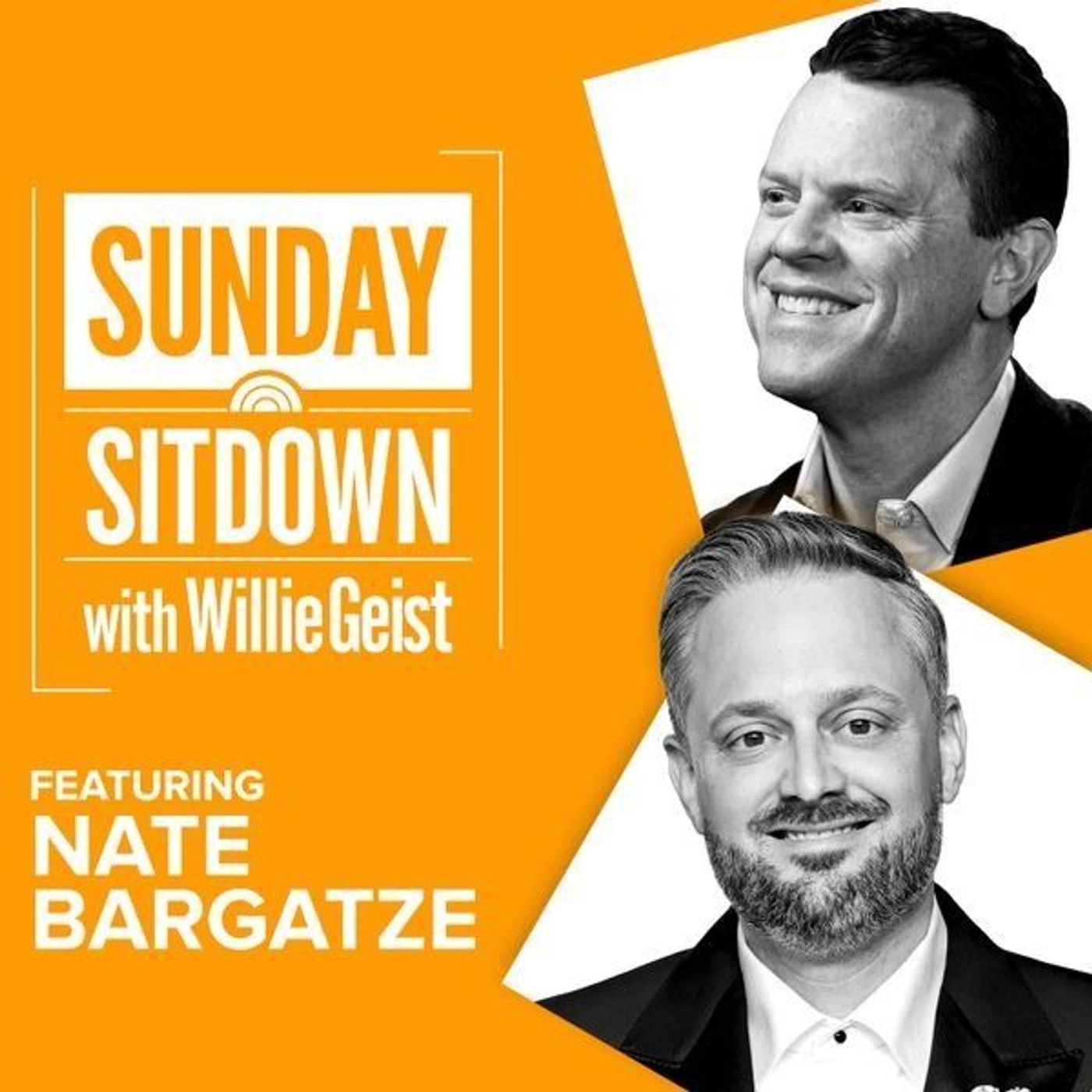
Sunday Sitdown with Willie Geist
Nate Bargatze on Success in Comedy and Nateland’s Expansion (January 2025)
01:09:20
Nate Bargatze has become one of the most successful stand up comedians of his generation, going from performing for a single audience member to selling out arenas nationwide. In this conversation from January 2025, Nate Bargatze sits down with Willie Geist during the first ever Sunday Sitdown Live to discuss his rise in comedy, the expansion of the Nateland brand, and what has fueled his steady climb. Plus, he answers audience questions and reflects on how relatability has remained central to his success. (Venue sponsored by City Winery.)
Loading summary
Transcript357 lines
- [00:01]
A
Hey, this is Jeff Lewis from Radio Andy live and uncensored. Catch me talking with my friends about my latest obsessions, relationship issues and bodily ailments. With that kind of drama that seems to follow me, you never know what's going to happen. You can listen to Jeff Lewis live at home or anywhere you are.
- [00:17]
B
Download the SiriusXM app for over 425 channels of ad, free music, sports, entertainment and more.
- [00:25]
A
Subscribe now and get 3 months free offer details apply Avoiding your unfinished home projects because you're not sure where to start. Thumbtack knows homes so you don't have to don't know the difference between matte paint, finish and satin or what that clunking sound from your dryer is. With thumbtack, you don't have to be a home pro, you just have to hire one. You can hire top rated pros, see price estimates and read reviews all on the app. Download today. Hey guys, Willie Geist here with a very special, special episode of the Sunday Sit down podcast. My thanks as always for clicking and listening along. Boy, do I have a treat for you today. Not only is my guest the hottest stand up working in the world right now, he and I also had our conversation in front of a live audience. His name is Nate Bargetze and he was the guest on our very first Sunday Sit Down Live. So what is Sunday Sit Down Live? Well, we invited you, the audience to come sit in the room while I did one of these interviews. We held the interview at the amazing City Winery in New York City right on the Hudson river, one of the most beautiful venues in all of New York. They were incredible hosts to me and to Nate and you could buy a ticket and sit in the room. And I was stunned as I met all the people who came through the door, how far they traveled. Genuinely I thought be some of my friends and family from New Jersey, maybe some folks from the Upper west side. If we're lucky, we get a little Brooklyn. No, people said they came from San Diego, came from Idaho and Houston and Miami and Knoxville and pick your city. I think it was 32 different states. People came from Canada and they bought tickets to the show. They bought a plane ticket and a hotel room. So honored and humbled that people would do that. So hopefully we gave them what they paid for and then some because Nate just one of the most naturally funny people that I've ever met. So we share something in common which is that we are fans of Vanderbilt University sports. I went to Vanderbilt. He grew up just outside of Nashville. His mom worked in the ticket office. His uncle was an announcer and a coach at Vanderbilt, so he has deep ties. So we've been Vanderbilt fans since before it was cool. Now we're having a great basketball season. Our football team was good last year, beat Alabama. It's become a little fashionable, but we go back, we've suffered. We've suffered for this success. So Nate was so generous to agree to do this in front of an audience. And, boy, can you think of a better guest. A guy who stands in front of massive crowds for a living and entertains them. If you don't know, Nate is a guy who sells out arenas. He has sold out Madison Square Garden, Bridgestone arena in Nashville, literally arenas across the world. He's got a book coming out called Big Dumb Eyes with a tour to follow. He has an entertainment company that you'll hear him talk about called Nateland, which he views as something he's going to set up in Nashville and family friendly entertainment that he doesn't think is out there right now, that there's a huge audience out in the country that's not being served. Um, he's got an incredibly successful standup special on Netflix right Now, more than 8 million views. He's hosted Saturday Night Live twice within the space of a year. October of 2023. Did that famous George Washington sketch, then came back the next October and hosted again. He was that good. So if you don't know Nate yet, you're about to get to know him. Just a great guy and a hilarious comedian. So sit back, relax, and join us inside the room with the live audience at City Winery in New York City for a very special Sunday. Sit down with Nate Bargetzi.
- [04:04]
B
Thank you very much.
- [04:07]
A
Come on in, man.
- [04:08]
B
All right.
- [04:10]
A
Wow.
- [04:12]
B
Wow. This is it.
- [04:13]
A
Wow.
- [04:16]
B
This is it.
- [04:17]
A
I think they like you, Nate. I think they might.
- [04:20]
B
That was very nice. I think they might like this. It was, yeah, very super cool.
- [04:27]
A
One bit that I left out of the introduction. Nate, I'm so grateful to you for doing this our first Sunday sit down live. He has been so gracious and generous with his time last night. I'll let you tell the rest of the story. There was some trouble with his flight getting here. So what did he do? He and the boys rented a van and drove from some little town in Pennsylvania to make sure they could get here tonight.
- [04:54]
B
Yeah, we're the real heroes. It was in Pottstown. My buddy. Pottstown, Pennsylvania. My buddy, Soul Joel. He has a room there. So when we started comedy, he was a big. He was kind of starting out, making shows and booking shows for us as comics. And so he kind of kept going, doing that. And we were at the beginning. We're starting. It's like we do shows for one guy. No one would be there. And so he's got his own club now in Pottstown. And so it was going back to see him and go do that show last night, which was very fun. And then we drove all the way up in the van. We had made a pretty good time. We had a big stop in sheets.
- [05:37]
A
Sheets. How'd you make out in sheets? Did all right.
- [05:40]
B
So I did okay until I realized that they will make milkshakes at midnight. And then it was like, well, that's gonna be kind of a problem, and you can just go make the whole thing. So we were in there. I mean, a gas station on the road is. There's not much better than just the best candy options. There's nothing in there that's not gonna give you diabetes. I mean, I think even the bananas are Something's a little like. They got something on them that you're. I bet that banana is not healthy. Yeah.
- [06:15]
A
What'd you go with on the. On the milkshake?
- [06:17]
B
So I would not normally do this. So my buddy. I wasn't going to get milkshake. I was trying to do the right thing. He gets a peanut butter Hershey cups milkshake. And then I'm looking at it pretty hard, and it's for him. But then he also got donuts. Like the six donuts. Oh, yeah, those are great. And powdered. Yeah, yeah. And so then he sees that I'm like. I mean, I'm eyeing it pretty hard. And he goes, you know what? You can just take it. I'm gonna do the donuts. And I was like, are you sure, dude? I was like, I don't. And then I had that.
- [06:46]
A
So did you finish it off, big boy?
- [06:48]
B
Yeah, yeah, yeah. It was big. Yeah, you get large. I mean, stuff's a bucket size. I mean, every place I go, McDonald's, anywhere, I go large. It's just the absurdness.
- [07:01]
A
They're getting larger, too, aren't they?
- [07:03]
B
They're getting bigger, but otherwise you gotta fill it up, then drink half of it, then fill it back up before you leave.
- [07:08]
A
That's right.
- [07:09]
B
That's always the move. I'm a big dude. I'll do that long.
- [07:11]
A
Absolutely.
- [07:12]
B
I just did it in and out. I was like, yeah. I sit there. People are waiting. And you just sit. I was like, let me just taste it. Let Me make sure it's okay.
- [07:21]
A
Right?
- [07:21]
B
And they just pound half of it. And I'm like, I'm just trying it out.
- [07:26]
A
So we should clear the decks of our shared love of Vanderbilt sports. Yes. Yeah, I just want to. I want to get it out there front and center. I remember hearing like 10. So I went to Vanderbilt. My wife did too. I remember hearing like at least 10 years ago, maybe more like there's this comedian Nate who's like a really big Vanderbilt fan. I'm like, oh cool. What year was he? Like, he didn't go. And I'm like. And I'm like, which, as you know, from the old days of Vanderbilt, not so much anymore. Was like, why? Yeah, why is he. Why did he choose to root for Vanderbilt sports in the SEC now? It's of course the golden age of sports at Vanderbilt. We've now Tennessee twice last week, men's and women. So how did you come to your Vanderbilt sports fandom? You are from right outside Nashville. Old Hickory.
- [08:18]
B
Yeah.
- [08:19]
A
How did you become a Van?
- [08:20]
B
Well, first with the Titans were not there. Most of my friends were Tennessee fans. Tennessee Vol fans. And then my. I had a cousin, Ronnie Bargettzi. He actually coached there in the 70s. So we were. And then he was the color commentator forever. And then my mom worked in the ticket office at Vanderbilt and so it just. We just grew up with Vanderbilt and just being big Vandy fans and it was. Yeah. And I love it. I mean, you know, being a Vandy fan, when you're going through the times where you're losing, you know, we'd win zero games or one game, two games a season. It was like, it's brutal. And you'd be watching the guy be at the games and we would lose by. We once got two delay game penalties called back to back and then we got the extra point blocked and lost. And you're just sitting, you're just in there. I'm like in high school, like, I can't believe this. So now to be where we're at the night Vandy beat Alabama in football. Best night.
- [09:26]
A
This, this was a huge night because our guy was hosting SNL the same night.
- [09:32]
B
Yeah. Yeah, it was. Yeah, it was at a buddy. He goes, God gave you this day, Vandy being Alabama hosting snl. I mean I got more text about Vandy than I did snl and it was, I. It was funny. Cause too they were like, hey, are you at the game? And so then I, you know, you don't want to be. You want some humility. But I Had to be like, I am not. I am hosting Saturday Night Live. So I was like, I'm sorry. Yeah, Yeah.
- [10:08]
A
I. By the way, I was at the game. I was. I was. I was there with my family. And as you know, being a longtime Vanderbilt fan, I swear, we'll stop talking about Vanderbilt sports after this. You're waiting for the other shoe to drop. Oh, great. First half, that'll be now. They'll come. They'll wake up. And it kept going and kept going. I remember just looking down the line at these other fans, and we're looking. Is this happening? Are we going to beat number one Alabama? And we did. And the goal post came down. They threw him in the Cumberland River. It was incredible. It's incredible.
- [10:38]
B
Yeah. Crazy.
- [10:42]
A
Think our New York audience is like, what are you talking about now?
- [10:44]
B
Yeah, yeah. Anyway, it's like. I mean, but it would be like being a Mets fan, like, it's like, you know, you're just. That there's like, something that's. You're not, you know.
- [10:53]
A
Yes.
- [10:53]
B
Y' all have won more than we have. The Maddie. We would dream to be the Mets. I'll be honest. I hope we get to that level.
- [11:00]
A
Met.
- [11:01]
B
But it's, you know, it's like, that's the fun part of, like, rooting for that team. That's like, they're not always going to win. And then when they get on these runs, you're like, well, it's fun. Greatest times of my life.
- [11:12]
A
Got a good coach now. Everything's going well. So I. I gave you that big introduction.
- [11:17]
B
Thank you.
- [11:18]
A
And I was sort of laughing. I introduced Jerry Seinfeld one time at an event, and we were backstage like that, and he goes, hey. And he hits me on. He goes, don't do the whole thing with. It's the greatest show of all time.
- [11:28]
B
Yeah.
- [11:28]
A
Just say, jerry Seinfeld, ladies and gentlemen. I don't need a belt on. Yeah, I did the opposite there.
- [11:33]
B
Yeah.
- [11:33]
A
I gave him the whole show. I gave him all of it. And you deserve it. But when you hear all those things laid out in one place and all the things you've done in the last couple of years and knowing where you started and how long a road it has been to get here, what does this moment feel like in your life?
- [11:52]
B
I mean, it's hard to take it just honestly. It doesn't feel like it's happening to you. So you just kind of like. I mean, I was even back there, I was like, I don't know what anybody would want to hear me Say, it's hard to imagine, you know, you go through. You know, you started out and you're doing comedy and you're doing shows for one person to eight people. Like, it's just this long, long buildup, and then. So it all takes very long, but then it happens very quick. So, like, then it took, you know, 20 years to. Then the last two years or whatever have been just, like, you know, shot out of a cannon. Which it was. It had been good because I was able to be way more prepared for what I was doing.
- [12:38]
A
Right.
- [12:38]
B
Where if I would have been, you know, shot out of the cannon too early, it's like, then you're not gonna really know what to do. You get thrown into stuff. So it's a blessing. Not that I wanted to be shot out of cannon early. Trust me, I was trying for early, but for it happening later. Yeah, it just kind of feels like. It's like that imposter feeling where you just go when you're at an arena, and I'm like, I can't imagine they're here to see me. Like, I don't know who they're here to. You know, you think, well, I could just walk around because I, you know, I feel like I'm just them. So it's. Yeah, it's a lot to take in. I think maybe you take it in later at another time, or maybe we can sit back and really be like, oh, yeah, I can't believe right now you're just kind of, like, in it. And you just try to stay as good as you can possibly be.
- [13:26]
A
You did SNL twice in a year, which doesn't happen. You hosted. Thanks. You hosted October of 23 and then again October of 24th.
- [13:39]
B
Yeah, that's.
- [13:40]
A
That just doesn't happen because the first one went so well. And we've got to talk about Washington's dream, which I think you would agree, just like. Yeah, took you to another place.
- [13:49]
B
Took it to a whole nother level.
- [13:50]
A
And I. And I didn't realize till I was reading more about you because it has already become this iconic SNL sketch that it didn't play that well. Like, in the table read on Wednesdays at snl, they read through it wasn't really hitting. But you kind of fought for it because you thought it was fun.
- [14:07]
B
Yeah, I thought it was. It was. I knew it'd be funny because, I mean, I'm so used to. I only perform in front of live audiences, so I could tell, like, when you're reading it in, like, just a table read, it's like, it's not getting a ton of laughs. I'm also not bringing, you know, the most because it's kind of awkward. And so I was like, well, once I get in front of people, like, it's going to be fine. And not everybody bullies, you know, not everybody has my confidence. They're like, this guy's out of his mind. He basically probably shouldn't even be hosting this show.
- [14:45]
A
And.
- [14:45]
B
But it was like on this, when you go up to the Lauren's office and you're looking at. Seeing you have all the sketches lined up, you have a lot more say than you think, which is the crazy part, because he really is. He's really unbelievable. And he's like, you tell me what you want to do. And you're like, lauren, you have been doing this for 50 years. I don't want to blow the whole system up because you're asking me to be like, let me tell you what I think. But that one was like, on the fence of maybe. And I was like, I would like to try that one. And he was like, all right. And then we put it last in dress rehearsal. And I mean, I honestly really was like, oh, well, once I get in front of a crowd, like, it's going to be great. And then, because it was the most, like my stand up, kind of like, it's kind of just doing stand up. I'm just telling jokes. And then so we did dress rehearsal and it destroyed. And then they moved it up. And so then it became what it all became. But Streeter Sidell, Mikey Day wrote that I had nothing to do with the writing. A lot of people think I did. They wrote it.
- [15:44]
A
And. So the writing was perfect, but the execution was too. Which is your.
- [15:54]
B
Thank you. That's what I tell them. I go, the writing was great, but actually was better.
- [16:02]
A
That's good.
- [16:03]
B
I say that to Streeter Mikey a lot. I go, that was the best part of the whole thing.
- [16:09]
A
But it's because George Washington's supposed to be this guy standing on the front of a boat crossing the Delaware. And you were just kind of like, you know, like, you just, you know, we're gonna do. We'll try the metric system. It's not gonna work. Like, you got all the. And so after you. That blew up and it's got all these views online. Could you feel something happening in your.
- [16:30]
B
Life that was the first, like, kind of mainstreamy thing.
- [16:33]
A
Yeah.
- [16:33]
B
So where I was at in my career, we were already. We were kind of at the point where I was doing arenas where you would have the stage at the end. But it was. It was. All my career has been very word of mouth to the. It's been very. Just people like you that have just said, come watch this guy next time he's in town. And so it's been this kind of very organic kind of thing. So there hasn't been just like a. There hasn't been this sudden, like, just large leap. And so for that, when I did snl, so I knew when I was going on snl, I knew I'm going to an audience, a mainstream audience that's probably not going to really know who I am, even though I could be selling arenas out. You know, it's like when you hear some young musician that's like, they sell arenas, you're like, I don't even know that person's name. And so it was like a somewhat version of that. So I knew, like, all right, well, I have to go do the best I can do. And so we went and I did it. And then, you know, it ended up becoming. We had to reschedule shows because of it, which. And, like, for Indianapolis, we had. We were doing the arena there, and we had to reschedule it for July or. Yeah. For like, the next year. And we added a whole nother show. So that's how much you could tell is, like, the schedule, the show that we had to reschedule, we added a show. That's how much it took off.
- [17:50]
A
And that's all right after snl.
- [17:51]
B
That was just right after snl, and we went to adding second arenas. And the stage is in the middle of the arena now, which fits more people. And so it just really, like, took it to this level where we were adding the shows. And I mean, you're still filling this next tour. We're already adding shows. And I mean, it's still. It's not gonna be till the fall.
- [18:11]
A
I was telling you, I was looking at your tour.
- [18:14]
B
Yeah.
- [18:20]
A
I was looking at your tour schedule for the new tour. You start early April and you have a couple days off somewhere in there, but you basically go through till Christmas.
- [18:28]
B
Yeah.
- [18:29]
A
And you start in Norway and you end in Nashville.
- [18:32]
B
Oh, yeah.
- [18:32]
A
Which sort of speaks to your appeal.
- [18:35]
B
Yeah.
- [18:36]
A
What is a show in Norway like for you?
- [18:39]
B
I went. We went there two years ago. Oslo. You know, you find the people that speak the English. You're not playing. I'm not in an arena there. Yeah. This would be like a dream venue for me. And I was like, oslo of them will be like, I'M killing it right now.
- [18:56]
A
Yeah.
- [18:58]
B
But it's going over there and just, like, having your presence be there, it's kind of what you do in America. You go to every city and you just kind of keep coming back and keeping back. So when you go over to international, it's kind of the same thing. You got to go over there. And then, you know, you'd be in front of 300 people. You could be in front of a thousand. Like, London would be like 2,000 people. Then it's, you know, Belgium is, you know, 150 people, like, and you just slowly. It's just like a mix. It really. It takes you back to the old days where you just. You go from, like, this, all this crazy arena to just, like, a regular room.
- [19:31]
A
I want to go back to Old Hickory, growing up in Tennessee, which is 30 minutes outside Nashville. Is that about right?
- [19:38]
B
Yeah.
- [19:38]
A
Yeah. And where the genesis of this comedy thing for you, where your dad is famously a magician, has opened for you on tour, A performer, a live performer.
- [19:49]
B
Yeah.
- [19:50]
A
Yeah. I love you, Dad. I love you, dad.
- [19:53]
B
Yeah. He's done over 100 shows with me. And look, that's every little boy's dream. Travel with your dad when you're 45 years old. So who doesn't love that? You know, I had to get a CPAP machine hooked up in the tour bus, but.
- [20:10]
A
Not exactly Motley Crue on the tour bus.
- [20:13]
B
If people knew. If people knew the amount of CPAPs were on that bus, they. You would see the bus and be like, I bet they're having fun. You're like, there's nothing happening. Everybody's already alone in their beds tucking in early. Tucking in early. Yeah.
- [20:30]
A
Hey, guys, thanks for listening to the Sunday Sit down podcast. Stick around to hear more from Nate Bargetzi right after the break. This is Rich Gannon from Sirius XM NFL Radio reminding you that Sirius XM is the place to hear every NFL playoff game from the wild card round all the way through the Super Bowl. Plus, you get to decide how you want to listen to the game. We'll have the hometown announcers for each game and the national broadcasters on your radio and on the Sirius XM app.
- [20:57]
B
And if it's football talk that you.
- [20:58]
A
Want, just search for NFL Radio on the app or tune to Sirius XM channel 88 in your car. Why have we asked our contractor we found on Angie.com to be our kid's legal guardian? Because he took such good care when redoing our basement that we knew we could trust him to Care for our kids, all eight of them, should something happen to us?
- [21:18]
B
Are you my dad now? Uh, no, sorry. I do basements.
- [21:25]
A
Connecting homeowners with skilled pros for over 30 years. Angie the one you trust to find the ones you trust. Find pros for all your home projects@angie.com a better help ad February is full of flowers and lots of relationship talk. But whether you're single, married or dating, just remember you're right on time. Sometimes it feels like everyone has it all together in their love lives, but the truth is, we're all still figuring it out. Therapy can help get some outside perspective from a professional. That can lead to new understanding and a lot less pressure on yourself. And remember, you're right on time. Visit betterhelp.com for 10% off. Welcome back. Now more of my conversation with Nate Bargetzi. So when did you start to get turned on to comedy? Or when did you sort of think, oh, I like a crowd or I like comedy, I like to be funny? When was that?
- [22:19]
B
I would, I mean, beginning. I remember being young and I would tell, my dad always said I told a joke like in a joke book when I was five. And it was the joke was the waiter or a guy goes, hey, there's a fly in my soup. And the waiter says, well, the spider on your toast will eat. Was something along those lines. But I was like explaining, my dad always tells us, I don't. But I was explaining the joke to him, like, why that was funny. And my dad always did magic. He did comedy in his magic. And that's where it kind of set him apart from a lot of magicians is because a lot of it's not, they're not comedic really with it. And so I was around that and being around him. And I think my timing obviously comes from my dad. And so being around all that stuff was just, it just slowly was like, I wanted to do this. I didn't think I really wanted to do magic. But we would see some stand up and I would always just have the back of my mind like you want to do, you know, I think I want to just be a stand up comedian. And it's solely just, you know, I mean, fortunately, no, there wasn't an education route that was heading in a direction. There was, I wasn't like going, you know, it wasn't like I was up for law school. I was. Anything that I was doing, college, any of it was like, basically, yeah, dude, go try something. Like all my jobs, I can go back to every job I've Had I could show up tomorrow and they'd be like, there's nothing new. I have to learn. Like, it's the same. As long as we're still lifting with our legs, I'm good. So I was able to take a chance. And my parents were fortunately, very, very like. So I got. I never had them being like, what are you doing? Or why would you do this? And so they were just very supportive and was like, yeah, and go for it. And then. And then when I was lived here in New York, my dad would have. He would have magician friends come by because I would stand on a corner and hand out flyers. That's how you got on stage to try to get the audience. So I would hand out flyers, and then at the end of the night, we would get to go up for, like, five minutes. But my dad would have magician friends without me knowing, like, check. Watching me to make sure I wasn't just, like, doing nothing. Like, you know, at least, like, he's just, like, keeping an eye on, Like, I just want to know that he's out there. Do you see him on the corner? And it's like, yeah, he's on the corner. You know, make sure.
- [24:41]
A
That's sweet in a way, isn't it?
- [24:43]
B
Well, I mean, I blew, you know, probably $800 from community college money. I can't imagine my loan was. I don't know if I had it. It's like 50 bucks gave cash. And so it was. Yeah, it was like just, hey, he's doing it. And then he's like, yeah, yeah, he's doing it. So it was. Yeah. And then they were just the more supportive with it.
- [25:02]
A
As you've said in your standup, you did go to college for a minute and decided it wasn't for you. And then you start going. There's an unbelievable story you tell in the new special in your friend Nate Bargetzi about being a water meter reader.
- [25:15]
B
Yeah.
- [25:16]
A
Have you all seen that? It seemed like a simple job until you were called upon to defend the nation.
- [25:30]
B
Yeah, they just asked us and it was. We went out. It was all real. We stood out in water tanks of Wilson county.
- [25:38]
A
This is after 9 11, right after. What did your boss tell you?
- [25:42]
B
After we got to defend our water. And if I don't like, it's fun to tell it because everybody that's older remembers the whole country was very scared. And so it's like, oh, they're going to poison our water. And so they just had us go out there just a bunch of times. 20 year old idiots just sitting out there, and they. I mean, they were real big on, you can't drink. There's all. You can't. Don't bring weapons. They did tell us. I think they told. Because we were in the south with like, you know, people like, I'll bring all the weapons. And we just would sit out. You just would spend the night out there and wait for our field. Yeah.
- [26:25]
A
You'd be in a field.
- [26:26]
B
Just in a. It's just a field, no light. And they had a little trailer thing, and we would just sit out there and just, like, prepare to get into a war with. With it. With terrorism. We were going to stop it because they were going to poison our water.
- [26:48]
A
I love that. You were the last line of defense of Al.
- [26:51]
B
Yeah.
- [26:51]
A
If Al Qaeda showed up, it was up to you.
- [26:53]
B
It was going to be. Yeah, I'm right there. Yes.
- [27:01]
A
Let me just. Let me just say in front of this crowd, thank you for your service.
- [27:04]
B
Thank you. Thank you. I appreciate it. I appreciate it.
- [27:16]
A
You. Your journey is amazing. The road you've traveled, and you've traveled so much of it with your wonderful wife.
- [27:25]
B
Yes.
- [27:26]
A
Who's been. You've been together for a long time. You met, I believe, correct me if I'm wrong, working together at Applebee's, right?
- [27:35]
B
Yes. Yeah.
- [27:36]
A
She was the server. You were the host. Is that right?
- [27:39]
B
That is right.
- [27:40]
A
And she has said since she didn't think you had the stuff to be a server.
- [27:44]
B
Yeah.
- [27:45]
A
You were better served just standing.
- [27:47]
B
I was like, host. Like, I just need a little interaction.
- [27:50]
A
Yeah.
- [27:50]
B
I didn't need to be super involved in their. In their eating journey. Like, that was. I just needed to get him to a seat and then be like, I need to probably back out of here, and y'. All. And y' all take it from here.
- [28:03]
A
Yeah. It was better for everybody.
- [28:06]
B
It was better for everybody. Yeah. Yeah.
- [28:09]
A
So when did. So you're at that point. You've. You've tried the water meter. You've worked at Applebee's, You've met the woman who's going to be your wife. When do you really get serious about comedy? Like, I'm going to pursue this as a career.
- [28:21]
B
It was with the water meter. I mean, I still was thinking about it. I wrote my 10 where I'll be in 10 years in high school when he wrote that. I did write I want to perform at Zany's, which is Nashville's local club. So it was. It was very much seeped in my mind to do this. I don't really I didn't really know how to start. Like, I didn't really know what to go do. And so I was reading water meters, and I had another buddy, Michael Clay, and he worked, and he wanted to go to Second City in Chicago. And so I was like, I think I needed that. Like, just someone that's like, I'll do this. Do you want to go try this? And we had another buddy, Trey, that kind of was like. He knew Michael wanted to do that, and he knew I kind of wanted to do stand up. So he's like, y' all should go do this. And. Which was very. Just encouraging to be like, y' all go out there and do it. So then it was like, all right, well, let's go try it. And then we kind of. The water. I started thinking about it a lot. I started, you know, delivered pizzas at night. I was just trying to save up some money to. To be able to get to Chicago and, you know, and kind of get started. And there. I took a comedy class and then just was kind of in that whole scene.
- [29:30]
A
Started improv. Decided that wasn't for you. Exactly.
- [29:32]
B
It was. I did, like, eight weeks of it. The thing I knew pretty quickly, I knew even from the beginning that I was going to work clean. So with improv, it's. Thank you, thank you, thank you so much. With improv, you got to go with wherever they're going to go, because it's. Everybody's kind of doing it. And when everybody's new, it's like, people are going to be dirty because that's just. They don't. You're starting out. And so I was like, I didn't. I was going to. I knew I was going to be put in positions that I didn't want to be put in, and I didn't like. So I was like, I just need to do it on my own. So then I'm more, you know, then I'm in full control of where it's going to go. And so then that's when I was. I kind of like. He stayed and did, like, a whole year class or whatever, and then I went and started doing standup.
- [30:21]
A
I love hearing you say that you made a decision early to work clean, which has obviously worked out for you. What was behind that? Was that your upbringing was that you thought it was funnier if you had to work within some parameters or what was the.
- [30:36]
B
It was my upbringing. I mean, you know, we're a Southern Christian, like, family. Like, my parents would. I have jokes about it. My parents were the Most Christian when I was born. So I never wanted to embarrass them. I didn't want them to come to a show and or them to say go watch my son and be embarrassed. And so I wrote everything I wrote, I write for them. And like I just want. Yeah.
- [31:05]
A
It's.
- [31:06]
B
It kind of. It helps too because you're kind of writing for two people instead of writing for thousands of people. So it's all very specific. Like you're writing to be. You know, I mean we grew up Baptist and I mean that's the strictest on the world. You can't do. And my parents are raised Catholic, so. And then they went to Baptist. So I have Catholic guilt without any of the fun and then the strictness of Baptist. So I mean I got a line I make myself walk is pretty tight. It's pretty tight.
- [31:41]
A
So how did you develop your style then? Okay, you know I'm gonna work clean.
- [31:45]
B
Yeah.
- [31:46]
A
Is if I saw you doing those early gigs Chicago or when you moved to New York. Is it similar to what I'm seeing now in sold out arenas?
- [31:54]
B
I mean now it's got. That's. This is what I love about stand up and is if you go listen to my old stuff, it's some stories but it's more joke form and then the longer you get, the more longer the stories get. And so it's just really changed. And I hope like when I've done it's like you go look at the beginning. You kind of watch it like a show. Like you can just go to the. Here's the beginning. Here's me before I married. Here's having a kid. Here's all these steps that you go through. But if you have. You went to the beginning. I mean I was always clean at the beginning. I never. You never want it to be about that. Like it's. That's the one thing when clean comics you're just kind of like, you know you would get sometimes put in a category and so you just kind of were like I would do shows at midnight and they're uncensored shows and all this and I just would, you know, you just kind of just do your thing and not really hope no one notices. But the joke. Yeah, like I was gonna get. They're go mad. This guy's not cursing. That's what I think they're gonna say. They never were. And I'm like, this guy was too clean. It's 12:30. He should be living it up.
- [33:00]
A
But you had people to look up to. It had Success. Seinfeld works clean giant.
- [33:05]
B
Seinfeld.
- [33:05]
A
Yeah. Who are your other comedy heroes?
- [33:07]
B
Seinfeld. Brian Regan. Brian Regan was. Yeah, he was the first. My dad got me his cd, Brian Regan Live, and so he was the first one that I heard. When I heard his cd, it's. I was. It was the funniest thing I've ever heard. And so it was my. It's your opening to going, like. Because all you really know is Seinfeld. Like, you only know kind of the famous ones. And then. So then you hear his. And I was like, my dad pulled. Had to pull. He was driving, and he had to pull the car over because he was laughing so hard. And so it was like, that was when you're like, well, that's what I want to make people do. I want. You want them to be laughing that hard where they're like, can't they have to stop for a second? And so first time I heard Brian Regan, I mean, I was like, I don't. This guy should be the most famous guy on the planet. Like, it's unbelievable. And so once you get into that, then you obviously come to New York and you see Gaffigan and then you. I see other comics. Gaffigan's another big one. Yeah, Gaffigan. No one. He writes more than anybody. I mean, he just did his, like, maybe 11th hour special, and it's unbelievable the amount that he just keeps able to turn it out material. It's very, very hard to write an hour material. And so the fact where he's done it and now getting to know him and, you know, gotten close with him, it's. It's. You know, it's. I mean, it's awesome. It's awesome to get advice and talk to him about things. And so my write, because we have the same management, same team, so my writer was always his writer. It's like, you just get hand me downs. Like, I would be at these shows, and there's just sandwich meat. I'm like, I've never. I never asked for this. And they're like, we just gave what Gafkin asked for. And then his was like, from John Panett or something. So we just kept getting everybody's writer that goes down. And my dad would always eat the sandwiches. Cause he felt bad. He's like, I think we have to eat all these sandwiches. Making five sandwiches.
- [35:08]
A
I love Gafkin. Sidebar on Gafkin. He's been on Sunday Today. It was during COVID and we were doing all our interviews on Zoom.
- [35:15]
B
Yeah.
- [35:16]
A
When it was kind of frustrating. You missed this kind of interaction. And so Gaffigan called up and said, hey, let's go do an interview. We'll just do it outside. And I said, okay, what are we going to do? Let's go cross country skiing. And I said, I don't know how to cross country ski. Do you? He goes, a little bit. So we went to a park in Westchester, the two of us, these two goons on cross country skill skis. And he wasn't good at all.
- [35:44]
B
Yeah.
- [35:45]
A
But he was, like, selling, like, this is my new discovery in Covid.
- [35:48]
B
Yeah.
- [35:49]
A
And I finally said. I said, you have no idea what you're doing, dude. He goes, okay. He goes, I can tell you the truth now. I've just been coming to do this to get away from my children. So he'd just go out in the park by himself during COVID and he didn't. Still didn't know how to do it. He was terrible.
- [36:05]
B
I like that he brought you and was like, yeah, yeah.
- [36:08]
A
And it was all a lot.
- [36:09]
B
Cross country skiing does look like you're like, well, how hard could that be?
- [36:12]
A
Yeah.
- [36:13]
B
And I bet it's pretty hard.
- [36:14]
A
Unlike downhill skiing. It's not fun either.
- [36:17]
B
Yeah.
- [36:18]
A
It's just work.
- [36:18]
B
It's. It's the hassle.
- [36:19]
A
It's just work.
- [36:20]
B
It's just the hassle of skiing. Yeah.
- [36:23]
A
There's no hill. It's just you doing the work. So I. When you were talking about making your parents proud, I think one of the things you also stick with is. Is not being mean on stage. And that could sound, like, Pollyannish, but it's not. It's you making yourself the joke.
- [36:41]
B
I don't even know what that word means, so. Because. Pretty good. Pretty good word that's good is that. I feel like that's one of the. Isn't that a hotel at Disney? Like, don't they have, like.
- [36:51]
A
It's a. It's a Vandy word. It's a bandy. Yeah.
- [36:54]
B
Because they don't teach us that at community college. They were like, you ain't gonna worry about this word, all right?
- [37:01]
A
It'll never come up.
- [37:02]
B
It'll never come up. This word will never come up. They go, only if you talk to Willie, guys. If you meet Willie, they said your name specifically.
- [37:09]
A
And this here.
- [37:10]
B
And here it is. And I should have been prepared.
- [37:12]
A
We'll talk offline.
- [37:12]
B
We'll walk you through.
- [37:15]
A
But you always make yourself the joke. Even when you're talking about your wife or your daughter, the joke is always on you, right?
- [37:22]
B
Yeah. Well, I did learn very early because when I would do stuff about my wife, it's. If you only did it one sided, it would come. People would just be like, well, it sounds like you shouldn't be married.
- [37:32]
A
Yeah.
- [37:32]
B
And so you kind of go like, all right, well, I have to like, because that's not the point. And then so you're like, you have to find a balance where you're kind of able to go back and forth where you need to be the joke. And I, you know, like, I would sit in front rows of comedy shows when I first started. I never wanted to be picked on or I never liked, you know, and I just don't want to be. I don't want anybody, honestly, I don't want anybody to think I'm ever better than them or better than me. I'm nobody. And so it's like, I just was like, I'll make, I'll. I'll make fun of me. You can laugh with me or laugh at me and it doesn't matter. And, and you keep it like kind of contained here. I think you can say a lot more stuff too, because it's you. I just could talk about myself. I'm not really making fun of someone else where it could be mean. It's like I think people, you know, just relate to it and self deprecating is very fun to do.
- [38:27]
A
And the great thing about great comedy, which you do so well, is you tell us something about ourselves. Like, I like to read. But when you talk about reading, it's so true. No, it's so true that it is the most words.
- [38:44]
B
They just, it doesn't get into you go, I don't even know what we're doing, dude. They should have a book that when you start the book could go. If you want, go ahead and go to page 40. Because I think some people want the whole journey, but then some of us are like, if you want to get in the thick of it, that's the first thing should be like, go ahead to.
- [39:11]
A
We don't need all those character development.
- [39:13]
B
Yeah, yeah. It's like, well, when you start about your childhood, you're like, oh God. You're like, just, where's the. You know, it's just, how do I get off sugar? That's all I'm trying to read.
- [39:28]
A
All of us have turned and hoped for that blank page from time to time. Just for the breathing. As you say, to get your head.
- [39:33]
B
Above water, give your head above water.
- [39:35]
A
You got to.
- [39:35]
B
Which I would love the. You Mentioned the book. The. The book will have some blank pages.
- [39:40]
A
It will. Thank you.
- [39:49]
B
It's all blank pages.
- [39:52]
A
You're really leading a movement of non readers. And I think that's.
- [39:56]
B
You need a break. You need a break.
- [39:59]
A
So, Nate, when to you feels like the breakthrough moment? I know you've talked about being on Conan or being on different comedy shows on tv. When did you start to feel like, all right, man, I've been at this for a long time. Here comes the first.
- [40:12]
B
Anyway, first funny of all, NBC. It was Conan. Conan was the first time, like getting to late night with Conan. Another big. Was Fallon. Fallon was like, where you had this big leap. Comedy Central was a big deal for us too. Comedy Central, that's what is rough now for, like, comics. Starting now. Comedy Central had a really good system where it was like, you would do live at Gotham, eight minute kind of set, and then you would do a half hour set, then you do an hour set. And so they really developed comedians. And there's not a ton of that anymore now. But it was Conan. Then Fallon saw me. There's a comedy club here called the Stand. And Fallon came in one day randomly and just happened to see me. And then he asked me to do late night with Fallon. And then our relationship built from there. So Fallon was a big. He was a big person to get my name in the circles of show business, the industry, I guess. Like, we developed a show together. None of this. It didn't go. But it was. I was still. My name was very associated with his name. And. Which played into the snl.
- [41:23]
A
Which.
- [41:23]
B
The snl. And like, Lauren giving me that chance at that moment, that was the. It was. Those two moments were kind of the big, big, like, leaps where we. You went to another level.
- [41:35]
A
And now what's cool is you and Lauren are kind of producing buddies. You did the great Christmas special in Nashville, which is a lot of fun. And as we talk about the climb and the journey and full circle moments, you're doing this huge network special with all these stars that has your name on the door. A place where I think you worked for a little while.
- [41:57]
B
Grand Ole Opry.
- [41:58]
A
You worked at the.
- [41:59]
B
Yeah, we used to have a theme park. So they had Opryland theme park. And I worked there. My dad worked there too, as a magician, and so we did that. And so to be able to perform there at the Grand Opry, they knocked it down for a mall. But I'm gonna get it back. I'm gonna figure out. I'm still. I didn't love that. But it was. Yeah, I worked there. I. I was a sweeper. Like, you know, it was my first job. I was 15, and I swept up the park, and I worked in the dog kennel where dog. And a dog got out, so. Oh, yeah.
- [42:34]
A
They fire you for that, or.
- [42:36]
B
No, I mean, they don't. You know, it was. I left the door open. It was big, and they had to call them over the speaker, and they were pretty upset.
- [42:47]
A
They called the dog over the speaker?
- [42:49]
B
No, the dog went and got under the car. So then we couldn't get it. We're trying to get it without calling the people. Best case scenario is that these people should never know their German shepherd got out. But it got under a car, and then you got to announce it over the speaker. And, you know, you're like, hey, hey, this family, could you come back to the dog kennel? Which can't be good news. No, you're not going to come back and be like, your dog's killing it. Something's up. And we're like, your dog's in parking lot C over there. If y' all can help us get it out. Like, how do you get out? You're like, you know, the door was open for some reason. I don't. You know, I don't know. I'm 15. That's how I got out. I don't know what I'm doing.
- [43:38]
A
Yeah. Did we get the dog back?
- [43:40]
B
We got the dog. Dog's fine.
- [43:41]
A
Okay, great.
- [43:41]
B
Dog's fine.
- [43:45]
A
Dog's good. Thank God. Thank God. But that's what a cool, you know, journey then, to do the show at the Opry. Another one of those, which I love, is you recently opened a new gym and athletic center at your high school that they put his name on, right?
- [44:04]
B
Yeah.
- [44:05]
A
And you. You tried to play ball there.
- [44:08]
B
Yeah.
- [44:09]
A
Did we ever make it, or.
- [44:10]
B
No, No. I got cut all four years, by the way. First year, my dad was assistant coach, and he. I still got cut. He got the ball.
- [44:20]
A
Your dad cut you?
- [44:21]
B
Yeah. And then from that, we had a different coach, and then I got cut all four years. I. Look, I don't know if I took it the most serious. I think I should have made the team. I played for my church after that. I did pretty good in church basketball, so I think I could have made the team one year.
- [44:39]
A
What was your game like?
- [44:41]
B
Scrappy point guard like? Yeah, just, you know, distributor. Yeah, yeah, yeah, yeah. Giving it out. But, you know, it was, you know, it was really good from the elbow, the free throw line. I was like, that was my. I was like, don't. That's what I would tell them. Don't let me get to the elbow. You don't want me at the elbow. Is what played on carpet, too. So your traction was great.
- [45:00]
A
Carpet at the church.
- [45:03]
B
Yeah. You could play in any kind of shoe because you had the most traction. You would break ankles. It's literally your ankle would break because your feet would get stuck and they don't move. And then. So, yeah, so then when my high school, I loved. I loved my high school, Donaldson Christian Academy, and I graduated with 56 people, which I get made for them, too. They're like, you still didn't make the team with that.
- [45:30]
A
And half of them were girls. Is.
- [45:31]
B
Yeah. I mean, half the school's girls. So you're like. It was.
- [45:34]
A
Yeah. Wow.
- [45:35]
B
It was a tough one. But, you know, my high school is my only alumni, and so it's. Yeah, yeah, it was. They got. I got a jersey, so actually, I did finally get a jersey. I got a jersey just last week. And now your name's on. So I let things go. Clearly. And, yeah. So now, yeah, I think I'm on the team.
- [46:04]
A
Very cool. Stick around for more of my conversation with Nate Bargetzi right after a quick break. Hey, everybody, Ted Danson here to tell you about my podcast with my longtime friend and sometimes co host, Woody Harrelson. It's called where everybody knows your name, and we're back for another season. I'm so excited to be joined this season by friends like John Mulaney, David Spade, Sarah Silverman, Ed Helms, and many more. You don't want to miss it. Listen to where everybody knows your name with me, Ted Danson, and Woody Harrelson. Sometimes. Wherever you get your podcasts, if you're looking for new ways to get ahead, then you're our kind of person.
- [46:45]
B
We're Udemy, and we help learners like.
- [46:48]
A
You upskill in AI, productivity, leadership and management, and more. Learn at your own pace from real world experts. You can also prep for certifications that show employers what, you know, upskill for the career you want@udemy.com now back to your regularly scheduled listening.
- [47:10]
B
Why have I asked my h vac guy I found on Angie.com to change.
- [47:13]
A
My grandpa's trachea tube because I was so amazed by how quickly he replaced our air ducts? I knew I could trust him to change Pop Pop's tube while I was on vacation. Make it quick, young man.
- [47:25]
B
Aw. See, Pop Pop trusts you. I think we should call a doctor.
- [47:31]
A
Connecting homeowners with skilled pros for over 30 years. Angie, the one you trust to find the ones you trust. Find pros for all your home projects@angie.com welcome back now to the rest of my conversation with Nate Bargetzi. Another cool thing you're doing is this Nateland. Can I throw out the word empire or. We're starting empire. Yeah, you've already. You got the podcast. You're doing a bunch of stuff under the Nateland company, but I think it sounds to me like you're trying to really make Nashville like a comedy town, Right?
- [48:05]
B
Well, a comedy town, but I also. Naetland, I. It's. I envision. I don't know, it sounds crazy, but it's like, you know, you could be another Disney. Like, it's another. It's. I. It seems. It's. It's stupid, but it's. I think I can just tell. I travel on the road a lot. I think entertainment you see with Hollywood, like, they're, They're. It's very much detached from what people want to see. And I think that's become more and more. And I. And when you go on the road, you can. You can feel that and see that. That people are not making stuff for families to even go to. Like, you can't watch. Commercials are brutal now. Like, I mean, there you'll be sitting with your daughter watching a football game. There's commercials that you're like, I don't want to explain. We're just seeing this stuff. There's just a lot of that. And so there's not much. You. I don't think there's stuff for people to watch, even as a family like you. I mean, you have this show. You have, like, that's what people are watching if they're going to watch anything together or you don't have to be worried if your kids are in the room or something. So the idea with Nateland was to. We're hopefully going to be making some movies, but I want you to be able to see. If you see Nateland, you can know you might not like it. It might not be, you know, but you can at least trust that. I'm not going to try. I'm trying to do my best to not make you. I want you all to watch it as a family. I want you to be able to go. And, yeah, they, like, they're. Because, like, people still, they think they want to go. You know, they're like, well, no one goes to the movie theaters. We do want to go to them. There's nothing. You're not making it where we can bring our whole fan. Like there's nothing funner than we saw. Moana was my daughter's first movie. Well, I want to go watch her watch a movie for the first time. Like that's the best. And then you want to go like the, you know, Home Alones are not getting made anymore. Like these movies that you go. We all go back to and watch, that's when you go see. You see Netflix and you see any of the stuff and the best show. The shows that are the most are Friends and these sitcoms. Raymond, Everybody Loves Raymond, Seinfeld, you're. I honestly think your system's kind of broken. If you haven't created another one of those. You shouldn't. I mean, you can, you can't even compete. And I just don't think they have, you know, their. Everybody. That's right. You know, it's interesting. I have a whole. I'm gonna. Yeah, so.
- [50:33]
A
But that's why we're here, man.
- [50:35]
B
Yeah, it's. Sorry. Sorry. But it's interesting show business. The show business is very. Still pretty new. Like Elvis's birthday was just here. He would be 90. Ideally, you think Elvis should be 180. That was yesterday was Elvis. So this is all very kind of new and rapid. Stand up comedy as an art form is still very new and still like, you know, as where you kind of see it as today. Not that comedy's not been around, but all this stuff is still very new. And so then the people that were making decisions with, you know, I mean, like Charlie chaplin died in 74. Like there's people that are in Hollywood that knew Charlie Chaplin and you don't think that that should be happening. But those people. Sometimes people don't get out of the way and so they kind of stay and then they. You don't really. We got a problem with. You're not developing any younger talent. So you're not the new people coming up. You're not letting them get. You got to get out of the way. There's a point where people get to a certain level. You kind of got to get out of the way because there needs to be more people kind of coming. That's where you're seeing like even like a Timothee Chalamet where you're having a guy come up that's kind of like, yeah, he needs to be a younger movie star. You need that kind of thing for your business to thrive. It can't just be the kind of same thing and so when everybody's creating new stuff, it's like, that's why there's a lot of making the twos and threes and fours. And you're just. Because you're like, there should be another Star Wars. It shouldn't be. Not that Star Wars. There should be another. What is Star Wars? It should. You should have someone that comes in and goes, here's a different idea. And make another Star Wars. You shouldn't rely on Star wars for the next hundred years. Like, you should have other stuff. And I love Star Wars. It's not anything against Star wars, but it's there. You just need to. I don't know. I think it gets lazy where people. You don't want to go really look for new people, and you need to go do that. And I mean, hopefully. I need to. I know what I need to do as Nate Land, honestly, I got to get it. I got to get some movies going. I got to get all this stuff to build up. But my plan is to step away. I have. I don't. I'm not gonna do. Stand up the way we're doing it. I see this tour. Maybe one more tour, maybe. But I. Well, that's. I know, but I know it goes. I know that sounds like crazy, but you gotta get out. I gotta get out of the way. It's you. It's. It can't. I can't sit here and just go do this stuff and not let. There's someone else. There needs to be someone else. And so I. And I won't. And I'm not planning on, like, being gone, but I just need to, like, then do some movies then I need to get out of the way, and I don't need to be in these movies. I need to find other. I want to be a part of them. I want. The idea with Nateland is like, I'll make sure that everything has what I think should be on it, but we need to have other younger people that are starting and starring in this that people can grow up with. So when they're 50, you know, it's like they're. They have their own Tom Hanks and they have their own, you know, whoever Eddie Murphy and whatever you need. But it's like, it can't be. You know, it's like, that's why I just see a hole.
- [53:54]
A
Yeah.
- [53:55]
B
And that's the idea with Nae Land is you just kind of see in Nashville's perfectly kind of becoming a city that's really kind of blowing up. And we do have A great local comedy scene there and a lot of comics doing it. But I. I think it's like you can, you know, I don't know. You can. There's a. There's just such a. I see it from stand up. I mean, you're seeing how many people are coming out just from talking. So imagine if you made movies for them, like, how many people would come watch that stuff. And so it's. You know, I think there's just a big gap, and so that's the. Hopefully you'd be able to fill that.
- [54:30]
A
I cannot wait to see what you turn out at. Yeah, this is going to be fun.
- [54:33]
B
Thank you.
- [54:41]
A
But by the way, the good news on Nate saying he's going to stop touring is the Rolling Stone said that in 1978.
- [54:48]
B
Go. Yeah. And then they toured for I get willed out there. Like, I'm still be.
- [54:53]
A
Yeah, you're fine.
- [54:54]
B
Jamming out. Yeah. All right.
- [54:56]
A
Our time is short and I want to make sure we get to some of your audience questions. I know, right?
- [55:01]
B
No, we got. No, we got some time.
- [55:03]
A
We're going to read your questions.
- [55:04]
B
Thank you very much. You guys are very nice. Thank you.
- [55:06]
A
I'm going to put on my turning 50 next year. I'm going to put on my reader. Oh, no. This year. This year. This year. It's this year. This year.
- [55:15]
B
Yikes.
- [55:16]
A
All right, Again, where you all have traveled from? I'm blown away by this. This is from Julie of Milton, Georgia. Are you in here, Julie? No. Okay.
- [55:25]
B
She left right there. That's right here. I honestly wish you left. Like, that would be very. But she goes, I gotta get out.
- [55:35]
A
Like, she goes, we sort of touched on this. But when did you realize you were funny? Was it that joke when you were five?
- [55:41]
B
Yeah, yeah, I think. And then also in high school, I was like at a party and I told was just ranting about some story and it was getting a lot of laughs. And so that was like the first kind of stand up set I felt like I did so that I could tell that it was like I was funny and, you know, and then that's when I started pursuing it.
- [55:57]
A
Those laughs are addictive, aren't they? You go, oh, I want that again.
- [56:00]
B
There's nothing. It's the best thing ever. Yeah. Yeah.
- [56:03]
A
Okay. This is from Alexander from New York City. Alexander asks, tell us about the first time you bombed on stage.
- [56:12]
B
Yeah, I mean, you bomb a lot at the beginning. You're doing shows. I mean, once we did a show for one guy once, he was sitting so there is a comedy club here in New York, but it was called Boston Comedy Club. And so I was there and this guy, he was a wonderful person. He did have a great laugh, but he was the only one there. And we're like, and basically it's my turn to go up. And I was like, what if we just don't do this? And he goes, no, no, it'll be fine. Just go do it. You're like, okay. And then so he was pleasant. But then another time, I remember I had a shirt on. Everybody was doing good. This crowd, it was sold out. Everybody's doing great. I go up and I bomb so hard like they, no laughs, the full like 7 minutes, just complete silence. I had a button down shirt. I had it tucked in and I blamed it all on that. And I never wore that shirt ever to that. I had to go walk around the block alone. I untucked my shirt and I love a tucked in shirt. I love a tucked in shirt.
- [57:21]
A
It can be nice.
- [57:22]
B
It could be nice. Yeah.
- [57:24]
A
So with those kind of shows, because like I said, you fair to say you became big when you were 35 or something.
- [57:33]
B
I theory with that. No one makes it. You either make it at 20 or 40. No one makes it in the middle.
- [57:37]
A
I've heard you say it. Yeah, it's right away or you got away.
- [57:40]
B
It's right away or you got to grind it out.
- [57:41]
A
So what gets you from age 21 to that weight to 40? In other words, when you're going to.
- [57:47]
B
Day, you get in front of me.
- [57:48]
A
Is there ever a moment where you're like, maybe this isn't going to be it for me?
- [57:52]
B
I never had that moment. I, I, I kind of felt I was supposed to be doing this, and so I never did. But you, you're slowly just going and then you're just seeing. As long as every year gets a little bit better. So you start, you know, I remember making like 30 grand a year. And you're like, well, I mean, that's what I'm going to be making at Applebee's. So I was like, I'm doing this.
- [58:15]
A
Yeah.
- [58:15]
B
And so then you just slowly just kind of keep going.
- [58:19]
A
All right, let's go to Carmen of Fort Worth, Texas. Thank you for being here, Carmen. Oh, this is a good one. How did you meet your wives? We talked about it for a minute.
- [58:29]
B
Applebee's.
- [58:29]
A
And do you think, all right. Oh, asking both of us, sorry. How do we. You just have the 1 1, right?
- [58:40]
B
I have one.
- [58:40]
A
You got one.
- [58:41]
B
I got one that I Talk about the other one I have not brought out yet. Yeah, it goes too much. It's opposite what I believe in.
- [58:50]
A
It'd be bad for your brand if.
- [58:52]
B
You came out blow to Nateland to go because he's got eight lives and you're like, you got. We try to keep it under wraps. This isn't being aired. Right? Yeah. Okay.
- [59:06]
A
That whole speech you just gave about culture just goes out the window. Out the window. And do you think you would have been as successful if you had never met them, if you never met your wife again? It's for both of us. They're asking both of us. So Applebee's you met and how important has she been to your success?
- [59:24]
B
I mean, I talk about her the most. She's been much more important than I probably have given her credit for and realized even in the moment. But the fact that she's just gone on with everything that I want to go do. I have a lot of ideas. I'm a like, I know I'm very kind of low energy on stage, but I'm a lot at home. And, you know, I mean, it'll be 11 o' clock at night. My wife wants to go to bed. I'm like, then we're gonna do this. And. And so it's a ton to take in. So to have a partner that it will let you do that is. That's the only way I would even have the success.
- [60:04]
A
I also just have the one wife, and she's here tonight. Christina, say hello. I met my wife in Ridgewood, New Jersey, across the river. We met in Mr. Kaplan's sixth grade homeroom class.
- [60:22]
B
That's crazy, man. That's awesome.
- [60:25]
A
In George Washington Middle School in Ridgewood, New Jersey.
- [60:28]
B
That's awesome.
- [60:29]
A
She also went to Bandy. And there's no way in hell I'd be anywhere I am now without Christina.
- [60:35]
B
Which is the truth.
- [60:41]
A
For support, encouragement, laughter, general coolness, knowing when to. When I can be a lot, too. I think it's fair to say.
- [60:48]
B
Yeah, yeah.
- [60:49]
A
And she'll say, why don't you just go. Go out in the woods with the dog.
- [60:52]
B
Yeah, yeah, yeah, yeah.
- [60:53]
A
And I go out and walk for 45 minutes with the dog and it's.
- [60:56]
B
All better and just the. And the dog's got to take it all in.
- [60:59]
A
Exactly.
- [61:01]
B
This dog's like, I need a break from your husband. Yeah. He doesn't stop. It's. He's like, I got a pee over here. Alone.
- [61:17]
A
All the way over here.
- [61:18]
B
Yeah.
- [61:21]
A
I love you and the dog. Okay. This One is from India, of Tulsa, Oklahoma, who I met earlier tonight.
- [61:28]
B
India, where?
- [61:28]
A
Yeah.
- [61:29]
B
All right.
- [61:31]
A
Oh, wow. Okay, this is for both of us again, who is your man crush? And you cannot say each other because you were gonna say.
- [61:42]
B
Yeah, I was gonna say you.
- [61:43]
A
I could see it coming off.
- [61:44]
B
Yeah.
- [61:46]
A
You got one?
- [61:47]
B
I have one. Just because I had a fun interaction with him. Kiefer Sutherland.
- [61:52]
A
Oh, that's a good one.
- [61:53]
B
He goes, so it's just because I was at like an event and he was there. I don't know Kiefer Sutherland. And he came up to me and was like, dude. He goes, buddy, I love you, buddy. I don't think he knows really who I am, so. But he was just so. He's like, I'm so glad, man. It's so great. Just you look at us, bud. He goes, I love you, pal. And he told me he loved me before he left. I've never talked to him before or after. I don't know if he knows I'm a comedian or if he thinks I'm somewhere else, but it was so nice that you're like, even if it's not me, that's a lucky guy. Who he thought I was. And so he's the man. That's a good one.
- [62:38]
A
I like comedy. I like a funny guy. I'm going, Paul Rudd. Can I go, Rudd?
- [62:43]
B
Yeah. Can I do Rudd? Yeah, right. He's great.
- [62:47]
A
He's great funny, self deprecating, like yourself, Paul. I'm going, Rudd.
- [62:53]
B
Rudd's the name.
- [62:54]
A
And I have met him a couple times too.
- [62:56]
B
Yeah.
- [62:56]
A
And again, unclear if he had any idea who I was, but it was nice to chat anyway.
- [63:00]
B
I'm sure he knew.
- [63:01]
A
He did. That's good. Kefir and Rudd Scott from South Orange, New Jersey, a great town across the river. What do you do when you realize the moment you're living through this is for you. Has the potential to make its way into your act? Do you realize it immediately? Do you put it in your phone? Like, what do you do?
- [63:20]
B
Sometimes you realize. Sometimes you have like a little. You have it. And I'll write the little funny thing idea down and then I gotta just find out where it's gonna end up going. And you sit on one that happened on that I knew. I have a joke where I take my shirt off at a golf course and this old man walks up and he mist. Yeah, Olivia. He mistakes me for his elderly wife. That's. That's the type of shape my body's in. Is. He's like, look at what she got, and she's got her shirt off. And he's like, he goes, olivia again. Taking her shirt off in the parking lot. And so when he came up, he goes, he goes, olivia. And everything happened. I covered up. I was like, I was like, I go, what's up? He goes, and. Yeah, and it was. There was a valet kid there. And then the guy walked away. And I went up to him, I go, did that guy call me Olivia? And he was like, yeah, yeah, he did. I mean, the kid's like, I'm sorry. And I'm like, that's. That's the best thing that's ever happened to me in my life. And I went and told that story. That story is on the opening joke on the Tennessee kid.
- [64:40]
A
Yeah.
- [64:40]
B
And I, I, that happened, I mean, weeks before that. That's how. So you get lucky sometimes where you're like, I don't really gotta add anything to this. I just, I'm gonna just tell you exactly what happened. So some become very easy.
- [64:55]
A
And then around the house, do you have to. Do you clear stuff with, with your family at all? Like, I. I think I might use this. Yes.
- [65:02]
B
Yeah, I would. That. I will always tell them I will never do anything to make. Because I don't. I would never. I. I've really backed off talking about my daughter a lot because I talked about her when she was younger and then now I just don't want her going to school and like in any kind of things. I even have some stories that I'm going to tell, but I need her. I just want to get old enough so she can understand, like, why I would be saying them and that it's not anything. So I. For her, I back off of. My wife definitely been in some fights where I'm like, that's not bad right there. She. We. My wife just bought some game card games where you're supposed to ask each other questions. You know, it's like, I imagine it's going to be the worst, but it's. But I was like, yeah, I'll do it. And I'm definitely doing it to see what I'm gonna get out. Like, it's so I don't do that all the time. But when she was like, will you play this game with me? I was like, I need material right now. So I was like, yeah, let's go at it. Let's have some fun. So we'll see if anything comes out of that.
- [66:10]
A
Your daughter's so sweet when she introduces you in the specials too. It's really Cute.
- [66:14]
B
She's so special.
- [66:19]
A
Not. Not named after Harper Lee, which you've made very clear.
- [66:22]
B
Yeah, yeah, yeah.
- [66:23]
A
No. Okay. This is from Allison in New York. I'm amazed by the volume of material comedians are able to memorize, particularly since the wording is so specific. You got every word right for the joke to work. Have you ever drawn a blank mid set? And if you do.
- [66:38]
B
Oh, yeah.
- [66:39]
A
What do you do?
- [66:40]
B
Yeah, it happens a lot. The way you think about it, it's like a song. So it's like, it's. It's like, like everything kind of has got to go into. So I try to make everything where it's like, I'm talking about my wife and then it goes into my parents. It's like, well, that makes sense. And so you make it where it goes, but it's exactly like a song. And so it's just an hour long kind of song. And it's very hard to remember old jokes because you gotta. When you do the next one, you're just kind of in a new, different kind of groove. But yeah, I've started jokes and then just like, was like, I don't even know why. I don't even know how this could be funny. I've had it. Even try to tell some old jokes like by like iced coffee with cream Starbucks joke. It's been so long that, like, even if I started it, I'm like, I could tell you an idea of why it would be funny, but I don't remember any of the pieces. So. Sometimes you do and you just got a bell on it. You just, in the moment, just go, I don't remember how that's gonna go. It's. It's not fun. It's a moment because in your head there's like a guy looking through papers going, like, I think I know where this is going. And you're like, you're like, well, we're almost there, buddy, so I need you to figure it out. And then he goes, I got nothing. He's gonna go, I don't know how that goes. He's gonna say that to 15,000 people. I don't know what I'm doing.
- [67:59]
A
The other thing I think people maybe don't realize is when you go on stage at Madison Square Garden in front of 20,000 people, you've done that set so many times, so many that it's almost second nature to you.
- [68:10]
B
Yeah, yeah, you're. And that's what live performance is so wonderful because it's. Every night's different because the crowds are different. And why they laugh and how their rhythm of when they laugh. And so it makes it where you could. Yeah, Stand Up. You're not coming up with stuff. I mean, there's crowd work where people are interacting with the crowd. But with stand up, like what I like, it's an act. And so it's this prepared act that you have taken all over the country. And so we do that, and then we record our specials at the end. Unlike music is they do an album and then they tour off that album. With Stand up, you tour, go get it kind of as good as you can get it, and then you tape it and you put it out. And then. So right now I'm, you know, I'm going to the DC Improv. I'll be there, but I'll go to some comedy clubs because I gotta start small and start building this new hour. Then you slowly build it up to be. So then when we hit the arenas and all this, it's all kind of ready to go. And it'll change over those times, but, yeah, you have. By the time you get to taping a special, you're usually kind of probably ready. You're like, I'm kind of done with these jokes. And then you want to get them taped and then start coming up.
- [69:23]
A
And now we got a new one coming. Okay, last one. This is from Jerry in Westbury, New York. What is your favorite place in Nashville? Oh, that's hard. There's so many good.
- [69:34]
B
There is so many amazing places. A restaurant that I love. That's. There's a San Antonio Taco satco. Satco on 21st. Yes, that's. That's a big Vandy.
- [69:46]
A
Big time.
- [69:47]
B
Big Vandy hang. So I went there last week.
- [69:51]
A
Did you really sit outside on the day?
- [69:53]
B
No, it was like a little cold. I mean, it was like 50. 50. Yes, but it was like a little chilly.
- [69:57]
A
What'd you go with?
- [69:58]
B
I go with two steak tacos, two beans tacos, and then queso. They have a mark where you get queso or queso and chips. I do the chips. Splurge for the chips.
- [70:10]
A
Yep. They got the. And they have the little pencils.
- [70:12]
B
You write your order out.
- [70:14]
A
Write your order.
- [70:14]
B
And so it's. Yeah, it's like the best.
- [70:19]
A
That's such a good call.
- [70:20]
B
Yeah, yeah, yeah. I mean, it's funny to me. It's all. It's just me and everybody that went to Vandy that's in there. It's like. It's just when I'm in there, it's just. I Did not go there. But it looks like I did. Yes, it looks like I did.
- [70:35]
A
We need to get you an honorary degree at this point.
- [70:37]
B
Yeah, well, you know. Yeah.
- [70:43]
A
You represent us very well.
- [70:45]
B
Yeah.
- [70:45]
A
We need to put something.
- [70:46]
B
I'm proud to do it.
- [70:48]
A
I'll go. Boy, Sacco was a great one. Because your freshman year, when you get there, like, that's the rite of passage that you go to. Setko. I'm going Station Inn downtown in the Gulch. If you know Nashville at all, which is this incredible divey music venue that used to be in the middle of nowhere by itself, and now they've built an entire little city around it. But it's still there. It's like that.
- [71:10]
B
Yeah.
- [71:10]
A
Tree grows also Exit by vanity. Is that still there? I think it is.
- [71:14]
B
That's still there. We I, I, we. I was there. My dad saw Steve Martin there.
- [71:18]
A
Really?
- [71:18]
B
Back in like 79 or something.
- [71:20]
A
Like they had something called Drinker drown on Thursday. It's five bucks. All you can drink out a little plastic cup.
- [71:26]
B
There was no rules back then.
- [71:28]
A
No.
- [71:28]
B
There. Yeah.
- [71:29]
A
But station is the kind of place you go in, you drink bud heavy. And then like, you know, Chris Stapleton walked. Chris Stapleton walked on the stage. It's one of those places. So I'm going Station in. But Satco is a good one. Pains me to say goodnight because it's been so much fun. I know, right? And you'll see this interview with Nate on Sunday, Today, next Sunday. Not this Sunday, but a week from Sunday. Guys, thank you for coming. Give it up for Nate Bargetta. Thank you for making the trip. Good night. Thank you. My big thanks to Nate for a great conversation, for being our very first Sunday sit Down live guest, and most of all, to the audience. Gosh, the energy in that room was amazing. And to City Winery for hosting our event. If you're ever in New York, go to City Winer. It's beautiful, right on the river. By the way, you can pre order Nate's book, Big Dumb Stories from a Simpler Mind right now. And my thanks to all of you for listening again this week. If you want to hear more of our conversations with guests every week, be sure to click follow so you never miss an episode. And don't forget to tune in to Sunday Today every weekend on NBC to see these interviews with your own two eyes. I'm Willie Geist. We'll see you right back here next week on the Sunday Sit down podcast. Hey, listeners. I'm Zaid Jones.
- [73:10]
B
And I'm Zach Stafford.
- [73:11]
A
And we are the hosts of a podcast called Vibe Check, where we make sense of what's going on in news, culture, entertainment, and more. From thoughts on protest strategies to friendship, breakups, and trying to figure out clothing trends or the economy, we check the vibe of what's going on in the world and how it all feels. It's like you and your bestie's text chain come to life. Join us for a Kiki every Wednesday and Friday. You can listen to and follow Vibe Check wherever you get your podcasts.