← Sunday Sitdown with Willie Geist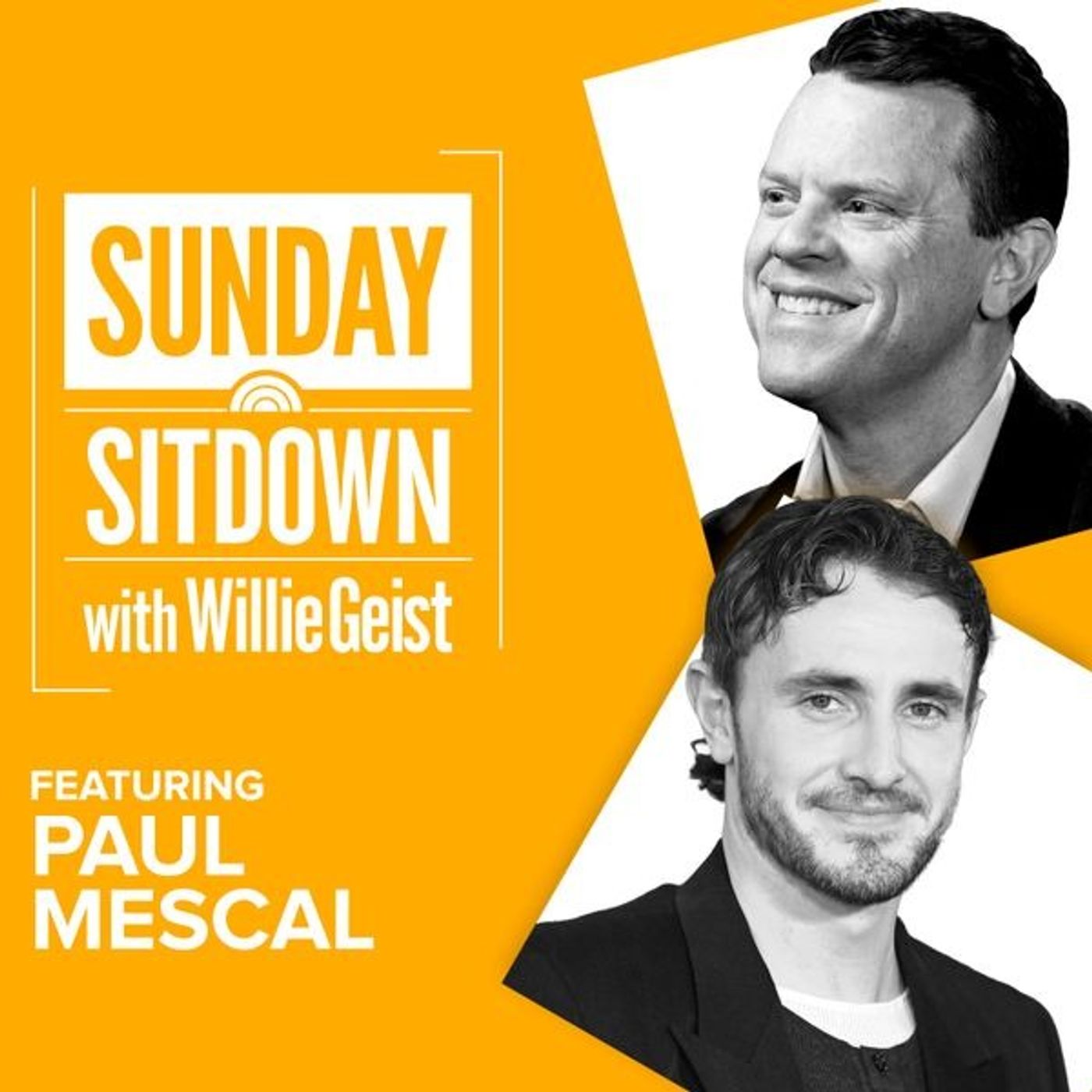
Sunday Sitdown with Willie Geist
OSCAR NOMINEES: Paul Mescal on ‘Hamnet,’ Shakespeare and Building Complex Characters (November 2025)
00:28:47
Paul Mescal has quickly become one of the most compelling actors of his generation and stars in Hamnet, which is nominated for Best Picture at this year's Oscars. In this conversation from November 2025, Mescal joins Willie Geist to discuss playing young William Shakespeare in "Hamnet," working alongside industry legends on "Gladiator II," and how he approaches crafting complex characters. Plus, the "Normal People" and "Aftersun" star reflects on his journey from school musicals to Hollywood.
Loading summary
Transcript119 lines
- [00:01]
Commercial Narrator
There's a difference between liking a house and actually getting it. Redfin is built to close that gap. Redfin agents close twice as many deals as other agents, so when you find a home you love, you're not a step behind when it's time to make an offer. That means less watching great homes disappear and more zeroing in on the one you'll actually end up calling home. Redfin helps turn saved listings into real addresses. Get started@redfin.com own the dream.
- [00:33]
Paul Mescal
Choose to show up
- [00:39]
Commercial Narrator
with the bold styling of the Mazda CX30.
- [00:43]
Interviewer
I wake up.
- [00:51]
Willie Geist
Hey, guys, Willie Geist here with another episode of the Sunday Sit down podcast. My thanks as always for clicking and listening along. Really happy to bring you my conversation this week with one of the brightest rising stars in Hollywood, Paul Mezkal. You may know him best as the star of Gladiator 2, where he went toe to toe and face to face with Denzel Washington in a massive blockbuster that grossed, I don't know, half a billion dollars or something like that. He's starring now in a movie called Hamnet, based on a novel, very popular novel. He plays William Shakespeare in this just extraordinary movie that provide backstory, the inspiration for his tragedy Hamlet. It's the story of his real life son. He had twin sons, the real life William Shakespeare, this is in around 1580 we're talking about. And he has twin children, a boy and a girl. The boy's name is Hamnet and He dies at 11 years old of the pestilence, as they called it back then, got sick and died. So it's this at first beautiful and then agonizing story of young William Shakespeare, who's just a Latin tutor and an aspiring playwright. Nobody knows who he is yet, who's now getting a little bit of acclaim and going to London and the Globe Theater to stage his plays, shuttling back and forth to the countryside where his family is. It's just so well acted. Across from an actress named Jessie Buckley, who plays his wife, Shakespeare's wife. And you can bet we'll be getting a lot of Oscar talk for this performance. Both of them will. So a great guy. So happy to sit down with him. You might remember, remember too if you're a fan. He kind of burst onto the scene in 2020 with the show Normal People, the series. It was on Hulu, a BBC thing that just became a big hit. Took off during the pandemic. Then he earned an Oscar nomination for his performance in the movie After Sun. Just a great Irish guy who started as a Gaelic Football star, which is kind of a combination of rugby and soccer, was an athlete. And you'll hear him talk about he in high school, just going out at 16 years old, auditioning for the school play and winning the part of the Phantom in Phantom of the Opera and kind of being off to the races from there. Went to college, graduated, started his career. He's done a lot on stage. He's won awards there and now developing a big film career, too. So sit back, relax, and enjoy my conversation with Paul Mezal right now on the Sunday Sit down podcast.
- [03:22]
Interviewer
Thanks for doing this, Paul.
- [03:22]
Paul Mescal
It's great to see you.
- [03:24]
Interviewer
I was just telling you I saw the film a couple of days ago and I'm still thinking about it. I was so moved by it. Your performance, Jesse's performance, Jacoby's performance, the young boy in Hamnet.
- [03:35]
Willie Geist
I'm just curious, first of all, how
- [03:37]
Interviewer
you approached this version of William Shakespeare, because as we were saying, you're not trying to capture his entire life and career. You're capturing a moment in time. So how did you look at this as an actor?
- [03:46]
Paul Mescal
Yeah, I think the first, like, typically, I would have been nervous about the concept of, like, a Shakespeare biopic and be asked to play Shakespeare. But I'd read the book before, and I was acutely aware that that wasn't the avenue that was of interest to Maggie the writer and Chloe the director. It was. You don't really hear. You don't hear his full name until the last 20 minutes of the film. So it did open up a real, like, sense of excitement for me because it was like, it made him accessible. I think I was like, oh, this isn't William Shakespeare in, like as a title. It's an artist. And I could relate to that. The concept of, like, feeling like you have to express something, but you're not aware of, like, your own myth.
- [04:34]
Interviewer
Yes.
- [04:34]
Paul Mescal
Like, Shakespeare doesn't know that he's. We're going to be sitting here talking about him 400 years later. He's just somebody who's a compulsion to write and tell stories. And I'm not a writer, but I feel connected to him in terms of wanting to communicate something about the world that we live in and the lives that we choose to live and everything that goes between that. So it just made. It took the kind of a sense of panic away from, like, where do you begin? If you're told, like, play one of the greatest geniuses to ever impact the world, be like, I give that to someone else, you know, So I felt very excited by the kind of setup of the book and the film.
- [05:12]
Interviewer
And that's part of the beauty of it. This is not the immortal William Shakespeare that we all know and have read in our schools for centuries. As you say, this is a struggling young artist, a Latin tutor teenager looking for love and a family and trying to find his way. So when you first heard that this book was going to be made into a film and that the director was very interested in you playing Shakespeare, did that thrill you, that excite you?
- [05:37]
Paul Mescal
Like, to be honest, I think I did my own fair share of manipulation with that. Like, I had heard that Chloe, she tells. She. She had basically passed on the film the day before I met her. So we were in Telluride together and Jesse was. I was there with after son and Jesse was there with women talking. And I met Chloe and I was kind of flirting with the idea of bringing up the Hamlet thing because I knew she'd been. But it's. I never really know how to broach those conversations. So I was like, hey, what are you up to? Anything, anything, anything coming down the line. And she started talking about Hamlet. And then I was, okay, great, we can talk about this. She had initially passed and then I think me and Jesse being in the same place over weekend up in the mountains in nature, which is very much like a big character in Hamlet. The film was kind of a beautiful coincidence that I think then she could see a map through what the film could look like. But when like for Chloe Zhao to be interested in the concept of working with you, I was like, this is nuts.
- [06:40]
Interviewer
Yeah. People don't know she's the Academy Award winning director.
- [06:45]
Paul Mescal
Incredible.
- [06:45]
Interviewer
And it's interesting to hear it wasn't quite serendipity. It was your plan to get.
- [06:50]
Paul Mescal
It was my. My. It was my grand. No. Because I loved the book so much and I really felt like. I felt like I could see a way of playing Shakespeare in a way that excited me and I think would. That would maybe step away from the tropes that we assume. We like, we have these assumptions about Shakespeare that I just think are completely nonsensical. Like we actually have no idea who he was other than the fact that he married Anne Hathaway, who's Anya's in the film. And he had three. He had his children. I mean he wrote these plays. But after that like this kind of bookish notion or this, I don't know, this academic kind of lore that has surrounded him. I really felt like the book tried to remove that. I was like, oh, this feels like an animalistic, like, impulsive man who's got an extraordinary talent, but actually he's not interested in his talent. He's interested in, like, the act of making, which I think is a really. I. I could just. You know, when you have that kind of feeling in your hands where you're like, oh, I know how to go about doing this. And oftentimes I don't have that feeling. And I have to work at the concept of what it would be like to make this character. But I always knew what the kind of rough sketch of him would look like for me, which is. Which was exciting.
- [08:11]
Interviewer
It struck me, watching the film, and maybe you too, that we know the work.
- [08:16]
Paul Mescal
Yeah.
- [08:16]
Interviewer
Just, like, handed down on stone tablets at this point. But we don't really think a lot about the inspiration for the work. What was he feeling? What was he living? As any writer would in that moment.
- [08:26]
Paul Mescal
Yeah. And I think that this film really. I felt incredibly emoted. There's a sequence at the end of the film where we go to the globe and it's the first run of Hamlet. Not the first, but the first kind of iteration of that play with. With his company. And I was struck by the fact that we take his brilliance for granted because it is brilliant. But what I don't think we focus on is the kind of generosity of spirit and bravery that it takes to take an incredibly painful period in someone's life and hand it over to an audience for public consumption. And that's kind of where my eyes separate from him. In my head, it's like, I have no interest in doing that. And that's an amazing act of generosity that he has given us for 400 years. He's shaped this love and grief and transfer, like. And not made it just about this pain of losing a son, but kind of making it this temple, this place that people can visit. His son and his love for his own. His wife's love for his son. And he's given it to us for forever. And I was struck when we were shooting those scenes that I was like, that's actually his brilliance to me. Like, obviously, his poetry is so beautiful, but there's a real emotional, humanistic literacy that I think he just. There's few and far. Like, there's few people who've given us that over course of history.
- [09:56]
Interviewer
For sure, the film is beautiful, but it's also devastating. You know, you don't have to be a parent to appreciate what that family is feeling. How did you get to that place? Not a father yourself yet. Oh, yeah. But how did you get into that, what a father would feel going through all that was happening in that home?
- [10:16]
Paul Mescal
I mean, I've played like after son, I played a father. And I don't necessarily sign up to the concept that you have to have lived the experience to relate. Yeah. Because I think, I don't know you're, you're a father. And I don't think I, I, when I speak to people who are like, invest in the work that they do, of course they're a father first, but they're human being before they're anything else. And I feel like I could access that. I also love the idea of being a father. I'm excited about hopefully that part of my life. So it's not something that I feel like, oh, afraid of. But I think to your point about the kind of devastation of the film, I do. It's obviously a part of the film that audiences are connecting with, but there is the part that I think is actually most important is the beginning of the film where you build this relationship between two people. And all of the loss that the audience and these characters feel can only be serviced if you really feel this love and commitment and loyalty that these two characters and these children, this family unit is like a nest. And I like, I think by really investing in that and the joy of that and the real kind of, it's really quite sweepingly romantic at the start and like gorgeous and lush. And I loved really investing in that because then you ultimately, if you stay true to that, all of the work is done for you because you have built these relationships both on and off screen so that like, the loss of a son or the loss of a relationship is only as painful in relation to what you've invested at the beginning. And I think that both those things are crucially important to the, to the, hopefully the catharsis the audience feels at the end.
- [12:14]
Willie Geist
Hey, guys, thanks for listening to the Sunday Sit down podcast. Stick around to hear more from Paul Mezkal right after the break.
- [12:23]
Commercial Narrator
There's a difference between liking a house and actually getting it. Redfin is built to close that gap. Redfin agents close twice as many deals as other agents. So when you find a home you love, you're not a step behind when it's time to make an offer. That means less watching great homes disappear and more zeroing in on the one you'll actually end up calling home. Redfin helps turn saved listings into real addresses. Get started@redfin.com own the dream Ryan Reynolds
- [12:53]
Paul Mescal
here from Mint Mobile. I don't know if you knew this, but anyone can get the same Premium Wireless for $15 a month plan that I've been enjoying. It's not just for celebrities. So do like I did and have one of your assistant's assistants switch you to Mint Mobile today. I'm told it's super easy to do@mintmobile.com
- [13:10]
Commercial Narrator
Switch upfront payment of $45 for 3 month plan equivalent to $15 per month required. Intro rate first 3 months only then full price plan options available, taxes and fees extra. See full terms@mintmobile.com shipping, billing, admin, payroll, marketing. You're managing all the things, so why waste time sending important documents the old fashioned way. Mail and ship when you want, how you want with stamps.com print postage on demand 247 and schedule pickups from your office home. Save up to 90% with automated rate shopping. That's why over 1 million small businesses trust stamps.com go to stamps.com and use code podcast to try stamps.com risk free for 60 days.
- [13:54]
Willie Geist
Welcome back. Now more of my conversation with Paul Mezkal.
- [13:58]
Interviewer
I don't want to give away too much so you can talk about it if you don't want to, but there's a scene when you come home from London.
- [14:05]
Paul Mescal
Yeah.
- [14:05]
Interviewer
Racing home.
- [14:06]
Paul Mescal
Yeah.
- [14:07]
Interviewer
And you see your daughter. Yeah. And you're so relieved.
- [14:10]
Paul Mescal
Yeah.
- [14:11]
Interviewer
Okay. And you're hugging her. Yeah. And there's this.
- [14:14]
Paul Mescal
Yeah.
- [14:15]
Interviewer
So I'm getting chills. Talking about there's this turn to see that you actually shouldn't be.
- [14:19]
Paul Mescal
I shouldn't be celebrating. Yeah.
- [14:21]
Interviewer
How did you act your way through that moment?
- [14:23]
Paul Mescal
That's one of those scenes that you're like this. I didn't try to overthink it because it actually ties to the point that I just said. It was just like I loved my family in that film. I love them as people. I love them as characters. So you're just trying to like, really, you're trying to not predict how that feeling is going to strike you when you walk into the room. There's a myriad of different takes that have the kind of polar opposite responses. That is like one of the scenes that I'm probably proudest that I've ever shot in terms of personally and as a company of actors. It just feels like I haven't, I haven't experienced what that is. But I feel like that response that like Jesse goes through and I go through and Olivia and Bode and Emily, it feels almost kind of documentary style. It's like this feels truthful to me about it also. It feels like a little bit like acting Olympics where you're, like, totally joyful that Olivia is there and you just see his body just go like. Oh. Like. It's just. Yeah. I'm very, very proud of that moment. It's like that. Yeah. 181 of. Rather than kind of going to the kind of maybe obvious Greek release of like, grief, it just actually totally silences him.
- [15:46]
Interviewer
Yeah.
- [15:47]
Paul Mescal
And he doesn't know what to say or how to act.
- [15:49]
Interviewer
Yes.
- [15:49]
Paul Mescal
And it's got. It was a. I was worried talking to Chloe. I was like, will the audience get that he's grieving? But actually she was so clever with how she directed that and how confident she was and not being the right choice. But then you, the audience are like, why isn't he releasing anything? But you see that in the final 20 minutes.
- [16:12]
Interviewer
It comes later.
- [16:13]
Paul Mescal
It comes later.
- [16:13]
Interviewer
Yeah.
- [16:14]
Paul Mescal
And I think that's like, not. I think the film is also, like, very much interested in maybe more stereotypical gender. It's quite gendered. I think the film in a more traditional sense. And I think that that concept of men or younger men struggling with the kind of initial release of grief or emotion, I think is true for. Not for everyone, but for. I definitely relate to that feeling of, like. It takes me a second to like, compute the enormity of. Of what the feeling might be versus, like, you see Jesse's like. It's so profoundly immediate and primal. And primal. Yeah. That I don't think the film or that moment would have worked if I come in and. And it's the same feeling for me. It. You know, and I think that's. That's a real testament to, like, Jesse's tournament. But also like, Chloe's like, the way she modulates all of that so that you get. If it takes time, you know, and
- [17:19]
Interviewer
you're right, as a man, your instinct
- [17:20]
Paul Mescal
maybe is to be strong, to be strong and protect. But actually in that moment, I was like, I don't. I don't believe this.
- [17:25]
Interviewer
Yeah.
- [17:26]
Paul Mescal
I don't. Right. I don't believe this. And Chloe kept talking about dramatic irony and of. In that moment, this kind of weird smile that comes over his face because he's like, of course it was never going to be my daughter because it would be too perfect. Yeah. This is too. It's unbelievable. I told him to be brave and he's. He's taken the idea of bravery and it's devastating. Yeah.
- [17:52]
Interviewer
Your co star, Jesse is extraordinary. Unbelievable. People are familiar with her. Probably they've seen her Some project. But it does feel like this is the film where the world is really gonna know her name. Can you talk about her talent as an actor?
- [18:06]
Paul Mescal
I. I think this performance is, like, not just one for this year. I think it's one for, like, truly for the ages. I think I knew it when we were filming it, but then having seen us and watched it and studied it, I really think it's just profound. It's brilliant. It is her. It's Anya's. It's like she's got just this appetite for people and a curiosity about people and love for people that it doesn't. She hides her brilliant craft in just this, like, wild humanity. And I think I'm so proud to have, like, sat across from her and watched her do it. And I also just have such a huge love for her that I'm so proud that. That. Do you always worry that the feeling of making something together won't translate into the finished product? But it superseded my hopes as a collector. But also, like, Jesse's performance is just on a totally different level to most of the performances I've ever seen. It's extraordinary. Yeah.
- [19:18]
Interviewer
And she says the same about you, by the way, when you read interviews.
- [19:20]
Paul Mescal
I pay her under the table.
- [19:22]
Interviewer
Oh, is that what it is? More manipulation?
- [19:23]
Paul Mescal
Yeah, more manipulation.
- [19:25]
Willie Geist
There's a theme here.
- [19:26]
Paul Mescal
Pocket full of dollars. Just like, say nice.
- [19:29]
Willie Geist
Stick around for more of my conversation with Paul Mezgol, right after a quick break.
- [19:36]
Commercial Voice
Your new home is now ready. Dr. Horton, America's builder has new homes that are ready today. With new construction communities throughout the Puget Sound and Central Washington areas And more coming, Dr. Horton has the right home for you at Dr. Horton. We're still building. With more construction, more communities, and more homes available every day. Tap your screen now or visit drhorton.com to find your new home now ready. Dr. Horton, America's builder. An equal housing opportunity builder. Amazon presents Laura vs Fruit Flies. Hide your bananas. These winged demons came to your kitchen to do two things. Eat fruit and. And they're all out of fruit. But thankfully, Laura shopped on Amazon and saved on cleaning spray, countertop wipes, and fly traps. Hey, fruit flies. Your baby boom ends here. Save the everyday with Amazon. Hey, guys. Finding the perfect gift for the food lover in your life is easy, thanks to Goldbelly. Goldbelly ships America's most iconic foods straight from world famous restaurants right to your door. So if you want to treat someone to Joe's Stone Crab from Miami, Franklin Barbecue from Texas, or desserts from famous foodies like Ina Garten or Martha Stewart. Goldbelly has you covered. Just go to goldbelly.com and for a limited time, get 20% off your first order with promo code gift. That's promo code gift.
- [21:05]
Willie Geist
Welcome back now to the rest of my conversation with Paul Mezkal. I want to ask you, Paul, about
- [21:12]
Interviewer
your start and how you got into performance because you grew up an athlete playing Gaelic football, which, for our American audience, a little bit of football, a little bit of rugby. Is that fair to say?
- [21:22]
Paul Mescal
Yeah.
- [21:22]
Interviewer
A bit of mishmasher somewhere in there. Yeah. Yeah. So it feels like sports were your first priority.
- [21:29]
Paul Mescal
Yeah.
- [21:29]
Interviewer
So at what point does performance and theater come into the picture?
- [21:33]
Commercial Voice
It was.
- [21:34]
Paul Mescal
We. We did a school musical. I was 16, and I was just totally bitten by the book. It's. I'm very grateful I've said this before, but I'm still, like, I can't say it enough that the school that I went to was public school. Like, wasn't like, a fancy school, but they had this policy where every student, whether you were sporty or no interest in musical theater, you had to audition. And I think that I would love for, like, schools and educational institutions to, like, really look at that model of just going, like, because we don't really focus on the arts enough in school. And I, I, it. I'm absolutely positive that that would have passed me by because I didn't fit that demographic. I was sporty, and I love. I still loved playing sports after, but had my school not afforded me that opportunity to be, hey, this isn't an embarrassing thing to do. You can go and do this. I was just. So. I grabbed it with both hands and just absolutely loved it. But it does kind of scare me that had I gone to a different school. Yeah. I wouldn't be the person that I am today.
- [22:51]
Interviewer
You play the part that you've almost been assigned, which is on the sports, and they're the theater kids.
- [22:56]
Paul Mescal
And we were talking about this just before we started turning over just this kind of concept of, like, you're so malleable as a young adult that you're like, oh, exactly. That you're kind of compartmentalized. And there's kind of, like these stereotypes that come up. Being sporty or being a theater kid or. And I was just. I was. I'm. I. I'm so impressed by the school. I'm also. I think we need to give children more credit for the fact that actually, if you give them the opportunity to express something that's outside of their small circle, they Will run with it with both hands. It's only embarrassing or frightening until you're told that it's not. But we shouldn't be placing that responsibility on 13 to 17 year olds with like. I think the infrastructure around them has to be just push a little bit to be like, this is also over here, if you want to have a look at it. If you don't want it, cool. Like some kids went in and sang Happy Birthday because they really didn't want to be in the musical. But everybody was given the opportunity to be like, hey, if you actually want to give this a go, maybe don't sing Happy Birthday. But you know what I mean? So it was very. That was my story.
- [24:02]
Interviewer
Was this the big Phantom performance?
- [24:04]
Paul Mescal
It's the big Phantom performance.
- [24:05]
Interviewer
We start right out of the gate with Phantom. And you are the Phantom, right?
- [24:08]
Paul Mescal
Yeah, yeah.
- [24:09]
Interviewer
I mean, wow. A star immediately in mayuth of nowhere else.
- [24:15]
Paul Mescal
Yeah, no, it was. I, I can. I like distinctly remember just the. I remember doing the first night of it so clearly and it's a big moment in the town that I grew up is like the school musicals, like they build up the, like the sports hall and it's like tiered seating and there's 600 people in there over five, like big and bring in like be the 20 piece orchestra. I remember like playing this like wooden organ was like my knees were just like bouncing. But I was beyond thrilled. And then the, the performance finished and we came out and bowed and it was the first time that like I'd kind of come up for air in the two and a half hours and I was like, oh, this feeling is extraordinary. That's like my. I was saying to somebody earlier, it's like my parents actually met on stage. So I have this weird thing that I feel like being there makes sense to me, you know, being on stage. Yeah.
- [25:22]
Interviewer
And you felt it first that night. That's amazing.
- [25:24]
Paul Mescal
It just felt like nothing. I think I'm still very much still chasing that that night when I was 16.
- [25:33]
Interviewer
We've done a good job with the pursuit of that feeling. I mean, you've done stage, of course, then you went on after college to notably normal people, which came out during the pandemic, which earned you acclaim not just in the uk but here. Everyone, we were home and watching. Oh, this is a great show.
- [25:52]
Paul Mescal
Oh, that's Paul.
- [25:54]
Interviewer
When that came out at a strange time for anything to come out and you sort of became this known person really for the first time. I think it's fair.
- [26:03]
Paul Mescal
Except for the school Musical and minutha.
- [26:05]
Interviewer
What was it? Right, right.
- [26:06]
Willie Geist
That was a big night.
- [26:07]
Interviewer
That was a big fight forever.
- [26:09]
Commercial Voice
Yeah.
- [26:09]
Interviewer
What did that feel like to you, to suddenly be, you know, you've done stage and some television?
- [26:14]
Paul Mescal
I think that was, like, pretty, like, intense period for the world generally. And I think it just felt a little bit magnified in a sense. I was like, I don't. It was. It's hard to compute. But weirdly, like, now post, like, Oscar nomination for after sun and big films like Gladiator coming out. I weirdly think the sharpest adjustment period happened when normal people came out. Yeah. And I'm so grateful to that show and the people that I met on, like, my best friends are from that time and from before. And I just feel like that was to have that sharp ascent and kind of be holding on for dear life, but to have friends who've shared that experience, it may. It makes the kind of ridiculousness of what my life seems from the outside make more sense. Yeah. It feels a little bit easier. And that's taken a second to get to, like, now I feel like there's not really, like, much more, like, weird.
- [27:19]
Interviewer
Yeah. This.
- [27:20]
Paul Mescal
That can. That can. That I feel like would be totally new now.
- [27:24]
Interviewer
Yes.
- [27:25]
Paul Mescal
Which I'm grateful for because it did destabilize me for a bit, I suppose. Yeah. I said, well, I'm kind of glad it did because I feel like if it didn't, I'd be a robot.
- [27:35]
Interviewer
Well, it's probably understandably intoxicating at first, the attention. Oh, I'm doing well. People know who I am. And then I guess at some point you realize, oh, I need to pull this back a little bit if I'm going to have a normal life.
- [27:46]
Paul Mescal
Yes. Right. Yeah. And I think. I can't remember telling this, but you can actually, like, regardless of how down you are in, like, public spheres, you can live the life that you want to live if you don't operate just purely from a sense of fear, you know, like, of course, it might be a little bit more difficult to walk down, like, Oxford Circus. Like, just don't go there.
- [28:12]
Interviewer
Right.
- [28:12]
Paul Mescal
You know, Like, I think I feel very grateful to, like, the scent. There's a real sense of community in London. I live in London now. And there's a real sense of, like. I don't know, it feels like. It's hard to describe. People look after you. They don't want to be invasive. Of course that happens. But, yeah, it feels more manageable. Life feels a little bit more manageable now.
- [28:36]
Interviewer
And the the leap got bigger with Gladiator 2, which you mentioned, this massive Ridley Scott film that does half a billion dollars at the box office. You're.
- [28:44]
Willie Geist
You're the guy, you're the gladiator.
- [28:46]
Interviewer
But also the opportunity to act with Denzel Washington. What did you learn from that experience? Just being nose to nose.
- [28:54]
Paul Mescal
Yes. And just to be like, with Denzel and Ridley, like two giants of the cinema. Like, they're kind of. They're there forever. They're like, they're on Mount Rushmore of like, of cinema. And I felt very. It felt. I feel very. I was like very close with Ridley and Denzel was just such a force to be opposite and to learn from. But what I was really grateful was that, like, they took away the stigma of, like, oh, you're working with Ridley and Denzel. It's like you're going to work with colleagues who care deeply about what we're making. And it just took away. I don't know, I thought going into something like that, it would be a different job. Like, something would feel different. But I feel very proud of how we approached that film. And like, to be stepping into a kind of world where people have such beloved relationship to the first film. I feel very, very proud of, like, how we went about doing it, you know. And I have an immense love for Ridley Scott. He's very special to me.
- [30:06]
Interviewer
Before I let you go, Paul, I've got to ask what you're working about, what you're working on right now, which is playing Paul McCartney. So from Shakespeare to McCartney, you're going big here. How has it been to step into McCartney's shoes?
- [30:20]
Paul Mescal
It's a real, real privilege. And like, as we know, Shakespeare is not alive to have the impact on Hamnet, but I've got to know him and his family a little bit. And they've been so generous with the idea of us kind of really getting into the fore of their lives. And I feel very proud that I feel like there's a transparency with the scripts and what we're. The stories that we're telling. It's not polished off. It's, it's, it's a. It's a really honest and exciting endeavor that we're stepping into. And it's one that's like keeping our brains and fingers very active.
- [31:05]
Interviewer
Well, I saw the way you just held the guitar there.
- [31:07]
Paul Mescal
Yeah.
- [31:08]
Interviewer
One of the things that comes to playing Paul McCartney is playing left handed.
- [31:10]
Paul Mescal
Yes.
- [31:11]
Interviewer
You're not a lefty, I take it, so you're learning how to play left handed.
- [31:14]
Paul Mescal
Yeah.
- [31:15]
Interviewer
Wow.
- [31:15]
Paul Mescal
Yeah. How's that going? Oh, there was a couple of dark months at the start of the year where I thought it was never going to happen, but it's, it's happening. It's, I'm really proud of the work that's like just tech, like film aside, like, it's definitely been the greatest technical challenge of, of my career. And I'm really proud with where we've, where we've gotten to with it.
- [31:38]
Interviewer
Well, we can't wait to see it. And in the meantime, people are going to love Hamnet. You are brilliant in it. Jesse's brilliant. Jackabee, who we didn't get a chance to talk to is brilliant, the young boy. So congratulations.
- [31:47]
Paul Mescal
Thanks very much.
- [31:48]
Interviewer
Pleasure to talk to you, Paul.
- [31:54]
Willie Geist
My big thanks again to Paul for a great conversation. Hamnet is just an amazing film and it is in theaters now. And as always, my thanks to all of you for listening again this week. If you want to hear more of our conversations with our our guests every week, be sure to click follow so you never miss an episode. And don't forget to tune in to Sunday Today every weekend over on NBC to see these interviews with your own two eyes. I'm Willie Geist. We'll see you right back here next week on the Sunday Sit down podcast.
- [32:31]
Commercial Narrator
This year, perfect your morning routine with Nespresso Vertuo up with a three second start, easy open lever and dedicated coffee creations mode button. It's easier than ever to brew coffee with smooth flavor and rich crema over ice or milk. It's your coffee your way at the click of a button. Sip for yourself and shop vertuo up@nespresso.com.