← Surrounded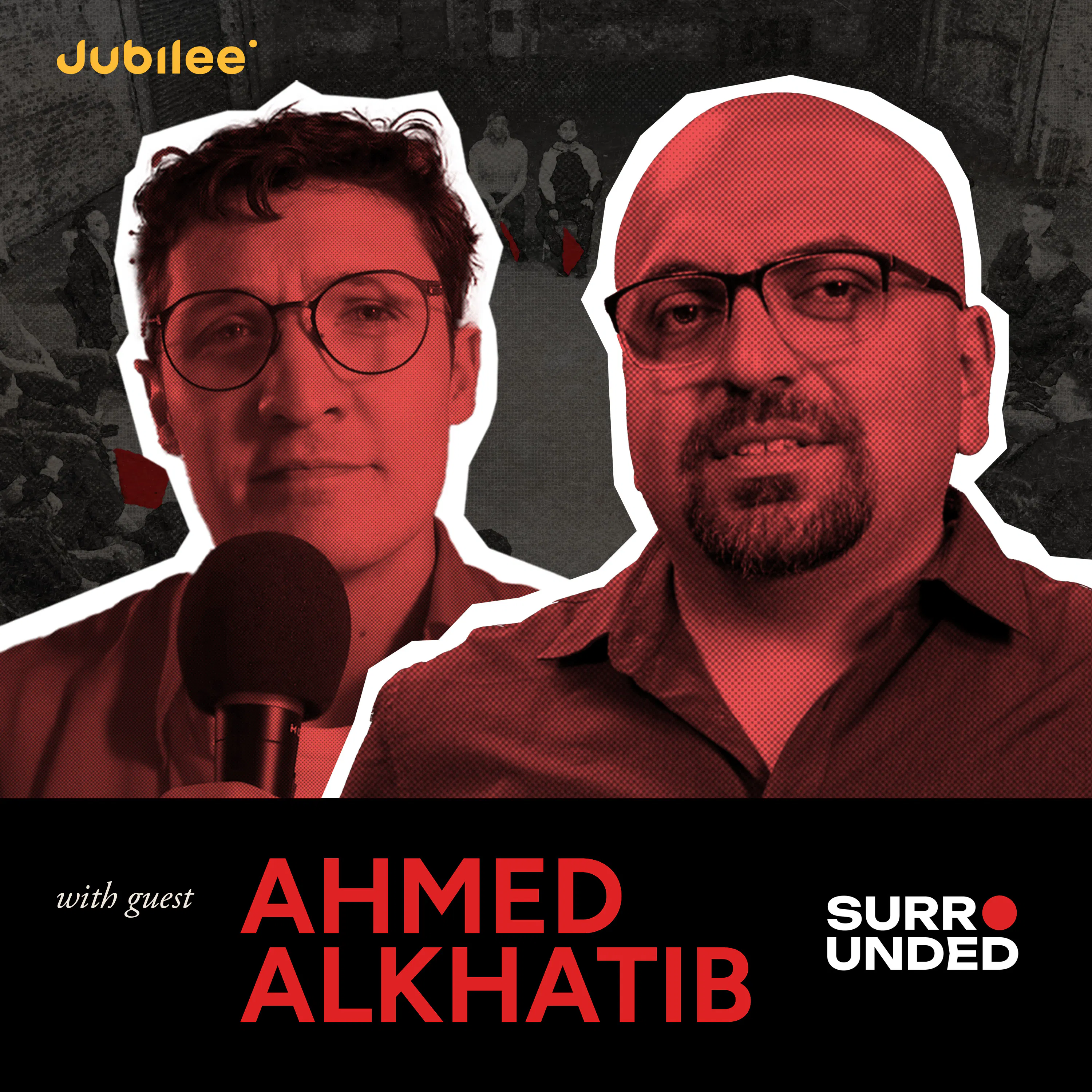
Surrounded
A Palestinian Who Doesn’t Agree With Protestors | Ahmed Alkhatib Surrounded Follow-Up
00:41:12
Loading summary
Transcript106 lines
- [00:03]
Ahmed Fouad Al Khatib
At New Balance, we believe if you run, you're a runner, however you choose to do it. Because when you're not worried about doing things the right way, you're free to discover your way. And that's what running's all about. Run your way@newbalance.com Running hey there travelers. Kaley Cuoco here.
- [00:34]
John Ricolato
Sorry to interrupt your music great artist BT Dubs, but wouldn't you rather be there to hear it live? With Priceline, you can get out of your dreams and into your dream concert. They've got millions of travel deals to.
- [00:44]
Ahmed Fouad Al Khatib
Get you to that festival gig, rave.
- [00:46]
John Ricolato
Sound bath or sonic experience you've been dreaming of.
- [00:49]
Ahmed Fouad Al Khatib
Download the Priceline app today and you.
- [00:51]
John Ricolato
Can save up to 60% off hotels and up to 50% off flights.
- [00:55]
Ahmed Fouad Al Khatib
So don't just dream about that trip. Book it with Priceline. Go to your happy price, Priceline. Who are we asking to bring in food into the Gaza Strip? Who are we asking to open up the gates for medical supplies? And guess what? It's not going to be the JVPS and the leftists and the J streets of the world who are going to influence the policy of the current Israeli government. It's going to be the mainstream of the Jewish community.
- [01:30]
John Ricolato
From Jubilee Media, this is the Surrounded Podcast. I'm John Ricolato and in today's follow up episode I will be interviewing Ahmed Al Khatib. He was at the center of last week's episode and he debated 20 pro Palestine protesters. Ahmed himself is a Palestinian American and he is head of Reline for Palestine, but his tactics and approach towards advocating for the Palestinians is very different than the majority of the protests throughout the United States and across the globe. We'll be revisiting some of the most heated moments from last week's debates and digging into some of the most polarizing aspects of this issue as well as the protests. As I am recording this, the world is watching in horror as the humanitarian crisis in Gaza continues to escalate. Could you just introduce yourself who you are and the work that you do?
- [02:31]
Ahmed Fouad Al Khatib
Certainly. So my name is Ahmed Fouad Al Khatib. I am a Palestinian American from Gaza, where I grew up and now, which I left many years ago. I'm also the head of Realign for Palestine, which is a project at the Atlantic Council and I am seeking to promote a different, healthier and pragmatic pro Palestine discourse away from the entrenched narrative of Hamas and armed resistance and more toward peace and coexistence as courageous evolutions that are needed.
- [03:09]
John Ricolato
I Do think it's important for our listener to know your connection to Gaza? How long did you live there and when did you move to America?
- [03:16]
Ahmed Fouad Al Khatib
I'm 35. I was 15 when I left. I was an exchange student at the age of 15. I came as a junior in high school, tried to go back, but I couldn't return. In 2006, I was 16 because Hamas abducted an Israeli soldier on the Israeli side of the border and that started a mini war, the blockade, and then Hamas took over in 2007. Our family was living in Saudi on and off in the early 90s. We moved back to Gaza in the mid-90s and then moved back a little bit and then finally settled back completely into Gaza before the second intifada. We got to experience the tail end of the Oslo peace process. I went from having an Egyptian travel document to a Palestinian passport. Gaza had a short lived airport and I flew into it in 1999 and in 2000 on the Palestinian airlines. I experienced the optimism associated with the peace process and the horror associated with the intifada and yes, Israeli violence. I also experienced a hearing loss in my left ear from an Israeli bombing that almost killed me and killed several of my friends. So, like, I'm in no way excusing Israeli violence or defending it. I am a believer that A there is space for Palestinian agency and responsibility to optimize for decision making that preserves what remains of the Palestinian people, that avoids, you know, unnecessary loss of life, and B, that when we are the weaker party, that don't have a military, that doesn't have an economy and allies and this and that and billions of dollars in aid, we need to be good custodians of our people and the leadership and the political movements such that we don't play roulette basically with our people's fate and get ourselves killed.
- [05:10]
John Ricolato
When I first heard the concept for this video, a Palestinian American debating pro Palestinian protesters, on its surface, I was like, this doesn't even sound like there would be a debate. It sounds like everyone involved would want the same things. But going into it, you seem to kind of anticipate that there would be conflict. I'm just curious, what was your frame of mind going into this debate and did it align with your expectations?
- [05:39]
Ahmed Fouad Al Khatib
Since October 7th, there's been this unhelpful form of pro Palestine activism that has failed, failed to capitalize on a global interest in the Palestinian issue. I am very much so pro and supportive of people's right to protest and I want there to be a pro Palestine movement. I want there to be activism that highlights the suffering and the hardships that the Palestinian people are experiencing. But to what end is where the disagreement comes in, as well as what methods and what rhetoric and what language are used? Going into this, I expected to be in conversation with folks who are very on the spectrum. Some are pro the armed resistance narratives, some are outright pro Hamas, some are pro the extremists protest movement that have been. That have really hijacked the narrative. Some of them have, you know, mixed Gaza and the west bank together in a way that was incredibly unhelpful. Some of them very much so want to live in the past and don't want to be future and forward looking.
- [06:58]
John Ricolato
Yeah, in a more colloquial sense. How did you feel that the shoot went?
- [07:04]
Ahmed Fouad Al Khatib
I was a little bit overwhelmed, let's just say, by the setup, to be honest. I've given hundreds and hundreds and hundreds of interviews, discussions, been on panels. This was a very unusual setup and I welcome new environments. What was a little bit intense is that I generally try to shy away from short, sound bitey hype engagements because I believe in nuance that requires, you know, laying out information and kind of a slightly more longer format. And this was a healthy challenge, I think, for me to try and really sharpen my information and my arguments. I was sometimes talking to someone for a minute. Sometimes I was just listening to them making their pitch. I noticed that a couple of minutes and then they were voted out before I even had a chance to respond. Sometimes I was talking to someone for five minutes. Sometimes I was talking to people who were cordial. Sometimes I was talking to people who were interrupting.
- [08:09]
John Ricolato
I think anyone who's watched the show would agree that being in the center is like. It's a challenge, to say the least. You have to really be in the zone and willing to go there with a lot of strangers for a long duration. So, I mean, first off, thank you for doing it. I really found the discussions and debates to be very, very interesting. And I thought positioning a Palestinian American against pro Palestinian protesters, it was an unexpected framing and I heard angles of the arguments that maybe I hadn't heard before. So I'd love to just start sharing some clips and then we can kind of hear your reaction and kind of go into those arguments very briefly.
- [08:54]
Ahmed Fouad Al Khatib
I wanted to just share that. One of the things looking back at this, that I wish I had more of a chance. Like my only, and this is my only regret of myself is that there are a lot of points and arguments and thoughts and ideas That I wanted to share that just due to the kind of fast moving pace, I felt that I didn't really get a chance to share, but I. And I couldn't tell how I was coming across. I'm hoping that at least people who listen to these clips, other than myself and you will at least learn new information that they weren't expecting.
- [09:35]
John Ricolato
Totally, totally. And that's my intention here is I want you to elaborate maybe where you couldn't. But I also kind of want to get into maybe the feelings you have and make this as a little bit of a reflection on the emotions that were coming up in these interactions. Certainly the first claim that I SAW, which was October 7, was a disaster that unleashed the worst catastrophe in Palestinian history. And so this is you debating Carlos. His name's Carlos. And this was in the context of you defending that claim. If Zionists wouldn't have colonized Palestine, then none of this would have began to begin with. Right.
- [10:19]
Ahmed Fouad Al Khatib
As a Palestinian who grew up in the Gaza Strip, what I can tell you is that who put you there, the Gaza Strip, who put you there, had immense potential to be the pride and joy of the Palestinian people. To prove that we are absolutely capable of having a functional state of our own that can rebuild our society, rebuild our heritage, reclaim our presence on the land, the entirety of the land.
- [10:48]
John Ricolato
Or just because I believe your parents.
- [10:52]
Ahmed Fouad Al Khatib
In a refugee camp. Right.
- [10:53]
John Ricolato
They were forced into that.
- [10:55]
Ahmed Fouad Al Khatib
There are nuances and complexities in history. Nuances and complexities, but that's a very objective name. Who put them there. That unfortunately Zionist. Right. You unfortunately, are not willing to listen to some of the new. The nuances and the complexities.
- [11:11]
John Ricolato
What's your reaction when you hear that encounter with Carlos?
- [11:16]
Ahmed Fouad Al Khatib
I mean, unfortunately, there's a demagoguery involved in a lot of the pro Palestine activism by those who feel that they can sit there and lecture a Palestinian trying to make a point about the Gaza Strip where my mom and my brother and my nieces and nephews and my household lived. This individual who happened to be of Mexican heritage, was trying to go out of their way to lecture me about Zionism and the origins in 1948 and how, you know, without even remotely trying to address parts of the claim, yes, two thirds of Gazans are refugees or descendants of refugees. We can discuss that. But there was no space or willingness. And you saw the constant interruptions, you saw the smugness about the demeanor. And I just. It was very unfortunate that right out the door, this was the attempt, I was attempting to say, can we just agree that Gaza in October, Gaza right now, where it is, is in a far, far worse place than where it was on October 6th. And that we need to discuss the role of Hamas in decimating aspirations for Gaza. And that relitigating the past endlessly, like this gentleman was trying to do, is going to get us nowhere and it's not going to achieve anything. To understand what's going on right now.
- [12:56]
John Ricolato
When I watch that clip, I anticipate a little bit of a Rorschach test among viewers. I think some people would definitely agree with how you just described it here. There was some interruptions and I think a tug of war over the framing. What Carlos was trying to point out was that, you know, if we rewind time, we can always find an element of this conflict which is Palestinians having land taken from them, you know, their historical lands taken from them by Israelis, by Zionists. You know, Zionist is a very charged term in the last few years and.
- [13:32]
Ahmed Fouad Al Khatib
So kind of a slur.
- [13:34]
John Ricolato
Basically, some people might listen to that and hear you kind of dodging, saying, Israelis or Zionists, what's your reluctance to say Zionist? Or what's your reluctance to acknowledge that land being taken from the Palestinians that he was pushing you to do?
- [13:51]
Ahmed Fouad Al Khatib
Because 100% Zionists and Israelis took land from Palestinians. My own grandparents and parents were like, displaced. But a. I didn't want to respond to what essentially was bullying and a form of verbal purity. So it's like, okay, just say it. It was the Zionists and the Israelis. And it's like, okay, then what? I wanted to keep the focus on Gaza. I wanted to keep the focus on October 7th. I wanted it to keep the focus on the now. Gaza is not destroyed right now because of Zionism in 1948. Gaza is destroyed right now because Hamas made a choice. A choice. And this is where a lot of the audience there. Not the audience, forgive me, the circle.
- [14:44]
John Ricolato
I sometimes say the audience, the circle.
- [14:47]
Ahmed Fouad Al Khatib
They don't believe in such a thing as Palestinian agency or responsibility. They feel that Palestinians are perpetual victims no matter what. And what they were saying is actually something that a ton of people in Gaza, a lot of people in Gaza that I am in contact with, the anti Hamas protesters, the people on telegram and social media who are holding Hamas accountable for serving them on a silver platter to the most far right and extremist government in Israel's history. The other thing, too, I'm used to very cordial exchanges. I am just as capable of being very aggressive and debates and conversations. I went in there trying to set early on the tone that, like, we're going to be respectful in this exchange. Yeah.
- [15:37]
John Ricolato
You went for a handshake at the beginning of that, and I'm not sure if Carlos didn't see it or if he was in the shuffle. He didn't want to, but there was no reciprocation.
- [15:46]
Ahmed Fouad Al Khatib
No, no, exactly. So, like, that's fine. That's his problem, not mine. But my point is, in the second half of, of the, of the episode, I decided to be a bit more aggressive. But there is a performative element to how some of them were talking to me that I just figured being cordial and letting them talk was just going to eat away at my opportunity to respectfully make a point. As for the second point, I kept saying, well, let's look at the numbers, guys. 52,000 dead, over 2 million people displaced. I mean, that by orders of magnitude tops the suffering that took place during Nakba in 1948. That's what I wanted to share.
- [16:41]
John Ricolato
Yeah, well, I mean, that was the theme of the episode, and it'll come up multiple times as we look at other clips is like you said, 53,000 Palestinians killed since October 7th. The tug of war that kept coming up was the onus is on Hamas, which was your kind of key argument is let's focus on Hamas and the accountability that needs to be, you know, acknowledged there. And then what a lot of the people in the circle were saying was, but who's been doing that killing? You know, that is the idf, that's Israel. And so shouldn't the onus be placed there? This episode is brought to you by LifeLock. Between two factor authentication, strong passwords, and a VPN, you try to be in control of how your info is protected. But many other places also have it and they might not be as careful. That's why LifeLock monitors hundreds of millions.
- [17:37]
Ahmed Fouad Al Khatib
Of data points, points a second for threats.
- [17:39]
John Ricolato
If your identity is stolen, they'll fix it, guaranteed or your money back. Save up to 40% your first year. Visit lifelock.com podcast for 40% off terms apply. This message comes from Greenlight. Ready to start talking to your kids about financial literacy? Meet Greenlight, the debit card and money app that teaches kids and teens how to earn, save, spend wisely and invest with your guardrails in place. With Greenlight, you can send money to kids quickly, set up chores automate allowance.
- [18:07]
Ahmed Fouad Al Khatib
And keep an eye on your kids.
- [18:09]
John Ricolato
Spending with real time notifications. Join millions of parents and kids building healthy financial habits together on Greenlight. Get started risk free@greenlight.com Spotify I want to kind of shift focus. There's something unique about this conflict since October 7th, which is images of death, destruction and horror has been in the palm of people's hands. And that has been a big factor in activating support, anger, protests. This clip is going to be with you and Danya, and you kind of discuss this media element to the conflict.
- [18:45]
Ahmed Fouad Al Khatib
You're saying that you want to see images of dead Palestinians, you want to see.
- [18:51]
John Ricolato
No one wants to see those images. But if that's what it takes to get people to recognize what's actually going.
- [18:57]
Ahmed Fouad Al Khatib
On instead of another Middle Eastern war.
- [19:01]
John Ricolato
Then that's what it takes. It's tragic that that's what it took.
- [19:04]
Ahmed Fouad Al Khatib
Do you recognize that Hamas, in official communiques, has and publicly and overtly has made it clear that part of their strategy relies on causing maximum death and destruction in Gaza, so that the ensuing.
- [19:20]
John Ricolato
Response in response to Netanyahu blatantly saying that his goal is ethnic cleansing.
- [19:27]
Ahmed Fouad Al Khatib
May I just finish?
- [19:29]
John Ricolato
Yeah. What's your reaction to that?
- [19:30]
Ahmed Fouad Al Khatib
Yeah, I was absolutely horrified by that statement. I mean, it was truly one of the most grotesque statements that I heard.
- [19:39]
John Ricolato
Why was that, though? My reading was just that she was sort of claiming that while it's awful, the media that people have seen is rallying support for the Palestinian cause, how.
- [19:52]
Ahmed Fouad Al Khatib
I interpreted it is that basically images of dead Palestinians is great for rallying support, which is basically what Hamas says, which is basically what the jihadis in Gaza very explicitly and clearly, from Sinwar to Haniyeh always have said, which is that dead Palestinians rile people up and they cause mass protests, and that's what's going to help us end the war. These are necessary sacrifices. That is literally how Sinwar said it. She said that I felt the quiet part out loud, which is that this is a spectator sport for a lot of people, whereby, you know, this is. I'm not questioning the sincerity of everybody who's horrified by these images. I am horrified. There's a reason why I'm doing what I'm doing. I had a quiet life in California that I walked away from. This is my family members, okay? And my brother and I, we made a decision not to publish. I have the photos. We made a decision not to publish images of my aunts and uncles and my niece and their decapitated heads, their body parts that my brother put together as jigsaws, for goodness sake. We made a decision that we wanted the world to remember them as beautiful, whole human beings. That was Our family's decision, and that's what we went with. But there is a popular belief out there that is not very much, very, very, very verbalized, often that dead Palestinians are good for the cause from an imagery point of view. And I don't want your activism to be fueled by our fallen ones.
- [21:31]
John Ricolato
What I would say is there's a feeling in younger generations especially that this horror, all of a sudden social media gave them a window into horror that existed in the world that they would not have otherwise had. And all of a sudden that motivated them. The horror and the rejection that that kind of suffering was necessary and that that many dead children and dead Palestinians was justified. They rejected that and they were like, we see it with our own eyes and we want change. But what I hear kind of coming from you is that's what Hamas wants. You're being manipulated by, by invisible actors that are maximizing the amount of Palestinians killed. And you're solidifying this idea that only through death, images of the dead can you get support. Is that kind of what you're arguing?
- [22:22]
Ahmed Fouad Al Khatib
To a certain extent? Absolutely. For me, it's like that hits, that's my family, that's my blood, that's my community. And I don't want a bunch of LA based Western activists to think that, you know, this is going to be the fuel for our activism.
- [22:38]
John Ricolato
You had an exchange with Dr. Ahmed. This was sort of about what you're saying right now. You know, this media has sparked a mass protest movement across college campuses in the us and what you were asking him is, what has this accomplished? And you guys had a difference of opinion there.
- [22:56]
Ahmed Fouad Al Khatib
At the end of the day, what have the encampments achieved beyond, oh my goodness, the fact that we have 20.
- [23:02]
John Ricolato
People here from different factions of lives, that's an achievement.
- [23:05]
Ahmed Fouad Al Khatib
Talk about results.
- [23:07]
John Ricolato
The fact that there's so much money.
- [23:09]
Ahmed Fouad Al Khatib
Are poured into trying to refute this.
- [23:12]
John Ricolato
Movement and this wave of young, brave people and students to defend the Palestinians, it's freaking them out.
- [23:18]
Ahmed Fouad Al Khatib
They're panicking the Knesset, they're panicking the Israeli government because of what's happening, because.
- [23:23]
John Ricolato
Of these young people. So I take my hat off to each one of them and I tell them, thank you for standing up for my rights and my people's rights.
- [23:29]
Ahmed Fouad Al Khatib
The divisive rhetoric that has emerged from a lot of the pro Palestine activism has pushed away vital allies on the Israeli and the Jewish side of the world. I'd rather gain the billions of people.
- [23:44]
John Ricolato
Around the world and give up those few thousands, a few hundreds of Israelis.
- [23:48]
Ahmed Fouad Al Khatib
Salam Al Shav and peace now and all that.
- [23:51]
John Ricolato
What are your thoughts hearing that at a personal level?
- [23:54]
Ahmed Fouad Al Khatib
Actually afterwards, Like, I actually respected Dr. Ahmed because several people wouldn't like shake my hands. And he said, listen guys, in Palestinian culture, when somebody's extending their hand to you, it's kind of rude. He was attempting to keep this a civil discourse at a personal level. I very much so appreciated him. He also made an excellent point later in the discussion that I have long heard and agreed with, which is that I can't have a situation where an illegal settler comes and surrounds my home, has a swimming pool right next to me, and then I have to get like a drop of water once a day. That's just, I can't make peace with that. There's no peace and coexistence with that. To which I said, preach brother. Like this is what I mean by I'm against the military occupation and the settlement enterprise that has robbed the Palestinians. That's I think, where our agreement and alignment, I think somewhat ended because I was at the UCLA encampment and they were cleared. And right now the pro Palestine discourse is so toxic. What has any of that achieved? What are any of them going to do on a policy level? How many mouse are they going to feed in Gaza? How many people are they going to get out? How many medical supplies are kits and hygiene kits? And like what are they going to do for Gaza's rebuilding and the future of the Palestinian people? Nothing, zero, nada, zilch. My point precisely is that he kept saying the 200, you know, like I think that was a very patronizing statement. The majority of Israelis, the center and the center right and the center left and elements of the right elements, not the entirety of the right, are critical allies, vital allies. Those are otherwise unreachable audiences that I have been trying to engage and plant seeds with to just to humanize the Palestinian people, to normalize the Palestinian people as people who deserve to have a state, who are capable of effective self governance. Because all these people Here are the Dr. Ahmeds of the world who are saying we want to protest and we want to get billions of people against the state of Israel. And you do this and do that to what end is what I asked. So this is where radical pragmatism is about what can you actually achieve? What is your end goal? And I've talked to policymakers in Washington who are like, I want to engage with Palestinians, I want to talk with people who are pro Palestine. But a, I don't want to be Yelled at B, I don't want every other word to be Zionist or genocide. 3D, C or 3 is give me something that's a little bit more achievable. Right now. The United States electorally is not at a place where they're going to cut off funding from Israel. So don't have that be the sole policy position that you have. And then finally D is at least pretend that you're against Hamas's terrorism. Don't go into, you know, Congress or the State Department or the White House or the campaign and say, well, this is what happens when you squeeze people into the war. So ghetto or an Auschwitz.
- [27:12]
John Ricolato
Is that the critical mistake that you think these protest movements have done is. Is not to immediately disavow the violence on October 7th.
- [27:22]
Ahmed Fouad Al Khatib
100% like what seems to be like low hanging fruit to bolster our movement, to bolster the pro Palestine narrative. Not just from just like a fake it till you make it thing, but from a more morality and a policy point of view and an efficacy point of view. It's not being done because people genuinely support Hamas. And you want to delegitimize Hamas, but that makes no sense to me. We use the term terrorist terrorists now.
- [27:52]
John Ricolato
Makes it so Hamas can't even plead.
- [27:54]
Ahmed Fouad Al Khatib
For help because if you're labeled a.
- [27:56]
John Ricolato
Terrorist, you can't go to the un.
- [27:57]
Ahmed Fouad Al Khatib
You can't go to this and that. And let me tell you one thing. This one thing I'll say is one person's terrorist is another person's freedom fighter.
- [28:03]
John Ricolato
All right? One of your claims was angry protests are not helpful to the Palestinian people or Gaza. And in that you had this exchange with Aydin, which kind of lands in some of the dynamics that you've just been describing? Where do we go when the protests don't do anything and when our government doesn't listen to us?
- [28:24]
Ahmed Fouad Al Khatib
We build broader coalitions. We talk to the other side of this issue. They're right across from us. We go to Hillel, we go to Chabad, we talk to the very.
- [28:34]
John Ricolato
I'm sorry, Hillel supports the genocide in Gaza.
- [28:37]
Ahmed Fouad Al Khatib
We talk.
- [28:37]
John Ricolato
We cannot make a coalition with people.
- [28:39]
Ahmed Fouad Al Khatib
Who support a genocide. We talk to them and we find the slightest of common ground where this is not a relationship that is characterized by constant fighting, but this can achieve us the win.
- [28:54]
John Ricolato
I'm sorry, I'm sorry. I agree that we should find common.
- [28:57]
Ahmed Fouad Al Khatib
Ground with people who share our values.
- [28:58]
John Ricolato
I do not agree that we should find common ground with people who swear to genocide.
- [29:02]
Ahmed Fouad Al Khatib
That's unacceptable.
- [29:02]
John Ricolato
Peace.
- [29:03]
Ahmed Fouad Al Khatib
That is Enemies, not with your friends.
- [29:05]
John Ricolato
No, we do not make peace with people who are murdering children. You make peace with your enemies, not your friends. Why is that so important to you?
- [29:17]
Ahmed Fouad Al Khatib
Because how else are we going to get past this current moment? How else? I mean, we're not going to, like, I don't. The people of Gaza aren't going to wait for Mr. Ayden in Los Angeles to, you know, figure out the moral purity tests of who supports genocide, who supports killing this, who supports that. Like, some of this is values based, but some of this is transactional based. Some of this is outcome based, Some of this is mutual benefit that serves the interests of both people. And by the way, the Israelis on the other side, some of the pro Israel side people will tell you we should do not make peace with people who took women and children and the elderly as hostages and call that an act of resistance. We do not make peace with people who killed Vivian Silver and peaceniks in Kibbutz Sperry and all the kibbutzim around Gaza, a lot of whom were actual peace activists. It's very easy to flip this argument around if you want to play that endless game of here's the purity test. Here's we're not going to make peace with. Then you know, then, you know, it's like, look at, look at the United States and the Biden and the Trump administration dealt with the Taliban, they dealt with the Houthis, they dealt with unsavory characters. Who are we asking to bring in food into the Gaza Strip? Who are we asking to open up the gates for medical supplies? And guess what? It's not going to be the JVP's and the leftists and the J streets of the world who are going to influence the policy of the current Israeli government. It's going to be the mainstream of the Jewish community.
- [31:05]
John Ricolato
Do I have time to show you one more clip?
- [31:08]
Ahmed Fouad Al Khatib
Yes, one more clip.
- [31:10]
John Ricolato
This is with William. I thought it was important to get this in. William was another Gazan and you brought, you chose him to come back and he presented a claim to you. And his claim was the root cause of the issue is the occupation of historic Palestine and the denial of self determination. And this was how you responded to what he thought was the solution. Here's what needs to happen. There needs to be accountability from this Israeli government and regime. And these terrorist settlers, they need to get the hell out of my land, go back to Brooklyn or Poland, wherever the hell they come from. They need to stop killing these people every day. They're Walking around with ars, you know what I'm saying? So like the guy.
- [31:53]
Ahmed Fouad Al Khatib
But isn't that a form of hatred to say go back to Poland when you know that there are generations of Israelis, excuse me, excuse me, some current Israelis right now, They've literally lived there for generations. Like you have two generations of Israelis who know nothing about the Poland, nothing about Germany, nothing about Brooklyn. For no fault of their own, their parents may have made a decision, their parents may have been displaced and this is where they are. So to say that go back to Poland as a solution is not only ineffective and is not only lacking in pragmatism, but they would argue is a form of hate towards them.
- [32:32]
John Ricolato
So is it okay for them to come and expand the settlements and displace Palestinians from their native land?
- [32:37]
Ahmed Fouad Al Khatib
Of course not. Of course not.
- [32:40]
John Ricolato
Is that worse than going back to Brooklyn or Poland or Ukraine?
- [32:44]
Ahmed Fouad Al Khatib
But what I'm saying, why don't we choose careful slogans? Why don't we choose language that better positions us so that we can have the higher moral ground?
- [32:56]
John Ricolato
You and William had, I thought, a really good faith exchange. And it was interesting because it was kind of the tale of two men from Gaza and how you're viewing the conflict.
- [33:08]
Ahmed Fouad Al Khatib
This issue matters to Palestinians in a way that there's a give and take. Like in Gaza, for example, you can used to have, you know, one household with members in Fatah and in Hamas you used to have people who were, you know, like William. And afterwards he said to me that you're right, I shouldn't have said the piece about go back to Poland. But I do think there are many Palestinians from Gaza and elsewhere who are looking for a different discourse, who are looking for something else other than what is currently unfolding on college campuses in the streets. What is currently said about, I mean, they're equally horrified by what's happening on the ground in Gaza, but they don't feel represented by the discourse. They don't feel that a lot of the non Palestinians who are the majority of the pro Palestine movement, there's pro Palestine and then there's pro Palestine in quotes. But they don't feel that a lot of the pro Palestine community really understands some of the cultural complexities and issues that we face. And so what I appreciated about William is that I felt immense space and capacity for change, for flexibility.
- [34:33]
John Ricolato
Right now there's over a two month.
- [34:35]
Ahmed Fouad Al Khatib
Blockade of no food, no humanitarian aid.
- [34:37]
John Ricolato
No water coming into Gaza by Israel. And the world is watching this. This is insane. The ICC has issued arrest warrants for netanyahu and Gallant because of war crimes against the people of Gaza.
- [34:50]
Ahmed Fouad Al Khatib
So do you believe that Hamas bears any responsibility in our people's suffering?
- [34:56]
John Ricolato
This is a byproduct of Israeli occupation, so this is impacting all aspects of life. You expect people to like, worship their occupiers. You know, no one's gonna go kiss their ass if they've been killing us, displacing us and starving us and killing our children, making our children, orphans, limp, you know, without limbs like this is.
- [35:15]
Ahmed Fouad Al Khatib
You gotta be realistic here. No one said anything about loving what Israel is doing. All I'm saying is that I think a variety of different actions and strategic choices by Hamas and others in Gaza could have led to radically different choices.
- [35:32]
John Ricolato
I suspect there's going to be a lot of support for a lot of these young students and protesters, and I think there's going to be frustration and maybe misunderstood misunderstandings of where you stand and what you're trying to accomplish. It really feels like you're trying to thread the needle. Let's not piss off the Israelis or alienate the Israelis, even though we certainly can acknowledge the atrocities that are being committed. But let's also be critical of our side and the Palestinians who are powerless but have this element, this toxic element of Hamas. It's like a very narrow path. And I feel like a lot of young people are going to watch this video and they're just going to be like, why is this guy saying that we need to focus on Hamas right now when Israel is the one who killed 50,000 people? If you were to lower the temperature in your heart and give the sincerest plea as to why you believe threading this path is the right way and you had someone who reacted that way to the video listening to you right now, what do you think he would say?
- [36:44]
Ahmed Fouad Al Khatib
I would say because I genuinely care about Palestinian lives and I am desperate to stop unnecessary slaughter of my people by mistakes that are entirely avoidable. And I do not for a second believe the Palestinian people are going to be served by ill informed, under informed or misinformed hordes of activists and students and young people supporting our cause in a very unhelpful and quite frankly detrimental way. I am approaching this strictly from a Palestinian self interested point of view, not from a pro Israel or Zionism friendly point of view. I wish nothing but safety and security for the Jewish people. At the same time, I am not here to speak on anyone's behalf, but the people of Gaza who reach out to me regularly and say, thank goodness you're saying what we know is true, but are struggling to say so publicly. Be a good ally to the Palestinian people and come up with different frameworks for nation building for how you come up with how Gaza can become a compelling example of of Palestinian self governance. That might not sound sexy for some academics who want to have radical revolutionary intifada, but that is actually what is genuinely going to help the Palestinian people build a compelling case that inspires the next generation of Palestinians and shows Israelis, Americans, the Arabs, the European Union, the whole world that when given a fair chance, we are capable of of building a nation. We are capable of being good neighbors, we are capable of focusing on empowering our youth and building our society. And that we are defined by what much more than simply our opposition to Israel.
- [38:48]
John Ricolato
I appreciate you talking about these things and I'm sure it is difficult and I, you know, I just want to share a sense of sorrow and condolence that you've had to see so many of your loved ones die in this conflict that your homeland has, you know, effectively been raised to the ground. That must be a really difficult thing. I'm sorry you've had to endure those experiences.
- [39:09]
Ahmed Fouad Al Khatib
I appreciate it, brother. Thank you, John.
- [39:16]
John Ricolato
If you want to hear more follow up episodes of Surrounded, be sure to subscribe wherever you get your podcasts. You can also check out Jubilee on YouTube and if you want to send me a message or give me feedback from today's episode, you can find me on X or YouTube. John Regolato, thanks so much for listening. Remember, you could be wrong, and so could I. Until next time.