← T-Minus: Space-Cyber Briefing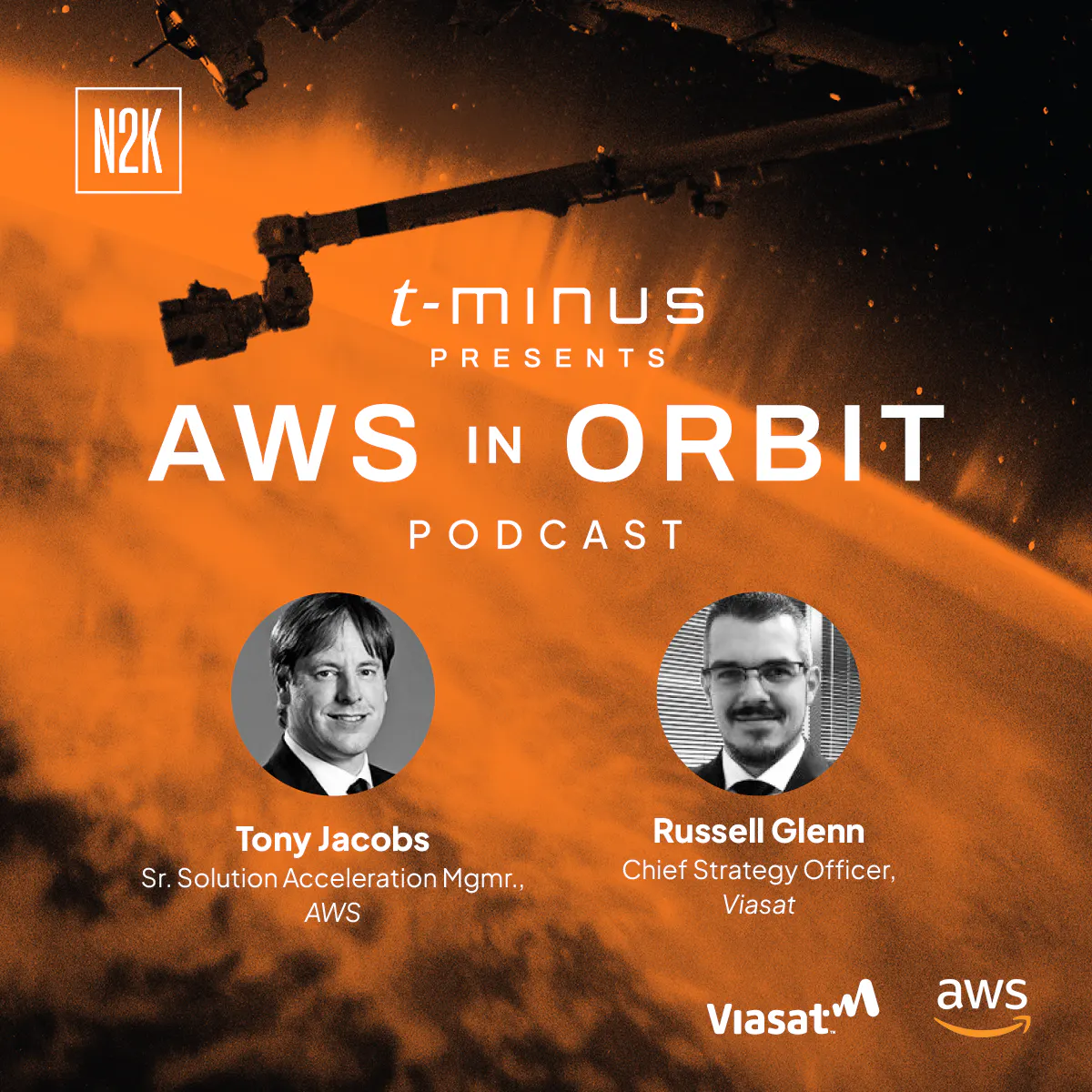
T-Minus: Space-Cyber Briefing
AWS in Orbit: Cloud, Space, and AI Convergence.
00:01:30
Learn about the transformative intersection of cloud computing, space technologies, and Generative AI through the lenses of AWS for Aerospace and Satellite and Viasat.
Loading summary
Transcript30 lines
- [00:02]
A
You're listening to the Cyberwire Network powered by N2K. Welcome to AWS in Orbit. I'm Maria Varmazes. We're working with AWS to bring you an in depth look at the transformative intersection of cloud computing, space technologies and generative AI. On AWS in Orbit, we are exploring not just what's possible, but what's meaningful. In the realm of space and cloud innovation. We grapple with the complex challenges and unparalleled opportunities that arise when we use space to address pressing issues right here on Earth. This is AWS in Orbit Resiliency at the tactical edge. With viasat, we've all experienced outages and service downtimes in our day to day. You go grab a cup of coffee while things work themselves out and then it's back in business, no big problem. But network reliability for the warfighter on the front lines is foundational and it is a strategic advantage. And it takes an adaptive, multi layered approach to enable that kind of resilience. Our guests today will tell us more about it.
- [01:42]
B
Hi, I'm Tony Jacobs. I'm a solution architect on our solution acceleration team here at aws. And my role is really to go into the field and build resilient communications and resilient compute so that when we're operating at the tactical edge, we don't have access to fat network connections that are robust and reliable. We find a way to get there and I describe my job as let's go make it go and figure out how do we make the bleeps and sweeps happen so that the mission providers, the folks that actually do sensing, affecting data and whatnot, how can they do their job and assume that the backbone works? Yeah, so you know, solution architect, I make things go.
- [02:35]
A
Russell, how about you?
- [02:36]
C
Thanks. So Russell Glenn here within viasat Government Solutions, I'm a chief strategy officer and partner coordination for our mission connections and cybersecurity. So as the name might allude, right. ViaSat is involved in satellite communications, but we're so much more. Right. So as a global communications provider, one of the things we focus on is actually our satcom and transport agnostic capability to deliver mission effects into both the enterprise, but really focusing here on the tactical mission battle space. And so what that means is we take missions, whether it is uncrewed swarms, whether it is space to ground sensors or whether it is, you know, obviously with aws, it's been a lot of mission enablement through AI and ML cloud to the edge and back to the infrastructure is to look at the highest Resilience, highest reliability transport network we can put together to ensure that the mission effectiveness is enabled. And doing that through open architecture research. While Bias is very proud of our global Geo Satcom architecture, we fully appreciate the growth and expansion in the realms of low Earth orbit, middle orbit, 5G and line of sight transports. And all of those are needed in this complex and competitive communications environment. So a lot of what I drive at is how do we create that open architecture and the strategy behind bringing together mission partners, not just in the connectivity, but also in the mission enabling applications for missions like Fires and Logistics and intel and certainly as we'll dive into today, those drone swarms.
- [04:15]
A
Gentlemen, thank you both for joining me today. And I just want to put a pin on something, Tony, that you just mentioned that I want to make sure we define up front, can you define what we mean by the tactical edge? And how would you define it?
- [04:28]
B
Sure. So tactical edge is when you are not in a data center. For many of our government customers, they're the war fighters who are actually out in the field. So you could say it's an austere network somewhere where you have a PACE plan that's the primary alternate emergency situation. So it's a. Like, how do you, when you have to deal with the connectivity both at a. It worked, it was great. It's a nice fat connection. Or what if we didn't have a connection? What if we lost connectivity to the cloud or to our peers for a few minutes or hours or days at a time? How do we deal with that? And anytime that's part of the conversation, you have bonus conversations like, oh, how much power am I drawing? How much cooling do I actually need? And you're having to reconsider all these things that we really don't have to think about whenever we're at the home office or we're in a data center or frankly, we're living our normal life when we're at the tactical edge, we have to deal with where does the power come from? Where does the data come from? Not seriously, where's the data come from?
- [05:38]
A
And a key through line for both of your intros was about making sure that things just work, that they've got to work, they've got to be resilient, they've got to get that mission accomplished. So I want to dig in a bit on how aws enables what ViaSat's providing when it comes to those drone swarms, the uncrewed swarms. You sort of both teased that a little bit. I would love to hear More about that story. So maybe Russell, I'll turn to you on that one. Tell me a bit about this.
- [06:05]
C
Yeah, sure. So a lot of people, when they see the drone swarms and the mission effects they can deliver, and that's everything from sensors to payloads to mission augmentation. Right. Even if you think about logistics, it could be vehicles that are driving along the ground. You have a lead vehicle driven by somebody, and you may have a train of drone followers being able to just deliver more materials. And so the capabilities of the physical platforms are always there. But generally speaking, the drones have been command and controlled. The C2 of those platforms have been through line of sight connectivity and generally a single radio, whether it's a mesh radio that's connecting or potentially sometimes 5G and cellular and those less austere environment, that non tactical edge that Tony was talking about. But what's really happening is as we tried to diversify and distribute those drone swarms, there needs to be both the network capability to bridge them across mixed hybrid networks. I talked a little bit about Satcom, 5G and radios, but even those would go across mixed radios. And the real magic behind those is the emission autonomy that's enabled by those drones. So you don't have to have one person flying one drone or driving one drone anymore anymore. With the growth and expansion of autonomy that comes from some of that artificial intelligence and machine learning, the drones can generally fly themselves. However, you have to be able to give them command and control and some compute assets on the back end. And that's where the power of the cloud really comes in. So being able to have Amazon's cloud available in the traditional cloud enterprise sense, but also driven out at that tactical edge, whether that's a mobile data center deployed on an island chain somewhere, for example, so that you don't have to reach back 15,000 miles across the world, but you can actually directly connect, right, to something in theater to connect to those drones. Because what they're collecting is lots and lots of data off those sensors that need to be turned into intelligent decision making. And so for us, the drone swarms need to be resiliently connected. Right. That austere environment Tony mentioned, you're going to have not only just environmental effects of. There are some places where certain types of communication just do not work. Right. There's fog, there's rain, fade, there's things like that that can affect satellite communications, but there's also adversaries that are wishing to knock those networks down to reduce our value proposition, our position in that area. And having that resiliency within the network to move the right data to the right place for the right mission effect, that's the motion on the network. And getting that to be that cloud enablement on the backside is where those drone swarm missions and those hybrid drone swarm missions that work across all those different domains and transports really rely on this open architecture, resilient network and high performance compute that comes from the AWS infrastructure and cloud and edge computing environments.
- [09:07]
B
If I could jump onto that a little bit more.
- [09:10]
A
Yes.
- [09:11]
B
With AWS providing the a hyperscale cloud infrastructure, we can do things like retraining models in effectively near real time. That way, not only can the tactical edge capabilities operate, run those autonomous systems, we can also continuously retrain it cloud side and push down improved models pretty much all the time. So what that really lets you do is not just operate in your and do your autonomy, but also continually get better at running autonomy simply because we've provided that resilient comms up to the cloud. And as you think about that a little bit more, you don't even need to do that in real time. I can actually push out all of my data, say in an overnight data burst, cook on it overnight and then bring better models tomorrow. So that kind of plays into the tactical edge concept where even if we have frankly very austere connectivity, we can still trickle data up, take advantage of the cloud and then bring that back down. That's, that's a big win.
- [10:23]
C
Tony talks about that ability to essentially store and forward the intelligence and put the processing out at the edge where it's closer to the data. It is about reducing that. We use the term latency, right. That's the time it takes to get, you know, data to the decision points and back to the edge. Some things are just driven by physics, right? A satellite that's 20,000 miles away is going to take longer to get to than a satellite that's 500 miles away. However, when you look at the global infrastructure that ViaSat and Amazon both bring, ViaSat as a global ISP and Amazon as a global cloud provider, there's a lot of global infrastructure fabric that's very resilient and high assurance for our commercial customers, that can be dual use leverage by the Department of War as they're looking to improve the capability of getting that data and those models to and from the point of need. So I think that's very important when you think about the global nature of the mission operations of these end customers. In particular, you take a region like the Indo Pacom area of operations. Right. There's, there's not a whole lot of ground infrastructure sitting there. So you've got to be mindful of how and where you can connect to and from and that having multiple global infrastructure paths is hypercritical. And viasat and Amazon bring those together and we're already patched in with the Dow infrastructure fabric that they use across agencies like DISA and others today, just by the nature of our existing businesses. So you're taking what's already in place and amplifying and expanding its use and adoption as the need for this. Both the sensor data coming off and the command and control data for these swarms continues to grow and expand. It's a force multiplier.
- [12:05]
A
Yeah. And as I was listening to both of you describing the very high level lay of the land, I suppose, metaphorically speaking, it strikes me at how much, you know, we're talking about things like the necessity of speed of information, the complexity involved, and then also enabling autonomy. And to me that makes me go, that is such a fascinating problem and challenge to be driving after. And that's gotta be also kind of fun to be figuring out how to do that. But also who is better positioned than ViaSat and AWS to try and take something like this on because what an incredible challenge. But also that there is so much that can be learned from the commercial sector, that can apply in the government sector, as you both are getting at. So that's how my brain was starting to connect this. And then Russell, you very brilliantly kind of just said that too. So I was going, that's, that's really interesting. And how on earth would that work? So I appreciate that.
- [13:01]
C
Yeah, for sure. You're talking to ViaSat and Amazon today, right? Two, two companies that definitely have a large global commercial footprint again in our opinions. Right. A fairly large global government and international government footprint. And so when we look at it, it's like, oh, it's good. Amazon and ViaSat have come up with a solution and that's something we both definitely don't want anyone to take away from here. Right. It's about creating an open architecture and an open ecosystem to have transport and compute capability available when and where needed. ViaSat's doing some work with Amazon right now today to take some of Amazon's Edge cloud compute capability and Deploy it on ViaSat Edge assets to where it's an open architecture that we can drop there, run those cloud processes, but on existing things that are adopted by the Dow today, and so I don't have to field an Amazon Edge compute kit. I have to be able to field Amazon Edge compute capability. But they have those open architectures to launch those. And we do the same thing in the transport space today again, we do work with. As Amazon is launching their global LEO Constellation, we're waiting with a lot of anticipation for what that's going to enable us because we look at the best available network to move the right data in the right space. And a lot of those LEO architectures are going to enable that tremendously. They have already today and they're going to continue to do that. But at the same time, we know there's capacity and density that might be suited for our own SatCom or partner SatCom and other places that it's just a line of sight shot to Tony's point. Those may not be available and you've got to be able to hit the things that are local in the region and so things that neither Amazon or viasat produce, we have to make sure that we partner with those again. We talk a lot about drone swarms. I'm sure a lot of us like to be hobbyists, but neither of us are producing any of these large platforms. And so making sure that we are open architecture and open standard to make it easy for those companies to adopt and take advantage of the value that we're putting together is a huge differentiator for what we need to do to move forward. These disa calls a mission network as a service. It's really what we're trying to push forward and enable.
- [15:14]
B
Yeah, and let me hammer that point just a little bit more. Russell mentioned it earlier talking about multiple low Earth orbit constellations, perhaps geosynchronous constellations, Perhaps using commercial LTE, commercial 5G, perhaps setting up a private 5G bubble, perhaps doing point to point comms, perhaps setting up a laser point to point comm, Perhaps using commercial ISP, perhaps using whatever the hotel WiFi is, wherever it is, you are binding all of those different connectivity paths together, picking the best one, making sure that the data that's going across the path is appropriate. So for example, if we're sending bursts of data off like we were talking about before, with autonomy and doing model retraining, we may not care about the latency. So we may want to run that up to a geobird. That's a higher latency connection. It's still a very, very good throughput. And we also know where all of those bounces are. They never hop through potentially hostile telecom. Whereas if we're going to go through the hotel, you really don't know what's going on there. So then you have to add that much more encryption and really think about that side of things. So those balances are continuous and frankly agnostic. Like I'm going to use whatever comms paths are available, even if it's not the AWS provided one, because I want to get you onto the AWS backbone as fast as we can. We want to use that hyperscale infrastructure, that global infrastructure everywhere. And that may mean that we're going to use commercial LTE for a few hops.
- [17:02]
A
Yeah. And it strikes me as again, both you are describing this, the open architecture by, you know, built in. It's that that is the plan. This was not baked on later that it also, aside from being a very pragmatic choice, it also future proofs a lot of what you're building, allowing for that interoperability and integration of what is whatever will be coming next in terms of innovation for the warfighter.
- [17:27]
C
Yeah, absolutely. Yeah. We've gone along this again, some of it driven by the customer for sure. Right. If there's a better mousetrap to be produced somewhere down the path. Right. They always want on ramps and off ramps. However, one of the other keys is that in different theaters of operation and for different mission sets, it is going to take different architectures. So from a software side, open application programming interfaces or APIs are always key and critical, but also open and well published interface standards so that anybody can connect into the network with whatever transporting compute they're bringing is critical. And again it's critical for Amazon and viasat as well to ensure that, you know, whatever mission is going to be needed. Again, we've focused a lot on the drone swarms, but there's definitely things across fires, missions, intel collection for just command and control. Everything from ground vehicles to the dismount soldiers. You had asked earlier, you know what, what defines the tactical edge? A lot of it for us is almost every soldier is a compute and a networking node on most networks today, even if that's not their job. So for us the tactical edge goes to wherever someone needs to be connected and you don't know what's going to be on that person, whether it's a cell phone on their chest with a single radio or just a cell phone with 5G to Tony's earlier point. But having those open architectures are critical, but making sure while they're open architectures, it's not, I'll say an open uncontrolled network. So one of the things, and you may be leading this path. So I'll lead the witness a little bit. One of the things we talk about the we talk about the network and the open architecture and the ability to get data to the compute and back and forth in the environment is certainly one of the challenges. But the other is cyber resiliency. And a big term within DOW is Zero Trust access control and Zero Trust networks.
- [19:21]
A
Yes.
- [19:22]
C
And so ensuring that while those mission applications do need that ubiquitous network and always on connectivity, there's a big difference in the threat of. I'm sitting at my house here today and because we're on a podcast, I don't have the VPN on because I don't want that to disrupt what we're doing. However, typically speaking, I run a virtual private network to access back into the ViaSat enterprise and I can process data. But the threats against me compared to the threat against an adversary in region are very, very different. And so we do take that very seriously. That while it's open and standard and as resilient as possible, there are still security mechanisms, whether it's high assurance encryption that's required again on the AWS side, that's what they call the infrastructure level IL5 and IL6 gov cloud type environments, or whether that's the zero trust access control that really has to be pretty seamless to the user. And when you talk about drone swarms, there is no user, so you have to make it so the drone can connect to the network without somebody being part of it. But you still have some level of assurance of its trust value and its capability. And those are things we have to lace into these capabilities. And viasat and Amazon are doing that even today for customers and demonstrations that we do consistently.
- [20:37]
A
Yeah, yeah. I was going to say you are anticipating beautifully where I'm trying to go, but as you're describing all these different activities going on in the network, I'm just thinking from the cyber point of view, having a high level visibility into what's going on on your network is so key. And being able to control obviously what's accessing, you know, what are the different assets connecting that is so crucial. But I would be very bad at my job if I didn't ask while talking to someone from ViaSat about 2022 and the takeaways there, as I know that there have been a lot from the cyber attacks in that year that involved viasat. So you all have learned a lot. There were a lot of really great takeaways and I'd love to hear what those takeaways were and sort of where we go from there.
- [21:23]
C
Yeah, for sure. I'll put out the viasat disclaimer and I can share the response that we had both with ourselves and our government counterpar that's available on our website as we look at that network cyber attack overview that occurred there in 2022. But really what happened was the network at the time, we had actually taken over primary operation of a, what was previously a joint venture satellite operations network. And so what that means obviously there was both entities had some portion of the network that they were operating. And we were in the process of bringing that on about the same time that the war in that region had kicked up and kicked off. And so what had happened was the adversary in that region had found a way to infiltrate. And so when we started to see the effects on that KASAT network, because of our cyber intrusion detection as well as our RF monitoring of the network, we were able to probably within about the course of 48 to 72 hours, identify what they had done. Some attacks on the actual modem infrastructure that was in those places. And within maybe less than 96 hours we were able to identify what those were, come up with a patch on the hardware, modem, ship out modems, because we have the, again that commercial availability of producing, you know, we have hundreds of thousands of SATCOM users. And so we just reached into our inventory, put the patches on those devices and push those back out into the field. And then as we did that, it actually gave us the ability to instrument and continue to analyze those threats against that network. Because the hostility in that environment as you see today, hasn't really cooled down a lot. And so what we're able to see is not only on the cyber operations side, where we're using AI ML and Autonomy tools that do run in various cloud environments, Amazon being one of them, to be able to run those detection mechanism, to see those either fast moving or low and slow moving threats. But also even in the electromagnetic spectrum, that RF environment of the actual SATCOM waves, as folks in that area are trying to deny or degrade the environment, because we do have that end to end control of the network, we're able to see and maneuver those frequencies around within the spectrum that's allocated to us in that region. It's still a commercial transport, so you can't just do whatever you want, but we can actually move around in real time and see those threats and adjust to them. And so it really just continued to. Tony talked about model training. It continues to help us train our models and advance machine learning algorithms to be able to respond to those threats and attacks. And so it was definitely a combination of physical cyber and electronic warfare that was witnessed there. And as a global commercial provider, we see that on a lot of different networks. That one happened to make the news, but there's lots of different people trying to get into global ISP networks for a variety of reasons, whether it's just financial gain or others. And so we have a really large inventory of petabytes of cyber attacks a day or attempted cyber attacks that we're able to train on and train against. And that's the value of a dual use commercial model, is that we're able to apply those on the transport side, even of the government network, we don't see the government data, but we see people trying to get in from the outside and can use that to tip and cue against threats that could be coming to those folks. And we do that in partnership directly where we can inform them what we're seeing and they can go investigate inside their own networks.
- [24:58]
A
Yeah, learning from those incidents is what it's all about, especially to make their networks more resilient. And truly network resilience has been the theme for this chat. So I really respect that and greatly appreciate you sharing those takeaways. I think it's incredibly important that we talked about that. So thank you. And I want to make sure that I get into any final thoughts, but also talking about maybe high level about the value that you have seen in bringing these cloud enabled, not exclusively, but cloud enabled capabilities to the warfighter and maybe some forward thoughts about what's next and what you're looking forward to bringing. So Tony, do you want to go first?
- [25:40]
B
Yeah. One closing thought, and I like to do this. I'm actually at a field event right now on an austere network. So like this conversation is happening because we do this all the time. Everything is, is always resilient. It's a fundamental and critical part of frankly war fighting today is to have good networks. The emergent capabilities like the, all of the AI training and all of the, all of the more traditional AI models and the emerging large language models, all of, all of that capability set, everything that the hyperscale cloud can bring to bear today is it's just a ridiculously capable set of tools that are in the toolbox. Now these tools were straight up not available 10 years ago and they're growing so very fast that in 10 years the entire ecosystem is going to feel different. So as long as teams like viasat and AWS are Working together and continuously experimenting in the field, finding these new capabilities, learning how to use these systems effectively, and taking away lessons on what isn't effective. That's just continuous learning. That's how we maintain, that's how we stay at the vanguard of what we're doing.
- [27:14]
A
Absolutely, yeah. Russell, any thoughts from you?
- [27:16]
C
Yeah, sure. So I think as we, as we kind of look at, I'll say, kind of closing and maybe what challenges and opportunities are presenting themselves in this space right there. Nothing. Nothing we're saying sounds like anything new. Right. I always have to appreciate that the Department of War has been doing cloud compute and global networking for many more years than I've even been in this industry. However, I think what's really changing is that onset of the capacity, density, scale and speed of data and autonomy that's being enabled by the emergence of things like AI and ML is making it so no one single source can probably provide the sufficient amount of network capacity, compute and other things. And so as we look at things like as a service models to be able to deliver these things, we've done that a lot. Right. The AWS cloud as a service across the government has been very successful and moving the needle to improve the resiliency, the compute, the capacity and the ability to deliver mission effects. But as we drive forward and we look at things to help us maintain that competitive advantage, it's things like kind of being able to guarantee that survivability of those mission networks, being able to spin up and spin down those networks. That point of need as you start to. You talk about being able to launch hundreds of drones, normally you'd have a force of the Army, Air Force, Navy, Marines, move into an area, set up shops, set up infrastructure, set up small command posts and be there for a long duration of time. And that's just not the way these future networks are going to be done. It's going to be about speed, scale, spin up, being able to maneuver and move quickly, but still having all of those capabilities and assets that are available. And so I think that's the biggest thing is making sure that some of the challenges right in the again, we call it the as a service operations model, certainly for the network. The Dow has operated their own networks for many, many years and for a lot of good reasons. But as things like radios as a service and cloud as a service have come on board, transitioning to that really can help to increase and augment and enhance the resilient scale and the demand that's going to be driven against these networks. So that you don't have to worry about what am I going to compute today? You'll know that you've got the network there to do that mission and when that mission's over you can take that network down because it's virtualized, it's in the cloud. You can move forward. So it should be more known cost approach on doing things. Some other challenges is probably again understanding the we haven't talked a lot about acquisition here. It's been a very technically driven approach, but just the acquisition model and the cost of things being able to stand up and field these networks in 90 to 120 days and be able to model the cost and how it's going to go forward and then really just expanding that ecosystem collaboration. We talked a lot about space, cloud and customer agnostic networks and platforms, what the Dow calls the combined joint all domain command and control. Right. CJADC2 really that J part, that joint and all domain piece. It sounds easy, it's really not. There's a lot of challenge there. So I think having delivery of those open systems, best transports, best compute at the point of need, I think those are the challenges and opportunities that we see coming. But definitely hopeful and glad to support with our partners and AWS to drive that forward for the warfighter and enabling those mission capabilities again. Drone swarms, keeping people safe. I'm generally all for that.
- [30:55]
A
Absolutely. Well Russell and Tony, that was really well said and I thank you both for your time and your expertise today. These are incredibly complex and fascinating challenges that you all are working on, but they are also incredibly important. So thank you both very much for your time. I greatly appreciate it.
- [31:11]
B
Thanks again.
- [31:12]
C
Thanks Maria. Appreciate it.
- [31:24]
A
And that's it for AWS in Orbit. Resiliency at the Tactical Edge with viasat. A special thanks to Russell Glenn from viasat for joining us today. For additional resources from this episode and for more episodes in the AWS in Orbit series, check out our show notes@space.n2k.com AWS this episode was produced by Alice Carouse and powered by aws. Our producer is Liz Stokes. Were mixed by Elliot Peltzman and Trey Hester with original music by Elliot Peltzman. Our executive producer is Jennifer Ivan. Peter Kilby is our publisher and I am your host, Maria Varmazes. Thank you for listening. We'll see you next time.
- [32:19]
C
Sa.