← T-Minus: Space-Cyber Briefing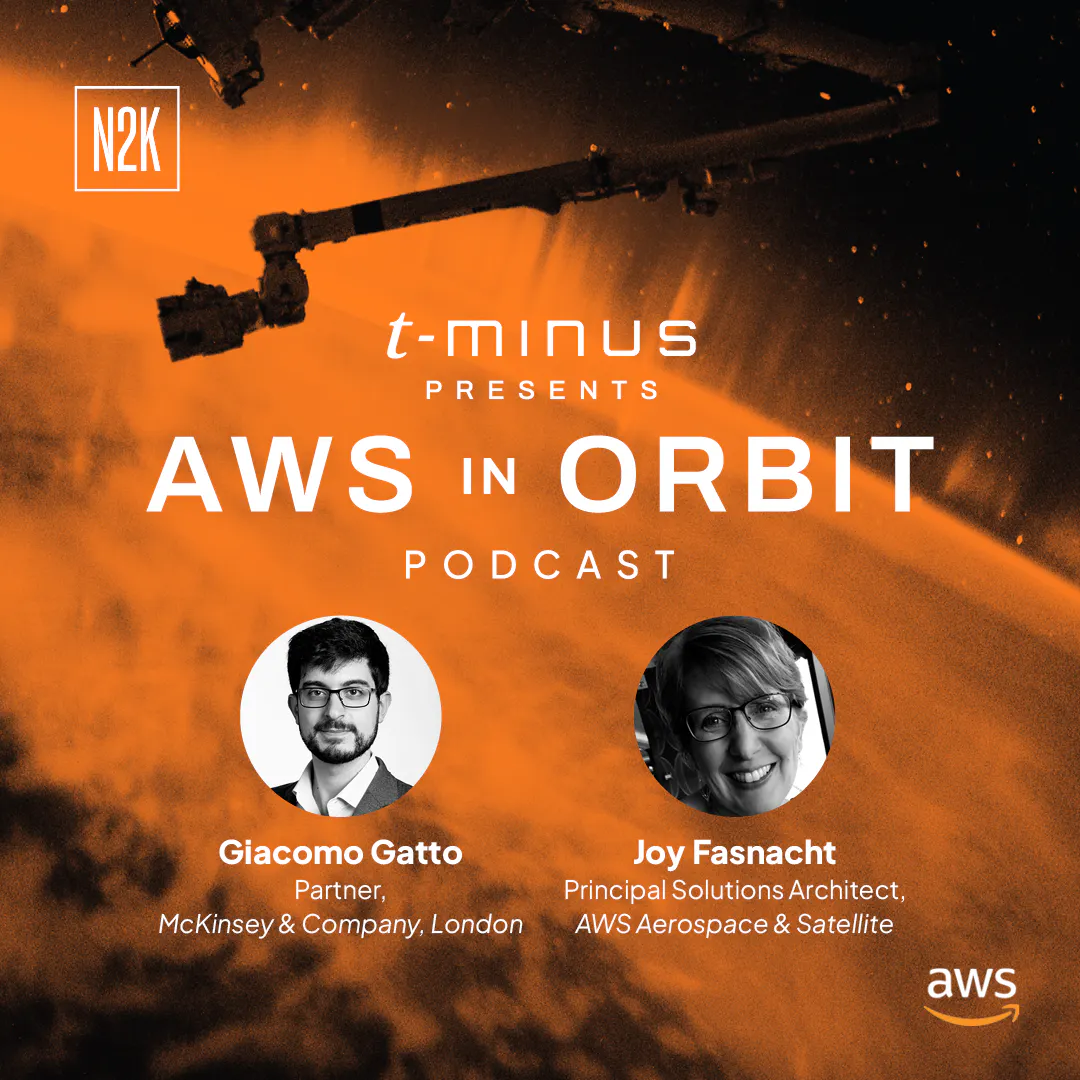
T-Minus: Space-Cyber Briefing
AWS in Orbit: Global Industries Forging Ahead, Thanks To Space.
00:19:54
Find out how AWS for Aerospace and Satellite is working with global industries to use space to improve their offerings.
Loading summary
Transcript34 lines
- [00:00]
Host
SA.
- [00:35]
Maria Ramazes
Welcome to AWS in Orbit. I'm Maria Ramazes. We're working with AWS to bring you an in depth look at the transformative intersection of cloud computing, space technologies and generative AI. On AWS in Orbit, we're exploring not just what's possible, but what's meaningful in the realm of space and cloud innovation. We grapple with the complex challenges and unparalleled opportunities that arise when we use space to address pressing issues right here on Earth. This is AWS in Orbit Global Industries forging ahead. Thanks to space.
- [01:25]
Giacomo Gato
I'm Giacomo Gato. I'm a partner for McKinsey and Company. I'm based in London and I lead our European space practice. I was a kid who wanted to be an astronaut and then went on to work with astronauts and design space systems and now do a lot of strategy work for space players and more in general for the space ecosystem.
- [01:45]
Host
Thank you so much for joining me today. And one of the things that you've been, many things that you've been working on is a study on how different industries use space in ways that maybe people might not predict or anticipate. So can you walk me a bit through what you found and maybe give me some use cases?
- [02:05]
Giacomo Gato
I find this fascinating. Right. There's been a lot of talk in the past about how much space can be felt, albeit maybe not consciously, all the time in our daily life. Right. We use stuff that originates from space exploration way before our time. Right. Like Velcro and gps. After that, you know, all these great things that we benefit from in our daily lives. But what people don't realize is that actually space has still a lot of potential to improve what we do here on Earth. And there's a lot of benefit that we can take from it here on Earth. And I'm talking like very concrete things that, you know, businesses can apply to operate more effectively and understand their business better, make more data driven decisions and so on. And this applies to all sorts of industries, right? It applies from shipping to aviation to insurance and financial services. And it can be anything from being able to track your supply chain all the way through, being able to understand how much you're emitting and where and when, understanding whether your infrastructure is at risk. So really lots of, lots of applications.
- [03:35]
Host
Because yeah, as you mentioned, I think a lot of us have in our back pocket, like the Velcro, the, the, the Tang orange juice, like the, the things from the Apollo era that people would like to recite about how space can be very helpful for us on Earth. And then there are certain industries that we know, like agriculture is a very commonly cited one. But what I found fascinating is that you mentioned a few just now that I wouldn't normally think of as much. And I wonder if you had a favorite that you could maybe walk me through. And I wanted to add a sort of a wrinkle to this also. Could you tell me a little bit how cloud might play into this as well?
- [04:11]
Giacomo Gato
Of course. First of all, you can monitor pretty much whatever surface you want. And those satellites can usually provide fairly detailed image that can allow you to discern between. Are the walls there? Right. Have they been built? We secured the area with fences. Are earth moving machines kind of operating in the way we are expecting them to? So you can literally monitor the development stages on a daily basis, on a weekly basis, and you can figure out whether you're on time and if not, which part is delayed. And therefore you can deploy your resources more effectively to catch up and potentially deliver on time and ideally on budget as well, which is fairly uncommon for big infrastructure projects.
- [04:56]
Host
Yeah, I was going to say this must be for massive projects for something like that. And not just building a house, but huge stadium, something like that.
- [05:04]
Giacomo Gato
Another one that I can think of, as I said more maybe socially oriented, is we mentioned disaster recovery. It's very common of people to think of space for disaster recovery, but typically the mind immediately goes to providing communication where ground networks have been enabled by earthquake, a tsunami or some sort of natural events. By having an eye in the sky, you can assess the situation a little bit more clearly and you can therefore deploy your resources which are very much constrained to prioritize interventions. A while back, there was flooding in a state of Brazil, State of Brazil, highly reliant on agriculture. It was necessary once all human lives were safe and secure and the resources of the civil service had to kind of intervene to secure human lives. The next step was securing the economic output so that those people's livelihoods could also be preserved. And by using satellite imagery, it was possible to assess which of the farmland was flooded, what kind of crops were there, because some of them are more susceptible to flooding, others less. And therefore you can deploy and harvest with a certain priority to try and save as much as possible from the flooding. And maybe the third one, which was something slightly more related to daily life, is the world is rapidly urbanizing. Satellite imagery can help facilitate that because it can help, for instance, identify and assess the issues around urban heat islands. And therefore you can prioritize the investment for, you know, net zero or for upgrading the home infrastructure in a way that basically tackles the most sensitive buildings first.
- [06:58]
Host
Quite amazing to go from that macro to the micro. I think traditionally not what a lot of us think of, of a space capability, and yet that is where we are and increasingly more so with more Earth observation providers providing that kind of incredible detail.
- [07:14]
Giacomo Gato
And that is exactly the role that cloud can play here. Because with that, you know, increased resolution, with that increased level of detail, obviously comes a lot of data.
- [07:24]
Host
Yeah.
- [07:26]
Giacomo Gato
Having cloud is usually a massive, massive enabler because it allows you to process more data processing more quickly, therefore reducing the time between detection and impact, which in many of these use cases is quite important.
- [07:46]
Maria Ramazes
Thank you very much for that, Giacomo. And as we've been speaking about the way that space data is transforming a number of industries, including ones you may not have thought of, let's also bring in a new voice here about how generative AI can add to that innovation.
- [08:02]
Joy Fosnot
Yeah. Hi, my name is Joy Fosnot. I'm a principal solutions architect with AWS and I work in our aerospace and satellite division of aws. So I get the good pleasure, if you will, of getting to help our space customers with their cloud journeys.
- [08:20]
Host
I speak to a lot of customers of AWS and also just in general in the space industry who their work has been transformed by what cloud can do for them. And they're seeing how turning to the cloud specific with AWS solves a lot of their tough challenges and helps them do what they want to do, but a lot faster. And what we're seeing also is that Gen AI has that potential and is already doing a lot to disrupt in a good way. I'm just curious what you're seeing in terms of the space industry using AI.
- [08:53]
Joy Fosnot
Yeah, we are hearing a lot from our space and satellite customers about Gen AI and things that they're. They're excited about trying and experimenting with with Gen AI. Unsurprisingly, a lot of our space customers for aws, they are doing Earth observation. Right. These are people with low Earth, low Earth orbit constellations and they're imaging and they're just creating tons and tons of data. But some of the things that they need to do in satellite imagery, it's challenging and it's manual and it's very labor intensive. And these are the kinds where they believe that generative AI is really going to be able to accelerate and automate. So some of the things like finding objects in satellite imagery. Right, that's very manual at the current state of affairs. But if you could pre train an Artificial intelligence model. That's one of the things that our Earth observation customers for AWS are talking to us about. So that's one use case. Another is actually sending satellite imagery into like a multimodal model, which is a model that understands both images and text and telling that model with your voice, with your prompt. Right. What do you see in this image? So this is a very common use case in things like catalogs. Right. But we're also seeing customers and hearing about customers who are experimenting with doing this with satellite imagery. Like describe what you're seeing in this image. Super interesting use case, human readable way. Yeah, exactly.
- [10:38]
Host
That's fascinating.
- [10:40]
Joy Fosnot
And then like, one more thing that we're hearing a lot about is our customers want to be able to augment these large language models with their own, like, set of documents. So these are really highly trained sets of skills that our customers need. Right. And so if our customers can augment these large language models with their own sets of documentation, and by adding your documents into the large language model, you can basically ask it questions in a very domain specific way, like, hey, I'm seeing this bolt coming off of this part or whatever. What does that mean? So, so that's. Yeah. So those are some of the use cases we're hearing about from our, our specific aerospace and satellite customers.
- [11:29]
Host
One of the commonly heard challenges about using generative AI is getting that prompt right. I know it's an art and a science, and from what I hear, you had an amazing lightning talk at a recent AWS reinvent about that topic that had people lining up around the room wanting to hear more about it. So, you know, since I wasn't there, but I heard it was amazing. Can I get a little CliffsNotes version of that?
- [11:53]
Joy Fosnot
What are some tips and tricks? Absolutely. The idea was, well, if I send a satellite image into one of these multimodal generative AI large language models that can both read that image and understand me, asking it like a natural language query, what happens with that? How do I really tune that prompt? This whole field of prompt engineering is really big in generative AI because you have to ask the question the right way to really get the LLM to feed you back an answer that makes sense and that's accurate. We did a little experiment and we pulled a satellite image of the coast of Western Australia and we just fed that into this multimodal model in Amazon Bedrock and we asked it the question, okay, just analyze this image. That's all we really wanted. You know, that's like the baseline. There's no prompt there at all. Just generate something for me. What is this image showing you? And it did a pretty good job. It said, well, it looks like a coastal area. I see trees, I see roads, I see structures. It did a pretty good job. And it even said which in satellite imagery analysis, like, the amount of cloud cover is really important. One of the things that's really helpful with prompt engineering is you give that, that large language model a role. You know, you say, okay, I want you to be in the role of a satellite imagery analyst. You have to kind of tell it that.
- [13:29]
Host
So we told it, and it knows what that means.
- [13:31]
Joy Fosnot
It knew. It knew what that meant. Yeah. Because of its context. Right. It's setting this kind of context for it.
- [13:37]
Host
Yeah.
- [13:38]
Joy Fosnot
And then you give it a job to do. You don't just tell it that role, but you also give it a task to execute. And we said, we want you to generate five paragraphs of summary about this image. And we want you to put yourself in the, in the position of telling us what would happen if there was a, like a ten foot storm surge. And again, it did exactly what we told it to. It came up with five paragraphs. It analyzed pretty well and told us, I see coastal areas that could be eroded, I see some buildings that are very close to the shoreline, et cetera. So it did a great job with that. And then we gave it even a little bit more information on the third try of refining that prompt. And we said, we want you to tell us if there's more than 25% cloud cover because that's going to be needed to be flagged for human review. And so it did that. Right. It said, okay, gave us the five paragraphs, it gave us the summary. And it also said, this is 40 to 50% cloud covered. So we suggest that you take this image and analyze this with a human in the loop as well.
- [14:52]
Host
Wow.
- [14:52]
Joy Fosnot
Pretty impressive.
- [14:54]
Host
I love that. So I never knew that giving a role was that important, but that makes a lot of sense given that what it assumes that it is obviously is going to really determine what it says.
- [15:05]
Joy Fosnot
There's a big science around prompt engineering that's a science all in and of itself. It's kind of cool.
- [15:12]
Host
I'm still learning so much about how large language models work and how you, how you interact with them. And I'm just at the beginning of my understanding. But it's so fascinating hearing how this technology is already being used in such fascinating ways. Joy. And tell me a bit about some specific customer use cases, about how generative AI is being used.
- [15:31]
Joy Fosnot
Yeah, like I said, we've got a lot of interest with many of our space and satellite customers for aws. There's one specifically that's running a really interesting project with this right now. And actually they spoke at Re Invent also about this. The customer's name is isi. So ISI is a satellite imagery analytics provider. They're founded in Finland and they fly a really kind of unique sensor type called sar. And the cool thing about SAR and why it's so important to Earth observation is it can see through like smoke and haze and clouds and it can see in the dark. It's a high resolution imagery type too. And it has a lot of application in things like natural catastrophes, which is what ISCI is doing with Generative AI and Amazon services, specifically Bedrock. So they're using combinations of their satellite imagery along with Bedrock, analyzing social media feeds of images like in flooded zones. So they're getting really fast insights to people like first responders in the cases of flooding. Yeah. To say, okay, the flood depth in this area from these social media images kind of coupled with the SAR imagery that they can capture looks like the flood in this area is about 10ft or what have you. So. So they're getting quick insights already using generative AI services coupled with their unique set of skills that they bring. Really impactful, of course.
- [17:21]
Maria Ramazes
And that's it for AWS in Orbit Global Industries forging ahead. Thanks to Space. For additional resources from this episode and for more episodes in the AWS In Orbit series, check out our show notes@space.n2k.com AWS this episode was produced by Alice Carruth and powered by aws. Our AWS producer is Lara Barber. Our associate producer is Liz Stokes. We are mixed by Elliott Peltzman and Trey Hester with original music by Elliott Peltzman. Our executive producer is Jennifer Ibin. Our executive editor is Brandon Karpf. Simone Petrella is our president. Peter Kelpie is our publisher. And I am your host, Maria Varmazes.
- [18:03]
Host
Thanks for listening.
- [18:04]
Maria Ramazes
We'll see you next.