← T-Minus: Space-Cyber Briefing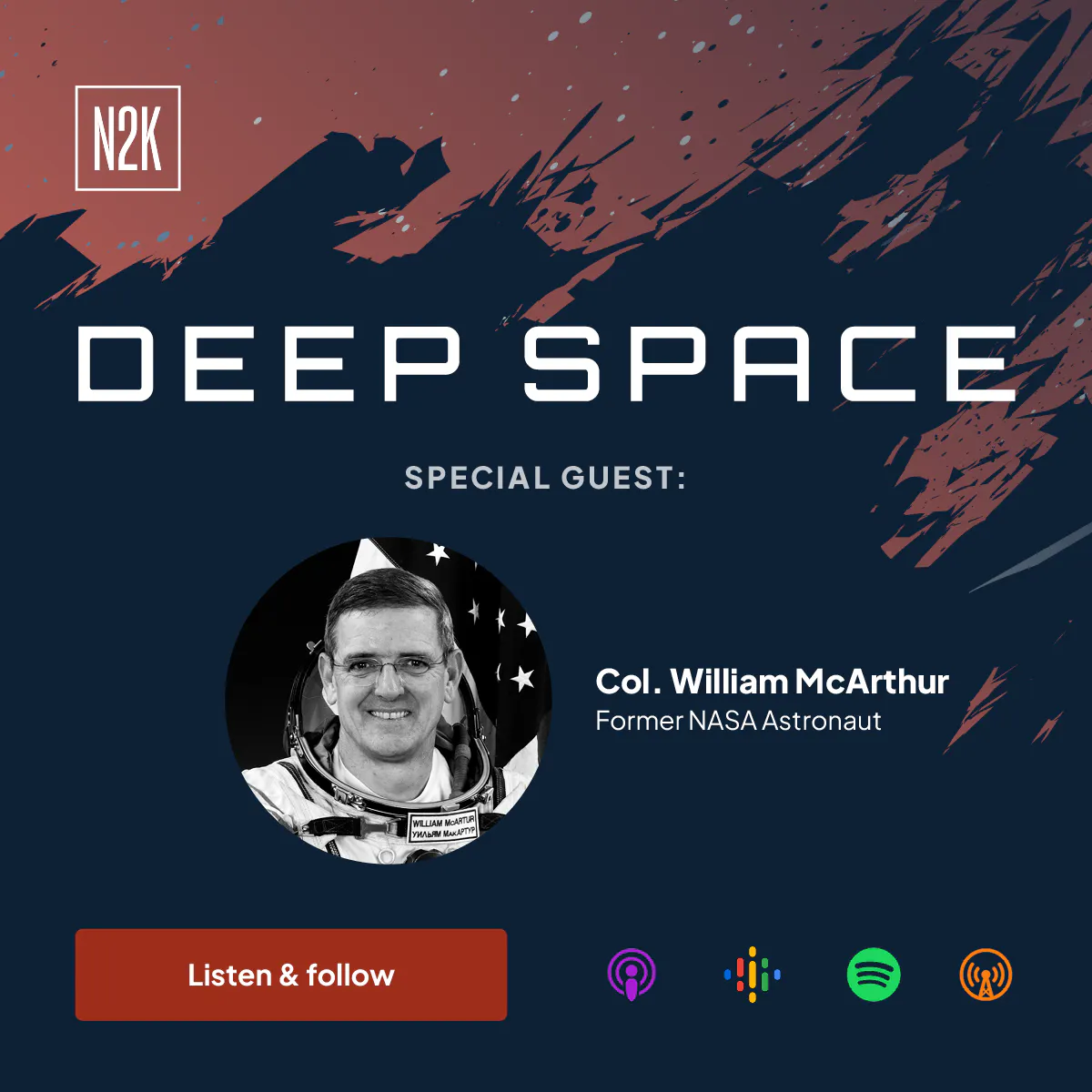
T-Minus: Space-Cyber Briefing
Career notes with former NASA Astronaut Bill McArthur.
00:39:04
Bill McArthur is a retired US Army Colonel, a former astronaut and a veteran of three Space Shuttle missions. He’s now the Chief Astronaut for Titans Space.
Loading summary
Transcript59 lines
- [00:02]
Maria Varmazes
You're listening to the N2K space network.
- [00:11]
Dave
Hey, everybody. Dave here. I've talked about Deleteme before and I'm still using it because it still works. It's been a few months now, and I'm just as impressed today as I was when I signed up. Deleteme keeps finding and removing my personal information from data broker sites. And they keep me updated with detailed reports so I know exactly what's been taken down. I'm genuinely relieved. Knowing my privacy isn't something I have to worry about every day. The Deleteme team handles everything. It's the set it and forget it peace of mind. And it's not just for individuals. Deleteme also offers solutions for businesses, helping companies protect their employees personal information and reduce exposure to social engineering and phishing threats. And right now, our listeners get a special 20% off your delete me plan. Just go to JoinDeleteMe.com N2K and use promo code N2K at checkout. That's JoinDeleteMe.com N2k code N2K.
- [01:24]
Maria Varmazes
There are few topics in the realm of all things space as guaranteed to start an argument as space tourism. Whether you're in favor of space tourism flights or not, it has to be said that they are opening opportunities up for people to make their space dreams a reality. And when these space tourism companies offer training with veteran NASA astronauts, then surely the opportunity for future astronauts becomes a little more interesting, doesn't it? This is T minus deep space. I'm Maria Varmazes. Our guest today is NASA astronaut Bill MacArthur. Bill is a retired U.S. army colonel, a a NASA astronaut, and a veteran of three space shuttle missions. He is now the chief astronaut for Titan's space. And Bill shares his story about his time in the astronaut office and how that experience has shaped his role as an advisor for Titans.
- [02:39]
Bill MacArthur
I grew up on a tobacco and cotton farm in southeastern North Carolina. Of course, something interesting happened just before my 10th birthday, April 12, 1961. Yuri Gagarin, a Soviet cosmonaut, became the first human being to fly in space. And as most young people, I looked at the people around me and, you know, maybe the people I saw on television and those were the things that I thought I could become as an adult. And so, you know, astronaut or cosmonaut really wasn't, really wasn't on that in that mix at that time, as I said, I worked on a tobacco farm. This is my dad's farm. And so in the summers, my job was to drive a mule drawn sled. I'd walk beside the sled holding the reins and would go up and down the rows of tobacco and the field hands would break the leaves off, put them in the sled. I would drive the sled to a nearby barn, offload the leaves and we'd begin processing them for market. Then back to the tobacco field, up and down the rows, back to the barn all day. And that was what I did in July and August in the hot sun. And I'm. And there is no shade in a tobacco field. And so my memories of my youth on the tobacco farm were of spending hours and hours in the hot sun looking at the south end of a northbound mule.
- [04:17]
Maria Varmazes
A pleasant sight.
- [04:19]
Bill MacArthur
Now. Now my, my dad, my dad was my hero. He really was. And fortunately he had an. There was another dimension to him. He had commanded a self propelled anti aircraft artillery battalion attached to Patton's 3rd army in World War II. He came after the war, he returned to his farm, but he was a weekend warrior. He was in the army reserves, commanded the 1st Reserve Special Forces Operations Detachment. So he was, he was commanded the first reserve Green Beret outfit. So here, here I am growing up and my dad is jumping out of airplanes. I didn't want to be a farmer and so I decided I would become a soldier. And so my career went down that path. I went to West Point, got commissioned in 1973. My first assignment was in the 82nd Airborne Division. So I was jumping out of airplanes just like my dad did.
- [05:25]
Maria Varmazes
Just like your dad. Yeah. That's so great.
- [05:27]
Bill MacArthur
How cool was that? And then actually a few, when I was there on the 82nd, my brother who was a midshipman at the Naval Academy, went through the Army's airborne school. And so I actually got to go down for his graduation and actually do a couple of jobs with him. Oh, but, but kind of fast forward a couple of years. And then in 1978, NASA selected 35 astronauts specifically for the space shuttle program. And this included the first six women, two of whom were my crewmates on my first shuttle mission. So I learned how to fly in space from Ray Seddon and Shannon Lucid. And the first three African Americans, the first Asian American. And then what really caught my attention, they selected the first astronaut out of the Army. And so when NASA solicited applications for the 1980 class, I applied. Not a snowball's chance in heck of getting selected, but it's like buying a lottery ticket. You know, the chances of winning are really, really small. If you don't buy a ticket, the chance of Winning is zero.
- [06:45]
Maria Varmazes
That's exactly it. Yep, that's right.
- [06:48]
Bill MacArthur
And then I applied every time that the application process opened up for the, for the next 10 years, and then, and then they finally realized there was only way, one way to get me to stop applying, and so.
- [07:02]
Maria Varmazes
Only one way to get rid of him.
- [07:03]
Bill MacArthur
Right? That's right. And. And in the, in the meantime, though, my army career afforded me just wonderful opportunities to go back and, and get a master's degree from the Georgia Institute of Technology. I taught aerospace aero aeromechanical engineering at West Point for a few years, went to the Navy Test Pilot School. And while I, while I was there, I got interviewed by NASA the first time. They didn't select me, but they asked the army to send me to Houston to support the astronaut office in recovering from the challenger tragedy. And, and the good thing was we, we were here for three years before the next election. My, my wife started teaching in the local school district, and they really realized that if they didn't let me stay that she would have to move with me, and they wanted her to stay in the community, so.
- [08:02]
Maria Varmazes
Right, right. Yep.
- [08:04]
Bill MacArthur
To keep her here, they let me stay.
- [08:06]
Maria Varmazes
I mean, it makes sense that you had that grit and resilience to keep trying for an astronaut post. I mean, was this something you were thinking, oh, I really want to be an astronaut, or was it more, you know, I would love it to happen, but I mean, was life sort of hinging around that dream?
- [08:23]
Bill MacArthur
And so I, it didn't mean. It had never entered my mind until, until 1978. And fortunately, the. I, I just had. I went from one just fantastic assignment in the army to the next. As I mentioned, they sent me to school. I got to do a lot of flying both here and in Korea. And so that was really, really exciting. And so the good news was that I was, I was on a career doing exactly the things in the army that I wanted to do. And coincidentally, those experiences, you know, help demonstrate that, that I had some of the experiences and maybe some of the, some of the ability that, that NASA was looking for. And so now, you know, once, once we move down here, that, that was, you know, that was. If I had, if I had not been selected for the astronaut program, that would not have served my army career well. And so, you know, maybe there was a little more pressure at that point that I'd, you know, that I'm, if I hadn't burned a bridge behind me, I had at least left a little fire on the side of it. So as time went on it became a little more of an imperative. But yeah, I can work out.
- [09:57]
Maria Varmazes
It worked out. I love it when it works out. Don't we? All right, so when it worked out, you went on a number of missions. So let's start at the beginning. Tell me about the missions that you went on.
- [10:09]
Bill MacArthur
I remember after I'd gone through initial astronaut training, I was actually doing public speaking somewhere and Dan Brandenstein, the chief of the astronaut office, calls me and he said, hey, we're thinking about assigning you to a mission that's going to have medical research on it. And I said, I'll volunteer for any experiment. And he goes, not so fast.
- [10:33]
Maria Varmazes
You just put that hand right up.
- [10:35]
Bill MacArthur
So not, not so fast. And so, and so my first mission was STS 58. It was, it in fact was a medical research flight. It was the first mission in which the space shuttle actually spent a full 14 days, a full two weeks on orbit. We orbited left wing down, sort of belly forward because that gave us the best data connectivity with the ground because we had 48 lab rats on board. And so we had to continue to provide telemetry with their health status data.
- [11:18]
Maria Varmazes
Right.
- [11:18]
Bill MacArthur
So the ground could monitor the animals.
- [11:21]
Maria Varmazes
Yeah.
- [11:22]
Bill MacArthur
And so it was. We just bored holes in the sky, but it was just fabulous. We had great views of the Earth. It was a wonderful crew. As I mentioned, Ray Seddon and Shannon Lucid were on the crew and also a couple of my astronaut classmates, Rick Serafos and Dave Wolf were on the cruise. So we just had a lot of fun. And it began a series of missions that all. You would almost think that my astronaut career had been scripted to end up spending six months on the space station. So we had a space lab in the back. We were doing a lot of experiments, you know, you know, here, here I am an army test pilot and I'm doing medical research. Well, I was.
- [12:15]
Maria Varmazes
Life's funny that way.
- [12:16]
Bill MacArthur
It is funny that way. And so, and so I was the operator some. And I was also these, the experimental subject some. And then, and then I also, you know, made sure I was a flight engineer. And so I had some really key tasks like fixing the leaking toilet.
- [12:38]
Maria Varmazes
Listen, that when you not having a toilet, kind of important.
- [12:45]
Bill MacArthur
It was, was really nice. Set task was successfully completed. But then two years later, I was assigned to SDF 74, which was the second shuttle mission to rendezvous and dock with the Russian space station Mirror Mir. Yeah, we carried a module up, about a 15 foot long module called a docking module, oddly enough, because for the shuttle to attach to Mir. It either required the Russians to do some significant reconfiguration of their solar arrays. They would actually have to move a module, which they did for the shuttle mission before we got up there. And so they wanted us to attach this little 15 foot kind of tunnel which would provide enough offset so that we wouldn't bump into the solar panels on Mir.
- [13:48]
Maria Varmazes
Right? Yep.
- [13:49]
Bill MacArthur
And so now here it is, a rendezvous and docking mission. They were doing assembly construction on a space station, a relatively small task, but it demonstrated the exact same technique that NASA used for the first ISS assembly mission that we flew. And so came back from that, started getting real serious about doing EVA training and was assigned to what would be the second major ISS assembly mission flown, flown by NASA. And in the critical path was the launch of a key Russian module. Well, it kept getting delayed and, and I think we normally hope to fly and maybe late 98 or early 99 eventually wound up flying in October of 2000, late October, late October, early November 2000 because of the delays in launching the Russian module. And so, yeah, and so now I've done a science research flight, I've done a rendezvous and docking space station assembly type mission, then we did a rendezvous and docking, go out and do spacewalks in this mission. And so by that time they, they figured I was probably, that I probably had the right experiences to go up and be the commander of an ISS expedition.
- [15:35]
Maria Varmazes
We'll be right back after this quick break.
- [15:39]
Dave
You hear from us here at T minus every single day now. We'd love to hear from you. Your voice helps shape the future of N2K networks. Tell us what matters most to you by completing our annual audience survey. Your insights help us grow to better meet your needs. There's a link to the survey in our show notes. We're collecting your comments through August 31st. Thanks. Did you know Active Directory is targeted in 9 out of 10 cyber attacks? Once attackers get in, they can take control of your entire network. That's why Cempras created Purple Knight, the free security assessment tool that scans your active directory for hundreds of vulnerabilities and shows you how to fix them. Join thousands of IT pros using Purple Knight to stay ahead of threats. Download it now@sempris.com purple-knight that's sempris.com Purple Knight Krogel is AI built for the enterprise SOC. Fully private schema, free and capable of running in sensitive air gapped environments. Krogle autonomously investigates thousands of alerts weekly, correlating insights across your tools without Data leaving your perimeter. Designed for high availability across geographies, it delivers context aware, auditable decisions aligned to your workflows. Krogle empowers analysts to act faster and focus on critical threats, replacing repetitive triage with intelligent automation to help your SOC operate at scale with precision and control. Learn more@krogel.com that's C-R-O GL.com.
- [17:39]
Maria Varmazes
Can I just ask doing that Eva for that kind of a build out? I was not to date both of us, but I was in high school when you did this, and I actually remember some of the photos and the like and just hearing about it and my imagination kind of went wild thinking about, like, what is that like to be building in space? Like, what is that like?
- [18:05]
Bill MacArthur
And so it was, to a, to a certain degree, it was a relief in part because of the delays in our launch. For every hour we spent outside, we spent 17 hours underwater in our big pool, the neutral buoyancy lab. And so, you know, it's sort of like when you finish 12 years of secondary education or four years of college, you just, you really want to graduate.
- [18:34]
Maria Varmazes
And so you have senioritis.
- [18:37]
Bill MacArthur
This was sort of, this was sort of our graduation. But we were so, so well trained. There was nothing mysterious about the tasks. What was new was actually being, and for this mission, actually being outside the space shuttle and you know, being in now we'd spent hours in the spacesuits and so we knew what a spacesuit felt like. But when you're in the water in the spacesuit, that's a bit like being in a submarine. You and the spacesuit are neutrally buoyant. You neither float to the surface or sink to the bottom. But inside the spacesuit, you're not floating. You're actually, you know, if you're upside down, all the weights on your shoulders, if you're face down, you're, you're laying on your, on your chest in the, this fiberglass shell. And so the training is very, very good, but you don't feel weightless. And so being out in space, it just is a pleasure to do work inside it. I mean, it's not particularly comfortable. It, it gets little pinch points and they're little hard spots that after six hours, you, you, you really understand why the princess worried about the pee under her mattress.
- [19:55]
Maria Varmazes
Those bruises, right?
- [19:56]
Bill MacArthur
Yeah, yeah, but, but it just, I mean, it was, it. I mean, it put the buck in Buck Rogers. I mean, it really did. I, I felt like a, a space explorer before, but the first time I went out, I felt Like a real space person.
- [20:13]
Maria Varmazes
Bill, I mean, you. God, I love hearing you describing all that. As I said that so much of what you worked on was part of my upbringing, hearing about it. So it's just a thrill to hear you describe it, especially with your reflection over time. It's just beautiful. And I can't tell you how thrilled I am to just hear you talk about it. After these missions that you did and all the incredible work that you did, what was your next act? Because there's been a lot. I mean, you've been up to a lot of stuff since then.
- [20:41]
Bill MacArthur
By that time, the astronaut office had gotten really, really large. And even before flying, I was told not to expect to fly, to do another flight. And having lived in space for six months, having trained in Russia, gosh, over a four year period, I spent about two years in Russia. And that was just a wonderful, wonderful experience. Just working with the cosmonauts and the Russian engineers and trainers. They were just wonderful people. They treated all of us with a lot of respect. And so it was a good experience. But as I said, the astronaut office management said, hey, look, we got a lot of people in line waiting to fly. And so we really want you to move on. At the time, a gentleman named Wayne Hale was a manager of the space Shuttle program. Wayne had been a flight director when I was at capcom. And so I worked with him and I worked for him in Mission Control. And he asked me to come over and become the safety and mission assurance manager for the shuttle. And I thought that would be a good way for me to begin to sort of pay back for all the opportunities I'd had and to support my colleagues in the astronaut office. I did that for a couple of years. And then one day, the next program manager, John Shannon, came to my office and he closed the door and he said, I'd like for you to become the orbiter project manager. So the orbiters, as you know, those were the Delta Wing vehicles, Discovery, Atlantis and Endeavor. And the orbiter project was the sort of. I would say it was a crown jewel project certainly in the shuttle program and maybe in the agency. And I like to maybe exaggerate a little bit and say, when John said, I want you to be the orbiter project Manager, I got up, walked out of my office to look outside the door to make sure it was my name on the office and that he hadn't made a mistake and was looking for someone else. Because I absolutely did not feel, feel remotely qualified to do that job, really. And I'm still Not certain. And in all honesty I probably wasn't qualified for that job. But, but he was looking for something different. And so I then embarked upon the second best job I ever had. It was just, it was just delightful. It just, you know, every day to come into work and talk about spaceships and talk about what we needed to do to get them and, and I, it was terrible, it was a terrible burden. But I had to go to every single launch.
- [23:39]
Maria Varmazes
I mean, oh gosh, poor thing, right.
- [23:45]
Bill MacArthur
And then, and then while the space shuttles were on orbit, I'd have to, late in the morning, I'd have to come chair a meeting for about an hour and we would talk about all the things, you know, if we would talk about any problems that we had with, with you know, Atlantis or Endeavor or Discovery and you know, what, what the big upcoming events were. We had a process by which we would do a photographic survey of the space shuttle as it, as it approached ISS looking for any damage which would compromise the integrity. When we would reenter and try to come back and share this meeting with some of the most wonderful people I've ever met in my life. I mean just these just world class engineers and the only thing they wanted to do was to keep the astronauts safe and to make the mission successful. Just what a wonderful job.
- [24:46]
Maria Varmazes
Yep. I was going to say it sounded, it sounds like it was incredibly rewarding and also fulfilling in the sense that you were with people who felt so passionate about what they did and understood the just people working at their absolute best. Which is often what I think a lot of us really hope for. Right. When we have these great jobs, you.
- [25:06]
Bill MacArthur
Know, and it is which, you know, is, which raises a puzzling question. When you have a group of people who individually and collectively are committed to excellence, who absolutely want to achieve mission success with the highest degree of safety possible, you have to be a forward leaning group of people and with a lot of confidence that you can make things work. Of course, eventually the shuttle program program ended and I became the Director of Safety and Mission Assurance at the Johnson Space Center. I did that for six years and I had an epiphany at some point and I realized in my entire career, and this is about, I'd had 45 years working for the government at that point and I realized I never had a job for more than three years. Now I was in the astronaut office for a very long time. But I would be training for a mission, fly a mission, come back, working mission control or working some other part, doing some other support task in the office. And so I realized that I really wasn't very good in a job beyond three years because, you know, I would come in, I would see the things I wanted to focus on and change. Maybe just for the heck of it or because I thought it would make things better. It's probably because I thought it would make things better. But that sort of an expression of a lot of hubris when you, when you think you can come in and fix things that people have been doing for years and years. But. And then I realized that after three years, the things I wanted to change, I had either changed or I was not going to be able to change them. And I was out of ideas. And then in 2017, I retired from NASA.
- [27:12]
Maria Varmazes
My colleague Alice said that she saw you at JSC recently. And of course I see the name on your screen about Titan space industry. So I would love to hear a bit about how you heard about Titan and how you joined.
- [27:23]
Bill MacArthur
I do a bit of public speaking either at the Space Center Houston here, about 10 miles from my house. And a few times a year I go to the Kennedy Space Center. I'll actually be there the last week and July and the last week in August. That's, that's a great place to go for. My wife and I go there and we just kind of, you know, relive our experiences from when we were there for shuttle launches and stuff. But, but at, gosh, last, last fall, the association of Space Explorers, I think we had our 35th. We call it a Planetary Congress. No arrogance associated with that. That's our annual get together. And I met a number of years earlier a gentleman named Frank White. He coined the phrase the overview effect and has interviewed many space explorers to try to capture their feelings, their emotions when they see Earth for the first time. When they're in orbit, you look out at the stars or the moon or, or whatever. And. And so Frank did a virtual introduction with a gentleman named Neil Lachman. Neil's the founding CEO of Titan Space Industries. And. And so I only got to chat with Neil for a few minutes last fall. And then this spring, Neil said, hey, look, we'd like for you to come. And I want to say work for Titan Space, but it's not really work because I'm not getting paid. And that's okay. I'm not. It's the next adventure. So what is Titan Space? Titan Space. It's Neil's vision and it is so ambitious, it takes your breath away. But in the near term, what we want to do is we're going to dust off a design from the 70s which never made it past the drawing board. Never really made it off. The conceptual table of a single stage to orbit space plane. It's a horizontal takeoff, horizontal landing. It has a suite of different engines. It has some air breathing engines to help accelerate up to supersonic speed. And then we have ramjet concept to try to accelerate us even to even higher mach numbers. And then eventually there will be. Right now we're looking at LOX hydrogen rocket engines to actually propel Genesis into orbit. Our initial mission profile concept would be about a five hour flight which includes two orbits of the earth. Now this thing is going to be huge. It's going to be the size of a jumbo jet. It's doable, but it's going to be probably the hardest, the hardest thing I've ever been involved with. We have been interviewing young, mostly young people, a lot of some more experienced people who we want to start training to fly in space. We're not going to employ them until we actually have something for them to fly on. But, but right now we're you know, identifying and I mean some of these young people, I mean we're talking about 22 year olds with two with double PhDs and what we're really trying to do is democratize access to space.
- [31:07]
Maria Varmazes
Yeah, Yep. Yeah. No. One of the, one of Titan's astronaut candidates is someone I've interviewed, Wanjiku Kanjumba and she's brilliant. So I was really thrilled to see. She's someone I've been really rooting for since I interviewed her a little while ago and I had a chance to meet her actually in Florida earlier this year. So I was really thrilled to see her announcement. So. Yeah. And especially if she. In some way, it sounds like you'll be working in some way with the astronaut candidates. What a great opportunity.
- [31:36]
Bill MacArthur
Yeah. And so I'm working with Vladimir Pletza and Mindy Howard. We're finalizing a draft for a training plan to get things started. My title is I'm the chief astronaut for Titan space and Neil has said I'm going to command the first mission. Now he and I may have a sort of different idea of what command means. While I am a test pilot, I'm a rotary wing test pilot and so no, I will not, I will not be a test pilot on the, on the space plane and I'll be more a commander ally. What I was on board iss so.
- [32:22]
Maria Varmazes
Understood.
- [32:22]
Bill MacArthur
I don't know, it's a long time. Well, I'm not Convinced yet? I'll be on board. But we're going to try to make sure that, that this is an opportunity for a lot of people.
- [32:34]
Maria Varmazes
Absolutely. I mean, a dream has to start somewhere and, you know, every idea starts at a certain stage and, you know, it's always very exciting to hear people having great ambitions. So it's honestly just sort of in my mind summing up hearing your incredible story. It's, you have a ton of grit and resilience like you must, and of course you are because of the amazing career that you have had. So, Bill, I just, I really just greatly appreciate you speaking with me and telling me your story and I want to make sure if there's anything that you wanted to mention before we close out, because I know I've taken a ton of your time and thank you again for speaking with me. The floor is yours. Anything you wanted to say with Titan Space?
- [33:12]
Bill MacArthur
There are a lot of skeptics out there and they, they are rightfully skeptical because our ambitions are, I think they're beyond the scope of, I think almost anything that's come before us. But you've got to, you know, if you've got a vision, you've got to start somewhere. And we are taking some concrete steps, such as working with local governmental agencies, trying to identify sites for a spaceport, sites to, to build, to build factories. I think back to when I was a boy, even when I was a young astronaut, when I, when I first became an astronaut, you know, the idea of, of companies like SpaceX and, and Blue Origin and Virgin Galactic, they were laughable. I mean, they really were. And, you know, and to see the things that SpaceX does, you know, landing their boosters, you know, returning their boosters, I know a drone ship or a landing on terra firma and then processing them relatively quickly and flying them again. If somebody suggested that was where we were going to be, you just laugh at them. It just, yeah, this makes, this makes no sense. And so, you know what I would, what I would just ask folks to do is, you know, wish, wish us well if you want to. If you're a skeptic, you're absolutely, you're being very, very reasonable. And maybe we're not, but by golly, we've got a very exciting vision and we've got a lot of exciting people who are just banging on the doors asking to come help us make this a reality. Foreign.
- [35:08]
Maria Varmazes
That'S T minus Deep Space. Brought to you by N2K CyberWire. We would love to know what you think of our podcast Your feedback ensures we deliver the insights that keep you a step ahead in the rapidly changing space industry. If you like the show, please share a rating and review in your podcast app. Please also fill out the survey in the show notes or send an email to space@n2k.com we're proud that N2K CyberWire is part of the daily routine of the most influential leaders and operators in the public and private sector. From the Fortune 500 to many of the world's preeminent intelligence and law enforcement agencies, N2K helps space and cybersecurity professionals grow, learn and stay informed. As the nexus for discovery and connection, we bring you the people, the technology and the ideas shaping the future of secure innovation. Learn how@n2k.com N2K's senior producer is Alice Carruth. Our producer is Liz Stokes. We are mixed by Elliot Peltzman and Trey Hester with original music by Elliot Peltzman. Our executive producer is Jennifer Ibin. Peter Kilpe is our publisher and I'm your host Maria Varmazes. Thanks for listening. We'll see you next time.
- [36:18]
Bill MacArthur
SA Foreign hi Kim Jones Here on CISO Perspectives, we get candid with the thinkers, doers and trailblazers shaping cybersecurity leadership. No scripts, no sales pitches, just real stories and hard earned lessons from folks who've been there.
- [37:12]
Dave
If you're looking to grow as a.
- [37:13]
Bill MacArthur
Leader or just want to hear how others are navigating this ever evolving field.
- [37:18]
Dave
Listen to CISO Perspectives.
- [37:20]
Bill MacArthur
It's your seat at the table.
- [37:34]
Dave
Hey everybody, Dave here. I've talked about Delete Me before and I'm still using it because it still works. It's been a few months now and I'm just as impressed today as I was when I signed up. Deleteme keeps finding and removing my personal information from data broker sites, and they keep me updated with detailed reports so I know exactly what's been taken down. I'm genuinely relieved. Knowing my privacy isn't something I have to worry about every day. The Delete Me team handles everything. It's the set it and forget it peace of mind. And it's not just for individuals. Deleteme also offers solutions for businesses, helping companies protect their employees personal information and reduce exposure to social engineering and phishing threats. And right now, our listeners get a special 20% off your DeleteMe plan. Just go to JoinDeleteMe.com N2K and use promo code N2K at checkout. That's JoinDeleteMe.com N2k code N2K.