← T-Minus: Space-Cyber Briefing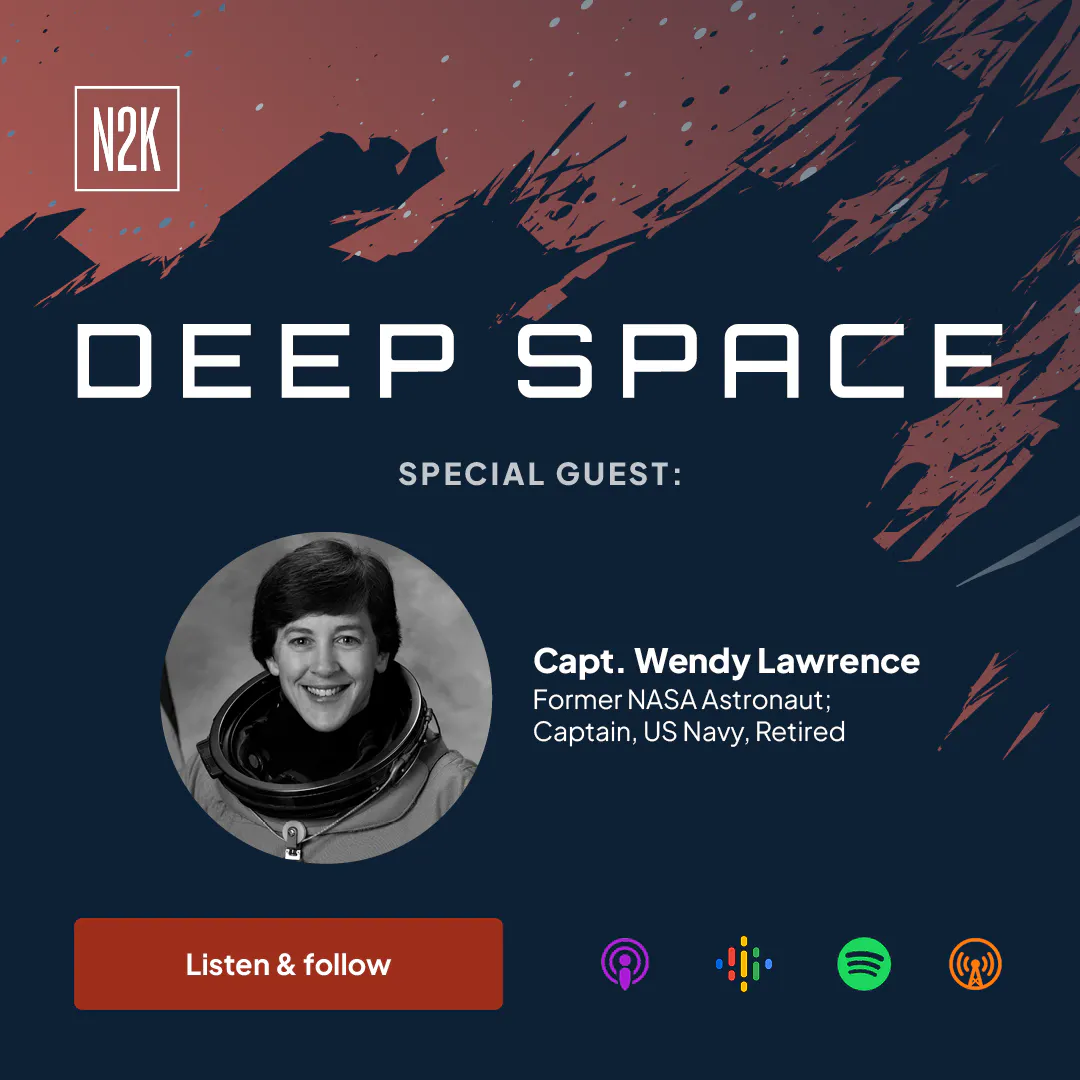
T-Minus: Space-Cyber Briefing
Flight and the future with Astronaut Wendy Lawrence.
00:26:22
Wendy Lawrence (Captain, US Navy, Retired) is an engineer, pilot, and a former NASA Astronaut. Wendy’s helping shape the future workforce with STEM outreach.
Loading summary
Transcript37 lines
- [00:02]
Wendy Lawrence
You're listening to the N2K space network.
- [00:11]
Dave
Hey, everybody. Dave here. I've talked about Deleteme before and I'm still using it because it still works. It's been a few months now and I'm just as impressed today as I was when I signed up. Deleteme keeps finding and removing my personal information from data broker sites. And they keep me updated with detailed reports so I know exactly what's been taken down. I'm genuinely relieved. Knowing my privacy isn't something I have to worry about every day. The Deleteme team handles everything. It's the set it and forget it peace of mind. And it's not just for individuals. Deleteme also offers solutions for businesses, helping companies protect their employees personal information and reduce exposure to social engineering and phishing threats. And right now, our listeners get a special deal. 20% off your DeleteMe plan. Just go to JoinDeleteMe.com N2K and use promo code N2K at checkout. That's JoinDeleteMe.com N2k code N2K.
- [01:25]
Alice Carruth
Many NASA astronauts talk about the moment that they decided that they wanted to pursue their careers in space. The Apollo 11 lunar landing and subsequent missions are often credited for inspiring the next generation of explorers. But what is inspiring this generation to go to the moon and beyond? This is T minus deep space. I'm Alice Carruth. Our guest today is a retired US Navy captain, an engineer, a former helicopter pilot, and a NASA astronaut. Wendy Lawrence is working to inspire the next generation of the space workforce.
- [02:18]
Wendy Lawrence
My name is Wendy Lawrence. I am a former NASA astronaut and retired captain in the United States Navy. I had the privilege of growing up during the Apollo program. So when you talk to astronauts who are around my age, our answer is pretty simple. It was all about Apollo. It was absolutely incredible to be able to lie on the floor in front of. I'm pretty sure it was our black and white television at home. For me, it was Apollo 11, watching Neil Armstrong and Buzz Aldrin take those very historic first steps. And I like to say to kids, even now, I cannot tell you what it was about watching them. I was mesmerized, eyes glued to the screen, and I had just turned 10 years old. I was growing up in Southern California, pretty much in the single parent household because my father was a prisoner of war over in the Hanoi Hilton. But I just remember watching them thinking, that's it. That's what I want to do when I grow up. I want to be an astronaut. I want to fly in space. No, I didn't see anybody who looked like me doing that. But about that same time with my older brother, I was watching every episode of the first Star Trek. So you did see people who looked like you zipping throughout the universe, and that was pretty inspiring as well. But that became the childhood dream. That was the dream that possessed me. I followed family tradition in that my mother's father went to the Naval Academy, became a naval aviator. My dad went to the Naval Academy, became a naval aviator. So I had an opportunity to join the second class of women to attend the United States Naval Academy, studied engineering, did break family tradition a little bit because I decided I wanted to fly helicopters instead of fixed wing planes. So it was a Navy helicopter helicopter pilot for a while. The Navy sent me to MIT and Woods Hole Oceanographic Institution to get my master's degree. And after a while I thought maybe I have enough qualifications that NASA might be interested in me. And so I submitted my application. I like to also tell kids that if you want to be an astronaut, it's like any other job, you have to let NASA know that, which means you have to apply. And I got selected in the astronaut class of 1992 and had an opportunity to fly on board the space shuttle for four missions.
- [04:52]
Alice Carruth
You glossed over all of that really quickly because I feel like there's so much more to it. I mean, your father being a prisoner of war must have been quite an incredible thing to have to overcome as a child to deal with that. And I understand your father was somehow involved with John Glenn and, and Shepherd.
- [05:13]
Wendy Lawrence
Yeah, kind of glossed over that fact too. So my father went through flight training in the early 1950s, and that was right around the time that the branches of aviation and the military were transitioning to jet aircraft. So my father learned how to fly jets. His first squadron that he was assigned to was out in the San Francisco Bay Area. And he's a new pilot. He's young, he's very inexperienced. And so typically you get paired with somebody who's far more experienced, he's been flying for a while, and you become that person's wingman. So my father happened to be Alan Shepard's wingman.
- [05:53]
Alice Carruth
Wow.
- [05:54]
Wendy Lawrence
Then after he finishes that tour in the now, kind of towards the mid-1950s, he gets sent to test pilot school at the Naval Air Station in Patuxent River, Maryland. And down the street live John Glenn and his kids. I wasn't born yet, but my older brother and sister used to play with the Glenn kids. So I do think that was incredibly Helpful. When I got into my later years of high school. And I'm trying to think, how do I make this dream come true? Because I still very much want to be an astronaut one day my dad could basically say, well, here's what people I know did. They all finished high school, they went to college, they study engineering or a science major. Of course, most of his friends had then gone into the military and become pilots. And so that was the path I charted for myself.
- [06:45]
Alice Carruth
What an amazing experience to have had that kind of exposure as a child and know that it was within your reach. Because a lot of people feel like space in particular is well beyond their reach. They don't know people that are in the industry. They don't know how to even get started. So that's gotta be quite a helpful start for somebody like you that wanted to go into that industry.
- [07:04]
Wendy Lawrence
Absolutely. Because these were family friends who were up orbiting the planet. So not anybody I had met. Cause I was too young. But people that were talked about in my household.
- [07:16]
Alice Carruth
And I bet your father must have been quite a big influence on you as well. You know, you mentioned that you followed his footsteps to be an aviator yourself. I'm assuming he came back from Hanoi.
- [07:26]
Wendy Lawrence
Yes, he did. Yes. In fact, he came back. And then my last three years at the United States Naval Academy, he was the superintendent there. So imagine going to college with your dad as the president of the school that you're in attending left some big footsteps, shoes to fill. But he was also a tremendous role model and example as well. So I benefited greatly from that.
- [07:50]
Alice Carruth
That's amazing. You are so fortunate and what a wonderful thing. And then you glossed over the fact that you had four flights on the space shuttle program. I'd love for you to tell me a little bit more about those flights.
- [08:02]
Wendy Lawrence
So space shuttle missions, by definition were what we call shorter duration, typically two weeks or so. And each mission had major objectives that you needed to accomplish. So on my first mission, which was onboard Endeavour, we were an astronomy mission. We had three specialized telescopes out in the payload bay for us to do astronomy in the, excuse me, ultraviolet part of the electromagnetic spectrum. So we operated the telescopes 24 hours a day. We split the crew into two shifts to do that. I was the flight engineer on that mission. So for me, that also meant I got to be the honor pilot for my shift. So it was my responsibility to input all the maneuvers into the onboard computers. That then precisely positioned the orbiter. So the other two people on my ship could then operate the telescopes to do our observations. So that was a lot of fun. I had a lot of chance opportunities just to sit up on the flight deck and look out the window and watch the world go by. Then my next three missions went to space stations, and they were incredibly busy. My middle two missions went to the Russian space station Mir when it was on orbit. That was part of what we called the Shuttle Mir program, or Phase one. Basically, it was a preparatory program for the International Space Station program. So it gave NASA an opportunity to start working with the Russian Space Agency in preparation for ISS operations. And then My last mission, STS114 on Discovery, was the first flight after the Columbia accident. So more than anything, we were a test flight, first return to flight mission. But we also went up to the International Space Station to do three spacewalks while we were there to repair some equipment. And we also delivered a lot of supplies to the station as well.
- [09:54]
Alice Carruth
Yes, I remember Columbia very well. I mean, it felt like anybody of a certain age certainly remembers watching that and being absolutely shocked. That must have been a really difficult time to be an astronaut and to put yourself forward for being that next mission coming up.
- [10:09]
Wendy Lawrence
Yes, that mission was very different than my previous three in that for much of our training flow, we didn't know exactly what we were going to do to implement the recommendations from the Accident Investigation Board. So it was kind of interesting to work in parallel with people in the shuttle program, the engineers, to try and figure out, how are we going to do external inspection once we're up in space? How do we look at the entire outside of the orbiter to inspect for any damage? Is that even possible? Or do we have to become incredibly creative and figure out a couple different ways to do that, which is ultimately, we had a couple of different ways that we did the inspection. How do we do repair? That's never been done before either. So it was a fascinating training flow from that regard in that we were doing things for the very first time. It was challenging in that for much of the training flow, we're like, how are we going to do this? I don't know. We're not there yet. So the very last part of the training flow became very, very busy as we finally figured things out and we had to practice the procedures.
- [11:18]
Alice Carruth
Yeah, I bet. I mean, space is always about learning. I'm sure it must have been continuously that way when you approached it.
- [11:24]
Wendy Lawrence
Yes, well, that's what I say to kids. You know, really the challenging part of being an astronaut is everything you have to learn and remember in order to do your job. So you are a student. You are very, very much a student. Nobody shows up having been an astronaut before. So, you know, I like to jokingly call it astronaut school, but you know, I emphasize to the kids just like you're in school right now. I had to go to astronaut school. I had to sit in class, I had instructors. We our tests basically are in the simulator, but we still had examinations that we had to complete, so to speak.
- [12:10]
Alice Carruth
We'll be right back.
- [12:15]
Dave
Did you know Active Directory is targeted in 9 out of 10 cyber attacks? Once attackers get in, they can take control of your entire network. That's why Sempras created Purple Knight, the free security assessment tool that scans your active directory for hundreds of vulnerabilities and shows you how to fix them. Join thousands of IT pros using Purple Knight to stay ahead of threats. Download it now@sempras.com purple-knight that's sempris.com Purple Knight Foreign is AI built for the enterprise SOC. Fully private schema, free and capable of running in sensitive air gapped environments. Krogle autonomously investigates thousands of alerts weekly, correlating insights across your tools without data leaving your perimeter. Designed for high availability across geographies, it delivers context aware, auditable decisions aligned to your workflows. Krogle empowers analysts to act faster and focus on critical threats, replacing repetitive triage with intelligent automation to help your SOC operate at scale with precision and control. Learn more@krogel.com that's crogl.com.
- [13:49]
Alice Carruth
You talk a lot about talking to students and I know you do a ton of STEM outreach. What possessed you to think, well, now I'm no longer working for the astronaut corps and I'm now retired from the Navy. I want to do STEM outreach?
- [14:01]
Wendy Lawrence
Well, I think part of it was due to the fact that my mother for 40 years was involved in early childhood education. She ran her own preschool for many, many years. And so my mother just has this amazing gift to keep three and four year olds absolutely mesmerized as she tells a story. So that was a huge influence. Whenever I would visit her, usually I would end up at the nursery school. My role typically was snacks and nap time, but I could see her impact and influence on young kids. But I think also looking back at growing up in Southern California in the mid to late 1960s during the height of the Vietnam War, with protests going on there, many different ways that my life could have ended up, you know, in sixth grade, I remember one of my sixth grade classmates was removed from class because he was taking drugs. So the drug influence was pretty strong. I could have just, you know, gone down to the beach and been a beach bum, But I was possessed by this dream. So I understand the power of having a dream and how it can push you and propel you forward in life. And so that's a message that I want to share with kids. Like, you owe it to yourself to try if there's something you're interested in doing. You don't know whether you can make this dream come true until you take the very first steps. And it may not work out for you. But I can also tell you that the journey is very enjoyable. It is not a waste of your time. You're going to learn a lot along the way. You're going to get to do some interesting things. And you do not want to get 10 to 15 years down the road and look back and go, if only. If only I had tried. They don't have the perspective at that young age to know that regret is a very powerful emotion, and it's one that you don't necessarily want to live with. And so that's the message that I pass on to them. You owe it to yourself to try.
- [15:59]
Alice Carruth
Absolutely. And have passion. It sounds like you really instill that into a lot of the student outreach you do. Now, I know you do presentations at jsc, like a lot of other former NASA astronauts, but you're involved with two outreach programs that I am very passionate about, the Challenger Learning center and higher orbits. Before we get into the higher orbits, one I'd love to hear about what drew you to the Challenger Learning center and what involvement you have in that program.
- [16:24]
Wendy Lawrence
Well, I joined the board for the Challenger Learning center last year at the request of another former NASA astronaut who had been on the board for quite a while. I think, in particular, having been on a crew following a major accident, you understand the impact on the families and how devastating it is to them. So I have great, great admiration for the Challenger families and how they turned a very, very difficult situation into something that's been quite powerful and quite impactful. So when Bill Reedy, former astronaut, reached out to me and said, would you be interested in joining the board? Of course, I said yes. And so I'm still learning about the mission, but it's been very enjoyable thus far. It's hard to believe that Next year marks 40 years since the anniversary. So much of the board work right now is focused on celebrating 40 years of challenger Centers and highlighting that accomplishment and looking forward to the next four years for Challenger Learning Centers.
- [17:36]
Alice Carruth
We're very lucky in my community to have a Challenger Learning Center. I know there's only about 45 of them or something like that left around the world, and it has an incredible impact on the students around this area. So thank you from the bottom of my heart that you've been involved in that. And the other STEM program that I mentioned is Higher Orbits. And hopefully you and I are going to be working together on a gopher launch later this year.
- [17:55]
Wendy Lawrence
We're.
- [17:55]
Alice Carruth
What am I in for? Because I know a little bit about higher orbits. I've known of them for many years, but this is going to be my first time being part of that.
- [18:04]
Wendy Lawrence
You're in for a couple of very long days, but you will be amazed at what the students are able to come up with in just those two days. Michelle Lucas does just an amazing program, amazing job of implementing this program. And it's not just a workshop in terms of kids being involved in stem. It's much more complete than that. I mean, she makes them get up and speak in front of groups. And so morning of day one, you have kids that are just terrified about speaking in public. By the end of day two, as they're presenting their idea for an experiment to fly to space station, they're much more articulate, they're much more confident, and so it's amazing to see that transformation in just a couple of days. But to me, what Michelle's doing is what STEM education should be. And I like to make this point also to the kids is like, yeah, we have. You sit in classrooms, but there's a purpose behind that. We have got to give you a foundation of knowledge, and it takes time to build that foundation. But once you get to that point, you then have the opportunity to apply what you have been learning. And that's what her workshop does. It gives these kids an opportunity to apply what they've been learning in the classroom again, try and come up with an idea of something that could be done on board the International Space Station in their experiment for 30 days. So what an incredible opportunity for a kid like Hank. You come up with a winning idea. You get to go to the launch, you get to see your experiment, go up to space, you get to collect data, analyze it. This is incredibly unique. I hope you appreciate it. But again, this is STEM education at its best. Apply what you learn, be immersed in it. The other tremendous benefit, I think, for these kids is I get to make a decision about whether or not they really enjoy doing this sort of work. And so as they finish up their high school years. Hopefully their decision is a more informed decision about, hey, I really enjoyed that workshop, trying to come up with, you know, pursue these science concepts or figure out the engineering design behind my experiment. I think I might want to go study engineering or I think I might want to go study a science major. So when my dad told me, you want to be an astronaut, you need to be an engineer, I didn't have any concept what an engineer really did. So mine was kind of a blind leap of faith that, oh, I will enjoy this engineering major. Fortunately, I did. But for these kids now, there gets to be a more informed decision about what they want to do after high school.
- [20:56]
Alice Carruth
You've done quite a few of these, I'm assuming by now with Michelle, you must have a story of some of the best experiments that people have come up with or even the failed ones. Have you ever seen that moment of the spark igniting in one of the students you've worked with?
- [21:11]
Wendy Lawrence
Oh, yes. And what's interesting is to meet the kids who are like, oh, I'm on my fourth go for launch because I had so much fun on the previous three that I wanted to come back. And that just warms your heart because you're like, okay, Michelle, you're making a huge difference in these kids lives. And then to be able to track what they're doing as they finish up into high school and then go on to college. At one of the Go for launches that I did with Michelle at the Kennedy Space center last summer, I met one of her former Go for Launch students who was getting ready to graduate from Embry Riddle, and she came down to be a mentor during the workshop. So Michelle stays in touch with these kids. They want to stay in touch with her. She continues to give them opportunities like go to International Space University in Australia for a week, meet kids from around the world, learn about all these amazing science and engineering concepts, go to the AIAASN conference, and stand up on the stage in front of hundreds of people and talk about your experience. And so, yeah, it's fun to see how she becomes their space mom. She wears that title proudly and the impact that she's having on their lives.
- [22:33]
Alice Carruth
What message would you like to give to people that are listening, that maybe are interested in perhaps pursuing careers in space, but don't even know where to start? What would you always tell them?
- [22:44]
Wendy Lawrence
If you're interested, take those first steps. Now that we've been involved in this space for decades, you have a lot of resources, so reach out. There are communities that you can join and be a part of. You can find people on LinkedIn, Instagram, you know, depending on whether you're in high school, there are programs like Michelle that you can be a part of in college. There are internships. But find a way to get that first foot in the door and see whether or not you really like it. That's critically important to just be immersed in it for a bit and say, am I enjoying the people that I'm working with? Do I like the work that I'm doing day in and day out? Do I see myself fitting in here? Are there opportunities that I can pursue? But unless you take those first steps, you're never really going to know. But the nice thing is there, there are a heck of a lot of opportunities. You know, if you live near a Challenger Center, a lot of them are also science museum with other programming that's offered. Go take a part of that as well. I'll put in a plug for Space Camp. If you have the resources to go spend a week at Space Camp, Michelle will tell you that can be a life changing experience for her. It was absolutely life changing because as she says, I found my tribe there. And so I'd also say to kids, you know, you've got to find some sort of support system because it took me 25 years to make the dream of flying in space come true. That is an incredibly long journey. There were lots of ups and downs and you're not going to be able to do it on your own. So you've got to find a group of people with similar interests who are willing to support you to basically become your cheerleaders and help you continue to put one foot in front of the other as you try and navigate your path.
- [24:35]
Alice Carruth
I love that. Persevere. I think that's pretty much what we can come up with from the end of that conversation. Wendy, thank you so much for joining us and telling us about your career and your outreach as well. And thank you for everything you do for the community.
- [24:47]
Wendy Lawrence
Well, Alice, thank you very much for the opportunity. It was great to speak with you. Foreign.
- [25:01]
Alice Carruth
That'S it for T Minus Deep Space, brought to you by N2K CyberWire. We'd love to know what you think of this podcast. Your feedback ensures we deliver the insights that keep you a step ahead in the rapidly changing space industry. If you like the show, please share a rating and review in your podcast app. Please also fill out the survey in the show notes or send an email to space2k.com we're proud that N2K CyberWire is part of the daily routine of the most influential leaders and operators in the public and private sector. From the Fortune 500 to many of the world's preeminent intelligence and law enforcement agencies, N2K helps space and cyber security professionals grow, learn and stay informed. As the nexus for discovery and connection, we bring you the people, technology and ideas shaping the future of secure innovation. Learn how@n2k.com N2K's producer is Liz Stokes. We're mixed by Elliot Peltzman and Trey Hester with original music by Elliot Peltzman. Our executive producer is Jennifer Ivan. Peter Kilpie is our publisher. Our host is Maria Valmazes and I'm Senior producer Alice Carruth. Thanks for listening.
- [26:09]
Wendy Lawrence
Sam. Foreign.
- [26:49]
Dave
Actors don't break in, they log in. Attackers use stolen credentials in nearly nine out of 10 data breaches. Once inside, they're after one thing your data. Varonis AI powered data security platform secures your data at scale across las SaaS and hybrid cloud environments. Join thousands of organizations who trust Varonis to keep their data safe. Get a free data risk assessment@varonis.com.