← T-Minus: Space-Cyber Briefing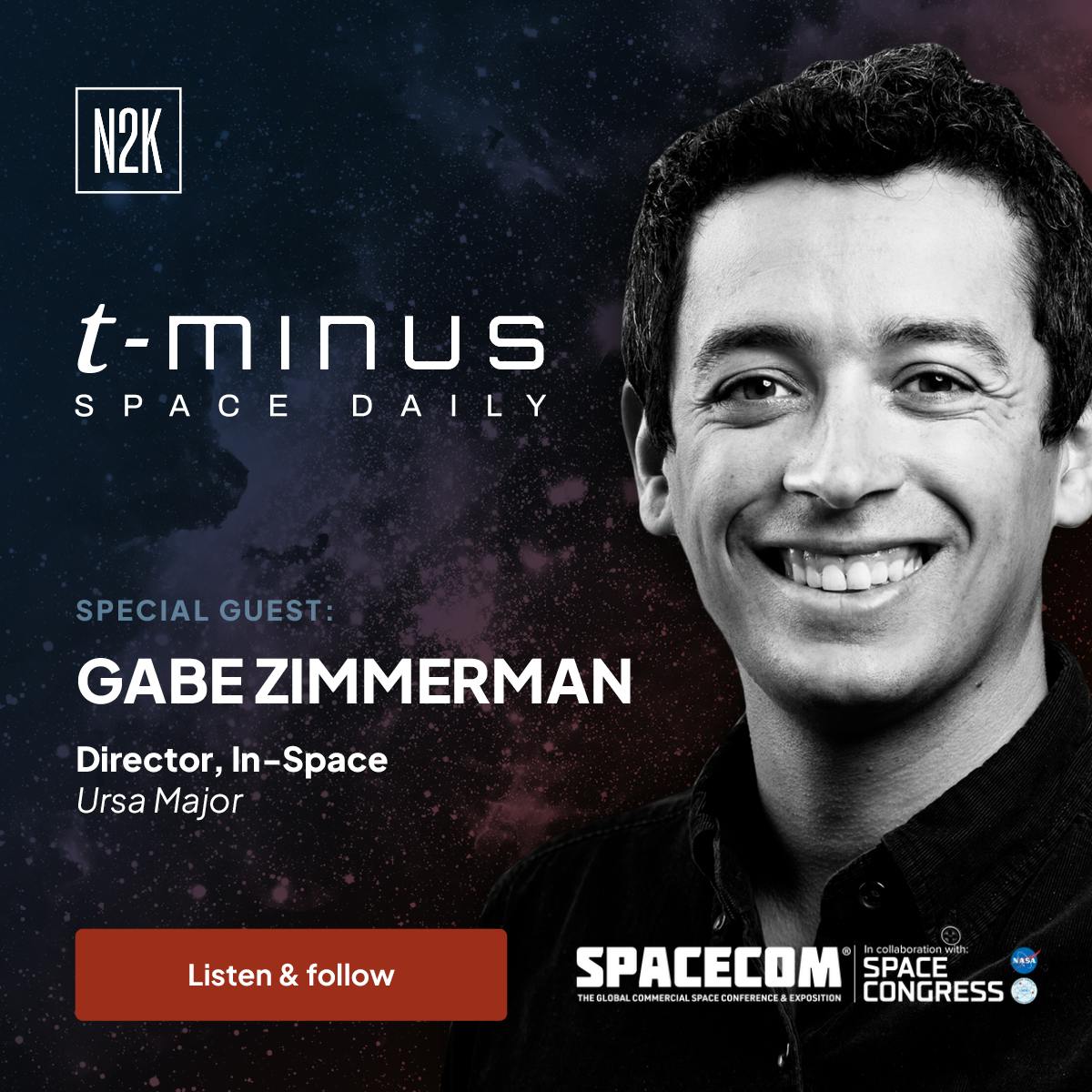
T-Minus: Space-Cyber Briefing
Rockets, Risk & Ramses.
00:27:26
ULA launched USSF-87 to GEO. Orbex has filed a notice of intention to appoint Administrators. ESA awarded OHB Italia a new contract for Ramses. And more.
Loading summary
Transcript35 lines
- [00:02]
Cyberwire Network Announcer
You're listening to the Cyberwire Network, powered by N2K.
- [00:12]
Cybersecurity Podcast Host
Identity is a top attack vector. In our interview with Kavitha Mariapan from Rubrik, she breaks down why 90% of security leaders believe that identity based attacks are their biggest threat. Throughout this conversation we explore why recovery times are getting longer, not shorter, and what resiliency will look like in this AI driven world. If you're struggling to get a handle on identity risk, this is something you should tune into. Check out the full interview@thecyberwire.com Rubrik. Maybe that's an urgent message from your CEO, or maybe it's a deepfake trying to target your business. Doppel is the AI native social engineering defense platform fighting back against impersonation and manipulation. As attackers use AI to make their tactics more sophisticated, Doppel uses it to fight back from automatically dismantling cross channel attacks to building team resilience and more Doppel outpacing what's next in social engineering? Learn more@doppl.com that's-o P E L.com.
- [01:36]
Maria Varmazes
Today is February 12th, 2026. I'm Maria Varmazes and this is T minus.
- [01:45]
Gabe Zimmerman
T minus 20 seconds to Los T Drift.
- [01:56]
Maria Varmazes
Planet Labs has announced strategic partnership with the Risk Management AXA digital commercial platform Hypersonica has raised 23.3 million euros in a Series A financing round. ESA has signed a new 81.2 million euro contract with OHB Italia for the development of the Ramses mission. Orbex has filed a notice of intention to appoint administrators. We'll explain more on what that means. ULA Vulcan launched the United states Space Force USSF 87 mission from Cape Canaveral Space Force Station. Our guest today is Gabe Zimmerman, Director of the Inspace Product Line at Ursa Major, and I spoke to Gabe about Ersa Major's new in Space propulsion offering. Definitely. Stay with us to hear more about that later in the program. Foreign let's dive into today's intel briefing, shall we? It was a very early start for some folks on the east coast today with United Launch Alliance's Vulcan lifting off from Cape Canaveral Space Force Station a little after 4am local time. It was the first launch for ULA of 2026, and the Vulcan was carrying the United states Space Force USSF 87 mission. Now, USSF 87 took an eastward trajectory from the cave, along with the payloads deployed to geosynchronous orbit. But not everything went as planned. According to witnesses, namely our partners at NSF, one of the Vulcan's solid rocket boosters or SRBs appeared to have another burn through issue at the throat of its nozzle. ULA acknowledged the issue on social media soon after the launch, sharing this we had an observation early during flight on one of the four solid rocket motors. The team is currently reviewing the data. However, it seems that it wasn't a big issue for ula, who went on to add in the post later that the booster, upper stage and spacecraft continued to perform on a nominal trajectory. That's a relief. The USSF 87 payload includes the Geosynchronous Space Situational Awareness Program, or GSAP system that will improve U.S. ability to rapidly detect, warn, characterize and attribute disturbances to space systems in the geosynchronous environment. Today's launch was the second national security space launch mission on a Vulcan rocket and we previously mentioned on this show that the UK firm Orbex is in financial trouble. They closed down their European branch and now the news is that the company is about to go into administration. Orbex has filed a notice of Intention to appoint administrators but will continue trading while all options for the future of the company are explored, including a potential sale of all or parts of its business or assets. The notice provides short term protection and allows the business time to secure as positive an outcome as possible for its creditors, employees and wider stakeholders. Orbex made this decision after fundraising, merger and acquisition opportunities all concluded unsuccessfully. The funding required for Orbex to remain a viable business was sought from a variety of public and private investors during its Series D funding round, which unfortunately ultimately failed. Several merger and acquisition opportunities have also been explored, with none resulting in favorable outcomes. As yet, we do wish the more than 100 employees at Orbex the absolute best of luck for the future. Let's turn our attention now to the European continent and the European Space Agency has signed a new contract with OHB Italia worth 81.2 million euros for the development of the Rapid Apophis mission for space safety, otherwise known as the Ramses mission. Ramses is planned for launch in 2028 and will rendezvous with the asteroid Apophis before its rare close encounter with Earth. The mission will provide unique insight into the physical properties and behavior of asteroids and strengthen international collaboration and European capabilities in planetary defense. The new deal builds upon the contract signed in October 2024 to begin prep work on the mission and brings the total value to approximately 150 million Euro. A second contract worth 8.2 million Euro was also signed with Italy's TYVAC International for the construction of one of Ramses Cubesats named Farinella after the Italian planetary scientist Paolo Farinella. This also builds on an earlier contract worth 4.7 million euros awarded for prep work last year and staying in Europe but moving more into the defense realm now. Hypersonic's company Hypersonica has raised 23.3 million euros in Series A financing. The Anglo German defense and aerospace company is developing and building Europe's first sovereign hypersonic strike capability. Hypersonica says the funds will accelerate the company's roadmap towards full scale flight testing beginning in Q1 2026 and help meet demand from NATO member states for deep precision strike capabilities, with which they say is a critical gap in Europe's defense portfolio. And Planet Labs has announced a strategic partnership with the Risk Management AXA digital commercial platform, also known as AXA dcp. AXA DCP will integrate data from Planet's satellites and high frequency base maps into its AI powered platform to better understand and manage both man made and natural disasters including floods, wildfires and hurricanes. Leveraging Planet's near daily global scan allows AXA DCP to provide its clients with a ground truth layer of environmental intelligence, enabling preventative action against extreme weather events. We do love it when data gathered in space has a real impact on us here on Planet Earth. And that is it, my friends, for today's intel briefing for you. As always, make sure to check the show notes or our show website space.n2k.com for further reading on all the stories that I've mentioned today.
- [08:47]
Cyberwire Network Announcer
This episode is brought to you by indeed. Stop waiting around for the perfect candidate. Instead, use Indeed sponsored Jobs to find the right people with the right skills fast. It's a simple way to make sure your listing is the first candidate. C According to Indeed data, Sponsored jobs have four times more applicants than non sponsored jobs. So go build your dream team today with Indeed. Get a $75 sponsored job credit at Indeed.com podcast. Terms and conditions apply.
- [09:17]
Maria Varmazes
Today's guest is Gabe Zimmerman, Director of the Inspace Product line at ERSA Major.
- [09:26]
Gabe Zimmerman
My name's Gabe Zimmerman, Mechanical Engineering by training at Cornell University. Did a informative and super awesome co op at JPL where I kind of got my teeth really into aerospace and have been in aerospace roughly the last decade since spent about five years at a legacy aerospace and defense company and then came to URSA Major originally as a designer doing work on Hadley and then Draper and now most recently the last year and a half has been all in space, which is really what we're here to talk about today.
- [10:02]
Maria Varmazes
It's always really cool to talk to you guys from Mercen Major because you all are so laser focused on what you do and you are very, very good at it. So it's always really cool hearing about what's the latest that you're working on. So tell me a bit about what you've been up to in the last year.
- [10:17]
Gabe Zimmerman
Sure. Yes. So Ursa Major as a whole has been just ticking off history making events, flying hypersonically, flying solid missile systems, and then really deploying this new in space product line focused on space mobility. And so when I talk about in space, it's obviously launch and it's kind of getting to orbit. But then we're really focused. The team I work with is on once you're in space, how do you get around and how do you do so effectively, efficiently, reliably? Kind of the last year has really just been technology maturation and manufacturing maturation and then also trying to really listen to what our customers and the end users are saying and respond to that to make sure we're bringing value to the table and really can offer a service and a technology that people want to use and need to use and we can stay ahead, cutting edge as a country and as a company.
- [11:15]
Maria Varmazes
Yeah, I'd love to hear more about that maturation that's been going on. I love the acronyms like trl. It's obligatory, but I feel like we gotta talk about that a little bit. So tell me a bit about that.
- [11:25]
Gabe Zimmerman
So the space mobility team is really focused on components and systems for satellite. So we're focused on monopropelant hydrazine. So it's kind of the legacy propellant and the legacy kind of tried and true a method to move around in space for a chemical system. And we are targeting if you want to actually offer something new and disruptive, you have to make all the pieces of the puzzle or all the pieces of the propulsion system. So for us, that's tanks, that's thrusters, that's avionics, and then that's system design. And so we really are targeting how do we take the components and walk them through, maturing the technology, iterating quickly, testing, testing again, learning some stuff, testing again, and then also co developing the manufacturing so that when we want to go make hundreds or thousands, we're not then figuring that out. We're actually doing that in parallel.
- [12:23]
Maria Varmazes
Both parts of what you just said I'd love to dive into. So let's talk about the components first and then we'll get into the broader.
- [12:29]
Gabe Zimmerman
Manufacturing base after we'll just start with thrusters. So we're making mono propellant hydrazine thruster. To do that, we're kind of using what's been proven and then building on that to make sure we can match the reliability and kind of performance of the legacy providers who have been objectively successful at delivering effective products, but then also offering a cost and a lead time that starts to discern Ursa Major because it's really a supply chain issue as much as it's a performance issue. And so to do that, we've done numerous trade studies and designs of experiments through the injector, through the catalyst bed, through the kind of the thermals. And have we. We've. We've run probably, you know, a dozen plus versions to continue to progress incrementally, learn something, iterate. And so the team has been doing that. That's all in a vacuum test environment. So you're getting tests like you fly. We're not. We really want to make sure we're wringing out anything we could learn before we go to orbit. Because that's a bad time to learn, you miss something. So we've got a really disciplined and effective technology path on the thruster and are kind of producing them at a nice cadence, stepping into kind of a higher rate production.
- [13:46]
Maria Varmazes
That sounds like that is the vision. And I know that it's been for a while, but you guys are moving really solidly in that direction of really building out that scale. There are a lot of steps between us now and then though. What does that look like in the meantime?
- [14:02]
Gabe Zimmerman
Yeah, there are a lot of steps and some of the hardest stuff is making a lot of something, making one of something. It can be a bit more artistic, it can be a little bit more manual. We really need to have manufacturing processes and digital backbone that lends itself to that scale. So for us, and I mentioned it briefly, it's kind of that codeveloping. So we don't want to figure out how to make a hundred after we've made 10. We want to be thinking about how to make 100 or a thousand as we go. So for us, that's smart, you know, strategic vertical integration. So bringing in things like vacuum brazing, which is a key process used throughout our thruster, where we control the process. We've developed our own specs for it and then we're using that successfully to make thrusters in batches. We can do lots. We've got CNC laser welding, so that's again all computer automated. We dial in a process, we qualify the process and then we build on that and use it for production. And there's kind of countless examples. But if you kind of get all the steps to get to a thruster ironed out, you can effectively scale a lot easier. Where maybe the answer to scaling is just a second shift or a second work center, but you've inherently built it around a scalable process. So that's really how we think about it as a co development and inherent to our philosophy as a product line and as a company. Because really across all the products it's about scale. People want a lot of the things so that we can use them somewhat without regret and strategically and not have to be rationing, for lack of a better term.
- [15:41]
Maria Varmazes
Yeah, especially you were mentioning space mobility. Huge area of growth right there. And we need a lot of what you all are making.
- [15:48]
Gabe Zimmerman
Yes.
- [15:49]
Maria Varmazes
And we need them soon.
- [15:50]
Gabe Zimmerman
Yes, yes. And we want to be able to. You know, there's some buzzwords like maneuvering without regret, like assured access to space. And those things rely on being able to get the hardware, trust the hardware, deploy the hardware and then get more of it. Right. Legacy aerospace. And there's a time and a place, but it's a lot of exquisite bespoke satellites and that could take years to engineer, years to build, years to launch. And for some of these applications it's a bit of a numbers game. So we are trying to angle ourselves to really support that because we think that's really where the industry is going. That's where what the government is looking for, the end users and ultimately kind of to. For national security reasons and also commercial and the benefits of civilians like you and me works for both. So.
- [16:38]
Maria Varmazes
So since we were talking about mobility and I'm thinking of sort of the larger in space servicing ecosystem, I know you all are doing a lot of work around enabling refueling as well, which you know, I've had a lot of fascinating conversations with other companies that are doing different parts of that interesting technical problem. But you all are doing something around that as well. So tell me a bit about that.
- [16:58]
Gabe Zimmerman
So we view refueling as kind of a key capability and cornerstone to make sure that we're future proofing or really just keeping up with the times. And so we look at refueling and modularity more generally at kind of a component level and at a system level. So our tanks, which are kind of one of the historically long lead and complicated parts, we're making those in house and those are designed with an elastomeric diaphragm that's inherently refuelable and so for some of our customers, they just want to buy components, tanks. And so that tank comes and is qualified to be refueled in orbit. And then at a more system level, because we're designing these propulsion systems with our components and have an inherent level of modularity, we're able to basically roll that refueling module in from whoever makes it and be agnostic to that, but offer that refueling, refuelability. And so we obviously rely on our customers who do the satellite bus integration to make sure that we're packaging and preparing the concept of operations conops for that. But we are kind of able to really baseline that and offer that in. And so it's a credence to kind of the way the industry is going, but also our ability to kind of look forward and say, hey, we know this is coming. It's happening in kind of more of a demonstration scientific method. But we think the future really is going to rely on it. And so how do we make sure we make things now that don't need to change to support that refueling?
- [18:23]
Maria Varmazes
That's super cool. I want to also ask about, when you talk about modularity, can you tell me a bit more about how you all define modularity? I'm not trying to be pedantic, although I am being a little pedantic, but.
- [18:33]
Gabe Zimmerman
Yeah, so for us there's kind of modularity at the component level and then there's modularity at the system level. And so from the component perspective, we're trying to make a 5 Newton thruster, let's say that you or any satellite manufacturer could go use. And so there's a modularity in can you go take our equivalent product? But maybe that's easier to get because it's more manufacturable or shorter lead time and kind of swap it at the bus level. So we can offer kind of bus level modularity by having discretized components that are offering a drop in replacement, more of a commercial off the shelf cost approach rather than everything being bespoke. And then there's a system level modularity where if we're making all the pieces of the system and you, Maria, want more Delta V, well, we can take the same propulsion system, do some repackaging and put a bigger tank and all of a sudden you've got, you know, 50% more, 75%, whatever, more Delta V. But you haven't changed fundamentally the whole design. Now, you know, you do some repackaging, some new cads, a little bit of manufacturing, but to, not to oversimplify it, but functionally not everything goes clean sheet just because you want to tweak one parameter. If you want full 6 degree of free maneuverability, maybe you need 12 or 16 thrusters. So then you can add some additional manifolds and tubing, but your tank could stay the same. And so there's kind of different ways. And then maybe the last. At the piece part level, we've got different sizes of tanks that have common pieces of machined. Machined parts, I should say. And if those same machine parts can go to two different tank sizes, then at the PSPAR level, you're almost able to diverge into two different sized tanks without redoing everything from scratch. So again, you kind of almost drive that modularity down further. You can get more buying power, more manufacturing efficiency, and then have a wider range of products without driving inherent inefficiencies.
- [20:27]
Maria Varmazes
It's also a lot more difficult to pull off than I think you are making it sound. So I'm also really admiring the fact that you're talking on those different levels because it's one of those things that's like, yeah, why haven't we done that before? Because it's super stinking hard.
- [20:40]
Gabe Zimmerman
Yeah. And the designers on our team will attest to go do that work and do that legwork up front is tremendously. It's a big investment, I should say. But the return on investment for ourselves and for our customers is that's like where the proof is in the pudding and it's where that justifies that. You know, let's make the design problem 10% harder so that the manufacturing problem is 50% easier. That kind of like trade off. It's always a trade off in engineering and aerospace, but we really view that as a worthwhile trade.
- [21:14]
Maria Varmazes
So the next year or so, again, I imagine you all have had a very busy year as it is. What's next?
- [21:21]
Gabe Zimmerman
Yes. So for, for the Inspace team, what's next is pushing through qualifications. So we're, we're either starting or about to start qualification on a handful of products. Those products are going to go into the hands of customers, partners of ours who we're excited about because they have a shared focus and a shared vision on that kind of supply chain and manufacturing and scale. That's really what they're targeting, that's what we're targeting. And so we're excited to kind of get products over the line, get products on the shelf, in the hands of our current customers, in the hands of future customers, and then into orbit in 2027, maybe a little earlier. Some of that's a little outside of our control, but either way it's a very dynamic, you know, 12 to 18 months upcoming and then Ursa more widely has got plenty of flights coming across our product lines. And so you know, that same, you know I'm talking through the lens of Inspace, but that you could take my words and basically apply them to our hypersonics platforms, our solid missile systems platforms and it's a very similar narrative. So so it's really a hyper growth time, a deployment time and a scale time.
- [22:42]
Maria Varmazes
We'll be right back.
- [22:47]
Gabe Zimmerman
The world moves fast. Your workday even faster. Pitching products, drafting reports, analyzing data. Microsoft 365 Copilot is your AI assistant for work built into Word, Excel, PowerPoint and other Microsoft 365 apps you use, helping you quickly write, analyze, create and summarize so you can cut through clutter and clear a path to your best work. Learn more@Microsoft.com M365 copilot.
- [23:19]
Maria Varmazes
Welcome back. Still going strong all these years later. The newest from NASA's Hubble Space Telescope is that it has captured its clearest view yet of the Egg Nebula. No yolk the Egg Nebula is a rapidly dying sun like star wrapped in layers of freshly shed dust and gas. Would that make it sunny side up? Or maybe over easy? The Egg nebula is about 1,000 light years away, tucked in the constellation Cygnus. Though the star itself is hidden inside a dense dust cocoon, twin beams of light punch through holes in the dust, illuminating delicate arcs and ripples quite a bit like rings in a cosmic tree trunk. Egg is a pre planetary nebula. It is a fleeting stage that lasts only a few thousand years, a cosmic blink of an eye when a star is shedding its outer layers but hasn't yet ignited the glowing shell of a full planetary nebula. And yes, the pictures are cool. Link in the show notes, go check them out. But it's more than that. This is a rare chance to study stellar death in real time. Stars, including our local one, don't go quietly into the good night. They sculpt. They illuminate. They seed the galaxy with the raw materials for future worlds and life forms like us. They go kaboomy in a beautiful way. And yes, that is a technical term. And in this case, they leave behind something that looks almost impossibly diaphanous and delicate. A luminous cosmic egg cracking open in space. And that's T minus Brought to you by N2K CyberWire we'd love to know what you think of our podcast. Your feedback ensures we deliver the insights that keep you a step ahead in the rapidly changing space industry. If you like this show, please share a rating and review in your podcast app. Please also fill out the survey in the show notes or send an email to space2k.com we are proud that N2K Cyberwire is part of the daily routine of the most influential leaders and operators in the public and private sector. From the Fortune 500 to many of the world's preeminent intelligence and law enforcement agencies, N2K helps space and cybersecurity professionals grow, learn and stay informed. As a nexus for discovery and connection, we bring you the people, the technology and the ideas shaping the future of secure innovation. Learn how@n2k.com N2K's senior producer is Alice Carruth. Our producer is Liz Stokes. We are mixed by Elliot Peltzman and Trey Hester with original music by Elliot Peltzman. Our executive producer is Jennifer Ivan. Here Kilpe is our publisher and I am your host, Maria Varmazes. Thank you for listening. We'll see you tomorrow.
- [26:18]
Gabe Zimmerman
T minus.
- [26:33]
Cybersecurity Podcast Host
If you only attend one cybersecurity conference this year, year make it RSAC 2026. It's happening March 23rd through the 26th in San Francisco, bringing together the global security community for four days of expert insights, hands on learning and real innovation. I'll say this plainly, I never miss this conference. The ideas and conversations stay with me all year. Join thousands of practitioners and leaders tackling today's toughest challenges and shaping what comes next. Register today@rsaconference.com cyberwire26 I'll see you in San Francisco.
- [27:18]
Cyberwire Network Announcer
My dad taught me a lot, including how easy it is to forget to cancel things. So I downloaded Experian, my bff. Big Financial Friend Experian could help me cancel my unused subscriptions and lower my bills, saving me hundreds a year. Get started with the Experian app today. Your big financial friends here to help you save smarter. Results will vary. Not all bills are subscriptions eligible. Savings not guaranteed. $631 a year average savings with one plus negotiations and OnePlus cancellations paid. Membership with connected payment account required. See experian.com for details.
- [27:46]
Maria Varmazes
Experian.