← T-Minus: Space-Cyber Briefing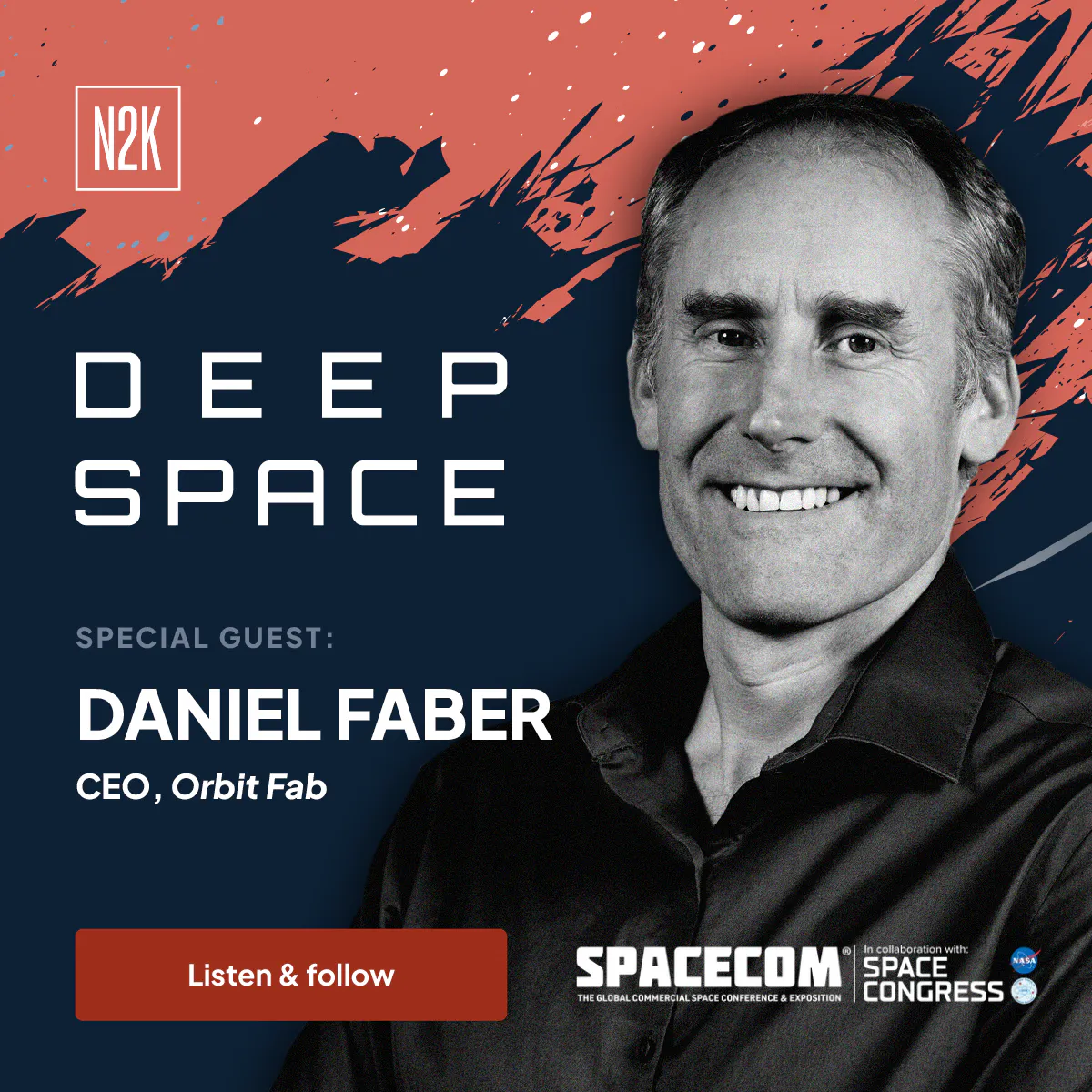
T-Minus: Space-Cyber Briefing
The future of in-space fueling.
00:25:33
Orbit Fab positions itself as providing gas stations in space. Is there a need for it in the market? Who is buying this service? We speak to CEO Daniel Faber.
Loading summary
Transcript120 lines
- [00:02]
A
You're listening to the Cyberwire Network, powered by N2K.
- [00:13]
B
Ever wished you could rebuild your network from scratch to make it more secure, scalable and simple? Meet Meter, the company reimagining enterprise networking from the ground up. Meter builds full stack zero trust networks, including hardware, firmware and software, all designed to work seamlessly together. The result? Fast, reliable and secure connectivity without the constant patching, vendor juggling, or hidden costs. From wired and wireless to routing, switching, firewalls, DNS security and vpn, every layer is integrated and continuously protected in one unified platform. And since it's delivered as one predictable monthly service, you skip the heavy capital costs and endless upgrade cycles. Meter even buys back your old infrastructure to make switching effort, transform complexity into simplicity and give your team time to focus on what really matters, helping your business and customers thrive. Learn more and book your demo@meter.com cyberwire that's M E T E R.com cyberwire.
- [01:31]
A
Orbit Fab positions itself as a future gas station in space. Well, is there a need for on orbit refueling? Who is buying the service? Well, to learn more, we caught up with CEO Daniel Faber at the Space Mobility Conference. This is T Minus Space Daily and I am your host, Maria Varmazes. And returning to speak with me this time in person is Daniel. Daniel, would you mind reintroducing yourself for our audience, please?
- [02:17]
B
Absolutely.
- [02:17]
C
It's great to be back. Daniel Faber, the CEO of Orbit Fab. Gas stations in space is our game.
- [02:22]
A
All right. And petrol stations in space, alternately. Thank you so much for speaking with me again. It's been a little while since we last spoke. It was virtual last time, so it's been a bit. It has.
- [02:32]
C
And it's great to see you in person.
- [02:33]
A
Likewise. Yes, it's nice to finally meet you in person. So last time we spoke, you all had announced at that time a new expansion into the uk, and it sounds like that's been going really well. Can you give us an update?
- [02:44]
C
Yeah, absolutely. So it was now three years ago, perhaps four, that we expanded into the uk. So that dates how long it is since we had.
- [02:53]
A
Oh my goodness. Okay.
- [02:55]
C
But yeah, at the time, the UK Space Agency had written a strategy to make the UK the world leader in satellite servicing and was bringing all the satellite servicing companies to the UK for us providing fuel in orbit. It was obvious that our first customers, the ones that were going to use a lot of fuel, are the ones that are going to move a lot. And if you're going to build a tow truck, you've got to go from satellite to satellite, to satellite. And it's not going to work unless you can refuel it, because otherwise you're throwing away your shiny new tow truck after a couple of tows. And so we had to be there because our customers were moving there. And so we hired one person and said, see what you can make of this. We got a really good person in Manisha who had previously stood up Bryce Tech's office there. And so he knew what he was doing and really grabbed it and ran with it, was able to win some contracts, took the resources that we gave him and built that up. And then his wife got a phenomenal job in the us. And so he told me one day that he was leaving when he got it up to about eight people. But he also told me that he'd hired the chief of staff of the UK Space Agency.
- [04:05]
A
Oh, that's not too bad.
- [04:06]
C
To come on board and run Orbit fab's UK office, which was absolutely brilliant. So Jake Geer is now the managing director of our UK office and he's taken it to a whole other level. So we now have 25 people in the UK. It's about a quarter of the company.
- [04:24]
A
That's amazing.
- [04:24]
C
And they've been doing great things. They pursued parallel technology. So in the us, we're focused on US government needs of hydrazine fuel delivered in geostationary orbit. In the uk, they focused on the fuels that are used most by the commercial satellite operators. So xenon and krypton, which are much higher pressure, very different characteristics, hard to pump and move them around. And they've been flight qualifying all of that hardware, and just signed a contract to build a fuel delivery vehicle for xenon for low Earth orbit with the European Space Agency.
- [04:57]
A
Wow. Well, congratulations on all of that.
- [04:58]
C
Thank you.
- [04:59]
A
The technical challenges of just building one model, for example, for the US government must have been, I can't even begin to imagine, to do an entirely separate adapter. The technical challenge of that must have been fascinatingly difficult, for lack of better terminology.
- [05:16]
C
Yeah. As an engineer, it's fun.
- [05:18]
A
Yeah. Yeah, of course. Right.
- [05:20]
C
The most difficult thing is understanding what it has to do because you're trying to dock satellites together and all, but not something that's been done a lot. You're in a plasma environment with really harsh thermal differences between different parts of a spacecraft, let alone two different spacecraft. Because it's a plasma. The spacecraft are charging up electrostatically. They can be at tens of thousands of volts relative potential. And then they're coming into dock with some level of misalignment impact energies and velocities and capture envelopes and lighting conditions are rather difficult because there's no atmosphere, the sky isn't glowing. You get one harsh light source from the sun and then you've got reflections off the other spacecraft and all these kinds of things. So you have to think about all of those things all together, all at once and try and boil that down into a gas cap that's as simple and small as possible and puts no imposition on the client. And then you move all the complexity over to the fuel delivery vehicle. And it's got to be able to do this reliably, repeatedly, with spacecraft built to completely different configurations by completely different manufacturers from different sides of the world. And so once we figured out those requirements and that interface, which took us years.
- [06:37]
A
Right.
- [06:37]
C
But we were able to share that from our US office to the UK office.
- [06:40]
A
Yeah.
- [06:40]
C
And so at least when they started working, they've got a higher pressure propellant with different characteristics. But a lot of the basics of getting the two spacecraft together, we could share that. We didn't even have to share the reasons and how deeply we went. I just share an interface specification and they could build off that interface spec. So that allowed them to move a lot more quickly.
- [06:58]
A
Okay, that makes sense. Can I back up a little bit though? As you're describing, just again, from an engineer point of view, a fascinating problem to solve. But backing up years ago, when you were looking at the scope of what you're trying to solve and build for, I'm sure you got a lot of that's not possibles. Right. Did people think that this was even possible when you were starting about like this would be great, but not possible.
- [07:20]
C
Or how it's not a new idea. The idea that it's possible wasn't really questioned.
- [07:27]
A
Okay.
- [07:28]
C
What was questioned was, do I need it? Do I need it? Now is the time. Now it's a 40, 50 year old idea. Why hasn't it been done yet? And the answer is, because everyone's always come back and said, let's let somebody else worry about it.
- [07:43]
A
Interesting.
- [07:43]
C
From our investors perspective, think about the bet that I'm asking them to take.
- [07:47]
B
Right.
- [07:47]
C
I'm going to have to go through all this engineering challenge to figure out what I'm designing. I've got to design it, build it, test it, deploy it to orbit, prove that it's safe.
- [07:56]
A
Yeah.
- [07:56]
C
And then people will buy a gas cap and they'll wait a few years until they run out of fuel and then they might buy Fuel. So closing that business model with significant upfront capex and a very long time until revenue has previously been seen as impossible. And we hear at Space Mobility and we're hearing speaker after speaker talk now about how critical it is to have refueling.
- [08:20]
A
Right. Yes.
- [08:21]
C
And yet there are some high ranking generals saying we've run the war games and I still don't get it.
- [08:28]
A
Interesting.
- [08:29]
C
They're in a paradigm, they've become very good at operating with one tank of fuel and to change that paradigm is hard. And so we're still running into that five or six years after we set up the company, after we've flight qualified all the systems, after we've deployed the first fuel depot on orbit and we still get that question, is now the right time?
- [08:49]
A
Interesting. That's so what an interesting takeaway for people who are thinking about even if they're starting their own business in this world about the technical problems can be addressed. It's really the people, the culture, the business.
- [09:05]
C
That's right. It doesn't mean the technical problems are easy.
- [09:07]
A
No, certainly not. Certainly not.
- [09:08]
C
There are great engineers in the space industry.
- [09:10]
A
Oh yeah.
- [09:11]
C
And so we're pretty confident we can solve this and think about docking two spacecraft together. I've got self driving spacecraft here that come together in that environment that I described and are able to reliably dock together. One of the reasons that we can feel pretty confident about that is because billions of dollars have gone into self driving cars and the compute systems have improved, the algorithms have improved. There are a lot more people with that expertise and we can just borrow that.
- [09:35]
A
Why not?
- [09:36]
C
It's a great place to start.
- [09:36]
A
Yeah. Repurposing.
- [09:37]
C
It's the same but different.
- [09:38]
A
Yeah.
- [09:39]
C
So now we have self driving spacecraft and these kind of like the technology does move and that helps. But yeah, from the beginning we were confident that we could do the engineering. It's just a matter of money and time.
- [09:53]
A
That's the trick, isn't it? Always the.
- [09:55]
C
What we had to get comfortable was that someone was actually going to care enough to pay for it.
- [09:59]
A
Right, right. And that's no easy feat right there, that's for sure. But going back to your point about hearing top brass in the military going I don't understand it as much potentially. I'm also hearing a lot of people going, I do understand it. I mean I'm sure you are hearing that as well.
- [10:17]
C
That has definitely changed over the last five or six years. Absolutely. It's gone from a few people saying yeah, we're going to need this soon to now only a few people saying, now might not be the time.
- [10:31]
B
Right.
- [10:31]
C
It's completely flipped in the ratios of people that get it. This conference has now been running for three years. And so space mobility, the existence of Space Force was a reaction to the realization that space is a contested environment.
- [10:46]
A
That's right.
- [10:46]
C
And so the big question Space Force has right now is just, are we only caring about serving people on the ground, making sure they have comms and remote sensing and all those kinds of things, or do we actually care about protecting those assets in orbit?
- [11:00]
A
Yeah, yeah.
- [11:01]
C
And every day space becomes more contested. It's fairly clear that the job of Space Force is going to become more and more dominated by keeping those assets on orbit alive and active and able to provide the services which have, frankly, become completely indispensable to economies on the ground as well as national security on the ground.
- [11:22]
A
Absolutely. I'm also curious about the other markets that you all are looking at. I'm sure outside of the US and the uk, you're also looking at. You mentioned the European Space Agency. Is that an area of huge growth for you all, or is that an area you're going to be focusing on?
- [11:38]
C
Absolutely. So this market's going to be driven initially by national security concerns. It's absolutely imperative that aligned Western nations have this capability that they're interoperable. These things matter. Six months ago, the Chinese did the first refuelling in orbit. And it's not 100% clear whether they refueled or just attached a jetpack, but either way, they had a satellite that was being quite active on orbit. It was checking out other satellites. They actually grabbed a satellite and moved it.
- [12:05]
A
Yeah, yeah.
- [12:06]
C
And put everybody on notice they had this capability. And so the US had drifted a couple of satellites over to check out what it was doing. The Chinese launched a spacecraft docked with that other spacecraft and refueled it, and they burned six years worth of fuel in 10 minutes, completely changed the orbit and left the American satellites in their dust.
- [12:23]
A
Just to see what I can do. Let me show you. Yeah, yeah.
- [12:27]
C
We could follow them, but if we burn six years worth of fuel, we've just lost six years off the back end of the mission.
- [12:33]
A
Yeah.
- [12:34]
C
And the Chinese, because they can refuel, will probably just do another burn and you can follow them. The second time you've got zero fuel left, you're gone. And so the decision had to be made that we can't afford to follow them, which means that we've already been completely outmaneuvered in orbit.
- [12:51]
A
Yeah, Yep.
- [12:52]
C
Yep. It's it's just shocking. This situation has come about when the US needs to be leading. We need to be the ones providing the deterrent on future conflict and the US and aligned Western nations. So that's driving the imperative. The good thing for the commercial industry and civil and everything else is that the advances we make on the back of funding for that imperative on national security, those advantages then can help us grow the in space economy.
- [13:19]
A
Yes.
- [13:19]
C
And create all of the other things that a lot of us got into this industry to see to see happen.
- [13:24]
A
That's right. That's absolutely right. We'll be right back.
- [13:41]
B
If securing your network feels harder than it should be, you're not imagining it. Modern businesses need strong protection, but they don't always have the time, staff or patience for complex setups. That's where Nordlayer comes in. Nordlayer is a toggle ready network security platform built for businesses. It brings VPN access control and threat protection together in one place. No hardware, no complicated configuration. You can deploy it in minutes and be up and running in less than 10. It's built on Zero Trust principles so only the right people can get access to the right resources. It works across all major platforms, scales easily as your teams grow and integrates with what you already use. And now Nordlayer goes even further through its partnership with CrowdStrike, combining NordLayer's network security with Falcon Endpoint protection for small and mid sized businesses. Enterprise grade security made manageable. Try Nordlayer risk free and get up to 22% off yearly plans plus an extra 10% with the code CYBERWIRE10. Visit nordlayer.com cyberwire daily to learn more. Most security conferences talk about Zero Trust Zero Trust World puts you inside this is a hands on cybersecurity event designed for practitioners who want real skills, not just theory. You'll take part in live hacking labs where you'll attack real environments, see how modern threats actually work and learn how to stop them before they turn into incidents. But Zero Trust World is more than labs. You'll also experience expert LED sessions, practical case studies and technical deep dives focused on real world implementation. Whether your blue team, red team or responsible for securing an entire organization, the content is built to be immediately useful. You'll earn CPE credits, connect with peers across the industry and leave with strategies you can put into action right away. Join us March 4th through the 6th in Orlando, Florida. Register now@ZTW.com and take your Zero Trust strategy from theory to execution.
- [16:21]
A
I feel like I kind of want to pick your brain a little bit about other parts of the space industry that you're especially intrigued about right now because you are in such an interesting part of it yourself. Not just you personally, but you're. I'm curious about what else you've got your eye on.
- [16:37]
C
Well, I think we mentioned last time we spoke, I got into this 25 years ago because I thought that getting life, getting humanity off Earth is going to be the most significant thing that's happened since we crawled out of the ocean.
- [16:49]
A
Yeah, right.
- [16:50]
C
If you think about it, this is crawling off Earth into the solar system and into the galaxy. Why would I work on anything else?
- [16:56]
A
Yeah, yeah, yeah.
- [16:57]
C
But in Australia at the time there was no space agency. And so I wrote down a list of industries that I thought could pay for the first permanent job in space and started chipping away at everything related to asteroid mining. And so I've seen a lot of things in that direction. I've dug into space tourism, space based solar power in space manufacturing. The FAB in orbit FAB was because we started looking at semiconductor manufacturing.
- [17:19]
A
Yeah, I actually wondered about that because my dad used to work in a fab, so I recognize that name.
- [17:23]
C
And I said, and then we tippeted hard and we do refueling. So yeah, I've kept an eye on all of these things and been interested in where it goes. Mostly the recognition is that we need a really thriving in space economy that is constantly reducing the cost to do operations in space and increasing the economic benefits and opportunities. And at some point you'll cross a threshold where we can either put people into space cheaply and cost effectively and we can just pay to go there because we want, or we'll create a need and an imperative that it's just going to be more profitable to have people in space permanently. And at that point we become interplanetary. And so everything that I'm looking at here, all these things I've mentioned are economic reasons, drivers profit, incentives to have more activity in orbit. So while we're working on fuel, right. I boil that down and say, well, today I need to build a gas cap because it doesn't exist. And that's what's going to unlock things. Now we've got the gas cap, right? So now I need to build fuel delivery vehicles and fuel depots and an infrastructure that uses that, that brings the capability to bear. And other people will build on that to build the servicing vehicles so we can then robotically do assembly and upgrades and repairs. At the moment, no satellites interact in orbit. The last thing you want to hear is that someone's going to come and poke your satellite. We need that to be not just common, but accepted, understood, desirable, a part of the standard operating procedure. It's going to be so much cheaper to upgrade satellites and not have to launch. The structure, the pointing controls, the power, the thrusters, the only thing that's on Moore's Law is the transponders or the instruments. Let's just replace the instruments. It'll save us 90% of the launch mass. And driving that cost down will mean that demand will go up by 100 fold. So everyone's going to benefit from that cost coming down. But that infrastructure in orbit starts to do it. And that will start to unlock larger facilities. Asteroid mining, tourism, manufacturing, all these things are going to need an industrial chemical supply chain. The ability for spacecraft to interact in orbit, all these kind of things. So I'm extremely bullish about where the industry's going to. And frankly, we really lucked out being that industrial chemical supply chain and happening to work on something so critical.
- [19:42]
A
Yeah. You are extraordinarily well positioned just to be at the heart of all of that. And it's a wonderful place to be. You mentioned a little bit about some future plans. I don't know if that was maybe at the beginning of our chat or a little earlier. I just wanted to make sure. I asked you about sort of the what's coming up next. What's on the radar for you all?
- [20:02]
C
So I mentioned we've got all the hardware flight qualified.
- [20:05]
A
Yes.
- [20:06]
C
We're on contract to deliver fuel for the US Government end of this year or early next year. We've got four systems total going up to deliver fuel to multiple clients, including now in Europe, the delivery of Xenon to low Earth orbit. So executing on that is the highest priority. And really perfecting that technology and building out the operational architecture and infrastructure. Because while we have all the equipment going up, it's all minimum viable product. So we need to scale that. So that's the next big step. But looking beyond that, some of the things that we're interested in is transitioning from a company that does storage and delivery into a company that does refining storage and delivery. Which looks a little like oil and gas. Right.
- [20:52]
A
Interesting.
- [20:53]
C
I don't want to become an asteroid mining company. Not with orbit fabric.
- [20:56]
A
Yeah.
- [20:56]
C
I don't want to become a shipping company. I don't want to do orbital transfer vehicles. I don't want to become a servicing company. But I'd like to be the biggest customer of asteroid or moon mine material. So this Starts off by launching from the ground one inert, simple feedstock that's easy to get into orbit. Water or something similar. And then turning that into a range of products that I'm already selling and already head of a market for. So on the propellant side, I could launch water and turning into hydrogen peroxide, hydrogen, oxygen or water. Four products for one storage facility of water. There are other chemicals that we're looking to produce, but that's the thin end of the wedge that gets us to fully refineries and processing asteroid material.
- [21:42]
A
Huh. So then in that way you would be almost a customer of another company that would be potentially doing some sort of asteroid mining and sort of feeding back into the space industry there.
- [21:54]
C
Yep.
- [21:54]
A
Yeah.
- [21:54]
C
The biggest problem with asteroid mining, of all the risks that they have, geology, technology, et cetera.
- [22:00]
A
Many. Yes.
- [22:01]
C
The biggest risk is no one's buying.
- [22:03]
A
Indeed. That's. I've often heard that too. People go, it sounds cool, but who's going to pay for that? Right.
- [22:08]
C
So what I'm trying to build is the market.
- [22:09]
A
That's amazing. That is amazing. All right. That would also be truly transformative to see that happen. So I think so. Yeah. Yeah. A little transformative, you know, just for fun. Well, that is also quite an interesting idea, just in general. So I just want to let that marinate for a moment. Is there anything else that you wanted to share with the audience today before.
- [22:31]
C
We close out, start building all this stuff? What orbitfab is building is we think it's fun and absolutely critical. And if we didn't think it was the most important thing that needed to be worked on, we wouldn't. But there's so many other people building pieces of infrastructure that are really important. And we don't build spacecraft bosses, we buy them.
- [22:50]
A
Yes.
- [22:50]
C
There's a lot of companies that are working to build lower cost spacecraft buses in greater quantity and everything else we don't build. The guidance and navigation, the rendezvous and docking, we buy that too. But that's a critical product and it needs to be productized and brought to market and matured so that everyone's comfortable with spacecraft docking and zipping around each other. There's other technologies that are being developed now that are coming online in the next couple of years that when looked at together, produce enormous opportunities, ways to rewrite the current business model.
- [23:21]
A
Such as.
- [23:22]
C
So I described how you could upgrade a satellite.
- [23:25]
A
Yes.
- [23:25]
C
Currently, if you want to do a global telecommunications constellation, you do a design of a highly integrated and optimized spacecraft. You build a satellite factory.
- [23:35]
A
Yep.
- [23:36]
C
You build a rocket. Oh, did I say you had to design a rocket? You build a rocket and you launch hundreds or thousands of rockets to get up tens of thousands of satellites in the future. You'll call up somebody that makes transponders, like Ericsson or Nokia or whoever they are, and say, I want 200,000 transponders, please. You'll call up a servicing company, maybe Astroscale, Clearspace, True Anomaly, Starfish, and say, I would like these installed on these cell phone towers, please. You call up a cell phone tower company. Just like in the US we have American Tower and Crown Castle. Someone will own a half a million cell phone towers in space. And you'll say, I'd like 200,000 slots, transponder slots for the next 25 years. And within a year, you will have deployed an entire global constellation that will be operational for a fraction of the capex that it would have cost if you had to build spacecraft.
- [24:31]
A
Hmm. The teacher is modular.
- [24:33]
C
That's it. So there's an opportunity to be the cell phone tower company.
- [24:38]
A
Interesting.
- [24:39]
C
Crown Castle and American Tower, 100 billion dollar companies because they own cell phone towers. That kind of model, the most exciting ones are almost certainly the ones that I can't imagine.
- [24:49]
A
Yeah, right.
- [24:50]
C
They're going to emerge smarter. People are going to come up with them. There's huge opportunities right now. So if there's a takeaway, it's go find those opportunities and surprise everybody in the industry by making something exist that no one thought of before.
- [25:05]
A
That is the best way to leave things out in that. So I want to leave that there. So thank you. Thank you so much for speaking with me and it was really lovely talking with you again and also meeting you in person this time.
- [25:14]
C
So it's a pleasure. I look forward to being back in a couple of years and telling you all of the stuff that we've done in that time as well.
- [25:30]
A
That's T minus deep space. Brought to you by N2K CyberWire. We'd love to know what you think of our podcast. Your feedback ensures we deliver the insights that keep you a step ahead in the rapidly changing space industry. If you like our show, please share a rating and review in your podcast app or you can send an email to space2k.com we are proud that N2K Cyberwire is part of the daily routine of the most influential leaders and operators in the public and private sector. From the Fortune 500 to many of the world's preeminent intelligence and law enforcement agencies, N2K helps space and cybersecurity professionals grow, learn and stay informed. As the nexus for discovery and connection, we bring you the people, the technology and the ideas shaping the future of secure innovation. Learn how@n2k.com N2K's senior producer is Alice Carruth. Our producer is Liz Stokes. We are mixed by Elliot Peltzman and Trey Hester with original music by Elliot Peltzman. Our executive producer is Jennifer Ivan. Peter Kilby is our publisher and I am your host, Maria Varmazes. Thank you for listening. We'll see you next time. Sa. Foreign.
- [27:15]
B
If you only attend one cybersecurity conference this year, make it RSAC 2026. It's happening March 23rd through the 26th in San Francisco, bringing together the global security community for four days of expert insights, hands on learning and real innovation. I'll say this plainly, I never miss this conference. The ideas and conversations stay with me all year. Join thousands of practitioners and leaders tackling today's toughest challenges and shaping what comes next. Register today@rsaconference.com cyberwire26 I'll see you in San Francisco.
- [28:00]
A
Wanna see your brand on tv? Roku Ads Manager makes it easy to launch targeted ad campaigns in minutes, track results in real time, and drive on screen purchases with just a click of the Roku remote. Get a $500 match on your first $500 spent with code ROKU500@ads.roku.com that's code ROKU500s.roku.com Terms apply.