← Take Command: A Leadership Podcast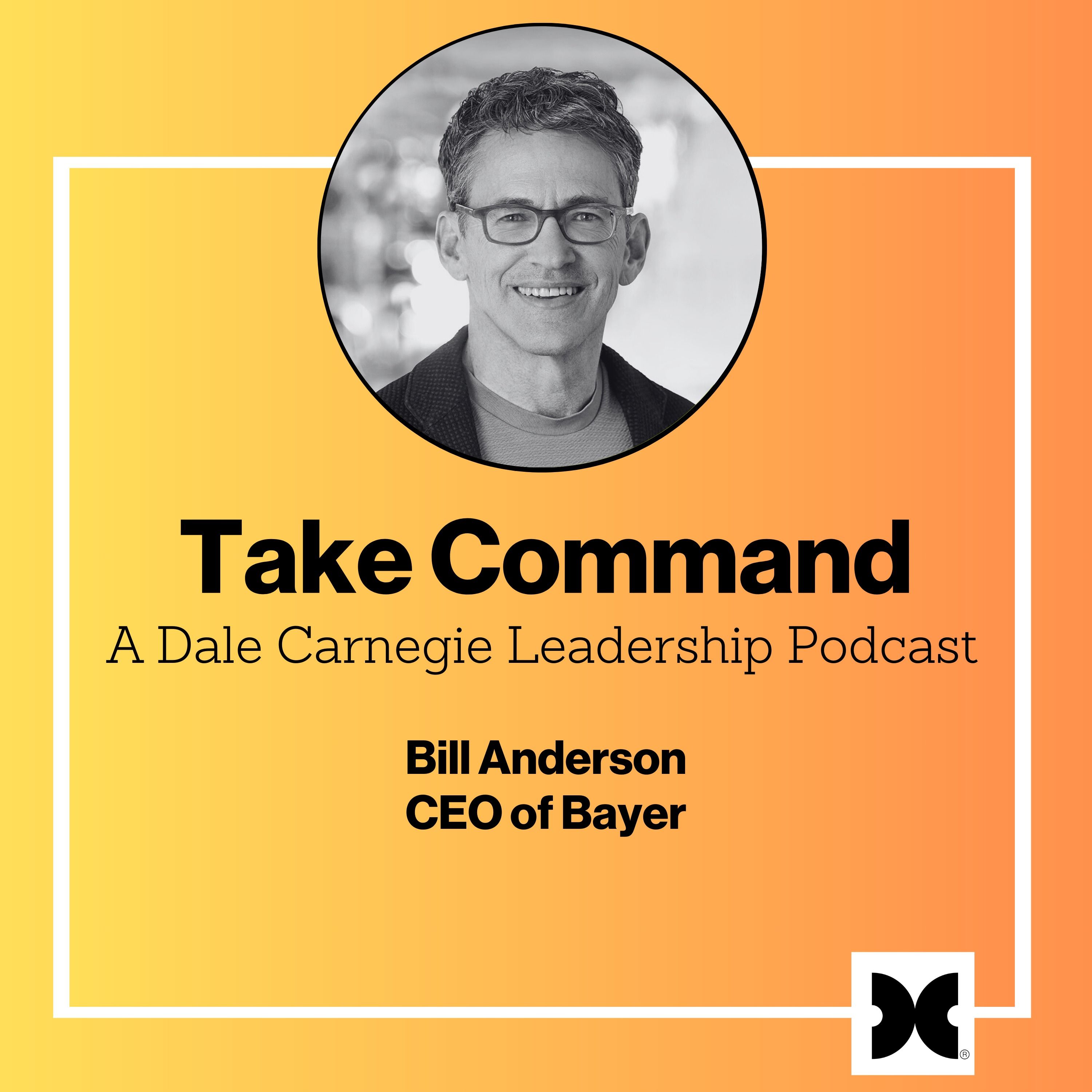
Take Command: A Leadership Podcast
95% Decisions, 100% Impact: Rethinking Leadership
00:39:00
Bill Anderson, CEO of Bayer, has built his career by transforming organizations from the inside out, focusing on empowering people and breaking through bureaucracy. He says, “I didn’t need more of a work ethic, I didn’t need more attention to detail, I needed to be focused on helping other people be successful.” Bill’s episode is packed with actionable insights. He shares why giving decision-making power to the people doing the work is key, how to redesign organizations around purpose and customers, and why curiosity and relentless improvement are critical traits for leaders. Bill believes, “Probably the most common principle that they all share is that the people doing the work need to be the ones making the decisions… 95% of decisions should be made by the people doing the work.” Tune in for this and other practical leadership wisdom from Bill.
Loading summary
Transcript38 lines
- [00:00]
A
People don't realize that leadership is not a feeling. People say, oh, hey Bill, you guys are doing this big culture change at Bayer. And I always stop and say, no, no, we're not doing a culture change. We're changing the mechanics.
- [00:24]
B
Welcome to Take a Man a Dale Carnegie podcast. I'm Joe Hart, CEO of Dale Carnegie. And before we started, make sure to follow take command so you never miss an episode that helps you lead with clarity and purpose. Today's guest has spent over three decades at the forefront of biotechnology and healthcare. A scientist at heart, he's built a career driving innovation and impact. And he'll share how a pivotal early challenge shaped the way he leads global teams. Today, he's guided some of the most influential organizations in the field, including Genentech and the pharmaceuticals division at Roche. His experience gives him a rare ability to move effortlessly from the manufacturing floor to the lab to the boardroom. Today, he leads one of the world's largest life sciences organizations. Please welcome the CEO of Bayer, Bill Anderson. Bill, welcome to the Dale Carnegie Takeman podcast.
- [01:29]
A
Hey, thanks Joe. Great to be here.
- [01:31]
B
I'm glad to have you here and honored to have you here. You're someone I have admired in terms of the work that you've done and certainly, I mean, you took over as the CEO of Bayer in 2023, a formidable undertaking. Such a massive company and certainly a company in a state of change. And you're bringing about some really dynamic, positive change. So I definitely want to talk to you about that. Also, you were kind enough to share with me. You are a Dale Carnegie graduate. You actually took it as a teen. So we'll want to hear about what your experience was there. But talk little bit, Bill, about what led you to bear some of the parts of your journey that really led you from being an engineer to a CEO.
- [02:09]
A
That journey was quite long time in coming. I graduated as an engineer at the end of the 80s. I've done a lot of different things. Yeah. Lived and worked in six countries, got to learn a couple languages along the way. Raised three kids with my wife and I. Worked in engineering, production, product development, finance, commercial. Went back through some of those a couple times. Yeah. But just always had a passion kind of early in life for leadership. I was always kind of fascinated at both how organizations work and how people manage to kind of make something out of that, do something great. My dad was a big fan of just this idea that, hey, if God's given you the opportunity and the skills to do something, then you ought to do something great with it and not just settle.
- [03:00]
B
What were some of the qualities that enabled you to advance as you had throughout, you know, your career as a great leader? I mean, what were some of the things that stood out and helped you go from engineering as you sit to all the different positions you've had leaderships at, Roche and Genentech and so forth before taking over Bare.
- [03:17]
A
First off, I would say I don't know if I'm a great leader today, but whatever kind of leader I am today, I started out distinctly as a not great leader. In fact, my first management job, I participated in a survey, you know, some sort of 360 survey that all the managers in my company at the time were doing. And I ended up in the bottom quartile. I was kind of wrecked because I'd always been interested in being a leader. And so I thought, oh, I'm going to be great at this because, you know, I'm sort of passionate about it. This is going to be easy for me. I came to find out that, hey, just using the skills that I had learned as an individual contributor in a number of functions, I would say I was a pretty good individual contributor. But extrapolating from that wasn't making for a great leader, not even a good leader.
- [04:10]
B
So what was the pivot point? Was that a defining moment where you're like, oh, my gosh, I need to do something, or what led you from that bottom quartile to the path that you're on now?
- [04:20]
A
Yeah, I did have one of those moments where I think all my dreams kind of flash before my eyes. Maybe this isn't going to happen and something's got to give. In fact, I remember on a Friday afternoon, I got a call from my boss who was a plane flight away saying, hey, I got a call from the head of sales. This is someone working for me. She told me, either you go or she goes. I want us to meet tomorrow morning and we got to hash this out and figure out what we're going to do. So that was a very uncomfortable experience. And it was very important for me to have that experience because it shocked me into, I'd say, a fundamental rethink of what it means to be a leader. In short, I was thinking, I'm trading on my intelligence and my work ethic. And actually, as a leader, I needed to be much more focused on the people I was leading and how to help them be as successful as possible rather than, you know, just staying in that groove. It wasn't easy, and it was probably three or four years of really consciously focusing on that and checking in a lot with my people saying, hey, how am I doing on this? You feel supported on that? And how was this week, this meeting we had? Do you like the way I showed up? You know, I got some positive feedback and some not so positive feedback, but that was all really, really essential for me.
- [05:48]
B
It's interesting. You know, so many people, I think, who listen to this podcast are always looking for, how do I improve as a leader. Right? Aspirational leadership. One of the common threads I see in a lot of the great CEOs I've interviewed is humility. It is that ability to look inside, say, look, I don't have all the answers, and how do I get better and so forth. I mean, so I definitely see that in what you just described, because you could have gone in a completely different way, right? You could have said, I'm not the problem, they're the problem. They need to change. But you didn't. You basically took it on yourself. What were some of, like, there's one or two kind of insights that you had from that experience that would be valuable for our audience. What would those be?
- [06:26]
A
Sort of the number one, number two, and number three insights all together was, it's not about me. It's really all about other people. And to see myself not so much as, hey, I've got to go prove myself. Hey, I've got to come up with the right answer. And by the way, wanting to solve problems, wanting to understand things deeply. Yeah, those are traits that run deep in me. And I'm not talking about becoming a dunce or something. You know, like stopping to care about technical questions or economics or something. Not that, but my emphasis to really be, hey, it's all about the other people. How do I make them or help them to be as effective as possible. How do I clear obstacles out of the way? Not just people in the organization, but also customers and what it comes down to. And I didn't have these kind of eloquent thoughts about it. I just had the thought of, like, hey, this isn't going well. I aspire to be a great leader. And I'm not. I'm distinctly not. As I said, I'm not even good. What do I have to do to change that? And in a nutshell, I didn't need more of a work ethic. I didn't need more attention to detail. I needed to be focused on helping other people be successful.
- [07:47]
B
Reality is, many of us have blind spots. I think at different points, we all have them. Even probably Right now. Right. It's always a constant state of getting better. But I remember early in my career having a very similar conversation with my boss and not having any realization that it wasn't going as well as I thought. But in that moment, kind of saying, I got to turn this around. And it really is about sometimes going from even individual contributorship to leadership. Right. That bridge. Someone becomes a leader, they've been outstanding as an individual contributor, as an engineer, as a lawyer, whatever it is. Now they're leading people, and they don't necessarily know how to do that. And that's part of the essence of understanding the training that we take, the investment that we make in ourselves.
- [08:25]
A
Yeah, absolutely.
- [08:27]
B
So from there, how did you get to bear. You had a career in multiple companies, and now you're leading one of the largest companies in the world. You're undertaking a massive restructuring undertaking at this company and certainly want to talk about. There's a philosophy that you're bringing to the company that is really bringing about some great results. What happened between kind of that interim spot where you had that epiphany to leading one of the largest companies in the world?
- [08:53]
A
Yeah, well, I had the opportunity after I got out of grad school to join the biotech industry, which is really cool because, you know, it's like, still a pretty new industry. In fact, when I got my first job in biotech, okay, I joined the second biotech company that was founded later. I ended up working for the first one. But at that time, there were two biotech companies in the world that were profitable, and there was maybe a couple hundred that weren't. Today there are dozens that are highly profitable, and there are some thousands in total. People were still asking questions like, yeah, is biotech, Maybe it's overrated. Maybe it's not going to be such a big deal. And so I had that opportunity to sort of learn and grow with the industry and. And I spent the next about 25 years in different kinds of roles in two really fascinating biotech companies developing medicines for things like multiple sclerosis, rheumatoid arthritis, hemophilia, macular degeneration, eye disease, lots of different cancer medicines. So that was really fantastic. I'm a scientist by heart. I'm fascinated with how things work. So it was a passion around these technologies and what they can do for people. So really fun. Along the way, I got to do different things. I worked in finance, I worked in commercial product development, got to work in different countries. So one kind of major turning point for me happened about Nine years ago now, I had a new job as CEO of Genentech. And that was a company that I had been working either in or with for the previous decade. It was great. I was really excited to have the opportunity. Kind of a dream come true. And when I started working there, you know, I started asking people like, what do you think needs done? And people said, yeah, you know, we love the mission of the company, the culture, our colleagues are great, but man, I can't get anything done. Can you fix that? So I talked to a lot of people and they basically all told me the same thing. And I thought, wow, this is really weird because the management of the company has spent the last decade trying to stop bureaucracy. And I'd been part of some of those efforts. I had to conclude that, hey, we are totally losing the fight. And so, you know, at that point I kind of said, wow. I mean, I had a little bit of a, I won't say an identity crisis, maybe an efficacy crisis. And I thought, is that what it means to work in a large company? We just have to settle for this kind of mind numbing year in and year out. We got the budget process and the people process and we just basically every January we get up and we turn the crank another year. You know, nobody's excited about that. Some young people come in and think this is kind of cool. But people who've been doing it for 10 or 15 years are going, yeah, okay, don't talk to me about excitement at work, okay? It's a job, it pays good money and, you know, I get to do something that's helping people, but it's not that exciting. At that point in time I thought, yeah, probably, God willing, work another 20 years. Am I really going to do this? And so I actually started a journey of just trying to explore, hey, what's going on out there in the big wide world? Is anybody figuring out a different way to do things? And what I found, I guess two things that surprised me. The first thing that surprised me was 99% of large companies are all doing the same thing. I thought surely people would be trying something different. 99% all doing the same thing.
- [12:48]
B
You're talking about the bureaucracy, the slowness, the lumbering kind of processes, those kinds of things.
- [12:54]
A
Yeah, well, think of it this way, Joe. Nobody gets up in the morning and says, hey, let's go be bureaucratic, okay? Bureaucracy is not an aspiration, it's a result. You could say, well, what constitutes it? If you study that, actually you can see what constitutes it. It's lots of layers. It's lots of functions cut up into little pieces, a lot of different specialized work. It's really the organization as a machine and with lots of checks and balances, lots of governance, and lots of talk about process. And then also things like the annual budget process that the leaders in the company spend four or five months a year doing. And then about the time they finish it, it's time to start it again. And there's a huge amount of gaming, sandbagging and all that stuff. The net result of it is if you're sort of at the bottom of a 10 to 12 layer organization and you have some great idea, if it's something you can do all by yourself, then maybe you can do it. But if it's something that requires a change in rules, funding, personnel, good luck, maybe you'll get to implement it in two years time, if you're lucky. And so that's what I call bureaucracy. It's that kind of hierarchical management method. So 99 out of 100 companies are basically doing that. And some of them do it kind of aggressively and others do it in a lazy fashion. The better companies, they tend to be kind of driven. They've got a lot of somehow cultural aggression, but it's still the same fundamental shortcomings.
- [14:39]
B
So Bill, how did you change that at Genentech? Because that's something you're known for, right? I mean, this is the birth really of your dynamic shared ownership, empowering people and eliminating layers, right? Yeah.
- [14:50]
A
So I said 99 out of 100 companies, but not 100 out of 100 companies. And it turns out that, yeah, there's a handful of large companies out there. Companies like Vinci in France, companies like Nucor in America, Nucor Steel, there's a range of other ones you can go look it up, right, that are doing things very differently. They refuse to accept that sort of stultifying bureaucracy. And they do it very differently. So what my colleagues and I had an opportunity to do was we spent several years kind of running experiments. You know, we would visit some of these companies, we'd talk to their leaders, we'd ask them how they were doing things. But then we had to customize it for our company because none of these companies were big biotech companies, they were other fields. And so we spent a number of years innovating, adapting, running experiments, failing sometimes, but also having some big progress at other times. That kind of led me to the point where I guess the story at Bayer begins.
- [15:57]
B
Let me ask you about Bayer. I couldn't help but think when I was reading about what you undertook at Bear, Right. I mean, this is a company that huge scale, over 100,000 employees, when you took over in 2023, dealing with a whole range of fairly serious issues. It could be daunting to someone. In fact, I was thinking about Al Mulally, who's the former CEO of Ford and Boeing was the first guest I had in the podcast. And I remember talking to him about when he went from Boeing to take over Ford. I mean, it's like that's an undertaking. You know, what you're getting into. And you stepped into this role. What was your thought process in doing that? I mean, it can be daunting, I would imagine, to thinking about just the scope of change that you wanted to undertake. And I know you told the board, if they weren't prepared for change, you probably weren't the right person. You really wanted to be a change agent and help the company become bolder and more agile and that type of thing.
- [16:44]
A
Yeah, I definitely saw it as an amazing opportunity. I guess I tend to run towards danger. If you have a bureaucratic hierarchy that's doing okay, there's not that much impetus for change. And so if you have a vision for doing something very different that you think is superior, but is a huge change and requires kind of superhuman motivation in the workforce, amongst the managers, amongst the people, then actually the best place to do it is someplace where things aren't going that well. Because frankly, you don't spend a lot of time explaining the why. When I got to Bayer, I started about, here's a system that I and many other folks have had some really great experiences with. I think it could work at Bayer. But let me tell you why I think it's important to do this. Let me tell you why. And after a few weeks, everyone was like, hey, okay, enough on the why. We got the why, how, how do you do it? And that tickled me because I was used to needing to spend a lot of time explaining to people, hey, why is this important? And nobody at Bayer was asking, hey, why is this important? It was an organization of great people, some great products, amazing science, a wonderful mission. Our mission which preceded me is Health for all, Hunger for none. And I think when I got to Bayer and started to meet the people at Bayer, we all agreed, hey, our mission, health for all, Hunger for none. It deserves a better operating model than the hierarchical bureaucracy that we had.
- [18:22]
B
So your philosophy was around breaking the bureaucracy. You've got humanocracy and really empowering people. So how did you go about doing that? Really at scale, where you start to empower people and have them take more ownership and accountability of things versus having to deal with all the bureaucracy.
- [18:41]
A
Yeah, and actually you mentioned humanocracy. I think that's not my term, but a couple guys, Gary Hamill and Michele, they've got a book called Humanocracy, which is a really interesting read. If your listeners are interested in this type of management that highlights some of the companies that are doing it. Each of the companies that's doing things differently, they have their own playbook. They have some common elements. So common elements, probably the most common principle that they all share is that the people doing the work need to be the ones making the decisions. Now, that has big implications for a lot of things. Once you say that. In fact, our rule of thumb is that 95% of decisions should be made by the people doing the work. Now you might ask, well, what's the other 5%? Well, okay, if that's a decision about are we going to go into the rocket ship business or something, that's probably not going to be just some team of recent college graduates who decide we're going to launch a rocket business, but the 95% of decisions that have to do with, hey, what are we focusing on in our crop science business in Brazil? What are we doing in, you know, this drug development program? What's the best next step? Those decisions need to be made by the people doing the work. And as soon as you say that, it changes a lot of things. For example, if you say that, but you have a structure with 12 layers and span of control of five, it's never going to happen in an organization like that that I just described with 12 layers and a span of control of five, you got a lot of managers. And those managers are ethical people. They're people who have a commitment to do their job. And their job is to govern and to make management decisions. And so you realize really quickly, if you're going to do this, you have to have way fewer managers. So at Bayer, two years ago we had 15,000 managers, and today we have 5,500. Two years ago, our average, we call it span of control at the time was 6, 6 to 1, and today it's somewhere north of 15. Now we just call it span. Because if you have 15 or 20 or 30 people working for me, believe me, you're not controlling them. So you have to shift a lot of things. The whole management approach changed. We have something we call vacc, Leadership Vision, Architect, Catalyst Coach. Those are the four and the only four jobs of managers at Bayer. Not reviewing and approving stuff, basically not babysitting their people, but setting a vision. Architecting means, hey, how do I make sure that the people in the organization have the resources they need to get things done, that they have the frameworks they need to come together to make decisions? Right. Catalyst when something's really broken, the ability to throw the red flag in the field. Hey, folks, let's get together. We got to do something different. And coach. And by the way, coaching is what managers do when they're not managing. If I have 30 direct reports and one of them seeks me out after work one day and asks for some advice, that's coaching. If I have five direct reports and I'm checking in with them weekly on what they're doing, that's not coaching, that's babysitting.
- [22:09]
B
That's a good rule of thumb, I think, for all of us, because sometimes we can think of, oh, I'm coaching, but really I might be monitoring or something like that. But, you know, underlying, again, this goes back to this concept of humility, I think, right? Because there is a mindset in some companies that I'm the leader. I know, I'll tell you what to do. It's this kind of command and control type of evolution in companies. But what I'm hearing you talk about, which is certainly something we teach in Dale Carnegie, which is about, you know, really valuing the person. You're empowering the person. It's that humility that you're talking about that says, hey, you know, you're doing the work, so you should be making 95% of the decisions. You know, one of the things we teach and talk a lot about is trust and relationships and the importance of effective communication in all that process. So you are, I think, probably humbly making some of this sound easy. You're coming into an organization, you're outside the organization. What were some of the things that you did to gain trust, to communicate effectively, to develop those relationships, and to encourage people to take some of the risk for them? That was, hey, we're going to do something different.
- [23:12]
A
I sat down with my team, the senior leadership team, right after I arrived, and I sort of said, look, let's all be honest here. This is a challenging situation we have, and it's made even more challenging and frankly, more awkward by the fact that you've got an outsider coming in as the new CEO. I get it. That's kind of weird too, right? I think. I don't know, 9 out of 10 CEOs are from within in large companies. And so that's a little different. But I said, that's not as weird as it's going to get, because I guess I have some very different ideas about how to lead a company that I've been working with my colleagues and my last couple companies to develop. I'd really like to try those here. But here's the thing. I can't do this myself. No way. Right? The only way this is going to work is if all of us are totally committed to this. And I don't expect that you should sign up to that lightly. So here's what I'm going to do. I'm going to write a paper, I don't know, maybe five pages or so, just describing, hey, what is this thing? How does it work? And I'm going to give it to you, and then we'll talk about it as long as we need to. Then we'll see where we stand. So we spent, I don't know, 15 or 20 hours over the next few weeks discussing this, talking through scenarios, how does it work in this situation, answering people's questions. And at the end of that, sort of said, what do you guys think? And basically everyone said, yeah, let's do it. And then we basically did the same thing with senior leaders. I think we got together, I don't know, the top 70 or 80 folks in the company. We spent a couple days in detail talking through, hey, here's what it looks like, here's what it is, here's what it isn't. And then we took a vote, and I think it was something like 88% of people said, yeah, let's do it. And the other 12%, they mostly said things like, just don't think it's going to be enough. They wanted change, but they weren't sure this was going to do it. So anyway, we started, and it's been two years, and we've moved some mountains.
- [25:21]
B
You're making progress. You're in the thick of things. I'm curious, as you look ahead and you think about even, like the next five years, Bill, what would you say is the most important leadership capability or quality that you want to see in your people and your team to really make sure that all of this is successful?
- [25:41]
A
In order to answer that, maybe I just have to sort of say, where are we? What we found is where we implemented the model with the most boldness. We've actually made the most progress. And you might think, oh, that's kind of Obvious, but actually, that's really not obvious. If you're doing something that's radically different, you might think that you might want to go halfway there first. If you were implementing some new software system, if it was radically different, you probably couldn't do it all in one go. So we've learned that through experience that, you know, hey, just the way things work. There were some parts of the organization that went kind of bigger, bolder, and others went a little more conservative. And I was content with that because I thought, well, you know, we'll learn from both of these approaches. But now we've seen that, hey, the places that had the most radical rearrangement. And what are we talking about? We're talking about, for example, commercial organizations where we clear out the old org chart and we basically draw totally new architecture, but designed around the customer. I mean, literally, you know, like, you start with the customer and then you work your way out. Like a radial org chart instead of a hierarchy, and the customer's kind of at the top of the chart, and everything feeds into it. Similar with product development, it's all about the product. You know, how do you make the best product in the fastest way, the most economical way, et cetera. So the indispensable property here is intense curiosity about how the system works and how to make it better. That sort of relentless desire to improve it. I think my aspiration for the organization is we're two years in, we've made tremendous progress. The thing that you notice that's the most stark is the speed in general. All our process times for everything are cut in half. Think about it. If you and your five friends are on a team and you want to get something done, and you've got to get through three layers of management approvals, and your neighbor and their five friends don't have any management approvals to seek. It's just all on them, who's going to win the race. I think the aspiration is that we have that in every corner of the organization.
- [28:06]
B
What gets in the way of that? You're talking about a mindset, and some people have it and some people don't. For those of people who don't, as a leader, that's what leadership is, right? You got to help people see things. I'm curious how you overcome those types of barriers.
- [28:18]
A
This was a huge lesson for me. It might be the most significant lesson that I've had at the meta level over these nine years that I've been doing this work is, yeah, you have some people who are holdouts who don't want to do this new thing. If I had to guess, I would say that's probably not more than 10 or 15% of any organization. What you have much more of is people don't realize that leadership is not a feeling. People say, oh, hey Bill, you guys are doing this big culture change at Bayer. And I always stop and say, no, no, we're not doing a culture change. We're changing the mechanics. The culture at Bayer is mission first, fascination with science, supporting your colleagues. That's the culture. We haven't changed that a bit. That's what I call culture. What we're changing is the mechanics. If a team wants to buy something, what are the steps to buy it? Do they have to get the budget approval? Then they got to do this and they got to do that. We'd say no. Actually the only thing you got to do, yeah, you got to issue a purchase order. We got to make sure that the people know how to get paid and whatever. Right. That we hit the right thing. But we're clearing out a huge amount of the rules and the governance and all that stuff. So you ask, so then what gets in the way? Well, what gets in the way is behavior change, for example. Let me give you a simple example. I described designing the organization around the customer. That's actually relatively straightforward. You don't have to be a genius to figure out. If I say, build the organization around the customer, how do you do that? Now let me ask you, let's say for the legal department, how does their organization need to change? That's a little more complicated because the legal department's not oriented around the customer. They have internal customers and they have to trade offs to make. So I think it's a little more of a case of you get the low hanging fruit in areas like commercial and then you've got to work a little harder in some other areas to sort of figure out, okay, how do I apply this model there.
- [30:27]
B
It's interesting because what I'm hearing you say about culture is you're changing structure and process and that changes culture to some degree. Of course, the other thing you said right up front, which I think goes to the culture, is I know you've worked on this personally to align people around your mission. You're a very mission focused vision. From a CEO standpoint, that's something you really communicate and articulate a lot. So it feels like you're coming at it from both ways and probably just going at it from one without the other. You could talk culture, but not make process changes, which makes us look hypocritical if we do that, I suppose. Hey, we want you to be agile and we've got 12 layers of management. So you're doing both. I just want to shift to your experience with Dale Carnegie. You were kind enough. I really enjoyed the email you sent me about talk about your dad and just kind of his experience being exposed to Dale Carnegie and the fact that you actually took a Dale Carnegie course as a teen, which you don't always hear. A lot of people take Dale Carnegie courses. They're transformative in their lives. They think of them as adults. I took one at 27, you took one at 15. What was your experience like and how did that Dale Carnegie experience influence you? How does it influence you now?
- [31:36]
A
Yeah, well, I have to say, I mean, my dad had a big influence on me. My mom also. They were great people. I'm very thankful to have had two great parents. And by the way, I was a late accident. I think my mom was 43 and my dad was 46. And this is back before modern technology. So I was definitely a surprise. But the upshot of that was that they were very experienced in life and in parenting. By the time I came along, my older brothers were kind of going off to school. And so I had two real veteran parents who were great people and strong faith. They were both depression generation, big influence on my life. My dad was really convinced of the importance of positive influence, not influence in some sort of manipulative sense that we often associate with. Influence is like a bad word. But he was like, no, no good. Influence is, is incredibly powerful. And of course we know that. And so he had taken a Dale Carnegie course as an adult and he was talking me into it. I was doing sales. I had a business when I was a little kid selling products from our garden. And then I was doing like junior achievement, doing a lot of door to door sales of products we were making. And so he said, ah, you really should do Dale Carnegie course. And I was like, you know, that's all old people dad. He's like, oh no, we'll ask, I think it'll be okay. And yeah, I was definitely the youngest person in my class. But I think especially what I learned, what I remember the most was the power of stories. We are story creatures. Do you know that's why people are so fascinated with movies and television and everything. We try to act like we're so sophisticated in the modern age. Well, we don't believe in old stories and fables and you know, we're so advanced. Yeah. And then we spend every minute of our spare time reading novels and watching Netflix or something. Right. So I learned some powerful techniques of just storytelling. How do you make a point? If you see, hey, here's an opportunity for an organization to move from mediocre to excellent? How do you cast a vision for that in terms that everybody can understand? I still remember those weeknights. It was like, I don't know, Tuesday nights or something. We always were making a presentation. So having to do that, you know, how do you make a presentation? How do you tell a story? So, yeah, it was a great early life experience in those programs.
- [34:11]
B
People are standing up and they're telling stories. That's the essence of what's happening. So we hear stories every session. We tell our own stories. The way you'd say that this affects you today, then you would just say that you're using kind of that idea as you lead. I mean, to what degree is it affecting you now?
- [34:26]
A
Yeah, for sure, for sure. Because, you know, honestly, I went to a program recently. I won't say what it was, but it was one of those places where people make lots of speeches. And I just remember thinking how. It always surprises me, so many people just getting up, who's the character in Peanuts that kind of went, wah, wah, wah, wah. You know, just saying stuff that is just sort of obvious, like, oh, hey, it's really important to do the right things and to mean the right things. And it's really good to have skill and luck, you know, and just talk on and on like that for 15 minutes. And then somebody else gets up and says something similar, and you just think, did anyone stop for a minute and think about who's on the other end of the speech? You want to say something that actually sticks with people, that helps them have either some new realization. The point of a story, in proper influence. The point of the influence is not to get something from your listener. It's to make a positive contribution to your listener's life, to give them something to inspire, not to take something. So if you're going to give them something, you got to actually spend a little time thinking about, like, well, what is it that I can give them? How can I make that stick in some way that inspires, that remains?
- [35:48]
B
And it's funny because we can be in the midst of a whole bunch of things, and the second someone starts to tell a story, we stop and pay attention. So if we want to connect with the audience, one way to do that, and as you know, we teach Two minute magic formula talks a two minute talk. Powerful. You know, Bill, as we wrap up, I've got to ask you, because you've got such a formidable job, you're in 100 countries, 90,000 plus people. How do you invest in yourself? How do you, whether it's in your health or your learning? And what are some of the things that maybe our audience would benefit from hearing that you do? In order to stay at the top.
- [36:20]
A
Of your game, you surely need fuel. I do try to exercise regularly and just fit it in. I don't have that much time, but I try to be regular with that. I try to read the Bible every day. This is wisdom that dates back the earliest to, I don't know, 2000 BC and I find that like no other book. It explains life, it explains what I encounter today. You know, I'm reading Proverbs of Solomon from, I don't know, a thousand B.C. and they're actually more densely acute and perceptive than anything that I see today about people, about relationships, about justice, about love. And so I get a lot of inspiration from that. I try to feed my mind with positive things, which, by the way, means I do very little social media. I post stuff that I do that I think is edifying. I post on LinkedIn and I try to avoid things that I don't think are edifying because you gotta have fuel if you want to accomplish something. That's great.
- [37:27]
B
Well, one of the things that Dale Carnegie talked about, right. James Allen, as a man thinketh this, a person thinketh, right. What are we exposing ourselves to? What are we thinking about all day long? And if we're focused on all this negative, toxic stuff, it's going to affect us. But I mean, and going back, even you talked about Proverbs or wisdom or Ecclesiastes or some of these things. This incredible wisdom, it's like. It's edifying for sure. So, Bill, it's been fantastic to have you on the show. Any final thoughts or words of wisdom for our audience now?
- [37:55]
A
Joe, I just appreciate the invitation. Yeah. I wish all your listeners a lot of great success in whatever they're attempting. Leadership is a high calling and it deserves our best, so go for it.
- [38:08]
B
Well, thank you, Bill. We'll be cheering you on from the sidelines as you continue your transformation at Bayer and look forward to talking again soon. I hope you enjoyed this edition of Take Command, a Dale Carnegie podcast. Check out our resources at www.dalecarnegie.com for more research, insight and tools that will support your success and help you take command of your leadership potential. If you enjoyed this episode, please consider rating it and following us on Apple Podcasts and Spotify. For more exclusive content, subscribe to our Dale Carnegie YouTube channel and follow us on social media. As always, thank you for listening and we're looking forward to you joining us for the next episode of Take Command, a Dale Carnegie podcast.