← Take Command: A Leadership Podcast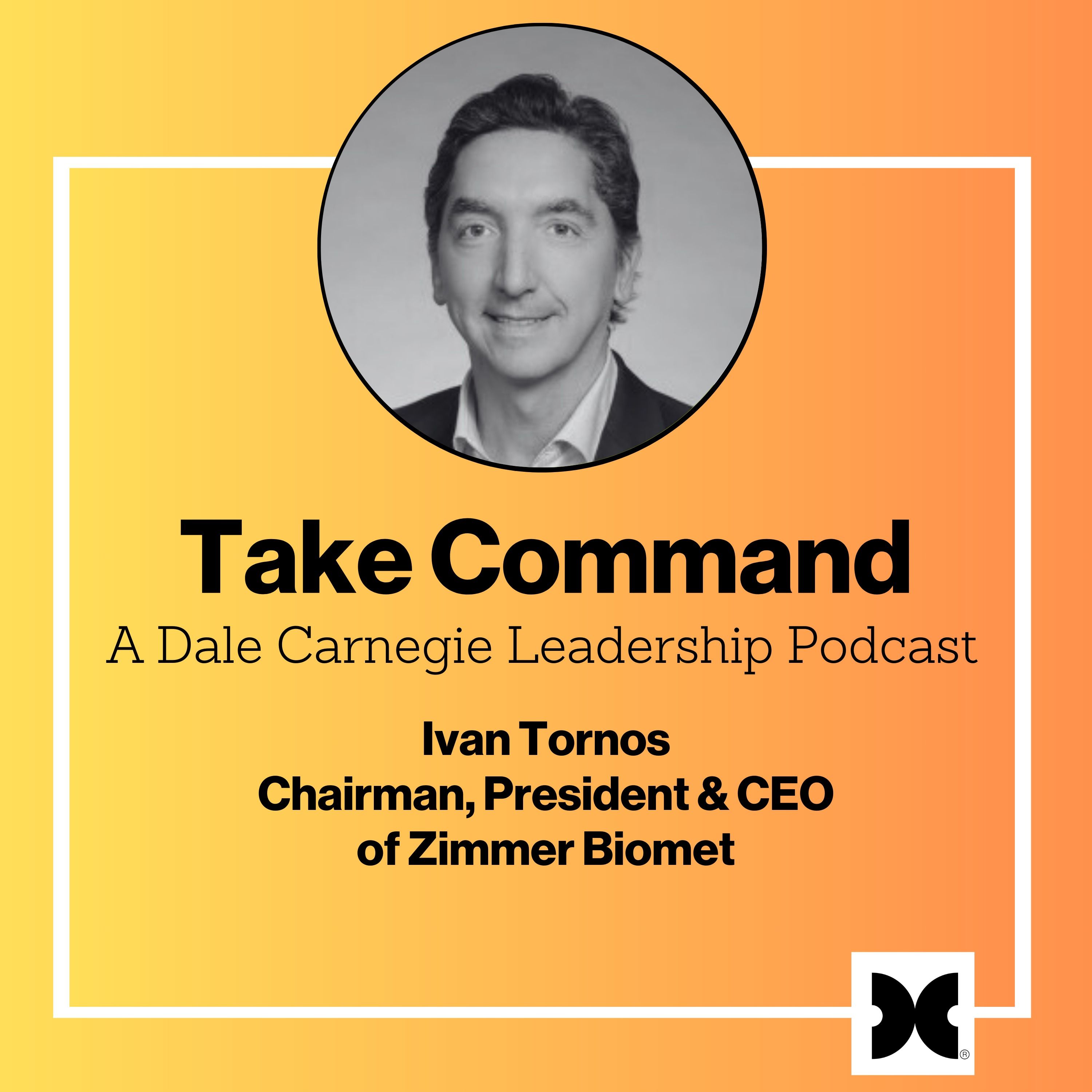
Take Command: A Leadership Podcast
Beyond Shareholders: Rethinking What Winning Means
00:28:50
Ivan Tornos is a purpose-driven CEO leading one of the world's top medtech companies, and his leadership philosophy was profoundly shaped by Dale Carnegie principles. Ivan brings his complete self to every challenge, balancing high-stakes results with genuine care for people, saying, "Great leaders are able to inspire performance and execute performance—that's my 4P model: Purpose, planning, people, and processes." Ivan shares powerful stories from his journey—from early family tragedies that ignited his healthcare passion to transforming Zimmer Biomet into a bold solutions innovator with partners like Arnold Schwarzenegger. He reveals his "winning in five dimensions" framework (spiritual, personal, physical, mental, professional) and hard-won wisdom: "What you're not gonna do is far more important than what you're gonna do." Tune in for an episode packed with actionable insights on authentic leadership, calendar discipline, and patient-first urgency.
Loading summary
Transcript34 lines
- [00:00]
A
What is your definition of winning? Very few can answer. Many years ago I wrote it down. My definition of winning is winning spiritually, personally, physically, mentally and then professionally. This sounds kind of corny, maybe sounds even geeky, but I have my own KPIs for that. You know, what is winning spiritually? What am I doing to keep my faith?
- [00:29]
B
Welcome to Take Command, a Dale Carnegie podcast. I'm Joe Hart, CEO of Dale Carnegie and before we get started, make sure to follow Take Command so you never miss an episode that helps you lead with clarity and purpose. Our guest today brings over three decades of global experience in medical devices, diagnostics and biotechnology. He has led organizations ranging from early stage ventures to multibillion dollar divisions around the world. And and he serves on multiple company boards including the US Chamber of Commerce. Just this past November, he was honored with the Ponce de Leon Award as corporate leader of the Year. He continues to shape the medical technology industry through strategic leadership and driving the next generation of global healthcare solutions. Please welcome chairman, president and CEO of Zimmer Biometric, Ivan Tornos. Ivan, welcome to the Dale Carnegie Tickman podcast. You and I have got to know each other a little bit and certainly you are leading one of the top biomedical device companies in the world. Actually no broader than biomedical devices, you've actually expanded into some other areas as well. An incredible career really in the healthcare space. A purpose driven leader. So excited to be able to talk to you today. So even talk a little bit about your philosophy about leadership. What are some of the things that you've learned about effective effectively turning your purpose into motivation for others that drives results?
- [02:00]
A
Sure. I would say my leadership style is about being authentic and that's why purpose matter. You know, you gotta find something that really inspires you and motivates you. And in my case, as I was saying earlier, and I'll say over and over for the next 45 minutes is about helping others, alleviating the pain of others. I've only done healthcare, I don't think I could ever do anything else other than healthcare. Once you get the purpose right and you're authentic about it, that's not enough. You know, you got to inspire performance and you got to manage performance. So I believe in proper planning, getting the right people and execute the right processes. So conveniently, that's what I call the 4P algorithm. Purpose plan, people and processes. Once you find your purpose, you still got to put a plan to achieve your goals. Extremely important. I don't need to teach you anything about these. You got to get the right People and I tend to look for people that have character, they have commitment to get things done and certainly their skill, they have competences and then it's the processes. You know, people that know me, they won't tell you, I hope, that I'm a macromanager, but they will tell you that I'm respectfully involved. I believe in having the right metrics, having the right governance over the things that matter, having a cadence of systems, meetings, whatever you want to call it, to make sure that things get done. If you're operating just with purpose, inspiring performance is not enough. I believe great leaders are able to inspire performance and execute performance. And Again, that's my 4Pmodel. Purpose planning, people and yes, processes.
- [03:30]
B
And how do you do that, Ivan, in practice, again, especially with your life and traveling all over the world, you're leading this $20 billion market cap company, you've got 20,000 employees. What are some things that you do? What are some things you've learned? Things you know now that even earlier in your career you're like, gosh, I wish I'd known then.
- [03:49]
A
Yeah, well, look, Warren Buffett has a great quote, says that 80% of what you and I do in business doesn't matter and most of the time you don't realize it. So spending time thinking about the things that really don't matter. I take an hour, if not two hours every Sunday after church to go through my calendar and really ask myself, if I don't do this, will it matter? Is this activity going to help me in driving best in class, Talent, People, culture, etc? Is this activity going to be driving operational execution forward? Is this activity going to be accelerating our innovation journey, which is critical here at Zimmer Biomet? If the answer is no, then I don't show up to that meeting or I treat that meeting a different way. So asking yourself, does it matter? Is one of the key lessons that probably I didn't learn many, many years ago. I try not to waste time throughout the day. I farm myself from email eight years ago. It's changed my life.
- [04:43]
B
You fired yourself from email. What does that mean?
- [04:45]
A
As a practical, it means not hyperbolic. But you know, some executives, you know, go to an office, they do meetings and they get behind the computer, send a bunch of emails, you reply, I reply, blah, blah, blah. And then 10, 12 hours go by. You wonder we move the agenda forward. So yes, I scan through all my emails very quickly. I reply with a sentence. If not true, I always read emails from the last sentence in the email because that's where the asking is. And by spending less time on email, I'm spending more time having thoughtful conversations. So I fire myself from email. I try to unmit myself from meetings, and I tell people to do the same. After the pandemic, we all created this new environment where, you know, Joe needs to be at every meeting. Otherwise people think that Joe is not working. I celebrate when people tell me, you know what, Ivan, I don't need to be in that meeting. Candidly, I don't believe that I'm going to bring much value to it. I'm not a decision maker in that activity, so I'm out of that meeting. So I try to practice those things, you know, proper planning, trying to really understand what is that, 80% that are time wasters. Whether it is trivial emails, whether it is trivial meetings, whether it is, whatever it may be. And yes, of course, you got to surround yourself with the right people because if you're not going to be doing a lot of this stuff, somebody else got to do it for you. So, again, combination of planning process and people is probably the formula here.
- [06:03]
B
Well, I'm glad you shared that. I mean, honestly, to me, it seems like that's a game changer. It certainly has been for me, that constant practice of saying, first of all, how important is it that this even be done? Does anyone even care about this? How important is it that I do it? And really just trying to be ruthless about prioritizing and just focusing constantly on the most important things. Because, I mean, especially in leadership, people would have you or me or any of us in meetings all the time, sending emails, copies and emails, all kinds of things all the time. We've really got to be just relentless, right, in terms of that discipline.
- [06:34]
A
It is discipline, Joe. And look, let me just tell you that I'm not perfect at it. You know, I'm sure there's some of my colleagues listening to this podcast right now. They're like, what? He's still attending way too many meetings. He still is doing way too many things. So I'm not perfect at it, but I'm getting better and better. And I can tell you going back to the planning every Sunday as a plan for the week ahead. I look at the week behind and I reflect on what are things in that week I could have done differently? Should I have delegated a meeting? Should have done something else in this regard. But it goes back to those planning sessions with yourself and just having that discipline that you're talking about. Not easy.
- [07:09]
B
Not easy. I mean, not easy both personally, but Then again, part of the key is having great people around us. Right. I mean, and I know that's been something you've really focused on at Zimmer Biomet is making sure you've got strong teams, strong people and so forth. What are some strategies that you have there to empower people, to encourage people, to create a culture that really, you know, drives people to do some of the same kinds of things you're talking about for themselves? Yeah.
- [07:32]
A
First of all, I tend to hire people, as I mentioned earlier, that offer three things. One is character. Secondly is commitment. And the third one is skills, competences. So let's talk about number two, commitment. It's hard to tell when somebody is truly committed. And it's a word that I love. Commitment. Medieval English is united in purpose to the extreme. Fact check me on that later.
- [07:52]
B
United to the purpose. In the extreme.
- [07:55]
A
To the extreme. Which means that you are 100% in. Right. It's not. You're partially involved. And, yeah, it sounds kind of radical, but that's what it takes. So as Rama said, with people that you can tell they're 100% committed, they're not partially involved. They're not doing things, you know, better than most. They are going to the extreme to get things done because of that sense of urgency behind the purpose. And I'll tell you, I got a lot of people in my organization that are a. When it comes to that commitment, that's one thing that I feel I do well to move things forward. And then it's allowing people to fail. You know, everybody talks about allowing people to fail, but rarely leaders. We, you and I allow people to fail. Accountability is very high. And then you make a mistake and you're out. When you don't allow people to fail, you don't have bold innovation. You don't bring the level of creativity that you need to bring here. You don't have a culture like the one that we created here at Sim Environment. So it's an element of allowing people to fail. You cannot be failing every day. You cannot be repeating the same mistakes. But by God, you better be allowed to fail because otherwise you would not have that culture that you and I aspire to have. And then it's, look, running the company without the hierarchical norms of the past. So one of the things that I believe I'm doing well, I give everybody my cell phone number. I know I would not give it today, but I give everybody my cell phone number and I ask people to engage, you know, send me a message when things are going well, ask me things. Challenge me when things are not going well. If you allow people to forget that you're the CEO and you're running the company truly like it's a friends and family club with obviously discipline and whatnot, a new culture emerges. So that's a lot that has in your way, but that's some of the things that we're implementing here.
- [09:39]
B
Well, you're certainly walking the walk and certainly I've observed that you respond very quickly to text messages and as you said, just get kind of a quick response. But that says a lot, right? It says that when you respond to people that they're important, they're meant, message is important and so forth. So that, you know, kind of creates the culture. You're also prolific on LinkedIn and I think from a transparency standpoint, you really. And authenticity, you're talking about things that are personal to you. I know you write these posts yourself. Some of them are lengthy, so they take some time. They're well written. In fact, I'd encourage all of our listeners, if they're not following Ivan now, follow him. And really, I think you're in for a treat in terms of some of these posts. But you know, in your post, you post about Zimmer and certainly the results you're striving to drive at Zimmer and you also talk about some of the people kinds of things that we talk about at Dale Carnegie. It's a people oriented thing. It's not just about the results, it's about how you get the results, how you bring out the best in people. You talk about kindness. So how do you balance that drive with results with, you know, I'd say are the Dale Carnegie kinds of principles that are around appreciation and listening and empathy and trying to see things from another person's point of view and all these different strategies that you're employing in summer?
- [10:45]
A
Yeah, first of all, I do manage my own LinkedIn. That's why you got typos and grammar mistakes and you can even detect my Spanish accent in some of my LinkedIn posts. So thank you for acknowledging that. How do you balance. It's like being a father. And you got many kids. I got many kids. You got to have the right perspective when it's time to offer a hug and when it's time to offer a kick. And I'm not sure that there is any school out there that will teach you how to do that other than the school of life and learning. When should I have given an additional hug and when someone needed that additional Kick in the butt. As a leader, you can detect those situations. I still don't do a great job at it, but I learn every day. And I often ask myself, leaving a meeting, a conversation, a project that failed, did I overdo one or the other? It's work in progress. But given the low turnover that we got hit at Zimmer Biomed, the high engagement that we had at Zimmer Biomet, I will tell you, probably something is working right, not just Ivan Tornoz. I'm not trying to hang any medals on me here today, but, but just the people that we hire and how they approach the business. It does take balance, that's for sure.
- [11:49]
B
It is probably the hardest balance in many ways of being a leader. Because on the one hand I think we want to have a culture that engages people. We want people to appreciate their work and to thrive. And at the same time, there's certainly. You have it, I have it. We all have a super heavy pressure for results. Even just going back to Zimmer, I mean, you took over this business and you've led and had huge roles in many, many large companies, J and J. Baxter and many others. You know, the space that you're in is a competitive space. So I'm curious, but again, any kind of advice you'd have or thoughts you have as you think about, hey, I'm trying to take this company from where it is. I mean, you've got this vision for Zimmer 10 years out, which is a huge, big, hairy, audacious goal kind of a vision. How do you balance a big goal like that with. Again, this is something I think we teach a lot in Dale Carnegie. So it's a little bit of a leading question that, because we know that these principles work. But how do you do that?
- [12:41]
A
Well, I definitely want to get your thoughts here because it continues to be a struggle when you're a public company CEO and you operate with 90 day work cycles. Every 90 days somebody's going to put you through a test. You deliver revenue, earnings per share, free cash flow. It's hard to reconcile that with some of the things you want to do for the longer term. So how do you do it? To me, it goes right back to purpose. Never forget why you are in business. Yes, shareholders are important, extremely important. 90 day cycles matter. You have a fiscal responsibility to deliver. But there's something far greater than that, which is why you are in business. We are in the business of alleviating pain and improving the quality of life for people around the world. And that should Be your mandate above everything else. And if you do that right, the stock will go up, down, things will happen in the quarter, things will happen in the year, but you'll be doing what you're supposed to be doing. And then think about the long term. To your point, we have this bold vision of becoming the boldest medtech company on earth, solving some of the most compelling challenges in healthcare. And today there are things like infection in hospitals or in surgeries. Rather, the fact that you got countless patients that are living a life in pain. The fact that being a patient is complex and is lengthy. I can go on and on, but we want to be that company that solves those very meaningful problems. And today we're doing orthopedics, tomorrow we're doing something else. So if you stay true to your purpose and to the longer term mission and you relentless around making sure that's your number one, number two mandate, I think the pressure is less.
- [14:11]
B
Well, and again, when you get everyone aligned around that, I think about the devices that you create. You could think about in the abstract, right, like a hip replacement, knee replacement. But when you get down to the individual human being whose life has changed by a good interaction with a device or an experience that you've created that drives that purpose. In fact, when you and I met for the first time, you were on stage with Arnold Schwarzenegger, who I know is your chief movement officer. You want to talk a little bit about Arnold and what he's doing to further the mission of Zimmer?
- [14:39]
A
Absolutely. This is Twins, Part 2. The first one was Arnold and Denny DeVito. The second one is Arnold and Ivan Tornos. He's been a great partner, a great mentor, a solid friend. He truly cares about others. So when we talk about alleviating other people's pain, that's what the governor has been doing for many years. I mean, he's 78 years old. As I tell him all the time, he's got more money than Qatar. He does not need to be a corporate partner. He does not need to be doing what he's doing at Zimmer Biomed. He does it because he truly does care about others. And that shows up in everything that he does. He's helping us with a very compelling mission. You got 600 million people on earth that are suffering from some sort of arthritis, osteoarthritis being the lion's share of those patients. And less than 5% of those patients are doing something about it. Going to a primary care doctor, checking what's going on with their body. That's the mandate. That's what my chief movement officer and I are doing together. Want to bring those patients from the sidelines into the funnel. Go take care of your health. It's never too late. 60, 70, 80, 90, 100. It's never too late to live a different life. And Arnold is great at it.
- [15:49]
B
He certainly has had an incredible career and is probably the perfect spokesperson for what you're talking about, particularly as he's gotten older and he talks about some of the different chronic situations he's had and so forth, and how your company can make a big difference for him or for others moving forward. Going back to you have Arnold talking about what you're doing. You've got a purpose in your business. You're looking to shape this huge global company. I'm curious about mindset, Yvonne. You talked about some of the habits that you have, and I want to get back to some, some of the maybe disciplines that you have that help you be effective. But just if you think about the mindset, because we have ups and downs in business, right? And again, something Dale Carnegie was talking about is choosing the right thoughts and making sure we've got the right mindset. What are some things that you do both for yourself and for others to have that mindset, that resilience that says, I'm going to lead with courage, I'm not going to let the fears and the different things hold me back. I'm going to keep moving forward in a constructive way?
- [16:45]
A
All of the above. And I also often reflect on my own personal definition of winning. You know, it's amazing. You meet a lot of CEOs and you ask, hey, what's your definition of winning? They can rumble through financial commitments, revenue, earnings, per share, free cash flow, X percentage of my business in, Y percentage of low growth markets versus high growth markets. But when you ask him, Joe, I'm talking to you. To Joe, what is your definition of winning? Very few can answer. Many years ago, I wrote it down. My definition of winning is winning spiritually, personally, physically, mentally, and then professionally. This sounds kind of corny. Maybe it sounds even geeky, but I have my own KPIs for that. You know, what is winning spiritually? What am I doing to keep my faith? Not only am I going to Mass every Sunday, which I do, but what am I doing for others? Am I volunteering? Am I taking care of those who don't have the same life that I have? So I got my own KPIs, if you will. On what is living a spiritual life look like then my second definition of winning is personally. You know, I've been with the love of my Life for over 20 years, Anna. We got a great family. Am I investing time in nurturing that relationship with my wife and with my kids? And again, there are elements on those KPIs, you know, do I still have my Friday night dates with my wife, Am I listening to my wife on my worst days, am I spending time with my kids, how many karate tournaments am I missing with my 7 year old, etc. Etc. Then it's physically. And some people tell you, hey, you need to put physically before personally. You know, what I put personally before physically, but physically is, you know, am I taking care of my body? You know, early this year, my wife got me a trainer, a personal trainer. Shoot out to Mike Margolis, my personal trainer. That keeps me alive. I go to the gym, you know, four or five times a week. I monitor what I eat. I make sure that I'm thinking the next 30, 40 years when it comes to my health, which is something that I was not doing before then it's mentally. Growing up in Spain, the whole topic of mental health was never a topic. If you are depressed, you're having a bad day, just deal with it. No, mental health is serious. Am I in control of my emotions? Am I expressing my emotions the right way to the right people that can help me out? When I have those down days, then the fifth one is professionally, what is my definition of winning? Is it making more money? Then it's the wrong definition. Is it just taking care of shareholders? Then it's the wrong definition. So there's a set of different KPIs within the definition as well that I have put in place. But again, you ask me, how do you cope, how do you move things forward is by being very disciplined around what is winning like spiritually, personally, physically, mentally and professionally. And that gives you a sense of perspective to realize that some things that you think are very acute or are only a subcomponent or one of those five buckets. And that's how I live my life.
- [19:30]
B
The fact that you're thoughtful about that, I think it's so easy for our lives or days turns to weeks to months, to years. All of a sudden we could find ourselves in a place if we're not making time. I mean, for me it's every morning I'm going to spend the first 30 to 45 minutes of my time. Part of it is focused on what happened yesterday and gratitude and part of it's prayer and part of it's meditation and part of it is planning the day. But if we don't create space for ourselves, it's like, what are our routines? If we wake up in the morning and the first thing is like, all right, let's check the email, let's check, you know, whatever. What I hear you saying is you are super intentional. The Dale Carnegie Take Command podcast. Taking command in Dale Carnegie is about being intentional, living an intentional life. So thank you for sharing and, you know, maybe giving us some ideas about KPIs. I'm going to have to ask my wife now. I've got 29 years of happy marriage here too. So it's a great going well. But it's always good to continue to come back to that and to think, all right, well, you know, am I spending the time, are we going out or whatever we need to do to continue to have a healthy relationship.
- [20:27]
A
Nothing like getting a performance evaluation from your wife every Christmas to realize that you got more areas of improvement at home that you do at work. You know, put it on your calendar. Everything that I'm talking about, if you were to look at my calendar, and it drives my executive assistant crazy. I put all my personal goals for the week and the day in that calendar. A block time for my personal trainer. Sometimes in the middle of the day, I just gotta skip for one hour and go to one session with Mike. I put my prayers, you know, at five in the morning, right before I start the day, I put in my calendar to call my 90 year old mother in Spain. Part of my definition of winning, you know, personally, you know, how am I interacting with my mother? So just put it on your calendar again. It amazes me how many of us have the level of discipline that we have when it comes to our professional lives. You know, from early on, I got to get my undergrad, I got to get my mba. I better go to one of these companies, I better be a vice president by age 30. A better. A better, A better. But when it comes to our personal, spiritual, physical, mental life, we don't have the same level of discipline. Which one is more important? I'm not sure that many people die and they regret not being the CEO of a company or not having made more money. I know of a few that, you know, that last day comes and they wish they would have had a better relationship with their kids or they would have done different things with their free time and their faith. So discipline. Put it in your calendar.
- [21:48]
B
It's funny, you got me thinking about It I remember as a young attorney, this is back in my 20s, I remember I used to have breakfast with the executive from General Motors who was a friend of mine, and he was a top, top guy at General Motors. And I say, geez, you know, how is it you're able to make time to meet with me for breakfast? He said, well, I put in the calendar. So it's exactly what you said. It's like we have control over our calendars and what are the things we prioritize. It goes back to kind of what you were saying even earlier in our discussion about, hey, what are the things I have to do? You must have to clear a lot of things off your calendar in order to focus on the things that are really the most important. And that's maybe a good reminder for me and for all of us just to make sure that we're constantly challenging ourselves to kind of up our game there.
- [22:26]
A
I try. I still feel better. I try. I mean, I'll give you one last example on this discipline piece. You know, for, I don't know, five years, I was in terrible shape. I got into a group president role. Then I became president CEO of a large company, Zimmer Biomedical. And then I was just not working out, sleeping very little, traveling the world and not taking care of myself. You know, one day I was walking down Madison Avenue here in New York. There was a gym there with a sign that said, inside of this gym there is somebody busier than you are. And that got me thinking, you know, how many times we use the excuse of I don't have time to call my wife, you know, I'm busy. You know, in this M and A review, you make time, you know, to do those things and learn how to say no. And really, just in a very reflective way, ask yourself, why am I not going to the gym? Why am I not spending more time with my wife? Why am I not spending time with my partner? Why am I not doing whatever it may be and just put in your calendar. My executive assistant does a great job in helping me in this regard. I put my 7 year old karate class in New York City in the calendar. And there are days that, look, I cannot attend that M and A Discussion because my 7 year old is going to get his orange bell today, put it in the calendar.
- [23:34]
B
And really, people will sometimes say, I don't have time for this. But that's not really the right thing to say. We should say is, I am prioritizing this over this, right? I am prioritizing whatever it is over this, that's much more truthful. But maybe for all of us, I mean, we could all have other people who hold us accountable. I'm asking my wife sometimes, hey, you know, if you ever see me doom scrolling on Twitter, just stop me. You know, just come by if I spent more than 20 minutes on Twitter. Interrupt me. You know, so I love this topic,
- [23:59]
A
is that what you're not going to do is far more important than what you're going to do, right? So look, I'm not on social media other than LinkedIn. I started using LinkedIn three years ago. It builds purpose, it inspires a different culture, it connects you with your people. But I don't do Twitter. I don't manage my own Instagram. We have a corporate account. I'm not a golfer. There's a lot of things that I don't do. I choose to do certain things really, really well. I work in my personal time. So that discipline of saying, look, I'm going to be mediocre in a million things, to be great in those four or five things, that's what I mean. And that's what you mean by funding time or prioritizing differently. Last thing I'll tell you, my buddy Arnold, the governor always talks about 24 hours a day. Has 24 hours, you sleep, I don't know, five, six, you still have a chunk of time working out, 10, 12, you still have a chunk of time. Time to exercise, to be with your partner, to read a good biography. But a lot of us waste time doing a lot of things that deliver absolutely no returns to our life.
- [25:00]
B
100%. Well, it's a good reminder to be intentional. So, Ivan, I've got to ask you. Sometimes I go to ChatGPT. I'm enamored with a AI and ChatGPT use it constantly. I'm sure you may too. And I asked it, I said, hey, I'm going to be interviewing Ivan Ternos. If you could ask only one question to Ivan, what would you ask? And this is the question that it asked. I'll give it to you right now exactly word for word. Ivan, beneath the titles and global responsibilities, what is the one non negotiable belief that defines how you lead, how you treat people and what you expect of yourself every day? This is what ChatGPT wants to know.
- [25:35]
A
What a question. That's why we got to stop using ChatGPT. What is a non negotiable belief other than of faith? That's unquestionable. My non negotiable belief is that we zimmer biomed will always do the right thing for those patients whose lives we care for. We're never going to prioritize shareholders over patients. We're never going to prioritize anything above those patients. So it's a non negotiable. We're going to do the right thing for the patient each and every day. We're going to do it in an ethical way, we're going to do it in a compliant way. We'll make the hard decisions and we have made those hard decisions at times that cause short term financial pain because we're going to prioritize doing the right thing ethically, morally, compliantly for that patient. So those will be my true non negotiables, my faith and family on the personal side. And we're always going to prioritize that patient, even when at times can be painful. From a financial standpoint, you're having that
- [26:26]
B
focus and that commitment, that conviction around purpose. I know the people I met on your team all feel that same way too. You've got great people around you, you know who you're working to kind of get that whole, whole organization really just driving that, which is exciting to see what you're doing at Zimmer. What are you most excited about as we close the interview here? What are you most excited about as you think about the future?
- [26:46]
A
This company, Zimmer Biomed, has been around for 100 years and we're just getting started. Started in 1927 in Warsaw, Indiana. I remind people Calvin Coolidge was the president of the US when we started to do innovation in hip shoulder knee replacement. And 100 years later, we're just getting started. This company is no longer your father's medtech company. We're moving from being a product company to a solutions company. We're going to be first to market in autonomous robotics, robots that can actually basically do the surgical procedure with little help. We are first to market in anti infective platforms, eliminating preventing the risk of infection in some of these surgeries. We are going to be democratizing how surgical procedures are done around the world, bringing technology all over the world. We will be the first company to shorten the episode of care in a meaningful way, using technology, AI, robotics, digital in a more comprehensive fashion, in a more thoughtful fashion. So I'm excited about the fact that this company that's been around for a century is going to look radically different in the next five to 10 years. That inspires me and I look forward to having a conversation five years from today and tell you how we did it.
- [27:57]
B
I'm looking forward to that too, Yvonne, and really watching from the sidelines as you're leading this great company. Thank you so much for being on the Dale Carnegie Take man podcast.
- [28:05]
A
Thank you, Joe. It inspires me to be here with you.
- [28:07]
B
Thank you. Look forward to talking to you soon. I hope you enjoyed this edition of Take Command, a Dale Carnegie Podcast. Check out our resources at www.dale Carnegie for more research, insight, and tools that will support your success and help you take command of your leadership potential. If you enjoyed this episode, please consider rating it and following us on Apple Podcasts and Spotify. For more exclusive content, subscribe to our Dale Carnegie YouTube channel and follow us on social media. As always, thank you for listening and we're looking forward to you joining us for the next episode of Take Command, a Dale Carnegie Podcast.