← Take Command: A Leadership Podcast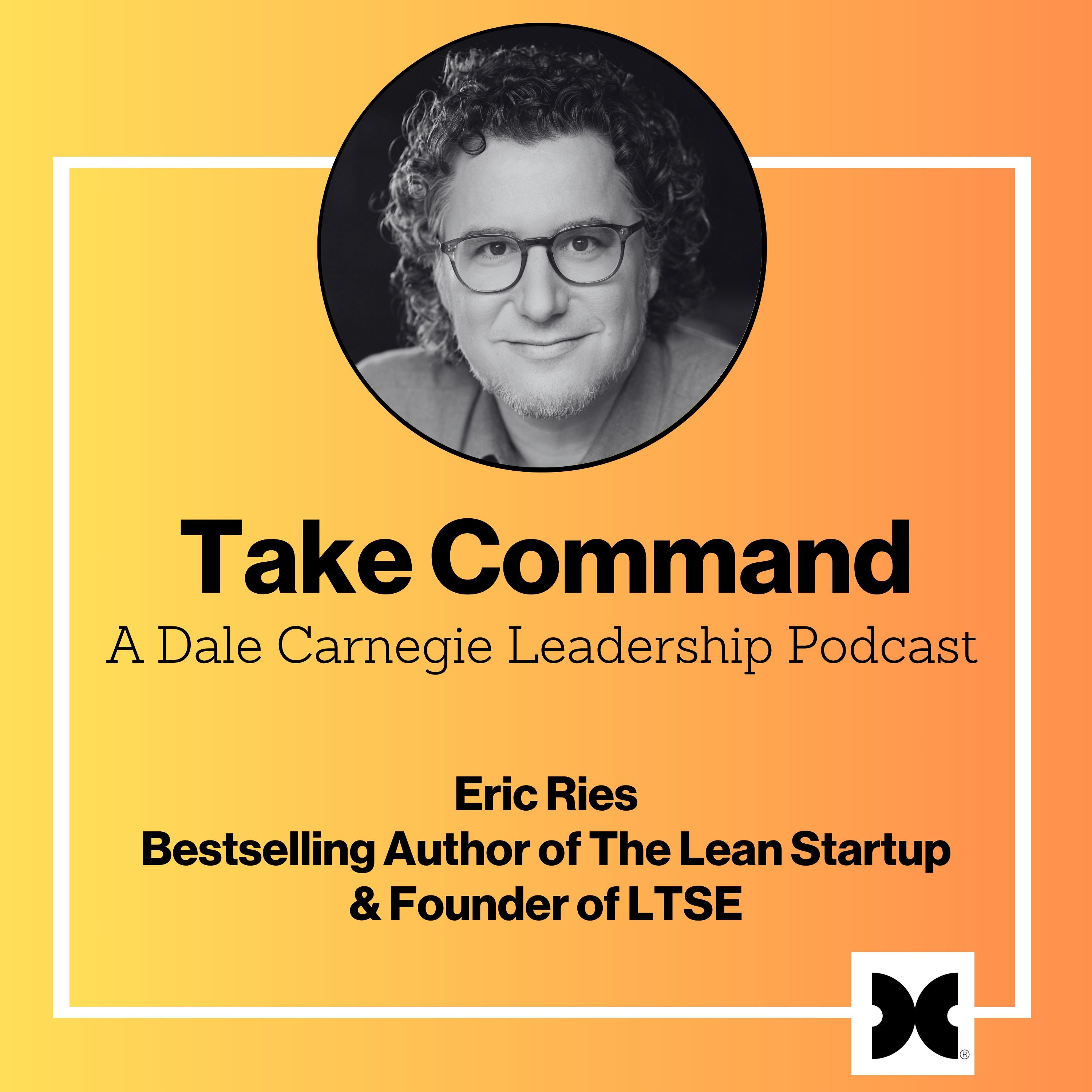
Take Command: A Leadership Podcast
Do the Right Thing, Every Time: Lessons on Leadership and Agency
00:44:16
Eric Ries has spent the last two decades reshaping how companies are built and led, emphasizing continuous innovation, long-term thinking, and purposeful governance. He says, “It’s not about doing more—it’s about doing the right things consistently. Your small actions compound, and they define the future of your organization.” In this episode, Eric dives into the principles behind the Lean Startup method, why leaders need to create structures that empower others, and how long-term thinking can transform organizations. He shares insights on why experimentation is a competitive advantage, how to influence without authority, and the value of making decisions with both vision and humility. Tune in for actionable strategies and thought-provoking advice from one of the most influential voices in modern entrepreneurship.
Loading summary
Transcript32 lines
- [00:00]
A
The late great Clay Christensen. In his last book, he wrote, it is easier to do the right thing 100% of the time than 98% of the time. Because when you've made a commitment to something, it just makes things simpler to be like, you know what? I just always do the right thing.
- [00:22]
B
Welcome to Take Command, a Dale Carnegie podcast. I'm Joe Hart, CEO of Dale Carnegie and before we dive in, forget to follow Take Command, where every episode gives you the tools to lead with confidence. Today's guest has reshaped how startups and corporations innovate. He is best known for developing the Lean Startup methodology, a framework that helps companies test ideas quickly, reduce waste and scale more effectively. Recognized by BusinessWeek as one of the best young entrepreneurs of tech, he co founded imvu, served as a venture advisor at Kleiner Perkins, and has advised startups around the world. He's also the author of two best selling books and the founder of the Long Term Stock Exchange, a pioneering approach to public markets that supports long term growth. Please welcome founder, entrepreneur and best selling author of the Lean Startup and Eric Ries. Eric, welcome to the Dale Carnegie Take Command podcast.
- [01:32]
A
Thanks for having me.
- [01:34]
B
Excited to have you. I know we were talking a little bit before we started to record and certainly you are the author of the Lean Startup. You've got a great new book out which is incorruptible. The Lean Startup of course is by many would say the bible. Not just the startups, but I mean even about for entrepreneurs and businesses. Certainly we're a hundred plus year old company and I shared with you before we started that some years ago I bought copies of this book for my executive team. Everyone loved it so much. We bought it for everyone in the company. I have a box of your books downstairs. I still send out to people. So fun to have you here on the podcast.
- [02:06]
A
Thanks for the kind words.
- [02:08]
B
Yeah, yeah, of course. So before we get into that book or your new book, so much of our podcast, I think today's gonna be about leadership philosophy, the kind of ideas that make leadership successful. Who is Eric Reiss? How would you describe yourself, your journey? Give us a little bit of background about you.
- [02:26]
A
Sure, sure, yeah. Happy to. I grew up in San Diego, California. I come from a family of doctors. So my family, what I do is considered a little bit disreputable, you know, not really being directly of service. So I'm always, always got a chip on my shoulder about that. But I for whatever reason didn't want to be a doctor or a lawyer or whatever. I grew up programming computers, so. So I thought programming was the most powerful force in the universe. When I discovered I was like, wow, the power to make things in reality with nothing but the power of your mind. It felt like genuine magic to me. I got a computer science degree. I did a bunch of writing and tech stuff even as a kid. Did my first startup during the dot com bubble. So I got kind of bit by the entrepreneurship bug. And I started to learn the hard way that technology, and even technology platforms are not the most powerful force in the universe. Because of course, technology is built by human beings. And so the coordination of those human beings is actually where the power is. And that is why management and leadership are the most powerful force in the universe. And that's kind of been the theme of my whole career, is trying these things and thinking I found the top of the hierarchy and then realizing, actually, no, there's something even more powerful that we're up against when we're trying to make change in the world. And eventually, you know, in the course of doing work helping revitalize established companies, you know, Lean Startup became this huge phenomenon. And I'm so grateful that people at both startups and established companies alike have embraced it as a useful tool. And so doing that work, I got to see both tiny startups in a garage become big public enterprises. And I got invited to work with lots of public companies and governments and NGOs and, you name it, the kind of companies I've had a chance to do work with. So I got to kind of see what business is really like as it's practiced all over the world. And I started to feel again that feeling of another invisible force, more powerful even than management, more powerful even than leadership. And I started to get really interested in this question of, like, why is it that organizations where leaders are so aligned around some specific goal ultimately drift and become something else? Why do we see it as inevitable that big companies become bureaucratic or even malignant as they scale? And so my work, for me, it's been one through line trying to pull this sweater on. How do we make things that are useful for people in the world? How do we understand what organizations are and how they work? And this new book had a chance to dig deeper into what I think of as the physics, the underlying forces that shape organizational realities.
- [04:42]
B
It's interesting. I mean, the second book clearly seems like an outgrowth of the first, although separated by what, 13, 15 years, something like that. Maybe it was something that you discovered along the way. For people who aren't familiar with Lean Startup, Just a little summary of that for everybody from you would be great. And then we can just write down.
- [04:58]
A
Sure, sure, sure, yeah, yeah, my pleasure. So when I first got into entrepreneurship, okay, I had no idea what it was and neither did anyone else seem to, you know, like it was really interesting. Like a lot of people were making a lot of money in the dot com bubble. Entrepreneurship was all of a sudden everywhere. But there actually were not that much written about it at that time. It wasn't something that was like that well studied. And most theories of entrepreneurs basically just like I call them, dollhouse theories. You take a theory of leadership in a big company and then shrink it down. We treated startups like they were dollhouses, like little tiny versions of a giant company and they need to be all the same. And that set of practices really does not work well for entrepreneurship. For anyone who's tried it, I learned the hard way that is not an effective way to go about it because entrepreneurship is a very particular management discipline. It is the discipline of building something brand new under conditions of extreme uncertainty. To me, the defining feature of entrepreneurship or innovation is that you don't know what's going to happen in the future. What is interesting to me about it is it is really a truth seeking discipline. You have to really find out the truth. You write a business plan, okay, great. You say all these good things are going to happen, okay, Even if people invest in you and they believe you and people work for you. All that proves is that you're very persuasive and very charismatic. But that's not the same as knowing what the truth is. And so Lean startup is about how do we apply the scientific method to discover the business truth that drive whatever our plan is? And then once we have figured those things out, that's where the techniques of lean startup come into. Things like the pivot, changing strategy without having to change the vision. Things like the build, measure, learn, feedback loop, trying to understand the fundamental cycle time that powers innovation and maybe most famously the minimum viable product. That initial experiment that we do to quickly, easily and inexpensively discover the truth of our leap of faith assumptions.
- [06:47]
B
It's interesting because so much of what you say feels just so obvious, right? The way you explain it. And yet I remember being involved in a startup in the early 2000s and the concept at that time was certainly you have an idea, maybe you go raise some money for that idea. You develop the idea, of course you've got customer feedback, maybe you develop it, you launch it and then you, maybe you iterate along the way. And I couldn't help but think about the minimally viable product concept as applied to kind of those early startup days. For ourselves, it would have, I think, saved us a lot of aggravation. Certainly over the years.
- [07:20]
A
Lean Startup has definitely been embraced by a lot of second time founders.
- [07:25]
B
That's right. Who'd wish they'd heard about it the first time.
- [07:27]
A
I get that a lot. And honestly, that's why I wrote the book. I mean, people say that to me. I was like, yeah, me too. This is everything I wish I had known when I started.
- [07:34]
B
I mean, this podcast is about leadership and mindsets. And I can't help but think that, you know, on the one hand we talk about the Lean Startup, right? And Lean itself comes from Toyota methodology. It's a process driven based thing and you're applying this to a startup process. But really, I mean, the culture and the leadership of the people involved seems undeniably obvious, but it's just so critical, right, because you could have two different companies with two different mindsets following the same process and you get different results. Talk about the mindsets that you see that are really important for a successful entrepreneurship.
- [08:09]
A
So I wrote this diagram. It was one of the, actually the last things I added to the Lean Startup when I was writing it. I called it the Startup Way. It was actually mostly to remind myself of the hierarchy of influence. It's very simple. It's just people, culture, process, accountability, in that order. And most people, when they talk about leadership, they talk about innovation, talk about any of these concepts that we're talking about. They really want to focus on the surface level, like get the right people in the right seats, which is of course undeniably important. Or maybe they want to talk about how to have an innovative culture or something like that. If they're sophisticated, they'll talk about process. You know, like, what tools should we use? Should we use AI? Should we use this thing? Should we use Six Sigma? Should we use Stage Gate, Lean Startup, whatever. But very few leaders are really willing to examine the mechanisms by which people are held accountable. And what I discovered in building out Lean Startup is that the influence travels from the bottom up of this pyramid. If you hold people accountable in the conventional ways, and if you require them to operate with their conventional mindset, then in whatever process you give them, it's not going to work. Because ultimate, the process is an outgrowth of these deeper commitments. If you tell me what process a company or an organization uses, I'll tell you everything about its culture. Like Culture ultimately is an outgrowth of those deeper commitments. And then the kind of culture that a certain kind of person wants to work at, that will ultimately determine who you can hire. So when people complain to me about talent shortages or about their inability to hire the top talent, or feeling like they're a talent disadvantage, they often see this as like a recruiting problem or a branding problem, rather than seeing it as an outgrowth of these deeper commitments. I'll give you one example. It comes up a lot because the new book Incorruptible is about making long term commitments and building like an organizational character, where that mindset you're talking about is deeply embedded in the organization, in its explicit managerial practices, but also in the culture that exists when no manager is watching. So those long term commitments, somebody will hear that and say, wait a minute, I thought lean startup was about rapid iteration and quick decisions. How can you justify or reconcile your long term commitments with the need for short term commitments? And that's one of the biggest misunderstand about lean startup that I still encounter to this day. I don't feel bad because Toyota production system and lean manufacturing people have been dealing with it for almost 100 years now, which is that in order to enable speed, we have to have immutable long term commitments. Very simple example, you say, well, I want to have rapid experimentation. Okay, what does it mean to have rapid experimentation? Well, first it means minimum viable product building, experiments, whatever. But it also means that we're going to agree ahead of time without knowing what the outcome is, to abide by the scientifically validated learning. In lean startup, the commitment to use science instead of astrology is not itself subject to rapid experimentation. It is a prior, a pre existing commitment from first principles to say, you know what? I think the scientific methods earned its place into our decision making for life. It's worked out pretty well over the last couple hundred years. We're going to be scientific in our mindset and that itself is the kind of long term commitment. So I learned this from all kinds of people who have studied the Toyota Way and many other of the greatest companies that have ever endured. A philosophy of long term thinking is often the foundation of their rapid success and their rapid decision making. So by having these pre existing commitments, we create an environment, a container that allows the right mindsets to form, that allows people to embrace these cultural values and make them their own. And that is what allows speed and efficiency and decisive action even in a crisis.
- [11:39]
B
So when we talk about philosophy of long term thinking, we really talk about is Our values? What are the values of the organization? Are those values shared? How are they communicated? What are some examples of organizations, either if you want to give names or not give names, where you found that to be really effective? And what did the leaders do to ensure that those values were not only instilled, which I guess is probably the lean start of it, but also long term. This is incorruptible, followed so that people stay on the right track, long term.
- [12:08]
A
In the book, I lay out a blueprint for how to do this. And it really contains two fundamental elements. The first step is to create something worth protecting. It sounds kind of silly to say this, but so many people skip over this step. They want to talk about, like, how do I resist outside pressure? And it's like, well, first of all, what's inside? Tell me if what's inside is worthy. Because. And this is not just like, oh, I want people who are aligned with my values to succeed. No, the ability to, to create what I call the architecture of institutional longevity. It requires a mission and a purpose that people can commit to, can feel an affinity for, can like feel in their heart that this is something worth transmitting. It's kind of like a natural selection that is applied to ideas. You see this with religions or nation states or all kinds of ideologies. Like only certain kinds of ideas are capable of sustained transmission over time because of the human nature and the things that we align with. So I really believe that when you set yourself a purpose aligned with human flourishing, then that activates these magnetic powers that makes the kind of longevity we're talking about possible. So that is the first step to build something worth protecting. But the second step, and this is also, I think, frequently misunderstood, we preach in modern business, unfortunately, a business philosophy that is very exploitative, very much like, take what you can for yourself and don't worry about the long term consequences. And it kind of puts all of investors and managers and employees into a bit of a prisoner's dilemma, where it's like, if I don't squeeze all the marrow out for myself, someone else is going to beat me to it. And so we feel this relentless pressure, I call it financial gravity, to conform to these kind of very short term values. So as a result, we teach people that the number one to protect themselves is to get successful, gain business leverage. And through that leverage, you'll have the power to make things the way that you want. Which is completely bad advice. Some of the worst advice I've ever heard, because success attracts predators. The more successful you are, the More valuable, the thing you've built, the thing that was worth protecting, it's not just more valuable to you, it's more valuable to somebody else who'd like to take it away from you. So the second part of the blueprint is to learn to build organizations that have what I call structural integrity. Not just integrity in the sense that they can keep a promise, but integrity in the sense that they can resist outside pressure. For organizations, these two things are the same. You cannot make a promise if you don't know if you're going to be there to keep that promise. When we structure our organizations this way, there's actually a whole bunch of practices out there, both on the inner side to create that alignment and on the outer side to create that protection that when together, combined, can produce organizations designed to endure.
- [14:49]
B
There's a lot there that you just said. I mean, certainly it's insightful and I know you've got some examples of the predators that basically come in and you kick out the founder and so forth, and the company's gone a few years later because the board or the company violates the original principles that the company was founded on. So I'm trying to think about just from a practical standpoint, like what advice would you give number one, to not just leadership in a business, but even a lot of people who might be listening to this podcast may not be the CEOs, they may be people within the organization and they say, I love this organization, I want this organization to thrive. What's your advice to not just the leadership, but also to people through in the organization where they want to drive that growth, they want to drive that agility, that long term commitment. What'd you say to them?
- [15:36]
A
Yeah, this is very important because one of the things I learned in writing this book and doing the research is that people have far more power and agency than they realize. I'm a founder by definition. Like that's my background. Obviously I come from that world. So it's natural when I tell a story about an organization, of course I tell it from the organization's point of view, as if I'm the leader of that organization. And people I interview are often founders themselves, founders and CEOs. So it's natural that I have the kind of highest leadership level perspective. But I tried to be very careful in the book to really explain that many of these techniques are not just for the highest leader, they're for anyone who sees themselves as a leader, because we all have tremendous leadership power over organizations. And I'll give an Example, most employees in most organizations feel powerless. They feel like, what I do, what I think really doesn't matter. But I've been called in to work with organizations where everyone feels that way, and yet where the CEO and the board and HR Department are spending immense energy being like, what's going to retain talent? What's going to keep people motivated? What do we have to do to keep people working here? And even, like, some pretty crappy companies, they're like, what can we get away with? What can we do? And still nobody will quit, right? Like, what do we have to do? You know? And obviously, at the very best companies, they're like, trying to make that an authentic expression of their underlying ethos. But other places, they're just like, what do I have to do? So what you have to realize in these situations is you may feel powerless, but your organization is obsessed with the question of what you will do. And anyone who's feeling like they live in a surveillance state at work, why are you being tracked and measured so much? Because this organization has an addiction. It needs to know what you're going to do. And when you give in to cynicism, you're feeding that algorithm permission to abuse you. It's that simple. But when you refuse, when you start to say what you actually think, when you actually start to act within your own values, you are creating gravitational ripples that emanate out through your organization and beyond. Now, can I guarantee you that it will never lead to you being fired? No. But I have had the experience. I remember early in my career going to a meeting once where I was like, you know what? I think I'm going to be fired. If I speak up in this meeting, I think I'm going to get fired. So I did the little, like, pros and cons. I was like, okay, I can either speak up or I can shut up. If I speak up, pro is I might get my way. Con is I might get fired. Be quiet. The pro is, I won't be fired. But I have to now implement this plan that I don't believe in, and that is not gonna work, therefore get blamed. And I was like, wait, the pro is the con? And then I realized that when I was doing the pros and cons, I was like, okay, it is true that I might get fired, but if I get fired, I'll have been fired for taking a principled stand. Even the people that fired me one day, I just had this image. It came to me in a flash. One day in the future, that person is gonna Be like, you know what we need for Company X? God, you gotta find me someone who's, like, obsessed with going fast and doing things this, like, iterative way. Like, this company just needs a K the pants. Do we know anybody like that? And they're going to be like, yeah, you remember that guy we fired? Boy, was he a pain in the butt about that. But you want someone you can be sure will not shut up about that thing. You come to stand for something in your career that's actually a career accelerator. So that's the employee perspective. And this is true for customers, too. You know, it's funny, most of us at work have had a conversation one day about what's called willingness to pay, right? Like, hey, I'm thinking about putting a more healthy ingredient in this product, one that's better for the environment or superior quality or whatever. Going to add $0.03 to the unit cost. Will a customer pay or won't they pay? Like, organizations are obsessed with the question of what you will do. So you may feel powerless, but they see you as a source of great power and in fact, convincing you that change is impossible. Breeding your cynicism. I say in the book, your optimism is the fuel that must be burned to make this engine turn. So that's why you feel this way. There is a massive amount of money being spent to make you feel impotent, but you're not. And once you seize that power for yourself, whether you're on a board or you're the CEO or you're in the C suite, or you're just a middle manager, or you're just a line employee or just a customer, an investor or whatever, once you seize that power for yourself, you'll be shocked where it will take you.
- [19:45]
B
So, Eric, what you're really talking about is taking command. That's what this podcast is about, right? Being intentional, being courageous. Easier said often than done, right? Especially today. You might even look at the job market and people are saying, gosh, I need to keep my job. And at the same time, part of what Lean Start up about is moving fast, testing, being iterative, learning, adapting, pivoting, and so forth. So what is your advice then? My kids often say this to me. I don't know how old your kids are, Eric. I think you get three kids. My kids will say, dad, that sounds so easy to say. Just go do this. Go be courageous. But you've got that moment of decision. I can say to them, hey, look, let optimism be your fuel, you know, which is true. But what is your advice to Someone who's actually in that situation right now. I mean, the pro cons for you worked. That worked for you. But how would you encourage someone just to have that little.
- [20:36]
A
I know. I used to find this kind of advice so irritating. Oh, come on, just be courageous. Yeah, thanks a lot, buddy. But there's two things I'll say. The first is, and this really took me a long time to understand, nobody knows what they will do in a crisis in advance. You think you'd be the hero of that situation. You hope. But, man, when the decisive moment comes, you genuinely don't know what you're going to do. Which means that wasting time, thinking about it, fantasizing about it, debating it, should I do the right thing, should I not? Is a waste of time. You honestly don't know if you're going to do the right thing or not. When the crisis moments come, you're probably not going to be able to think about it. You're just going to have to act decisively. And I know so many people who missed that moment, not even realizing that it came because they were, like, complicit in something really bad, right? They were in the meeting or something evil was discussed. They needed to say something right then, but they didn't. Now they feel like they've bought into that plan. Now they have to disagree and commit. Now they're a year in, and now they've like, lent their own gravitational energy to this thing that they hate. And now it's really complicated. And now they can't just quit because now their resume is tainted with this thing. You know what I'm talking about? Like, oh, yeah, yeah, you missed them moment. So one of the stories I tell in the book is about Johnson and Johnson. And I like this story a lot because it's on the one hand a very, very, very famous story and also a story that very few people really understand. So anyone who's been to business school, I guarantee you, studied the case of the great Tylenol. Recall, everyone remembers there was a psycho who put poison in a bunch of Tylenol bottles. And I think it was in Chicago and told everybody about it. And there was this big outcry about whether Tylenol was safe or not safe. Now, Jim Burke, who was the CEO of Johnson Johnson at that time, he had been the person brought in to revitalize the JJ credo, you know, that put patients first. And he did something that everyone at the time thought was totally crazy. This is before anyone knew what the cause was. All that was known is that Somebody took Tylenol and got sick. So he recalled every bottle of Tylenol off every shelf in America. He went on TV and talked about how they were going to do this and pay all this money. He invited the press to camp out in his office in the C suite and film everything and watch everything. He was super transparent, and he was just like, we're going to do this. Everyone thought he was nuts. It cost the company so much money, and it turned out it had nothing to do with him. Eventually, the guy was caught. He confessed there was not a manufacturing defect. Tylenol was perfectly safe the whole time. If he had just toughed it out, it would have been fine. But because he spent all this money and pulled it off the shelf and made a big deal about it, Tylenol became the number one painkiller brand in America. The trust that that action engendered, however, we're only teach it as an example of, like, corporate social responsibility or crisis management. And we missed something really important. Burke had been president of JJ for many years at the time that this happened. And in fact, one of the first things he did about being CEO is he created something he called the Credo Challenge because he felt the company had kind of lost its way and was starting to come under the sway of what we would now call shareholder primacy. The idea that profit making money is really the main goal of a business. And so taking care of patients or customers or quality or any other value is subsidiary. It's like, well, we take care of patients only insofar as we can make money for our shareholders, which I think is a really silly idea. Idea, but the dominant idea in the world today. So the Credo Challenge was he would sit with his managers and they would discuss. They would do, like, business planning for specific situations. What if this happened? What would we do? What if that happened? What do we do? Like, they weren't sitting in their dorm room agonizing about, what will I do? It was training. It was kata, if you know martial arts, like they were working it. And he cascaded this down through the whole organization. Every manager, every middle manager was required to do these exercises. He had a CREDO survey where he asked people about it. The board had compensation targets for everybody that was tied to Credo adherence. Like, they spent, I think it was 10 years, 15 years on this before the crisis came. So that when the crisis came, although everyone knows this story, they don't understand what made it possible. It wasn't just Burke had a brilliant insight from his crisis management whisperer. Being like, hey, you should be really transparent. They understood what to do when the moment came. The late, great Clay Christensen, in his last book, he wrote, it is easier to do the right thing 100% of the time than 98% of the time. Because when you've made a commitment to something, it just makes things simpler to be like, you know what? I just always do the right thing. So I tell this story. To answer your question about what should people do to prepare? It's not enough to be like, oh, I hope I'll be courageous. You got to practice it, you got to drill it. You got to treat it like doing push ups or pull ups or whatever exercise you like to do. People are like, I want to be strong. Okay, what's your plan? Oh, I hope if I ever get in a fight, I'll be strong. It's like, that's not a plan. Tell me your plan. Get in the gym. So what is the gym of this? It's learning to do these things in small ways. If you're in a position to do a credo challenge like James Burke, that's a great idea. I highly recommend that. That would be awesome. But even if you're not, you can just start tomorrow. Because every day these issues come up and you can think to yourself, okay, the decision that we're about to make, like, here's a classic one. You're in a meeting. I don't care if you're the boss or the intern taking notes. Every meeting a company has involves some level of question about what its future trustworthiness will be. Are we keeping our promise or breaking it? And you might not have the courage to jump up on the table and say, guys, this is wrong. And I can't believe, hey, I understand. That might not be good. That's not level one. Maybe level one is just ask the question. Will this decision have an effect on customers willingness to trust us in the future? Can you say those words out loud? You're just asking a question. Naive question. And in fact, the first time you ask a question like that in a conventional business, you will probably be told, don't worry about, oh, yeah, it's going to be fine. Customers are too stupid to worry about. You're like, you might get a really dismissive answer. That's okay. Level one is just learning to say it out loud. In the book, I also discuss a lot of structural innovations that companies can make to kind of put their values or ethos deep into the sinews and into the DNA of the company, depending on what Metaphor. You like, right? So you might not be the CEO on the board who can make those choices. You might be like, oh, I don't know if i5 the power to do. That's okay. That's okay. You could start. You could simply ask. You're in a job interview. Here's an easy one for you. You're in a job interview. The company says they're mission driven. You can just ask. Oh, that's interesting. You're mission driven. Is the mission written into the company's legal charter? Is it? Or are we a shareholder primacy company? Probably. The person you're asking will tell you, what a stupid question. Or they might even say, I don't know. Now, that's level one. Can you go to level two? Oh, could I see a copy? Could I see it Now? Corporate charters are a matter of public record. You're not asking to see some secret thing. You call any friend who's a lawyer and ask them to pull the charter for you. They can do it for you. So you're asking for something that actually everyone could know. So if they tell you, no, you can't see it, or, no, we don't know how to do that, whatever. Like, they're giving you such powerful information about what they really care about. But also, they're going to have to report on this meeting afterwards, right? They're going to be asked their boss, hey, I got asked this question. Interview. I don't actually know the answer. What is our answer? Oh, you don't know? Does anybody know? Only the board would know. And all of a sudden, you've given that person an excuse to go talk to their board about whether the company is mission driven or not. Like, you created a moment of grace that ripples outward to places you'll never, ever know. So practice being courageous in little ways before it comes to the decisive moment.
- [27:43]
B
I love this, Eric. And it goes back to what you said earlier. Frankly, one of the most common questions I get is, what do I do if I'm not the boss? If I'm just an individual contributor? And you pointed out everyone's got agency, but so much of it depends on how we see our agency. We're often more capable than we have any idea, but what's our mindset? You know, two people look at the exact same thing, and one says, well, I could never say anything here. The other one says, well, sure I could. But conditioning ourselves over time is such a critical part of that. In a moment, I want to ask about if there's anything you do in particular. But the other thing I just want to highlight, I think that's critical for leaders today is on the other side of it, the people who are making the decisions. Why not do the right thing? Right? Why not have the kind of mindset that you're talking about? Because ultimately incorruptible. You talk about this case after case where people are focusing on that short term profitability over the long term, objectives and values of the organization, I mean statistically must always or more likely lead to disaster over the long term. Right? So I mean, I think what you're also saying, there's something here for leaders. Going back to you, how do you prepare yourself or how have you in the past? You've been at this for a long time, you're very successful, you're a best selling authority entrepreneur. But what would your advice be to someone about what that looks like in practice? Do you take a certain amount of time every day? Do you visualize before a meeting? What would be your advice? Like I could start doing this right now if I want to get stronger. You might say start doing push ups, start going to the gym three times a week, whatever. What is the equivalent of that when it comes to this idea?
- [29:16]
A
Yeah, so this is a little bit of a tricky one because I tried really hard to write this book without using the word stakeholder, without using the word values and minimizing use of the word culture. Okay. And it's not that those things are bad, it's just that a lot of people in business have gotten confused about what these things mean. I was even hesitant to use the word purpose because people have gotten so jinky about this. Like these ideas are actually very simple. It doesn't have to be this like complicated highfalutin thing. So I use the old fashioned, really old fashioned term fiduciary instead. Who do you have a fiduciary commitment to now? Most people only know the word fiduciary in the context of a organization's fiduciary duties to its investors. So it has this financial meaning to it in modern parlance. But actually the word fiduciary just means someone that you're like a trustee of, someone you care for. You put their interests before your own. A lawyer has to put the client's interest before their own. Right? That's a very simple idea. So one thing, really simple, almost like a total hack, it's like so easy, it's ridiculous, is just to ask yourself, who would I rather die than betray? What is the purpose of this business? Who is it really, really, for some people would be like, it's just to make money for shareholders. Okay, fine. Then many of the techniques in this book aren't going to help you. Good luck. But even people who say that to me often don't really believe it. They know they're supposed to say that. I'll give you an example. I was talking to a founder, repeat founder, very successful, had built, like, really cool technology companies before, was starting a new company, and I was talking to him about this stuff, and he was like, I'm not woke. I don't want to hear about stakeholders. That's a bunch of bs. Blah, blah, blah. Really cranky guy. And I was like, oh, that's okay. You don't want to hear about stakeholders. We don't talk about that. I was like, but how do you feel about your employees? He's like, I would do anything for my employees. I was like, oh, I see, but you just don't like the word stakeholder. Got it. Okay, no problem. Fine. Let's talk about your employees. I said, okay, so what kind of company? He's like, listen, I just. My feeling, we're just going to build a company that makes as much money as possible. We make a bunch of money for investors that's going to give us the freedom to do whatever we want. I was like, oh, and what is it that you want? He's like, I want to build a company that engineers will say, this is the greatest company I've ever worked at in my life. Ooh, that sounds great. Where quality is number one and we do the best work of our lives. I was like, this sounds like a really cool company. Awesome. Hey, by the way, is it your experience that this kind of naturally happens to companies as they get bigger? They naturally adopt this philosophy. It's like, no, actually, my previous companies all got corrupted and they turned into blah, blah, blah. He starts ranting to me like, okay, okay, so what's your plan? He's like, well, I'm just going to insist on it this time. We're going to make money, have leverage. It's like, this is such a classic plan. Make money, have leverage, have it be my way. I was like, okay, so you're going to make money by whatever means necessary. It's like, exactly. That's not true. You're wrong. He's like, what? What do you mean? You're saying that's the wrong strategy. I'm like, no, that's not what you actually believe, and I can prove it to you. You. He was like, super. Super pranky. Now he's like, what do you mean? Do this hypothetical for me. Imagine one day one of your employees comes up to you and says, boss, I just figured something out. We could make extra money by taking the quality out of one of our products. We can make a product worse. We'll make it cheaper to make. We'll make extra money per customer. And the customers, they're not even going to notice. They're too stupid to notice. Would you do it? He's like, of course I wouldn't do that. That's outrageous. How can you suggest such a thing? I was like, but I thought you said you're gonna make money by whatever means necessary. It's like, well, not like that. Oh, oh, what's that you say? You have some commitments more important than making money. You have fiduciary commitments to something. What are they? He's like, well, quality is number one. I was like, okay, as soon as you say quality is job number one, you are already a business revolutionary, whether you admit it or not. You want to think of yourself as woke. I don't care. But you are at odds with our dominant business culture. What do you think shareholder primacy means? Primacy means first. So the simple idea is just to say it out loud. Who do we exist to serve? Why does this organization exist? I'll never forget I was doing a lean startup workshop with a big, big, big company. Company. Everybody knows. And, you know, we're doing teams and teams. We're all going around the room. Everyone's saying, what customer problem is this project meant to solve? But we didn't phrase it as that. We just said, what problem does it solve? And so we get to a team and the team says, oh, the problem we're trying to solve. Our company does not have sufficient market share in market segment X, Y, Z. I was like, what kind of problem is that? What do you mean? He's like, well, that's what we're here to do. We don't have enough market share. We want to increase market share. I was like, okay, but will the customers be better off? They're like, oh, no, they don't care. It was just like, so classic. It was such a. Like, we're just a purely selfish thing. I said, great, we could just stop this project right now. It's guaranteed not to succeed because you don't care. You don't care. You have no reason for this to exist. Like, then they're like, we want to talk about marketing strategies. You don't have anything to market to Customers, you're not making their life better in any way, so you can't achieve differentiation. Sometimes we make these things so complicated when actually it starts out often with one very simple choice. Who would you rather die than betray?
- [33:46]
B
Powerful question, and maybe a question that certainly our listeners can think about and leaders can think about. One of the things I think Dale Carnegie has taught about is how do people perceive us? And sometimes we cut ourselves some slack. We think that people see us by our intentions, but they really see us by what we do, what we say. I think that question puts people in a position of really trying to align, are your values really here and what are you doing and why are you doing it? Do you have a strong enough reason and is there a good enough reason and those kinds of things? I do like the idea of practice and visualizing. Right. Even just trying to think. If the concern is, I'm in a meeting and I'm afraid to speak up, envision yourself speaking up. Like you said, level one, level two, different ways you can do it. But the thing that strikes me, Eric, is that we have the potential to do so much more than we often think we do. Dale Carnegie would talk about we're only operating at a fraction of our capability. What holds us back is our mind and our thinking. I want to ask you a little bit about AI, because, I mean, AI is certainly something that is a game changer, clearly, to say the least. And, you know, as we move into an AI driven world, what parts of the Lean Startup become even more important? And what advice do you give to people as they think about Lean Startup principles or incorruptible principles, you know, relative to all that is transforming the world right now.
- [35:04]
A
Oh, that's great. Yeah. I was doing an interview the other day and, you know, I get asked about AI every time, of course, but the person who framed the question like, do you feel vindicated because all the stuff you wrote in Lean Startup is now so much more important than ever. I hadn't thought about it that way, but I was like, I do kind of feel vindicated. That's absolutely right. Because obviously the specifics about generative AI, I'm not a futurist, I didn't predict any of the specifics of it, but the economic consequences of the technological curve that we've been on for quite a while now, like, are important parts of Lean Startup that as this technology improves, what are its effects? Well, one is we move from the ownership of the means of production to the rentership of the means of production to Turn Karl Marx's famous idea on its head. Anybody with 20 bucks a month can get world class generative AI technology, the same technology that the most famous people in the world. Maybe you pay 200amonth now for the extra fancy version, but like you don't need to spend $400 million on CapEx to get this capability. It's just available on demand, on tap, as much as you want. That's incredible thing. What are the consequences of the wide availability of the means of production? Well, the cost of experimentation goes down, but also the level of uncertainty goes up. In traditional management, this goes back to Alfred Sloan, you know, and before the simplest, most important idea is we hold people accountable by fidelity to the forecast. So we forecast what's supposed to happen and then if they do a good job, doesn't matter if they didn't prove quarter over quarter, year over year, they have to approve against the forecast to be considered to be doing a good job. That's General Management 101. But where do accurate forecasts come from? You can only have an accurate forecast if you can make an extrapolation from a long and stable operating history. So as technology improves, we have higher uncertainty, therefore we have fewer accurate forecasts. Right? We can no longer tell what's going to happen because everything's changing. So the sweet spot for lean startup techniques has always been in the two by two matrix, the zone of rapid iteration, right, where the technology allows us to make experiments inexpensively and quickly and we have high uncertainty about what's going to work, what customers want, what the future is going to hold. So AI is just putting those two trends on turbocharge. I'll also say I get asked a lot, is AI a financial speculative bubble or a transformational technology? And as the meme says, why not both? Because obviously both things are true. We're going to see a correction, no doubt, and there's a lot of insane things going on right now. But also the underlying technology is extremely powerful. So I think it's really the principles of lean startup are more important than ever. But there's going to be all kinds of new tactics that come into fray. And my personal belief, I'm a bit of an AI contrarian. I helped start an AI research lab called Answer AI and we have a contrarian thesis around AI which is that LLMs should be used to augment human creativity, not replace it. So I don't personally think the trend of people like fully delegating all their decision making to these LLMs is going to go very well. I think we need to be thinking about how to do human in the loop, you know, AI assisted or augmented reasoning. Obviously we build products and courses and stuff in answer AI to make that happen. But I think that's what we're going to see as we get over our initial mania and our initial enthusiasm for this technology. We're going to start to realize some of the downsides of what we've been doing. And unfortunately, the safety consequences of the way we're doing it right now probably also will force us to take a different approach. So I think when we get to that different approach, we will see incredible renaissance in entrepreneurship and innovation because this just will democratize who has access to those tools by such a large degree.
- [38:19]
B
To go back to what you're saying about being contrarian and the reality that effective people using AI are going to be far better than those. I mean, it's an obvious statement to say ineffective people, but there's a temptation that some people have toward laziness, right? I can let this do the work for me. Or someone can cultivate their own skills, their own creative and social and emotional intelligence, their ability to communicate more effectively, to lead to influence, leveraging the tools and then exponentially get more than if they're just leveraging AI to do that. Certainly it's something that we're teaching people today. We've got a human by design program and concept. How do you future proof yourself? And I think that's the same kind of philosophy. How do people learn about Incorruptible if they want to buy the book? It's March 17th, St. Patrick's Day, so I know it's not out today, but when will the book be out? How did they get it? And is there a site or something they can go to to pre order or get some information about it?
- [39:13]
A
Well, thank you for asking me, because as an author that is my favorite question. Yes, you can pre order the book. It comes out May 26, 2026. It is available wherever books are in hardcover, ebook or audiobook format. I read the audiobook myself. The audiobook actually comes with a bunch of bonus content too, which is pretty cool. You can go to Incorruptible Co, that's the official book website. And not only can you find out where to order the book there, but you can register for all kinds of cool pre order bonuses. We have all kinds of bonus content, implementation guides, reader guides, a secret chapter of material that was cut from the original manuscript, a research course for people want to understand the academic research behind the book. And we're doing a free author Q and A and a bunch of cool events. So a lot of cool stuff you get if you pre order the book. Now look, if you have a friend in your life who's an author, the number one thing you want to do to do a favor to that person and make their day is pre order their book. Get your organization to pre order that book, ask your friends to do it, come up with an excuse for people to do it. Because when a book comes out, the world is so skeptical. Unless you're already like an Oprah level celebrity. Most books are never read because nobody finds out about them. And most people, their attitude is like, well, after I hear about the book book, then I'll read it. It's like after it becomes a bestseller, then I'll check it out. That's like, It's a catch 22. How can a book become a bestseller if no one will check it out? So people who take the time to pre order a book, even though I know it's a bit of a pain, they are the ones who decide, ultimately decide which author's ideas are able to enter the world and which ones will spread. Last thing you can find on the website. I'm a huge believer in independent bookstores. Please support your local independent bookstore. Of course, you can buy the book on Amazon or wherever else, but. But independent bookstores are incredibly important community spaces and many of them now allow online ordering. We actually have a little clicker. You can find it on the website. It'll help you find your local independent store and buy it from them. But anyway, any kind of pre order, any kind of order of the book is immensely helpful and I thank everybody who's willing to do it.
- [40:57]
B
Well, I would encourage people to do that. I know I've done that and we're going to do that for our team. If I go back to the Lean Startup and the reason why I think your book will be successful. The thing about Lean Startup is there are books, nonfiction books that we can read and say, that was an interesting book. And then there's books. I will often buy a book on hardcover because I'm like, I gotta keep this book. I happen to have this book in hardcover, Audible and Kindle. The reason I say that is this is a book. It's something you keep coming back to. It's instructive and from what I can see about, incorruptible. It's the same kind of book. Any final pieces of advice, Eric, for our audience that you'd like to impart.
- [41:33]
A
Well, that's incredibly kind of you to say. Yes, please get the trifecta in all the different formats. That's extra helpful. Helpful. I'll say one last thing, which is every story that I tell in this book can be read the normal way as a story about an organization and the challenges it faces and the opportunities it faces, the success it's had. But they also can be read what I call an upside down way. It goes to the question of, like, who in business, who in an organization is really the protagonist? Who's in charge? I quote from an old passage from the Grapes of Wrath where tenant farmers are asking, who is the bank? Like, who actually is in charge here? Who decides? And so the book makes the case, for example, that companies and organizations that are aligned with human flourishing, they have this incredible talent advantage. So is that a recruiting guide or is that a guide about where you should go work? Customers are exceptionally loyal to brands that they trust. Is that a marketing guide? No, it's also a shopping guide. Right. And most importantly, companies that are aligned with this philosophy create tremendous economic advantage for their investors too. So that is also an investment thesis. And all of us, we have retirement savings. All of us who are listening to this podcast have influence as investors too. So every one of these stories, you can read it as a story about what organizations can do, but you can also read it as a story of what you can do to wield the power that gravity puts in your hands. So. So for everybody who decides to take the leap to be courageous and wield that power, I thank you and wish you good luck.
- [43:06]
B
That's great, Eric. It's funny you say that, because I was thinking beforehand about these are often viewed both lean startup and incorruptible as corporate kinds of things, but they are individual principles as well. I'm the custodian of my career and brand and all those kinds of things. And what are the things that I can apply from Lean Startup or Incorruptible? What are the values? Those types of things. So thank you so much for being on the Dale Carnegie Take man podcast. Great to have you here.
- [43:30]
A
Thank you very much. I really appreciate it. Thanks for the thoughtful questions too. It really means a lot to me.
- [43:39]
B
I hope you enjoyed this edition of Take Command, a Dale Carnegie podcast. Check out our resources at www.dalecarnegie.com for more research, insight and tools that will support your success and help you take command of your leadership potential. If you enjoyed this episode, please consider rating it and following us on Apple podcasts and Spotify. For more exclusive content, subscribe to our Dale Carnegie YouTube channel and follow us on social media. As always, thank you for listening, and we're looking forward to you joining us for the next episode of Take Command, a Dale Carnegie podcast.