← Take Command: A Leadership Podcast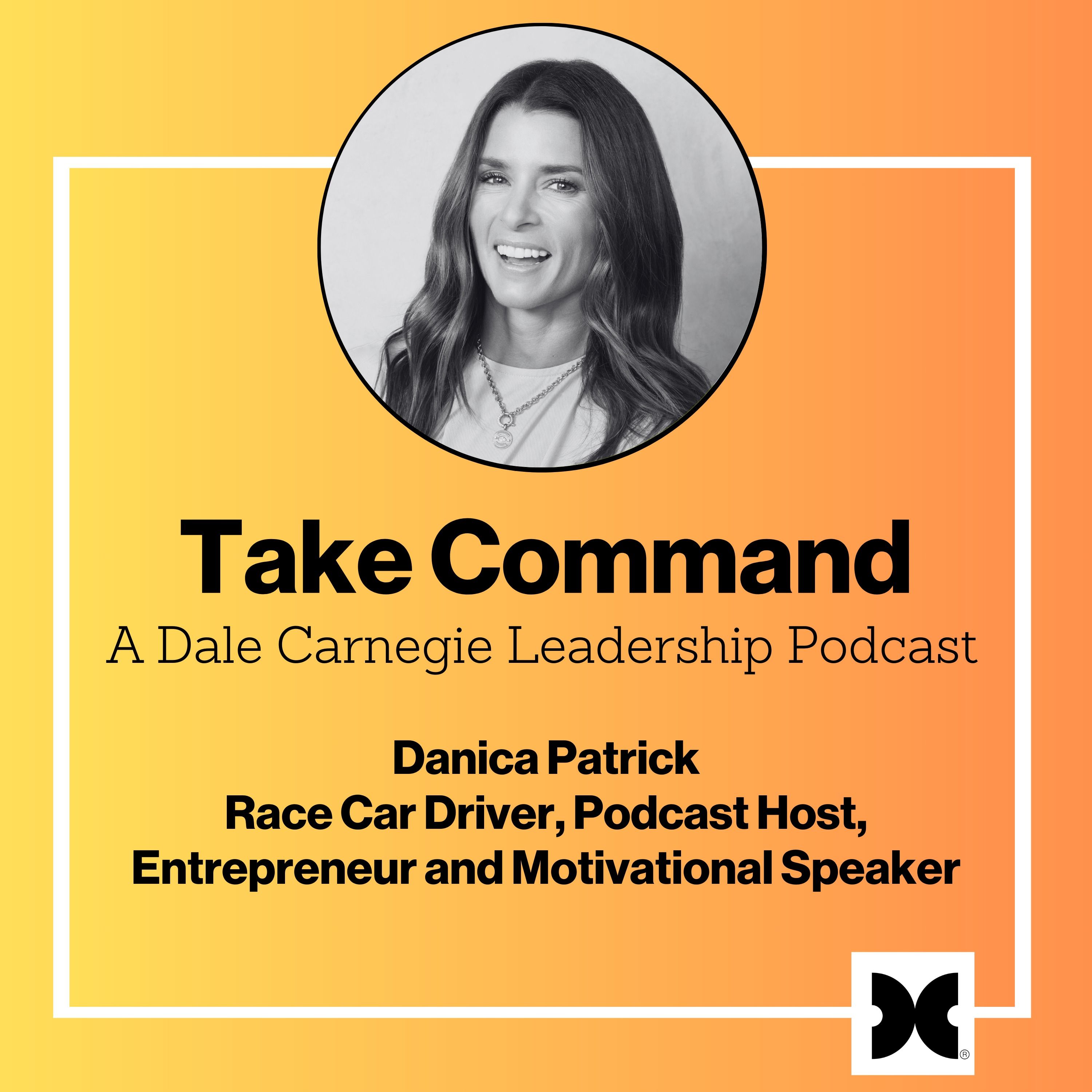
Take Command: A Leadership Podcast
Driven: Danica Patrick on High-Performance Mindset and Modern Leadership
00:38:40
Danica Patrick has built a career defined by fearless choices, relentless drive, and embracing discomfort as a catalyst for growth. She shares, “Ignorance is bliss... you don’t know what to be afraid of then,” reflecting on her bold decision at 16 to race in England. This special 100th episode of Take Command: A Dale Carnegie Podcast is packed with inspiration. Danica opens up about building confidence through tough decisions, trusting your potential even when the path is uncertain, and staying resilient by loving what you do. She champions action over hesitation, saying, “Always saying yes to the hard steps.” Tune in for her raw stories and timeless insights on the Take Command podcast.
Loading summary
Transcript60 lines
- [00:00]
A
It's really not about failing. It's just how many times you're willing to get back up. The magic sauce in the middle is that you actually like doing it.
- [00:17]
B
Welcome to Take Command, a Dale Carnegie podcast. I'm Joe Hart, CEO of Dale Carnegie and can you believe it? This is our 100th episode. 100 conversations about leadership, growth and transformation. And we are just getting started. Thank you to every guest who shared their insights and every listener who's tuned in, learned and grown with us along the way. What better way to celebrate this milestone than with a guest who has shattered barriers and inspired millions in the high speed world of professional motorsports and beyond. She was the first woman to make history in the NASCAR cup series and has consistently defied expectations while setting new records. She has been recognized on numerous favorite female athlete and most powerful woman lists, including times 100 most influential people. As a serial entrepreneur, she has launched successful ventures spanning apparel, wine and lifestyle. With appearances in a record setting 14 Super bowl commercials. She has turned her groundbreaking racing career into a platform for media entrepreneurship and personal branding. And she's a Dale Carnegie graduate. Please welcome Danica Patrick. Danica, welcome to the Dale Carnegie Take a Man podcast.
- [01:44]
A
Oh, thank you so much for having me. I feel like I'm on the spot having taken a Dale Carnegie speaking course when I was 14 years old and now I'm on the podcast and I'm much older, having hoped to have, like, cultivated very good skills. Like, I'm on the spot. I need to deliver well for you.
- [02:01]
B
You will deliver well. We know that you are excellent at what you do and it's kind of full circle, isn't it? I mean, you took this course really at the very beginning of your career, and now you're kind of at a different stage of your career. And here we are again to talk about a lot of what you've succeeded in doing and kind of where you're headed and that type of thing for our audience. You are, Danica, a pioneering race car driver. You, you broke so many barriers at the highest levels of racing, both in IndyCar and NASCAR. You're an author, you're a model, you're a media personality, podcast host, and as you said, you're a Dale Carnegie graduate. So there's plenty of things for us to talk about today. I'd like to start a little bit with your background because, you know, it's really a remarkable journey. I mean, you were young and you started in go kart racing. Ultimately you left high school at 16, I believe, and then went to the UK to race, which is pretty remarkable. I mean, you're a woman in a male dominated sport, you're going to another country. Tell us about what led to that. And really the confidence that you had to do that, what gave you that kind of strength?
- [03:03]
A
Oh man, ignorance is bliss. Let's just start there, right? You know, you don't know what you don't know and you don't know what to be afraid of then or how hard it would be. I always say with anything that's done right, you probably don't want to have to do it again because it's very difficult at least to achieve great things. And so it was a journey and I wouldn't want to have to do it again. But I'm proud of myself for always saying yes to the hard steps, you know, always saying yes to whether it's the speaking course at 14 years old amongst all the adults or, you know, moving to England at 16 wasn't exactly that hard to sell a kid in high school, like to be able to leave high school and go like follow a dream, that was not a super hard sell. But racing go karts from 10 years old and having a lot of success, especially right at that age of 14, I think that was the year that I won 30 out of 40 features or something like that. Like it was almost all of them. And it was really my sponsors, you know, that saw the skill and saw the potential and they paid for me to go do the speaking course. And then so fast forward from there, it was really just about being able to take it to the next level. And when I was again 14 years old, lot of things happened. When I was 14 years old, I went to the Indy 500 and there was a family that had a suite outside of turn two and Lynn St James, a former IndyCar driver as well, she was kind of like helping me out and showing me around and introducing me to people. She introduced me to this family with this suite. And so I was up in the suite drinking a kitty cocktail and, you know, talking to the people there. And there was a British guy that I was talking to and he said I could learn more in one year in England than five years here in the States. And I thought, wow, that sounds smart. They had contacted me about going over to England two years later when I was 16 years old and had the ability to then drive race cars because I was old enough and I left and I took that maiden voyage back when you remember when you used to be able to go to the airport and your Parents could walk you all the way to the gate.
- [04:54]
B
Yes, I do.
- [04:55]
A
Those days. That was when I went over there. So I think my mom cried most nights from what I hear. But they also knew that it would be far worse for me to not have the opportunity. And so I spent three years in England before I came back.
- [05:10]
B
So I want to ask you in a moment about any hesitation you may have had to go, but just going back, because you mentioned taking the Dale Carnegie course at 14. How did that come about? And, you know, what was that experience like?
- [05:20]
A
Yeah, it was a sponsor that paid for it. I can't remember which sponsor it was now, but I'm guessing. I'm sure it was probably, you know, on an executive level, someone, maybe they took the course, or maybe they knew it was available for their C suite or their employees or something like that, and that's probably how it came about. And they paid for it and put me through it. Yeah. I remember, again, it was 30 years ago. It was intimidating. I don't remember being nervous, but I remember feeling, like, very out of place because I was so young, everybody was adults, and so I've never been afraid to speak in front of people, but it was definitely a different environment. I remember it was, like, at least 30 or 40 minutes from where we lived. So it was a drive. You know, I remember there being some tools for name memorization that we did, which, I'm sorry to say it didn't stick. That one. I'm still awful with names. But there was, like, name association. It would have been like Danica Patrick. So it'd be like, you'd think of, like, a person named Dan, and then there was, like, St. Patrick's like, there's, like, a name association. So I remember that, and I remember there being, like, definitely these breakout groups and moments to speak within them. Is it like, 14 classes long? Is that.
- [06:29]
B
Am I. Yeah. So back when you took it, it would have been 14 weeks. They went from 14 to 12. There's some different versions today, but again, you get a great memory. You're 14. You get all these adults there, you know, and you're going through this. What would you say you took away from it? So, like, you went through it. And how did that help you?
- [06:44]
A
Well, I think so much of life is almost like a desensitization to certain things that you need to grow into or being able to be comfortable in the discomfort. Right. So that was uncomfortable. I mean, if I'm being honest, I might have cried before I left one time. Being like, what am I doing, but it's when you do hard things that you don't necessarily always want to do or that you don't feel comfortable with, that you sort of expand that comfort zone. So whether that was saying yes to something hard, maybe doing something I didn't want to do, or getting used to speaking in front of people, getting used to formulating thoughts in a more mature way. And so, you know, I could equate that to just driving in a sense that, you know, you start slow and you build up that speed and, you know, you put yourself in difficult situations as much as possible. I did a lot of hard things, and I really believe that while they were hard at the time, it's made for my life to be so much richer and so much more comfortable. Like, the amount of comfort I have with things that other people would absolutely meltdown in, you know, is just all a result of doing things like that that were not easy and not comfortable, but absolutely part of growing. And so, yeah, I remember it well.
- [07:55]
B
I can't help but think that, you know, we can have confidence in one part of our lives. For example, like, you know, you're this great driver, even at 14, you're winning all these things, and then you find yourself standing in front of a room full of other people, and that can be just absolutely daunting for anybody. Right? But, you know, part of what happens as a result of that is we build our confidence even more. There's a great quot quote in how to Win Friends, which is do the things you fear, and the death of fear is certain. Right? And certainly that's how you've lived your life. You've certainly faced incredible challenges and fears. So you went to the uk. What happened when you went there? What was the chronology and what was your experience there?
- [08:31]
A
So I moved over to England at 16, and when I first moved over there, I mean, I was sleeping on a couch underneath the stairs because, like England, the houses are very small. They're very tiny. And. And so I slept on a couch for, I feel like a couple months maybe before I ended up getting a room. So one of the women kind of shifted and she became the couch girl because she would go to London on the weekends. So then I got this tiny little shoebox of a room. I couldn't drive yet because you have to be 17, I think, is the age legal age to drive in England. And I was only 16, so I couldn't drive yet, so I had to have somebody drive me around. But it was cool. Like, it was very exciting. Really fun to be over in another country and be young and like leave high school and follow a dream. That was very cool. That was very cool. But I would say that the novelty did wear off. You know, just the age that I was to be 16 years old and racing with a bunch of other 16, 18 year old kids because I was there for three years, so we were all teenagers and they were all guys. And so at some point in time, it wasn't really that comfortable. By the last year that I was there, I lived by myself. That got incredibly lonely. So I was definitely happy to come home. But it taught me a lot about life. I thought I'd learn a lot about racing, at least according to whatever that guy said. You know, I was going to learn more there and one year than five in the United States. I learned a lot more about life and learned to keep my guard up and protect myself a little bit. I was a very naive, young, trusting 16 year old and I came back, as my parents would say, cold.
- [10:04]
B
Tell us more about that.
- [10:06]
A
I mean, you know, I just think that I didn't have great friends. I didn't have people that really, like, cared. I remember when I came home from England, I would call my friends that I spent years around and they never called me. And after I feel like it was like six months, I noticed that I was really the only one making contact. And so then I just stopped. And then of course it stopped because they weren't really friends again. It probably conditioned me for a public life and a scrutinized life. Better to kind of put my guard up a little bit more and be a little bit more protective of my energy and information and time. But I definitely came back colder and with a little bit of an accent.
- [10:46]
B
That must have been pretty cool to come back with that.
- [10:49]
A
Yeah. And I was driving on the other side of the road, so I do think there were a couple of moments where I probably pulled over to the wrong side of the road once or twice. But I did get very good at roundabouts while I was there.
- [11:00]
B
So I'm curious again. This topic of confidence, I think is one of the really important things that would be interesting to hear about. You're doing all these things and even in the face of, let's say, adversity, friendship issues, coming back colder, et cetera, how did you find the confidence and the belief in yourself to keep on moving forward and to continue to go into harder and harder environments where you're under the microscope even more? You become a public figure, you know, you have all kinds of people in media saying all kinds of things. You've got haters, you get lovers, people love you. How did you have the confidence or how do you develop within yourself that confidence, that inner strength to deal with those challenges?
- [11:40]
A
I mean, I touched on a little bit of like building that up and over time being put in hard situations and being able to get comfortable there. I have very good parents. My dad did push me pretty hard. But I have this theory that human nature is to do the minimum and everybody's minimum is different. My sister's two years younger than me. When we were in school and we had summer break, the phone would ring at 8am and it wouldn't stop ringing until one of us picked it up. And it would be my dad on the other end of the line going, get up. Don't waste the day, get up. So like, I was never even one of those kids that just got to sleep till you like, wanted or could. So I don't know what it means to sleep in, never have and don't. Now I'm very light activated, so I get up with the sunshine. But I'm sure some of that came from the conditioning of being a kid. But that's just an example of like my minimum was pretty high within my family and my parents. And so it was hard then, but of course I'm grateful for it now. It wasn't a cushy life, but it made for so much more bandwidth. As you get older, right, things aren't nearly as overwhelming or challenging because you've kind of been there already. So, you know, that's an example. So my parents were pretty tough and held a pretty high standard for us. And I had this thing just called blind faith. And I called it that then and it's still absolutely accurate. I love to philosophize, so I'm not sure if it's because I thought like that that it ended up becoming true that I would become a race car driver. Because my blind faith was that I had too much to offer and I just needed to get given the opportunity and I would make the most of it. And I had this sort of phrase in my head. I was like, it could be a really big deal. Like if somebody just gives me a chance, this could be a big deal. And so, you know, here I am decades later and I don't know if it's the belief in that or if it's that some esoteric sort of spiritual belief system is that this was already lined up in the ethers for me. I don't know, but I just knew it. Like, I just felt it. I guess maybe this could even become like something that someone may call a calling, right? When they just feel so drawn to something and they feel like nothing will get in their way. You know, having a podcast as well, I've heard lots of amazing stories of very successful people that had that sort of similar mindset where they believed in what they were doing or their product more than anyone ever did. And sure enough, it eventually comes to fruition in the way that it's seen by the person. But it takes time and attrition and that confidence. So, yeah, call it confidence, call it blind faith, call it something in the stars, I don't know. But those are some of the things I think that led me to, to the path that I was on.
- [14:20]
B
Yeah, it's interesting to hear that because I think all of us can relate. I mean, your calling, so to speak, was different than somebody else's. You have a very unique and special one. But it seems like for all of us, there's this inner drive, whether it's something that connects to our interests or our abilities or our fire, our intensity, whatever it is. But then again, you know, often there can be the challenge of, gosh, should I follow this or not? You've got people who say, oh, you can never do this, naysayers and so forth. My story was different. I left the practice of law and went into business. And there are a lot of people who said, why are you throwing away three years of law school? But we all have to do that in our own way. And probably even people who are listening to this show right now are having the same kind of dilemma. So for you, was it just crystal clear, you're like, hey, this is where I'm going and nothing's going to stop me. Or did you ever have kind of self doubt along that path?
- [15:07]
A
Well, I mean, I had a lot of like self doubt within the moments within, you know, following a race or a qualifying or practice or some situation. Of course there was like absolute crying breakdown moments of like, am I good enough? Can I do this? But the overarching belief in the vision and what I wanted in general, that never really changed. It was more about like those moments where you just, you know, are human and it's hard and like, it's not supposed to be easy. Right. So I had those. Yeah. But I always believed it was always possible.
- [15:40]
B
Well, if you look at your racing career, I'm looking at a list. Preparation I've done for this podcast has been Extensive. I think I've watched every interview you've given, you know, over the years.
- [15:49]
A
So much to me. Thank you. As someone who does that as well, I always feel like it's respectful to, like, know the story and know what they've done and where they've been. So thank you for taking all that time. I know how long that can be and I don't know how you do it, but like, basically I just listen to interviews, watch interviews, and I just make notes. Like I have a notepad. I sometimes do it on my phone if I'm walking. But like, I'll just continuously make notes and they're all random thoughts of questions that I have. And then I have to kind of organize my thoughts. But thank you. Thank you.
- [16:17]
B
Well, no, you're welcome. I like to do the same thing and then just like leave it all aside and just kind of get it in the conversation. But what's interesting is I'm not super close to racing. Certainly not how you've been. But I mean, I've watched it over the years and it was just amazing to kind of watch the different things you achieved over the years. First woman to win an IndyCar race. Only woman to lead laps in the Indianapolis 500, first female Indy 500 finish. I mean, all of these accolades. And I'm curious, if you look back over that career, are there a couple of even moments that kind of stand out or things that stand out in that career that you'd say were, and we talk about this in Dale Carnegie, almost like defining moments for you?
- [16:55]
A
Oh, yeah. I mean, when I was in England at the end of the first year, my managers had heard that I'd been out and doing too much partying and being too irresponsible. And was that true? Oh, for sure. I was going out. I was like 16, without parents around. Of course I was. You can drink at pretty much any age in England for the most part, but I was like hanging out with every other driver. Like, we were all kind of doing the same thing. We were brat packing it up around town that then got back to my parents, got back to my managers and they wanted to pull the plug on it all. And at that point, that's when I moved in with a family for my second year. It was like basically like house arrest. And so I think that was a defining moment. That's the first one. I think that was pretty big. So the way that I got a ride once I moved back home when I was 19, 20 years old, was a very happen chance sort of Scenario, I was going to the racetrack with my dad to the IndyCar races most weekends, lots of weekends. And we would walk around and we would talk to teams and talk to teams on the lower levels to see if they would test me and if a ride was available. And I had been told by someone that if Bobby Rahal said that he would start a Formula Atlantic team for me, that there was a full sponsor ready to go. And so this was summer. In the summer, it was a Milwaukee race. And at that point in time, I was so sick of going to the racetrack. I was like, dad, I don't want to go. I just. I'm sick of it. I'm sick of it. I mean, my dad and I would go to the bathroom for something to do at the racetrack. We're like, hey, want to go to the bathroom?
- [18:34]
B
Sure.
- [18:35]
A
Took a lot of humility to do that over and over again. And so it was Milwaukee, which was only like, 45 minutes from where we live, because I grew up on the border of Wisconsin in Illinois. And so I said, all right, fine. He goes, we'll just go for one hour. So we go. I have this information in my head. We go to Bobby Rahal's hospitality unit, and I see him, and I walk right over, and I'm like, hey, apparently we could have a full sponsor if you say that you'll start an Atlantic team. And he said, okay. And two weeks later, we did a press conference announcing that this was going to happen. And come to find out, much later, everybody around Bobby was like, are you crazy? And so, like, I'm still good friends with Bobby. I just had dinner with him and his family in Colorado after Christmas. And so, like, still very good friends with him. But I just love that he was right. I love that he got to be right, because I almost won the Indy 500 my first try. I did two years of Atlantic and then did IndyCar. And so I'm glad that he was right. But that was a pivotal moment to go to the racetrack and sort of be very blunt and upfront. By the way, never heard from that person again. It was like, almost like, you know, the universe just dropped in. This imaginary call that I made up in my head and put them on the spot. So that was one of them. And then, you know, my first Indy 500 was just really the massive turning point for me as far as, like, a staying power race car driver. I remember when I started an IndyCar, I was like, oh, my God, you gotta stay. Now, it's one thing to get a Ride, it's another thing to stay. And after that first Indy 500, which was 2005, and it was, like, the fourth race of the year, so it was at the beginning to have it go like it did and, you know, nearly qualify on the pole, I started inside second row and had a big catch in qualifying that, you know, still managed to qualify there. So that was, like, one of those things that people remember as being a, you know, feather in my cap as a race car driver, and then to lead so many laps and have a shot at winning and to be so fast the whole time we were there, that was where it was like, all right. And then something that I didn't coin, but the media did. Danica Mania started then, and so that was a fun time.
- [20:41]
B
It must have been magical. I can only imagine that that experience was a magical moment in your life and career, and you were in a career where you're up or you're down, right? And so a lot of times we look at those kinds of things, but then when you're down, you got to pick yourself up to keep on going. And I'm curious, because certainly there were challenges that you had in your career as well. And how did you find the resilience? I mean, this is the Take Command podcast, right? This is about taking command, being intentional, having the right mindset. I know you focus on a lot of these things on your podcast as well. How do you find the resilience? How did you then? How do you now? And what advice would you give to people who might be facing challenges and things that could be daunting or there could be naysayers? What would you say?
- [21:22]
A
Well, you have to find something that you love. That's the first thing. You have to find something you feel calling for a passion that you really, really feel, like, drawn to. Like, you'd want to do it even if you weren't paid, Right? Like, that's the level of love and commitment that you need to do something great, right? There's so many people that don't like their job, right? There's so many people don't like what they do. How can you be great then? Like, how do you ever put the extra effort in? How do you really excel when you're just doing the minimum? So you have to find what you love. That's first off. And then the thing that kind of kept me going through my career when I have those doubtful moments, is that I tried to remember the body of work that I had. I tried to remember that I did all of this to get this ride, and now I'm here. And then it was like, okay, you know, now I've been in IndyCar for seven years. I'm having a horrible time. But, like, I'm here, and I've done all of these other great things, and I'm not here by luck. You know, you can have lucky moments, and everyone does in life have lucky moments, but you can have these lucky moments. You don't get to stick around for decades out of luck. Right. So I had to remember the body of work that got me there. And that is usually what I would do. And then after that, it's really about just trying something new. You know, definition of insanity, doing the same thing over and over again, expecting a different result. So sometimes you have to try something new, be afraid of change. That's it, too. That's a big one, to not be afraid of change. I Learned this through IndyCar and, like, early on in my career, and having engineers be changed on me in certain situations within the team, maybe that I didn't want, but then when they'd happen, it would go better. And so I had, like, enough of those examples and experiences where I was like, okay, I'm like everyone else, and, like, when big change comes, you kind of get scared. But then I think maybe it could be better than I could ever expect, because you can't imagine something you haven't seen or to a place that you haven't been before. And so you have to allow the universe to sort of take you on a path that might be better than you could ever imagine because you haven't been there.
- [23:21]
B
It's often we want to control things and something will change around us, and we get worried about it, when in reality, that could be a far better opportunity for us. So much of it comes back to mindset, right. I can't help but think, you know, you were giving yourself a pep talk. And this is one of the things that Dale Carnegie in How to Stop Worrying and Start Living talks about is, hey, is it okay for us to give ourselves a pep talk? It's like, of course it is. We have to remind ourselves of all of the good because we can have an inner voice that tells us all the bad things right, or all the things that could go wrong. But it really is, I think, a battle of the mind. Dale Carnegie talked about the biggest challenge we have is choosing the right thoughts. And when we choose the right thoughts, that's halfway toward getting the results that we want.
- [24:02]
A
Well, we can just look at the idea, the blind Faith that I had that made it all happen. Right. That was just in here. That's it. I love the Henry Ford quote. Whether you think you can or you think you can't, you're right. And another thing that I always sort of remind myself of along the journey, whether it's professionally or personally or anything, it's an inside job. It's always an inside job. When we change the way we see things, the things we see change. Like, that's how it works. I think there's another sort of analogy or parable of like, you never step in the same river twice because you're not the same person. It's the journey of life. You know, when people say, oh, you've changed, it's like, God, I hope so. Like, I've been working on it. I hope it's in good ways. But, you know, it's about growing and evolving. And so I've definitely had a lot of experiences to help me and to force me to do that.
- [24:49]
B
So, Danica, what are some of the things that you do today? If we think about how do you cultivate that peace and that strength today, now you're at a different stage of your career, right? So your race car career is over. You've got a whole range of other things you're doing. You're facing a new future. What are the things you do for yourself to kind of create the peace, the strength, the focus, the mindset, the reminder of all the things that got you here and so forth. How do you create that for yourself today?
- [25:13]
A
I find things that I love to do. There's so many other aspects of me and interests that I have. And so it's been racing, but it's also now many other things. So if you do the things you love, then for me, it sort of spawns an idea into, like, starting a company, and how could I expand that? What could I do with that? And then just like mantras, I think, have been always a very big thing for me. Just the thought of, like, if somebody's got to do it, might as well be me. Like, somebody's got to do this, might as well be me. Like, somebody's gotta be great. Somebody's got to win. Somebody's gotta sell this. Somebody's gotta build this. Might as well be me. Why not? Somebody is going to. And so really having the staying power, the attrition needed is so important because everybody kind of thinks everybody becomes zero to hero in a second and really takes so long. It's really not about failing. It's just how many times you're willing to get back up. The magic sauce in the middle is that you actually like doing it.
- [26:06]
B
Well, that certainly can be something that carries us forward, right when it's really hard, if we like doing it. And there's a strong enough why around it. By the way, I can't help but think one of the things I learned about you in preparing for the podcast is that you ran the Boston Marathon in 2021. I've run it myself. And, you know, people don't, you know, they see the finish line, but they don't see all the work that goes into leading up to that race.
- [26:27]
A
Right. And the mindset. So, interesting enough, I was actually here in Chicago and it was before the marathon, not long before, and I had dinner with Michael Wilbon, who's an announcer on ESPN and a friend, and he said, you know what? Athletes are different. He's like, you're going to get out there. And he's like, when it's race day, you'll just find more. And I had actually trained like 100 miles less than the other girls that I was running it with. I kind of just always had this idea like, I'll just go run one without even training. But I did do some training, but I also was the least healthy I ever was in my life. So I went through some health challenges. And so recovery was like terrible. If I did anything over a 10 mile run, 12 mile run, it took me two days to recover. So, like, I just wasn't in a very good state to do a lot of training. And so I didn't know if that was really possible. And so race day came and I, you know, obviously kept up with my friends who were doing it with me. It was my sister and a best friend and their minutes per mile were better. And like, a lot of things were going on. Now, mind you, I was training either at altitude and Telluride, or I was in Arizona where it was 100 degrees by 7am I realized that heat with running is terrible. Terrible.
- [27:35]
B
Worst.
- [27:35]
A
Yeah, terrible. And so anyway, so I was maybe a little bit more conditioned than I thought, but here we go. Race day comes and my friend ended up getting to the hills and her thigh like cramped up and so she dropped out. So now it's just my sister and I and we're coming down the hill. Mile 19, I think, is when you start going down.
- [27:52]
B
You're right by Boston University, I think. Yeah.
- [27:55]
A
So we had about five miles left, basically, and sure enough, I found it and I was like, we did Negative splits for the last five miles. Obviously the fastest five miles of the entire marathon. And everyone was faster than the one before until we finished.
- [28:09]
B
That's incredible.
- [28:10]
A
So, yeah. And so I'm telling my sister, who, you know, again, I didn't feel as prepared, but I was like, we got to go, we got to go, we got to go. And the athlete in me came the mindset. You say that the training is important. Yeah, but the mind is even more powerful. And so that was that moment. And I was, like, blocking people from her in the corner so she could take the inside line. And we had the goal to finish in under four hours. And so what I didn't realize is that you got to run a minimum distance. And so 26.2 came. We've still had, I think, 0.35 miles to go. And so I was like, oh, shoot. And so we finished in 40120.
- [28:49]
B
So you're talking about your watch. Your GPS told you you hit 26.2, but you weren't done. One of the hardest things about running a marathon is actually the GPS watches are off, right? Or you run the tangents or the outer part of the track, but I.
- [29:02]
A
Mean, still the signage on the road, because they put the sign, and I'm like, oh, that's off, that's off. I got the GPS here. It's like, no.
- [29:10]
B
But a great time nonetheless. Negative splits for the last five miles, especially in the Boston Marathon. You're going to run to the end of a finish line. That's the race to be finishing it strong. Congratulations. Speaking of health, you wrote a book called Pretty Intense, and it's really about health, and I think some of your health journey. And are there some things you'd want to share about that book and also encourage our audience? If they want to pick that up, you'll let them know. I know it's on Amazon and on your website, but maybe you can tell them specifically where to get that, please.
- [29:38]
A
Well, you know, I wrote that book as a result of being a young athlete and not sure exactly where my life would go. I ended up freezing my eggs when I was 33 years old and then ended up understanding what it meant to have hormones go crazy. And so I, like, gained some weight from it. I was like, oh, God, what am I going to do now? And so I started this whole new regiment of, like, diet and training, and it changed my body, and so I wrote a book about it. Then I probably need to do an addendum or I need to write a part two or like, pretty intense, but not that intense. Maybe should be the next book because I've really learned the value of rest and recovery. And, you know, I went through my journey of like, thinking that I didn't maybe need to eat protein. Maybe that was just all bunch of lies. Not at all. Eat your protein and lift weights. So I don't really train like the book anymore, but it does work. And so you have to be good on the body. And some of my health issues came as a result of a little bit of overtraining, a little bit of under eating, or at least like, not enough, you know, diversification within my diet and stress. And for me, I had breast implants put in, and after seven and a half years, I took them out. And they were also a big culprit with my health issues. So when I ran the Boston Marathon, I had them in. I still was, like, trying to figure out why my body wasn't working and why my hair stopped growing and why I gained weight and my face looked different and my energy was low and my recovery was terrible. So, you know, for those out there, as a word of warning, whether you are a woman or you obviously, I'm sure know them, there are definitely things that they say are okay to do that I would definitely say be careful and trust your intuition. So that was one of those things for me. I was trusted by intuition and got them out. And honestly, I have the best body composition and energy of my life, and I'm obviously the oldest I've ever been, so.
- [31:30]
B
So any tips around that? If there are one or two things or three things that you do consistently that you'd recommend?
- [31:36]
A
Yeah, well, I think that I like to go from, like the top down as far as the hardest, most expensive things to do and then drop that down to the simplest. And probably one of the best treatments I ever did was this treatment called eboo, which is basically a blood dialysis. And so I did that a bunch. And I do that every year now. I think that really helps just clean up the body. And then I would say after that, I think red light is super powerful. Red light is a really powerful tool for mitochondria, for your skin, for energy. And then I'd say after that, I love, like, anything that gets the lymphatic system moving. So I do a lot of gua sha and sort of little techniques to help the blood pump, but those are just modalities. I'm like quite a biohacker. So overall though, eat your protein, lift some weights, and just allow the Body to rest and recover. I think I used to think about stressful things on the body in buckets, like categories. I was like, oh, that's emotional bucket, and this is a physical bucket. You know, they all had their own buckets, but it's all the same. It could be even just traveling being taxing. You don't do anything else, but it's taxing. Or maybe you have an emotional conversation with somebody, or of course you went ran 10 miles. All those things are stressful on the body. Cold plunge is stressful on the body. Right. Heat is stressful on the body. In the sauna, all these things are stress. Not eating enough is a stress on the body. So fasting, all of these things are all in the same bucket of stress. So try not to stress your body out. I always set a limit of like, I don't have to think about it now, but one or two things a day is it. I used to do them all. I used to do them all. And I think as you get older too, that becomes increasingly more important. But the body knows how to heal. You just have to give it the right environment.
- [33:16]
B
It's interesting. I've been focusing on sleep as a priority, honestly, over the last several years especially, and intermittent fasting has been very positive.
- [33:25]
A
Fast long enough, your body gets rid of bad cells called autophagy. So if you do it long enough, but also the body, it's good to take good rest. Right? I think I kind of practice about 12 hours, but not because I'm trying to fast, but just because I try not to eat super late at night. But I love breakfast. So fasting in the morning was always just so painful for me. And men and women are different, so men can do a little bit more of it than women. But yeah, there's a lot of really powerful modalities out there. And thank God for podcasts and all the biohackers of the world and, you know, sharing that information because we know so much more now.
- [33:57]
B
Speaking of podcasts, I was going to ask you, that's one of the things that you're focused on right now, but what are you most excited about when you think about your future the next several years?
- [34:07]
A
Well, I like to think of ideas for companies. I don't know if it was modeled by my parents. They started a lot of companies. I'm sure nature versus nurture, it's all there. But I have that confidence and I also just sort of follow passions. So the newest one that isn't out and isn't sort of in its Total fruition of deliverable is starting a driving school. I'm in the final phases of sort of looking at how that's going to go, but basically, I've just driven around my whole life thinking, everybody sucks at driving on the road. What do you do with that? You felt them.
- [34:36]
B
You mean like a driving school for, like, teenagers, or do you mean like a driving school?
- [34:39]
A
Yeah, I mean like a driving school for the road. Like someone when they're getting their license to teach people better techniques, more awareness, certain things that are just going to help them become safer as well as more competent on the road. I have a very large comfort zone based on all of the things that I've done. And that comfort zone comes as a result of doing dangerous things. Right. And so driving on the regular road to increase that comfort zone, well, that's very dangerous. So driving school will be designed so that you get put into situations that you may have never seen before or are dangerous. But we're going to do it in a way that's going to give you that sort of visual experience that will help you become a better driver, because it's all about expanding that comfort zone. If there's any one advice I have for anybody driving on the road, it's literally just that. Just stay in your comfort zone. Because as soon as you get outside of your comfort zone, you know, you have one of those fight or flight responses. And so usually your focus goes down to, like, a pin drop. You see nothing else. Right. When you're panicking, you can't take in all the information. So always stay inside your comfort zone on the road.
- [35:42]
B
Great advice. So the last question I have, I've been going to ChatGPT. When I've been doing this podcast, I said to ChatGPT, I'm interviewing Danica Patrick today. If you could ask Danica only one question, what would that one question be? And I'm going to give this to you. And I think we've touched on this to some degree. But if you could distill one mindset shift that helped you take command of your career, relationships, and life, what would it be and how can our listeners apply it right now?
- [36:10]
A
I would say that again, it's hard to overcome the hump of, like, getting over the anxiety that a lot of people suffer from or fear. But it's really just to be okay with change. It's really about being okay with change and sort of telling yourself that it could be better than I could ever imagine when I retired. I don't like to call it quitting I like to call letting go. I had to learn the difference between quitting and letting go and how I sort of was fine to keep racing after 2017 full time, but I was not going to force it and I was going to let things happen. And in the process of doing that, the chips didn't fall as they may, they fell all over and it didn't work. And so that was sort of like I took those signs from the universe and from life and from my circumstances, and I was like, all right, it's time to move on. Then I had a mantra for a long time. Try harder. I won't bore you with the story of how that happened. It's kind of funny, but it was like, try harder, try harder. And that is very beneficial. But at some point in time, you have to know when it's time to pivot. You have to know when it's time to let something go, that something greater might be waiting for you. When things are meant for you, they go fast. When it's meant for you, things kind of just fall into place. The right person shows up, synchronicities happen, and the person that needs to call you or the person you need to meet shows up. Like, all these things tend to fall into place. So, you know, take notice of the opposite of when life is not working and that maybe it's time for a change.
- [37:39]
B
Awesome advice, Danica. Great way to end the podcast. Thank you so much for being here and we look forward to continuing to cheer you on.
- [37:47]
A
Thank you so much, Joe. And thank you to the Dale Carnegie Course for helping me become the speaker that I am today.
- [37:53]
B
We're excited to count you among the Dale Carnegie grads, so thank you so much.
- [37:58]
A
Thank you.
- [38:03]
B
I hope you enjoyed this edition of Take Command, a Dale Carnegie Podcast. Check out our resources at www.dalecarnegie.com for more research, insight and tools that will support your success and help you take command of your leadership potential. If you enjoyed this episode, please consider rating it and following us on Apple Podcasts and Spotify. For more exclusive content, subscribe to our Dale Carnegie YouTube channel and follow us on social media. As always, thank you for listening and we're looking forward to you joining us for the next episode of Take Command, a Dale Carnegie Podcast.