← Take Command: A Leadership Podcast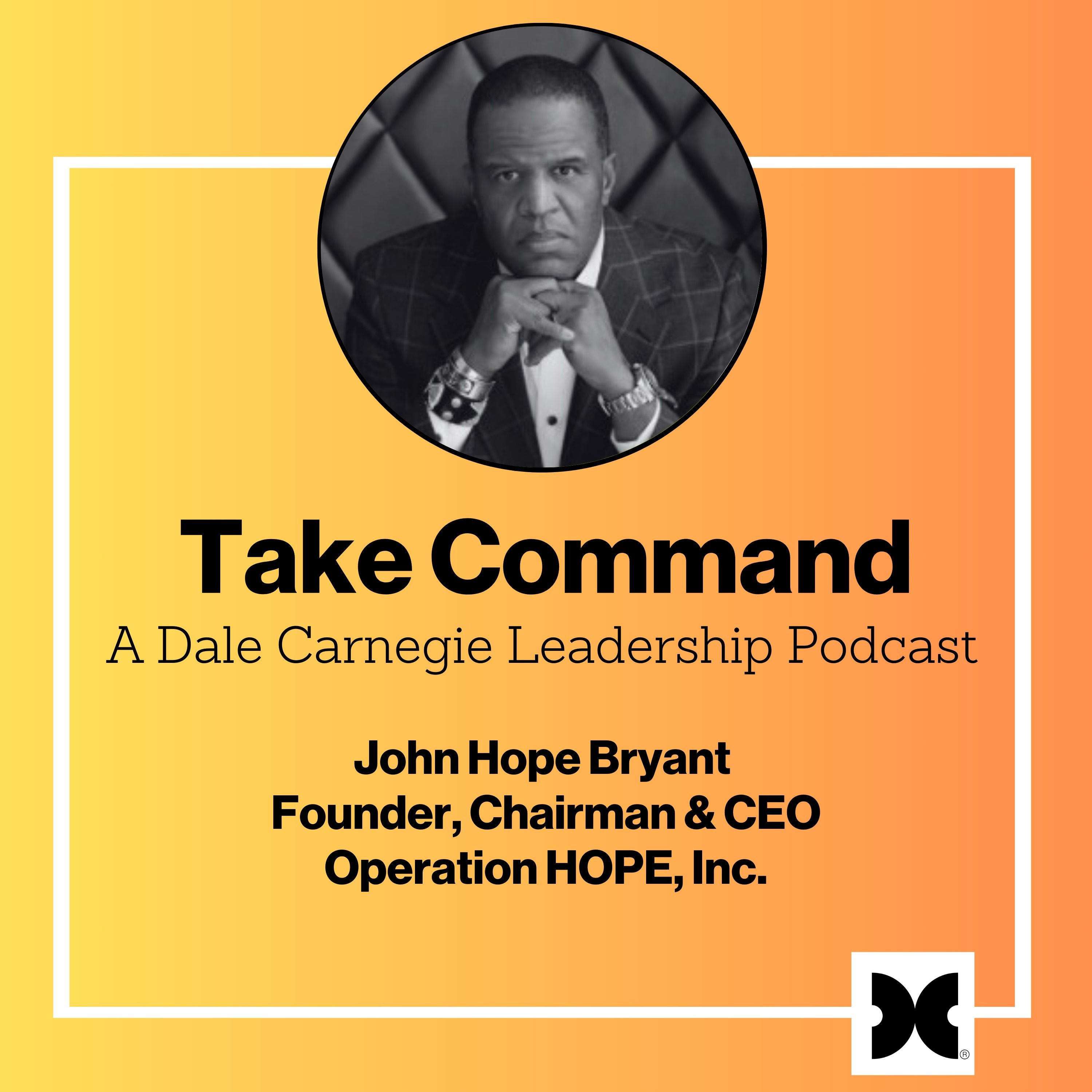
Take Command: A Leadership Podcast
Eagles Don’t Fly in Packs: Courage, Faith, and Leadership
00:42:12
Some people follow the crowd. John Hope Bryant pursues transformation. From personal growth to inspiring leaders worldwide, John shares how courage, optimism, and intentional action shaped his journey. He says, “If you become the person that Dale Carnegie’s trying to evolve you into, there’s a high likelihood that most people are not going to understand you anyway.” This episode dives into stepping into fear, leading with faith, and embracing principles that turn potential into action. John reminds us, “Keep the faith, ignore the noise, punch right through it, because light defines darkness, not the other way around.”
Loading summary
Transcript37 lines
- [00:00]
John Hope Bryant
Keep the faith, ignore the noise. Punch right through it. Because light defines darkness, not the other way around. Goodness defines badness. Badness has failed goodness. So if you look at who succeeded, it's all the good people with the light.
- [00:25]
Joe Hart
Welcome to Take Command, a Dale Carnegie podcast. I'm Joe Hart, CEO of Dale Carneg, and if you're ready to grow your leadership skills, follow. Take command now and never miss an episode that could transform your career. Today's guest shows how purpose driven leadership and financial empowerment can transform communities and careers. He explains why building economic literacy and inclusive opportunity isn't just a moral imperative, it's essential for sustainable growth in an AI driven future. He leads the nation's largest nonprofit provider of financial literacy services for youth and adults. Recognized globally, he was named to the Forbes BLK50 list in 2024 and Time magazine's inaugural the Closers list. A best selling author and CNBC contributor, he reaches millions through his Straight Talk series and continues to advance economic opportunity and inclusive capitalism. Please welcome entrepreneur, author, philanthropist, and global authority on financial literacy, John Hope Bryant. John, welcome to the Dale Carnegie Take Command podcast.
- [01:40]
John Hope Bryant
Honored to be with you, sir. Good to be connected again. You certainly are continuing to lead in the Dale Carnegie spirit based on the little I know about you.
- [01:50]
Joe Hart
Well, thank you, John. I appreciate that we've gotten to know each other a little bit and certainly I'm excited for myself and for our audience to get to know you better. You one of the most influential voices not only in America, but I mean really around the world on financial empowerment. You're an entrepreneur, you're a best selling author. You've created what I think, John, you'll correct me if I'm wrong, is the largest nonprofit of its kind in the United States around financial literacy, really helping people to empower people. I also know you've got a phenomenal personal story about how you started and really how you grew that in other businesses, because you've got multiple other businesses as well. So I'm excited to hear about how you've taken command. And I also know we'll let our audience know that Dale Carnegie had a pretty important impact on your life too. So tell us a little bit about your early life, John, and really what inspired you to start on this path of helping people with financial literacy.
- [02:41]
John Hope Bryant
Well, I think the most pointed thing I need to say right up front is beyond the fact I think you're a cool guy and I was honored to meet you. They're lucky to have you as their leader. The reason I said yes to the podcast request invitation was because of Dale Carnegie's legacy and his lineage and impact in my life, I read how to Win Friends and Influence People. I remember that book. I remember it was a paperback. I got it from the library because I couldn't afford to buy books back then. It was dog eared. It had all these stamps from people who had borrowed it. Back in those days things weren't digital, it was physical. So the library would literally stamp the book when you checked it out. They called it checking it out. And you could keep it for a week and bring it back. And this one was stamped all over like a passport of somebody who traveled all around the world. But this was just simply in California. It was really inspiring looking back to think how many young bright lights in Compton, California, which is one of the so called poorest. I define poor differently than most people, but it was one of the economically poorest neighborhoods then and now in the country, certainly in California. And to have all these young bright lights being attracted to the story of dale Carnegie from 1936 and checking this book out, you have no idea how many people's lives Dale Carnegie impacted and turned around because that was pre Internet first of all. And two, these are not folks in the suites. These folks in the streets. They don't have that relationship capital. They don't have the ability to go to a cocktail party or the CNBC CEO summit where we met and meet you in a hallway and tell their story. So I'm telling you on behalf of them, I'm being an ambassador on behalf of all of the unseen voices, the heroes and sheroes who went and led and built and did and served. That the impact of whatever you think Dale Carnegie did is probably 10x because of folks who did not have the ability to communicate as I am with you now. What happened when they read that book and stamped it at the library, checked out and checked back in that book not only changed how I saw myself back then, it has changed how I interface with people to this day. I can't guarantee you that being positive is going to make you a success, but I absolutely guarantee you that being negative is going to make you fail. Now that's a John Bryantism, but one could argue that is classic Dale Carnegie, which is avoiding criticism and giving honest appreciation which would come from that first book, the book how to Stop Worrying and Start Living, which I think was 1948ish. I don't remember that book as much. But I say today, if you're going to pray why worry? You're going to worry. Why pray? And that rainbows only follow storms. You cannot have a rainbow without a storm first. You can't grow except through legitimate suffering. That's biblical, by the way. But all those things I take no for vitamins. An entrepreneur works 18 hours a day to keep from getting a job over to round it through it. I'm going to get to it. I mean, those are Briantism. These are my quotes. But you cannot doubt that the ether, the underlying foundation is a Dale Carnegie sort of spirit. Now, you know, I read books like mere Christianity from C.S. lewis in 1940 something and Dr. Scott Peck, you know, the Road Less Travel. There's all these books that were foundational in my life, but the book that helped me take those wonderful threads and lean them into business were the Dale Carnegie books. So I just want to give proper credit where credit is due. None of us got here by ourselves.
- [06:30]
Joe Hart
Thank you for sharing that, Janet. It's powerful to hear that, especially given what you've done. You've taken what you read and you've continued to live those principles. And I know we're going to talk about some different ways that you've internalized that into your leadership and how you treat people and really your personal mission. It's I think, inspiring to see how you continue to live those principles.
- [06:49]
John Hope Bryant
Well, thank you. I also think that what you guys are teaching there, inspiring others to this day, almost 100 years later, it proves that true leadership is timeless. Culture is not the most important thing in business. It's arguably the only thing in business. It's also the only thing in life. Dale Carnegie's office there has a culture. My office has a culture. My home has a culture. A city has a culture different from the state. If that wasn't the case, why travel? Do a road trip from your city to another city in the state. Why go from one state to another if everything is the same? The cultural foundation you guys have set the soil, you create some seedlings, you took the plant, you put it in good soil. To quote my friend Bishop T.D. jakes, good soil. And I think that that is extraordinary. And I applaud you guys for staying the course, particularly in times like now.
- [07:41]
Joe Hart
Thank you.
- [07:42]
John Hope Bryant
Where leadership foundational principles may not be all that obvious to a generation that is increasingly exposed to more through digital but has more limited social interaction because of digital. They're just really focusing on the little screen in front of them and they are somewhat isolated. You grow through constructive friction. You got to talk to people who are different than you and deal with tough situations, then life is 10% what life does to you and 90% how you choose to respond to it. What's your response going to be? Those responses, those response muscles are born not through success. That's easy going. Shopping is easy. Traveling is easy. Taking a bow is easy. It's through failures. It's through falling down and getting up again. It's having hope and loving in spite of, not because of. If we love because of, we wouldn't love anybody may not only love ourselves. We have to love in spite of lead, in spite of care, in spite of be concerned in spite of, have hope in spite of, be kind.
- [08:41]
In spite of. When you get up in the morning with the truth, the lies made it halfway around the world by the time your feet hits the ground. Because it's cheating. It's the lie, Lucifer. In my opinion, the devil is cheating. They're con artists. So the truth, the light, has a harder role. Because love is work. Non, love is laziness. Anti, love is evil. Evil exists, but it's very rare. Most people are just lazy intellectually, spiritually, emotionally, physically, financially. They don't want to do the work. They want somebody to do it for them. They want to end up at the finish line. That's not the way it works. As you well know. Only in the dictionary does the word success come before the word work, because it's alphabetical. So love is work. So now to go to your question about my background. It literally is that, and that is why I wake up every day. And when problems come my way, when frustrations come my way, when difficult people come my way, I can shrug it off pretty easily.
- [09:38]
Joe Hart
What was it? I mean, you know, you started without tremendous advantage. You really went through many challenging times. You've developed this mindset. And one of the things we talk about a lot in this podcast is around resilience and courage and taking action and so forth. Because a lot of times we could look around and we can have all kinds of things. We can blame the way that things are, the way that they're not. How did you go from, you know, where you started and talk a little bit about that? What were some of the things that you did, and what advice would you have for people really to have that mindset that you're talking about right now?
- [10:08]
John Hope Bryant
I'm going to cut to the end about values and go back to the story, give you the backstory of how we got there. If somebody said to me, john, what are you proudest of today? What is Your special sauce. I probably would say three things. One, I know I'm God's child. There are 8 billion people in the world, but nobody has my fingerprints. You go to the airport now, go through the international check in and you stand there for, I don't know, a second and a half and it says, go, proceed. I'm like, go where? Proceed where? No, like going about your business. You don't need my passport. I mean, it's scary that my eyes are so unique that it can identify me. Almost 8 billion people in a second and a half. And so confident. It says you don't need to show any documentation that shows how rare you are. So number one, I know I'm God's child, I'm unique, I'm special. And I've got to just articulate, express my specialness, exploit that, grow that, build that. Number two, I'm resilient that over the rounded through it I'm going to get to it that again. Failure is just a stepping stone to knowledge and wisdom and rainbows only follow storms. Number three, my mother told me she loved me every day of my life. Nothing more powerful than a child being told that they're loved. And so it's okay if you don't like me. I like me. I'm not as good as my compliments, I'm not as bad as my criticisms. I am who I am. You like me, great. You don't like me, still great. I really respect me. Learn to like me, then like me, never respect me. And to understand that eagles don't fly in packs is to appreciate that if you become the person that Dale Carnegie is trying to evolve you into, is a high likelihood that most people are not going to understand you anyway. And so I just want to walk through life consciously oblivious of most things around me because it just doesn't matter, Joe, Most things around you just doesn't matter. It's just noise. So how does it relate to my background? It's everything because I grew up in noise. When you grew up in a poor struggling neighborhood, whether it's black and brown urban or poor white rural, it's noisy, there's a lot of distractions. People talk about their ideas, they talk about other people. There's traffic jams, there is a check casher next to a payday loan lender next to a rental owned store next to a title lender next to a liquor store next to a pawn shop, all selling some distraction from your dream and really target marketing distress. And my second great grandmother and my second great grandfather Were slaves. Still shocked me to say that my grandfather, my father's side was a sharecropper. My dad was a businessman. I'm an entrepreneur. That's not genius, that's role modeling. On my mother's side, my second great grandmother owned a home, a modest home, had a border, no mortgage, had a border, a renter. So she's sort of self reliant in her spirit. My grandmother, my mother's side owned a shotgun shack. Which means you could open the door in the front through a shotgun shell through the house. Never hit anything if you open the front and back door because it's just a building, a room empty in the outhouse. This is where you went to the toilet in the back. That's where my mother grew up. My mother ended up buying and selling seven homes. I ended up buying 700. I became the largest minority owner of single family rental homes in America until I sold that company for $120 million three years ago. And now I just started a billion dollar fund with CIM Group, a $30 billion company. We've already raised $250 million for affordable housing on multifamily. The CIM BGV Impact Ventures was launched last week. That started twice the size of Promise Homes. I'm not a genius though. I'm building on my mother who built on her mother who built, who built, who built. So role modeling matters. My mother told me she loved me every day of my life. My dad gave me a sense of yes I can. My mother gave me a sense of yes I am. And when they got together, mom and dad in South Central LA Joe, they for a moment they were aligned and they built. Man, they had a home number one way you build wealth in America's home ownership. They had a gas station in South Central LA at Vernon and Western southeast corner. Still there. They owned a eight unit apartment building cement contracting business. Anyway, they lost it all through what came next, which was financial literacy or illiteracy. The fact they didn't realize they were not just lovers and partners romantically, they were business partners. And my dad should have made it, my mother should have managed it, right? But they didn't realize the roles. If you can't make it, at least manage it. Can't make it, at least invest it. If you can't make it, at least help to keep it. The first person making it is also spending it, which was my dad. I never said the story, by the way, this way to anybody. And my mother, who was a great investor, who had an excellent credit score and great investor was not empowered to help them keep it then. If your outflow exceed your inflow, your overhead will be your downfall. And so when my mother put money aside, send my brother to college, the college of his choice, $4,000. My dad got to that money also. He wasn't just messing up his, he's messing up hers. She said, that's it. They fought in front of me. Domestic abuse, they divorced. Number one cause of divorce and domestic abuse, money in front of me. I'm four or five years old. Fast forward, my mom leaves, leaves my dad with all the assets. Joe now California community property State. She could have taken him literally for everything she had, the kids, she was a mother. The courts would have given her almost everything. She left with literally the shirt on her back. Her two kids said, the oldest one to military is gonna get a four year education now. And we went to go stay with one of our girlfriends. I witnessed a murderer at that house. The guy who saved my life. I was swallowing my throat on his porch one day. Then I saw when mother bought a house in Compton. And my best friend George was murdered with the next door neighbor who was a drug dealer when I was nine. So four years old, seven. Destruction of family net worth. Seven years old. Murder of a guy who saved my life. That was about drugs. Third nine years old, murder of my best friend. That was about drugs. So money, money, money. So I'm nine years old now to ask you a question of what, how? And this white banker comes into my classroom in Compton, California, teaching financial literacy. But it's important to say it was a white banker. Because the only person who was white in Compton, California with a suit on, Joe, was a detective. And it wasn't a good suit. So this was a guy was wearing a beautiful tailor made suit, Egyptian cotton shirt. I mean, you could see the threads on it. And I'm like, who is this dude? Like the car was in the parking lot. It had tags on it and a license plate. It was legal.
- [16:58]
And he was from bank of America. And I asked him, what do you do for a living and how'd you get rich legally? And he said, I'm a banker and I finance entrepreneurs. I said, joe, I don't know what an entrepreneur is, but whatever it is, if it's legal and you're financing it, I'm going to be one. And that's who I am today. Later on, short of one day with a suit on, modeling what he was wearing, that suit's going to be put in the Milken center for the advancement American dream, I'm told. I wore this suit, a little crushed velvet, purple thing. I said, are there any other bankers like you? He said, sure, there's countless. And your job is to lend poor people money and all we got to do is prove we can pay it back. He says, yeah. I said, this is legal, right? And I don't get dead if I don't pay the money back. And he just laughed. Why would I kill you? Guess what happens around the corner? He said, no, I'll give you a notice of default. I said, you give me a piece of paper if I don't pay your money back. Sign me up. That's Operation Hope to this day, the largest organization of its kind in the country. And one of the largest in the world, probably, if not the largest, because we're the largest economy here in the US. 1500 offices, four and a half billion dollars invested. But we're really teaching the rules of the game. We're the economic plumber for underserved America. We're serving poor, white, rural neighborhoods. We're serving black and brown urban neighborhoods. We're serving streets to the suites. We're creating new customers for banks and capitalists. We're making capitalism relatable to all of God's children. Have a book coming out next year called Capitalism for All. I think this is what Dr. King would be doing if he was alive today. I think this is where he was pivoting toward. I call this period, this era, the third Reconstruction. As you mentioned earlier, I've created about 50 entities, three of which are the largest in their category in the country.
- [18:34]
Joe Hart
So let me ask you a question, Jen, because, I mean, this gets back to leadership, right? When you create those kind of entities, when you have the kind of success that you've had, that really starts with leadership and vision. You'd probably be the first to say you didn't do it by yourself. You inspired other people. You built teams of people. I'm certain that there are people who are watching or listening to this podcast who would say, gosh, I want to build something like John did. Again, you're modest in terms of the way you explain this. And at the same time, people could look at your success and they don't see all the things, the ups and downs and the challenges and so forth that may have gone into achieving what you've achieved. What are some things you would share about your leadership journey that would be helpful? Things that if you went back and talked to yourself, even when you started, some things you didn't know at that time that you wish you'd known that you do. Now that would be valuable for anyone thinking about really strengthening their leadership abilities or starting a business or really just trying to even enlist other people, enroll other people into their vision.
- [19:33]
John Hope Bryant
That's an excellent question. And I'm gonna try to give you a succinct answer because that answer could be a separate podcast all by itself. What would you tell your 18 year old self? The first thing I would tell my 18 year old self is ignore the noise. There's a lot of noise around you. I just walk through life consciously oblivious of most things around me because it just doesn't matter. That's the conclusion I'll come to. It's just people running their mouth and criticism is an easy sport. Throwing rocks is an easy cheap sport. Being a professional critic, a chief criticism officer is a cheap easy sport. Being low frequency a person meaning the opposite of high frequency. I think Dale Carnegie was a high frequency thinker. Are easy sports. And we spend most of our time trying to impress somebody that we actually don't want to be like. You got this four square block celebrity in your neighborhood. In the neighborhood, he or she is everything. He's got the car, the girls, the team captain on the football team, he's whatever you know, or the lady, she's a cheerleading squad leader or she's got the Goldilocks hair and the people want to be like her. She's pretty, she's popular. And we spent all our time trying to chase after these people for their approval. And you grow up and you realize that person that you were trying to impress is coming to me for a job. These folks are all coming to me. Who criticized me, who wrote me off, who called me bad names. At some point, whatever goes around comes around. And they did not have what it took to get out of that three square block temporary popularity zone. In fact, that made them lazy. The fact they were popular in a celebrity unearned. Okay, you're handsome or you figured out some little short term gimmick. So what? Eagles don't fly in packs. You've never seen a flock of eagles. But buzzers love packs. They're low altitude birds and turkeys got wings and can't even fly. So you know, I think that is the most powerful thing and two things can be true at the same time. That doesn't mean that you should be doing the thing that's unnatural for you. What I mean by that. So I'm first generation, I'm a builder, my wife's Second generation, the daughter of a man who helped build a big company. My wife's gonna have a different perspective on wealth and work and all that stuff than I will. A builder's just gonna have a different perspective. I'm gonna be more paranoid, I'm gonna have a greater sense of urgency. I'm gonna think the world's falling. You know, I was homeless when I was 18 years of age. When I was homeless, my wife was at a great college or whatever, you know, and by the way, I should be calmer and more relaxed in my success as she is. We were at dinner last night and she. There was something on the menu and I didn't understand what it meant. And she explained it instantly. Well, that's because she's very cultured and she knows the world. She has enormous exposure. And if there's anything about wellness or well being or health or culture, I go to her. But are you talking about hustle and grit and punching through a wall and jumping out of an airplane and building the parachute on the way down? Well, that's me. And I have a sense of great urgency. My wife doesn't. She takes great time to figure out what's the best paint for this room. And by the way, that's necessary in the world. That art, that beauty, that taking time. But I'm trying to figure out how to pay the mortgage on the room that she's building. And so it's a different set of priorities. And it's not one or the other. It's both. Like, you got to understand there's something you can learn from her. She's something she can learn from me. But those two things, both of which are true, are different. And you got to figure out again, go through life consciously, oblivious of most things around you, what is your path, what is your truth, what does your success look like and what is it going to take? And as my billionaire friend Tony Ressler once said, and I can't say it exactly the way he said it because it wasn't appropriate for this podcast. But your audience will figure it out. He's the 200th richest man in the world today. Last time I checked on the Atlanta Hawks. Great guy. He and Michael ARR Getty, another billionaire, back in my Promise Homes company, which I sold, he said, if you don't blank quit, you can't blank fail. I'll say that now on a PG version. If you don't quit, you can't fail. Just keep at it. And when people are saying to me, john, stop all that work, and come up to the club with me. I said no. Oh, John, why are you doing this? Don't you want a break? No, I got a break. I'm good. I'm so glad, Joe. I ignored all that because you cannot succeed if you don't put in the time. You just cannot.
- [24:14]
Joe Hart
So what you're talking about is hugely valuable. I can only imagine people might be listening to it and saying, you know, it's a little easier said than done, right? I mean, because you look at yourself and what you basically said is, look, I believe in myself. I'm not going to listen to all the noise. You got all these people who are bad influences. I just think about someone who's trying to build something. There's someone in an organization also good.
- [24:34]
John Hope Bryant
Influences with good intention. My wife is an excellent influence with the best of intentions, but she's got a different business plan for her life than I must have for mine. Continue.
- [24:43]
Joe Hart
What you have is determination and discipline and an ability to kind of push out some of that noise that would deter you. You think about things like fear or things that undermine or some of the negativity. And I guess I'm just going to push you for like, if there's one piece of advice about how to do pretend someone doesn't have the same kind of mindset that you do right now, but they see you and they're like, I want that. I want to set aside the negative, the fear, the people who are telling me I can't do it. What would you say to someone who says, yeah, how do I channel that determination so that I can be a better leader, so that I can build the business, so that I can inspire other people. But first I can't get what I don't have, right? I got to get it myself first. So what's your advice to that person?
- [25:30]
John Hope Bryant
So in my book Love Leadership, I said about courage. In that book, courage is nothing more than your faith, reaching through your fear, displaying a selfish action in your life. So if you walk out, and this is why I think people over index on their brain, put their brain in charge of their life, you're going to have the paralysis of analysis. You're going to question yourself, you're going to enable gaze, you're going to make the wrong decisions. Your brain is nothing more than a GPS device to tell you where your intuition has already told you you want to go. To me, every decision I make is intuitive. I don't make mental decisions. To me, God is within me. I am a child of God. I am an instrument. We're not human beings having a spiritual experience. We're spiritual beings having a human experience. Energy is everything. And so I wake up and I have an intuition about people like I had about you. And then I say, okay, now I feel this thing. How do I now operationalize my vision to make the vision real? So if you walk out right now from your studio and there's a truck coming down the street at 80 miles an hour, it's a 20,000 pound truck, there's a kid, five year old kid walking across the street. And your mind calculates quickly, this kid's in trouble and this kid's gonna likely die if you don't disconnect from your mind at that moment and go with your intuition. The kids did. But what most people will do, real leaders, they'll make that quick calculation. Yeah, there's a math problem here. You run out if you're close enough, you push that kid across the street, you both end up in the gutter, the suit's torn, you turn around, the kid, what's wrong with you, kid? You could have got both of us killed. Are you okay? Are you okay? Where's your parents? And then the moment you say, oh my God, now the fear comes back. We could have both been killed. But that was not your mind working, that was your intuition, your instinct again. Courage is nothing more than your faith, reaching through your fear, displaying a self action in your life. You are made to win. Everybody listening to this? You're already made with the special sauce. As you grow up, the world beats it out of you. The world gives you cynicism and criticism and we learn all this negative stuff, right? You're born a light, you're born natural, you're born believing. You do anything. Go back to that childlike belief system, keep life really simple and know that you can do anything in this world, anything, and become anybody. But the greatest asset and the greatest liability is facing you in the mirror. You are your greatest asset and you're also your greatest liability. I am just reasonably comfortable in my own skin. This person can agree with me, disagree with me, is irrelevant to me. By the way, you can't fall from the floor. Let's assume somebody says, well, I'm not sure what John is saying, I'm not sure what I can do. I would say to them, well, how's your life working so far? Give it a shot. Give faith a shot, give optimism a shot, Give hope with a business plan a shot. Give these things a try. And if you look at who's succeeding model that you'll find 99% of them think alike. By the way, here's a great one, Joe. In the history of the world, you've never had a group of bad people ever succeed for more than what's defined as a few years. Hitler had a thousand year right vision. We're going to lead for a thousand years. Okay? Thirteen years later, he's gone, right? And Osama bin Laden and Stalin, and you can go down the list for the moment, in the moment, my God.
- [28:48]
Joe Hart
The world's over, right?
- [28:49]
John Hope Bryant
Keep the faith, ignore the noise, punch right through it. Because light defines darkness, not the other way around. Goodness defines badness. Badness has failed goodness. So if you look at who succeeded, it's all the good people with the light.
- [29:05]
Joe Hart
You're right. And I also can't help but think two things. One is you talked about Dale Carnegie's how to Stop Worrying and Start Living. And one of the things he said is that the biggest problem that we have is choosing the right thoughts. And so much of what you're talking about right now is choosing the right thoughts. You choose the right thoughts and we have the ability to do that. We have to condition ourselves for success. It's clear to me that for you, it's kind of a reinforcing process. You know, you're taking shots and then you're reinforcing it. So it's building a mindset so that it becomes automatic, which is absolutely critical. So let me ask you about that. I mean, what are some of the habits or the things that you do yourself not only to reinforce the mindset, but even just to take care of John Hope Bryant. What are the things you do to place yourself like every single day? Do you have any rituals? Is there exercise? What are some things you do so that you are able to play your best every single day?
- [29:57]
John Hope Bryant
Yep. I consider myself a professional athlete of the mind.
- [30:01]
Joe Hart
So what do you do?
- [30:02]
John Hope Bryant
A good NFL player, NBA player, is just athletically gifted. If you're in the professional sports, you're in the top, you know, 1% of all athletes. But to be 1% of 1%, the thing that separates a good athlete from a great one is mindset and strategy. So my whole life is a machine with elegance wrapped around it. You only succeed because of compounding, right? Good things compound. So the bad things, the easy things, I wake up and exercise 15 minutes every day, no matter where I am. I'm in a hotel right now. Well, I'm an exercise routine in a hotel. I don't say, oh, I'M not at the gym so I can't exercise. That's an excuse. Push ups, sit ups, breathing. I've got my AG1, my vitamins and minerals I travel with and I drink that every morning and my cup of coffee after that. And I don't look at text messages or emails before I do that because you'll get distracted. The urgent crowds out the important. I do the important first every day. I'm ruthlessly selfish about my time. You can abuse my money, you cannot abuse my time. I can waste my time, you can't.
- [31:02]
Joe Hart
Right?
- [31:03]
John Hope Bryant
So I get my body right, I get my mind right, I get my spirit right. I think about what God has intended for me which is to do great and be great. I have this formula that I've written which says vision, mission, strategy, plan, strategic plan, tactics to do's to duns assessment, evaluation, reevaluation of the assessment upgrade my software based on the assessment and reevaluation reset. I go to sleep rest compounding, I wake up the next day and if I'm not better tomorrow than I was yesterday, I failed. Back to vision. If something's not aligned with my vision for my life, I don't do it. If somebody's not aligned with the vision of my life, they got to go. You ain't got to go, but you gotta get the heck out of here. I just am obsessed with getting toxicity out of my life. And when I got serious about that, I found how violent the toxic people were to stay in my life, how violently they would react. Like you try and get this thing off of you and it's been sitting there for days, weeks, years, decades, comfortably sucking off of your energy or your resources, whatever. They knew they couldn't succeed on their own. They needed you as the host. When you get rid of it, it violently reacts Everybody who's hurt me try to unsuccessful. I knew it's very important for your audience now to understand. Everybody who attempted to take me out attempted to hurt me because I didn't serve their needs or whatever their expectations. I knew wasn't a stranger, but I understand that hurt people hurt people. They didn't mean to hurt me. But if I don't like me, I can't like you. If I don't feel good about me, I can't feel good about you. If I don't respect me, how am I gonna ever respect you? If I don't love me, I don't have a clue how to love you. And whatever goes around comes around. So they had no choice in their viewpoint of the world than to suck off of me, host off of me, grab from me, take from me. So that gave me the new definition of relationship show. A giver. A giver is exotic. A giver to taker is neurotic. A taker to take her is psychotic. So if you're low frequency, you're going to have one of those two last relationships. If you're high frequency, you need to give yourself the gift of increasingly only having high frequency relationships and only associating yourselves with givers. That giving, giving, high frequency, high frequency love, love creates with a business plan attached to it. Oh my God, how do you fail?
- [33:40]
Joe Hart
I love it. And I also love going back to what you said earlier about, I mean, even just criticizing, right? Because in the face of some of the advers and the people around us, what we can do is be pulled into the negative and just complain. But instead what you're talking about is taking command. It's like, hey, no, no, I've got to be conscious of the people who are my life, the boundaries I set, the things I do or don't do. Ultimately I'm responsible. Which is what taking command is all about.
- [34:03]
John Hope Bryant
That's the book that's behind you, by the way. Take command. Yeah, yeah. I mean, look, I tell people I love all the time, get all that stuff away from me. I don't do excuses, I don't do rationalizations. To rationalize is to tell rational lies. Like, knock that stuff off, take that somewhere else, right? If you mess up, own it. You're gonna own the success for sure. But a real leader is not defined by the successes, defined by how they manage their failures. And succeeding in life is really managing pain, Joe. It's the pain you create for yourself in the pain visited upon you by others. Because life is 10 what life does to you and 90 how you choose to respond to it. Now, there's not a thing I've said since we've been talking for 30, 40 minutes that your listeners, they cannot help but come to this conclusion. That's simple stuff. That's stuff I can do, that's not tied to the privileged class or the wealthy or even the rich. Rich is a contract, or the powerful or the elite. This is accessible empowerment. I just need to change my mindset and I'll go one step further. All forms of poverty, other than sustenance, Poverty, roof over your head, food on the table, reasonable health care. All other forms of poverty, our mindset. So whether you believe you can or whether you believe you can't, you're absolutely right. Is the glass half full or is it half empty? Depends who's looking at the glass. Just Change your mindset 100%.
- [35:23]
Joe Hart
So, John, as we prepare to wrap up, one of the things I've done recently is I've gone to ChatGPT and I've said I'm interviewing John Hope Bryant today. What's one question that you'd ask John if you could? And I'm going to read you the one question to some degree, I think you've touched on some of these things, but we'll be able to put into a single kind of thing. John, you've devoted your life to helping people move from poverty to possibility. If every leader listening today could internalize one principle about dignity, leadership and ownership that would transform their life and the lives of others, what would it be?
- [35:56]
John Hope Bryant
And by the way, I'm co chair of the AI Ethics Council with Sam Altman, who happens to be the CEO of OpenAI, which owns ChatGPT. And I think that AI is going to transform our world along with financial literacy. I call that future proofing in future literacy. So under the theory that PhDs are good and PhD's are better, what I'd say is if you want to have a little grace, show a little mercy. And my wife is better at this than I am. My wife shade true. So mercy is when some rancid SOB does not get the rear end whipping they so rightly deserve. And grace is where you and I get the gifts and the blessings that we don't deserve. I didn't deserve to be in Arizona where I met you at the CEO Summit for cnbc. I mean, I did as God's child, I did because I'm smart. But I didn't earn that. Somebody offered it to me. Somebody invited you and invited me. Selected us. I didn't earn the honors that I just got this morning from U.S. news & World Report. They selected me. You shouldn't be arrogant about this. You shouldn't be self absorbed about this. You should have a humility. You can have high confidence and humility at the same time. Now, if you tell me I can't do something and you stand in my way, you might have tire tracks on your face as I run you over. So that's not advisable. I feel sorry for anybody who underestimates me. But if you tell me that you can help me do something better than I'm doing it. God gave me two ears and one mouth. So I listened twice as much as I talk. So now I'm nosy, I'm all ears. I'm ear hustling, trying to figure out how to upgrade my software goes back to vision, mission strategy, what I teach you earlier. So I understand I'm constantly being visited by Grace. Grace does not mean that bad things doesn't happen to good people. That is not what that means. It means that when bad things happen, that you'll be helped by the universe because, to coin a movie phrase, the force is with you. So now I'm going to have this pain, I'm going to have this disappointment. I may have this failure, but it's just an outcome to an experiment. I'm going to fall forward, I'm going to learn. I'm going to be better tomorrow. And oftentimes I found Joe. If I got what I thought I wanted, I would not have want what I actually got. I wasn't supposed to get that thing that I was obsessing about. God has not ever given me something he wanted somebody else to have. He never gave anybody else something he wanted me to have. So relax, chill, right? If you're gonna pray, why worry? Or you're gonna worry, why pray now? There's somebody trying to trip you up, there's somebody trying to hurt you, but just let their face hit your fist. It's their mistake. Don't contribute to it. If you get into a fight with fight now. Fire. And fire creates an inferno. Take water, put it on the fire and create steam. Like, relax, chill. Because your body's 70% water. So if you're angry and getting all worked up, now you're just cooking your organs. Now you're just burning yourself up quite literally. It takes energy to be negative. It's actually easier in your system to be positive. So grace, mercy, love, charity, compassion, empathy, forgiveness, moving on. I didn't say forgive and forget. Forgive, even though you can't forget, it's a gift you're giving. Not to the other person, you're giving it to yourself. If I sit here obsessed about all the people who've tried over all these years to jam me up, including as recently as, I don't know, yesterday or last week, I'd be burning up with anger and envy and I wouldn't get anything done. Grace, forgiveness, love. Hey, it's good. Do you. I hope that's working for you. I'm moving. I'm going this direction. I'm heading toward the light. Let's see whose business plan works best. I released myself again. I'm ending where I started. Walking through life consciously Oblivious of most things around me because it just doesn't matter. I have released myself from that toxicity. It's not jumping on me. As my wife would say, a lot of disease is dis ease giving somebody grace and mercy, grace and forgiveness. Mercy and forgiveness. Not only is it spiritually in doubt, it's also great selfish strategy. And then setting yourself up for grace to visit you is a rocket booster on your intended success. And if you add that with the things we talked about in these, the building blocks that we talked to success we talked about in leadership, it's almost like, how can you not succeed? A lot of people are just average Joe, I hate to say it. People just bumbling through life, mediocre in their everything. And no one's impressed with that. So if you are impressive and you come along, you're trying to give, not extract, why wouldn't somebody want to embrace.
- [40:26]
Joe Hart
You? We often attract what we put out, right? And I think it's also a great reminder that forgiveness is for us. I see people who are angry and bitter and frustrated, and I feel badly for those people because it doesn't feel good to feel that way, you know? So as much for the person who's wrong us as it is for us. John, a tremendously inspiring episode today. Just on behalf of myself and our guests. So great to have you here today. So thank you very.
- [40:51]
John Hope Bryant
Much. My deep honor. And remember, everybody listening to this, you make money during the day. You build wealth in your sleep. Sleep's a mindset. And what we've been talking about today is a mindset. And if you focus on what you have to give, not what you have to get, you'll wake up one day and you'll have more than you ever need. And just make sure you keep the ladder down and pass it on to somebody behind you. That's exactly why the front windshield is much bigger than the rear view mirror. But make sure you pull back and help somebody come through that rearview mirror so they can see the light.
- [41:20]
Joe Hart
Too. That's right. It's not just about us. It is about helping other people get to that next level, too. So thank you so much.
- [41:26]
John Hope Bryant
John. Peace and.
- [41:27]
Joe Hart
Light.
- [41:35]
I hope you enjoyed this edition of Take Command, a Dale Carnegie podcast. Check out our resources at www.dalecarnegie.com for more research, insight and tools that will support your success and help you take command of your leadership potential. If you enjoyed this episode, please consider rating it and following us on Apple Podcasts and Spotify. For more exclusive content, subscribe to our Dale Carnegie YouTube channel and follow us on social media. As always, thank you for listening and we're looking forward to you joining us for the next episode of Take Command, a Dale Carnegie podcast.