← Take Command: A Leadership Podcast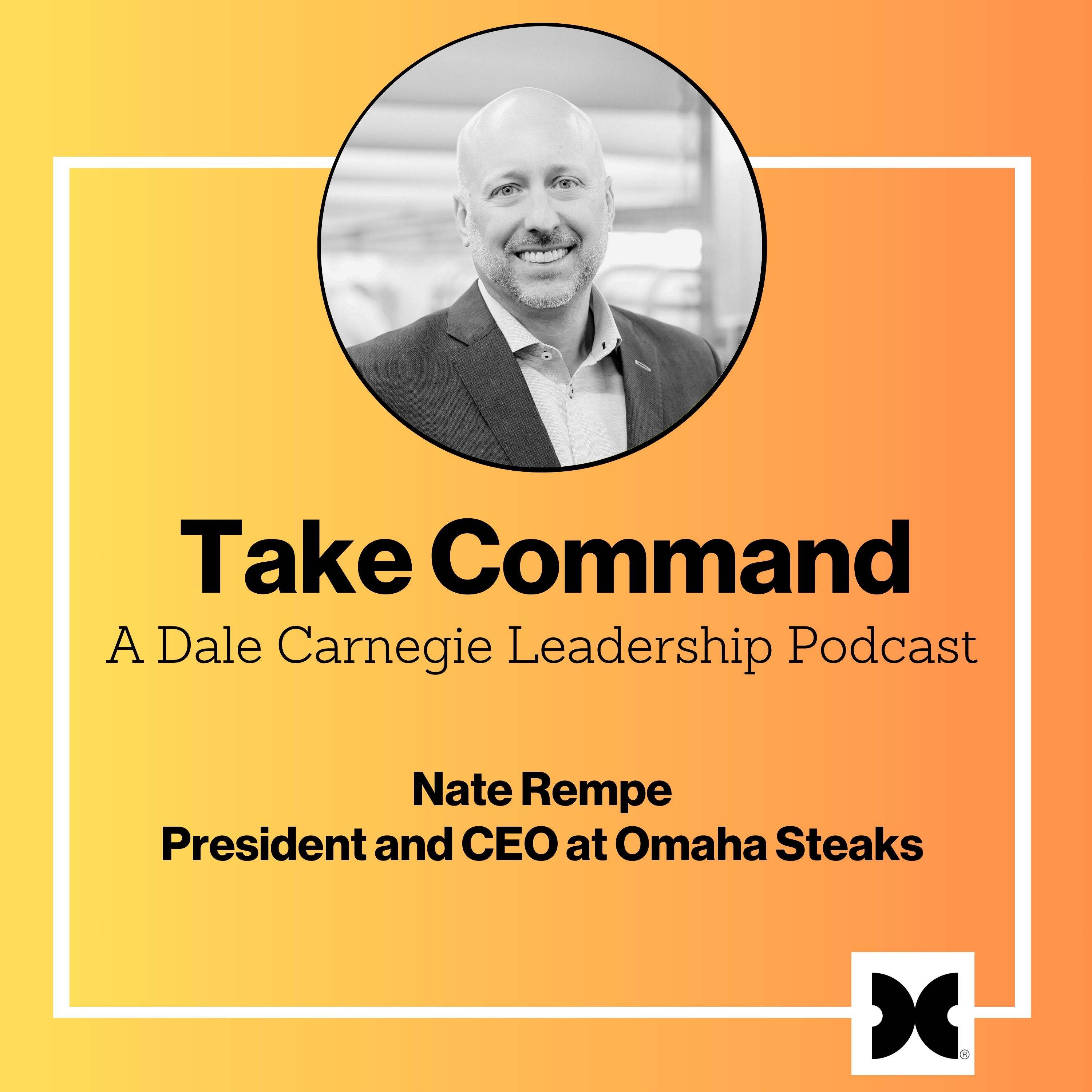
Take Command: A Leadership Podcast
Empathy, the Hidden Superpower of a Modern CEO
00:40:38
Nate Rempe’s journey is anything but ordinary. From writing code in grade school to becoming the first non-family CEO of Omaha Steaks in over 100 years, his story is a masterclass in adaptability, courage, and human-centered leadership. In this episode, Nate shares how stepping into uncomfortable situations shaped his rise from CIO to CEO—and why empathy became his greatest leadership advantage. He says, “Empathy is absolutely necessary at the CEO level if you want to win hearts and minds. And if you can’t win hearts and minds, you can’t be successful as a CEO.” You’ll also hear his advice for aspiring leaders: “Before you take the role, you should have been in the role without the title long enough that when you actually get the title, everyone says, ‘Wasn’t Nate already the president?" This conversation is packed with insights on breaking self-imposed limits, building confidence, and creating cultures where people thrive. Tune in to learn why fear is relative, how hobbies can unl...
Loading summary
Transcript56 lines
- [00:00]
A
Empathy is absolutely necessary at the CEO level if you want to win hearts and minds. And if you can't win hearts and minds, you can't be successful as a CEO. I truly believe that. I think there's plenty of history if you went back and you looked at CEOs that were very mechanical, that treated people like things or numbers as opposed to humans with feelings and needs. If you can use empathy to connect with those things, you can be way more successful. So I think that's a message to technologists and to people without empathy. You cannot be effective at the very top of leadership if you don't connect with that empathetic aspect of yourself.
- [00:50]
B
Welcome to Take Command, a Dale Carnegie podcast. I'm Joe Hart, CEO of Dale Carnegie and if you're ready to to grow your leadership skills, follow Take command now and never miss an episode that could transform your career. Today's guest reveals how discomfort and purpose driven leadership shaped his rise from IT leader to CEO. He shares why embracing empathy and innovation isn't just transformative for careers, it's the key to building companies that thrive. He leads one of America's most iconic food brands as the first non family president and CEO in the company's 107 year history. Rising from IT leadership to CEO, he proves that technologists can be visionary business leaders. He also serves on the board of the North American Meat Institute and is a named inventor on four US patents. Please welcome president and CEO of Omaha Steaks, Nate Rempe. Nate, welcome to the Dale Carnegie Take Command podcast.
- [02:00]
A
Thanks Joe. Super pumped to be here.
- [02:03]
B
I'm pumped to have you here, especially after having the honor of being your guest on your podcast Brain of Command. So that was a lot of fun.
- [02:13]
A
You brought a ton of really interesting points and value. So on top of being a nice guy, you also sort of know what you're doing, which is always nice to see and hear.
- [02:23]
B
Thank you. I appreciate it. I do the best I can when I can. Sometimes successfully, sometimes more than others, sometimes less so. Nate, you've had incredible career. You're the CEO, President, CEO of Omaha Steaks. You're the first non family member CEO 107 year old company. Interestingly, you started your career in IT. In fact, I think for the first maybe 17 years of your career as an IT related person, you came into Omaha Stakes and as a VP of IT became the CIO and in 2020 became the CEO of Omaha Stakes. So a lot to talk to you about. Let me just ask you kind of right out of the box. So to Speak, that's not a common career path for a lot of CEOs. A lot of CEOs aren't necessarily going from it to the CEO role. How did you do that? What was your experience?
- [03:09]
A
Yeah, I think the likelihood for technology minded people to elevate to CEO is actually going to become more common. I think largely because problem solving is what every business needs. It used to be historically it's like, you know, the CFO moves into the CEO because of the finance connection. But you know, today, innovation, problem solving, understanding how to align technology with business needs is just so valuable that CIOs and CTOs and leadership minded technologists are finding themselves in a situation where they can actually step forward and elevate. You know, for me, I kind of always had a bit of a unique mix. I wanted to be in the business side, but I had this affinity towards technology. I mean it was mathematics, writing code, understanding technology was not difficult for me. It just came naturally. Even in grade school, I remember when I first plugged into the Internet, I had a feeling like the world is my oyster now, right? All this information and access was available and that just lit a fire inside my heart that has never been extinguished. But I knew that I still wanted to connect with people, you know, in business, relatively social, kids still active in sports. And I found a way to blend that. When I went to my undergraduate program ala mater University of Nebraska, I really took a multi track there where I was getting a business degree but also computer science. And so as I was going along I found that I loved both. Upon graduating, Creighton University launched their masters of science in electronic commerce which was just around the turn of the century in 2000 when the dot com bubble was happening and E commerce was like all the hotness, right? And so they had hundreds and hundreds of applicants and I applied and got accepted in a small initial class. It really kind of created that platform for me to put my technology and computer science background and to stitch it together with business. But the market wasn't ready for it yet. It wasn't ready to put the technology guy into the business leadership role. And so I kind of came up through leading technology people, you know, I could relate with them. I held some respect because I could write code and you know, really create technology. But every time I had the opportunity to put my foot in the door to emerge as someone that could lead and inspire people, I didn't hesitate to take that opportunity. And I think as I teach leaders around me, in particularly leaders that have these unique skills, I'M very motivated to help individuals identify those moments where they can change the trajectory of their career and to capitalize on those moments. Because I think historically what has limited technology people, for example, is that they feel sort of self restricted, the constraints they are putting them on themselves, thus not taking the opportunity to step forward and lead a company like Omaha Steaks, for example. And I think as that continues to become more prominent in the market and as technology skills are more dynamic, CEOs will start to become more technology savvy, I think over time.
- [06:33]
B
It's interesting though, because I've seen what you've said, which is a lot of people who are IT focused, technical or whatnot, they will often put a limitation on themselves. You talked about kind of the self restriction, so to speak, where they don't necessarily see themselves. They see themselves as a certain way or I could never do this. We've had many, many people who've gone through Dale Carnegie programs who've said, you know, once I took this program, it really unlocked this ability for me to see more broadly that I could do these things. But maybe prior to that time they lacked the confidence or whatnot. What are some of the pieces of advice you might give to somebody? Whether it's it or otherwise, this is a mindset issue partly. People are capable of a lot more than they often think that they're capable of. What are some of the things that you advise people? How do you encourage people to kind of get out of that comfort zone, change their mindset?
- [07:18]
A
It's a good question. And it's a difficult thing because sometimes the hesitancy comes from a place that's kind of part of their being. I was a relatively introverted person and I had to kind of teach myself to be comfortable in an extroverted environment. I came to study myself and find out that I really did have this extroverted side. To me, my social battery holds a lot of capacity, but it discharges quickly when I'm out of battery. On the social side, like, I am done. Like my wife, for example, knows, you know, when we're in a social environment and she can kind of like, you know, see the low battery blinking there. We've come to have a way of like, hey, I think it's time to go. One thing that I would tell you though, that I think is a really interesting thing to think about is it used to be that the term computer nerd was not a good thing. Decades ago, you kind of manifest this image in your mind of a computer nerd. That's you know, got the pocket protector and the taped glasses and there's the black green screen and just typing, going away and kind of mousy of sorts. Now in today's environment, that's a compliment. Internet fame, you know, the ability to take a computer and to create apps and things. And so for those technology people that have felt like they're kind of abstract out of that kind of socially accepted environment, it really is the realization that computer nerd is something exciting and sought after. And so the connection between the human experience and the technologist, that gap has shrunk to an all time low. In fact, another phenomenon, Joe, is that to create technology is now much easier than it used to be. You know, like the difficult syntax programming on a mainframe kind of require that you lock yourself in this dark room and remove yourself from social environments and humanity and just focus on the computer. And over years now that's become where it's more visual. Of course, AI is going to change that even more rapidly. So, you know, the technologist is no longer typecast into this kind of introverted, uncommunicative person that can't inspire people. It's much different now. And so generally just that fact is going to allow more technology people to move into business roles.
- [09:46]
B
Yeah, especially if they're open to it. I mean, it sounds like for you, it was something you embraced early on. I mean, you saw that maybe you had that capacity, that desire and so forth. The mindset or the proverbial kind of thought about a programmer as being kind of internal and focused on the data and the code and so forth. There is that bridge that you need to build which is, hey, how do I interact with other people? How do I influence? How do I communicate and so forth. And for you, it sounds like maybe those things were always natural, maybe for others, less so. What are some of the things that you did to be able to develop your skills? And what do you advise other people right now who may have that potential? They don't see it. You see it. How do you help coach them?
- [10:25]
A
Depends how much they want it. For some people, I think it's okay to be that introverted. There's nothing wrong with having a technology career through and through, but I had to put myself in uncomfortable situations. You know, I had to do things that really made me learn how to function in these environments that are much different than the technologist environment that I was more comfortable in.
- [10:52]
B
What would be an example of that? Nate, take us to one of those tough times that you had to overcome.
- [10:56]
A
Yeah, you bet. It started early, and I give much credit to my mom who kind of put me in these situations. I was in a select vocal group when I was in grade school called Puri Cantores. It was run at the University of Nebraska, and I loved music and she took me and I tried out for this and I made it. And it was a traveling singing choir. And we would go into, not huge arenas, but, you know, like fairly large environments where people would come and we were this really good choir that sing. And I would have these solos and I was this like, you know, a hundred pound, skinny seventh grader. And I would walk out in front of a couple thousand people and I would sing this solo. And it's a lot easier to do that as a kid. But that put me in a situation where I think early on I kind of built this comfort level of being in situations that were not necessarily compatible with what I would generally want to do. I think, you know, if I would look at myself on paper, I wouldn't put me in the slot of like singing in a choir and soloing in front of a couple thousand people. And then it kind of went forward. And Joe, I would tell you that music and performing has given me tools that I don't think I would have otherwise had. And so how that could translate to your audience is like, what are those things you love that isn't technology, that isn't business, that has some of the complexion of putting you in those environments that maybe are a little bit uncomfortable? How can you lean into that to almost train yourself in a place where you love, in my case music, to train yourself to be more comfortable with those things that aren't necessarily who you are most of the time. And I know that that sounds difficult to do, but I think a little bit of introspection in your audience's case, to think about what are those hobbies that I love and how can I leverage those to be a bit of a short circuit to allow me to move into that different world and to get more experience there.
- [13:01]
B
I can't help but think though, too, there's a component of fear, right? There's a great quote, which I love, which is that everything you want is on the other side of fear. So there's things that would hold us back. Usually it's us, if we want it, we've got to kind of go after it. And part of what you did in that example, you maybe didn't realize that you could do that. And it probably was terrifying in the beginning, but once you did that Created confidence. And certainly I think about going through the exercise of doing standup comedy, which is something that absolutely terrified me. And I did it just as a lark because my grant had taken these classes. But when you do something that pushes you out of the comfort zone, right? And then it's like, oh, my gosh. I mean, this is what happens in Dale Carnegie classes, where people, they think, I could never stand up in front of a room and give a talk or I wouldn't be very good. But they do it, and all of a sudden they discover it's like, what else could I do?
- [13:50]
A
I didn't realize it.
- [13:52]
B
So this idea of having a catalyst, and I like what you said, Nate, which is you can start with something building off of something that's a strength, right? Maybe you push the envelope a little bit, but that opens up a new world of possibility.
- [14:05]
A
You know, there's another thing about fear, Joe, that's. It's all relative to your experience. I mean, you're afraid mostly of the things that you don't know or don't understand. And once you understand or know them, or you can kind of relatively put them into a box, you can benchmark what real fear is, and it actually allows you to deal with more. So the example, which, of course, again, is not necessarily something that I manufactured, but my middle son, Connor, is special needs. He has challenges that you and I don't. Things like walking down the stairs, you know, he's got to grab the railing, feels a little bit unstable, shooting a basketball from the free throw line. And so as I've watched and just fell in love with my son, the value proposition that he brings to our family is he has redefined what fear is for me. He's benchmarked real challenges and has allowed me to look at my life and say, what is really hard about this? I mean, I can get up in the morning and, you know, put my clothes on, brush my teeth. The things that we do every day that we just never think twice about. Conor's got to put a little bit more effort in now. He's got all kinds of things that I wish I had, like a totally optimistic view of the world, a deep love for his family, and just that innocence and kindness that I wish every human being had. The world would be a better place. But Keith also doesn't have those things we take for granted. And I think everybody needs a little bit of grounding, you know, And I think good CEOs are able to understand maybe through life experiences, some of which come intentionally, some unintentionally by choice or not. And in my case, when we had Connor, I had no idea the value and the power and the love that he would bring to my family. And most people don't write, special needs kids are not something that people ask for normally, right. These things happen in life, challenges come. But if people knew what the value is, I truly believe it would be something like, I do want that because it strengthens family, it empowers career, it builds confidence. And even my other children, you know, Allison and Calla, who kind of sandwich Connor, Allison being older, Calla being younger, they are the benefactor of skill sets that normal kids their age don't have. They also are benefactors of that perspective. And so I think sometimes advancement in your career comes as a function of things that are completely unrelated that help you take a different perspective on life. You can create those moments by finding hobbies and putting yourself in situations where you get a little bit of comfort. But you can put yourself outside that zone and think about how that relates to what you're doing every day at work. How can you leverage those experiences? But often you'll find that good leaders, good CEOs have a special story that they may not always share that has put them in an X factor situation. And in my case, there are a couple of those things and I just have leveraged them. And I think that's the differentiator. You can have these experiences and you can be an observer and a passive participant, or you can be an active participant and you can acknowledge what they are doing for you as a human being and leverage that power to make other people better, to make other companies better. That's really some of the secret sauce.
- [18:06]
B
Well, Nate, thank you for sharing that story and your experience with Connor. And I can't help but think that based on especially what you're saying, that you're a better CEO, a more effective leader and more caring person as a result of how he has affected you and your life. What are some ways that you'd say that you have grown in your personal leadership as a result of either Connor or your family? Because I know you talk a lot about some of the qualities that you bring into leadership as the CEO of Omaha Stakes that, as you just said, maybe derived from someplace else.
- [18:39]
A
Yeah, one thing that I think is maybe exemplary of what you're talking about is empathy. Technologists minded people, technology minded people, type A personalities, binary ones and zeros, very logic driven, tend to be low or completely non existent on the empathy scale. And that was something that I lacked, particularly, you know, pre married life, pre Connor, pre family, pre oma stakes. And he literally filled my empathy bucket. He taught me that skill. He created that skill in me that did not exist before. And like you said, more caring, more thoughtful. You know, I put more energy and passion into the things that I care about because he taught me how to do that. And that's a really interesting thing, Joe, because empathy is absolutely necessary at the CEO level if you want to win hearts and minds. And if you can't win hearts and minds, you can't be successful as a CEO. I truly believe that. I think there's plenty of history. If you went back and you looked at CEOs that were very mechanical, that treated people like things or numbers as opposed to humans with feelings and needs, if you can use empathy to connect with those things, you can be way more successful. So I think that's a message to technologists and to people without empathy. You cannot be effective at the very top of leadership if you don't connect with that empathetic aspect of yourself.
- [20:11]
B
It's so interesting, Nate, that you're talking about this. As I think about a common thread over the dozens of interviews, amazing CEOs and leaders I've had in this podcast, a couple things jump out, one of which is humility, which is something I think is a requirement for empathy. Because I have to recognize the value in the other people with whom I work. I have to care, which ultimately leads. Leads to that empathy. There's a great quote which is, people don't care what you know until they know that you care. All of us who are leading and interacting with other people are about building relationships fundamentally. We've got a great principle in Dale Carnegie, which is Principle 17, Triancle. To see things from another person's point of view. I would agree with you 100% that you really can't lead truly effectively. Not where there's a foundation of trust, not where there's a foundation of a relationship. If you don't have that empathy, if you're not caring enough about someone to try to see things the way that they're seeing doesn't mean we're going to do all those things. But people want to be heard and listened to and valued and respected for sure.
- [21:09]
A
Agreed. I mean, everything in moderation, though. You can even overdo the empathy. You got to make hard decisions. Sometimes empathy can get in the way and cloud clarity. As a CIO that has had to kind of manufacture empathy, I'm very distinctly aware of its impact on my Decision making. And one of the things in my 11 leadership principles that I've kind of developed over time is the right way to brag. One of the hacks. Right way to brag, yes. It essentially talks about this idea that being able to sprinkle in a little narcissism in the right way can drive the perception of confidence. And that sometimes empathy is the antagonist or the antithesis of the perception of confidence. Like, too soft, cares too much, this type of thing, which in our society is often thought of as negative personality traits. And so understanding how to give off the air of confidence by adding in a little bit of narcissism. In fact, I just came from a meeting with my director team and my senior leadership team, and as I was speaking, I was telling a story, and I referred to myself as having a face for radio. But despite that, you know, being a good dresser, charismatic and pretty damn funny, you know, like, you gotta be able to talk about yourself in an affectionate way and be confident about that, and don't be afraid to express the things that you like about yourself and to be confident about those so that people know that in the moment you can make the hard decision, that they'll be able to get on your bus when things are hard and that you won't fall down because your cup is too full of empathy. Being a CEO, Joe, as you know, is a balance of all kinds of different traits and skills, and it really is mostly about knowing what arrow to pick out of the quiver at a particular time that makes the difference between an average CEO and a great one. Yeah.
- [23:12]
B
I can't help but think, though, you're talking about empathy and having your cup too full. To me, empathy is really about understanding. Right. It's about seeing things from another person's point of view that's separate from necessarily doing that. It doesn't mean we're going to fall over ourselves or we're going to agree with whatever someone wants to do, but it is to say, hey, I see you. I hear you, and having that respect and so forth. But let's just pivot to Omaha Steaks for a second, because you're the first non family member in over 100 years to lead this great company. You've got thousands of employees, one of the most prominent, if not the most prominent company of your kind in the space. What was that like going into that role? I mean, what kind of pressure were you feeling and how did you address that?
- [23:54]
A
It was a lot of pressure. I mean, I came in, I was young to boot, which Was kind of added an additional layer of complexity. You know, who's younger?
- [24:02]
B
You're still young. Younger.
- [24:04]
A
Hey, come on, Joe. I mean, look, I lost my hair in college. I look older than I am, right? But I was a C level executive when I was 28, okay? So I achieved the C title. There was a lot that I had to learn before I was going to really be able to own that title. And Omaha Steaks, the culture here taught me just as much about myself as I taught it about what it needed to do to be viable for the next hundred years. I came in as the CIO and pretty quickly realized that there was a whole sort of cultural rebuild that needed to happen, which I think is fairly common in multi generational family businesses that are trying to have that step growth moment, kind of set them up for the next generation, the next long term. And I was by chance, really the benefactor of being able to be right at the driver's seat of that moment. Pre pandemic, the Omaha Steaks brand really was kind of not realizing its full brand promise that it had built over a century. The landscape was changing. You know, the environment in which we operate were different. You know, we were really driving towards margin as opposed to towards customer satisfaction, really building that, you know, the best steak of your life promise that we had. And so the first thing that I did was really connect with the family to understand what is it about the Simon family that is so special that allowed them to build this amazing business and brand over multiple generations. It became just very apparent right away that it was the resiliency and intelligence and passion and depth of the family's love for a craft that had been in their family. The Simon family came over to escape religious persecution and did the thing that they had always done, which is butcher. It wasn't like Omaha Steaks was this massive departure from, you know, what was their family legacy even before they got to America. It's in their blood. And while their last name might be Simon, it might as well have been Omaha Steaks or Table Supply Meat company, which was actually the name of the business before it became Omaha Steaks. Because Joe had. They didn't have the capital to buy a building and rename it. So they bought Table Supply company and they just moved the co over and put meat up there. And there it was, Table Supply Meat Company, which is just an amazing story of entrepreneurship and resilience. Creating that relationship with the family helped me really understand what Omaha Steaks was. You know, just looking at the business, only you'd miss A piece you'd miss a big piece. Who was the family? Who was Bruce Simon? Who was Todd Simon? Who was Alan and Stephen Fred? What really made them tick? And I got to really know Bruce, and Bruce got to really know me. And we found out that we had just an enormous amount of things in common. A value set that was similar. He was a gadget guy, so was I, and I built trust, and that allowed me to set a whole bunch of more change on top of it.
- [27:15]
B
So you took over in June of 2020, in the midst of COVID at that worst possible time, so to speak, in many ways, maybe the best possible time in others. What were some of the first things that you did to get the team, get the company on the track that you wanted to take them? You had been at the company, you knew the company, you'd had some relationships. Now you're the CEO. What are some of the first things that you did?
- [27:38]
A
I got the title in June 2020, but I was doing the job far before that. Another one of my leadership principles is called play the part, which is the idea that before you take the role, you should have been in the role without the title for long enough that when you actually get the title, everyone in the company says to themselves, wasn't Nate already the President? So in 2019, I was working very closely with Bruce Simon, and he was collaborating with me on big decisions, really, kind of co running the company. He was asking me to do things that were far outside what a normal CIO would be doing, and the company noticed. And so by the time we were amidst Covid, I had established myself as a leader that could guide the company through this very difficult time. I did not hesitate. I stepped forward. I took control. I drove confidence into the team, and I guided us through Covid to massive success. And the one thing that I told my team at the time is that, you know, we will think back during this period, and people will ask us, what was the best thing about COVID And we will want to say it was the opportunity to take advantage of the demand. But what we will say is we had the privilege to help people eat during a period of time that they were afraid to leave their house. And that will be a door that we will walk through as a team, and it will change the face of our culture forever. And it absolutely did that, and we took advantage of it, and we intentionally changed who we are, and we made our products better, and we created transparency in the culture, and we shared information that would never been shared before, and empowered leaders to actually make an impact. And that has catapulted us into a trajectory where we see growth numbers that would never have been imagined, you know, five or seven years ago.
- [29:43]
B
Part of what you've done, even in that moment, was to galvanize people behind a purpose. And part of what you've done with your brand, I mean, you focus on the experience. I mean, you and I have talked about just Omaha Steaks and how much you were kind enough to send me some steaks at one point. Kind gesture on your part. And we enjoyed those as a family. We had a big family gathering. Food can really just unite us and create memories and experiences and so forth. And you've really built that into this brand. That's really. You're about is Omaha Steaks is creating the experience that brings people together. Right.
- [30:15]
A
And that's not something that I created. Again, that's the Simon family. We are not a food company. You know, I mean, although steaks is in our name, we are also not a marketing company. We're not a technology company, we're not a logistics company, we're not a manufacturing company. We're all of those things. But we are an experiences company. And all I had to do was just amplify what was already there. Just good bones in this business. It just had everything it needed. It just needed to stitch it together in the right way and to have the right culture based on core values and things like trust to set that growth on top of.
- [30:54]
B
So the company is growing. You're continuing to build your team to execute on your leadership. There certainly are stresses that we all face in our day to day work, day to day lives. What are some of the things that you do to manage your stress or invest in your own physical mental health?
- [31:11]
A
My family is a big part of that. You know, my wife, an amazing woman and keeps me sane and puts up with me and that's loving my family. Supporting my family and them supporting me, I think is a big part of it. But I also have my outlets, so I play live music. Playing a 90s 2000s cover band. In fact, we're playing in Vegas in early October.
- [31:33]
B
What's the name of the band? Is this Nirvana Grun?
- [31:35]
A
Yeah, yeah. It's no Motive is a band, so it's no motive music.com, if you want to go out and check it out. So I get to be up there on stage, which kind of goes back to that, you know, performance aspect of my DNA and not be the Omaha Stakes CEO for the most part. Most people, if not everybody doesn't know what I do professionally. When I'm on that stage playing guitar, I can be this different person. All the stresses of my normal quote unquote job go away as I focus really on that passion. And I think having an outlet like that is really critical in a role like this. The stress just eats you alive. And exercise is another thing I think nowadays medicine has become more focused on. It's not just about the pillow, although there's a lot of science advancement. But, you know, one of my really good buddies is an orthopedic surgeon, and he's a do instead of an md which really looks at the whole person. And I just love that, really, as an example of how the CEO really also needs to be a do, like the whole person. How is your social life working? How is your home life working? What are your hobbies? How are you finding that balance so you don't get so burnt out or you have to go to a massive extreme, which can also introduce bad decision making, you know, to kind of have.
- [32:53]
B
That release any rituals, habits, daily things that you do to kind of keep yourself on track.
- [32:59]
A
Definitely. I exercise every day, actually. I tell you, I could probably stand not to work while I exercise.
- [33:07]
B
You're working while you exercise? Are you golfing? What kind of work?
- [33:10]
A
No, it's like, you know, you know, I got like, a little gym in my basement, you know, and so like the elliptical or I've got like one of those really intense gauntlet step mills and then, you know, some core work. And I'm trying to get back into lifting weights, which I hear you need to do as you get older. I think having a good sweat quote, unquote, right. Is a good way to manage the biology of being a CEO.
- [33:33]
B
Well, certainly a physical outlet for all of the stress is important for all of us. And investing in our health, you know, our health is our most valuable asset. We think about all kinds of other things that are valuable. But if we're not taking care of our physical health, our mental health, and we're not as valuable to the people around us, we want to make contributions, so we've got to invest in ourselves. One of the things I've been doing from time to time is asking ChatGPT, I went to ChatGPT and said, you know, I'm having an interview with Nate Rempe from Omaha Stakes, and if you could ask Nate only one question, chatgpt, what would it be? And I'm going to give you that question right now. Probably the best question of the whole podcast. Among all the leadership lessons you've embodied, from blending tradition with innovation to building trust through transparency, what's the one mindset or habit you believe is most vital for a younger leader? Stepping into uncertainty today.
- [34:25]
A
Holy cow. That is about the best question possible I know.
- [34:29]
B
I mean, I'm going to be replaced as the podcast host.
- [34:33]
A
You know what? We're all going to be replaced, aren't we? Oh, gosh. I would tell you that the one thing that just keeps coming up over the years is when I talk about, okay, someone asked me, well, what impact have you had? What's the one thing that really keeps you going? It's like these examples of seeing people do more than they think they're able to is just like fuel. Now, that's not necessarily a habit I do every day, but it's something that continually drives, like my hiring, you know, my promoting. Putting someone in a role, even on a project basis, like talent identification, talent assessment. Good people make all the difference. All the difference. I mean, it is the one thing. If you could hire all the right people, you would win every time. Leveraging networking, creating relationships, identifying people that have high potential, and investing in them. I think over the years, I have become way more in tune with the idea of hire people smarter than you, which sounds so cliche. And it's not really smarter than me. It's really just people that you can mold and craft into something amazing and instill belief in themselves. I think is so satisfying as a leader. And over the years, it's taken me probably too much time to recognize that that's the real win as a leader is to see the success of those in which you have hired or empowered.
- [36:07]
B
I mean, ultimately, that's what it is, right? I mean, leadership is bringing out the best in other people so that you and they can achieve things that you couldn't do by yourself. We have to help other people be successful. And I think it goes back to what you said about empathy, which is seeing things from another person's point of view. It's empathy, having some caring for other people. But we want to help the people around us truly succeed.
- [36:29]
A
And sometimes helping them succeed is telling them that this is not the right role or letting them move on to something else. And I think everybody that's listening or watching has probably said, I should have taken that step faster. You know, this person wasn't the right person. I kept trying to make it work. And I think good leaders also recognize that sometimes what's best for the team member is to let them go to Something else. And that's a difficult thing. And to learn from that is really part of talent assessment. And building the right team is to not hesitate to identify when someone is not the right person and to move on that swiftly.
- [37:14]
B
Well, that's right, because we have to be upfront with people. Right. I mean, sometimes it can be hard to give someone feedback that they might not want to hear, but it is our responsibility as leaders to do that for themselves and for the team.
- [37:26]
A
Absolutely. It's not easy. Never is, and never feels normal or fun. But I guarantee, if you're the type of person that hasn't fired somebody on the other side of that experience, it always feels like this was the best thing for everyone involved. So having that in mind when you're looking at making a hard decision like that is to recognize that on the other side of that difficult decision, everyone tends to benefit, including the person that's losing their job, even though that's difficult to see.
- [37:59]
B
Yeah, it doesn't always seem like that at the time, but then they move on to something that's probably a better fit for them where they truly can succeed and thrive. Nate, I'm going to give you a chance to plug Omaha Steaks. People want to buy steaks, order steaks. How do they do that?
- [38:12]
A
Now they go to Omaha steaks.com we've got just an amazing assortment of proteins, steaks in our name. But we're not limited to steak. We got chicken, pork, great seafood, all kinds of good sides. And, you know, the holidays are coming up, Joe, and there is just not a better gift than the gift of an experience like we talked about before. And so Omaha Steaks can create that for your gift recipient. And over the years, seeing pictures of my customers and hearing testimonials like creating that smile, like that excitement when you get a gift seems to be harder to do these days. So, you know, give an experience. Give Omaha Steaks this holiday and give the warmth of a great meal at the table.
- [38:54]
B
Okay, so Omaha steaks.com and by. You didn't mention that the desserts. The desserts are fantastic.
- [38:59]
A
Oh, well, we got the famous caramel apple tartlet, which I'm sure the one spectacular.
- [39:03]
B
I would just have those. So I'm going to put you in the spot. Nate, I don't know if you have a special discount code for our listeners. If you do, we could drop that in the notes. If you don't, I guess we're all paying full price.
- [39:15]
A
So Oma stakes front slash. Dale, something special like we'll do 20% off. Go the full order there.
- [39:23]
B
That sounds pretty good.
- [39:24]
A
Yeah, I think so. And we don't normally give discounts that high. In fact, this is actually pretty special because we would tend to gravitate towards 10%. But this has been such a good podcast that I think. Let's go 20, Joe.
- [39:37]
B
All right, listeners, thank you. Nate, you're the best. I'm just going to say again, I'm a fan of Omaha Steaks. I've ordered Omaha Steaks for people over the years. Everyone's been very excited about those gifts. So, Nate, fantastic having you on the show. Thank you so much and look forward to talking with you again.
- [39:53]
A
Thanks, Joe. I appreciate you.
- [40:02]
B
I hope you enjoyed this edition of Take Command, a Dale Carnegie Podcast. Check out our resources at www.dalecarnegie.com for more research, insight and tools that will support your success and help you take command of your leadership potential. If you enjoyed this episode, please consider rating it and following us on Apple Podcasts and Spotify. For more exclusive content, subscribe to our Dale Carnegie YouTube channel and follow us on social media Media. As always, thank you for listening and we're looking forward to you joining us for the next episode of Take Command, a Dale Carnegie Podcast.