← Take Command: A Leadership Podcast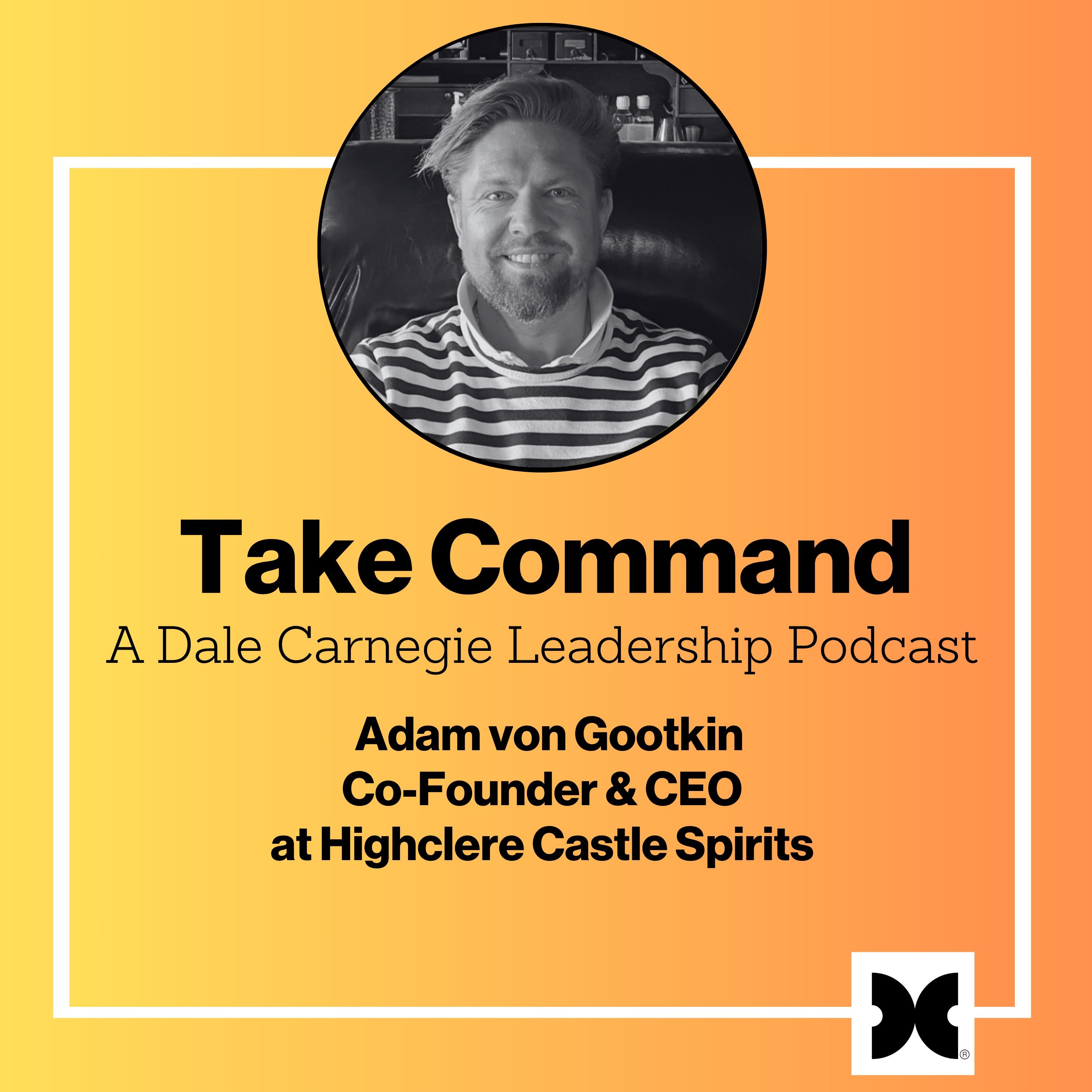
Take Command: A Leadership Podcast
Fearless by Design: Building Global Brands with Purpose
00:35:42
Some people chase trends. Adam von Gootkin builds legacies. From selling candy in high school to founding one of the world’s most prestigious gin brands, Adam shares how bold thinking, authentic connection, and a fearless mindset shaped his entrepreneurial journey. He says, “If you don’t have much to lose, then you learn to become bold… either fearless by intention or too stupid to be afraid.” This episode is packed with insights on overcoming fear, embracing awkwardness, and leading with passion. You’ll hear how a single email to a British castle led to a business partnership with royalty, and how Dale Carnegie’s timeless principles helped shape a confident, purpose-driven leader. Tune in to learn how Adam turns vision into reality and why enthusiasm, authenticity, and storytelling are the most underrated tools in leadership.
Loading summary
Transcript50 lines
- [00:00]
A
I just see such beautiful things in people that I meet. Beautiful qualities, beautiful strengths. You know, like Dale Carnegie says, I'll never give a false compliment, but if I see you and I don't even know you and we don't even have a meeting and I like your shoes, I'm definitely going to say something. If we're open with our love, if we're open with our kindness, if we're open to seeing the beauty in humanity and finding the magical sparks that someone does have and leaning into that with them or leaning into that for them if you have to, I think from that comes great things.
- [00:39]
B
Welcome to Take Command, a Dale Carnegie podcast. I'm Joe Hart, CEO of Dale Carnegie and if you don't want to miss a moment of transformation, follow. Take command now and unlock the power of leadership with every episode today we take a closer look at how our guest created a global luxury brand from a bold idea. The leadership traits that powered his journey and the role of storytelling and authenticity in building lasting business relationships. Inspired by a deep family legacy in distilling, he co founded an award winning craft brand that helped revive regional traditions and redefine premium spirits in the United States. Through bold international partnerships, he expanded into the luxury cigar and spirits market, quickly earning industry acclaim. A recognized leader, he serves on several advisory boards and is regularly featured in outlets like Forbes and Bloomberg. Please welcome the co founder and CEO of Highclere, Castle Spirits, Adam Von Gutkin. Adam, welcome to the Dale Carnegie Take Command podcast.
- [01:52]
A
I'm honored to be here and always enjoy chatting with Joe.
- [01:56]
B
So great to see you and to be with you again. You spoke of course at our 2022 convention in New York City. Gave what I think is one of the best talks we've had at any Dale Carnegie convention. We're just saying a lot because we've had some amazing talks at our conventions. You're someone who has created a extraordinarily successful business from nothing. You are a force of nature, energy and boldness. So definitely looking forward to talking with you about what you're doing and how you got there.
- [02:24]
A
I know you introduce me wherever I go. That was the best ever.
- [02:28]
B
Well, seeing as how you're going to some pretty cool places high Claire Castle. I'm happy to come in to do that. Maybe it'll be a little part time gig for me.
- [02:36]
A
Yeah.
- [02:36]
B
So Adam, you know when people look at success, they often see the success. They don't see what underlies that how you got there. And I know you came from very humble beginnings. Your mom was A single mom working to support you and your family, and you didn't have a lot. Tell us a little bit about that upbringing and how that influenced you and your leadership today.
- [02:57]
A
One thing I will say that I was very fortunate to have, and not all people could say it, is that I was surrounded by love, a very loving family and a mother who worked very hard. But, yeah, we didn't have a whole lot, you know, single mother raising two boys. And it did make it challenging. I mean, you can only have boiled hot dogs so much before you start to really appreciate fine cuisine when you're older, anyway. I think that kind of upbringing bring a certain level of humility that stays with you forever and that you can't really forget where you've come from. But I also think it allows one to be a catalyst for bigger, greater and better things. And the other thing I'd say too, is that if you don't have much to lose, then you learn to become bold and you learn to have no fear because there's nothing behind it to drop out from under you or it can't get much worse. And so I think all of that helped me to kind of, I guess, engineer a life or a mentality or an outlook that was just semi fearless. Either fearless by intention or too stupid to be afraid, one or the other. But either way, it resulted in my ability to kind of get things done and dream very big and take action towards those dreams.
- [04:02]
B
Well, you really do that. You embody that, and you are someone who gets out of your comfort zone. And I know you did that even at a young age. You had this entrepreneurial zeal, if you will, and you started businesses or quasi businesses early on in your life. And what was the spark for that? Then talk a little bit about what some of those early ventures were.
- [04:21]
A
Well, in high school, before I could work, my mother didn't have a whole lot of money. We were kind of a prideful family, too. So asking for money from people or from other family members wasn't really an option. So I started my first business selling candy in school, in the classrooms, repurposing those fundraiser boxes, but just kind of keeping the profit for myself. At the time, I didn't think much of it because I didn't have lunch. The very first business I started was created because I was pretty hungry. If you want to get lunch, you got to do something to get some more money together so you can have lunch. Not so romantic. But the honest truth, you got kind.
- [04:58]
B
Of that taste, so to speak, no pun intended, of what it is like to earn some money. And I know that kind of inspired you in different things. You've also shared that a very formative part of your teenage years was getting exposed to how to win friends and influence. People talk about that.
- [05:12]
A
Yeah, I'll never forget that moment. I must have been about 16 and I got my first job as a, like a pool attendant. The thing about the pool attendant job is that you're not a lifeguard, so you don't have a whole lot of responsibility. You're just kind of checking people into the pool and making sure they live in the apartment. Kind of complex. And so I had tons of time on my hands. And I've always been an avid reader, a voracious reader, but this allowed me seven, eight hours a day to read. And somehow at that point I was introduced to Dale Carnegie. I think I know the guy who, who did it. I'm not certain it was him, but I believe a friend of mine from there, an older friend, said, hey, I think you might like how to win friends and influence people. And I read the book and it was like, you know, taking the blue pill in the matrix or something. You know, it was like, wow. Like, I had no idea that the world kind of functioned this way. It all seemed rather mysterious to me. But it comes down to people and personal connection and being hyper thoughtful about others. And through that becomes this magical truth. And I felt at the time that it allowed me to wield this kind of magical power. I still kind of feel that way.
- [06:19]
B
One of the words, I think it really describes you is authenticity. You're authentic. How does that authentic application of Dale Carnegie's principles affected you in different parts of your life?
- [06:30]
A
Well, you know, being that I didn't have a kind of in my house, father figure, I had wonderful uncles. Though I might have been on a daily basis missing that kind of father figure component of here's kind of how we look a man in the eye kind of idea. I think that book infused a level of confidence in me in a weird way. It allowed me to kind of feel like all this intimidating adult stuff that's happening is really nothing. It's just people being people seeing to the, like, kernel of it. At the time, I started integrating some of these ideas into how I communicated. Really, you know, this would have been like 1999, 98. So email was kind of early and it wasn't like I was doing professional communications or real business at the time, but just reading Dale Carnegie's anecdotes, you know, kind of Thinking a lot about how he thought about business. Because at the same time, and I'm sure many of the Dale Carnegie, you know, members do the same thing. But I was reading, you know, the biography of Rockefeller or of Richard Branson and other great entrepreneurs. So to kind of take the biography of some of these great entrepreneurs and side by side reading it with how to win friends and influence people, you start to say, oh, that's how you kind of do that. And again, it's not really about reinventing the wheel. It's kind of like if I want these results, copy these behaviors, read the book again, internalize it, until you change bad habits into good habits or your communication skills increase so that people can understand you better when you communicate to them. And all those little things make the biggest difference. So I can't think of one precise example per se, but I just know that it became part of kind of how I.
- [08:10]
B
And that's absolutely what happens. I think a lot of times we think about things in terms of discrete principles, but the reality is that the more that we apply these things in our lives, it just becomes a part of who we are. And certainly I know a lot of what you've done is to listen to people, to talk in terms of their interests, to give honest and sincere appreciation. Which maybe is part of what helped you even start this highclere Castle gin brand, which, you know, for our audience, you started this in 2017, so really started it from nothing. Started with a very bold reach out. I'm not going to steal your story, but why don't you talk about how you started this and how highclere gin today has become one of the top gin brands really in the world. A very high end premier brand. I will say that you were kind enough years ago to gift me a bottle. It was a special bottle. I think it's the most delicious gin I've ever had. Tell us the story about how you started this business.
- [09:07]
A
I had built the first distillery in Connecticut to make moonshine and whiskey which were traditional spirits made here in fact by my family dating back to the 1800s. I learned the liquor business on my own. I can tell you 24, six packs of moonshine fit into a Saab 9 3. We were self distributing and we were producing it, we were marketing it and all that. And that was really kind of how I learned how many different components of a business come together. Manufacturing, distribution, marketing. It's a lot of moving parts in most businesses, but particularly when you're making a product, there's so many Moving pieces that you have to have all in alignment, that distillery and branded very well. But I felt like I had outgrown it rather quickly. And I was eager to use what I learned and explore the holes that I found fundamental to the liquor business. And I wanted to kind of use these weaknesses and strengths to launch a brand that I felt had truly global legs. But in the world of liquor, like in so many different sectors right now, I think celebrity and mass marketed garbage stuff ends up taking over the limelight, when in fact the products are occasionally, often even inferior. And so I knew in order to launch a global brand, I needed to find my own magic dust is what I call it. But it still had to be rooted in authenticity. It had to be something, something that I felt was real and worthy, a brand that would still be here 100 years after I'm gone. Which is kind of how I try to look at anything that I spend my time on. Is it going to outlive me or be a flash in the pan, which doesn't interest me so much. I started looking around for ideas around the world. I selfishly wanted to spend more time in the UK because I love London and I love being in the English countryside. And I was introduced to Highclere Castle through the TV series Downton Abbey. When I learned it was a real place lived in by the Earl and Countess of Carnarvon, I thought to myself, my God, what an epic location for a spirit. Brad, you know, you've got gardens, you've got this kind of incredible heritage and history. My only hope, you know, fingers crossed, would be that Lord and Lady Carnarvon would be open to my idea, number one. And number two would share my vision and number three would be true partners. I wasn't interested in just licensing an image of a castle. And then number four, that we had a similar outlook on life and way of being, that a business partnership would actually function. Because business partnerships, as you probably know, are very, very difficult to get right. And you have to work very hard at them, like a marriage.
- [11:38]
B
So here you are watching tv. You've got an idea of something you want to create. You see this high Claire Castle in the Downton Abbey show, and you then do what? You've got this idea. What do you do?
- [11:51]
A
So the very next day I go to the Heikler Castle website, I go to the contact form and I write a email in, you know those terrible contact forms that you feel like going to a black hole. I wrote an email in there that was very honest and forthright and I said, listen, I'm an American entrepreneur. I'm very passionate in the spirit space. I do have access to some wonderful distribution opportunities. I know distillation and manufacturing like the back of my hand. And I'm looking to launch a brand that is rooted in authenticity, that is beautiful, that is elegant. And I found you through the show. Eddie Interest called me, and the next day the phone rang and it was Lord Cadarvan, godson to Queen Elizabeth, you know, and we had the most glorious conversation for about an hour. And I really genuinely liked him, and I think vice versa. A couple weeks later, I was on a plane to go stay at Highclere for the weekend with my wife.
- [12:46]
B
What is going through your mind? You pick up the phone and you have Lloyd Carnarvon there on the phone, and then now you're going to Highclere Castle. What is going through your mind at this point?
- [12:55]
A
Well, you know, that's the thing that we talked about earlier about, like, this fundamental. I don't really have any fear. It's almost sometimes, I think, dangerous, because I just always look at everything as there's nothing to lose by going after what you want and simply asking for it. And you may recall the speech that I gave at the Dale Carnegie Conference kind of hinged on that part. I mean, really, in life, we don't have anything to lose. I mean, we have life and then we have death. And so make the most of it while you're here. There should be no fear at all, except for the very fear itself, as they say, is the only thing that could possibly set you back. So, yeah, there were moments where, you know, I'm like, what am I doing? I mean, I remember arriving at Highclere Castle. The park around the castle is designed by this famous developer in the 1800s, I believe, named Capability Brown. And he designed it in such a way that as you're driving up the driveway, which is miles long, weaving through the parkland, it's done in such a way so that as you're going up the last stretch of the driveway, just about to reach the castle, there's a berm, a very large hill. And the castle has this illusion of kind of appearing slowly out of the ground as you're driving up the hill, and then all of a sudden it's there. And for any of you've seen Downton Abbey, it looks majestic on screen, but in person, it's like, oh, my God. And I think it wasn't until I arrived there that I said, you know, what have I done? What have I gotten myself. This is a little bit crazy. I hope I can pull this off, but we did.
- [14:25]
B
I want to have you talk about what happened after that, because in the seven years that followed, eight years now, you've built really an incredible brand. It's a 50, $60 million, maybe more business so far. I know it's growing constantly, but I have to go back to this topic of fear, because I'm sure that many of our listeners, our audience are listening to you right now, and they're saying, that sounds nice in concept, that there should be no fear. You've got life and death, and there should be no fear in between. But the reality is that fear is kind of hardwired in many ways into the human genetic code. Right. I mean, we are fearful in a protective way. If we think about historically. Right. We're trying to ensure that we survive. There's a survival instinct, and so we avoid things that can be painful and whatnot. So how would you advise someone, what's your advice to somebody who, even right now, as they are listening to this discussion, are saying, hey, look, I want to start my own business, or I want to ask for this next level of my career, or I want to open a new part of our business, but I'm afraid. What advice do you have for people to put fear behind them and to move forward boldly?
- [15:33]
A
It's a great question. And to be clear, I hope I'm not coming off sounding like I've mastered the art of controlling fear, because that is the absolute opposite of the case. And certainly it's something that I think we all struggle with. You know what I've noticed, Joe, is that the things that bother me the most in the back of my mind are the same few things that I procrastinate. And once I've identified that this thing is itching me back here, it's bothering me. Usually it's bothering me because I haven't addressed it. Why haven't I addressed it? Most of the time it's because I'm afraid to. So I procrastinate these things because I don't want some kind of a result that I don't want. The procrastination is born from the fear. So what I find helps me is I put the issues down on paper, and I'm a huge proponent of writing by hand when it matters, like goals and things like that. So I write the issue out on hand and I say, why aren't I addressing this? Why aren't I just tackling this thing? Well, it's because I'm afraid, I'm afraid he's going to think this and that, or I'm afraid she's going to say no, or I'm afraid that's not going to work. And then I say, okay, so if that happens, what are the consequences? And I list out what the consequences are. And 99% of the time, consequences couldn't bother me at all. They're not serious. These aren't real issues. It's not real. So once I explore, and I think of it as kind of a thought vomit, once you kind of get it all out and it's on paper and you've taken the motion of physically writing it with your hand, you realize this is a silly problem. This is like being afraid of a mouse. And then, okay, so what are the action steps today? What can I do right now? And then I list those action steps out and whether I want to or not, I pick the phone up and I get it done. And almost always, not only does it actually work the way I hoped it would, but the sense of relief is so beautiful. And then you train your body into the high. I think of the positive reinforcement of actually addressing the procrastinated fear that you started off with to begin with.
- [17:37]
B
Well, that's a great insight and I'm glad you shared it with me and our audience. What you're really talking about is developing a mindset, right? So we all have within us this humanity, this part of humanity that is afraid and is self protective and so forth, but we can overcome that. You know, there's a great quote that I love. I'm not even sure exactly who said this, but everything you want is on the other side of fear. We're never going to be able to have the things we want in life unless we're willing to face a little bit of fear. And what happens. This is what Dale Carnegie talked about, right? You know, do the thing you fear and the death of fear is certain. When people in our classrooms are terrified of standing up and giving a talk and they start to do it, they're like, oh my gosh, didn't realize I could do this. And they gain confidence and like, what else in my life could I be confident about? And I hear you saying that even for what you're doing, which is, hey, you start, you pick up the phone and do it and then you start to build that anti fear muscle, so to speak.
- [18:29]
A
Yeah, yeah. I mean, it's beautifully said. I call it embracing the awkwardness. Seek out the no be so overjoyed. With even the sensation of those shaky legs right when you first get up on that stage, like, just try to double think yourself into loving it, because the moment the legs stop shaking and the nervousness in your stomach goes away, and then all of a sudden, it's like a filter is lifted from your eyes. And then when you're in front of a crowd and you love them and you're delivering them a message that you know is positive for them, and you're overjoyed to deliver it. That ability, that sensation of connecting as your eyes look around the room and no one's bored and they're not all glazed over because you actually have a little passion and excitement and you're not putting people to sleep. That sensation is so beautiful and so amazing, and it's worth doing that so many times until you get comfortable with it, because the reward is so beautiful and it's so fulfilling.
- [19:28]
B
That's great, Adam. It's really true. And really, each of us have that opportunity in small ways and big ways all the time. But the key is to start. So you have this idea. You've now reached out to the people at Highclere Castle. You have the concept, because you're still at the idea stage. You got to raise money, you got to put together a business, you got to hire a team. Talk a little bit about some of the things that you did and some of the things that you learned in the process from going from zero to now an established and really thriving company.
- [19:57]
A
Well, the first main step was I really needed to understand the culture of the brand, which is Highclere Castle. As similar as we are to our British cousins, we. We are a different country, and culturally, we are very, very different. And even with regards to life at Highclere and the kind of elements of Downton Abbey that still exist, although it's not all like that, but there are elements that still exist. This kind of world of the old English family, you know, this kind of noble world is very distinct culturally, and I needed to understand that. I needed to understand the history of Highclere, the history of the gardens. What are these botanicals that you're growing here that we're going to be using in the gin? What's the story behind all this? And I won't go into this now, but the stories at Highclere are so immense and so cool, and the heritage is so beautiful. And Lord and Lady Carnarvon have worked so hard and tirelessly to protect Highclere and to keep it going, both as a private home and a Place that's open to the public. So I always give them tons of kudos for that because they are working their butts off to pass this on to the next generation. And I don't mean that just from the sense of their kids, but for the public to enjoy and for people to get inspiration like me from. So there's something to be said for that. From a business practicality perspective, launching a brand globally was going to take a lot of capital. I needed an excellent business plan, I needed to line up an excellent management team, and then I needed to raise a large amount of money. I've raised over $10 million in capital in our Series A round and we're in the tail end of our Series B round now. And I suspect that will be our last capital raise. But you know, liquor brands can lose money sometimes for five to 10 years before they're profitable because we're going up against all the big boys like Diageo and Bacardi, and these guys have a lot of cash to throw their weight around with and they try to keep the little guys out and so very expensive. In order to manage that part, there's a whole other world I have to manage. That's called investor relationship. How do you attract qualified, quality investors that aren't going to mess your company up or create a bad culture of things? How will they fit? Will they come to Highclair for my private cocktail parties and get totally drunk and laying on the floor? We can't have that. So it's finding the right kind of people that share similar philosophies to myself around what business really means and how do we treat it. And also, one thing that I always endeavor to do is to surround myself with really great people who are a lot smarter than me, which isn't too hard to do. But in this case, I wanted people that had vast experience in sophisticated finance, hedge funds, banking, global distribution, the spirits industry, of course, luxury or lifestyle hospitality, etc. Etc. And what's resulted in is the most incredible network of investors in this business, many of whom have said to me, you know, we've been involved in many investments and you're very, very lucky, you know, because there's none of the wrong sort kind of in the group. And so I think again, like attracts like. Be open, be transparent, be clear, and you will get the right people that you need all around you so that you can execute your thing like a legion. That's kind of how I have always thought of it.
- [23:10]
B
What are some of your traits that you think have really helped you be successful that attracted the talented people that you're talking about. Because I'm thinking about many of the people who are listening to our show, watching our show. We all aspire to be great leaders, and certainly this is a podcast about great leadership. What are some of the leadership qualities that you have or that you've seen in others that are critical to your success?
- [23:35]
A
I would say, firstly, a fair amount of humanity strikes me as a big borer. And I think that if you can muster up a little bit of excitement and passion and express it, then people will be more apt to listen. And if they'll listen and they're actively listening, the hardest part is over. Now it's like, what are the details in the messaging and how do you structure those details in a way that somebody can understand in a minute? Today, you know, if you're an influencer on social media, you have like something like two seconds to get someone's attention. I think it starts with finding that excitement and that passion and that fire in your belly and not being afraid to let it come out. Sometimes I get too excited and I think I even freak people out a little bit. But, like, I'm just a very passionate, high energy person, especially about things that I find exciting. So that's part one. I do believe it's helped me to stand out just by being authentically excited and not just sleepy. A lot of people in the world, you know, just are going through the motions and that's boring to me. I want to hear about why you're so excited to go through the motions that you can't stop talking about it.
- [24:42]
B
You know, Adam, there's two things that strike me about what you just said. Number one, and this is something and Dale Carnegie's talked about, the little known secret of success is enthusiasm. Enthusiasm is something certainly that you bring to the table. The other thing is, it's not a false enthusiasm. The other thing he teaches and that we teach in our programs is the importance of being authentic. You are you, I am me. Each of us have our own unique qualities and traits. And it's clear that part of what really drives you is that passion and so forth. Other people, our temperament might be different. Someone else is not going to have that kind of energy. But they may have something else. So what I'm taking away from what you're saying partly is, hey, look, you know, you've really tapped into one of the traits that really drives you, which is enthusiasm. And probably for me or for all of us, we need to do that. For us, what makes us unique and special. And let's just make sure that we're leveraging that as much as possible.
- [25:34]
A
Beautifully said. I mean, I guess that's really what it is. It's coming to terms and being hyper comfortable with who you are and not being ashamed of it. And if one of my few gifts is the gift of excitement or enthusiasm or passion or whatever you want to call it, then so be it. And then figure out, how do you put that to use? I think the way I put that to use is through storytelling. Storytelling is sales. If you're a good storyteller, then you're a good salesperson. And if you're a good salesperson, then you can kind of truly contemplate all areas of a company and how it really works. Right. Because it's really all comes down to sales.
- [26:08]
B
Absolutely, it does. Which kind of leads to something else, which is sales really is about relationships. Right. It's about how we connect with each other. And, you know, what are some things that you do or strategies in terms of helping connect well with other people?
- [26:23]
A
I just see such beautiful things in people that I meet. Beautiful qualities, beautiful strengths. You know, like Dale Carnegie says, I'll never give a false compliment, but if I see you and I don't even know you, and we don't even have a meeting and I like your shoes, I'm definitely going to say something. If we're open with our love, if we're open with our kindness, if we're open to seeing the beauty in humanity and finding the magical sparks that someone does have and leaning into that with them or leaning into that for them if you have to. I think from that comes great things. I can't think of anybody I know in my closer circle, whether it be my management team here or our investors or even my customers. I was just seeing a couple hundred retailers in Long island, and then I was seeing customers down in Florida. I had a lot of, you know, we have three or four minutes to catch up. And, you know, the stories they share, the things that they're doing in their hobby time. I just see beauty in the way certain people phrase things, or I see some of them as being deeply fascinating with how they see something different than how I see it. And I just love that. And it's worth pointing it out to people. I suppose it makes a special connection because maybe they don't hear that often, or a lot of people aren't willing to say, hey, hey, Joe, those are really cool glasses you're wearing there, buddy.
- [27:33]
B
Thank you, by the way. No, I find the same thing. I mean, it's just like, you know, what's the cost of kindness? Again, as Dale Carney would say, it's got to be honest and sincere. It's not about flattery. It's got to be something that's genuine. If we see something that we admire, why not say something? And even more so around the people with whom we work. Certainly it's our job as leaders to try to bring out the best in other people and we want to give people confidence. So part of that means recognizing the things that we see people doing that are successful. Adam, what do you see as the future? Like, what fires you up right now as you look at building your company and say the next five or ten years or just anything in general? What is exciting you for the future right now?
- [28:14]
A
Oh, yeah. So, I mean, I'm super excited. You know, I've got this TV show that's in development. I can't name the network, but it's going to be the first TV show ever that goes behind the scenes of the world's most iconic and obscure spirit brands. Kind of an adventure around the world and my excuse to go Visit, you know, 10 countries in 10 weeks.
- [28:34]
B
So you're hosting the show?
- [28:36]
A
Yeah, yeah, exactly. So I'm very excited to see where that will go because again, back to storytelling. Plus sign adventure around the world, quiet corners. I'm excited about that. And as I'm growing Highclere Castle gin and our heckler Castle cigar business, my original attention before COVID hit and now we're getting back on track is to really turn this into a very bespoke, ultra high quality portfolio of brands that I'm creating that I feel have a story worthy to tell. You know, we're also in the preliminary stages of launching a private club for like minded individuals that really appreciate beauty and authenticity and the best of the best. And people are welcome to reach out to me on my Instagram page or TikTok if they want to learn more about any of this stuff. I'll always help a Dale Carnegie person for sure, but I am excited about what we're building. I'm lucky to have three young, healthy children. I'm excited about, you know, as the world is growing smaller, the capacities and potential for AI is going to get very interesting. Lots of challenges and problems to solve, but I'm excited about that prospect and looking and seeing where the spirit industry goes and even at some point, diversifying into other, I guess you could say adjacent industries like fashion or apparel and things that I'd like to get into as I look to build an amazing portfolio.
- [29:50]
B
Yeah. One of the neat things I've known about you is that you have this limitless mindset about what's possible. And I think that's inspiring for all of us to think. You know, a lot of times it's very easy to look at wherever we are or whatever's happening at a particular time. And we've almost got, like, blinders. We can't see beyond that. But what you do and what I've seen you do is there are no blinders. You're looking out and saying, hey, what's possible? What can I go after? What can I create? I would expect that over some period of time, you will have this house of authentic brands, of which highclere gin will be one, there will be others. The inspirational thing, maybe for me and for all of us who are an audience to this podcast, so to speak, is there's no reason why we can't think big. There's no reason why we can't be bold.
- [30:35]
A
Yeah, 100%, absolutely. The bigger the better. I mean, one of the devil's advocate side of that, of course, is, you know, we could have a million great ideas. It is the action that matters when all is said and done. And sometimes I can find myself thinking so big and going so many directions that it's kind of an add component. And I recognize that that's a strength and a weakness. However, I believe I've addressed it very well by surrounding myself with an excellent management team who are hyper detailed, oriented and rooted in reality. And we're all about getting our things actually done. They allow me the freedom to paint, so to speak.
- [31:10]
B
Yeah, I mean, you can be creative and they can keep you honest. I also just want to say for our audience, especially when's watching this podcast, Adam, I mean, you got strep throat right now, and thank you for being here. I offered to reschedule this and, you know, I've never met anyone with strep throat who has as much energy and enthusiasm as you do right now. I know that when I had strep throat, the one time I did it, I wasn't talking to anybody. So thank you for working through that.
- [31:36]
A
You're welcome. I think it peaked a couple days ago, but it's still there. But I didn't want to miss talking to you.
- [31:41]
B
Well, likewise. And you know, prior to this interview, one of the things I've been doing on this podcast is going to chatgpt and Saying, hey, you know, and I did this. I chatgpt. I've got an interview with Anna von Gutkin coming up here. And you know, if you could ask Adam only one question, what would that question be? I'm going to give you that question right now.
- [31:59]
A
Yeah.
- [31:59]
B
Adam, you've built globally respected brands not by chasing trends, but by honoring history, authenticity and purpose. For someone in their 20s or 30s trying to build a meaningful career or business today, really, it could be for any age, right. But for someone trying to build a meaningful career or business today, what is the most important lesson you've learned about staying true to yourself while still taking bold, unconventional risks?
- [32:26]
A
A pretty thoughtful question. I've been presented with so many opportunities to make large amounts of quick bucks, and in all the cases where I've declined them, I felt like they didn't serve a greater purpose. I feel like they didn't serve either ethically or even in terms of what I view as my entrepreneurship or my art, it didn't fit. And while I was tempted and I've declined, you know, celebrity partnerships for celebrity brands and on and on and on, and it was hard in some cases, you know, to say an absolute no to seven figures to do a thing. But staying true to yourself and what you believe, in my case, I also have my faith. I'm a Roman Catholic and I meditate and I do yoga and stuff. So I find those activities help to keep me centered and grounded. And when things come into my sphere that are attractive from a financial perspective or from an influence perspective, I'm not going to say that I've not been tempted many, many, many times. But when they don't fit naturally and it doesn't feel warm and fuzzy, I've declined them all. And so, you know, I'm 42 years old now, so I've been an entrepreneur since I was 18, was when I started my first real business. And I've been a full time entrepreneur ever since. So I've never had a paycheck guaranteed to me. I dropped out of college after one semester as well, so I don't even have a bachelor's degree to lean on. Most companies require that kind of stuff. So for me, there's no backup plan. And so by staying true to who I am, by letting it filter through almost on a spiritual level, does this feel right to me? Does this feel good? Does this feel worthy for my time long term? I think that's always been my ultimate barometer.
- [34:19]
B
It's being true to yourself and true to your values. We have this life. And ultimately we gotta look ourselves in the mirror and make sure that we feel good about who we are and the things that we're doing. And that's a great reminder, all of us to be grounded, to make sure that we can always look in the mirror and feel good about who we are and what we're doing. Adam, thank you so much for being on the Dale Carnegie Take Man Podcast show. It's a pleasure to be with you as always.
- [34:44]
A
Oh, it was my honor. I'm a big fan in every way of Dale Carnegie and of you, Joe, and the other Dale Carnegie folks that I met in New York City. And hopefully I'll get to see people in person again at some point soon.
- [34:56]
B
Be fantastic. Thanks again.
- [34:58]
A
Okay, ciao.
- [35:05]
B
I hope you enjoyed this edition of Take Command, a Dale Carnegie Podcast. Check out our resources at www.dalecarnegie.com for more research, insight and tools that will support your success and help you take command of your leadership potential. If you enjoyed this episode, please consider rating it and following us on Apple Podcasts and Spotify. For more exclusive content, subscribe to our Dale Carnegie YouTube channel and follow us on social media. As always, thank you for listening and we're looking forward to you joining us for the next episode of Take Command, a Dale Carnegie Podcast.