← Take Command: A Leadership Podcast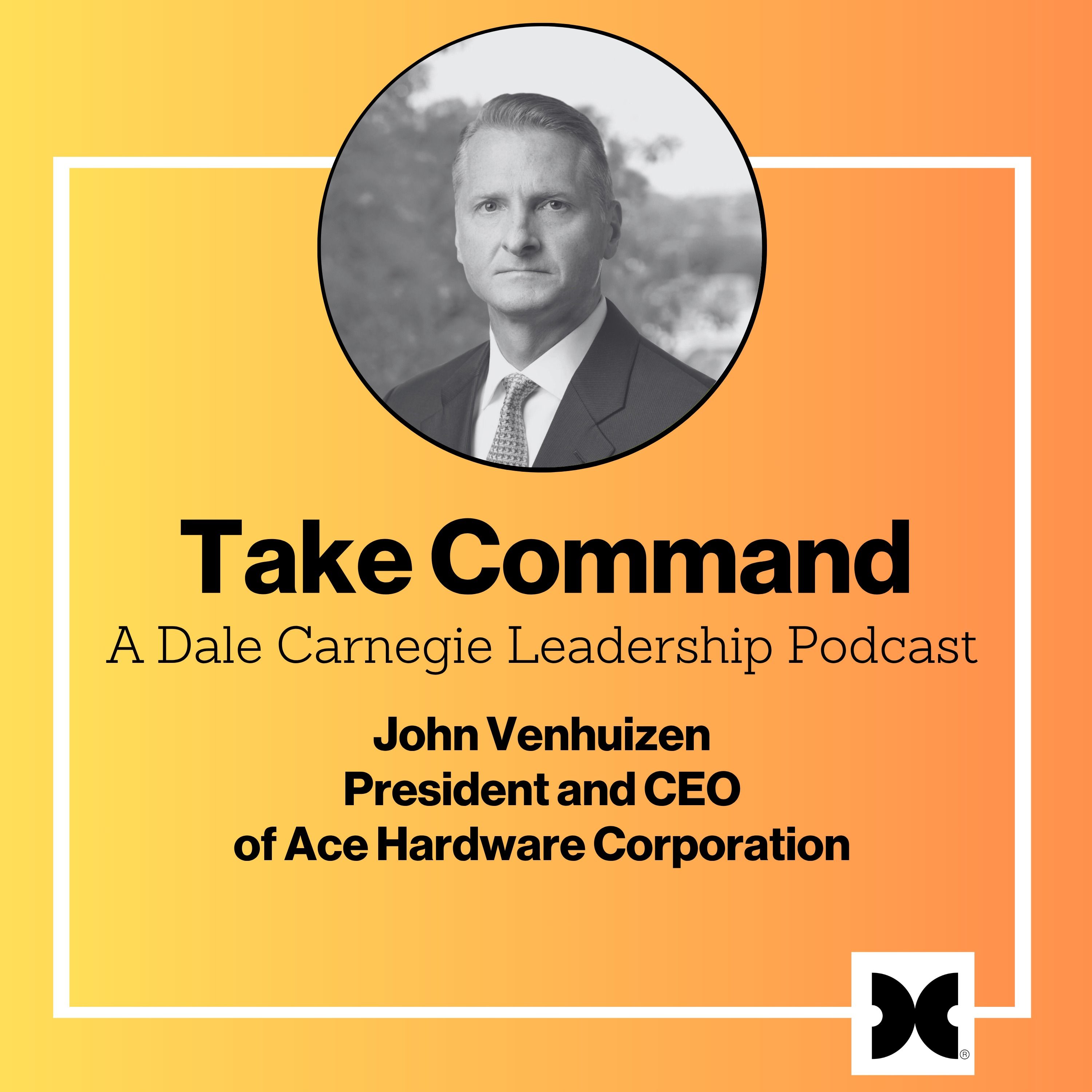
Take Command: A Leadership Podcast
Forged in the Dark: Why Real Leaders Run Toward Problems
00:38:52
John Venhuizen, CEO of Ace Hardware, knows firsthand that business is tough — a constant battle against some of the biggest players out there. But for John, it’s never just about products or profit. It’s about people, relationships, and a deep sense of purpose. In this conversation, John opens up about how Ace’s unique model — combining a powerful global brand with locally owned stores — creates something special that can’t be easily replicated. He talks about the daily grind of leadership, the importance of embracing problems head-on, and why a servant heart is the true competitive edge in today’s tech-driven world. John also gets candid about balancing leadership with life, why humility matters more than titles, and how AI is helping Ace’s frontline heroes serve customers better — all while never losing sight of the human connection that really moves people. If you’re looking for honest, practical leadership advice rooted in real-world experience, this episode is for you.
Loading summary
Transcript51 lines
- [00:00]
John VanHuysen
In a world that is driven increasingly towards technical, impersonal, artificial, faceless interaction, we are betting the farm on what we believe is a timeless truth that a servant heart and human connection will always have the potential to stir a soul and man. When we do that, well, technology or not, it's not just good for business, which it absolutely is. I think it's what makes us the helpful place. It's good for society.
- [00:45]
Joe Hart
Welcome to Take Command a Dale Carnegie podcast. I'm Joe Hart, CEO of Dale Carnegie. If you are ready to grow your leadership skills, follow Take command now and never miss an episode of that could transform your career. Today we explore how our guest's hands on approach to empowering local owners helps keep the company competitive and connected in a changing market. We'll also dive into how humility and problem solving have fueled his long term success. With nearly three decades of experience at the organization, our guest leads the world's largest retailer owned hardware cooperative spanning over 5,500 stores in 69 countries and generating $22 billion in system wide sales. Under his leadership, the company is ranked number one in customer satisfaction for 14 of the past 15 years according to JD Power and it's been recognized as one of America's best employers and most admired companies by Forbes. Please welcome the President and CEO of Ace Hardware, John VanHuysen.
- [01:55]
Unknown Host
John, welcome to the Dale Carnegie Take Command podcast.
- [01:59]
John VanHuysen
Thank you Joe. Good to be with you and appreciate the opportunity.
- [02:02]
Unknown Host
Well, I'm excited to have you here and for a variety of reasons. You reflect so much of what we teach in Dale Carnegie. Your people first, leadership, humility first. You're the CEO and president of Ace Hardware and interestingly you started as a marketing associate, went all the way up to CEO. So I definitely want to ask you about that.
- [02:20]
Joe Hart
I just have to share with you.
- [02:22]
Unknown Host
A story because I'm so excited to.
- [02:23]
Joe Hart
Be with you, John.
- [02:24]
Unknown Host
You know, one of my childhood memories, your whole store is based on being friendly in the friendly neighborhood store. That's a value. As a child on Saturday mornings my father would take me around on errands and we would go to the cleaners and pick up cleaning. We would go to a, like a CVS kind of a store and we would always go to Ace Hardware and my dad would know the people there, they would know him, they'd call him by name, he'd call them by name. It always stuck with me that, you know, you think about brands and the impact that brands have. Ace is one of those brands that for me I can go back to My childhood. It's a brand that really reflects the kinds of things that you're focused on today.
- [03:04]
John VanHuysen
Yeah, Kind of the way it ought to be, right? Motherhood. Apple pie. Ford, Chevy. Robert Redford. Ace Hardware.
- [03:11]
Unknown Host
It is really true. It's an iconic, certainly American brand. I know you're a global company now. You've got operations all over the world. World.
- [03:17]
Joe Hart
Tell us a little bit about you, John.
- [03:19]
Unknown Host
I mean, you started as a marketing associate at Ace. You worked your way all the way up into the leadership of the company. What led you to Ace to begin with? Did you ever think you'd become the CEO? And what advice would you have for our audience about really kind of growing your career at a company like Ace?
- [03:36]
John VanHuysen
I was at a little ad agency in Chicago and then, as you said, I got a job in marketing with Ace Hardware. Probably the story of my career has been I've been fortunate to have quite a few terribly irresponsible bosses who gave me way more opportunity than I ever deserved. And I can say this, it probably sounds a bit hollow to some of your listeners because of the title, but what has kept me here has not been that, you know, in life and business, very often it's not so much what you do, it's who you do it with. I tell you, I just feel so blessed to be at a place with some of the smartest, hardest working, humble, salt of the earth people I've ever been around. And as you know, that's pretty rare in business, particularly big business. And it's kept me here. So it's really largely about the people, the attachment, engagement we have together. It's a unique place, but one that's littered with just exceptional people. So just like I tell my kids, yeah, you want to find something you're good at and you want to find something you love. And often they intersect. It's a nice little Venn diagram. But you want to find a place where you actually can say, I actually love who I work with.
- [04:45]
Unknown Host
I've often thought that working with great people can make an average job a great job. And working with not great people could take a great job and make it not a great job. So important. The culture that we have in our organizations and the role of the CEO. Just to go back, though, talk a little bit about your journey. I mean, it's pretty unusual for a person to go from a marketing associate. You've been with the company for 30 years. I mean, you rose to the level of CEO. What was that journey like, John? And I think about people who might be listening to this, whatever stage of their career and thinking, how do I have a career path that leads me to a higher level? What happened and what did you learn along the way?
- [05:23]
John VanHuysen
You know, I know there's a lot of debate in this. I think these days HR and OD specialists would argue that the best path for people is to take them and move them around. I know many organizations, particularly larger organizations, will take in their new people and they'll bounce them around from here to there and try this department, that department. And there's definitely some goodness in that. That happened to me often. It was kicking and screaming. You know, I really like what I do. I don't want to go do that. And there's certainly a path for that, for sure. But I think like a lot of things, people fall in love with just one idea, that it's the only idea. Kind of like a society that says if you don't go to college, you don't count. You know, I think that's crap. But a lot of people and a lot of money and $1.7 trillion worth of debt is all headed because everybody's got a quote of college. It's a great path for some, but not all. And I think career advancements the same way. The other path that many people should take and probably will fulfill them greatly is to become wonderful subject matter experts in a swim lane for which they are expertise is world class. And I'm sure glad we got a lot of people like that here too. I don't think there's one. This is the way to advance your career. I think largely it's about finding something you really love, you're really good at, and then if you're lucky or skilled, you get around a bunch of other people, you feel great about the trust factors. High speed of trust is fast and it just makes going to work, heaven forbid, a little fun. And that's certainly what we're trying to do around here. And I was fortunate to be able to get in that path.
- [06:50]
Unknown Host
That's awesome. I'm curious, were there any pivotal points along the way where you thought about leaving or where you faced some challenging decisions that made you really kind of think twice?
- [07:01]
John VanHuysen
No, never. I always wanted to be here just in case there's any ace listeners out there. Yeah, there's always. You get a wandering eye or a temptation or business is hard and you get a bad day and suddenly you think the pasture is greener on the other side of the fence. And I know a lot of people have built careers that way. I don't mean to be degrading towards it, but there's a lot of people who build their career by trying to get logos on their resume. Two years here, two years here, two years here. I find it hard to figure out if anybody really has done an effective job in that short a time. It can look impressive, but I used to joke back when Jack Welsh was sort of regarded as the greatest CEO of all time. I know there's different feelings about that now, but back then, you know, we let the largest market cap company in the world, and certainly we all learned a lot from Jack about leadership. But, you know, I told our HR folks all the time, just because you work for George when Jack Welch was there, doesn't mean you're great. Conversely, just because you worked for Kmart when Eddie Lampert was running it and it was declining doesn't mean you're not great. The understanding of the individual and their unique ability to bring value to the organization through what we call the 3C framework is valuable. Character, competence, chemistry. You got to be great at what they do. We got to try to figure out who they are really when no one's looking. Their character, very hard to do in a couple hour interview. But also they gotta be a great teammate. We gotta have great chemistry. And when we can bring that together, I think it's great for the organization. And generally speaking, there's always exceptions. It's great for that person's career.
- [08:32]
Unknown Host
It would be. And if you get the right person and the right culture, they can really thrive. And I'm just curious about the culture because again, a lot of what I've read about you and learned about you is these values of humility and service and so forth are really hardwired in terms of who you are and, and you've worked to hardwire them into the culture. You're talking about hiring people who have that character and so forth. What are some of the things that you do as a leader to create that kind of culture in the organization? And how do you make sure that that permeates throughout the whole company? Because a lot of times that could break down along the way. You could have a leader or someone who's not congruent with the values of the organization. So how do you do that and what advice do you have for others?
- [09:13]
John VanHuysen
Well, I think for us it started with codifying what those values are. And not just so they look pretty on some wall in the lobby, but really codify them. That's a interesting story. Probably for a different time. You can imagine how trying to work with some senior leaders to codify your values is a lot like developing a mission statement with 12 people. Right? It ends up being four paragraphs and nobody can ever remember it. So we fought very hard over what specifically would be unique to our culture and company. And after quite a few hours and I think a few meetings of doing this, we landed on, okay, like, these are the words that we're going to choose. And surprisingly, we didn't do this on purpose. We truly did not. Our CFO was the one who noticed. He goes, look at that. We thought about this for days, but now we landed on it. The first letter of every word that we just chose as our value spells we light. And you know, the heavens opened and angels came down and it was we.
- [10:03]
Unknown Host
Light L I, G, H, T we.
- [10:04]
John VanHuysen
Like, which stands for winning, excellence, integrity, gratitude, humility, teamwork. And I always save the L for last because our highest value is love. And I know that creeps people out, but we really do believe if we have an organization who not only may love a lot of what they do, but love who they do it with, actually love the people, I think we can outperform our enemies who can't even say that word without blushing. So codifying it starts first and then building parlance around it. Number two, I think is really important. Hopefully you've heard of ACE as being the helpful place, right? That's our brand. But we use parlance internally. That's very aspirational. You know, our mission is to be the best, most helpful hardware stores on the planet. There may be somebody on Jupiter that's more helpful than our store, but not here. We say we've been blessed to be in the business of serving others. When we look at our one pager that says our mission, vision, values right in the middle says purpose. What's our purpose? Well, our purpose is we exist to serve others. And so the parlance in the language you can see sort of aspirational to try to truly be a servant led organization. But then, and I'll show up after this. Thirdly, where the rubber meets the road, of course, is your practice. Our behavior. We often say values are what you believe, but culture is how you behave. So the behaviors are really critical. We want to codify it, we want parlance around it, but how we actually act, that's ultimately how you try to permeate this throughout an organization. And again, if given the choice between one and. I'm air quoting here, ideal CEO or an army of servant leaders, choose the latter. Every day of the week and twice on Sunday. And so that's what we're trying to build. I'm not arguing efficacy here. I'm arguing intention.
- [11:49]
Unknown Host
It's the intention that starts everything, though, right? And often that's where things break down along the way. Either if there's not a good intention or if there's an intention and it's not lived upon, then we have hypocrisy or however people are viewed. But, you know, part of what you're saying, I think is really important. And certainly we talk about the role of the CEO in driving the culture. You and I and others who are honored to be in that role have that responsibility. And yet it really is true that everyone in the organization has a part in that culture. You could have someone at any level of the organization. If they violate the values of the organization, they're allowed to do that, then it's going to be really reflective and impactful in a negative way. And it's, again, reflective on leadership. I'm curious about the times where you encounter people or situations where that are antithetical or against the culture. When I talk to a lot of especially younger people, they'll say, look, I'm not a CEO. What role do I have in culture? So how have you addressed difficult situations? And how do you encourage people who may not have a title to take that leadership to make your culture A great one?
- [12:53]
John VanHuysen
Oh, my goodness. So three things here. 1, 100% agree with the way you articulated that. A lot of times, particularly when people enter an organization, their body language with respect to culture tends to be, you know, arms crossed, and it's understandable they're in evaluation mode. I've heard the values. I may have heard the CEO babble at the, you know, my onboarding session about what they are, but is it really happening around here? Let's be honest. Most people think businesses run by the rich, for the rich, and usually at the expense of the most vulnerable in society, who they probably believe to be them. That's the starting point, and I understand it. Business leaders like us have given them ample reasons why they should be a bit skeptical. Their posture in an organization is to evaluate. Let's see if this is really the culture, and I think there's a period for that. But you can't live there. You know, the posture's got to be one of, like, advancing forward. Like every person has to carry the culture forward. You know, it's these aggregation of seemingly insignificant, but in aggregate add up to be a really big impact on the Culture by unique individuals, one interaction at a time, Right? Like from a leadership lens. I think this is probably why Ken Blanchard's work from what 40 years ago is still so relevant, called situational leadership. And listen, I don't care what your title is. If you're leading merely because of your title, you're quite likely not a leader. I don't give a flying rip what your title is. We can define leadership here in a minute. But leadership can be done and often is done by people without titles. That situational leadership demands, in my opinion, that the leader, not the quote unquote follower. I hate that word, but you know what I'm saying, Not the person who is lesser on the org chart. It's incumbent on the leader to modify their style based on that person in that situation. It's not my way or the highway. It's not like this is my style. Deal with me. And I think over time when you get, like you said, large numbers of people behaving that way with an actual heart, you know, of empathy, and maybe actually with a love gene, the culture tends to over time produce an ability to spit out that which it doesn't want. And here we always talk about that as high performing jerks. Think of a vertical axis as our performance and the horizontal axis is your culture. The vertical axis is very easy to measure. You know, are you delivering? Are you producing? Are we producing profit? Is sales growing? Are we putting in new stores? We got 100 metrics for that. The horizontal axis is a bit more difficult to measure because it's culture and values. But if you think about the bottom left quadrant underperformers who are trampling all over the culture, it's pretty easy to get rid of that group. What's difficult for leaders, particularly the higher up they go, is the upper left quadrant high performers who are trampling all over the values. And I think what happens is leaders like us often give them a pass. And it's why that group often kills companies and gives companies the bad brand they actually have with most people. So we talk about that a lot in the hopes that the organization, like not me, the organization recognizes that group and treats the top left quadrant exactly the same way as we do the bottom left. So we say, look at, we're not full of it when we talk about these values as being just as important as the performance. You know, how we do it matters just as much as what we do.
- [16:32]
Unknown Host
I'm really glad you said that that way too because I think about the responsibility you and I have as leaders. And everyone who has a role as a leader. My philosophy, first of all, is sometimes the person who's the jerk and who's doing the trampling, they may not even realize they're doing it. A lot of times those people have blind spots. The first responsibility, I think, and often people are afraid to have direct, transparent conversations with people. I remember. I know about you, Jen. Early in my career, I. I had a hard time having direct conversations with people. It might be defensive. How are they going to respond? But it seems like the first responsibility we have to those people is to at least bring to their attention, hey, this is what we're seeing in your behavior. And this is not acceptable here. Do you want to change? Are you open to change? We'll support you, we'll help you. But ultimately if they don't, that's when it's time to make a decision, right?
- [17:23]
John VanHuysen
Totally agree. And by the way, you said when you were in your younger, in your career, difficult time, you know, confronting people, I still hate it. Who likes that? It takes an incredible amount of discipline. And our argument is, if we really mean it when we say our highest value is love, that's just not peaches and cream. Love demands that you be very difficult. So confronting someone when they're out of line, out of bounds, both very matter of factly and yet with a very humble spirit yourself. Because, you know, I've learned shockingly that just because I believe it doesn't make it so. A lot of things in leadership, there's these paradoxes between two seemingly opposite or competing forces. You want to be profoundly humble, but also have this resolve that's intense. And I think that's the same way you want to approach difficult conversations. To not do it and bury your head in the sand like an ostrich is embarrassing and pathetic leadership. But to do so, like enjoying it. We don't want those people here either. Right?
- [18:21]
Unknown Host
100%. No, no, I'm with you. And it's interesting too, I should at least bring up and thank you also. I mean, you are. And Ace is a client partner of Dale Carnegie. We work together for many, many years and we appreciate that. And I can't help but think about what Dale Carnegie believed, which is that every single person has inherent greatness. And so much of what the principles, the Dale Carnegie principles talk about is, is, you know, you can almost say anything if you say it in the right way. This is what I'm hearing you say, John, is, you know, to try to see things from another person's point of view. If I'm wrong, admit it quickly and emphatically myself. Look, we all make mistakes. You talked about humility for us to recognize, hey, look, I don't have all the answers. What do you think? And so forth. So the kinds of values that you clearly have embodied in your organization, I'm humbled to hear what you're saying because I think so much of it is what we're aspiring to teach to people throughout the world.
- [19:12]
John VanHuysen
You guys have been good teachers. You know, assuming you're able to keep your mental faculties about you, which not everybody can, I don't take that lightly. But assuming that fact, increasing your leadership potency is one of the very few things for which you can go all the way to your grave. Getting better at, it's rare. I'm not going to get any better looking, my physique's not going to get better, my health's probably not going to get any better. But an open mindedness with a learning spirit to try to get increasingly good at leadership is truly something you can go a lifetime improving upon. You probably have a good business model. Presuming leaders are open to learn, you got a lifetime of it. It's a complex, nuanced thing and we should probably spend some time about saying, when you say get good at leadership, what do you mean? But it is an amazing thing that you have an ability to continuously get better at an incredibly complex, important thing. And I agree with Maxwell, like everything rises or falls with leadership. I don't care if it's church, school, your marriage, your business, your parenting, everything rises or falls with leadership. And when that hits you and you take it seriously, particularly if you're in an organization where you're getting paid and you have a title to be good at it, I think it's incumbent upon us to take it seriously.
- [20:29]
Unknown Host
It really is our responsibility individually, irrespective of the level that we have in the organization to develop ourselves. As you said, it's the one thing that we can do. It's the one thing my father, who I mentioned earlier, always talked about life's about personal growth and how do we continue to get better and better. Just to shift the conversation for a second, Chen, you are coming off your best year ever. You had a tremendous year. You've continued to grow and frankly, that wasn't always a given. I think that you had an emergence of big box stores a few decades ago. Look like ace. What's the future of ace? Is ACE going to be able to compete against these mammoth stores? And you've thrived what have you learned in that process? What is some of the secret of how you've been able to do that?
- [21:12]
John VanHuysen
Business is hard. We compete with some of the biggest, baddest, most well funded companies in human history. And you'll never catch me saying anything bad about them. I mean, Home Depot, Lowe's, Amazon, these are really, really good competitors. Now, I don't want to go down a business proposition rat hole here, but we're thankful to be in a business that's materially different. We always say they're about home renovation, we're about home preservation. So I want to start by saying the best leadership is almost impotent in business without a really solid business strategy, like a uniquely better, relevant, differentiated proposition that consumers actually want. And again, I don't want to diverge off of the topic here, but it would be disingenuous of me. Not to mention I think that is critical. And we have such smart people who are constantly trying to make us better at that. Business is tough because you got a lot of competition. You're trying to earn the loyalty from people who have all sorts of choices and you have to have something uniquely better to offer them than the other guy. Business is a lot like sports and war. You got to put more points on the board than the other team. And the consequences of losing are significant. I tell our folks all the time, you know, there's literally hundreds of thousands of people whose lives and livelihood and well being and aspirations to reach the zenith of their potential depend on us being good at this. So let's take it seriously. But more through the leadership lens, I think is where you want to go. A lot of leadership is about solving problems. If that isn't something you like, you're probably never going to be really good at leadership. Right? Again, back to the two seemingly competing priorities. We say in our company we want to make sure at Ace we have two things working at the same time. Number one, no problem's a problem. Make sure your people are bringing you problems, right? If they're insulating you from problems, you got a whole deal there that's bad. But at the same time, we don't tolerate problems, right? Like no problem's a problem. We don't tolerate problems. And the way we talk to our young leaders is ultimately your leadership destiny is largely going to be predicated on the conviction and efficacy with which you tackle problems and challenges. And it's hard. Leaders are not found in the limelight, they're forged in the dark. It's the grind of the work of forgetting your title, rolling up your sleeves and getting in a room and solving problems. We call it grinding the sausage. Forgive the crass metaphor. It's not often pretty. And it takes tremendous discipline to do that well. And I think when you have an organization that's willing to confront the challenges, you got a fighting chance of having a proposition that can survive. We're proud to be 101 years old this year, and I joke sometime with our senior leaders, like, do you want to be part of the team that screws it up? Like, do you want to be in the book that's written about how he's failed? So the intensity, the overcoming of complacency. We don't talk about our best year ever. We talk about the future. Leaders are ever forward. So it's a complex, nuanced thing, But I think the combination of a uniquely better proposition coupled with an organization where a lot of that culture is just recognizing things are hard, problems will happen, and when we join hands, we can tackle them together. That's the goal, anyway.
- [24:35]
Unknown Host
It was interesting too, is the commonalities I see between your business and our business. You have independently owned stores. You really rely upon that entrepreneurs are running your stores. And we have independently run franchise organizations all throughout the world. You're 101, we're 113. So we got you by a little bit.
- [24:55]
John VanHuysen
Man, you're old.
- [24:56]
Unknown Host
I know, 101. I remember 101. But I think, you know, the fact that you have that kind of reliance on the individual stores reminds me a lot about, I think, the greatness in our organization. We've got people, people who are running their own businesses, connected to Dale Carnegie and so forth.
- [25:12]
John VanHuysen
Just to interject, that is such a key ingredient to our success, in my view. You know, we have 6,000 stores around the world, and every single one of them, except 252are locally owned and operated. The combination, it's such a beautiful thing, in my view. It is one of the most special things I've ever seen in business is this combination of the scale and strength of a global brand, coupled with the autonomy and local embrace of a beloved owner who lives in that market, whose life savings is mostly tied up in that operation. You know, the combination of that requires also a great deal of humility. Right. You said franchise. We don't use that. We call it the F word. We call them owners. But, you know, these are brand partners. Very often they're at odds with one another. You know, if you read the franchise disclosure document of most of the brands, you Know, we're the fifth largest franchise in the world and if you looked at the top 10, you'd see it's littered with lawsuits. Our competition isn't internal, it's external. Our local store owners are also the only owners of our business. It creates a unique situation, but the alignment is special. So it is, as you point out, I think a recipe that is a competitive advantage for us and often something consumers lean into. They like supporting the local retailer and yet behind them they have this scale that gives them huge advantages you couldn't have gotten on your own. So I think the combination is beautiful and it is advantage.
- [26:35]
Unknown Host
We've seen that. Exactly as you said. I know you're a global company as we are and to have operations in 80 countries where the people live there, speak the languages, are part of the culture that's their business. I mean, how do you replicate that? It's such a beautiful thing. Our view has been one Carnegie, we're one global organization serving that customer at the center of all that we do with a purpose and a mission which is around unlocking greatness and so much commonality. And I appreciate that, John, about your leadership and what ACE is and how you're leading that business. Being a CEO can be very difficult. Suffice it to say many people struggle with work, life, types of balance. How do you invest in your own well being, your family's well being, how do you make time for the things that are important to you?
- [27:20]
John VanHuysen
You know, I don't think I'm any different than anyone else here or in business. I think it has to start with prioritization. I talk about this with all of our new employees, to anyone who will listen. Really, if your faith and your family and your friends are not more important to you than your work here, that's a real problem. In fact, I try to really use some combative language. I'll say if you define yourself by your work, if your self esteem is mostly wrapped up in your title and your job and your work and your company, the truth is you're a really big dork. Like I own that because, well, in the short term that might be good for a company. In the long term, I think it's horrible because those are people whose priorities are screwed up, in my view. Don't get me wrong, we need our team's best here. We need them working together and collaborating. I mean, again, our enemies are really good, so we need their best. I'm not saying the excellence quotient or bar goes down, but in terms of prioritization we think you can be great here and still have it be fourth or fifth most important in your life. So I think it's got to start there because back to your point from earlier characters at the foundation of it and now, it's very difficult to figure out. But who you are when nobody's looking really makes for either a great teammate or someone you just always aren't quite so sure you trust. And when you have an organization like that, everything slows down. It's just like sand right in the gears of if it was a mechanical process. So it starts to me with prioritization, builds on character. Then we can start to talk about skills development, which is wildly important, but not at the expense of those first two things. And of course, as we've talked about, I mean, I'm no different than anybody else. There's just so many things these days from which we can get knowledge. Ted talks, YouTube videos, podcasts, reading. I mean there's just so many ways if you're willing to learn and from a leadership lens, boy, almost any interaction you have throughout your day is an opportunity to learn, either good or bad. It's just the commitment and the discipline to lean into learning. Don't get me wrong, if it was healthy, I would much rather eat potato chips and binge watch Netflix. But it is back to discipline. So to me that's a huge part of the thing. But it's third place.
- [29:41]
Unknown Host
Do you have anything in particular that you're leaning on right now relative to your health? I just interviewed Guy Fieri and he talked about his religious connection to sauna and cold plunge. You know, there's different kinds of things that people are doing. Do you have a single thing that you would share with our audience that you think is helping you stay physically and or mentally healthy?
- [30:03]
John VanHuysen
The answer to that is yes. And you know, you got to have disciplines in life in all these areas. The one thing though, I would say many of us in business miss as an opportunity for learning and probably well being and health. Like I said, business is a lot like sports and work. So I think most of us, when we have thought about our development and our learning and our knowledge over the years, have primarily leaned into those three sectors. Sports, war, business leaders, and we all learn from the same folks. And to be sure, there's lots to be learned there for sure. But I think what dawned on me years ago kind of hit me like a ton of bricks is the notion that there is a sector, let's call it the not for profit sector. I think this is wildly untapped as a learning opportunity for most leaders. And let me tee it up for you this way. By juxtaposing sort of the tools I have for my leadership versus, let's just say, the pastor of a local church. So again, think about all the tools that I have that the people that are inflicted with my leadership I control, their pay, their compensation, their merit, their bonus, their company car. Like I've got all these tools to inflict my will upon those I'm supposed to lead. I'm not saying that's a good form of leadership at all, but you know what I mean? And lots of people in business have that. Now juxtapose that against, again, say the pastor of a local church where almost all the heavy lifting is being done by volunteers. So this kind of leader has to create a vision for the future and cast that vision with such clarity and conviction and compassion that people willingly sacrifice their time, their talent, their treasure to go after the cause. Now, you may or may not agree with the cause, but again, through a leadership lens, that's an impressive form of leadership. When people willingly sacrifice their own stuff and time. I think we could learn a lot from that sector.
- [31:59]
Unknown Host
Yeah, it is interesting because I think about my own growth. A lot of it has come through the volunteer world. Taking on a role as a leader in something and learning and interacting with other people and trying to motivate people and inspire people who, like you said, you don't have any kind of authority over necessarily. It's just you're working together, but trying to get people really galvanized around a cause. You know, this even goes back to something you were talking about before. Poor, just even about relationships. The quality of our lives often depend on the quality of our relationships. And those are great opportunities. If we can really develop our own leadership skills and relationship skills and great relationships with other people, that can lead to a lot of happiness and I think really strong mental well being.
- [32:40]
John VanHuysen
That is such a good point. We all come out of the womb very good at blaming others for our woes. We kind of overestimate our own abilities and then we tend to vilify other people to justify it. But I think the way you said that is right. The quality of life we have is largely predicated on the quality of decisions we make and the people we surround ourselves with. Again, that goes back to accountability and discipline and most of us, myself included, don't like that.
- [33:07]
Unknown Host
So, John, a moment ago you were talking about the different ways that we can learn and just kind of as a Closing question here. I'm curious about the role of AI in your life and maybe even an ACEs, but I'm thinking specifically, specifically about you because this is one of the questions I'm asking a lot of leaders is how are you personally leveraging ChatGPT AI in your work or your day to day? Is there something that you're doing that's effective that you'd want to share with our audience?
- [33:33]
John VanHuysen
I am a believer that AI and again, when we talk about AI, we think machine learning, deep learning, generative AI all the way down the funnel. I think this is the opportunity that's yet untapped. We can even say old world businesses like ours to leverage that technology, almost like the industrial revolution to make us wildly more productive. And when I think about it in terms of, you know, our little world, the use cases, there's three primary use cases that I believe are already gaining steam. The first is with respect to think about how difficult it is. Joe, you know, we have literally 6,000 stores around the world and none of them give us a forecast of what they're going to sell and none of their customers call in advance and tell them what they're going to buy. So the prediction, the prediction of demand of what to put in a store so that when you walk in there, we have what you need is wildly difficult. Well, we've got very good tools for many years and wonderful team of people who do that very well. But AI has already improved our predictive power and reduced our inventory. So we've been able to better predict demand which allows us to better Delight customers with 60 plus million dollars less of inventory. That's a really good thing for business. The second use case, I'll just call this a really wide swim lane. We'd call everyone's improved productivity. The way we say it here is, listen, you're not going to lose your job to AI, but you could very likely lose your job to a person who knows how to leverage AI. So we've got, you know, enterprise relationships so we're legally following the right path here. But there's not a job here that I can think of that's not going to get more productive if a wise person leverages AI appropriately in big and small ways. The third lane though, that's pretty cool for us because our brand is all about service, is to leverage AI to better equip people to be more competent with their tasks and more confident in approaching customers. So we have a hundred thousand people today. We call them red vested heroes. They're our most Important employees working on the front line in our stores, trying to serve their neighbors well. And you can imagine how much they need to know. We stock 101,000 SKUs. Their local store probably has 28,000 different items. The amount of things that they need to know to truly be helpful is stunning. You can already start to see how technology is going to help them get more competent in their tasks and more confident in approaching customers. But let me blanket all that with a phrase. We talk around here a lot, and I mean this to our core, because I think people end up in one ditch or the other. In a world that is driven increasingly towards technical, impersonal, artificial, faceless interaction. We are betting the farm on what we believe is a timeless truth, that a servant heart and human connection will always have the potential to stir a soul and man. When we do that, well, technology or not, it's not just good for business, which it absolutely is. I think it's what makes us the helpful place. It's good for society. It was stunning to me to read the Surgeon General's warning a few years ago that isolation and loneliness is the new epidemic in America. So much so that according to the Surgeon General of the United States, being alone in isolation is worse for you than smoking five packs of cigarettes a day. I mean, are you kidding me? So human connection and a servant heart, AI or otherwise, is, I think, ultimately what stirs people's souls and makes them want to work for a company, makes them want to shop for the company or be associated with a company. I think that can't be lost as the rest of the world is all chasing after this artificial, technical, impersonal, never at the expense of human connection in our view.
- [37:29]
Unknown Host
There's no question.
- [37:30]
John VanHuysen
Right?
- [37:30]
Unknown Host
Because at the end of the day, we are people and the nature of our existence is around connection. And that human connection is not going to go away. In fact, it may become even more important than ever. And in fact, our own skills and the way we connect with the world may become more important than ever as well. John, fabulous being with you. Thank you so much for being in the Dale Carnegie Take man podcast.
- [37:51]
John VanHuysen
Thank you, Joe. And again, thank you. Ace has been a benefactor of the great work you guys do, so thank you as well. We're proud to be affiliated with Dale Carnegie, so appreciate your time. Thank you.
- [38:00]
Unknown Host
Well, thank you, John. Appreciate the opportunity to work with you. And also just a shout out to our Chicago team, which I know is taking the lead in working, working with you. So thank you for trusting us.
- [38:08]
John VanHuysen
Thank you.
- [38:16]
Joe Hart
I hope you enjoyed this edition of Take Command, a Dale Carnegie Podcast. Check out our resources at www.dalecarnegie.com for.
- [38:25]
Unknown Host
More research, insight and tools that will.
- [38:28]
Joe Hart
Support your success and help you take command of your leadership potential. If you enjoyed this episode, please consider rating it and following us on Apple Podcasts and Spotify. For more exclusive content, subscribe to our Dale Carnegie YouTube channel and follow us on social media. As always, thank you for listening and we're looking forward to you joining us for the next episode of Take Command, a Dale Carnegie Podcast.