← Take Command: A Leadership Podcast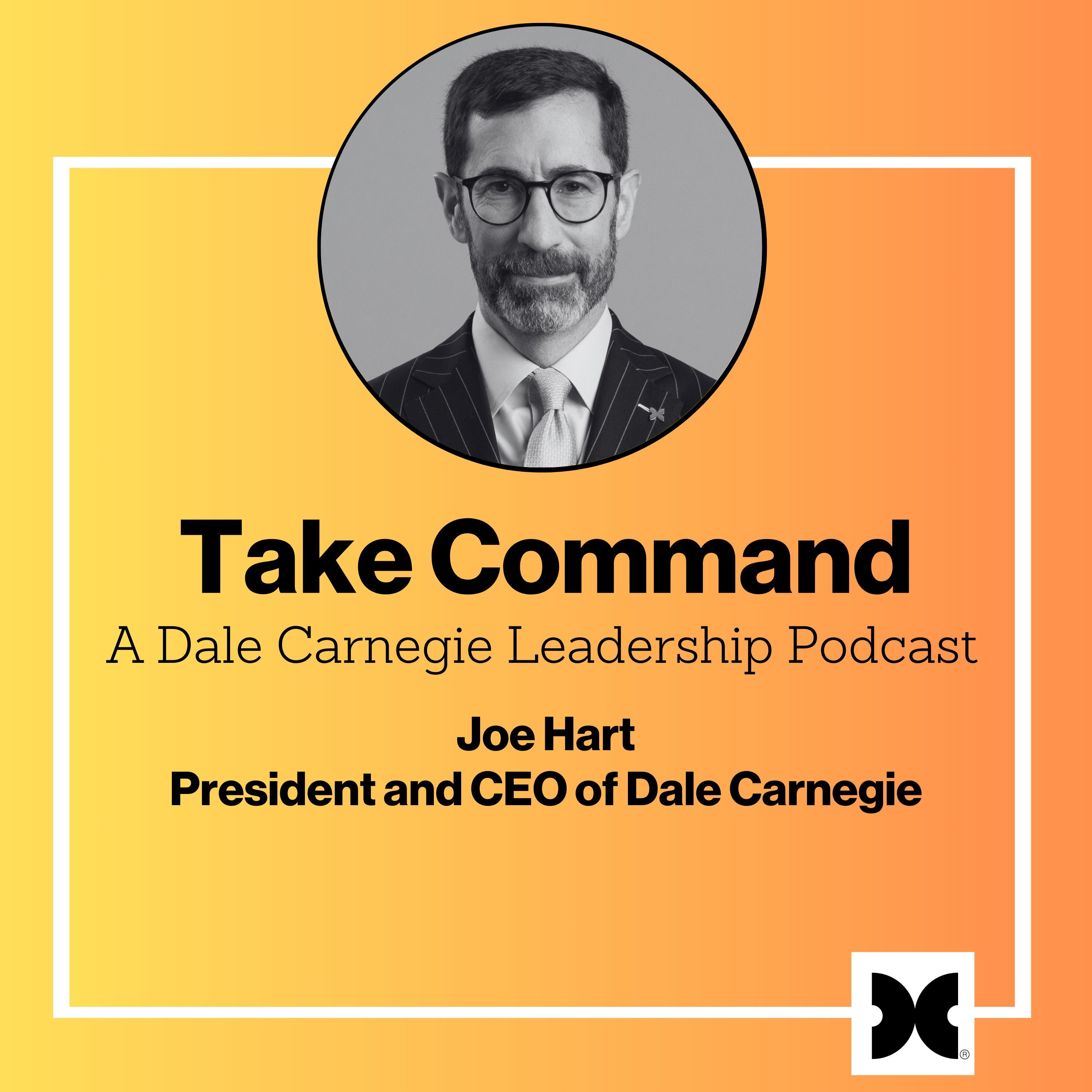
Take Command: A Leadership Podcast
From Law to Leadership: A CEO’s Journey of Purpose
00:55:31
This episode of the Take Command podcast comes with a twist—Joe (our usual host) is our interviewee! He sat down with Dr. Greg Story, president of Dale Carnegie Training in Tokyo. Among a plethora of exciting topics, Joe brings up the idea of trust, a concept he discussed with Richard Edelman on another podcast episode. Joe says, “At the end of the day, it does come down to believability. Do people do what they say they're going to do? Do they care? How do they follow through?” In this episode, Joe gives plenty of examples and advice on how to win friends and clients in business and why believability all comes down to human relationships.
Loading summary
Transcript154 lines
- [00:00]
Joe Hart
People need to develop levels of courage and confidence and emotional intelligence through doing and through taking risks and so forth. And the kinds of programs that we teach, of course, put people in those safe environments where they can take risks and build their confidence. And that's a critical competitive advantage for people these days, is that confidence, confidence can be a game changer and a lack of confidence can ruin a career.
- [00:34]
Greg Story
Welcome to Take Command, a Dale Carnegie podcast. I'm Joe Hart, CEO of Dale Carnegie, and if you don't want to miss a moment of transformation, follow. Take command now and unlock the power of leadership with every episode. We're closing out this year with a special twist. This time, I'm the one being interviewed. I had the pleasure of sitting down with Dr. Greg Storey, President of Dale Carnegie Training in Tokyo for a conversation originally featured on Japan's Top Business Interviews. During our conversation, we explore why AI should be embraced as a tool to engage with rather than something to fear. We also discussed the power of building genuine, meaningful connections and why it's often more valuable to be the person with ideas than the person with the plan. I hope you enjoy the episode.
- [01:29]
Welcome back. This latest episode of Japan's Top Business Interviews. I'm your host, Dr. Greg Story, President, Dale Carnegie Tokyo Training. My special guest today is my boss. Joe Hart is the president, global CEO of Dale Carnegie and Associates, the franchisor for the whole Dale Carnegie organization. Joe is an honor and a pleasure to have you with us again. Thank you, Craig. It's your third time in Japan and you've been fundamental in changing a lot of things in Dale Carnegie since you've joined as president. But let's go back a little bit and give us some of the backstory on how it is that you came to become the president of this global organization, Dale Carnegie.
- [02:10]
Joe Hart
Yeah, it's really a pretty incredible story. It's one of those times in life where you don't see how the dots connect until you look backward. My father, growing up talked about Dale Carnegie. My mother was a 1965 Dorothy Carnegie graduate. So I grew up in a house where the Dale Carnegie name was familiar.
- [02:24]
Greg Story
And Dorothy Carnegie graduate means that Dorothy Carnegie started a course for women.
- [02:30]
Joe Hart
That's right.
- [02:30]
Greg Story
Specifically.
- [02:31]
Joe Hart
That's right.
- [02:32]
Greg Story
Which until that time, that hadn't existed. Dale Cunningey had a course, everyone could participate. But then she thought, well, women should get something. And so. That's amazing.
- [02:39]
Joe Hart
That's exactly. That's right. I've actually got the picture of her. I've got her graduation pin. In fact, this is a side Note. But you might be surprised to know they took minutes of the meetings. She's got all the minutes. And they created a newsletter. It was really a little community that they created in that class.
- [02:54]
Greg Story
I didn't realize that. That's pretty organized.
- [02:55]
Joe Hart
Yeah, I can actually send you copies of it. But my ambition as a high school college person was to go to law school, become a lawyer, join a large firm, become very successful, do that for 40 years. And I was on that track. I was a young lawyer since 1995, and I decided at that time to take a Dale Carnegie course.
- [03:13]
Greg Story
Now, why was that? I mean, was this through father's influence, your mother's influence? Was it someone who spoke to you about. It was something advertising. You saw what sparked that?
- [03:21]
Joe Hart
It was two things. Thank you for the question. One was, my dad always really instilled in me that life is about personal growth. You know, you always want to continue to improve and get better. And to me, I was very much into the concept of self development. And the second thing was the franchise owner. The sponsor at that time in that territory was Ralph Nichols, who was a.
- [03:40]
Greg Story
Legend in Dale Carnegie circles, of course.
- [03:42]
Joe Hart
And I'll tell you, he had radio ads all the time. Ralph Nichols Corporation, Dale Carnegie. So I remember hearing the ads and I kept thinking to myself, I just have to do this. I went to my law firm and I said, gee, this is a program that's going to help me be a better lawyer. And would you want to pay for this? And they said, you can take it, but no. So $890, 1995. I take this course and I walk into this room in Troy, Michigan, in September 95. I didn't know what to expect. Greg, at that time, I walk in, there's 33 people in the room. That course just had such a profound impact on me. Just a couple things that really were. One was, as you know, the remembering names exercise. They went through this exercise. You're going to remember people's names and.
- [04:18]
Greg Story
Teach and remember first and last name for all 33 people in the space of what, half an hour or something? That's right, isn't it?
- [04:27]
Joe Hart
They said that you're going to be able to do that. I said to myself, there's no way. Horrible at remembering names.
- [04:32]
Greg Story
We all are, actually. We're all hopeful. So.
- [04:34]
Joe Hart
But I had 31 of the 33 names, and it was just absolutely incredible. The other thing was, the challenge in your vision is, you know, where do you want to be? Who do you want to be? Where do you want to Be. And over a period of time, I started to think about, you know, do I really want to be in law for 40 years? I wasn't necessarily. I was a successful lawyer. I wasn't a happy lawyer. And I decided ultimately, as a result of that Dale Carnegie course, I think.
- [04:54]
Greg Story
That'S the standard definition for lawyers. Successful but not happy. Right. I hear that so often. Yeah, I hate this job, but I'm doing so well. I'm going to keep going with it. So you were probably fitting nicely into the spectrum of typical lawyers at that time. But how many years were you in the law as a lawyer before you took the course?
- [05:14]
Joe Hart
Just a couple. I started in 1993. It's 1995.
- [05:17]
Greg Story
So. Okay, you're two years in. Right.
- [05:18]
Joe Hart
And then 98 is when I actually left the law. It was Dale Carnegie that really kind of inspired me. And the courage. There are many, many lawyers who I talked to at that time who were unhappy lawyers and are still unhappy lawyers. You know, it takes courage to leave. And I think that was also something I got from Dale Carnegie. But the most important thing beyond that was just interpersonal skills. You know, six months after I took the course, I was thinking about all these Dale Carnegie principles that I was not applying. So I said, I spent $890 in this program. I want to maximize this.
- [05:46]
Greg Story
I get my value.
- [05:47]
Joe Hart
I want to get my value. So every single day I develop a calendar. And every day I started to practice Dale Carnegie principles, I'd write down a principle and a quote from the book, and I'd reread the chapter. And I'd usually work on a principle for a week, and I go to the next principle. And over a period of time, there.
- [06:02]
Greg Story
Are 30 of these human relations principles and. 30.
- [06:05]
Joe Hart
That's right.
- [06:06]
Greg Story
Management principles. Right. So you got a cycle of 60 there, if you think about it. So you can actually not being bored with it, because it's always going to be fresh.
- [06:14]
Joe Hart
Always fresh and always hard, always challenging. You know, you think about things that, you know, we say common knowledge, not common practice. Right. It's common knowledge that we should give people appreciation. But how often do we do that? And I started practicing this, so can imagine seven days in a row when I was practicing, give honest and sincere appreciation. I'm going to people and I'm giving them honest and sincere appreciation. Over a period of time, people are saying to me, you really seem like a different person. You know, prior to D.L. carnegie, I was a little prickly.
- [06:43]
Greg Story
Not a litigation lawyer by any chance.
- [06:45]
Joe Hart
I was a litigation Lawyer.
- [06:46]
Greg Story
As a matter of fact, mostly litigation lawyers are pretty prickly by design and.
- [06:52]
Joe Hart
Egotistical and not particularly empathetic. You know, so my relationship started to get better. People started to notice this. I ultimately decided to leave the practice of law. I went to work for a couple years at a, in the United States, a publicly traded real estate company.
- [07:06]
Greg Story
Just before you talk about that, in terms of, okay, you have, as a lawyer, you have colleagues, they're usually partnerships, and you have clients. So, you know, you noticed from your colleagues who you're working with, they were reflecting that something's changed with Joe. He seems a little bit different from before. And what about with clients? Did you find that being able to apply these principles in how you related to clients also changed your business acumen.
- [07:32]
Joe Hart
Or your business ability 100%? It made me far more valuable to my clients. And I was a far more effective lawyer because I listened to my clients more effectively. I really tried to understand their point of view. I mean, it's natural to ask questions, but, you know, the lawyer, I can't speak for all lawyers, at least I would tend to form an opinion very quickly, say, okay, this is what we're going to do. But unless you really dig, unless you really understand, you know, really everything. And so I became, you know, more empathetic.
- [07:58]
Greg Story
And that's a good point too, because as a civilian, you're a non lawyer, it's very complex in the law, and your understanding of it is always a struggle. And lawyers, this is their business, so they can be very quick and very confident. But you yourself, you can't make a judgment about that. And to have a lawyer who's really empathetic trying to really dig into, okay, what's the deeper layer here? Not just the tip of the iceberg.
- [08:24]
Joe Hart
That's right.
- [08:25]
Greg Story
That would be, I imagine, for clients, a bit of an unusual experience, I think it was.
- [08:28]
Joe Hart
And people noticed that. And my partners noticed that. The people I worked for noticed that. And my reviews were very good. And by the way, you know, the fact that I left the law, I know so many lawyers who've taken Dale Carnegie and it's helped them in their practice. So actually, one of the partners in my firm who I worked with was a Dale Carnegie graduate. In fact, it was her, you know, after a couple years of using this kind of calendar system, she was the one who encouraged me to send a letter to the CEO of Dale Carnegie at the time, Ali Crom, telling him about the system I had developed that might be valuable to Dale Carnegie graduates. So two Things were happening at once. So I'd sent this letter to ali kwam. I FedExed him a letter in New York. I waited a day. Then I called him and he answered his phone, you know, Ali Crom. I said, Mr. Crom, you know, CEO Dale Carnegie. And I explained, I'm a Dale Carnegie graduate. I've got the system. It's really helped me apply the Dale Carnegie principles. And you know, is this something you'd be interested in learning more about? He said, yes. We ultimately did a pilot with two franchises to test this out. It was actually an Internet based. We turned it into the software based kind of system. And at the end of this, he said, well, what would it cost to do this? And I gave him a number and he said, that's a lot of money. We're really not in a position to do that right now. So I was disappointed. I said, I think there's something here. And that something was a process for breaking down content like Dale Carnegie content and reinforcing it over time. Because as you know, and you share with me, Greg, you're excellent at this. You know, the reinforcement curve, right? I mean that knowledge curve. Knowledge is lost over time, but if you reinforce it, you can keep it at a high level. So I developed a business plan for this concept and ultimately started to talk to people about it. And some people I've talked to liked it and ultimately invested it. And I left at that time the company, I was with the real estate company and started my own E learning company in 2000.
- [10:12]
Greg Story
So you've gone out of the law into real estate now working for yourself and what's the span of time of that period?
- [10:19]
Joe Hart
So I left the law in 98. I spent two years at the real estate firm. And while I was there I was working on my business plan. And by the way, phenomenal job and I love the real estate company. My goal was just to work on this business plan and, you know, see what happened. And ultimately took on the life of its own. So 2000 is when I left and started my own company. And that was for all the people who are entrepreneurial. Certainly you are one. You know, it's daunting to start something from nothing. It's daunting to be on your own.
- [10:45]
Greg Story
And are you single, married by this time?
- [10:48]
Joe Hart
I'm married. I'm the sole breadwinner and we have two babies.
- [10:52]
Greg Story
Right. Two kids, wife. And we're just going to throw away the law, which is a. Not guarantee, but a fairly robust, reliable employee. And we're going to take a risk here, that's not easy.
- [11:05]
Joe Hart
It was not easy. It was terrifying. I'll tell you what, though, my wife was a key part to this because, you know, when I raised the seed run funding to start this company, the investors had said, you can keep your job at the real estate company if you can find a way to get somebody else to do this. We like the idea. We believe in the idea. And I went back to my wife and I said, katie, I said, I've got good news. I can keep this job that I love and find somebody else to run this company. She said, that's great. So I got a question for you. Do you think you can find someone who's going to be about as passionate about this as you would be? I said, probably not. Another question. You think you might regret not giving this a shot, you know, if it doesn't work out? And I said, yes. She encouraged me.
- [11:47]
Greg Story
She really encouraged you?
- [11:48]
Joe Hart
She really did. If it wasn't for my wife, I'm not sure that I would have done it. You know, the responsibilities.
- [11:52]
Greg Story
Absolutely.
- [11:53]
Joe Hart
Kids, everything else. So I did start. And you're a gracious podcast host because I'm giving you the long story here and you're taking me back through my memories. But the long and short of it is I start this elearning company and I go to Dale Carnegie. Go back to Dale Carnegie that time there's a new CEO and new people there. And I basically said, look, what if I built this system for you? You don't have to pay for it. You know, let's work with your franchise network and we can create reinforcement programs for Dale Carnegie courses. And they said, great. So I started a company. It was called Info Ally. It was an e learning company. I worked with Dale Carnegie globally. We translated our courses into five languages. This is the early 2000s eLearning for Dale Carnegie.
- [12:33]
Greg Story
So a lot of companies, way ahead.
- [12:35]
Joe Hart
Of the game, way ahead of the game. At that time, we had other clients, and I ultimately built and sold that company and then became the president of a new company that was in many ways rooted in kind of the technology from the first company. The people who bought my company wanted to start something new, so we did. I was the president of that company for about 10 years.
- [12:53]
Greg Story
That's also impressive because exiting from a business is not that easy. You know, you can start a company, but then you have to get to a certain stage where it's attractive enough to someone else to want to put up some money and take it off your hands. And then for them to believe that they can make it a success. And you've got to leave enough money on the table for them to want to do that. That balance is not that easy either. So you know when you talk about if you're in business and you hear someone's had an exit, you say, well, congratulations, well done you. Because you know that's not very easy. So well done you.
- [13:26]
Joe Hart
Thank you.
- [13:26]
Greg Story
On managing that first exit, it was something else.
- [13:29]
Joe Hart
I was really excited that we were able to do that. And again, the people who bought it were excited about it because it enabled them and me to work with them to start a new company.
- [13:38]
Greg Story
Is the company still running?
- [13:39]
Joe Hart
It is very good.
- [13:40]
Greg Story
That's even more appropriate. The legacy is there.
- [13:43]
Joe Hart
Yes, it is.
- [13:44]
Greg Story
There's nothing worse than starting something and then the people who come after you screw it up or throw it away or they stop doing it. And your whole effort, everything you poured into it, all your heart and soul just evaporates and you can't do anything about it. But so this is great. You say, well, I started that company. It's still running successfully today. You've got some legacy. That's great.
- [14:03]
Joe Hart
I'm proud of it. It's 24 years since we started it.
- [14:06]
Greg Story
Wow.
- [14:07]
Joe Hart
And it's still, I mean again it is morphed into something else. But that seed is what has created what is there today. And what is there today continues to thrive. So.
- [14:14]
Greg Story
And what was the next business you went into?
- [14:16]
Joe Hart
So it was called Asset Health. The U.S. a wellness company. Essentially. In the U.S. the healthcare system is such that large employers typically pay for they self insure the medical costs for their employ. They want their employees to be healthier. So they put programs in place that teach their employees about the benefit system and how to heart health, diet, nutrition, exercise, those kinds of things. So we created e learning around health programs using that original system. And also we acquired a company along the way. So we had nurse coaches and other kinds of things. We would do biometric screenings. So our clients were typically 1,000 employees. Was a small client and the largest client we have was about 100,000. We were doing at one point we were doing work for General Motors, for Johns Hopkins, for major health systems in.
- [15:02]
Greg Story
Companies in the US that surprises me, Joe, because you know, your American health system is, let's use the word unique. Complex is another good word to describe it. There's a lot of money tied up in that. So it's interesting to me that you're able to come up with a new idea and have companies of that caliber, like General Motors, et cetera, to actually buy your company services. You know what I imagine is an incredibly red ocean of a crowded competitive marketplace. So how did you manage that?
- [15:30]
Joe Hart
We were very fortunate and I'd say a couple things. We partnered with another company that had been doing some work with General Motors. So they brought us in there to do some work with them. In other cases we were initiating. We had a very effective sales and marketing team and that type of thing and a pretty compelling product.
- [15:46]
Greg Story
So how many people are in the company at that time?
- [15:48]
Joe Hart
It was not huge. I'm trying to think back. 70, something like that.
- [15:53]
Greg Story
Still 70 people. It's pretty, I mean, you know, I Wish we had 70 people here. That'd be nice. But to build it up from zero to 70 people in what space of time?
- [16:02]
Joe Hart
Let's see, we started that in 2005 and I left in 2015. So that was about 10 years.
- [16:10]
Greg Story
So you put 10 years hard work in there.
- [16:11]
Joe Hart
Yeah.
- [16:12]
Greg Story
And did you sell the company? Did you have another exit?
- [16:15]
Joe Hart
No, I, that was the thing. When the prior CEO of Dale Carnegie retired, I was contacted by some people I knew who were still in Dale Carnegie and they said, hey, you know, you should apply for this role as CEO. And I thought it was an absolutely mind blowing thing to me to think about this program. Because one thing what I haven't said is that Dale Carnegie continued to be a part of my journey every step along the way. When I was starting that first company I always had how to win friends and influence people was on my desk. It never left my desk. It was always within three feet. I looked at it every day. I tried to build the company with those kinds of principles, the stress and worry principles. When 9, 11 happened, we were in the midst of a funding round that completely collapsed. It looked like we were going to go out of business. But you know, the stress and worry principles helped me. I think about, you know, I graduated in 1995 and met with my wife in 1996 and I was telling her all about Dale Carnegie, got her to take a Dale Carnegie course.
- [17:09]
Greg Story
Oh, that's good.
- [17:10]
Joe Hart
And we both agreed that we wanted our kids to take Dale Carnegie courses. So even before I came to Dale Carnegie, I'd had my two oldest daughters take teen programs. Now all six of my kids have gone through Dale Carnegie. So when in 2014 I had heard about this opportunity to potentially be the CEO of Dale Carnegie, I mean it was both exciting, but also I, I mean I was leaving something that I had helped build. I was the president of this company. And I was excited about, you know, the company that we had. And I don't think if it was a company other than Dale Carnegie, I would have considered moving my family to New York, which we did from Midwest United States to New York. I did it partly because this is a company that transformed me. I was passionate about, I was committed and am committed to the idea of, of building the brand and trying to reach just exponentially more people. Because the world needs Dale Carnegie. You know this. I mean, it is transformative in terms of the ability to give confidence and help people lead and deal with stress and worry and communicate and have better, healthier relationships. So I was into this very competitive, rigorous process for the CEO selection. And after that process, it was, I mean, I guess the rest is history.
- [18:19]
Greg Story
You got the job, right?
- [18:19]
Joe Hart
I got the job about nine years ago almost now it was in April, is that right? I started full time in May of 2015. So nine years ago.
- [18:30]
Greg Story
So, you know, when you're entrepreneur like yourself, you've started two companies and you're operating within the realms of the United States and the legal system, the business culture there, the language is English. That's one level of complexity. Now you join to become the president of Dale Carnegie. It's not the president of Dale Carnegie America, it's a president of Dale Carnegie. Global countries all around the world have Dale Carnegie and so different cultures, different languages. So now there actually aren't too many American business people who ever have to take on that challenge. Now in the sense of they're running a global operation, they might be sent by their firm maybe to Tokyo or Sakura, perhaps for a couple of years on a posting, two, three, maybe four, five years, and then they go back or they go to another country. But in this case, you're based in the States, but you're running a global organization. So when you took on the job and you said, okay, I'm going to stop working over here as a president of this health wellness company, I'm going to take on Dale Carnegie. What was your thinking about approaching it as a global operation? How did you think about that?
- [19:38]
Joe Hart
It's interesting. One advantage I had maybe over any other candidate who was applying for The Dale Carnegie CEO role is that I had had about 10 years of experience working with Dale Carnegie franchisees all over the world. I knew the business and I knew the people and I understood many of the dynamics because again, I mean, when Dale Carnegie and Associates, the franchisor, agreed to work with us, they basically opened the doors for us to work with franchisees. The franchisees were my clients. I was going to franchise by franchise. So. And we had translated to five languages. So that was throughout Latin America and Europe and different parts of Asia were using our programs and so forth. So I did have a sense of really the global nature of Dale Carnegie. And I also had a passion for the franchise owners because I understood that they, like me, were entrepreneurs. They were taking all the risk of hiring and running a business and so forth. And they were the ones who were delivering these transformative experiences that had impacted my entire life. So you talk about connecting the dots. I go back, I was a Dale Carnegie franchisee or the time sponsor that made all the difference in my life. I had great appreciation for those people. Of course, I still do. That gave me that perspective about just the global nature of the business. And really, when I started, the first thing I did was rather than coming in and saying, okay, I'm a man with a plan, I said, I'm not a man with a plan. I've got some ideas. In fact, I had presented to the board a proposed plan. I told them my thoughts, and then I said, I need to go talk to the franchisees. I spent about six months really just talking to people and saying, what do you think, Greg? What do you think we need to do to really advance this business? What are the most important things? And how do we serve our customers most effectively? And so all that input from the franchisees came into what became our first strategic business plan, which was called our foundation plan. And that guided the things that we did really, for the next five years.
- [21:30]
Greg Story
And in terms of for yourself, when did you get a chance to start visiting franchisees outside of America? Because, you know, the vast concentration of franchises are in the States, naturally, because Dale Carnegie started there in 1912. And, you know, it's been very successful, of course, but, you know, getting the time when you're taking on a new job like that to actually travel, that's very difficult for a start, because your time frames are always tight. But, you know, if you've got a global organization and it probably helps to visit some of these places. So how long did it take you before you could start traveling, trying and really immerse yourself in what's going on with those franchises today? Because you dealt with them some number of years ago and, you know, they made those franchises are turned over as well, and people retired or they'd sold out or whatever, and new people are there. How long did that take?
- [22:16]
Joe Hart
Not long. I mean, first was there was, of Course zoom, which I would do right away. But actually getting in the field, like my first international trip was in September of 2015, and that was to our Latin America region, Panama. And that was in Brazil a couple weeks later. And then it was in. In Europe, I was in Spain. And then my first Asia trip was here to Tokyo, which is a terrific opportunity because we had all of our Asia Pacific franchisees meeting here in Tokyo in 2015.
- [22:43]
Greg Story
We were hosting the Asia Pacific Convention here.
- [22:47]
Joe Hart
Yes, you were. And so that enabled me in one trip. And for each of these trips, there were regional events that we had where franchisees were coming together. So in each of those cases, I was able to meet, depending on the region, 20, 30, 40, 50 franchisees, all at the same time. I was able to meet all of our Asia Pacific franchisees. And in those meetings, I set up one on one time. My goal was to have one on one time with every person who was there.
- [23:10]
Greg Story
We alternate. Don't we have a national convention? We have regional conventions. So by attending those, you're sort of capturing a lot of things at one time. Your business model is interesting because you're actually not a training business yourself, per se, as a franchisor. You are in the franchise business as a franchisor, overseeing franchises who are training companies. It's a bit of an interesting animal, isn't it, because you're actually, It's a training industry, but you yourselves as dalekinney Associates, basically, although these days you are doing some teaching, that's sort of changed. I should rewind my words there because you are actually delivering stuff internally, which wasn't the case probably when you started. So it was probably the franchisees that were delivering the training. You're looking after the franchisees as a franchisor. So how did you find managing that difference between how franchisees would see their world and how you as a franchisor see that world? Because there is a balance needed there, isn't there?
- [24:08]
Joe Hart
There's definitely a balance. And, you know, I had, I think the fact that I had started working with franchisees and had so much personal familiarity, people had invited me into their homes and had dinner and that type of thing. And I felt like I had a really good perspective. Dale Carnegie Associates. We have really maybe four roles. You know, one role is as a franchisor. I mean, clearly. And that is really supporting our franchisees. In fact, our strategic plan, one of our core parts of our strategic plan is how do we help our franchisees have a strong franchise network? So that was and remains a real Priority of the business. The only territory that we operate as a franchisor is our New York City center of Excellence, which. That's where Dale Carnegie started it. So we operate that territory and that's.
- [24:49]
Greg Story
Got a new location now, I think. Just remind me, which street is that in New York again, for people who may be visiting New York?
- [24:55]
Joe Hart
Yeah, yeah, it's 783rd Avenue, which is right on. Between 48th and 49th on 3rd Avenue. Right in Midtown.
- [25:01]
Greg Story
Midtown, okay.
- [25:02]
Joe Hart
So the third part that we are involved in, which is what you're referring to, actually was before my time was a sort of a digital operation. So it's interesting because that was delivering live online training to, you know, to different territories, primarily North America. And that really came in. It was critical during COVID The roots.
- [25:22]
Greg Story
Of that started in 2010. So actually, Dale Carnegie was way ahead of the game in terms of understanding how to deliver content digitally for 10 years before COVID suddenly made it mandatory for all of us. And I remember ourselves when we. In February 2020, I had a conversation with Jean Louis Van Dorn, who takes care of all the franchises disease. He was relating what was going on in China, because in Japan we were sitting here thinking, well, Asian flu. We missed that. It never even got to Japan. This will be the same thing. We didn't think anything about COVID Right. Corona, nothing. And then he mentioned, well, actually our Chinese colleagues are telling us this is really, really bad and really, really serious. And so we got that early warning. So from that period, it was like 20th of February or something, within about 10 days, we completely certified everybody in how to deliver digitally. Because in Dale county, you have to be certified to do any sort of teaching. And also producers had to be certified as well. So we went through the whole program and then we started our first classes in March because clients were canceling classes all over the place, face to face. Just, I remember everything's booked for April. Cancel, cancel, cancel, cancel was a nightmare. But fortunately, because Dale county had the foresight to start in 2010, we got to 2020. We had a solid base of expertise. And also we had a lot of content. I remember, you know, we could go and get the. The manuals, which were designed for digital delivery as opposed to classroom delivery.
- [26:55]
Joe Hart
That's exactly right.
- [26:56]
Greg Story
That was a lifesaver. You know, if that hadn't happened, I don't know what we would have done.
- [26:59]
Joe Hart
It really did. First of all, we had a process for certifying trainers. We knew what worked and what didn't work in live online Delivery. We had 70 programs and content and manuals and everything all ready to go. And our priority as a franchisor, we started, of course, Asia was the area that shut down first. So it was like, okay, we've got to get our Asia Pacific franchisees certified as fast as possible. Then it went to Europe and Middle east and Africa. Then it went to the States and then it went to Latin America as the lockdowns progressed from place to place, of course. And again, I don't need to tell you, that was a harrowing time, I think, for all of us. It was interesting. I'll relay a conversation I had with our cfo. You remember Andrew Reben?
- [27:34]
Greg Story
I do.
- [27:35]
Joe Hart
This is in October of 19. We were doing budget forecasting and preparation for the board. And you always do pressure testing. Hey, what happens if. At that time, I think the world was kind of anticipating potentially a recession for the next year, because there have been a number of years of just economic growth. And we'd run some scenarios about what if the business is down 10%, 15%, 20%. I remember saying to him, I said, are we forecasting enough? He said, I can't imagine a situation in which all of our regions shut down at the same time.
- [28:03]
Greg Story
Who could imagine such a crazy idea?
- [28:05]
Joe Hart
Because in the past, one region might have an issue, but other ones are okay, so you have this balance. But yeah, that was something else. And thank goodness for you, Greg, and our franchisees and our trainers around the world, because, you know, we forget that for people who deliver their entire careers in person and Dale Carnegie being as animated and active of a program as this, people were skeptical. Hey, is this going to work? What are the results going to be? But then when we got the net promoter scores, the voice of customer scores, saying, hey, these were as high as they were in the classroom. So now we came out of COVID with greater capability, far more competitive, and in fact, the single fastest area of growth for us as a business has been on large companies that are still. Some are remote, some are in person, but they've got operations in different places. And how do they reach those people effectively? Those global accounts have continued to increase dramatically, and I expect they're going to in the future because Dale Carnegie, we have this huge competitive advantage that other organizations just don't have.
- [29:04]
Greg Story
Yeah, we copied something from the 2011 earthquake, tsunami, triple nuclear meltdown disaster here in Japan, where we were running stress management classes for free for our clients and also for public. And so we said, okay, we're feeling a lot of stress because of corona and what's going on in the economy, other people are bound to be feeling it too. So we made our very first classes. We ran online around stress management in this room. We're sitting in the Mochizuki room at the moment. But we went through five full blood rehearsals, full massive rehearsals. We're looking at the tech, we were looking at the trainer. How did that go? The engagement? We're analyzing all this stuff. Five full blooded rehearsals before we went live for a free event. Because it was so new and it was not something we'd ever been anticipating. We weren't trained for. And being Japan, of course, you know there's no such thing as minimum viable product in Japan. It's got to work perfectly. We blew up the tech because we didn't realize we had 150 people signed up, but the tech couldn't take 150 people. We had all sorts of tech issues in one of the. Not the first one, but one of the others. And then we discovered, okay, there's a limit on how many people the system can hold. So we didn't know that. So yeah, we learned from that. But coming back to again, you've got your own team in Dalekinning Associates and you've moved everyone basically to operating remotely. You have the headquarters in New York for the team that operates there. But fundamentally mostly everyone else is operating remotely. Now how have you found that transition to go from having people together in a place? You had your headquarters on Long island and Dale Kenney had been himself on Long island for a very long time. He operated from there when he was alive and we always had a presence there. And then you don't have a presence on Long island anymore. You have that place in New York, but that's not where the people are gathered. So how's that transition been to having people running remotely? From your point of view as a person running the organization, it's been far.
- [31:10]
Joe Hart
Smoother than anyone would have anticipated. Part of the reason is as a franchisor, half of our people were working remotely even before COVID Because of course with our franchisees in the field, in supporting our franchisees, we've got people who are in the field where our franchisees are. So literally half of our people were remote before our digital team was remote. So we had three offices, New York City, Long island and St. Louis. St. Louis was a very small product office. New York City was our operational team and some of our marketing team. But really the leadership team and I were in Long island finance and accounting team it. So when we switched to going remote in March of 2020. The preparation we had, we laid a foundation for it. We found ourselves was very productive really in the years that followed. And that was ultimately what led us to say, do we really need this Long island office? We've got another office, it's an hour away. We had people coming in a couple days a week. It just didn't have that kind of cultural chemistry that it had before when people were in every day and we really couldn't bring ourselves to saying, yeah, we need people here every single day. They've been productive before. And for us wasn't a strong rationale. So we basically said, we're going to continue to be remote. We subleased that space, we consolidate with our New York City office. We closed our St. Louis office, or when the lease expired, we didn't renew it. So what? We've worked very, very hard to continue to have a stronger culture. I'll tell you, our team engagement scores have continued to go up significantly. And part of the reason is we really make a very intentional effort to check in on people, to have teams get together to do things that are fun. Just last week we had two half days in a row from 9am to 1pm of a all company retreat. That's just for the DC Naver team.
- [32:52]
Greg Story
This is physically in person.
- [32:54]
Joe Hart
This is online.
- [32:54]
Greg Story
Online.
- [32:55]
Joe Hart
This is a virtual, virtual all company retreat. We actually had done an in person one and we'd like to do one at some point. Just the logistics didn't work. People had such a great experience. I mean, this was about learning and development and also fun. We had, by the way, this a magician. Have you heard of Mentalist?
- [33:13]
Greg Story
I saw the program on YouTube about the mentalist. Very handsome Aussie actor. It was the lead in the show. But no, I don't know about the.
- [33:19]
Joe Hart
I've never ever seen magic like this guy was doing. I mean, he was interactive with us and it was just absolutely mind blowing. But people had such a good time. But those are kinds of things that we do to try to help build culture as well as, you know, really trying to the best we can live the values that we teach as, you know, with the Dale Carnegie principles. We had whole sections, by the way, on how do we serve our franchisees more effectively. How do we really be as responsive as possible. So. So there's a lot that we do to build our culture and it's worked very well, notwithstanding the fact that we're remote.
- [33:51]
Greg Story
I must say I was always incredibly jealous when I visited the headquarters New One in Melville. And you had your own green screen wall lighting in the ceiling studio set up. Because you do a lot of videos. We do a lot of videos too. And I always looked, I thought one day when I go up, I want to be like, like Dale Cunningham says, I have my own special studio, fully equipped, just for doing all the shoots. We use this room. We set up green screen in here, but it's also used as a training room. So it isn't dedicated space like you had. I always thought that was fantastic.
- [34:24]
Joe Hart
It was ironic. I loved that space. It was fantastic. We had built it specifically to be a studio. We had great, great equipment and everything else. But, you know, ultimately that was a, I guess a casualty of our decision to be remote. And we've still been able to make things work. You know, we still are able to produce video and audio and podcasts and all kinds of things. Look at what we're doing right here. So.
- [34:44]
Greg Story
Yeah, well, you've also got your own podcast, Take Command. And I don't know if I can take any credit for you starting that, Joe, but I do remember encouraging you a few number of years ago. I said, joe, you know, let's think about a podcast. And you're the president, you're a fantastic presenter, you should do it. And you did it. So that's great. How many episodes you're up to now?
- [35:04]
Joe Hart
Gosh, I'd say 70.
- [35:06]
Greg Story
70 is my guess.
- [35:07]
Joe Hart
I mean, actually we don't refer to them by number. I know some people do say number 1, 2, 3, 4. I'm guessing we started this in January, ironically, January of 2020. Yes. Brilliant timing and continued it, but it's gone really well. It's got a global presence, including here in Japan. I mean, there's a very significant number of people listening.
- [35:25]
Greg Story
So for our viewers and listeners, certainly check out Take Command podcast by Joe Hart, president of Dalekini Associates. Definitely required listening. It's done audio, it's not done video.
- [35:38]
Joe Hart
We do audio and video, but we generally focus on the audio.
- [35:41]
Greg Story
Audio.
- [35:41]
Joe Hart
We have just started to change that a little bit because what we're finding is that YouTube is becoming a top podcast platform, so.
- [35:49]
Greg Story
That's right.
- [35:49]
Joe Hart
Who knew?
- [35:50]
Greg Story
Yeah, well, that's true. Video is always going to be powerful communicator in terms of you think about building trust. Now we go through something like Corona very hard on the training industry. We certainly saw a massive drop in our revenues immediately when Corona hit. And this happened globally through the whole training industry. People have to size down organizations to cope with that change. Then, you know, things turn around, you can scale it back up again. I'm just thinking, what did you find worked well to build trust in the organization? When you're going through those hard times, you know, when things are rocking along and everyone's band of milk and honey, it's all great. But when you hit hard times and you know, in business, we'll always hit hard times, so what are some lessons you took away from that experience of how to get through the hard times and keep the trust and build the trust with people?
- [36:46]
Joe Hart
It's interesting. People talk about trust and we think about that. And at the same time, I mean, trust really comes down to individual relationships. Do I trust this person, do I trust you, do you trust me, etc. And, you know, the things that we teach in Dale Carnegie are just critical in terms of building trust. Do I try to see things from your point of view? Do I try to listen? Am I attentive? All the different things we teach, I found in Covid there was no substitute for actually reaching out to somebody and saying, just, how are you doing? And what can I do to help? And those kinds of things. And I think that was a very valuable process and also for me to understand what people were going through and to think, how do we help and how do we. As effective as possible. So I gave two talks yesterday on AI that you were kind enough to organize two terrific events with the German Chamber and the Tokyo American Chamber. And you know, right now, companies struggle with trust. In fact, I had on my podcast, Richard Edelman is the CEO of Edelman, the largest PR firm in the world. And he does the Trust Barometer, which is an internationally known measure. And we both agreed. I mean, there's a trust crisis around the world. And at the end of the day, it does come down to there's a believability. Do people do what they say they're going to do? Do they care? How do they follow through those kinds of things?
- [38:01]
Greg Story
And you talked yesterday too, about transparency, as leaders needing to have transparency, you know, and it's difficult, you know, when you're a leader and times are tough, how much transparency is enough? Because, you know, at some point, you don't want to scare people and alarm them about the viability of the organization. Even though you're going through a very, you know, hard time financially because of the industry being in the doldrums, but at the same time, you've got to be open about what's going on, that that balance is not that easy to plumb. So how do you plumb that balance?
- [38:36]
Joe Hart
It's a tough balance. I mean, as leaders we can't say from a confidentiality standpoint. There's some things you can't say and then there's other things that you can say. So my rule of thumb is say as much as you can say and just try to treat the other person that you're communicating with the way you'd want to be treated. If I was in the receiving end of this information, what would I want to know? And try to share what you can share. And I think people understand that you can't share everything. There's just certain responsibilities that we have and what we're doing. But share what you can. And again, trust is something that. It's a really tough thing, right? It takes a long time to gain trust. You can lose it very quickly. I talk to my kids about that all the time. Just remember it's like you can lose trust in an instant. So that means as it relates to transparency, we were talking about AI. There's fear and that's the other thing that factors into this. Whereas the recipients emotional state and sometimes do people assume positive intent, Are they afraid, are they insecure? Where are they? All you can do is the best you can. But over a period of time, if you're consistent and you demonstrate caring, hopefully that is effective at building trust.
- [39:39]
Greg Story
And with AI, I mean, you gave a great talk in those two venues yesterday. For the people listening or viewing, what would be some takeaways from your thoughts on that presentation that's sort of, for leaders will be some sort of hints or some direction or some suggestions for them to deal with this. Because it's coming, it's here, it's just going to elongate, it's going to accelerate, it's going to complicate. There's going to be a lot of things changing in how we work and how companies function. So as leaders, what are some hints for us on what we should be thinking about doing to accommodate those changes?
- [40:16]
Joe Hart
Well, it's a great question. I know from our high impact course I shouldn't grade your questions, but that was a great question. All your questions have been great questions. You know, the first thing is that AI is a technology. It's a technology that people will use and frankly to use it effectively, people have to be really engaged with it. It's an imperfect technology. It makes mistakes. There can be biases and different kinds of things and ultimately people are going to roll it out. So the effectiveness of people being engaged really goes to are they motivated to be engaged? Are they confident? And this is the three factors in our research that we came to that are the most important ones for companies to take into consideration are, number one, is there trust of leadership's handling around AI? Is there transparency? And do people feel like they have the skills to succeed in the years ahead?
- [41:04]
Greg Story
What does that mean, trust in the leaders handling of AI? Is that code word for or you're not going to get fired and replaced by AI? Is that what that means?
- [41:14]
Joe Hart
I think it means we could look at trust at any particular point in time, but in a relationship there's a period of time, over time that trust is built or lost. So setting aside AI, do the employees trust leadership as leadership and trustworthy and have them inconsistent? Do they do the things that they say that they're going to do? So over a period of time, people could say, I have trust in leadership. Well, now you've got this new change management initiative which is AI. So if there's already a foundation of trust when you come to introducing AI, then you're in a better position. On the other hand, if the company has been inconsistent in what it's done, leaders have said one thing and done another over a period of time. Now here comes AI. Why should I believe what you're telling me about this when I haven't believed what you've said about other kinds of things? This goes fundamentally to engagement overall as well. I mean, how do we engage people? And people want to work with leaders that they trust and they believe in.
- [42:08]
Greg Story
There's also the issue too of communication. I mean, you know, classically as a leader, you think, well, I've told them, you know, I had the town hall or I sent out the email, they.
- [42:18]
Joe Hart
Know, done, check that off the list.
- [42:20]
Greg Story
Check that off the list and move on. Because there's a ton of other things, right? But as we know, and to our chagrin you find out, they haven't understood it it or they haven't read it, or they've forgotten about it. And so this need for constant updating of the communication I think is also critical. Something like AI, which is evolving very fast, you know, it's a moving feast really. So that I think the impetus is on us as leaders to keep communicating and not think that we've shot one gun off here and we're done, we're.
- [42:50]
Joe Hart
Never going to be probably done 100%. I mean, and I think that's a good rule of thumb for all communication, which is, you know, we think about even people in the Workplace today, their expectations of their roles and of leadership are different than they were in the past. They expect to be more engaged in things than maybe in the past. It used to be if you go back even decades where you had more command and control leadership, you know, you do something and maybe that was it. Now people have the expectation that they're going to be included. We always teach Dale Carnegie that people support a world they help create. So, you know, how do we drive engagement and how do we really have people engaged even in AI? Well, part of it is involve them a little bit in the process. Ask their opinions, understand what their concerns are. Ask them what would be important to you in rolling out this technology? Well, they may say I need training in this or I'm concerned about this.
- [43:41]
Greg Story
And what is the training? There is this. Are we all going to become so called prompt engineers? Is this what we're looking at? What do we talk about, we talk about training with AI. What does it actually you think that means?
- [43:51]
Joe Hart
Means, yeah, for me it really is around soft skills training, less so than hard skills training. And let me explain what I mean, part of the benefit I think AI is going to bring to the workplace, certainly in the shorter term. You know, people are concerned about displacement of jobs and that may be a real concern over some period of time. Where we are right now is AI is something that can make our jobs even better. I used the example yesterday of salespeople because in our own Dale Carnegie world, we're seeing our salespeople become more effective. Why? Because they can leverage a tool to summarize meeting notes, get key bullets and follow ups, do their research more effectively. They can learn more about companies faster than they ever could before just by using Google or whatnot, generating proposals faster. So things that were mundane, rote types.
- [44:37]
Greg Story
Of things that were salespeople, they hate. It's the admin.
- [44:42]
Joe Hart
Absolutely, they hate the admin. So now let's just say that a salesperson can open up 3, 4, 5, 10 hours a week of time that was previously done in those things. Now if they can redirect that to what? Stronger client engagement and improving their skills so that they can better understand what their clients need, anticipate what their needs are, communicate more effectively, have positive influence, those kinds of things. In a world where they're competing against other salespeople, they've got to really understand, strengthen those skills. So that's an opportunity for them to work on the people skills. And the same thing is true of other areas. You know, people are still going to be involved in AI, but they're going to work together as a team. They're going to have to work together to have a high performing team. Are we aligned? Can I communicate my ideas effectively? Can I inspire? Can I influence? How do I influence if I don't have a title? All of these different things, those types of skills are going to become more and more important. Important is AI takes on some of the more rote algorithmic kinds of things that frankly we probably rather not do anyway.
- [45:45]
Greg Story
From a sales point of view, if you think about it, the preparation before meeting a client previously would have been maybe check media sources for any occurrences where they've been reported or press releases they put out. Check the annual report if it's a listed company. If it's a non listed company, you start to struggle straight away to get information because it's held privately. But with AI presuming they're not hallucinations, and you should tell that hallucination story about Dale cutting his quote in a moment because that what you told it on yourself. Fantastic. One of the downsides of AI is you can't necessarily always trust what it's telling you. But presuming that what it's giving you about the company is true and you can check the sources, that saves so much time, I mean, you know, to actually get at a snapshot of this company. Where are they today? What are their major aspirations? What's their strategy? What's their financial picture, any acquisitions, anything they've sold off? Change of direction, change of leadership. I mean, 30 seconds, you've got it. Whereas before you would have spent hours running around trying to prepping to get into the meeting with the client to have a more intelligent conversation. But please tell that hallucination story well. I mean, you say that was fantastic.
- [46:57]
Joe Hart
Well, It's July of 2020. We're having our first in person Dale Carnegie Associates board meeting since January of 2020. And I'm preparing for our board dinner the night beforehand and I want to give a toast. So I go to ChatGPT and I'm asking, you know, I'd like to give a good toast to this board around teamwork. I'm looking for a Dale Carnegie quote on teamwork. And so ChatGPT gives me a great quote. I'm like, I've never seen this quote. This is a really, really great quote. It just, it doesn't sound the way Dale would a talk. And I went back, are you sure this is dale Carnegie? And ChatGPT said, yes, this is Dale Carnegie. So I then cut and Pasted the quote and I dropped it into Google and up came Andrew Carnegie.
- [47:38]
Greg Story
Steel Baron.
- [47:39]
Joe Hart
That's right. I went back to ChatGPT and said, this quote came from Andrew Carnegie. And I got into a. Basically a little.
- [47:46]
Greg Story
Ted argued with you.
- [47:48]
Joe Hart
It differed. Yeah, I was going to die on the sword on that one.
- [47:51]
Greg Story
That's interesting.
- [47:51]
Joe Hart
So it's true that you can't consistently rely on the information we get from ChatGPT.
- [47:57]
Greg Story
Well, I don't know. Maybe over time that will improve. I don't know exactly why it has hallucinations. I don't understand the technicalities of that, but hopefully that'll get fixed. But still, as a investigative tool, as a prep tool for sales, fantastic opportunity that I think. And also people worry about giving presentations. They think, well, you know, everyone is going to be so great giving presentations now because they can just go to Chat GDP or some other mechanism and it's all produced for you. And so the sort of the red ocean of competition around that area, trying to represent your firm, represent yourself publicly, is going to be a nightmare. But you know, when you think about it at this point anyway, what makes people's presentations really interesting is their personal stories. And we talk about, about storytelling in Dale county, of course, but it's unique to you. And ChatGPT or any other mechanism won't know that. And when you can wind that and weave that into your presentation, it's very much authentically you. It's unique. It is drawing a lesson out of that. And that, I think, will always protect us from having a sort of harmonization that everyone's basically given the same standard presentation. Because the stuff you get out of ChatGPT is very generic. Like when you actually ask to produce something, it's good, but it's generic and a bit boring, frankly. So I think there's still opportunity for us as human beings to stay ahead of the game here because we authentically ourselves have got insights, experiences, tales to tell, and if we're good at that. And then there's also the delivery component, so you can have the greatest presentation put together by Chat gdp. You just got to get up on your hind legs and deliver a damn thing. You know, that's a different killer fish right there, isn't it?
- [49:38]
Joe Hart
It absolutely is. And I think what you're highlighting too is the importance of each person continuing to sharpen their skills, because that's what they're going to have. You know, Warren Buffett talks about the investment that we make in ourselves being the most important investment, and particularly over time for us to focus on the things that make us unique and authentic. What's the most compelling speech that we hear? It's something that really speaks to us from a person's own story. What are they sharing? It's not just that they're going out, they're going to read something from ChatGPT, but it is that essence of who they are. So going back to your original question about kind of skills and developing even the salesperson example, a salesperson has an opportunity to demonstrate caring and understanding toward their customer, their client, in a way that they've never been able to before. That can make them more effective in helping their customer. This is a special time. It's a really opportunity. But, but if people look at it just as, oh, I don't have to do the work now, those people over time I think are going to be much less successful than the people who are focusing on the technology and themselves and their development. Those people are going to thrive.
- [50:44]
Greg Story
And the irony too is, you know, I got a phone call on my landline in the office the other day. I was thinking to myself, when was the last time I got a phone call on my landline? Because always is mobile, you know, its text. And so particularly with young people, they are very, very much text oriented. And we had some research done here in Japan recently that quite a large proportion of young people are fearful in the workplace to pick up the phone. That is amazing. They are fearful to pick up the phone. They don't want to answer the phone because they're used to texting each other. And so, so you start to think about, well, okay, what does that mean about their communication skills? What does it mean about their confidence to communicate with other people? Why couldn't they pick up the phone, have a conversation? What's holding them back? So that skilling up component, I think, you know, one of the big areas I think opportunity will be as a training industry and ourselves as a training company is to make sure that people really maximize that opportunity to have succinct, clear conversations in the workplace that are effective and not be scared to contribute and participate in those sorts of conversations and not be scared to pick up the phone and talk to someone. So I think there's still, you know, we may be leaping ahead on the technology one side, but we're sort of going a bit backwards in some cases. What do you think about that?
- [52:09]
Joe Hart
No, I mean, it's 100% correct. It's ironic because we could talk about how socially connected we are and yet how truly disconnected we Are we may be spending all kinds of time following people or feeling like we're connected to them, but really we're disconnected. And so much of what is out there makes us unhappy, makes us down, makes us fearful and so forth. So in one level we might expect an increase in confidence, an increase in people feeling courage. But what we see is high levels of anxiety throughout multiple societies. Young people, mental health is a real, real challenge. And I don't think that ChatGPT is going to solve that. I don't think that AI is going to solve that. I think this is the kind of thing that people need to develop levels of courage and confidence and emotional intelligence through doing and through taking risks and so forth. And the kinds of programs that we teach, of course, put people in those safe environments where they can take risks and build their confidence. And that's a critical competitive advantage for people these days, is that confidence. Confidence can be a game changer and a lack of confidence can ruin a career.
- [53:16]
Greg Story
This term psychological safety popped up, I don't know, three, four years ago, I guess. I can't remember exactly when it popped up, but I always thought to myself, well, that's ironic because Dale Carnegie ourselves as an organization, we've been doing psychological safety from 1912. You know, where there's no critique in Dale Carnegie if you're giving feedback, it's what is the person doing well, how could they do it even better? So it's always in the positive going forward as opposed to you missed this and that was bad and you made a mistake there criticizing people, dragging them down. So we should have come up with a sexier title than what we're doing, called it Psychological Safety Ourselves. But the essence is that's what we've core to what we've been doing. So I always thought about that when that term came out, I thought, wow, we already know about, about that. And I think your point about encouraging people out of their comfort zone, young people particularly, where does that confidence come from? And that is very hard to generate yourself. It's very hard to suddenly become super confident because all the things are dragging you down, are dragging you down and you can't dig yourself out of that hole. And I think that's where the training industry and ourselves particularly we play a role there 100%. I think with the Dalconic principles and how we think about how we treat people and the insights we give people and the practice we can give people and the coaching they can get, I think we will always have a big responsibility and obligation to help future generations as well as dale Carnegie started 1912. So Joe, thank you very much.
- [54:39]
Joe Hart
Thank you. Great.
- [54:40]
Greg Story
We have to head off and have another event coming up in May, so I'll need to pull it up here. But please join us again for our next episode of Japan's Top Business Interviews.
- [54:54]
I hope you enjoyed this edition of Take A Dale Carnegie Podcast. Check out our resources at www.dalecarnegie.com for more research, insight and tools that will.
- [55:07]
Joe Hart
Support your success and help you take.
- [55:08]
Greg Story
Command of your leadership potential. If you enjoyed this episode, please consider rating it and following us on Apple Podcast, Cast and Spotify. For more exclusive content, subscribe to our Dale Carnegie YouTube channel and follow us on social media. As always, thank you for listening and we're looking forward to you joining us for the next episode of Take Command, a Dale Carnegie Podcast.